fbpx

January 12, 2023

Students from Los Angeles Among 40 Selected for Special Israel/UAE Visit

Brandon Takavoli, 20, will never forget a story his relative told him about what happened to her in a grocery store in Tehran.

“My grandmother said she grabbed a cucumber in her hand and the clerk said ‘don’t touch that you dirty jew you’re going to contaminate that cucumber for the rest of us,” Takavoli told the Journal from Jerusalem.

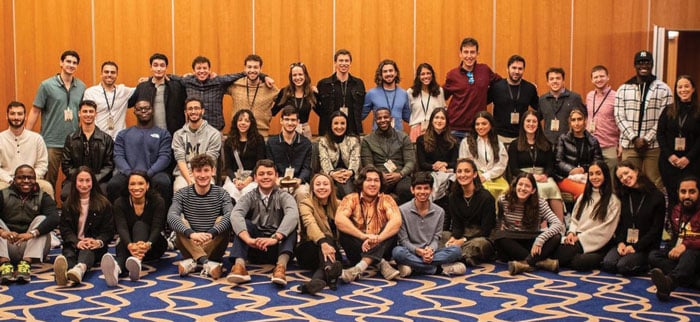
Takavoli, a sophomore at the University of Southern California, and a graduate of Milken Community School in Los Angeles, is in Israel with about 40 college students from across America as part of the Geller International Fellowship, a trip from January 2-13 that will include a visit to the United Arab Emirates. The trip required three rounds to be accepted as is under the auspices of Israel on Campus Coalition, known as ICC.

Takavoli said on the trip so far, he has spoken to Israelis in East Jerusalem and representatives of the Palestinian community in the West Bank.

“I think it’s important to make that human-to-human connection,” he said. 

He explained that his family left Iran for Los Angeles for freedom.

“The fight is in my bones for a long time,” he said.

He explained that he works on his campus to fight against the Boycott Divest and Sanctions movement known as BDS.

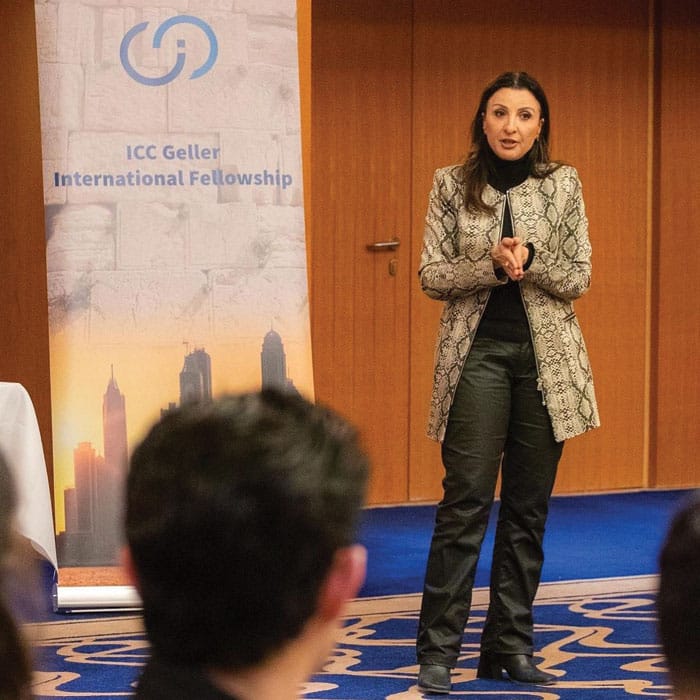
Jerusalem’s deputy mayor, Fluer Hassan-Nahoum, speaks to the students
Photo courtesy of the ICC.

“The anti-Israel campaign at USC is subtle,” he said. “USC’s anti-Israel campaign is subtle. We don’t have an apartheid wall and in-your-face stuff like UC Berkeley. Our institutions have anti-Israel bias. Our student government avoids conversations about Israel because pro-Israel students in our student Senate don’t want to open a can of worms. The best example I can give you is the student newspaper had an article by the editorial board about the administration’s failure to take measures against Greek fraternity life to protect women. Right at the end, out of nowhere, it included a sentence that said this is the exact same thing how administrators don’t take a stand on the Israeli-Palestinian conflict. No connection at all. But they just throw it in there. It triggers people and gets people annoyed.”

Lauren Samidi, 22, said that growing up in a tight-knit Persian Jewish family in Beverly Hills, she hadn’t seen antisemitism until the Chabad menorah was vandalized at San Diego State University, where she is a senior. Samidi said things are generally okay at her school.

Jacob Baime, Chief Executive Officer of the Washington, D.C based Israel on Campus, said the idea was to have a national trip for elite students exemplifying leadership qualities.

“We have to engage people today who will be leaders tomorrow,” he said, of the group which included Christian students. 

Baime said that anti-Israel groups on colleges were “investing so heavily in campus because they believe the path to ending U.S. support for Israel winds through the campuses so that’s one of the reasons we are seeing the rise of anti-Israel activism in the U.S.” 

Baime said this is the first in what will be an annual trip of college students who will be selected each year.

The group met deputy mayor of Jerusalem, Fleur Hassan-Nahoum, who did “a phenomenal job of explaining Israel’s position and changes with the Abraham Accords” and met with a top police official and visited the Aida Refugee Camp. 

He said the group met deputy mayor of Jerusalem, Fleur Hassan-Nahoum, who did “a phenomenal job of explaining Israel’s position and changes with the Abraham Accords” and met with a top police official and visited the Aida Refugee Camp. They will also visit the LGBTQ community in Tel Aviv.

He said there were 116 applications for 30 seats, and they got more funding to increase it to 40.

“With the huge rise in antisemitism, our entire coalition is scaling up, because the challenges are mounting so quickly,” Baime said. 

“When it comes to campus administrators,” he added, “what I think we need to see is for them to exercise moral leadership. One of the real challenges we have is that university, presidents, chancellors and deans often look at anti-Israel activism on campus and incorrectly think they are witnessing a political debate. What we have to remind them is Israel is a crucial component of Jewish identity.” 

He praised Hillel International, The Academic Engagement Network and the Brandeis Center for efforts to explain what has been taking place to college officials.

“This modern incarnation of antisemitism is presented as anti-Zionism,” he said. “They’re having some success working on different campuses and I see it making some impact. Israel is central to Judaism and Jews prayed for thousands of years, not only to Jerusalem but to return to Jerusalem. We see what is happening at a handful of student organizations to ban Zionist speakers and that is why there it a Title VI investigation.”

Students from Los Angeles Among 40 Selected for Special Israel/UAE Visit Read More »

New ATS President, Milken Coach Recognized, Rabbi at Newsom Pre-Inauguration

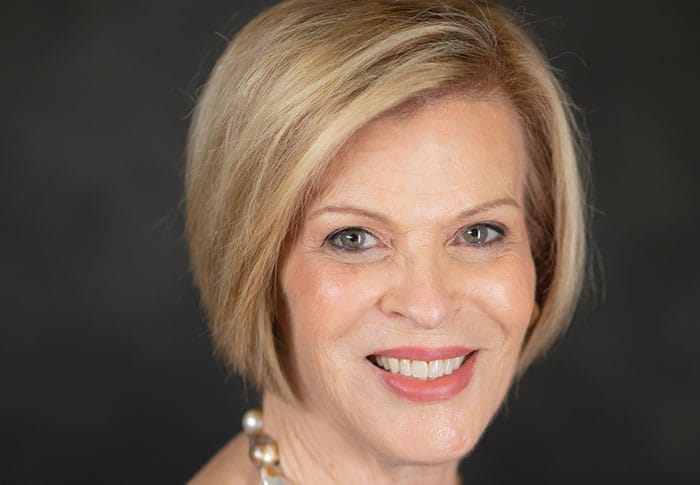
Janey Sweet of Beverly Hills has been named the new president of the American Technion Society (ATS).

“It’s an honor and privilege to lead the American Technion Society, especially at this very pivotal time when we commemorate the Technion’s upcoming Centennial Celebration in 2024,” Sweet said. “It’s an amazing opportunity to elevate public awareness about the Technion’s remarkable impact on Israel and humanity.”

Sweet was elected to the position by the ATS board of directors. She succeeds outgoing President Steve Berger, who becomes the organization’s chairman of the board. 

“Janey Sweet has long been a true champion for the Technion, and is very qualified to lead the American Technion Society,” Berger said. “Her knowledge and passion will be invaluable as we work to advance the Technion research, education, and innovation that benefit Israel and the world.”

Sweet’s term as president began Oct. 1. It comes at a defining moment for the Technion as it marches towards its Centennial celebration in 2024. 

Working with CEO Michael Waxman-Lenz, the new ATS president is leading efforts to generate awareness of and raise philanthropic support for the Technion-Israel Institute of Technology, a science and technology research university in Haifa.


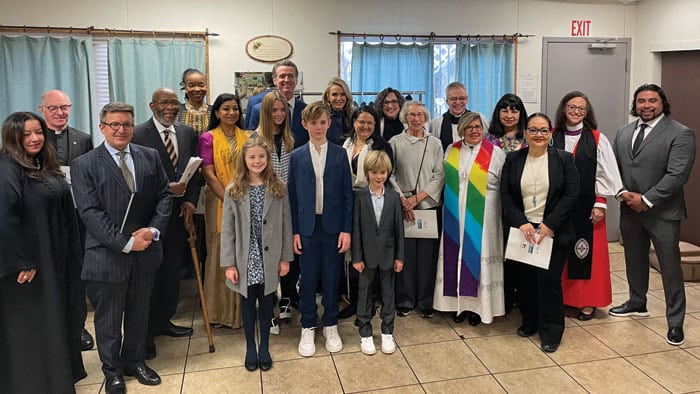
Stephen Wise Temple Rabbi Sari Laufer joined other faith leaders for an interfaith unity service in Sacramento with Gov. Gavin Newsom ahead of Newsom’s Jan. 6 inauguration. Courtesy of Stephen Wise Temple

Stephen Wise Temple Rabbi Sari Laufer was among the faith leaders who celebrated California Gov. Gavin Newsom’s recent reelection to a second term.

On Jan. 6, Laufer traveled to Sacramento and took part in a pre-inauguration interfaith unity celebration at St. Paul’s Episcopal Church. Laufer recited the Traveler’s Prayer on Newsom’s behalf while wishing him continued success as California’s topmost elected official.

“We know that there is potential ahead — so much potential,” Laufer said. “That is why the people of California believe in you, why we elected you again, why we support and work for and with you. We also know there are pains and pitfalls, and we are ready to face those with you as well.”

Laufer was one of three women rabbis to participate in gubernatorial inaugurations across the country this month, according to Stephen Wise Temple.


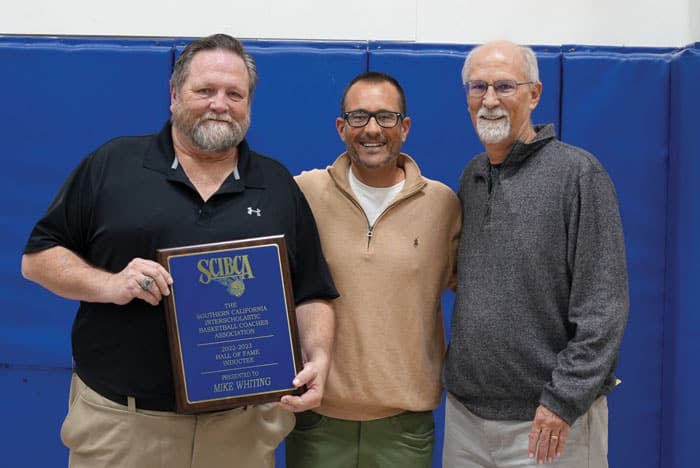
Milken Community School celebrates the induction of basketball Coach Mike Whiting (far left) into the Southern California Basketball Coaches Association Hall of Fame, during a Jan. 5 reception at its campus. Courtesy of Milken Community School

Former Milken Community basketball Coach Mike Whiting was inducted into the Southern California Basketball Coaches Association Hall of Fame.

Milken welcomed back Coach Whiting to its campus on Jan. 5 along with many of his former players as the school honored him. 

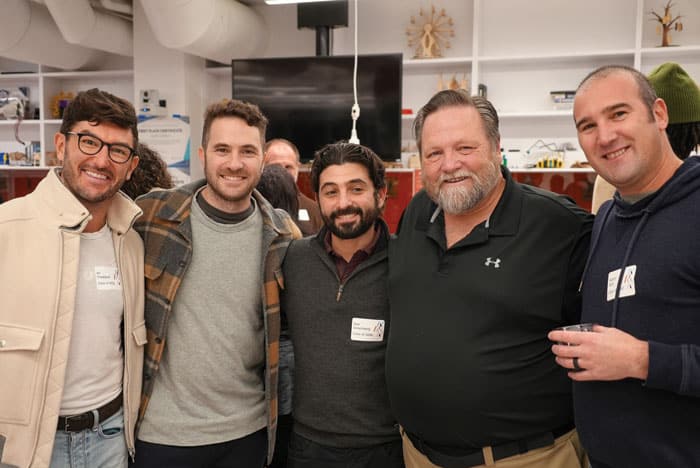
Coach Mike Whiting (fourth from left) is joined by former players at a reception at Milken Community School. Courtesy of Milken Community School

Whiting was a Milken basketball coach from the ‘90s until five years ago. While coaching at Milken, he had a California Interscholastic Federation (CIF) championship — with the banner still proudly displayed on Milken’s gym wall — and was the CIF-Southern Section Division 4A boys basketball Coach of the Year; won 15 League titles; and trained 11 All-CIF athletes. Besides all these incredible statistics, he helped shape the basketball program and Milken athletics as a whole and make it what it is today.

In attendance at the Thursday night reception was Whiting’s wife, Ann, who was also a teacher at Milken’s middle school for 12 years; his sons, AJ and Nicholas; his mother, Edith Parkinson; and his brother, Peter, and sister-in-law, Tracy.

The evening included light refreshments, followed by a Milken Boys Varsity Basketball game. Coach Whiting received special recognition during halftime. 

New ATS President, Milken Coach Recognized, Rabbi at Newsom Pre-Inauguration Read More »

Nazi Graffiti Found at LA Bus Stop

Graffiti of a swastika and the words “Auschwitz Welcome” were found on the window of a Los Angeles bus stop on January 11.

Stop Antisemitism tweeted out a photo of the graffiti, stating that it was found on the corner of Vineland Avenue and Ventura Boulevard. “This vile hatred must never be tolerated in your city,” Stop Antisemitism tweeted to Mayor Karen Bass.

Other Jewish groups also condemned the graffiti.

“This vile graffiti is an unsettling reminder that anti-Jewish hate is the fastest growing category of hate crimes in America,” American Jewish Committee Los Angeles Assistant Director Odin Ozdil said in a statement to the Journal. “No community should have to be confronted with threats to their existence, especially those that evoke such horrific trauma as the Holocaust. We encourage local authorities to be unrelenting in their pursuit and prosecution of the perpetrator of this hateful act.”

“[The] Jewish community needs the help and empathy from our non-Jewish neighbors if we are to push back on the distressing anti-Semitism on our streets and on social media,” Simon Wiesenthal Center Associate Dean and Director of Global Social Action Agenda Rabbi Abraham Cooper similarly said in a statement to the Journal. “Perpetrators don’t worry that a shrinking police presence would detect such hate.”

StandWithUs CEO and Co-Founder Roz Rothstein, the daughter of Holocaust survivors, also said in a statement to the Journal, “We’re grateful to Mayor Karen Bass for taking seriously the dangerous issues of anti-Jewish bigotry and to the LAPD for exposing this vile hate speech. Vicious Nazi imagery like this has no place in civil society. This is yet another example of why Holocaust education is so important.”

Nazi Graffiti Found at LA Bus Stop Read More »

A Mouthful – A poem for Parsha Shemot

So now, go! I will be with your mouth, and I will instruct you what you shall speak.
-Exodus 4:12

I never knew I was ready to do something
until someone asked me to do it.

Like the first time I picked up a guitar to
lead a song which I never would have done

had another songleader not told me it’s time.
Suffice it to say no-one died from my efforts

and now at least a part of my mortgage is paid
by intertwining souls with music and voices.

It doesn’t always work out that way. When they
promoted me to shift manager at McDonald’s

(pausing for shocked reactions about the Jewish
vegetarian poet who used to work at McDonald’s)

because I was so good at the window, flawless really.
It didn’t work out and after the incident with the

lunch rush and too-slow counted cash register drawer
I was gone. I landed on my feet, as most nineteen

year-olds do with a plush Radio Shack job where
I quickly became the top salesperson, though

I infuriated the owner one day when he saw
I’d put one of his neck ties I found in the back room

on display with a price tag. I left that job of
my own accord when they offered me an opportunity

to press buttons at a radio station. I also got to
point at people when it was their time to talk.

It was a dream, until the place was sold, and
without wanting to detail every instance of my life

in this one poem (I mean, really, who has the time)
it all worked out fine. Now I press other buttons

and the mortgage people are happy.
I couldn’t have done any of this without others

putting their mouths behind me and urging me
forward with their words. Moses, on the breath of

the biggest words possible defeats an empire
starts us on our way home.


God Wrestler: a poem for every Torah Portion by Rick LupertLos Angeles poet Rick Lupert created the Poetry Super Highway (an online publication and resource for poets), and hosted the Cobalt Cafe weekly poetry reading for almost 21 years. He’s authored 26 collections of poetry, including “God Wrestler: A Poem for Every Torah Portion“, “I’m a Jew, Are You” (Jewish themed poems) and “Feeding Holy Cats” (Poetry written while a staff member on the first Birthright Israel trip), and most recently “I Am Not Writing a Book of Poems in Hawaii” (Poems written in Hawaii – Ain’t Got No Press, August 2022) and edited the anthologies “Ekphrastia Gone Wild”, “A Poet’s Haggadah”, and “The Night Goes on All Night.” He writes the daily web comic “Cat and Banana” with fellow Los Angeles poet Brendan Constantine. He’s widely published and reads his poetry wherever they let him.

A Mouthful – A poem for Parsha Shemot Read More »

A Bisl Torah — To Heal and Be Healed

January marks the month in which we commemorate the death of beloved Jewish musician, Debbie Friedman. I am deeply touched by her canon of liturgical compositions. Most notably, her misheberach, her prayer for healing, provides a space for pain to be expressed and courage to be accessed.

In rereading her piece of liturgy, I began to seek out other texts of healing. The questions that surfaced were, “What is the definition of healing? In which ways do I heal others and in which ways do I need healing?” Through study, I discovered that healing in a Jewish lens may be offered through the avenues of prayer, presence, medicine, and respecting someone’s privacy/boundaries. There doesn’t seem to be one definition of healing; but rather, the “healer” reads the person, situation, and environment to determine which ways they are needed…or not.

The Talmud (Bava Metzia 30b) explains that when a ben gilo (a contemporary of the person who is ill) visits, it is as if he has taken away 1/60th of his illness. The Talmud reminds us that while someone who is ill may appreciate a call from the rabbi or another authority figure, one of the greatest connections may occur when you visit someone who is in your similar stage of life. This kind of visitor may offer a certain kind of empathy.

I remember the weeks after the birth of our first child. When people would ask how I was, I would respond, “I’m great. The baby is amazing.” But inside, I was exhausted from lack of sleep. Not understanding every cry or cue from my child, I often felt as if I was failing but that wasn’t something I was willing to admit. One afternoon, a friend came to the door, and she wouldn’t “buy” my act. I looked at her and started to cry. Wordlessly, she took my daughter from my arms, ordering me to shower. She understood. I wasn’t journeying motherhood alone. Her comfort was exactly what I needed.

Offering healing involves a sense of vulnerability and an open heart. May we find ways to heal and be healed. As Debbie Friedman implored, “Bless those in need of healing with r’fuah shleimah; the renewal of body, the renewal of spirit, and let us say, Amen.”

Shabbat Shalom


Rabbi Nicole Guzik is a rabbi at Sinai Temple. She can be reached at her Facebook page at Rabbi Nicole Guzik or on Instagram @rabbiguzik. For more writings, visit Rabbi Guzik’s blog section from Sinai Temple’s website.

A Bisl Torah — To Heal and Be Healed Read More »

StandWithUs Files Complaint Against GWU Over Prof Allegedly Targeting Jewish Israeli Students

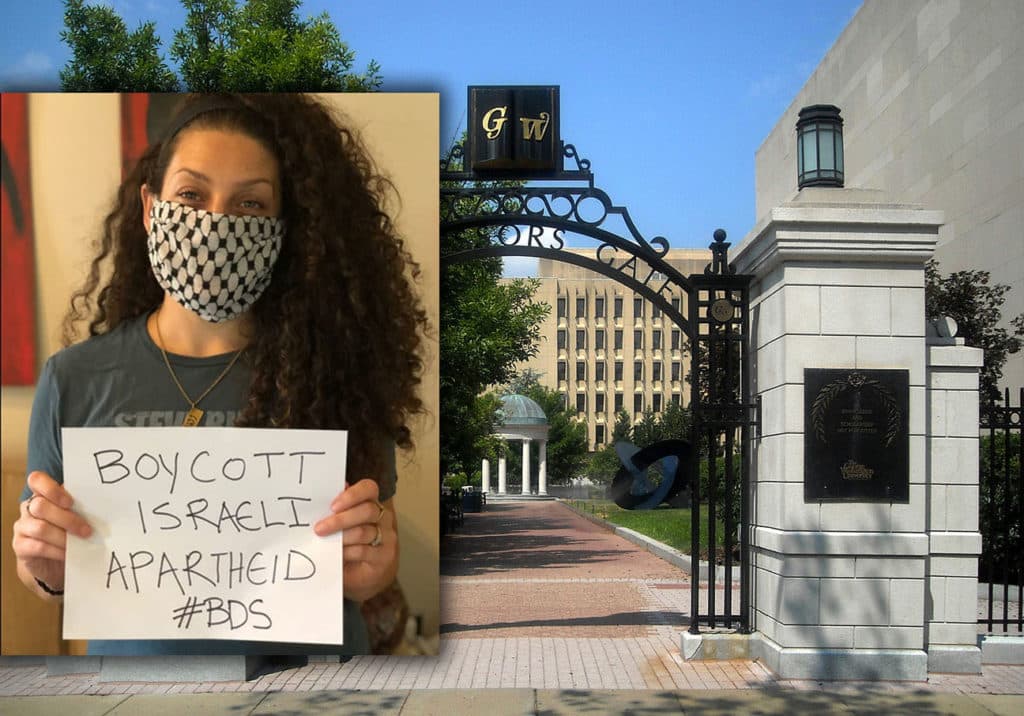
The pro-Israel education group StandWithUs filed a complaint to the Department of Education’s Office of Civil Rights against George Washington University (GWU) on January 11. The complaint, which was obtained by the Journal, alleged that the university violated Title VI of the Civil Rights Act for failing to take action against a professor accused of targeting Jewish Israeli students in the university’s Professional Psychological Program.

The complaint centers on mandatory diversity classes held by Dr. Lara Sheehi, an assistant professor of psychology at GWU. On August 29, 2022, the first day of class, Sheehi asked each student to share their identity and she validated each of them, until one Jewish student said they were Israeli. Sheehi responded by telling the student it wasn’t their fault “they were born in Israel,” meaning that the student should be “ashamed” of her Israeli identity, the complaint stated.

About a month later, Sheehi encouraged students to go to her Brown Bag Lecture scheduled in between Rosh Hashanah and Yom Kippur. The lecture featured guest speaker Dr. Nadera Shalhoub-Kevorkian saying “that good deeds done by Jews and Israelis are done to mask sinister activity,” per the complaint. “Invoking age-old antisemitic tropes about Jews using money for nefarious purposes, Dr. Shalhoub-Kevorkian claimed that humanitarian and philanthropic efforts by Jews and Israelis must be seen as suspect,” the complaint stated. “She denigrated Israel’s disaster relief work around the world, and stated that Israel “use[s] tikkun olam [the Jewish value of bettering the world] to camouflage [Israel’s] oppressive power.” Additionally, Shalhoub-Kevorkian suggested that the recourse to “white Israeli racism” is “violent resistance,” including stone-throwing. She also hailed an imprisoned Palestinian teenager who, along with his cousin, stabbed two Israelis, one of whom was a 13-year-old Jewish teen in 2015; both of the victims survived.

“Jewish students in the first-year diversity course reported that during the weekend following this lecture they were unable to eat or sleep due to anxiety,” the complaint stated. “They spoke among themselves about the pain and alienation they were experiencing and grappled with how to convey to the teacher and the class the way in which they felt targeted by the program based on their Jewish ancestral and ethnic and Israeli identities.”

The students did share their concerns with Sheehi during class the following Monday, telling her, and the entire class, that Shalhoub-Kevorikian’s lecture made them feel “unsafe” and seemed like “an excuse to bash Jews.” One of the students asked the class to think about what it must be like “to go out to a bar on a Friday night in Tel Aviv when there is suddenly a terrorist attack with people shooting” to understand day-to-day life in Israel. Sheehi’s response was to claim that the student’s use of the term “terrorist attack” was Islamophobic and that it was impossible “to separate the student’s identity from the political.” Furthermore, not only did Sheehi reject their claims that the lecture was antisemitic, but also she said it was “beneficial” for the students to feel targeted during the lecture and that they should “lean into” that feeling as part of how the class aims to disrupt. She was also adamant that the viewpoint that anti-Zionism is not antisemitism is simply a fact.

“At no point did Professor Sheehi validate any of the students’ experiences, even though each student prefaced her remark by describing how vulnerable, upset, and anxious she felt,” the complaint stated. “Instead, Professor Sheehi denied that what the students had experienced was antisemitism, aggressively rebutted every point the students raised, accused two of the students of engaging in Islamophobic rhetoric, and implied that the students who were complaining about antisemitism were themselves racist and antisemitic. Professor Sheehi never denied or dismissed the concerns of any other identity group in the class, much less in such an aggressive fashion. Professor Sheehi did not subject members of any other identity group to such public vilification. During the course of the semester, she never invited any other speaker or encouraged student attendance at any other program focusing solely on one national or ethnic group, as she had invited attendance at the September 30 program which disparaged Israelis and Jews.”

The students proceeded to take their concerns to university administrators, telling one unnamed official (referred to in the complaint simply as “Dr. [REDACTED]” in the Department of Professional Psychology that based on what they experienced, they did not feel comfortable sharing their Jewish Zionist identities in Sheehi’s class and were afraid of retaliation for coming forward to the official. At first, Dr. [REDACTED] seemed to be sympathetic to the students, calling Shalhoub-Kevorkian’s lecture disconcerting and that the lecture shouldn’t have been scheduled during the High Holidays; additionally, Dr. [REDACTED] said the department would bring in a brown bag speaker to talk about antisemitism and he would personally sit in on her classes to see what went on in the classroom.

But 10 days later, Dr. [REDACTED] changed his tune, telling the students that he met with Sheehi and she denies being antisemitic or in any way excusing antisemitism and the department wouldn’t be able to do much to help the students. He also backtracked on his prior statements, saying that the department would not be bringing a speaker to campus to discuss antisemitism and he would not be personally observing her classes. “They took her words wholesale to heart,” a student told the Journal, saying that the university “believed her without thinking, ‘Well a bunch of students just claimed that this professor is antisemitic.’ Instead they just let what she said stand, and that was the end of that.”

Additionally, the College of Arts and Sciences Dean’s Office sent out a communitywide email on October 22 addressing the matter and framed it as a “political debate,” per the complaint, and encouraged community members to share their thoughts on the matter. The college would also consider bringing an outside expert to foster discussion on the issue. One Jewish student met with a college dean to discuss the issue, saying that they were warned by students who had previously taken her classes that antisemitism is prevalent in the course and that they were better off hiding their Jewish identity. But the dean was unmoved, rejecting their claims of experiencing antisemitism and told her in a subsequent email that if she withdrew from the course, she would still have to take it in a later semester and there was no guarantee she would have a different teacher.

The complaint proceeds to allege that Sheehi began taking retaliatory measures against the students who reported her to the college, stating that she began to spread false claims about the students to other faculty members “as pretext to justify initiating disciplinary proceedings against the students.” “Upon information and belief, the fabricated justifications for subjecting the students to disciplinary action have continuously and repeatedly changed,” the complaint stated. “The students have been informed that the faculty voted to initiate disciplinary proceedings against them, but to date, neither the students nor their faculty advisors have been told what the students did to warrant the disciplinary action. Rather than provide the students with a statement of their offense, faculty have instead asked the students to describe to the faculty what they did wrong and what harm they caused.” And if they don’t admit to wrongdoing, they will face “further disciplinary action” and their academic records will be stained with “a permanent disciplinary notation.” The complaint does not detail what these disciplinary measures are; one student told the Journal that she didn’t want to provide any specifics of the measures out of respect for the privacy of the students involved, but such measures require “the vote of the faculty.” The student called the retaliatory measures a “silencing tactic to guarantee that nobody speaks up about the antisemitism again.”

When a student told Dr. [REDACTED] about the retaliatory actions, he simply told the student that it was too early in the disciplinary process to appeal it.

Sheehi’s alleged retaliatory actions also took place in the classroom, as the complaint details an accusation that Sheehi excoriated a Jewish student’s final paper discussing whether or not Jews are white as having “lack of empathy and misattunement” despite the student running the paper before a faculty advisor before submitting it. Additionally, the student had received clearance from Sheehi to write about the topic beforehand.

The complaint also mentions an incident on October 31, when Jewish students raised concerns to the class about some of the essays they were required to read. This included an essay that Sheehi wrote describing a Lebanese woman patient telling a “non-Zionist” Jewish psychoanalyst that she has a “violent dream” about her committing “terrorism” and then the analyst discusses how to deal with the “terrorist” in the patient. Sheehi writes in the essay that the analyst’s use of the word “terrorist” is reflective of an “anti-Muslim and anti-Arab ideology.” When Jewish students said during class essays like this were antisemitic, Sheehi “silenced” them and “refused to discuss their concerns,” the complaint stated. Additionally, the complaint alleged that a student then accused the Jewish students of having “white fragility” and called on them to leave. “Professor Sheehi said nothing to support or defend the Jewish students, instead offering them the option simply to leave the class,” the complaint stated. “At that point, the Jewish students who had spoken up felt compelled to leave the classroom.”

Outside facilitators didn’t seem to help, as the complaint mentions how a “restorative circle” was held on November 18, but the facilitators told two of the Jewish students not to attend. But the facilitators didn’t initially communicate that to the rest of the class, resulting in students lambasting the absent Jewish students as being “racist” and having “white fragility,” though the Jewish students that were there did get the facilitators to acknowledge that they asked the two students not to come. Even still, the antisemitism these students experienced was not addressed and was “exacerbated” by the circle, the complaint stated.

By failing to take action against Sheehi and engaging in disciplinary measures that are retaliatory, GWU has violated Title VI of the Civil Rights Act, the complaint argued, calling for the university to end the disciplinary measures against the students, provide a different option than Sheehi’s class, fully investigate the students’ claims against Sheehi and adopt the International Holocaust Remembrance Alliance (IHRA) definition against antisemitism.

“It’s been a really bad year for Jews at GW,” a student told the Journal. “It’s clear that events like the one in my class are related to the string of horrific antisemitic incidents at GW: desecration of a Torah scroll, folks chanting [and] promoting the intifada, and that’s just the tip of the iceberg. If you teach students in class that Jews are powerful, that we’re racist white supremacists, that you should silence our allegations of antisemitism, then of course students will be emboldened to take action against us and that’s exactly what happened.”

The student added that she is “actively pursuing other alternatives as I see how this plays out.” “This has had a very real impact on myself and the other students,” she said. “More than one of us has had to go on antidepressants as a result of this. I had to pause my part-time job, couldn’t keep food down, couldn’t sleep because this is really an assault on my identity in a class that’s supposed to be about accepting identity. It’s been impossible to show up every day when I know my classmates and faculty have been turned against me by my professor. It’s had a real physical and psychological impact.”

“The hostile environment at the George Washington Professional Psychology Program and the failure of the administration to act to correct it are unacceptable,” Carly Gammill, founding director of the StandWithUs Center for Combating Antisemitism. “Too often, when Jewish students raise concerns about antisemitism, they are subjected to gaslighting or false claims meant to cause self-doubt and deflect the bigotry at play. Jewish and Israeli students deserve the same level of respect and consideration as all other minority groups when they report cases of bigotry and discrimination.”

A university spokesperson said in a statement to the Journal, “George Washington University strongly condemns antisemitism and hatred, discrimination and bias in all forms, and we are committed to fostering a welcoming and inclusive environment where all feel safe and free of harassment, hostility or marginalization. Resources, avenues for support and complaint mechanisms are available through the Office for Diversity, Equity, and Community Engagement; Division for Student Affairs; Faculty Affairs and Employee Relations. The university also recognizes and supports academic freedom, and the right of all members of our community to speak out on issues of public concern, understanding that they are not speaking on behalf of the university.”

The spokesperson added that they are aware of the allegations in the OCR complaint and that it reflects “the advocacy group’s perspective.” “The university will respond to OCR regarding any complaint it may receive from OCR,” the spokesperson said. “In the meantime, the university will continue to provide support to students as well as faculty who have shared concerns about recent experiences and work with students and faculty involved to take appropriate actions to address these concerns.”

Sheehi did not respond to the Journal’s request for comment.

StandWithUs Files Complaint Against GWU Over Prof Allegedly Targeting Jewish Israeli Students Read More »

Print Issue: Restoring the American Story | January 13, 2023

CLICK HERE FOR FULLSCREEN VERSION

Print Issue: Restoring the American Story | January 13, 2023 Read More »

How an Old-New Ideology Alienates Immigrant Jews

In recent years, there has been increasing emphasis on making mainstream Jewish institutions more inclusive to “Jews of color” and others. And for good reason: The American Jewish community has, indeed, been dominated by a one-size-fits-all understanding of Jewish life. Jews have always been much more diverse than the dominant American Jewish culture has reflected and given voice to.

Unfortunately, efforts to make the Jewish community more inclusive of Jewish diversity have been used to smuggle in an illiberal ideology—often under the guise of racial justice or antiracism. This ideology has scrapped the original notion of racial justice from the civil rights movement in favor of a radical version that insists on three ideas. First, racism and oppression are foundational to our society. Second, the world is divided into victims and oppressors, based on immutable factors such as skin color. And third, “whiteness” (which refers to America’s dominant, Western culture) must be entirely dismantled in order to address inequalities.

This ideology distorts the ideals of justice and equality and diverts the focus from addressing racism and other hatred to a particular extremist worldview that fosters division.

In addition to its indoctrinating qualities, this ideology is highly exclusionary of many immigrant Jews. One of the writers of this piece heads an organization dedicated to preserving, perpetuating and representing the history, traditions and voices of Greater Sephardi Jewish communities in America. Another is the son of an Iraqi Jew and works to empower Jews who support liberal values. And the third came to the U.S. from the former Soviet Union (FSU) and runs a nonpartisan, grassroots coalition of 10,000 parents, teachers, and community members who support constructive ethnic studies curricula.

Our own experiences and those of our peers tell us that countless immigrant Jews, considered a separate race or nationality before emigrating, were oppressed by the very kind of race-essentialist ideology now being promoted under the banner of antiracism. These immigrant Jews have heard (and lived) this ideology before, and they are concerned about the long-term implications.

The idea that Jews benefit from a presumed system of oppression paints them, in the prescriptive victim/oppressor ideology, as privileged oppressors. This notion, which should be offensive to all Jews, is downright insulting to many immigrants who were often severely oppressed in their home countries. For example, Middle Eastern and North African Jews were “otherized” at times by legal restrictions and by informal yet widespread discriminatory practices. Jews from the FSU suffered overt, government-led oppression that explicitly kept them out of universities and workplaces and sent them to prison or labor camps for so much as learning Hebrew. Defining them as “white” in the binary model where all white people are considered oppressors erases their identities and imposes a worldview completely at odds with their lived experience.

This notion, which should be offensive to all Jews, is downright insulting to many immigrants who were often severely oppressed in their home countries.

Too often, American Jewish organizations have misguidedly embraced this ideology themselves. One Jewish denomination offered a four-part “learning” on race and racism for rabbis and cantors, proclaiming, “This space is for white clergy and will serve as a white antiracist affinity space.” Such ideological pronouncements and trainings (disturbingly similar to “re-education” campaigns that many suffered through) are anathema to immigrant Jewish communities that oppose the familiar revolutionary concept of dismantling systems, rather than making incremental progress in the very nation and system that has attracted refugees from all over the world. Indeed, for all its flaws, America remains the number one destination in the world for immigrants, voting with their lives to attain the unrivaled freedom of the U.S. Constitution, which ensures that the American system can evolve and that individuals can define themselves and make their own opportunities.

If the Jewish community listens, it will hear an immigrant chorus that is in equal parts dismay and horror. Dismay over the reality that most American Jews cannot recognize the extreme ideological and antisemitic undertones of what is happening right in front of them. And horror over the fact that by the time American Jews come to their senses, it may be too late. These Jews are far more likely to feel alienated rather than supported by these well-intentioned, ideologically charged efforts at making the Jewish community more inclusive. Such efforts do not, in fact, make Jewish life more inclusive. They make it more exclusionary. They shut out Jews who bring to this country all of their high hopes—as well as their traumas.

Jewish Federations, human services organizations, advocacy organizations, and congregations who worked so hard to bring Jews in from all over the world must ask themselves if they are really prepared to alienate a large swath of the immigrant Jewish community.

Being inclusive doesn’t require adopting a specific ideology like racial essentialism. It requires an open mind to varied perspectives on addressing our challenges, a welcoming attitude, and a commitment to Klal Yisrael—the entirety of the Jewish people—in all its diversity and beauty.


David Bernstein is founder of the Jewish Institute for Liberal Values (JILV) and author of Woke Antisemitism. Jason Guberman is Executive Director of the American Sephardi Federation (ASF). Elina Kaplan is President of the Alliance for Constructive Ethnic Studies (ACES). 

How an Old-New Ideology Alienates Immigrant Jews Read More »

Possible Changes to the Law of Return

The Law of Return states that anybody with one Jewish grandparent can make aliyah and get Israeli citizenship, but things may be changing with Benjamin Netanyahu’s new government. There are fears that the new coalition government will make radical changes to Israel’s Law of Return and restrict immigration of persons who are not recognized as Jewish under the halacha (Jewish law). Many of these fears center around the far-right politician Itamar Ben Gvir who serves as the Minister of National Security in Netanyahu’s coalition.

The Jewish Journal interviewed David Gardner, a Los Angeles-based immigration lawyer, who recently became a member of the Israeli Bar. In addition to his U.S. legal practice, he has joined the Israeli immigration law firm Kan-Tor & Acco in Ramat Gan to work with their private clients moving to Israel and to assist with complex U.S. immigration cases. Gardner, originally from England, now splits his time between Jerusalem, Ramat Gan and Beverly Hills.

“Issues regarding Israel’s Law of Return are not new,” he explained. “The law as originally proposed was intended to allow every Jew to come to Israel as an oleh (an immigrant). Israel’s first ‘nationality law’ in 1950 gave the right for every Jew to make aliyah (to immigrate and live in Israel) as long as they have at least one Jewish grandparent. The definition of a Jew was based on the Nuremberg Laws. Later amendments extended aliyah rights to spouses and children, regardless of whether they are Jewish.

Proposed Changes to the Law of Return

The religious parties have made a series of demands as a precondition to joining a government coalition. Some of these proposals, if passed, could even restrict the rights of non-Jewish spouses under the Law of Return.

Gardner says that current policies have allowed immigration under the Law of Return based on ties to a great-grandparent. Recent proposals from expected members of the new coalition government could eliminate this policy. More significantly, “One of the current proposed changes in Israeli law is to amend the Law of Return to eliminate the provision which permits aliyah through a grandparent.” Gardner compared this to the U.S., which has changed its derivative citizenship rules multiple times and does not provide for automatic citizenship to grandchildren of U.S. citizens. Currently Israeli citizens may claim U.S. citizenship through a grandparent but only if they can prove that the grandparent resided in the U.S. for specified periods.

Proposed Knesset Override to Supreme Court Decisions.

Gardner voiced concerns about the hurtful comments that have been made by Ben-Gvir and other Israeli politicians such as Betzalel Smotridge in the past. However, he cautioned against pre-judging the new government based on pre- and post-election rhetoric. He explained that Israeli laws are debated thoroughly through the legislative process—much like the U.S. Senate and the House of Representatives—and even then remain subject to review by the judiciary. His greater concern was that the Knesset might enact an override clause that would restrict the current authority of the Israel Supreme Court to strike down laws it considers to be unlawful or in violation of the constitutional principles of Israel’s Basic Laws.

Conversion Controversies

One of the hottest topics is potential legal changes around recognizing conversion to Judaism. Since 2005, Israel has recognized conversions that are recognized by a known Jewish community outside of Israel, regardless of whether they are Orthodox, conservative or progressive. Gardner explains that “the worst case scenario would be if there were legislative changes to the recognition of conversions performed outside of Israel. This is a very sensitive issue where Diaspora Jews have a lot at stake.”

It is important to have a consistent legal standard for the question of “who is a Jew” since the definition of being Jewish affects the definition of nationality and eligibility for residence and citizenship.

It is important to have a consistent legal standard for the question of “who is a Jew” since the definition of being Jewish affects the definition of nationality and eligibility for residence and citizenship. Currently there is a process for recognizing conversions that involves interaction between religious authorities in the Diaspora and the Chief Rabbinate in Israel. There is a concern that a restrictive conversion policy will adversely affect non-orthodox Jews and in turn limit rights to Israeli citizenship.

Past Immigration Controversies Regarding Ethiopian Jews


In the past, the Orthodox rabbinate demonstrated flexibility and were sensitive, humane and understanding regarding the Jewish identity of the Ethiopian Jews who needed to leave their country at a time of emergency. Many had assimilated and intermarried, or lacked any documentation. Lenient halachic (Jewish legal) rulings were issued by Rav Ovadia Yosef, Israel’s former Sephardic Chief Rabbi, and Rabbi Moshe Feinstein. Both of them ruled in favor of converting the exiled Ethiopian Jewish community based on the principle of pikuach nefesh (mortal danger). It was considered a life-or-death emergency situation when “Operation Solomon” used 35 Israeli aircraft to evacuate 14,325 Jews from Ethiopia on May 24-25, 1991. Rav Ovadia ruled that the community should come to Israel first and then undergo “light conversion” to avoid any doubt regarding Jewish Identity.

Proving Jewish Identity In U.S. Immigration Cases

Gardner favorably compared the ability of Israeli government authorities to authenticate Jewish identity for purposes of immigration and asylum law to U.S. Immigration authorities. He stated that in the U.S. there is no government support to authenticate identity. “In one case, the Immigration judge was struggling with the fact that a Jew from the Ukraine had grown up without any Jewish background and lacked necessary identity documents because they were inaccessible. The judge ultimately approved the case when we showed that having a bar mitzvah had been prohibited in the former Soviet Union. In another case, involving an assimilated Jew from an Arab country, he was unsuccessful in establishing Jewish identity for purposes of asylum because of the inability to do research from the community records for fear of harm to other family members. In addition, all the markings on Jewish headstones had been erased following anti-Jewish attacks.” He believes that had the case been in Israel, the authorities would have been able to trace family records through checking with community members. He stresses that the Israeli government has always been and remains committed to assisting persons with Jewish ties in times of distress and danger. 

Ingathering of Exiles

In 2018 the Knesset adopted the Basic Law, Israel the Nation State of the Jewish People, which states: “The State shall be open to Jewish immigration, and the ingathering of the exiles.” “This Basic law does not define who is a Jew,” said Gardner, “and in my view, it has a constitutional effect, which would take precedence over the Law of Return and any amendments to it. I foresee that legal challenges could be made to any attempt to change the definition of a Jew under the Law of Return by asserting rights under this and other Basic laws such as the right to human dignity.” He fears that a Knesset override law restricting legal challenges to immigration laws would undermine Israel’s entire legal framework.

Ukraine

Gardner wants to clarify that Israel has accepted more than 15000 Ukrainians who are fleeing the conflict and that most of them are not Jewish. He states, however, that “any proposed changes related to the regulation of asylum, and action taken to deport persons who are undocumented or without legal status, come within the scope of Israel’s right to regulate its Borders. Israel has the right to define who is and is not given permission to work and live in the country and should not be held to a different standard than other countries which have far more restrictive immigration laws.”

Israel is a Jewish and Democratic State

Gardner, who was in Israel and voted in the recent elections, concludes that “Israel is a Democratic and a Jewish State. The best way to have an impact on Israeli law and day-to-day life, is to become a citizen and to participate in the democratic process by casting your vote in Israel.”


Marcus J Freed can be found online at www.marcusjfreed.com and on social media at @marcusjfreed 

Possible Changes to the Law of Return Read More »

Top Ten List of Ways to Stay Healthy in 2023

Congrats, pandemic survivor. With renewed appreciation for your future existence, why not consider  2023 and beyond? As COVID wanes it’s time to revisit basic non-COVID health issues.

I occasionally give health talks. I offer a reminder that the purpose of life is not to stay healthy. Health remains a means to an end, empowering us to fulfil life’s purposes. We should attend to the basics and move on. I usually offer my “top ten,” a list of relatively easy steps to optimize health. Here’s the current edition:

  1. Eat a balanced diet with emphasis on fruits and vegetables.
  2. Maintain appropriate body weight.
  3. Avoid cigarette smoking, excessive alcohol or other substance abuse.
  4. Avoid unprotected/promiscuous sexual activity.
  5. Get periodic medical evaluations and standard preventive care including vaccinations, mammography and colonoscopy.
  6. Limit sun exposure.
  7. Get routine dental care.
  8. Stay physically active.
  9. Stay interpersonally connected.
  10. Wake up with a purpose.

That’s it. Stay true to the top ten and you’ll likely thrive. Is it possible to get partial credit? Absolutely. Seven to nine may work well depending upon the ones you de-emphasize.

The top ten list is about the power of habits. Over time good habits can create a positive personal health trajectory without excessive time expenditure. In contrast, bad habits damage health insidiously. Take smoking, still the common habit most corrosive to health. Some of my patients smoke a half pack (10) daily. Comparing themselves to one or two packs per day smokers, they consider their habit “light.” I remind them that health effects aren’t about daily use. They need to consider the 3500 cigarettes per year or 35,000 per decade on their horizon. How will the carcinogens in 100,000 cigarettes affect the chance of surviving three decades?

The same habit calculus applies to mild vices like soft drinks. A 150-calorie drink means almost nothing as a one-off. But drink it every day for a month and it’s 4500 calories, well over the 3500 that puts on an extra pound. One a day for a year? Over 15 pounds.

Over years of practice I’ve seen good health habits translate into longer, more productive lives. But one caveat: not always. So, the pursuit of happiness justifies some hedging. Is moderate alcohol a completely harmless choice? Perhaps not, but it’s also not catastrophic. As one of my medical school professors noted, “one out of one dies of something.” Overall, when betting with one’s life, like personal investing and other matters of chance, it’s sensible to focus mainly on the big picture issues. Additionally, expert opinion, seemingly out of fashion in the COVID era, deserves consideration.

Unfortunately, no 2023 health review would be complete without at least a mention of COVID-19. I still have about one patient per day newly diagnosed with the virus. Fortunately, most are vaccinated and do well with little risk of hospitalization or death. The new bivalent (two strain) booster is safe and effective. If you’re vaccinated with it you’ll be less likely to get sick. If you do get sick, the illness would likely be milder. If that seems threatening or inconvenient, be prepared to have your winter interrupted by an unpleasant febrile illness. Not surprisingly, influenza also causes flu-like symptoms. In a typical season, flu vaccines reduce risk of the illness by around 60%. That’s not bad for a mild vaccine that typically causes only a mildly sore arm for about half a day. And thousands of people, mostly seniors, still die from flu every year. So, getting flu vaccine should also be a no brainer.

Fortunately, we also have the COVID drug Paxlovid, which works reasonably well. Although it has some important drug interaction issues, it has only minor side effects. For flu, Tamiflu remains modestly helpful.

Once you’re fully vaccinated and caught up with the top ten, what about life’s purpose? On that subject, doctors like myself have less to offer. It’s like asking your mechanic where you should drive your car. If you went to Yom Kippur services this year, I’d suggest a three-month check on your progress. Try to help someone else. Pick a project. Whatever you do, don’t spend too much time and effort on health. Just stick to the top ten, then go chase some rainbows.


Daniel Stone is Regional Medical Director of Cedars-Sinai Valley Network and a practicing internist and geriatrician with Cedars Sinai Medical Group. The views expressed in this column do not necessarily reflect those of Cedars-Sinai.

Top Ten List of Ways to Stay Healthy in 2023 Read More »