One verse, five voices. Edited by Salvador Litvak, the Accidental Talmudist
A new king arose over Egypt who did not know Joseph. Manasseh was the first-born. – Exodus 1:18
Nili Isenberg Judaics Faculty, Pressman Academy
Rav and Shmuel disagreed about the nature of this new king. Like other great rabbinic pairs, Rav and Shmuel were known for their disagreements. Rav usually took a literal interpretation of the text, whereas Shmuel relied more on context. Rav was known as an expert in ritual law, whereas Shmuel was an expert in civil law. Regarding our verse, Rav said that it refers to an actual new king; Shmuel said that it was the same king but that he made new edicts (Talmud Sotah 11a).
What is the significance of their disagreement? From these two Babylonian Jewish leaders we can learn abiding truths about the nature of Jewish life in exile, truths that resonate to this day when we continue to ask “Why do they hate us?”
Rav’s opinion illustrates an antisemitism born of ignorance, when a “new king” fears us, our traditions, and our values. To prepare for such a time, we must do everything we can to advocate and educate.
Perhaps, however, there is also a more sinister story here, of someone who stands to gain from a strategy of “new edicts” that serve to empower and enrich him while stripping away the humanity of the other. Unfortunately, taking such people on a tour of a Holocaust museum won’t change their hardened, evil hearts.
What we have learned from centuries and millennia of this story on repeat is that the Psalmist was right: Ultimately, it is better to seek protection in God than in man (Psalm 118).
Rabbi Gershon Schusterman Author, “Why God Why?”
The comity between Pharaoh and the Israelites ended when Joseph died. Joseph was the national hero who saved the region from famine and also brought it Divine awareness. Once they forgot Joseph, that’s when the plotting to subjugate the Israelites began. In the pagan world licentiousness ran rampant because they had no God who set moral standards. When Joseph’s ancestor, Abraham, came to a neighboring region, he said: “There is no fear of God in this place and they will slay me to take my wife.”
Joseph unabashedly shared his awareness of God with all, including Pharaoh who fashioned himself as a God. When Joseph rebuffed the advances of his master’s wife, he said, “How can I perpetrate this great evil and have sinned against God?” When he was imprisoned, the warden gave him supervisory responsibilities because he sensed that, “God was with him and whatever Joseph did God made successful.” When Pharaoh said to Joseph, “I understand that you interpret dreams,” he responded: “This is beyond me; God will respond to Pharaoh’s welfare.” Later Pharaoh said to his servants: “Is there another like Joseph, a man in whom is the spirit of God?” However, when Moses said to the new Pharaoh “Let my people go,” Pharaoh responded “I do not know God, nor will I let Israel go.”
As long as Joseph was known and his God’s influence was pervasive, the fear of God prevented Pharaoh from running roughshod over the Israelites. When Joseph died and God was no longer known, their subjugation began.
We’ve seen the difference one man makes. A nation can have the potential to be good or bad, but it is the leader who often determines the actualization of either.
Germany was nationalistic before Hitler came along, and many perhaps were already antisemitic. But until Hitler used that nationalism to dehumanize the Jewish people and other unwanted peoples, Jews lived and worked side-by-side with Germans. One hundred thousand Jews opted to remain in Germany between 1933 and 1939 (Haavara Agreement) because they claimed to be just as German as the next German. Some Germans may have agreed, but Hitler and his people did not, and by the time these Jews realized the truth, it was too late to leave. All of them died in the Holocaust instead.
It happened in Spain as well in the 1400s. King Ferdinand and Queen Isabella had been friends of the Jews until a virulently antisemitic priest came along and changed their minds. The result was the expulsion of an entire nation in 1492. It wasn’t the first time this happened in history, and it certainly wasn’t the last.
It’s a very short verse with a powerful message that has pretty much been ignored by generations of Jews. The civility we enjoy today can change at a moment’s notice if the “right” person comes along to do it. Given our long and often difficult history, it would be wise to look out for such potentially destructive leaders and remain ready to respond appropriately.
Rabbi Rebecca Schatz, Associate Rabbi at Temple Beth Am
Early advice in a new job is, “Listen and learn about the place and people who are integral to the community.” But what advice was a new Pharaoh given? How could he have “not known” Joseph, responsible for much of Egypt’s success and strength? Assuming everyone in the inner circle of power knew of Joseph, we might read this verse as, “… the new Pharaoh did not choose to know Joseph.” Joseph might have changed with age, leaving an altered legacy at Court. After all, he’d been at least three different characters in Torah: boastful brother; prince of Egypt; heroic son and savior.
Maybe the new Pharaoh didn’t want to be dependent on previous administrations’ advisors. Maybe resentful advisors saw an opportunity to supplant Joseph’s influence. The idea that Pharaoh feared we would grow too numerous and powerful could support this idea.
I wonder why the king — new or old — did not instinctively value this relationship. Why do we separate from people at the moment we could connect with them most deeply or learn from them most? Why are we afraid of success through partnership and dialogue? Our tiny people have often been slandered as, “too numerous” or “too powerful.” We are surrounded by people who do not know us. Unfamiliarity and ignorance easily turn to fear and hatred. We should want to renew ourselves and forge new relationships with others so that they will choose to partner us rather than fear us.
Rabbi Dr. Jason Weiner Cedars-Sinai Hospital
Some see this verse as lamenting the passing of the generations. This interpretation focuses on the end of the verse: new generations often forget about their predecessors. They would be so much better off, the argument goes, if they would look back and be like those who came before them rather than attempting to reinvent the wheel.
But I prefer to see this verse as a challenge, not a lament.
One of my concerns about new medical innovations that seek to prevent aging is what incentives would there then be for the old to make way for the young? And if the young aren’t given space to lead, might this lead to a prolongation of functional immaturity? If the young have no incentive to lead, and the old have no desire to pass the baton to a new generation, what will happen to human progress and social advancement? Furthermore, if people knew they could have very long lifespans, might there be less motivation to accomplish and innovate in the first place?
This interpretation focuses on the beginning of the verse: a new generation will arise. It must. That is the way of the world. Our challenge is both for the older generation to recognize that a time comes to make way for the younger generation, and for the younger generation, as they take on the mantle of leadership, to step up and learn from those who came before them. Even as they innovate, will they remember the crucial lessons and precedents of the past?
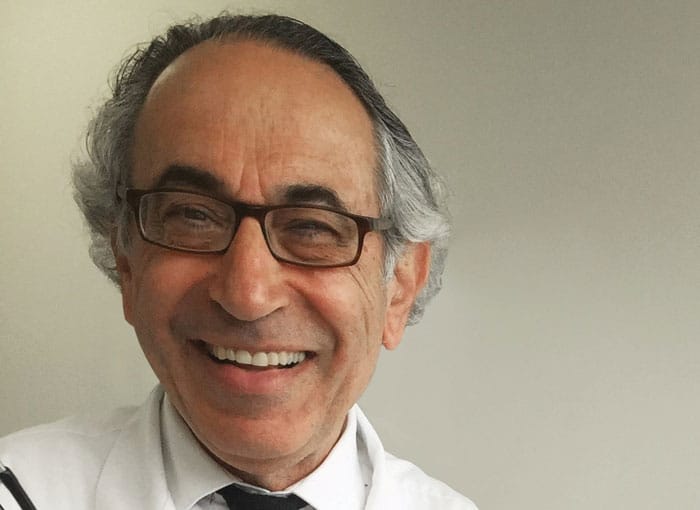
Dr. Massood Bral, a prominent pediatrician and healer of the Los Angeles community, passed away unexpectedly at the age of 78 on October 22, 2022. He was born in Tehran, Iran, in 1944. At age 13, he started working for his father, Dr. Mousa Bral, at Rey Pharmacy, a compounding pharmacy that represented global products such as Guigoz baby formula. Inspired by the local doctors who came before him, Dr. Bral applied to the University of Tehran’s School of Medicine. After graduating medical school at the top of his class in 1969, he spent six months training in Iran’s obligatory military service and 18 months providing medical care as a First Lieutenant Medical Officer.
In 1972, Dr. Bral left Iran to complete his residencies at D.C. General Hospital in Washington, D.C., followed by Mount Sinai Hospital and Rainbow Babies & Children’s Hospital (of Case Western Reserve University) in Cleveland, Ohio. In 1977, he joined the pediatric office of Dr. David Levi in Beverly Hills and in 1979 established his own solo practice in Westwood, subsequently moving to Brentwood and, finally, Santa Monica. Early in his career, Dr. Bral worked part-time at the Los Angeles County Central Juvenile Hall and at USC’s Pediatric Pavilion ER; and he volunteered for six years at the UCLA School of Nursing Health Center at St. Joseph’s Parish, helping those experiencing homelessness.
For decades, Dr. Bral worked as an attending physician at Cedars-Sinai Medical Center, UCLA Medical Center, and Santa Monica-UCLA Medical Center. For 10 years, he served as Assistant Professor at UCLA School of Medicine’s Department of Pediatrics and UCLA School of Nursing. In 2018, he became a member of Children’s Hospital LA’s Care Network.
2022 marked 50 years that Dr. Bral selflessly dedicated his life to pediatric and adolescent medicine in the United States.
Dr. Bral was a gifted diagnostician and truly understood the art of medicine. He maintained the highest level of professional, moral, and ethical standards that earned him his reputation as a truly honorable person.
Like his father (who headed the Health Committee in Iran’s Parliament, served as chair of the Department of Nutrition, Food Chemistry, and Toxicology of Tehran University and authored several books, including “The Medicinal Plants of Iran”), Dr. Bral was passionate about healthcare and integrative medicine. He incorporated nutrition and natural remedies into his practice in combination with what he called “miracle” Western medicine.
As a patient’s father said, he brought “a small-town doctor experience to the big city.”
Dr. Bral was a true tzadik who personified righteously living out one’s Jewish values. His sole motivation was to provide service to others, even extending his benevolence to strangers. He was known for treating each child like his own – going above and beyond to optimize their overall health, with a compassionate and soulful approach. Without any regard for office hours nor financial considerations, he provided limitless care, exhausted every professional resource, and regularly made house calls. As a patient’s father said, he brought “a small-town doctor experience to the big city.”
Generations of patients and their families describe Dr. Bral as being more than just a doctor: he was a source of comfort, encouragement, hope, and laughter – a kind person who made people feel seen and heard. He was adored for his authenticity and his playful nature; always making special efforts to lift the spirits of every child.
The death of Dr. Bral is a loss not just for the medical community but for humanity. He will forever be remembered in the hearts of all who crossed his path.
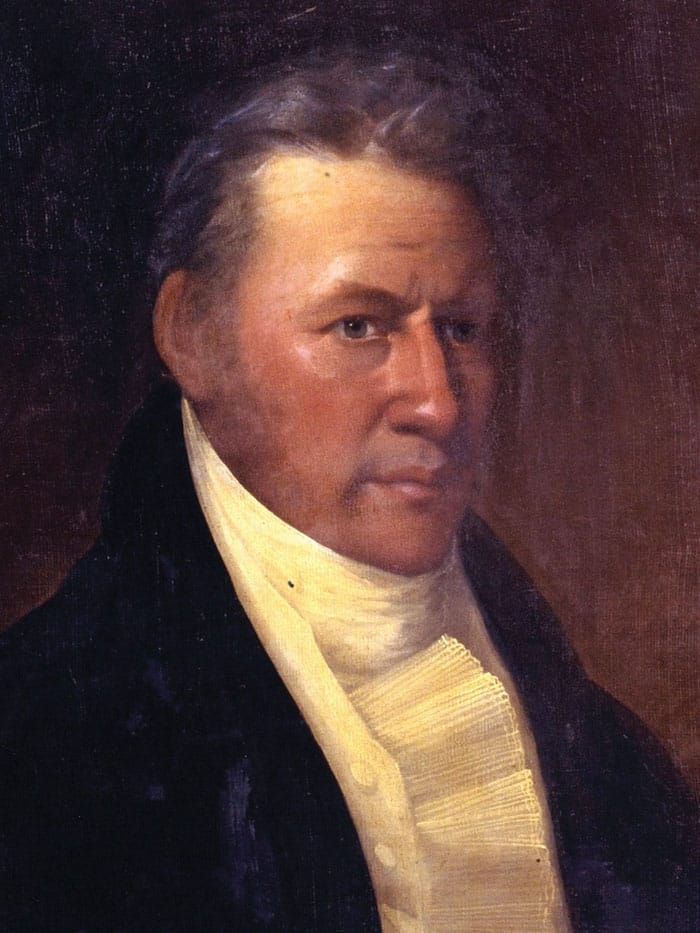
In the mid-19th century, James G. Birney, a former slaveholder hailing from Danville, Kentucky, recognized the societal scourge that was the slave trade and decided to do something about it. Accepting the nomination for president from the Liberty Party in 1840, the party’s platform “demand[ed] the absolute and unqualified divorce of the general government from slavery, and also the restoration of equality of rights among men, in every State where the party exists, or may exist.” Birney did not win. In fact, he received a paltry 6,797 votes.
James G. Birney painted by Asa Park
So, like many undeterred idealists, Birney ran again. And he lost again. This time, he tallied over 62,000 votes, representing a more respectable 2.3% of the popular vote.
Though not electorally successful, Birney and the Liberty Party’s efforts, among the most consequential of any third parties in American politics, utilized lobbying and publicity campaigns to move the political needle in favor of abolition. While you likely have never heard of James G. Birney, you probably have heard of the candidate who ran with the support of former Liberty Party members under a new banner just a few years later. The recently formed Republican Party’s presidential nominee was named Abraham Lincoln.
Lincoln’s role as the Moses of his people, America’s Great Emancipator, has been well documented. But what is less known is that his moral predecessor, Birney, looked to the Hebrew Bible to depict his own fight for emancipation.
Lincoln’s role as the Moses of his people, America’s Great Emancipator, has been well documented. But what is less known is that his moral predecessor, Birney, looked to the Hebrew Bible to depict his own fight for emancipation. The logo of the Liberty Party was a biblical tree, the Cedar of Lebanon.
As the Book of Kings describes, King Solomon used cedars from Lebanon to construct the Temple in Jerusalem. In case the symbolism was too subtle for its supporters, the party made the theology behind the image explicit. It ran campaign ads with images of the tree, accompanied by the slogan taken from Psalm 92, “the righteous shall … grow like a cedar in Lebanon.”
The imagery of the Jewish Temple, the site from which justice was to, in the words of the prophet Amos, “well up as waters, and righteousness as a mighty stream,” served to shape the fight for a more righteous and just America.
The imagery of the Jewish Temple, the site from which justice was to, in the words of the prophet Amos, “well up as waters, and righteousness as a mighty stream,” served to shape the fight for a more righteous and just America.
The story of the biblical inspiration behind Birney’s fight against slavery is, like so much of the Hebrew Bible’s role in American history, not well known. And yet at a time when America’s political scene, as pundits are so keen to proclaim, hasn’t been this fractured since the Civil War, it is the type of story that Americans need more than ever.
The Jewish story, an investigation into American history will reveal, helped shape America’s moral language of liberty and articulate its highest national ideals. While the American project undoubtedly remains imperfect, by restoring the American story’s biblically inspired ideals to national prominence, a unifying narrative can be reclaimed.
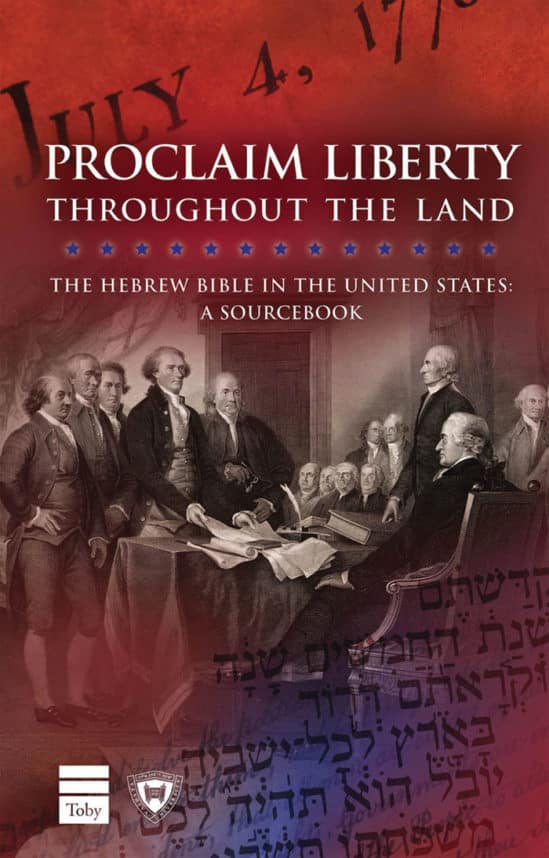
This spring, on March 19, 2023, Yeshiva University, in a historic collaboration across multiple organizations and multiple faiths, is convening a conference called “Restoring the American Story” for high school educators on its Wilf campus in New York City. YU’s Straus Center for Torah and Western Thought, which has published volumes on foundational American documents inspired by the Hebrew Bible (“Proclaim Liberty Throughout the Land,” Maggid Books, 2019) and tracing the Purim story’s role in American politics (“Esther in America,” Maggid Books, 2020) has partnered with YU’s Azrieli Graduate School of Jewish Education and Administration to assemble the Jack Miller Center, Tikvah Fund, Prizmah, Civic Spirit, Religious Freedom Institute, Pepperdine’s School of Public Policy, the Faith and Liberty Discovery Center, BibLit, Ashbrook Center and OpenDor Media.
The story of the biblical inspiration behind Birney’s fight against slavery is, like so much of the Hebrew Bible’s role in American history, not well known.
Together, over the course of the full-day conference, participants from these organizations and their networks of educators will discuss key themes including why the study of American history is important in religious schools, how the books of Psalms inspired the American founding, John Milton’s impact on American political thought, the usage of the Hebrew Bible in the modern presidency, and how the Bible might be a source of reconciliation in America during divided times.
The proceedings will be chaired by Rabbi Dr. Meir Soloveichik and Dr. Wilfred McClay and feature preeminent American Jewish historian Dr. Jonathan Sarna, Dr. Tevi Troy, Dr. Shaina Trapedo and Dr. Dov Lerner and other scholars. Rabbi Soloveichik, who received his doctorate in religion from Princeton University, is one of the world’s preeminent Jewish thinkers and educators, and one of America’s most influential religious leaders. Director of the Zahava and Moshael Straus Center for Torah and Western Thought at Yeshiva University, he is also the rabbi at Congregation Shearith Israel in New York. Rabbi Soloveichik has lectured internationally to Jewish and non-Jewish audiences on topics relating to faith in America, the Hebraic roots of the American founding, Jewish theology, bioethics, wartime ethics and Jewish-Christian relations, and is currently writing a book on the Jewish perspective on statesmanship. He writes a monthly column in Commentary Magazine, and his writing has appeared in The Wall Street Journal, The New York Times, Mosaic, First Things, Tradition, Jewish Review of Books, and many other outlets.
Dr. McClay holds the Victor Davis Hanson Chair in Classical History and Western Civilization at Hillsdale College. Before coming to Hillsdale in the fall of 2021, he was the G.T. and Libby Blankenship Chair in the History of Liberty at the University of Oklahoma, and the Director of the Center for the History of Liberty. His most recent book is “Land of Hope: An Invitation to the Great American Story” (Encounter, 2019). His book “The Masterless: Self and Society in Modern America” (University of North Carolina, 1994) won the Merle Curti Award of the Organization of American Historians for the best book in American intellectual history. Among his other books are “The Student’s Guide to U.S. History,” “Religion Returns to the Public Square: Faith and Policy in America,” “Figures in the Carpet: Finding the Human Person in the American Past,” and “Why Place Matters: Geography, Identity, and Public Life in Modern America.” He was educated at St. John’s College (Annapolis) and received his Ph.D. from Johns Hopkins University. Dr. McClay was recently awarded the prestigious Bradley Prize in recognition of his scholarly achievements.
The March conference follows a summer 2022 week-long seminar for high school educators, in which Drs. Soloveichik and McClay were joined by Dr. Diana Schaub and Dr. Daniel Dreisbach to think together on how the participants could use material pertaining to the Hebrew Bible and America in their classrooms. Dr. Schaub is Professor of Political Science at Loyola University Maryland, has served as Visiting Professor of Political Theory in the Government Department at Harvard University in 2018 and 2020 and is the author of “His Greatest Speeches: How Lincoln Moved the Nation.” Dr. Dreisbach is a professor in the School of Public Affairs at American University in Washington, D.C. who has authored or edited 10 books, including “Thomas Jefferson and the Wall of Separation between Church and State” (New York University Press, 2002), “Reading the Bible with the Founding Fathers” (Oxford University Press, 2017), and “The Sacred Rights of Conscience” (Liberty Fund, 2009).
The summer cohort studied texts from John Winthrop, William Penn, John Adams, Thomas Paine, Ezra Stiles (an 18th-century polymath and the President of Yale University who was a deeply devoted student of Hebrew texts), abolitionist Angelina Grimké, George Washington, Thomas Jefferson, Abraham Lincoln, Frederick Douglass and others.
The seminars from the summer, as well as the presentations from the upcoming conference, will be collected in a book to be edited by Dr. McClay, which will also contain sample lesson plans for classrooms.
The goal of the conference is to give dozens of teachers the tools to bring the story of the Hebraic voice of America to their students and colleagues.
Excerpt from the introduction to “Proclaim Liberty Throughout the Land: The Hebrew Bible in the United States” (Maggid Books, 2019) eds: Meir Soloveichik, Jonathan Silver, Matthew Holbreich and Stuart Halpern.
The influence of the Hebrew Bible can be understood in at least four ways.
First, the Hebrew Bible is a source for, and an element of, collective identity and self-identification. One way to gain access to how people think about themselves is to notice the names they give to places that surround them, to cities and rivers and valleys and colleges. The American countryside is filled with names of biblical places such as “Zion,” “Canaan,” “Shiloh,” and “Salem.” Many American colleges, such as Yale and Dartmouth, were founded as seminaries with broader purposes, and chose Hebrew mottos to encapsulate their mission. Harvard College required its students to study Hebrew. As late as 1817, orations at Harvard were occasionally delivered in Hebrew.
Political assemblies in America often open with prayers, and on great national occasions, presidents often turn to the Bible as America’s unifying text. The national government has declared days of thanksgiving and repentance. When Revolutionary pastors read of the Persian court in the book of Esther they thought of Britain; when they preached about the depredations of British tyranny, they explained themselves in the language of Ahasuerus and Haman. When Thomas Paine wanted to make a case to the colonies that monarchy was a primitive, outdated, and illegitimate form of government, he cited the book of Samuel. Washington was compared to Moses and to Gideon. When Washington died, most houses of religious worship eulogized him with words from the Hebrew Bible.
From the colonial period to the Civil Rights Movement, ministers and preachers were some of the most important figures in American political life, and Hebraic themes were brought into public discourse through them. During the Revolutionary War, biblical themes were used to cast aspersions on perceived enemies. Colonists who were not quick enough to come to the aid of their brethren were said to have suffered from the curse of Meroz (see Judges 5:23). Later, some of the largest reform movements in American history, including the movement for prohibition, took their inspiration from religious movements that were themselves but applications and interpretations of the Hebrew Bible. Its story has reflected Americans to themselves and endowed the people of the United States with an identity set apart from that of the other nations.
Second, the Hebrew Bible has been a source of political and cultural vocabulary. That is, the Hebrew Bible provided a series of narratives and themes that were powerful in the minds of the Puritan settlers, Revolutionaries, enslaved African Americans, the Civil Rights Movement, and the broader population. To notice this is to already see that the Hebrew Bible is not just a source of private contemplation. It is a public book that has been felt in public debates and public social movements. The biblical vocabulary has taught Americans to speak and think about chosenness, exodus, and covenant. For Americans the Bible is, as Mark Noll puts it, “the story of all stories,” containing a “storehouse of types” that they have grafted onto their collective life. These big ideas have had different uses and have held different meanings, expressing aspiration and aspersion, collective longing and individual disappointment. But regardless of the sentiments expressed or the hopes shared, it was biblical vocabulary that Americans have been impelled to use.
These narrative themes are perhaps the most powerful and enduring cultural resonances of the Hebrew Bible in America. It is worth going through each briefly. “Chosenness” is the idea that God selected a people for a special mission to advance His ultimate plan. The Protestant Reformation and Calvinism placed “election,” another word for chosenness, at the center of Protestant theology, which migrated north to Amsterdam and west to the New World. The Puritan settlers conceived of themselves as a “New Israel,” chosen by God to plant a vine in the wilderness; the Mormons, on their long march to the West, also thought they were a latter-day chosen people heading toward a new Zion; and the United States as a whole saw itself as a chosen nation.
Chosenness is not a singular concept. Rather it oscillates in American history between two different modes. On the one hand the rhetoric of chosenness sanctifies the present, providing it with divine sanction. This variation allies with a form of American nationalism in which the current national form and its current projects are identified with God’s ultimate plan. Josiah Strong’s writings on Manifest Destiny exemplify this nationalist triumphalism. The notion of “the chosen nation” is also, on the other hand, a way to critique the present generation for not living up to the divine mission for which they were elected. This latter interpretation divorces or puts distance between any given national project and divine intent.
These divergent postures prompt two different cultural moods: one of triumphalism and one of aspirationalism. Each cultural mood has its own specific form of rhetoric. In the case of triumphalism there is bombast, a feature that is readily seen when the United States interpreted chosenness as a justification of imperialism. The other rhetorical mood associated with aspirational critique tends toward the rhetorical form of the jeremiad. The jeremiad is a rhetorical critique rooted in a shared aspiration to achieve a common goal that the community has failed to attain. It chastens the community for its failures, reminds them that divine judgment will be visited upon the people for failing to live up to their covenantal promise, and recalls their purpose to them, giving them renewed confidence that redemption is possible through rededication and sacrifice. The jeremiad is the form of rhetoric adopted by Jonathan Edwards and by Abraham Lincoln in the second inaugural address, for example.
The narrative of Exodus is another central element of the American political vocabulary. The book of Exodus recounts the journey of the Hebrew people into Egyptian bondage and their miraculous liberation from it. The American people have used the Exodus narrative in identifying tyranny, expressing the longing for freedom, and describing the journey out of enslavement and the jubilation of liberation. To the Puritans, England was Egypt, the house of bondage, and their voyage across the Atlantic was their exodus, their parting of the seas. For the enslaved population, the North was Zion, and their songs and hymns reverberated with some of the greatest melodies of collective longings for freedom in the American tradition, with such songs as “Go Down Moses” and “Didn’t Ol’ Pharaoh Get Lost.” Washington and Lincoln were both called Moses. In fact, Washington was compared to Jacob and Joshua, Samuel and Elijah, David and Daniel. Finally, to speak of Exodus is also to speak of Egypt, of Pharaoh, of plagues, and of judgment. It was used to point a finger at the English and at the Southern slave owners as the tyrants who would meet with divine wrath. Lincoln, perhaps the single greatest employer of Hebraic tropes in American history, warned that if America became Egypt and did not redeem itself, it would meet with the same fate.
Another element in the American Hebraic vocabulary is “covenant.” A covenant is different from a contract. A contract entails rights of voluntary exit and is premised on the joining together for mutual self-interest. A covenant, on the other hand, is an intergenerational commitment to a higher cause that transcends the individual and to which the individual dedicates himself. Both are very much present in the American tradition. The Declaration of Independence is an example. It is on the one hand an expression of classic liberal Enlightenment social contract theory. The individual, who is morally prior to the state and who is endowed with natural rights, voluntarily circumscribes his natural rights to enter into a mutually convenient compact with others to form a limited government. When government is destructive of those rights, then the people can form a new government based on new principles. But conjoined with the contractarianism of the Declaration are the mutual pledges of the delegates, as representatives of the people of the colonies, of their lives, property, and sacred honor, for the cause that temporally transcends their lives, property, and sacred honor. This mutual binding that combines contract and covenant also characterizes the Mayflower Compact. A contract is not automatically self-enforcing; it requires sacrifice and dedication, the words that resonate most strongly in Abraham Lincoln’s Gettysburg Address.
A third way that the Hebrew Bible has influenced American public life is seen by looking at rhetorical tools employed in cultural and political debates. Beyond providing a common language in which debates could be expressed, key Hebraic references became actual authorities, on whose merit audiences were more likely to be persuaded. Thomas Paine’s “Common Sense” is an example of relying on the Hebrew Bible as a source of rhetorical authority. Paine argues, based on the book of Samuel, that the Bible is anti-monarchical and thus provides a justification for a break with England. Whatever the intrinsic merits of the argument, Paine understood that appealing to the Bible as a source of authority would resonate with his biblically literate audience.
Moreover, because the Hebrew Bible has been a rhetorical authority, it is often found on multiple sides of American debates. The fact that orators and writers employed the Bible in polemics does not necessarily mar the book. Rather, it indicates just how exalted a status it had in American public life. An argument that was based on the Hebrew Bible, they believed, would confer unique authority on their views. So there have been arguments for both republicanism and monarchy, for and against Revolution, and for and against the Articles of Confederation and the Constitution—all with the Hebrew Bible serving as a proof text. It was used to denounce slavery, and it was used to justify slavery. But both parties to a debate thought it necessary to demonstrate that the Hebrew Bible was on their side.
It is important to distinguish between the way the Americans used the Hebrew Bible in political debates and the Bible’s own teaching about politics. Exploring the Hebraic teaching on politics (one should probably say biblical teachings in the plural) is a rich exegetical enterprise. The Hebrew Bible is filled with stories that are open to multiple interpretations. There are stories of the founding of cities and their destruction, the rise and fall of kings and of political institutions. The Hebrew Bible is a story of the creation of the universe, the origins of human society, the rise of a family into a clan and nation in exile, the return of the nation to its ancestral homeland, and its political and military rise and fall. The book of Samuel alone, for instance, offers a complex interplay of secular and divine power: the emergence of the political out of the shadow of divine exclusivity and the negotiation of the relationship of political to priestly power. The political lessons in the Bible are also tightly bound to the complex psychologies of individuals like Samuel, Saul, David, and Jonathan, which take on heightened importance in dynastic successions. One should resist the temptation to conclude that the Hebrew Bible has a single political teaching. One should also resist thinking that its teaching neatly overlaps with the commitments of our early republic or the liberal democracy we have become. While Americans have often enlisted the Bible as proof and guarantor of their political views, the biblical text resists any single authoritative interpretation.
A fourth way that the Hebrew Bible has influenced America is through the powerful and eloquent language of the King James Bible. It influenced American novelists such as Nathaniel Hawthorne, Herman Melville, and William Faulkner, and statesmen like Presidents Lincoln, Theodore Roosevelt, and Woodrow Wilson. In fact, in the nineteenth century there was an entire genre of writing that mimicked the Bible. The way a nation writes is the product of, and influences, the way a nation thinks about itself. Noted Biblical scholar and translator Robert Alter remarked that “style is not merely a constellation of aesthetic properties but is the vehicle of a particular vision of reality.” To hear the resonant and powerful words of Lincoln’s second inaugural address without reference to the moral world of the Hebrew Bible is to truncate the text and excise worlds of meaning.
The Hebraic worldview, which runs deeper than language and cultural conversation, articulates a vision of human life that is redemptive, endowed with sacred meaning, and which seeks to combine righteousness and freedom. It is this worldview that has contributed to the American moral language of liberty.
Rabbi Dr. Stuart Halpern is the Senior Adviser to the Provost and Deputy Director of the Straus Center for Torah and Western Thought at Yeshiva University.


 First, the Hebrew Bible is a source for, and an element of, collective identity and self-identification. One way to gain access to how people think about themselves is to notice the names they give to places that surround them, to cities and rivers and valleys and colleges. The American countryside is filled with names of biblical places such as “Zion,” “Canaan,” “Shiloh,” and “Salem.” Many American colleges, such as Yale and Dartmouth, were founded as seminaries with broader purposes, and chose Hebrew mottos to encapsulate their mission. Harvard College required its students to study Hebrew. As late as 1817, orations at Harvard were occasionally delivered in Hebrew.