This week, Sinai Akiba Academy put on their annual challah bake. We gathered, put the various ingredients together to mix our dough and schmoozed while the dough had time to rise. While challah making is a well-known Jewish ritual, I think we forget the mindfulness embedded in this ancient tradition.
This week, for me, it is all about the kneading. How do we expend energy, anger, disappointment, or frustration in our constantly moving world? Many of us choose exercise, breathing, meditation or even prayer as vehicles to pause, reflect and reengage. But kneading dough shouldn’t be discounted. The pounding, shaping, rolling, and forming allows for an integration of physical, emotional, and spiritual worlds. This week, what do you knead into your challah? Are you kneading the tears shed from loss or anguish? Are you kneading the joy experienced from celebration and community? Are you kneading the questions faced with an unknown future or are you kneading the comfort that comes with knowing Shabbat is just around the corner? What do you knead?
Challah isn’t just a delicious Jewish food. Challah is an immersive Jewish experience. We remind ourselves that Shabbat is an opportunity to take what the week has given us and for just a moment, be still. The events and emotions of the week can be externalized, taken off our shoulders, kneaded into the bread that sits before us. It doesn’t mean the problems of the world have faded away. But it does mean we are given a few precious hours to shift focus, count our blessings and make room for the week that is about to unfold.
To prepare for Shabbat, the very question we must ask ourselves is the following: What do you knead? The dough seems ready to receive. And in return, perhaps, we will have the space needed to grow.
Shabbat Shalom
Rabbi Nicole Guzik is a rabbi at Sinai Temple. She can be reached at her Facebook page at Rabbi Nicole Guzik or on Instagram @rabbiguzik. For more writings, visit Rabbi Guzik’s blog section from Sinai Temple’s website.
Truth can be repulsive,” Bruno Walter, a conductor whose life had taught him that fact all too well, once said. “But Mozart has the power to speak truth with beauty.”
If there was one composer that Walter, who was able to make beauty from truth like few others until his death in Beverly Hills in 1962, was most associated with during his career, it was that Viennese master; the story of Walter’s life, the conductor said, could be told as “the history of the development of a love for Mozart.”
Writers often dignified Walter with spiritual metaphors — the author Stefan Zweig compared the beam on his face while conducting to “the countenance of the angels when they look upon God” — and it is revealing of his artistry that they were exactly what Walter aspired to achieve. For him, the Germanic music from Bach to Strauss was pure, uplifting, redemptive. It offered an “unchanging message of comfort,” he wrote in his memoir “Theme and Variations”; its “wordless gospel proclaims in a universal language what the thirsting soul of man is seeking beyond this life.”
His authority, lightly worn, came not from technique or intellectual heft, but from “his love and his faith,” the New York Times critic Olin Downes wrote after a concert with the Philadelphia Orchestra in 1946. “Love, and not merely interpretive comprehension of what he is playing. Abiding faith in the music he represents.”
Gershon Hepner is a poet who has written over 25,000 poems on subjects ranging from music to literature, politics to Torah. He grew up in England and moved to Los Angeles in 1976. Using his varied interests and experiences, he has authored dozens of papers in medical and academic journals, and authored “Legal Friction: Law, Narrative, and Identity Politics in Biblical Israel.” He can be reached at gershonhepner@gmail.com.
Case Western Reserve University to Hold BDS Resolution Vote
Case Western Reserve University’s Undergraduate Student Government (USG) will be holding a vote on a boycott, divestment and sanctions (BDS) resolution on November 8.
The resolution, which was obtained by the Journal, calls for the university to divest from companies that “directly provide weaponry, security systems, prisons, or military support for the illegal occupation of the Palestinian territories” and “directly facilitate the building, maintenance, or economic development of illegal Israeli settlements, outposts, and settler-only roads and transportation systems on occupied Palestinian territory.” The resolution also accuses Israel of being an apartheid state.
USG Assembly Speaker Ethan Dreemer said in a statement to the Journal, “As a leader in student government, I have an obligation to represent my constituents who have expressed to me their overwhelming opposition to this boycott, divestment, and sanctions (BDS) bill. BDS is not a constructive solution to the Israeli-Palestinian conflict and will do nothing except create a hostile environment for Jewish students on our campus at a time when antisemitism is sharply on the rise in America. Sadly, the authors of this resolution fail to recognize the full effect that their actions will have to the detriment of Jewish students on this campus. Instead of divesting, we need to work together to invest in the Israeli and Palestinian people to help lift up both communities instead of lifting up one community at the expense of the other. Our student government must reject this dangerous resolution. Instead, we need our student government to show support for the Jewish community more than ever.”
Anti-Israel Flyers at Northwestern University
Anti-Israel flyers were found at Northwestern University on November 3.
Stop Antisemitism tweeted out photos of the flyers on November 4; one photo showed a community posting board filled with flyers saying, “Long Live Palestinian Resistance,” “End the Siege on Jerusalem Now” and “Free Palestine.” Stop Antisemitism posted another photo showing a “Long Live Palestinian Resistance” flyer and another flyer saying “The UN predicted Gaza would be uninhabitable by 2020. It’s 2022” posted on a tree.
“Satanic Jews Control the World” Flyers at ASU
Stop Antisemitism also tweeted out a photo of a flyer found at Arizona State University’s (ASU) campus saying that “Satanic Jews control the world” and “Kanye is right.”
The flyer also showed “The Happy Merchant,” an antisemitic meme, with devil horns added. Stop Antisemitism tweeted to ASU President Michael Crow, “Your Jewish students deserve to feel safe on campus, this is truly horrifying.”
Former Tufts Admissions Employees Alleges “Culture of Antisemitism”
Former employees for Tufts University’s admissions office are claiming that there is a “culture of antisemitism” inside the university’s admissions office.
The employees spoke anonymously to Tufts Daily, alleging that Dean of Admissions Officer JT Duck called for more conservative Jewish applicants to be accepted, but did not specify whether or not he meant conservative from a religious or political perspective. The result, the former employees claimed, was “resentment toward Jewish applicants.”
The former employees also alleged that Duck gave promotions to staff members who had discrimination complaints lodged against them and that Duck frequently misgendered people and make wisecracks about pronouns. Duck told the Daily, “I have always sought to create an environment in which differences are respected and values of diversity, equity, inclusion and belonging are embraced, and I remain committed to doing so moving forward. As a manager, I fully support the right of individuals to raise their thoughts and concerns with me and to seek redress from the university’s established processes if they feel their concerns have gone unheard.”
Antisemitic Graffiti at CUNY
New York Governor Kathy Hochul, a Democrat, tweeted on October 31 that antisemitic and homophobic graffiti was found at the City University of New York’s (CUNY) Hostos Community College earlier that day.
She wrote that the graffiti targeted a staff member at the college; what the graffiti depicted was not specified. “Let me be clear: We will not tolerate hate in any form in New York,” Hochul wrote.
Dawson College Student Allegedly Wears Nazi Costume
A student at Dawn College in Montreal is alleged to have worn a Nazi costume during Halloween, MTL Blog reported.
Stop Antisemitism posted a photo of the student marching and appearing to give a Nazi salute while wearing a gas mask. The student claimed that the uniform was actually resembling an East German officer after World War II. The college said in a statement that “the actions of this student threatened many students’ fundamental sense of safety. Dawson College also strongly condemns antisemitism and discrimination in any form.” ■
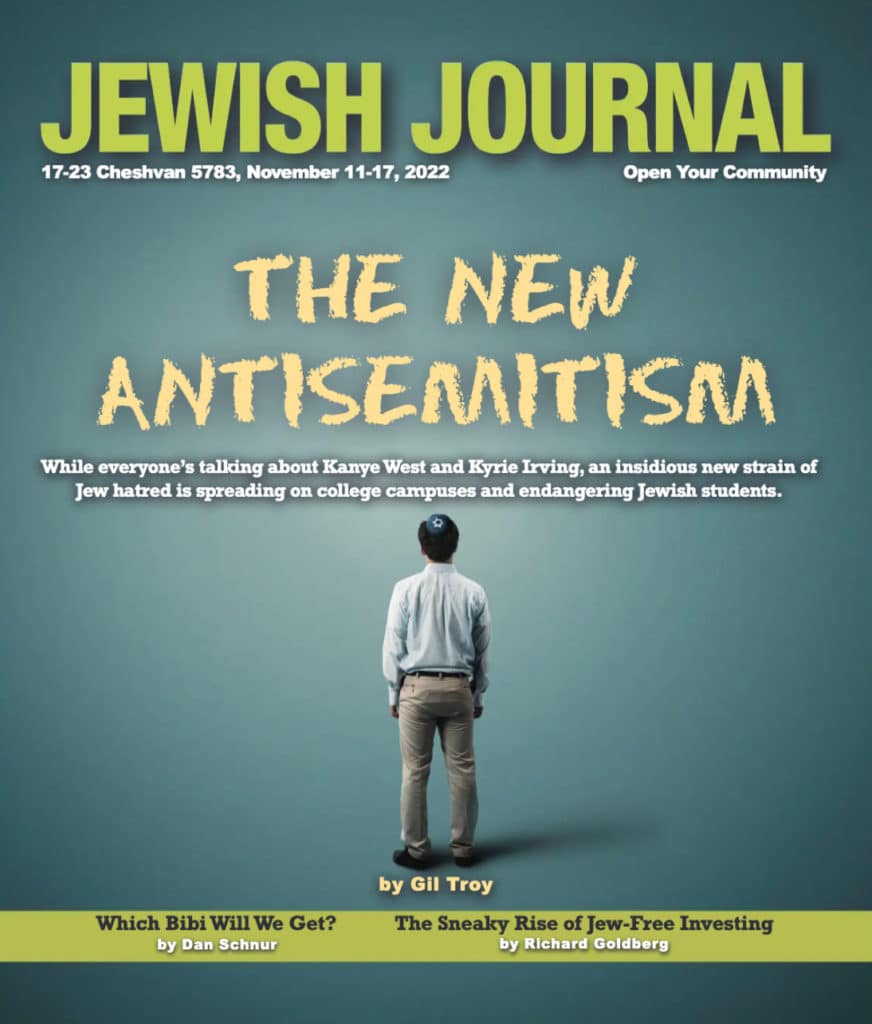
Last year, at University of Illinois-Urbana Champaign, a pro-Palestinian student threw a rock at Jews standing by Hillel, the Jewish students’ organization. At the University of Oregon Hillel, vandals left an illiterate, hate-filled, message: “Free Palestina You genocidal rasist f…ks.” At an unnamed college, one student tried blocking a Jewish student from her friend’s dormitory unless she said “Free Palestine.”
These were among the 2,717 incidents of assault, harassment and vandalism directed against American Jews in 2021. America’s small Jewish community endures nearly two-thirds of all anti-religious hate crimes annually. Few criminals who have attacked visibly Orthodox Jews in Brooklyn have been imprisoned. Paul Pelosi’s hammer-wielding attacker spread antisemitic conspiracy theories. And on November 3, the FBI issued a rare warning against New Jersey synagogues being targeted.
In this age of outrage, the once-clear distinction between the left-leaning Jew-hatred of the salon and the right-leaning Jew-hatred of the street may be breaking down. The Jew-hatred of the salon is now increasingly violent while the Jew-hatred of the street is now increasingly ideological, “justified” by theorists of white supremacy or black power. But regardless of the source or the forms of expression, the target remains the same: Jews, individually or collectively — making it imperative to reject all manifestations of this Jew-hatred of the sewer.
Ronald Martinez/Getty Images
Beware: The broad-based repudiation of Ye, the bigot formerly known as Kanye West, is well-deserved, most welcome, but misleading. Like the cliched “Not Dead Yet” surprise in Halloween horror movies, Jew-hatred is nowhere close to being vanquished, even though West lost friends, fans, endorsement deals, and his billionaire status. In fact, all the virtue-signaling around the Kanye West and Kyrie Irving denunciations risks distracting Jews and non-Jews from the spread of more insidious and violent expressions of Jew-hatred.
While the Twitter-verse and corporate America denounced Ye, as headlines screamed and essayists agonized, American society overlooked what the Odessa-born Zionist thinker Ze’ev Jabotinsky called the more entrenched “anti-Semitism of things.” Most of the street bullies who have attacked black-hatted Jews in Brooklyn roam free, emboldened by the prosecutorial “discretion” soft-pedalling their crimes. The new Republican hyper-partisans refuse to condemn any of their fellow Republicans who rub elbows with Jew-haters or dog-whistle against Jews. And last month, as Ye’s tweet-tantrum cascaded, the Anti-Defamation League (ADL) released a sobering analysis detailing 359 acts of abusive campus Jew-hatred last year, which the media and most universities ignored.
All forms of Jew-hatred are unacceptable, even when our political allies perpetuate it.
There is no stupider debate in the American Jewish community today than the one asking “which is worse, right-wing Jew-hatred or left-wing Jew-hatred?” It’s like debating whether you would rather be run over by a truck or killed by poison. All forms of Jew-hatred are unacceptable, even when our political allies perpetuate it. Jewish conservatives waste their breath railing against university Jew-hatred, just like Jewish liberals waste their breath railing against MAGA bigots. And we all delight our enemies by fighting one another rather than uniting against them. It is increasingly obvious that in an increasingly polarized America, Jewish Trumpians have to call out right-wing Jew-hatred, while Jewish Progressives have to call out left-wing Jew-hatred.
It’s an old story. Beyond being, in the words of the late historian Robert Wistrich, “the longest hatred,” Jew-hatred is also the most plastic hatred: moldable, adaptable, artificial and occasionally toxic. Over the millennia, antisemites have attacked Jews for fitting in and standing out, as too capitalist and too Marxist, too universalistic and too nationalistic, too deferential and too aggressive. Some blame Jews for all that is wrong with society; others blame Jews for all that society believes is wrong with the world. Today, the children of Abraham and Sarah perform an important service for a divided America: the far right and left share at least one nemesis — Jews.
That both are equally contemptible doesn’t mean that right-wing and left-wing Jew-hatred are the same. Right-wing Jew-hatred is the antisemitism of the street. It’s usually more thuggish, more violent, more brazen. It most targets the Jewish body, and rarely disturbs the Jewish soul because it’s so extreme, so cartoonish, so intellectually disreputable. True, extremists from Louis Farrakhan to the leading white nationalists try to give their particular forms of Jew-hatred some rationale, but the claims are so outlandish as to be laughable.
This kind of goonish Jew-hatred requires very few paragraphs to dismiss. And it’s the kind of Jew-hatred easiest for most Jews and most decent Americans to denounce. It’s the traditional, made-in-Europe, currently most-popular-in-many-Muslim-circles variety, caricaturing Jews as big-nosed, greedy, powerful, power-hungry, and endlessly responsible for whatever is going wrong at the moment. Unfortunately, the rise of social media has brought this kind of bile from the sewer to a server, and then into too many minds via too many screens.
Especially since the Holocaust, and in an overwhelmingly-liberal American Jewish community, this is the Jew-hatred most American Jews love to hate.
Today’s Jew-hatred of the salon, however, lurks under the radar — or behind a mask of social justice talk. It’s far more subtle, insidious and disturbing because it comes with mortar boards, tweed jackets and hipster tattoos. And it launches a series of guided missiles aimed at the Jewish soul, making too many of us feel guilty for being attacked and too many others feelashamed of our identity or our homeland. That’s why the silence that greeted the ADL analysis amid the Kanye West shout-storm is so disturbing. The report, “Anti-Israel Activism on U.S. Campuses, 2021-2022,” catalogued nearly 400 moments on American campuses, in one academic year alone, when criticism of Israel crossed the line into aggressive and intimidating Jew-hatred. The always-cautious ADL did not assess the thousands of professorial sneers, pseudo-scholarly tweets and student snubs against Israel and against Zionist students that feed the lynch-mob atmosphere on too many campuses. Instead, ADL researchers emphasized harassment, from physical bullying to verbal browbeating, that often started with disdain for Israel but ended by targeting that oldest, most adaptable and useful scapegoat, the Jew.
These attackers reject Israel for what it is, not what it does — often blaming every Jew for Israel’s existence.
These attackers reject Israel for what it is, not what it does — often blaming every Jew for Israel’s existence.“Our goal is not to document or quantify routine criticism of Israel’s actions or policies,” the ADL authors explained, “but to provide a snapshot of a more radical activist movement which places opposition to Israel and/or Zionism as core elements of campus life or as a prerequisite for full acceptance in the campus community.”
It’s stunning. If Catholic students on dozens of universities across America found themselves cancelled and sometimes physically threatened by pro-choice activists because the Vatican remains anti-abortion, wouldn’t there be an outcry? What if African-Americans were targeted because of some African dictator? Wouldn’t college presidents, alumni, donors, parents, professors and students rally to their side? Wouldn’t inter-university task forces be established, responding to indignant editorials nationwide? And wouldn’t fighting such hatred become a top priority for all these new Diversity, Inclusivity and Equity administrators draining money from traditional university activities like teaching?
Instead, worse than silence, there is often annoyance. On campuses hypersensitive to micro-aggressions, Jews are expected to swallow macro-aggressions. In a universe privileging certain victims’ “lived experiences,” Jewish victims are gaslighted, told their supposed “white privilege” means any harassment cannot be harassment. Jews are bombarded with justifications for this obsessive assault on the world’s only Jewish democracy. Even victims of violence have been assured that their assailants were not anti-Jewish, “merely” anti-Israel.
This new Jew-hatred risks becoming as standard on many campuses as grade inflation, binge drinking, carefully-sifted recycling and woke posturing.
The problem, alas, is not new enough to attract headlines. It is just more widespread, worming its way into the woodwork of university life. This new Jew-hatred risks becoming as standard on many campuses as grade inflation, binge drinking, carefully-sifted recycling and woke posturing. The report, “Anti-Israel Activism on U.S. Campuses, 2021-2022,” commendably focuses on just the facts. It catalogues the rocks thrown, insults launched, lies spread, abuse endured, and violence against Israel and Jews advocated.
It’s worth exploring how Jew-stalking became a campus craze.
Clearly, as universities have become more fanatically progressive, anti-Zionism has progressed from the margins of campus life to its center.
Clearly, as universities have become more fanatically progressive, anti-Zionism has progressed from the margins of campus life to its center. The turn from truth-seeking to virtue-signaling, from transcending victimhood to wallowing in it, and from cultivating independent individual expression to imprisoning people in particular identities, followed its Marxist logic. Once various “out” groups are designated as the “oppressed” destined to become the new “in” groups, they seek new “out” groups to ostracize as “oppressors.” As always, finding a common enemy is the best way to impose groupthink on your own followers.
In the 1970s, the Palestinian scholar Edward Said attacked “Orientalism,” scholars’ supposedly “crude, essentialized caricatures of the Islamic world.” Such cultural imperialism, he argued, exposed the “Orientalists’” prejudices. Today, the illiberal liberalism and unscholarly scholarship spreading crude, essentialized caricatures of Israel, Judaism, and Zionism could be called “DisOrientalism.” DisOrientalism misreads Israel through a partisan Western prism, in a true act of cultural imperialism. Forgetting that Judaism and the Jewish people never fit easily into neat modern categories of “religion” and “nation,” DisOrientalists treat Judaism and Zionism as Western transplants lacking authentic Middle Eastern roots.
These Bash-Israel-Firsters then dismiss the Jewish national liberation movement, Zionism, as “settler colonialism,” negating Jews’ 3,500-year-old ties to the land of Israel. They call little, multicultural, polychromatic Israel racist and imperialist, although Israel has no empire and is fighting a national battle with Palestinians, not a skin-based color war. And they accuse pro-Israel Jews of promulgating “Jewish supremacy,” a term wrenched from the Nazi handbook for demonizing Jews.
Many anti-Zionists also appear disoriented — supporting feminism and gay rights everywhere, yet overlooking Palestinian society’s rampant sexism and homophobia. They champion democracy and dissent worldwide, yet excuse the autocracy and oppression committed by the Palestinian Authority and Hamas in Gaza. They claim to pursue peace everywhere, yet endorse Palestinian terrorism anywhere.
With these distortions mainstreamed, no wonder so many professors who could make anything sound complicated, oversimplify about Israel. Better to trash Israel blindly than analyze the Middle East subtly. Better to sling slogans than risk ostracism. Many students then parrot the distorted Israel critique, romanticizing the Palestinians, following the trend. Since Communism collapsed, pro-Palestinianism has become the ultimate left-wing virtue-signal, qualifying anyone for membership in an anti-Western woke world. Said charged that Orientalism affirmed European identity; DisOrientalism affirms modern Progressive identity in its most illiberal forms.
Many enter academia to mobilize legions of social justice warriors, not nurture critical thinkers.
This anti-Israel mania reflects the deeper rot of American universities. Our society spends billions, alumni contribute millions, and parents bankrupt themselves subsidizing centers of education that are degenerating into propaganda factories. Every semester, thousands of professors, especially in the humanities and social sciences, commit educational malpractice brazenly, intentionally, by hijacking their lecture podiums and transforming them into political platforms. The essential professorial mission has changed, especially in the social sciences and humanities. Many enter academia to mobilize legions of social justice warriors, not nurture critical thinkers. Echoing the anti-Israel orthodoxy, they project every Western flaw onto Israel.
Having cast the Jewish state as “the Jew” of the world, deemed to be the source of so much evil, the haters naturally spill over into hating the Jews in today’s world. Given Zionism’s centrality to modern Jewish identity, all Jews are found automatically guilty, coconspirators in Israel’s alleged crimes — unless they make loud, flamboyant declarations of anti-Zionism.
That’s why The Jewish Journal’s report of nine Berkeley Law School student groups banning Zionists from speaking about any topic is so disturbing. It takes cancel culture to an extreme and essentially asks Jews and only Jews for loyalty oaths affirming they are not Zionists, God forbid!
This trend of demonizing Jews, and accusing little democratic Israel, whatever its shortcomings, of committing every major Western sin, from imperialism and settler colonialism to racism and white supremacy, rings Jews’ atavistic alarm bells.
In the late-1800s, years before he helped launch the modern Zionist movement, Theodor Herzl noticed how scholarly Jew-haters updated and prettified their ancient scourge. Herzl was particularly dismayed that Eugen Dühring’s 1881 screed “Die Judenfrage als Racen, Sitten und Kulturfrage” (“The Jewish Question as a Racial, Moral, and Cultural Question”) was “unfortunately so well-written, not at all as if base envy had guided the poison pen of personal revenge.”
“When such infamous nonsense is presented in so straightforward a manner,” Herzl wrote, “when so well-schooled and penetrating a mind, enriched by scholarly and truly encyclopedic knowledge … can write this sort of stuff — what then can one expect from the illiterate mob?” Watching this elegant, well-educated, academic Jew-hater replace medieval Christian blood libels with new, pseudoscientific, race-based hierarchies, Herzl sighed: “He has kept pace with the times. He knows that one can no longer dish up these stupid old lies that have led to so much bloodshed, and so he thinks up more plausible new ones.”
The problem is daunting. Ending academic malpractice in the universities will take decades, while Jew-hatred has been mutating for centuries. But no solutions will ever emerge without first recognizing that there is a problem.
Without stifling debates about Israel’s rights and wrongs, it’s time to put this new Jew-hatred on every college leader’s agenda.
Without stifling debates about Israel’s rights and wrongs, it’s time to put this new Jew-hatred on every college leader’s agenda. Ultimately, it is a consumer protection issue: Last spring, the Louis D. Brandeis Center for Human Rights Law found that 65 percent of students who feel proudly Jewish and committed to Israel report feeling unsafe on campus, while 50 percent felt compelled to play down their Jewish identities. That is far too many students left feeling uncomfortable, singled-out, battle-fatigued, with some, as the ADL report details, bullied and traumatized. If campuses are “safe spaces” for all students, they must be welcoming to Jews too.
We also know that this academic Jew-hatred is particularly unsettling for American Jews because American Jews worship academia more than perhaps any other American institution. More than in most households, the typical American Jewish childhood revolves around college-worship. Jewish high schoolers are constantly asked by every significant adult in their lives “Where are you going to go to school?” until they are asked “Where did you get in?” until they are asked “What are you studying?” With all that pressure to get in and do well, it is no wonder that many American Jewish students not only choose to overlook the Jew-hatred but internalize it, excuse it, and sometimes help peddle it.
Hate breeds hate. Like all thought-viruses, Jew-hatred fuels other bigotries and respects no boundaries.
Hate breeds hate. Like all thought-viruses, Jew-hatred fuels other bigotries and respects no boundaries. Progressive antisemitism may begin with Zionophobia, disdaining Israel as too conservative; right-wing antisemitism may begin with Judaeophobia, disdaining Jews as too liberal. But, feasting on millennia of the same misanthropy, the same lies, they meet in exaggerations about Jewish money, power and evil.
These prejudices must be fought simultaneously, with partisans cleaning their own camps. Limiting your battleplan to confronting only right-wing Jew-hatred or left-wing Jew-hatred is as futile as fighting pollution over Beverly Hills and not Beverlywood.
Moreover, while rooting out the rot, refusing to settle for cheap, symbolic victories, we also have to fight the growing despair. America still is different. Unlike in Medieval Christian Europe or today’s Muslim world, most incidents of Jew-hatred in America have happy endings — with broad condemnations from neighbors, co-workers, celebrities, politicians and thought-leaders. I still lead students in singing “There are no cats in America,” along with Fievel Mouskewitz from “An American Tail.” We still need to define America by its majority of decent-people rather than its shrill minority of haters.
But the haters are both ever-louder and ever-more subtle. Without a united, multi-pronged front, glued together by zero-tolerance for the Jew-hatred of the street and the salon, this Jew-hatred of the sewer will get more toxic, will spill over more broadly, and become harder to combat.
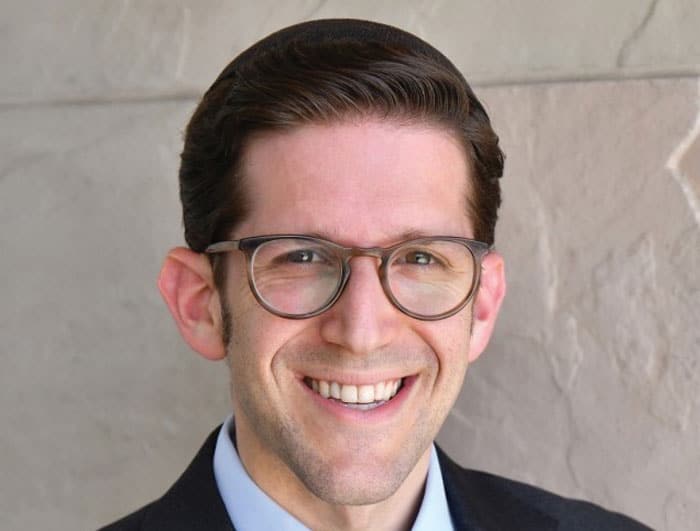
Gil Troy is a Distinguished Scholar of North American History at McGill University, and the author of nine books on American History and four books on Zionism. He is the editor of the new three-volume set, “Theodor Herzl: Zionist Writings,” the inaugural publication of The Library of the Jewish People (www.theljp.org).
After paying my dues for 20 years, I am calling it quits with the Authors Guild (AG). Begun in 1912, the Guild does vital work in supporting and protecting authors’ rights, from fair contracts to copyright protection and more. I have personally benefited from their services, including legal advice on a publishing contract and attending various seminars. But like most major cultural organizations and institutions today, the Guild has gone increasingly woke.
First among their stated principles on their website is the ubiquitous “Diversity, Equity, Inclusion, and Accessibility.” They promise “to elevate the voices of Black writers and other writers of color who have too long been suppressed.” But equity shoves equality and merit out the door. It imposes a preordained outcome through preferential treatment for a select group. I stand for equality of opportunity instead.
“Diversity” and “underrepresented voices” never seem to apply to writers like me — traditional, Shabbat-observant Jews, or traditional Christians, for that matter.
I also became fed up with the meaningless cliché of “diversity,” especially used among a group of writers, who should appreciate how important it is to use words with precision. In today’s cultural landscape, it’s laughable how many book, short story journal, and magazine publishers seek submissions from “diverse” or “underrepresented” voices when they really just mean “people of color” or those representing the rainbow coalition of sexual preferences. “Diversity” and “underrepresented voices” never seem to apply to writers like me — traditional, Shabbat-observant Jews, or traditional Christians, for that matter. (However, if you have an Orthodox-bashing memoir in the works, they’ll probably want to see your first fifty pages ASAP.)
AG programs have overwhelmingly featured authors talking about their careers from these communities that are increasingly narrowly defined.Eventually, I tired of never once seeing a single author whose path or story seemed relatable to me.
My tipping point, though, arose from the AG’s relentless alarmism over the issue of “banned books.” It’s true that many school boards and some state legislatures are ramping up efforts to keep certain books out of school and community libraries. The majority of the books targeted are sexually explicit LGBTQ memoirs and novels aimed at a youth audience. The memoir “Gender Queer” often requires parental consent for readers under eighteen. Some books are targeted for removal because they teach white guilt. (Maybe some books are removed because our kids increasingly can’t read, write, or do arithmetic, and some basic skills texts are needed instead.)
In fairness, the AG also opposes attempted book removals by the left, such as those targeting “To Kill a Mockingbird,” but in their written communications, they coyly omit the names of any of the sexually charged books most likely to be pulled from schools and the nature of the complaints against them.
Not allowing a book into a school or community library isn’t the same as “banning” it. These books are readily available for sale with two or three computer clicks.
Not allowing a book into a school or community library isn’t the same as “banning” it. These books are readily available for sale with two or three computer clicks. Many on the left actually love book bans, which are public relations bonanzas. Banned Books Week has been celebrated annually since 1982, and “brings together the entire book community — librarians, booksellers, publishers, journalists, teachers, and readers of all types — in shared support of the freedom to seek and to express ideas, even those some consider unorthodox or unpopular,” according to their website.
In response to an email I sent to the AG over my many frustrations with their policies, I was invited to Zoom with CEO Mary Rasenberger. For starters, I challenged the organization’s use of the word “ban,” which I felt was deeply dishonest. I was pleased that Rasenberger acknowledged that perhaps it wasn’t exactly the right word to convey the situation, and she agreed to raise my concerns at an upcoming meeting with board members.
I also wondered why the AG had shown no similar outrage when Abigail Shrier’s courageous book from 2020, “Irreversible Damage: The Transgender Craze Seducing Our Daughters,” was refused reviews; refused advertising space by Amazon; and yanked from the shelves at Target in response to two Twitter rants. The American Booksellers Association apologized for the “serious, violent incident” of sending a paperback copy of the book to members. Rasenberger said she decried any such efforts, but it was notable that she seemed completely unaware of this infamous situation. Perhaps efforts to cancel a writer with conservative views didn’t register on the radar, not considered any real threat to free speech.
I appreciated the chance to speak to the AG’s CEO, mollified to have been heard. Though she and I clearly have starkly different views on many cultural issues, talking is better than not talking, and doing so face to face, even virtually, is better still.
I don’t expect that my arguments will prompt any change in the organization’s policies. I expect that the Authors Guild will continue to march to the drum of Diversity, Equity and Inclusion (DEI). And I expect they will continue to celebrate the plethora of LGBTQ books targeted to young readers (a genre that publishers can’t get enough of). I doubt they will see or find distressing its possible association with the skyrocketing rates of kids who are questioning their gender and causing themselves and their parents deep anxiety, and in some cases, irreparable harm. I doubt they will see or find concerning the lack of titles for the millions of teens who identify as heterosexual and who have traditional religious views. These readers also crave understanding. They also deserve to see relatable literary protagonists on the page, perhaps now as never before.
It is like this throughout the journalism and publishing world, though I believe slivers of light are beginning to shine through. Wokeism is exhausting. More people like me are finally willing to make small (or big) breaks with cultural arbiters, saying: I’ve had enough.
Judy Gruen’s most recent book is “The Skeptic and the Rabbi: Falling in Love with Faith.”
I was sitting in the car with my husband Daniel when I had a sudden realization.
“Oh no,” I said, panicking. “I forgot to pack my laptop.”
“Good,” Daniel said. “You don’t need it.”
“But what about my work? What am I going to do? What if I miss something?”
“You can use your phone if it’s really urgent. But you need a break.”
We were on a two-day family vacation to San Diego. My husband and I work six days a week, and I have my laptop on me at all times, except for Shabbat. I was planning on getting some work done while on our trip, but now I couldn’t.
How would I go two whole days without my computer? After all, I was working on my computer the morning of my wedding. I was working while I was in labor and brought my computer to the hospital when I gave birth.
How would I go two whole days without my computer? After all, I was working on my computer the morning of my wedding. I was working while I was in labor and brought my computer to the hospital when I gave birth. I’d taken approximately 10 vacation days in 10 years.
I was feeling extremely anxious about not having my laptop with me. So, I did what I always do in moments of stress: I prayed.
“Hashem, please don’t let any work come in over these next two days,” I said in my head. “Let me enjoy this time with my family.”
I then looked at my two beautiful girls and my two cute dogs sleeping on the backseat and Daniel, my loving husband, and thought, this is what really matters. I braced myself for two days of fun.
And Hashem delivered.
We fed wolves frozen yogurt at the California Wolf Center, where our 3-year-old screamed “Doggies!” with glee and made our 10-month-old laugh her head off. We took adorable photos at a pumpkin patch and drank the best apple cider ever. We ate a delicious home-cooked meal with our friends in La Jolla and checked out the incredible kosher section at Ralphs. We rode kiddie rides at SeaWorld and went to a bubble show, which mystified my baby and got splashed by a gigantic killer whale, which made my toddler squeal with delight. We all slept together in the hotel bed and gave each other lots of kisses and hugs and we pet our doggies.
A few clients emailed me and I told them I was on vacation and I’d get back to them soon. I buried my phone deep in my bag and didn’t check it for hours at a time. I let the battery run out on purpose.
And I didn’t miss my laptop at all. I was having too much fun.
On the way home from our trip, my husband, daughters and I saw the gorgeous San Diego sunset and listened to Raffi songs together. We talked about the big whale at SeaWorld and the pumpkin my toddler picked out, and we finished the last of the apple cider. I sprayed the car with the lovely new scent I got at Bath & Body Works. Its name? Endless Weekend.
I realized that God put a mental block in my head so that I’d forget my laptop and could really enjoy myself. There is no other explanation for why I forgot it that time.
He knows what’s best for us. I certainly didn’t … but now I do.
The music of The Barry Sisters takes me back to a very specific memory. It was Pesach, I was about eight or nine, and my grandmother was leaning over a large pot of matzoh ball soup on the stove. I remember the smells vividly — fresh parsley, buttered potatoes and chicken slowly cooking in the oven. “Tumbala, Tumbala, Tumbalalaika,” my grandmother quietly sang under her breath, and suddenly, the memory became distinct. It became a place I could travel to when I needed to feel connected to Judaism and to my Jewish family. When I heard this song years later, the wave of sentiment and nostalgia was overpowering. When browsing through TikTok, I came across The Shvesters, Polina Fradkin and Chava Levi, two beautifully talented young Jewish girls who have taken the internet by storm by singing the Yiddish oldies — songs that take us all back to the Pesach kitchen. The first thing I told Polina and Chava upon meeting with them was that their renditions of “Rumania Rumania,” “Mein Yiddishe Momma” and “Hava Nagila” triggered a euphoria within me that I immediately had to share with all my friends. I sent their account far and wide on Instagram and TikTok, and similar nostalgic reactions flooded in from my followers.
“Yiddish music was prominent in my childhood as well,” says Polina. “At every event that my grandmother organized, she would strongly suggest which Yiddish song she wanted my siblings and I to perform.” Polina was born in Russia, the place her family had lived for centuries, and says that Yiddish music and Yiddish art in general connect her loved ones to the Old World, which for her relatives, is not that old at all. “My grandfather on my father’s side had this massive collection of Yiddish music that was in stacks all around his house,” Polina recalls. “When he got older and developed Alzheimer’s, the only thing that brought back his lucidity was when I sang to him in Yiddish. Suddenly, he would be there with me, singing along. That definitely strengthened my connection.”
Polina’s family left Russia far later than my family left Russia, in the 1990s rather than at the turn of the century. Yet they left for the same reasons: a rise in antisemitism, feelings of suffocation that came with being a Jew, and a desire to live the American dream. We discussed how the iconic klezmer-jazz music that The Shvesters recreate has a certain Diaspora-ness to it. It is reminiscent of the immigrant Jewish experience as our ancestors began to establish themselves. In that regard, the music is timeless. It does not matter when your family made the leap to the Golden Medina, they still clung to that which tethered them to the mother countries.
Chava came to join The Shvesters from her studies as a musician. Her interest in the specific new-Jew-in-America genre came after watching “The Marvelous Mrs. Maisel” and finding herself drawn to the quirks of the Jewish Upper West Side in the 1950s. Chava’s expertise contributed to the unique sound of The Shvesters, which Polina and Chava both say is a departure from the “shmaltzy, comedic” role that Yiddish now plays in American pop-culture. Today, Yiddish often exists for us to make fun of it, to lampoon the crabby Jewish mother or the forgetful zayde. Yiddish is a relic, the butt of a joke, slang within our traditional lexicon. But The Shvesters, in contrast, take their sound seriously. The harmonies are carefully balanced, the classical feel is prominent, and the language is precise. Polina muses that she and Chava must call her grandmother before going on camera in order to avoid any fatal mispronunciations when recording.
Their demanding work has paid off. “Absolutely Amazing as Always!” one commentator on TikTok writes under a Shvesters video. “You are treasures. Please never stop making music,” another reads. Others include: “This made me tear up,” “My mother’s favorite, I just got chills,” “My grandmother would love this,” and “Yiddish died in my family with my grandfather, I listen to your songs on loop to hear the language of my ancestors spoken four generations ago.” These comments are certainly an encouragement to keep going, Polina and Chava explain. They began to work with this music one evening when they were both very busy and living in Israel. The only live gig they’ve done together is a small show at Malan 18 in Tel Aviv, a night club with live music that closed shortly before the pandemic. And seeing these reactions, these heartfelt notes of love and thanks, has compelled them to stick with it.
“People who have a stronger connection to their background have a stronger drive to pass on what they received and make the future better.” – Polina Fradkin
Once Chava and Polina told me they began their creative journey in Israel, our conversation got a bit deeper. I asked them how they square their treasuring of Yiddish with their connection to a Jewish homeland, a Jewish homeland that speaks Hebrew, a divergence that created political turmoil at the time of Israel’s establishment and continues to divide Jews who value the aesthetic of a left-wing, anti-Zionist fetishization of Yiddish and the “new Jews,” those who gave up on the Old World. “If you don’t know where you come from,” Polina answers this question insightfully, “you’re not going to know where you’re going. People who have a stronger connection to their background have a stronger drive to pass on what they received and make the future better.” Polina adds that many years ago, Hebrew was the language of religion, but Yiddish was the language of lullabies, of lovers, of business, of life. It therefore still sparks intense emotions in Jews, and that is something to celebrate. Chava notes that Yiddish has a way of changing the Jewish perception of self, reflecting on the truism that individuals express themselves differently when speaking different languages. Yiddish is nostalgic, innocent and unique. Therefore, Jews the world over, no matter how Zionist they are, can still revel in it.
Next for The Shvesters is to continue with online content and to kickstart more live performances. They would love to participate in Klezmer festivals and one day to create an album with a full live jazz band. Polina wants to share a stage with Mandy Patinkin, who she was delighted to tell me has a Yiddish hits album. The “pie-in-the-sky” goal is to be featured on “The Marvelous Mrs. Maisel,” where the specific genre of music they recapture for the hearts and minds of our generation is on full display. “We want to create, and to bring back Yiddish Jazz” says Chava, as we are wrapping up our conversation. “It has definitely been lacking. When I listen to contemporary Yiddish music, I can’t help but think ‘oh what I wish I could change to make it feel more like you want to dance to it.’” The Shvesters do not just make us want to move our feet to Yiddish; their music makes us long for Yiddish. In an age when social media and fast-moving content flushes out connection to culture and to our ancestors, we all crave an opportunity to be back, at nine years old, in the kitchen at Pesach. It warms our hearts, it links us to our loved ones, and it inspires us to keep being Jewish. “We’re taking something that is dying to be back into the mainstream,” says Polina, “and bringing it into the light in a new, sophisticated, and exciting way.”
Instagram: @theshvesters
TikTok: @shvesters
Blake Flayton is the New Media Director and Columnist for the Jewish Journal.
When Rabbi David Block was younger, he took a strong interest in his synagogue, Young Israel of West Hempstead in New York. He’d go on Friday nights with his father and, as a teen, he was the gabbai for the teen and young adult minyan.
“I really loved it,” he said. “It was a quiet and beautiful minyan. The fact that there were opportunities for inclusion really helped me enjoy the experience and facilitate that experience for others.”
The minyan also provided him with some of the training he’d need many years later, when he became head of school at Shalhevet High School. There, he works with the leadership team to “help them cultivate their potential and an academically rigorous environment where students enjoy learning,” he said.
The school is Modern Orthodox, which means that students learn how to engage with the outside world while staying true to their Jewish religion and heritage.
“The Torah is meant to be a guidebook that teaches us how to live in the world and develop sincere, authentic relationships with God, the Jewish community, the entire world and ourselves,” Block said. “The world has inherent spiritual potential.”
According to the rabbi, there are challenges for every generation of teens, but today, the biggest struggle is the constant distraction of the outside world.
“I don’t look at the world like something that’s against us,” he said. “All social media can be used for beautiful and very positive things, but it can be quite distracting. It doesn’t allow us to appreciate the moments they’re in.”
Instead of focusing on the quick, fleeting moments of pleasure social media can give teens, Block tries to get them to discover how to nurture their happiness through their Judaism.
Instead of focusing on the quick, fleeting moments of pleasure social media can give teens, Block tries to get them to discover how to nurture their happiness through their Judaism.
“Helping students tap into spirituality can be challenging, because it takes effort, maturity and development,” he said. “How do we move beyond the temporary pleasure and into true happiness and wellness? That’s very difficult to do.”
Another issue that seems to be popping up over and over again is extremism, since we’re living in a highly polarized society.
“Teens are constantly thinking about their own identities and about who they are,” Block said. “They are particularly susceptible to holding onto an extreme view and not seeing much nuance.”
One of the ways the rabbi, and Shalhevet, combat that extremist thinking is to hold Town Hall, a weekly event where students and teachers gather and openly exchange ideas. They speak about topics like gun reform, health care and obsessing about college admissions.
“At our Town Hall, we are able to think about things in nuanced ways and have productive meetings with each other,” he said. “The conversations we’re having, the nuance we listen to and the beauty we’re tapping into are really unique.”
Block knows how important high school is when it comes to forming one’s Jewish identity. It was in his senior year of high school that he realized he wanted to work in Jewish education, and included in that was becoming ordained.
“I wasn’t sure whether I’d go into education itself or into a pulpit position,” he said. “But I got the feeling towards the end of high school that there was this depth of the Torah that I wanted to sink into. I wanted to go into a profession that would allow me to tap into Torah more and uncover that depth.”
After graduating from high school, Block went to Yeshiva University (YU) for undergrad, where he majored in Medieval Jewish History, and then he got smicha at Rabbi Isaac Elchanan Theological Seminary at YU. He worked at NCSY, a Jewish youth group, was a teacher at the Rambam Mesivta high school in New York and then a content and curriculum developer for Aleph Beta, which makes videos on Jewish teachings. He moved to Los Angeles and started at Shalhevet in 2016.
When talking about what he hopes to accomplish with his work, Block focuses on assisting students with cultivating the most important relationship in their life: the one with their Creator.
“I don’t want every student to have an identical relationship with Hashem, because then it’s not authentic,” he said. “I help them maximize the potential God gave them in the realm of all the relationships they have. The ultimate goal is to help students become their best selves.”
Fast Takes with David Block
Jewish Journal: What’s your favorite Jewish food?
David Block: Cholent. I love a good cholent with potato kugel.
JJ: How about your favorite food in Pico-Robertson?
DB: My favorite spot is Beverly Hills Thai. I get the pad see ew.
JJ: What extracurriculars did you do in high school?
DB: I played hockey, baseball and soccer. I spent a lot of time in NCSY and I was in the Rambam band, where I played music.
JJ: Who from the Torah really resonates with you?
DB: Yoshiyahu. I think his story is just breathtaking. My wife and I named our youngest son Yoshi.
The story of my seven-year-old mother at the airport in Baghdad has entered family legend. Before their departure, my grandmother Nana Aziza and my great aunts told her that she wouldn’t be allowed to take her jewelry to Israel. She reluctantly allowed them to remove her earrings, her necklace, her bangles and her anklets. But she was determined to hold onto her ring.
No amount of cajoling could convince her to take it off. She was adamant that it was her ring.
In May 1951, my grandparents made Aliyah to Israel. They packed one suitcase for themselves, my mother Shoham and her brothers David 6, Baruch 4, Kaduri 3 and Menashe 6 months.
When they arrived at the airport, there were two lines. My grandmother carried baby Menashe and walked with my mother to one line, my grandfather took the three boys to another. In the women’s section, two Arab women did a body search of my grandmother and checked Menashe’s diaper for smuggled jewels. They tore apart the baby’s bassinet. Then one of the women looked at my mother and said to my grandmother “Your daughter is wearing a ring.”
The woman refused to meet my mother’s eye and in angry defiance, my mother took off her ring and threw it at the woman.
My mother was born in the village of Al-Uzair, where my Nana Aziza’s father was the keeper of the Tomb of the Prophet Ezra, a shrine revered by the Jews and the Shiite Moslems, and where he had become wealthy by supplying the British Army. A few years later, my grandfather Aba Naji and Nana Aziza moved their family to Baghdad, where his family lived and where his father had been a respected doctor.
During Operation Ezra and Nehemiah, the nascent Israeli government airlifted 120,000 Jews from Iraq to Israel. They left one of the oldest communities in the Diaspora. They left the Tombs of the Prophets Ezekiel and Daniel. They left their synagogues and their businesses and their homes.
What do you do when you leave everything behind? You rebuild your family and you tell your stories to the next generation.
Now that my grandparents Nana Aziza and Aba Naji are no longer here to tell their stories it is incumbent on my generation to tell the stories.
My very talented cousin Sarah Sassoon has taken the story of my family leaving Iraq and woven it into a spellbinding tale, “Shoham’s Bangle.” Published by Kar-Ben Publishing and beautifully illustrated by artist Noa Kelner, this children’s book captures the sadness of leaving a home and the importance of remembering where we come from.
Like my mother, the Shoham in the book has to give up her favorite piece of jewelry, her gold bangle. The bangle that joins Nana Aziza’s many bangles to “make clink-clanking music when we chip-chop garlic and onions.” That cuts “perfectly round date cookies when we bake.” That “glitters golden in the sun when we pick figs from our garden.”
Before their departure from Iraq, the grandmother in the book bakes pita khibezz for the family to eat upon their arrival in Israel. She tells Shoham that it is like the matzoh that the Israelites baked in Egypt.
To find out about the wonderful surprise of Shoham’s Bangle, you’ll have to read the book.
—Sharon
I call Sharon’s cousin Sarah the smart girl. Whenever I am in Jerusalem, we meet up at her favorite coffee shop, Kadosh on Rechov Shlomzion HaMalka. When she published her beautiful children’s book “Shoham’s Bangle,” I was inspired to bake pita like Nana Aziza in the book.
Over the years, I have baked all kinds of breads. I have mastered the art of Challah. During COVID, I played around with sourdough, so that I could be like the cool kids. I have made Southern style biscuits and English scones.
Sharon’s Nana Aziza called pita by the Arabic name khibezz. I have made Moroccan khubz.
How hard could this be?
Sharon’s Nana Aziza called pita by the Arabic name khibezz. I have made Moroccan khubz.
The recipe for pita is super simple. The recipe is basically four ingredients and making the dough was very simple. Even forming the pita wasn’t a problem.
But to my disappointment, the pitas didn’t rise. (Only a few did, which was very exciting!) The pita tasted great. It was soft and fluffy but it didn’t have that nice pocket. This was more of a dipping bread. Sharon and I made a wonderful board with hummus and we all enjoyed the pita with the yummy black olive tapenade, green olive tapenade and artichoke tapenade that were so generously sent to us by Elyon Gourmet.
A little later, I went back to the drawing board to find out why my bread wasn’t as successful as I would’ve liked. I decided it was the yeast, definitely the yeast. It didn’t bloom properly and get all foamy. I had assumed that my kitchen was too cold that morning, but I should’ve known and thrown the yeast away and opened a new package.
I decided to give it another try and yes, this time the yeast bloomed and my pita blossomed.
Maybe you’ll have time to bake some soon.
—Rachel
Pita Recipe
1 tablespoon yeast
1 ¼ cups warm water
1 teaspoon salt
3-3 ½ cups flour
Preheat oven to 425°F.
In the bowl of a stand mixer, dissolve yeast in water and let stand for about 5 minutes.
Add salt and 1½ cups flour, then use the dough hook and beat to form a batter.
Add the additional flour until a rough, shaggy dough is formed.
On a floured surface, knead for 5 minutes until dough is smooth and elastic. If the dough is too sticky, add a little more flour.
Divide the dough into six pieces for large pitas or ten for smaller pitas.
Form dough into balls, then flatten with a rolling pin into ¼ inch thick discs. Using the palm of the hand works well.
Make sure the dough is an even thickness as this is what helps the pita “puff’.
Allow the pita to rest on lightly floured counter, covered with a tea towel for 30 minutes until slightly puffed. With a large spatula, flip the rounds of dough upside down on to a baking sheet.
Bake 10-15 minutes until pita is a light golden color.
Store at room temperature in a Ziploc bag for up to two days or in the freezer for a month
Rachel Sheff and Sharon Gomperts have been friends since high school. They love cooking and sharing recipes. They have collaborated on Sephardic Educational Center projects and community cooking classes. Follow them on Instagram @sephardicspicegirls and on Facebook at Sephardic Spice SEC Food.









 Before their departure from Iraq, the grandmother in the book bakes pita khibezz for the family to eat upon their arrival in Israel. She tells Shoham that it is like the matzoh that the Israelites baked in Egypt.