

fbpx
[additional-authors]
November 10, 2022
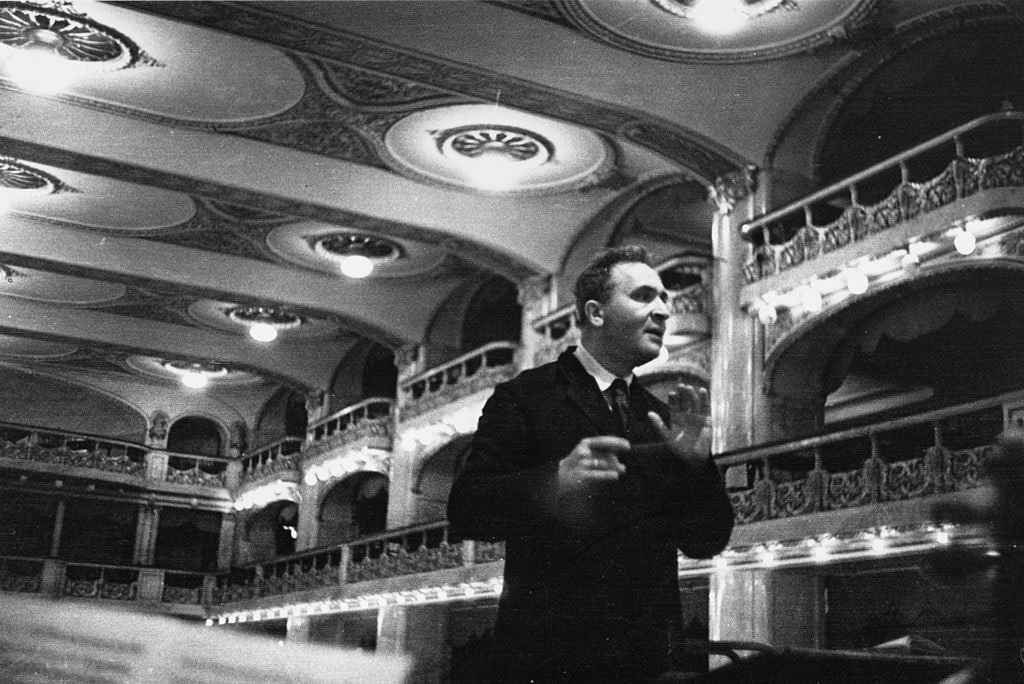
Bruno Walter (1876 – 1962), conducting the Czech Philharmonic Orchestra in Prague. (Photo by Erich Auerbach/Getty Images)

It was not his ability to inspire people with interpretive comprehension that made Bruno Walter

a great conductor, but his faith in music — especially of Mozart and of Mahler! — he loved to conduct,

abandoning the religious faith from which he, just like Mahler — professionally pragmatic — had converted.

Olin Downes, a major New York Times affiliated music critic,

identified in this quite unobservant Jew a quality that is semitic:

deep faith, a quality required from all rabbis who instruct

their followers by faithful concentration on their sacred literature, making efforts most concerted

to broadcast what they might interpretively comprehend to Jewish homes, which act both as their pulpit and their altar.

David Allen writes in “Bruno Walter, a Conductor Who Found Truth Through Beauty,” New York Times, 11/2/22:

Truth can be repulsive,” Bruno Walter, a conductor whose life had taught him that fact all too well, once said. “But Mozart has the power to speak truth with beauty.”

If there was one composer that Walter, who was able to make beauty from truth like few others until his death in Beverly Hills in 1962, was most associated with during his career, it was that Viennese master; the story of Walter’s life, the conductor said, could be told as “the history of the development of a love for Mozart.”

Writers often dignified Walter with spiritual metaphors — the author Stefan Zweig compared the beam on his face while conducting to “the countenance of the angels when they look upon God” — and it is revealing of his artistry that they were exactly what Walter aspired to achieve. For him, the Germanic music from Bach to Strauss was pure, uplifting, redemptive. It offered an “unchanging message of comfort,” he wrote in his memoir “Theme and Variations”; its “wordless gospel proclaims in a universal language what the thirsting soul of man is seeking beyond this life.”

His authority, lightly worn, came not from technique or intellectual heft, but from “his love and his faith,” the New York Times critic Olin Downes wrote after a concert with the Philadelphia Orchestra in 1946. “Love, and not merely interpretive comprehension of what he is playing. Abiding faith in the music he represents.”

Gershon Hepner is a poet who has written over 25,000 poems on subjects ranging from music to literature, politics to Torah. He grew up in England and moved to Los Angeles in 1976. Using his varied interests and experiences, he has authored dozens of papers in medical and academic journals, and authored “Legal Friction: Law, Narrative, and Identity Politics in Biblical Israel.” He can be reached at gershonhepner@gmail.com.


Did you enjoy this article?
You'll love our roundtable.

Editor's Picks

Latest Articles

A Tunisian Tuna Delight

Over the years I had heard so much about this classic Tunisian tuna sandwich and, boy, did it live up to the hype.

A Bisl Torah ~ Good Notes

The loving, kind, compassionate, patient facets of our soul and likewise, let them lift up, and illumine from within.

Unfinished Business: A Dream Realized

Two weeks ago, I had the tremendous honor of joining approximately 500 African American pastors and community leaders on a special mission to Israel. The trip was transformative and cause for optimism.

Put Not Your Trust in Princes

The wins, whining and weaknesses of those under his direct command is the subject of renowned historian and member of England’s House of Lords Andrew Roberts’ new book, “Napoleon and His Marshals: Victory, Rivalry, Betrayal,” his second on Napoleon. 

From Struggle to Song

The Jewish people carry the name Israel because struggle is woven into our DNA. Yet struggle is not our destination.

Being the V’

Frankly, being Jewish isn’t exactly an easy lift. But, with the right mindset and some help from friends across all ages, we can do it.

Eisenkot’s Hard Choices

The most important question in Israel is no longer whether Gadi Eisenkot will break a campaign promise to become prime minister. The question now is which promise he will break to get the job.

The Only “Ethnostate” Abdul El-Sayed Opposes

El-Sayed’s rule is this: Pakistan may stay an Islamic republic, Egypt may keep Islam in its constitution, and a future Palestine may define itself as Arab and Muslim. Only the Jews must give up the one state they have.

More news and opinions than at a Shabbat dinner, right in your inbox.






























