fbpx

November 10, 2022

Another Failed Test – A poem for Parsha Vayera

Drive out this handmaid and her son, for the son of this
handmaid shall not inherit with my son, with Isaac.
-Genesis 21:10

Think of what might have been
had Abraham not sent Ishmael away.

Stones not thrown
in the place where they
keep throwing stones.

Where borders keep changing
and no one agrees what they are
anyway.

Where sweet and salt
mix together like water springing up
out of the desert.

Both sides of the river, forever
everybody’s inheritance.

A father and a son
not separated.

A handmaiden who carried a son
taken care of as she should have been.

Maybe they wouldn’t be hanging
words of hate over the 405 Freeway?

I think of the unrepairable mistakes
I’ve made that reverberate throughout
the decades of my life.

This one’s up there.

My heart still weeps for everyone
I’ve treated like Ishmael.

I open my tent, like Abraham,
and pray the long-lost
will come home.


God Wrestler: a poem for every Torah Portion by Rick LupertLos Angeles poet Rick Lupert created the Poetry Super Highway (an online publication and resource for poets), and hosted the Cobalt Cafe weekly poetry reading for almost 21 years. He’s authored 26 collections of poetry, including “God Wrestler: A Poem for Every Torah Portion“, “I’m a Jew, Are You” (Jewish themed poems) and “Feeding Holy Cats” (Poetry written while a staff member on the first Birthright Israel trip), and most recently “I Am Not Writing a Book of Poems in Hawaii” (Poems written in Hawaii – Ain’t Got No Press, August 2022) and edited the anthologies “Ekphrastia Gone Wild”, “A Poet’s Haggadah”, and “The Night Goes on All Night.” He writes the daily web comic “Cat and Banana” with fellow Los Angeles poet Brendan Constantine. He’s widely published and reads his poetry wherever they let him.

Another Failed Test – A poem for Parsha Vayera Read More »

The Danger of Celebrity Influence on My Fellow Teens

In 2019, I wrote a cover story for the Jewish Journal about the effects of social media on teens. The article discussed how social media often affects our self-esteem because it creates feelings of exclusion or a fear of missing out (fomo!). Acknowledging that it is difficult to simply disconnect, and understanding that a lot of what is put on social media is just for show, I resolved to balance the best of social media with actual real-world engagement.

These days, when I’m with friends or family, I ask everyone to put their phones in a pile so we can all have real conversation. In fact, although I do succumb to watching TikTok videos when I’m bored, I have become the least obsessed phone-user in my family. 

While reducing my screen time was a big step for me, I am realizing now that the feelings of isolation and exclusion that can result from social media are only part of the problem. A far bigger issue is the prominent role social media plays in disseminating disinformation and misinformation.

Disinformation, of course, is planting false information online. With little or no barriers to entry, anyone can post anything. Sometimes the sources of disinformation make it appear as though they are legitimate news sources, which increases the likelihood of people reading and disseminating it. When readers, not knowing the information is false, repost and share, misinformation spreads. Online “friends” and followers often spread it further. This is especially true when the misinformation aligns with someone’s predispositions. 

Most people my age consume their news and information from online sources, such as Instagram and TikTok, and many are strongly affected by social media influencers, including celebrities such as Ye (the rapper formerly known as Kanye West). This gives disproportionate power to those with the largest platforms, even if they may be misinformed or intentionally spreading hateful rhetoric themselves. 

Influencers can convince their followers to adopt certain political positions or, even worse, racist ideas. These positions often change depending on what is trendy or popular in the moment. At the start of the pandemic, for example, hate was expressed toward the Asian community, based exclusively on misinformation. Currently, people like Kanye West and Kyrie Irving spew antisemitism. 

These two cultural figures have a great deal of influence on the public and their words affect millions of people. Kanye alone had over 30 million followers at the time of his rant, and there are only 14.8 million Jews in the world. In fact, many of Kanye’s followers were influenced by his words as evidenced by their outrage when Adidas cut ties with him.

In an already divided world, it is alarming when “influencers” use their enormous platforms to open the floodgates of hate.

Reading the antisemitic social media comments was frightening, but seeing a banner agreeing with Ye on the 405 freeway took it from online rhetoric to real-world action. In an already divided world, it is alarming when “influencers” use their enormous platforms to open the floodgates of hate.

Further, thousands of #IStandWithIrving and #FreeKyrie tweets have been posted in Irving’s defense after Kyrie publicly promoted a documentary with blatant, antisemitic disinformation. The fact that both celebrities have been “canceled” to a certain extent is one thing, but their words and the fact that they both doubled down on their beliefs have affected the opinions of millions of young people. While it is to be expected that extremist groups are celebrating, many mainstream teens are using these incidents to forge their own viewpoints about the Jewish community. The fact that Kanye’s tweet seemed to empower Irving also proves the point that once a high-profile celebrity promotes disinformation, others are inspired to join in, creating a snowball effect of hateful content. Although some celebrities spoke up against Kanye and Kyrie, those voices were largely offset by the online hate.

While this is daunting, the takeaway is that if social media is your main source of information, make sure to investigate everything that you read, both the veracity of the information and the credibility of the source (and understand that even many credible sources are still skewed to affect public perception). Most importantly, think for yourself, remain open-minded, and do not take someone’s words as truth just because they happen to be famous.


Riley Jackson is a high school student in Los Angeles. She is the founder of Driving With Daisy, a charity that supports underprivileged children. 

The Danger of Celebrity Influence on My Fellow Teens Read More »

This is Our Revenge

I have been to many Jewish weddings, but never have I seen such pure abandonment and unbridled joy as I experienced when Sara Krakowski and Ryan Kossoy tied the knot in New York recently. Neither have I been to a wedding where the Shoah took center stage. One might assume that such darkness would have no place at a time of celebration, but as I discovered, being reminded of the past is sometimes the best way to look to the future.

Under the chuppah, as the bride and groom exchanged rings, Chief Rabbi of Israel emeritus, Meir Lau, recalled for the bride that he and her grandfather, Israel Krakowski, had survived the Shoah together. He spoke of the fact that the two of them, along with her beaming father Harry Krakowski, who at the tender age of eighteen was its first donor, had helped to found the American Society of Yad Vashem.

As Rabbi Lau spoke surrounded by the white roses and orchids that adorned the chuppah, it did not seem out of place when he talked about the murder of their ancestors. The point was clear, seventy-seven years after the end of the Shoah, the Nazis are long gone, but we were all there to celebrate a new Jewish family being formed. If there was ever an act of revenge, this was it.

Although the principle of an “eye for an eye” appears to promote revenge in Jewish Law, the act of taking revenge is prohibited in the Torah (Leviticus 19:18). The concept of an “eye of an eye” is to provide a means for the justice system to balance restitution, not an invocation for violence. But taking revenge and having revenge are very different. No one in the Krakowski family set out to avenge the deaths of their family members by physically attacking German people. Maimonides describes taking revenge as an extremely bad trait and urges those who have been wronged to rise above their feelings about all worldly matters.

Israel and Elli Krakowski had been severely wronged. There was no legal mechanism to seek justice for the murder of their families. They had no means to carry out physical revenge even had they wanted to. Their only pay back to the people that destroyed their family was to create a family; the answer to the destruction of their home was to build a home; their answer to financial ruin was to work hard for economic security. They rose above the ideology of hate, and with love they answered death with life.  

They rose above the ideology of hate, and with love they answered death with life.

Father of the bride, Harry Krakowski, is a placid, fun-loving mensch of a man, always thoughtful in the moment. The dancing was well into its second hour, when Harry took the microphone, cleared the dance floor and invited the four Holocaust survivors present to share a blessing for the guests. Some 600 people stood to their feet as the festivities paused in baited silence. It was a moment of awe and reverence. Each of the survivors Rabbi Meir Lau, Jerry Wartski, Sam Domb, and Bob Desau summed up the moment: Hitler had tried to wipe us all out, but we are still here, still living, still dancing. In a few brief sentences they passed an unseen torch of memory and identity to Sara and Ryan, part of the next generation of Jews, who will themselves, pass that torch along.

L’dor v’dor, from generation to generation, reminds us that Jews have thrived through the ages in spite of the evil and persecution that have come their way. Indeed the Jewish people have succeeded like no other group I know when it comes to passing the torch from one generation to the next. But as the last survivors of the Shoah leave us, there is no time in Jewish history when this torch matters most. The light was nearly snuffed out. It is now our responsibility to keep it brighter than ever before.

As the band started up again we danced with the four survivors at the center of the circle, who despite their age pulled off remarkably agile moves. If only Hitler could see them from his place in hell, exuding the very life he had tried to extinguish still living, dancing, celebrating. This is their revenge—and our heritage.


Stephen D. Smith is CEO of StoryFile and Executive Director Emeritus at USC Shoah Foundation.

This is Our Revenge Read More »

Going Gray—Gracefully?

When I left New York to move to Los Angeles in 1982 I was sad. No more newsstands on every corner, no more filthy subways, no street hot dogs with mustard and sauerkraut. But when I said good-bye to my hairdresser—someone with whom I expected to grow old—I was desolate.

When it comes to hairdressers, I prefer a long-term relationship. There is something so intimate about sitting in that chair and staring at yourself in a mirror while a man handles your hair that I can’t bear switching. Plus, why run the risk of a terrible haircut? Hair may grow back, but who wants to sit around and wait?

After a few false starts, I found my ultimate LA hair man on Sunset Plaza in West Hollywood. My literary agent handed me Bob’s phone number as if it were a state secret. As soon as I set foot in his cozy modern salon, I felt comfortable. He had a low-key charm and just enough Italian flair to make my heart pump. He was efficient—as soon as one gorgeous client left, the next slid into his seat for her Bob time. Before we could begin our first visit, he hustled me out to the parking lot to see how my chestnut brown hair looked with sunbeams bouncing off the top.

“I’ll need to color your grays or we shouldn’t get started,” he said with a straight face once we were back in the salon. Even though at 35 I had not even noticed those errant strands, I quickly agreed. Over the next 20 years, Bob did a great job of keeping my hair in line. Together we went from feathery blonde highlights that he artistically painted on with a brush—total coloring time 30 minutes—to me sitting in his chair for half a day with tin foil radiating from my head like a bad science experiment as he helped me bravely battle the clock.

The fact is I enjoyed our time together. Bob was smart, we shared an obsession with restaurants, plus my appointments gave me an excuse to stop at the original Jewish Chinese, Chin-Chin for take-out. Sadly, it all ended when Bob packed up his scissors and retired to Calabria, where he could sit in a café sipping espressos rather than stand all day.

By the time I hooked up with my next hairdresser the hair was starting to present more challenges. Not only was it galloping towards total grayness, it was also thinning and the chemicals were turning the texture to hay. Priorities had switched in my mid-fifties. As much as I still cared about my looks, free time was at a premium. When a local mom introduced me to my next hairdresser, or Bob 2, I fell in love with his location, a ten-minute walk, no parking. I chose to overlook his odd demeanor and mercurial temperament. Sure I squirmed when he bragged about his intimate relationship with Sharon Stone or made me wait 30 minutes while he fussed with his toupée. But he gave a good haircut and I wasn’t interested in shopping around.

Our problems began ten years later, when I started to question the wisdom of aggressively attacking the grays with a pasty brown goo that sat on my head for close to three hours every six weeks emitting toxic fumes. The resulting flat brown color created a disconnect between my sagging jaw line and what was happening on top of my head, and inside my brain. If I waited a minute past six weeks, I grew the white fringe of a medieval monk, not a good look.

When I opened the topic of going natural, Bob 2 slammed me. “You will look terrible and your career will be over,” he said with absolute certainty. Wow, I thought for a second. I knew it was time for a break-up.

The search for a new hairdresser began with one requirement—he/she had to be open to  having a conversation about going gray. When a friend told me that her female hairdresser’s method was to listen to what you want, then do it with precision and Zen-like calm, I booked an appointment. I was tired of the theatricality of moody men.

Within five painless months, my short hair was totally bright white gray. Or platinum as she called it. My resemblance to my mother was astonishing.

“All the cool young girls are trying to get this look,” she told me, “but it’s difficult and expensive to strip the hair of its natural color before adding the silver.”

“Too bad, my pretties,” I cackled to myself. Then I kept on aging with my perfect hairdresser by my side.


Los Angeles food writer Helene Siegel is the author of 40 cookbooks, including the “Totally Cookbook” series and “Pure Chocolate.”  She runs the Pastry Session blog.

Going Gray—Gracefully? Read More »

50-year Partnership Between HUC and USC Renewed

The 50-year partnership between Hebrew Union College-Jewish Institute of Religion (HUC-JIR) and the University of Southern California (USC) has been renewed for the next 25 years. 

“This partnership models our shared values of diversity and inclusion through the participation of students of all faiths and backgrounds and helps build a strong foundation of mutual understanding and respect among future leaders of society,” HUC-JIR President Andrew Rehfeld said. “The renewal of our partnership for another 25 years is an historic step forward for both our institutions.”   

On September 12, USC President Carol Folt and Rehfeld commemorated the partnership at a gathering of these institutions’ Trustees, Governors, alumni, supporters, community partners, faculty, administrators and students.  

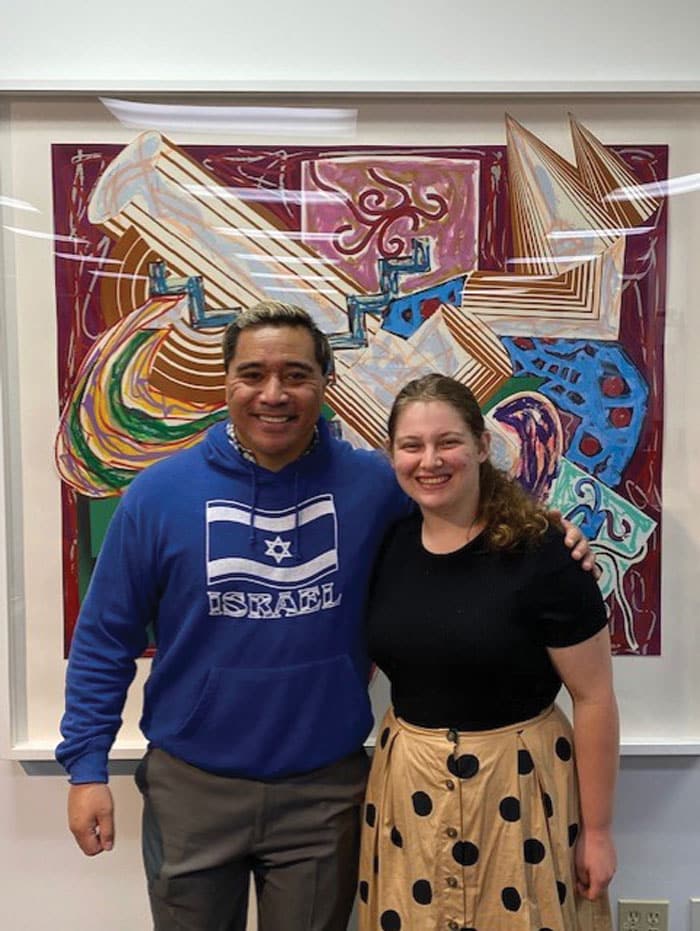
Sione Kefu and Shelby Chickman, Jewish studies majors who graduate in 2022 (Photo courtesy Louchheim School for Judaic Studies at USC)

“It is an honor to celebrate the great vision that led to this partnership, the work of so many who have contributed to it over the years, our shared history and our continued responsibility to educate future generations in Jewish studies and to build a better and more just future,” Folt said.  More than 650 USC students of all faiths and backgrounds participate each year; more than 50 HUC faculty and more than 20,000 USC students have taken part over the years. 

HUC-JIR-taught courses include Hebrew language, Jewish history, the Holocaust, Israeli society and literature and religious studies. Founded in 1875, HUC-JIR is North America’s leading institution of higher Jewish education and the academic, spiritual and professional leadership development center of Reform Judaism.

“From the student perspective, the collaboration is seamless,” Dr. Leah Hochman, director of the Louchheim School for Judaic Studies, told the Journal. 

USC students take Jewish studies classes at USC, receive USC credit and earn USC course requirements. 

“That level of integration is a real blessing that developed out of the longevity of the arrangement between the schools,” she said. ”From the faculty perspective, it’s a complete blast to teach both in a secular institution of higher learning and a seminary focusing on training clergy, educators and non-profit managers. No two conversations ever repeat.”

Hochman looks forward to bringing people from each institution who do not yet know each other together. 

“There is such a wealth and depth of knowledge and curiosity at each place; I think the collaborations — in terms of classes, projects, community-wide programming, trainings and more — are exciting to anticipate,” she said.

When asked what he was most excited about collaborating on, Dr. Joshua Holo, dean of HUC-JIR’s Jack H. Skirball Campus in Los Angeles, said that there were too many to list, but specified “Stronger than Hate at USC” of the Shoah Foundation, the Casden Research Seminars and their numerous degree programs.

“Overall, I’m most excited about the combined collaborations that leverage the remarkable power of all our various units.” – Dr. Joshua Holo

“Overall, I’m most excited about the combined collaborations that leverage the remarkable power of all our various units,” Holo told the Journal. “We just produced a joint event with USC Hillel and the Casden Institute for the Study of the Jewish Role in American Life, in which we heard a riveting lecture from the great-grandson of Eliezer ben Yehuda, the man credited with reviving the Hebrew language around the turn of the 20th century.” 

The audience of more than 100 people included graduate and undergraduate students, faculty and visitors from HUC, USC and beyond.

“HUC’s relationship with USC represents one of the richest, longest-standing and most productive institutional relationships of its kind, in which we feel tremendous pride,” Holo said. “It represents a complementarity of academic strengths for our students, neighborly opportunities for shared programming and constant enrichment for our combined faculties in Jewish Studies and allied fields. I’d be hard pressed to imagine a more gratifying academic and institutional relationship.”

The HUC-USC relationship provides academic engagement for both institutions, the sharing of faculty expertise and research partnerships across disciplines, and enriched educational opportunities for undergraduate and graduate students.  

“Fundamentally, our partnership works so well, because we each bring distinctive gifts to a common goal, that is, excellent higher education,” Holo said. “Our complementary faculty live in a world of shared ideas and commitments, not only teaching with a view toward rigor and enrichment, but also exchanging ideas amongst ourselves for the development of our own research, which spans Jewish languages, history, literature and sociology and more.”

Institutionally, the leadership of HUC and USC have sustained close relationships, generation after generation, he said. Thus, embedding their shared purpose.

“The history of the partnership is fascinating and it is intertwined with the development of that part of Los Angeles,” Hochman said. “Continuing the partnership underscores the creative energy at both institutions as they each support Jewish studies on campus and the students who engage in it.”

50-year Partnership Between HUC and USC Renewed Read More »

Thomas Keneally on 40 Years Since Writing ‘Schindler’s Ark’

On October 18th, the book that led to arguably the most acclaimed non-documentary Holocaust film of all time, “Schindler’s List,” turned 40.

Before there was a film, there was a book, originally titled “Schindler’s Ark.” And before there was the book, there was a chance encounter between author Thomas Keneally with Leopold “Poldek” Pfefferberg (otherwise known as Leopold Page) at Pfefferberg’s Beverly Hills luggage bag shop. 

“I was saved, and my wife was saved, by a Nazi. I was a Jew imprisoned with Jews,” Pfefferberg told Keneally that day in 1980. “So a Nazi saves me and, more important, saves Misia, my young wife. So although he’s a Nazi, to me he’s Jesus Christ. Not that he was a saint. He was all-drinking, all-black-marketeering, all-screwing, okay? But he got Misia out of Auschwitz, so to me he is G-d.”

And now, 40 years since the story of Oskar Schindler hit bookshelves, Keneally spoke with the Journal from his home in Sydney, Australia to reflect on the impact of the book over the past four decades.

Several times in our conversation, he says a variant of, “that’s my excuse for being a dumb Irish Australian,” and “I didn’t know what I was doing, I was a dumb goy stumbling into Poldek’s store in Beverly Hills.” 

He was 45 at the time he met Pfefferberg, and even at 87, he can only humbly accept his own place as the messenger of horror and history. Several times in our conversation, he says a variant of, “that’s my excuse for being a dumb Irish Australian,” and “I didn’t know what I was doing, I was a dumb goy stumbling into Poldek’s store in Beverly Hills.” But Keneally is keenly aware of the impact he had by taking up the story of how Oskar Schindler saved 1,200 Jews. 

“The most wonderful thing that is beyond my merits as a writer, I just happened to be a dumb gentile, a former student of the priesthood who had met Poldek and read prisoners’ reactions to Schindler,” Keneally told the Journal. “And I thought this is wonderful, this shows that the virtuous man is not always the man who will [deliver] you — the spirit of beneficence can breathe in unlikely situations. And that is an enduring enlightenment. And also that sense of real people whom I got to know very well and who were no different fellow homo sapiens, the mystery of why they were pursued.”

In 2007, Keneally published the book “Searching for Schindler” about the process of learning, researching and writing “Schindler’s Ark,” and of course its adaptation into the Academy Award-winning film “Schindler’s List.”

Keneally still recalls in detail the encounters he had with Schindler Jews and their descendants during the two years he spent writing the book, and in the 40 years since it was released. He speaks of Ryszard Horowitz, possibly the youngest Auschwitz survivor. He also shares stories about Leosia Korn (known as “Lucy’s Story” in “Schindler’s List”) who moved to Australia following World War II. 

In “Searching for Schindler,” Keneally wrote, “The Korns’ immigration story was a little like Leopold and Misia’s. When they arrived in Sydney postwar, they had been amazed to discover that the chief sectarian fight was not between Gentile and Jew but, at that stage, between Catholic and Protestant. ‘I said to a friend,’ Leosia told me, ‘here the Catholics are the Jews!’ Australians, who with unabashed xenophobia labeled all foreigners w—s, did not discriminate between Polish Catholics and Polish Jews, and abused them both with equal ferocity. Equality at last, thought the Korns.’”

But in writing “Schindler’s Ark,” Keneally could see how the moral ambiguity and puzzlement that the story of Schindler, an ammunition supplier for the Nazis, could bring people. As he dug more into the story, he wondered, what motivated Schindler? He was a womanizer, a drunk, and shifty businessman who wanted to be rich.

Keneally said that Schindler “wanted to be rich, but he didn’t want to be rich and stand on a heap of corpses and be rich.” 

Keneally said that Schindler “wanted to be rich, but he didn’t want to be rich and stand on a heap of corpses and be rich.” 

The story is more complicated and nuanced than that, as can be ascertained by reading Keneally’s books or watching Steven Spielberg’s film. And that is something that Keneally wants readers to remember about the story — that the details are delicate and deep.

“No one forgets the story [in the film “Schindler’s List”] of the little girl in red or the little boy who threw himself in the latrine — both are true and both are terrible and daring,” Keneally said. “However, it makes you realize what those millions went through. So that is the genius, the implicit genius, in the Schindler story that I didn’t make up, that I inherited, that I could have only messed up because there’s always a danger, no matter how good the story, a narrator — either film or text — will mess it up.”

The weight of the story was a lot for Keneally to carry before writing “Schindler’s Ark.” 

“I was just a novelist from the Antipodes fascinated by a story, and my early claim was I couldn’t write it,” Keneally said. “Why? Because I didn’t know many Jews.” 

His father served in the Royal Australian Air Force in World War II in North Africa and the Middle East where he told stories of cordial interactions with Jews. Following the War, Jews in Australia settled in two areas, neither of which were where Keneally lived. He was still fascinated by the history of Judaism and the various sects from antiquity. Keneally enjoyed books by Mordecai Richler, and his favorite writer was Saul Bellow. He still smiles at the mention of his adoration of Mel Brooks and Billy Crystal. 

Regardless, Keneally still buckled down and wrote his most famous and important work, “Schindler’s Ark,” while splitting his time between a Sydney library and a room of a house overlooking Bilgola Beach. 

The book’s title was changed by Simon & Schuster to “Schindler’s List,” after fears that “Ark” could be offensive, with imagery of Noah and animals being led two-by-two. But Keneally said that “Ark” had a different meaning, that “there was an Ark, a rough Covenant between Oskar, the black-marketer, and his Jews,” Keneally said.

In our conversation, Keneally offered many stories of the long-term impact of the book. One was how it helped open conversations between generations of Holocaust survivors and their descendants. 

“So many Jewish, youngish — about your generation, or maybe in their 50s — come up and say in America and all over the world, ‘My father or mother didn’t speak about the camps until the Schindler phenomenon,’” Keneally said. “And insofar as I’m responsible for a small bit of that, I had no idea that this would be the result of my work. And this is incredibly gratifying that they were able to make peace with their children about what they went through, which they thought would either burden their children or give them a negative concept of the human race.”

Thomas Keneally on 40 Years Since Writing ‘Schindler’s Ark’ Read More »

A New Pair of Eyes

For the first time in over 22 years, I pushed a baby in a stroller on Shabbat. And boy was I proud to be pushing. Why shouldn’t I be proud? It was my 2-year-old grandson, Ben. The night before, he had slept over, so it was my job to take him to Shul to hand him off to his parents.   After clicking him into his crisscross safety harness, he looked like a Formula 1 driver about to take off at 200 miles an hour.  And by the way, when I was growing up, my parents were poor and did not own a stroller, so they would just drag me by a leg.

So I’m pushing Ben at a brisk 1.3 miles per hour, trying extremely hard to avoid all bumps and cracked sidewalks. If he feels the slightest thump, I might get yelled at like I was a 19th century Shanghai rickshaw driver. “Zayde, no bumps. No bumps, Zayde!”  There goes my tip.

On our walk, like the unpaid tour guide that I am, I like to point out things he might like. “Hey Ben, there’s a kitty cat. What sound does a kitty make?” 

“Meow.” 

“Yup.” 

Then, running into a friend, my friend says, “You know how I know that’s your grandchild?” 

“Because I’m 68 years older than him?” 

“It’s the smile on your face,” he says.

We smile because we know we’re giving the grandkids back at the end of the day, and we smile because we are grateful for every minute we’re still alive to have these moments. 

When parents are not looking bewildered and exhausted, they will occasionally smile. But it’s nothing like a grandparent smile. We smile because we know we’re giving the grandkids back at the end of the day, and we smile because we are grateful for every minute we’re still alive to have these moments. We smile because we have more time to see the miracle.

If you’re open, grandchildren bring many gifts. With each new grandchild, a new heart chamber filled with love can break open.  Also a new set of eyes and sometimes a new lease on life is there for us.  How could we not smile?

Back to our journey that Shabbat.  I’m walking him close to the bushes because I know he likes running his hands along them.  Then, out of the corner of my eye, I spot a tiny flower. The top is roundish and has six or seven explosive bright colors.  I’ve been walking this route for years and I never saw this flower before.

So excited and forgetting it was Shabbat (you’re not supposed to pluck), I plucked. “Here Ben, give this to your mommy.”  He quickly brings it to his lips and proceeds to blow on it.  I’m not sure, but it’s possible he was making a wish. Just like big people, 2-year-olds also wish for things.

Each time he blows on the flower, another petal or two would fly from its stem into the air — then  float down like magic dust.  He keeps blowing and blowing ’til he’s left holding nothing but stem.

Now at Shul, we go up to childcare where we sit on the floor and play. Not easy sitting on the floor with sciatica. Me, not him. I try getting him to play with other kids, but he won’t have it. Instead, he rests his head in my lap and holds me tight. He does not want his Zayde to leave him. I oblige. No worries, you’re safe with Zayde.

Then he looks up at me and starts to ask for his momma. “Momma, momma, momma.” I notice a few tears rolling out. He misses his momma. He wants his momma. He continues, “Momma, momma, momma.” I try soothing him by rubbing his back. 

“She’ll be here soon.”  Soon means nothing to a little boy. 

He continues on, “Momma, momma, momma.” After probably a few dozen “mommas,” I realize that, like him, I’m also starting to well up. His repeating the mantra “momma, momma, momma” has released in me something I’ve been hiding from. Something I don’t like to think about. It released in me that I also miss my momma. It has been 24 years since her death. He continues, “momma, momma, momma.” With my heart and eyes now open, I understand exactly what he means.


Mark Schiff is a comedian, actor and writer, and host of the ‘You Don’t Know Schiff’ podcast.

A New Pair of Eyes Read More »

Youth Philanthropy, Guardians President, Beit Issie Shapiro Gala

National youth philanthropy organization Honeycomb is implementing a one-year pilot project focused on teen giving at Adat Ari El in the San Fernando Valley, Congregation Ner Tamid in the South Bay, Sinai Temple in Westwood and University Synagogue in Irvine.

The initiative is called LAunchpad: The Los Angeles Synagogue Incubator for Youth Philanthropy. 

“Judaism teaches us that tzedakah, actions of justice, is the path of righteousness,” Sinai Temple Rabbi Erez Sherman said. “Sinai Temple is proud to participate in the Honeycomb LAunchpad, to teach our teenagers, the future of the Jewish community, that their actions as young adults can matter today.” 

The new program is transforming young people into sophisticated philanthropists, equipping them with tools for enacting civic and social change. Honeycomb is providing a total of $70,000 to the four participating synagogues, working closely with the congregations and staff on curriculums, resources and trainings.

“We are thrilled to bring this level of support to these synagogues so they can host the highest quality Jewish youth philanthropy programs,” Honeycomb Executive Director Wayne Green said. “Now more than ever, young people will have agency to make change in their L.A. community.” 

LAunchpad’s primary funder is the Ziering Family Foundation, which was inspired to bring this opportunity to Los Angeles-area synagogues after seeing the successes of youth philanthropy programming at their synagogue, Kehillat Israel, in Pacific Palisades.  

“The youth philanthropy program at Kehillat Israel, which started 10 years ago with seed funding from the Ziering Family Foundation, has been the most transformative program for post b’nai mitzvah teens at the synagogue,” Ziering Family Foundation Trustee Rosanne Ziering said. 

The New York-based Honeycomb is the teen philanthropy arm of Jewish Funders Network. For additional information, contact Honeycomb Senior Program Director Danielle Segal at danielle@honeycomb.org.


From left: Beit Issie Shapiro Executive Director Ahmir Lerner, Barak Raviv and Uri and Stacy Blackman. Photo by Orly Halevy

On Oct. 30, the West Coast chapter of American Friends of Beit Issie Shapiro held its annual gala, “Celebrating Our Differences Together,” at Sinai Temple. 

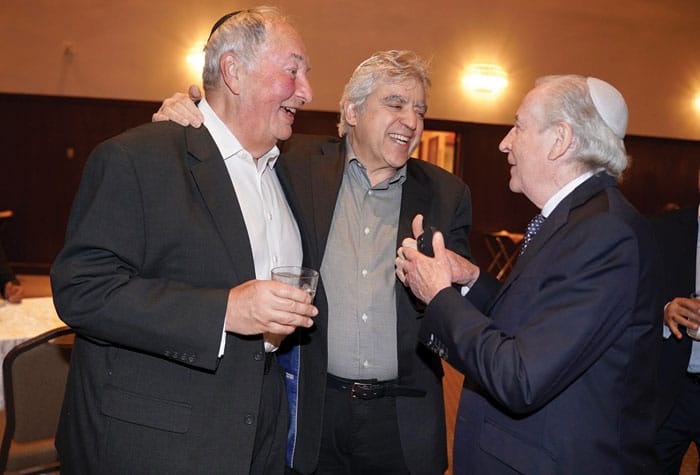
From left: Community leaders Selwyn Gerber, David Suissa and Errol Fine enjoy the recent American Friends of Beit Issie Shapiro gala.
Photo by Orly Halevy

More than 250 of leaders, dignitaries, celebrities and supporters acknowledged the inspiring work and admirable impact of Beit Issie Shapiro on the lives of more than 500,000 people globally. Local philanthropist and business leader Barak Raviv presented the “Legacy Award” to Stacy and Uri Blackman.  The two honorees serve on the Friends of Beit Issie Shapiro board. 

Beit Issie Shapiro is an Israeli-based nonprofit and a pioneering leader and innovator in the field of disabilities and inclusion. It empowers people with extraordinary abilities to lead full lives through innovation, research, and knowledge sharing.

Food, entertainment and event production was provided by Pat’s Catering, Allen G. and Kasha Music and the Chameleon Garden Floral Design. 


Guardians President Anthony Behar.
Courtesy of L.A. Jewish Health

The board of directors of the Guardians, a volunteer support group of Los Angeles Jewish Health, has named Anthony Behar its new president. 

Behar, who was unanimously confirmed, will be serving in this role for the next two years.

Behar has been involved with the Guardians in several leadership roles over the course of nearly three decades.

The focus of the Guardians is to raise funds and support for the seniors served by L.A. Jewish Health, an organization that cares for 4,000 older adults each year. L.A. Jewish Health, formerly known as the Los Angeles Jewish Home, is the largest nonprofit, single-source provider of comprehensive senior healthcare in the Greater Los Angeles area.

“I am honored and grateful to be serving as Guardians president,” Behar, a commercial real estate broker, said. “The organization has a very special place in my heart. At one point, I had seven great aunts and uncles living at the Jewish Home, and I saw the amazing care and support they received. The Guardians gives us a chance to have an impact on the lives of thousands of seniors in our community, while also providing opportunities to develop long lasting friendships and participate in top-notch events. There are many extraordinary people who served before me in this role and I hope to meet and exceed what they have done for Los Angeles Jewish Health.”

Behar lives in Encino with his wife and two children.

Youth Philanthropy, Guardians President, Beit Issie Shapiro Gala Read More »

Table for Five: Vayera

One verse, five voices. Edited by Salvador Litvak, the Accidental Talmudist

And Abraham lifted up his eyes, and he saw, and lo! there was a ram, [and] after [that] it was caught in a thicket by its horns. And Abraham went and took the ram and offered it up as a burnt offering instead of his son.

– Genesis 22:13


Rabbi Nicole Guzik
Sinai Temple

According to Bereishit Rabbah, this is not the first time the ram is caught in the thicket. Several times throughout the fateful day, the ram entangles itself in one set of branches, gets loose and finds itself ensnarled again. The ram becomes a representation of the numerous times the people of Israel will find herself in trouble, with the ram’s horn to serve as a future reminder of how we might “wake up” and free ourselves from our constant stumbling. 

It is a personal lesson as well. While the ram is usually seen as the replacement sacrifice for Isaac, we are also given a model for teshuvah. We too entangle and ensnarl ourselves in missed opportunities, scenarios in which we wish we could loosen ourselves from the grips of mistake and regret. And yet, the shofar is made from the same materials as the trapped ram, the ram who falls right back into imprisonment. Our wake-up call cannot be external; our alarm clock must come from within. 

Too often, we search for “answers” outside of ourselves. But the Torah offers a beautiful alternative. When faced with angst, sometimes the path forward is listening to our seemingly hidden voice: the heart yearning to be heard. 


Rabbi Chanan (Antony) Gordon
Inspirational Speaker

Parshas Vayera contains the last of Abraham’s ten tests. The binding of Isaac, the Akeda, has many pedagogical life lessons for all of us, the progeny of Abraham. 

We can learn one such lesson from two phrases in Vayera related to the Akeda: “lifted up his eyes” and “caught in a thicket.” 

After embracing the final test of the Akeda, Chazal explains that Abraham “lifted up his eyes” as if to question the way the Akeda concluded. Abraham sought to draw a drop of blood from Isaac to publicize his belief in G-d. To this, the angel responds, “do not stretch forth your hand … nor do anything to him” to dispel the notion that proving one’s faith in G-d requires some tangible action. 

Chazal point out that there is an important lesson being imparted by the fact that the ram was “caught in a thicket.” We, the descendants of Abraham, are destined to become entangled in our sins and caught up in troubles, but we will be redeemed through the horns of a ram. The centerpiece of the Rosh Hashanah service is the sound of the shofar.

Since the central theme of Rosh Hashanah is the recognition of G-d as the King of His World, it is through such acknowledgement — which does not have to be manifest through outward trappings — that we will be successful in breaking free of the troubles with which we are entangled. Profound and clear counsel as we begin a new year.


Michael Borkow
TV Writer: “Friends,” “Malcolm in the Middle,” “Mom”

There are certain things you lead with when you want to show someone the beauty of Judaism. Shabbat is a big one. The emphasis on community. Charity. But you know what you don’t mention? That God asked our founder to slaughter his son as a sacrifice and Abraham got up early in the morning to do it. Yet we’ll read that story this week, we’ll reread it on Rosh Hashanah, and the shofar is a reminder of it. So it seems we’re quite proud of the story. What gives? 

I’d like to propose an explanation. The Sages call it “The Binding of Isaac,” using Isaac’s name, not Abraham’s. The midrash teaches us that Isaac (who was 37) asked to be bound so that he wouldn’t flinch and injure Abraham or injure himself, which would invalidate him as a sacrifice. So we see that Isaac responded to God’s command as enthusiastically as Abraham did. But Isaac didn’t hear it from God, he learned of it second hand, which allows doubt to creep in. And that makes Isaac’s accomplishment the greater one. 

That’s our situation, too. God gave the Torah to Moses who gave it to us, yet we’re challenged to keep it with the confidence of someone who received it directly from God. And if we do — if we conquer our doubts — we can encounter the divine. Sounds hard but, hey, Isaac did it. He was like us and he pulled it off. No wonder we like to tell his story.


Hindi Kalmenson
Relationship Coach

Every parent agrees that their child is their life. A child represents our legacy, and therefore the very purpose of our existence. Avraham waits 99 years for this precious child and then is instructed to kill him. 

Is Akeidas Yitzchak just about G-d bringing Avraham to the brink and back only to let him know that he passed the test, or is there something deeper for us to interpret from these passages? 

The Baal HaTanya teaches that every Jew has two inclinations. One, he terms “Animal Soul” and the other, “G-dly Soul.” The “Animal Soul” is only concerned with itself and how to survive. The “G-dly Soul” is altruistic and goal oriented. Both contend for the body’s attention to fulfill their own intent. What determines if the body succumbs to the desires of the “Animal Soul” or fulfills the purpose of the “G-dly soul”? The mind. If we contemplate G-d and His world, we align ourselves with purpose. If we avoid awareness of G-d, we strive to serve ourselves. 

This passage not only portrays a powerful moment in Jewish history, it illustrates a father bequeathing a legacy for all posterity. Avraham enlightened us on how to approach every moment when he “lifted his eyes”. He immersed himself in a G-dly reality so that when faced with a challenge, he was able to sacrifice His animal to serve G-d. When we are faced with our own proverbial ram, Avraham informs us, lift your eyes, acquaint yourself with G-d, and choose purpose. 


Rabbi Chaim Tureff
Rav Beit Sefer Pressman Academy and director of STARS Addiction Recovery

I still remember when I started teaching 20 years ago, a student asked me why G-d would ask Avraham to sacrifice his son. Like a great student, she rebuffed every answer I gave, and we continued a year-long dialogue on this subject. This pasuk is one of the answers, which was that G-d did not have Avraham sacrifice his son. 

Avraham was given 10 tests. There are differences about what they were but everyone agrees that this was the 10th test. It is difficult to imagine a more arduous test. And yet at the same time, it worked out. Avraham obeyed G-d’s directive, followed through and, in turn, didn’t need to sacrifice his son. The commentaries note that Avraham knew that the ram was supposed to be sacrificed instead of his son because he didn’t see it beforehand and it appeared after the angel told him to stop. 

So too in life we are sometimes pushed up against the proverbial wall. We are stuck in a situation and the current answer just seems so wrong. That is where the power of prayer can come in and guide us through those most difficult moments. We are taught that if we’re able to call out to G-d from our utmost depths, there will be guidance – not simplicity, and maybe not even the answer that we want. 

Unlike G-d’s answer to Avraham, G-d’s answer to us might be something quite different than what we hope for, but sure enough there will be clarity, maybe even in the thickets. 

Table for Five: Vayera Read More »

A Moment in Time: “Your Soul-print Matters”

Dear all,

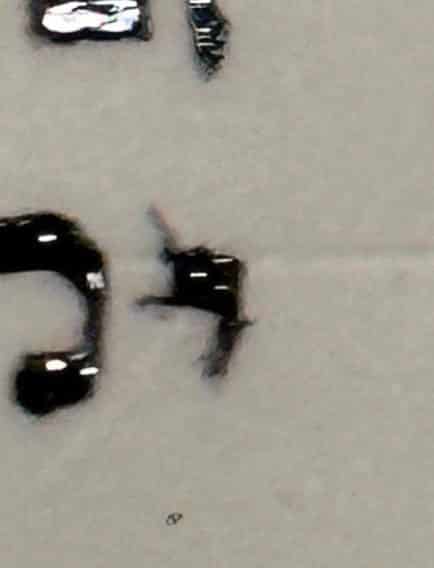
Temple Akiba’s Sisterhood worked with the incredible scribe, Linda Coppleson, to repair one of our Sifrei Torah (Torah scrolls). Members of our community had the opportunity to gently hold Linda’s wrist as she inscribed individual letters onto the scroll.

My letter was a “Yud” (pictured here is the actual letter. The white splotches are reflections of the overhead light).

Now, “yud” is the smallest of all the Hebrew letters. But it made me realize just how significant each and every letter is, no matter the size or shape.

The letters represent each human soul. We all add our voices, our experiences, our journeys to the puzzle of life. We join our expression to those who surround us to create meaning and light. And if we ever feel that our contribution may be minuscule, like the “yud” – we take a moment in time to remember that our soul-print matters. We make a difference. We help make the world whole.


With love and Shalom,


Rabbi Zach Shapiro

A Moment in Time: “Your Soul-print Matters” Read More »