fbpx

October 12, 2022

The Essence of Simchat Torah

Simchat Torah, which marks the end of the annual cycle of weekly Torah readings and the beginning of the new cycle, is a joyous holiday that celebrates the Jewish love of Torah and study.

Marking the end of the Sukkot festival, it is a celebration of our beloved Torah and all that She generates for us, her inheritors. She reveals the nature of God, creation of the world, and formation of our people, from liberation in Egypt to the revelation at Sinai. Since the destruction of the Holy Temple and our exile to far-off lands, the Torah has remained central and enduring, for She exists beyond time itself. Torah, since Her beginning at Sinai and travels to the Holy Land, has been the very core of our peoplehood and Covenant with God. She is the very ‘heart’ of our tradition, as She teaches in Torah, since the last letter is a Lamed and the first letter is Vet, spelling the word Lev, meaning heart. Her secret message is that She represents the Love of the Holy One.
Reading Torah provides not only stories and the history of how we began and who we are as a people, but many secrets. Our sages teach that we read Her on four levels represented by the letters that spell the word Orchard, or PARDES. These four levels are the plain story line, the hints and allusions, the moral, legal, and psychological, and lastly, kabbalistic mysteries. Each approach reveals deeper and deeper explanations and potential meaning. The Torah guides, teaches, models and enlightens every aspect of our psycho-spiritual life. 

Distilled into a myriad of possible interpretations, the flow of wisdom is exponential. Beginning with the Mishnah, almost 2000 years ago, each generation has expanded and deepened how we understand the literal and metaphorical language of this precious Hebrew. Levels upon levels of discourse, exposition, and reinterpretation has created the ultimate gift to each one of us, the gift that keeps on giving.

Proverbs offers an unusual way to relate to Torah. “I am wisdom, I was with God from the beginning before anything was created, even before earth … like a child, I was God’s daily delight.” The Torah, with its wondrous pathways and innovative teachings, is truly God’s plaything and muse. Like the chicken and the egg, it’s hard to know what came first. Then Proverbs offers another explanation, that “She is a Tree of Life …” and in “holding fast to Her brings happiness.” Torah is wisdom, a young child, a bride, the female expression of nurturance and guidance, and like a tree, rooted in the earth, spreading her branches throughout time. Torah is all this and more. For She is an unending Shefa, a flow, from God, constantly nourishing, feeding, and sustaining her people.

Just as we experience life and change, each year we see Torah with different eyes and hear with different ears. 

And so, the rabbis have us reread Her over and over again. Designed to be read every Shabbat over the course of one year, we end on Simchat Torah, when we dance with the holy scrolls, and then start all over again, discovering, despite the many times we’ve heard her, new vistas and new understandings. Just as we experience life and change, each year we see Torah with different eyes and hear with different ears. Our own life experience opens us to receive her in totally different ways, year after year.

Torah for the mystics was a midnight encounter. They would wake at the witching hour, like a betrothed, frolic with Her, study and encounter Her intimate truths. In fact, in the last chapter of Torah, which we read on Simchat Torah, it says “Torah is an inheritance,” using the word, Morashah, but the sages say we can read it as M’orasah, meaning betrothed. Torah is the bride, embraced by us all, as we dance with her seven times on this holiday, each circuit representing multiple symbols – seven days of creation, the seven Ushpizim, ancestors of the past, and the seven circuits at the wedding before Chuppah. 

In the Jewish calendar this is a glorious Simcha, a joyous celebration that lifts us by embracing the Holy Scroll and dancing with Her. Torah will live beyond time continually showering us with God’s truth and God’s love, feeding both our minds and our spirits.


Eva Robbins is a rabbi, cantor, artist and the author of “Spiritual Surgery: A Journey of Healing Mind, Body and Spirit.”

The Essence of Simchat Torah Read More »

Rabbi Alex Kress

Rabbis of LA | Rabbi Alex Kress: The Lucky Rabbi

In March of 2020, just as the pandemic started, Rabbi Alex Kress of Beth Shir Shalom in Santa Monica was diagnosed with testicular cancer. It spread to his abdomen and he had a series of surgeries to treat it. 

“Luckily, because I was under surveillance for cancer, they found it very early,” he said. “This past September, I had a fourth surgery, and to be sure there is no more spread, I’m going through a round of chemotherapy.”

The young rabbi has been contending with all of this while raising his two kids and becoming rabbi at Beth Shir Shalom in July of 2021. These past High Holy Days were the first time he conducted services in person. 

Even though the past few years have been challenging, Kress has a positive attitude about everything he’s been through. 

“It’s been quite a journey with ups and downs and surprises,” he said. “You think you’re past cancer, and then it comes back. It’s significantly life altering, but at least I’ve had a good prognosis because testicular cancer is treatable. It’s frustrating to be knocked out of commission many times, but I’m also feeling very lucky and grateful for having good care.”

Kress feels lucky to only have to go through the one round of chemo, colloquially called “chemo-lite.” He’s happy to have competent doctors and to have his community supporting him when he needs it the most. 

“The community is almost as powerful as my faith,” he said. “People show up and they bring meals, and they’ve been really amazing. It’s a blessing. It really makes you count your blessings.” 

Weekdays, the rabbi works at the synagogue and preschool; he gets to spend time with his 3-year-old son, who is in preschool there.  

“That is a great blessing also,” Kress said. 

The rabbi grew up in an interfaith home in Philadelphia. From a young age, he was skeptical of religion, but he gained appreciation for it when he became a teenager.

“I started to understand the complexity of life and how ritual and Torah inform us and guide us through life,” he said. “For me, it was all the relationships I had that kept me in the community.” 

Kress became involved in his temple’s youth group as well as URJ Camp Harlam. He said that it was his rabbi, Rabbi Peter Rigler of Temple Sholom in Broomall, Penn. who first gave him the idea of going into the rabbinate.

“He was a very young, cool rabbi who took me under his wing. He told me I should be a rabbi. I thought it was the craziest idea.“

“He was a very young, cool rabbi who took me under his wing,” Kress said. “He told me I should be a rabbi. I thought it was the craziest idea. But I realized: What’s a profession? It’s something you enjoy doing. And I enjoyed Judaism, so it all clicked.”

Kress attended Temple University for Jewish Studies and then enrolled in Hebrew Union College-Jewish Institute of Religion in Los Angeles. After graduation, he worked at Temple Sinai of Roslyn in New York, but realized he wanted to come back to LA. He took on a position at Hillel at UCLA prior to joining Beth Shir Shalom last year.

The time spent in and out of doctors’ offices has been hard for Kress, as he hasn’t gotten to spend as much time at his congregation as he wants. But, he’s finding ways to stay connected to his faith.

“There was this very clear moment where I tried to pray, and I got to asher yatzar (“who formed”), the prayer about the inner workings on the body and I thought, ‘Wow, the body is amazing,’” he said. “I’ve gone through multiple surgeries, and my body is still working.”

Now that Kress has gone through such difficulties, it’s given him a sharper focus of what he wants to accomplish in life. 

“My ultimate goal is to bring people together and help them find meaning in their lives,” he said. “Judaism has given me guidance and strength, partly from its teachings and partly from its emphasis on community. I want to repair our piece of the world and leave it better for others. I want to help people navigate the very difficult terrain of life, and help them find meaning and support.”

Fast Takes with Alex Kress

Jewish Journal: What’s your favorite Jewish food?

Alex Kress: Brisket is my go-to on the Jewish holidays. I love my grandmother’s recipe. It’s food that evokes memory and family.

JJ: Your website says you like hip hop and coffee. Who is your favorite hip hop group and what’s your favorite coffee?

AK: A Tribe Called Quest, and if we’re going local, Caffe Luxxe. The one that really got me hooked on coffee is Ruby Colorful Coffees, which is based in Wisconsin.

JJ: Why aren’t you on Facebook or Instagram? 

AK: I got off of both of them and it’s been great. I really don’t miss it. 

JJ: What do you do instead?

AK: I have a Duolingo streak going for Hebrew. I listen to more podcasts and read more books. One of the biggest things I do is spend time with my kids. I’m always buried in my phone, and trying to be present for them in the moments we are together is really important to me.

Rabbis of LA | Rabbi Alex Kress: The Lucky Rabbi Read More »

A Moment in Time: “Do not Insult the Deaf nor put a Stumbling Block before the Blind“

Dear all,

There’s a teaching from the book of Leviticus that has resonated in the past few days here in Los Angeles: “Do not insult the deaf nor put a stumbling block before the blind.” (Lev. 19:14). While at first, it often seems that both parts of this text offer the same instruction, the two are distinct.

If you put a stumbling block before the blind, they will trip.

If you insult the deaf, they may or may not find out.

In other words, regardless of whether they hear you or not, you don’t say something insulting about another.

Yes, this is true for our leadership. But it’s true of each of us as well.

Do not insult others. Period.

We own our words and our language. So we take a moment in time before giving those words away. That moment can make the difference between being a source of darkness – or being a source of light. It’s our choice!

With love and Shalom,


Rabbi Zach Shapiro

A Moment in Time: “Do not Insult the Deaf nor put a Stumbling Block before the Blind“ Read More »

Rosner’s Domain: Ukraine and Lebanon: A Story of Two Tweets

It’s an hour or so after the first day of Sukkot, and opposition leader Benjamin Netanyahu goes back on Twitter to send the following message: “Behind the backs of the citizens of Israel and the Knesset, Lapid and Gantz surrendered to Hezbollah’s blackmail”. 

Maybe half-an-hour earlier, Prime Minister Lapid took to Twitter to send a different message: “I strongly condemn the Russian attack on the civilian population in Kyiv and other cities in Ukraine”.

There is a connection that merits exploration, as the world grapples, yet again, with a daunting question: what is a cause worthy of devastation and war?  

Two leaders, two topics, same say – three weeks to Election Day. There is a connection between these messages, political and substantial. There is a connection that merits exploration, as the world grapples, yet again, with a daunting question: what is a cause worthy of devastation and war?  

Let’s begin by getting rid of the political optics. Netanyahu responded in his tweet to reports that, after a short hiatus and a few hurdles, Israel and Lebanon are scheduled to sign a maritime border deal. I wrote about this deal last week. The deal is supposed to end a dispute over some 860 square kilometers of the Mediterranean Sea, including areas where gas fields of both countries are planned or located. Netanyahu’s political goal is to paint the deal as weak on security, and hence its signatories as unworthy of Israel’s votes. Lapid’s political aim is to seem strong on defense. Sending a strong message in support of Ukraine, and defying Russia is one way to do it. 

The events in Ukraine, where Russian forces bombed civilian infrastructure in what was clearly a vindictive response to a bold Crimea bridge attack, are a stark reminder that war can be devastating. They are also a stark reminder that strongmen are not easily deterred by a weak response to aggression. And here is the similarity between Israel’s dilemma and the many dilemmas with which the Ukraine war is burdened. Vladimir Putin threatened to devastate Ukraine unless it responds to his outrageous demands. The Ukrainians decided to fight back, to pay a heavy price. Putin calculated that the rest of the world will not respond with boldness to his aggression – but some countries surprised him by showing more backbone than he expected. 

Did he quit? Not really. He is now upping the ante, behind a threat to use nuclear weapons. “Mr. Putin hopes the political shock waves set off by nuclear explosions in Europe would shatter the West’s resolve to support Ukraine,” writes Walter Russell Mead. Like many aggressors before him, Putin’s bet is on the lack of resolution of the other side. Like many before him, his bet could lead to triumph – or disaster. It is not always easy to predict how a rival might respond to a dramatic threat. Would Ukraine cave and surrender? Would the West put pressure on Kiev to settle, less the crisis becomes a World War? 

The inconvenient truth is that threats do work against societies and governments, especially against societies of free countries. Putin might have erred by not thinking through complications he could encounter with his own public if the war goes south, but for democratic governments such process of considerations are built in. Hence, when Lapid and Netanyahu debate the risks and the merits of the deal with Lebanon, what underlies their debate is a contrasting assessment of Israel’s willingness to take a risk for achieving a certain goal. 

In fact, there are two main goals: One:  To have natural gas extracted. Two: To enhance Israel’s defense against Hezbollah. Lapid would argue (with the support of the military) that Israel gains by getting both. Israel could drill, and Lebanon would also drill and hence have something to lose, and thus less prone to provoke Israel (this would be a mutual deterrence as both countries will have gas fields that can be attacked and destroyed). Netanyahu is making a more challenging argument. Yes, Israel could drill, but it was willing to compromise only because of the Lebanese threat of war. Long-term – that’s Netanyahu’s argument – compromising with an aggressor is a bad strategy, as his appetite only grows. You want proof of that? Read Lapid’s tweet about Ukraine.

Something I wrote in Hebrew

As far as I could find out, there has never been such a static election campaign. Not in the history of Israel. This is not necessarily surprising, given the circumstances. After four consecutive elections, everyone already knows who their party is. No significant changes in the camps or parties occurred (except for the Arabs), so there was nowhere to move either … Deviations of a mandate of two up or down in the polls mean little. These are random deviations. In the average polls, the Netanyahu bloc stands at about 60 seats. And saying “60” is not only a prediction – it is also a state of mind. A tie. A coin-tossing state of mind.

A week’s numbers

Less we forget, because of all the other news, that this is the holiday season. A number from our study on #IsraeliJudaism (Google it, if you want to know more): 

A reader’s response:

Hans Dollinger asks: “Will Israelis travel to Qatar to watch the World Cup?” Answer: In droves. They love soccer and love the opportunity to travel to a country that doesn’t usually accept them with open arms. 


Shmuel Rosner is senior political editor. For more analysis of Israeli and international politics, visit Rosner’s Domain at jewishjournal.com/rosnersdomain.

Rosner’s Domain: Ukraine and Lebanon: A Story of Two Tweets Read More »

On “Jewish Free Zones” at Berkeley, the Debate between Chemerinsky and Marcus Continues

Dean Chemerinsky writes:

Dear Editor,

Ken Marcus continues to make his nonsensical accusation that there is a Jewish-free zone at Berkeley Law. There is not now and never will be such a thing. Berkeley Law, and the Berkeley campus, has a strict rule prohibiting discrimination and indeed has an “all-comers” rule that all student organizations and all student events must be open to all students. I know of no instance in which this has been violated or any Jewish student excluded.

Mr. Marcus continually focuses on a bylaw adopted by a handful of student groups that pledge to exclude speakers who support Zionism and Israel’s policies. I am stunned that Mr. Marcus never once has called me or anyone at the Law School to learn what has actually happened.

For example, if he had done so, he would know that two dozen law professors, including me, signed a statement: “we also condemn the discriminatory bylaw adopted by a small minority of our law student groups refusing to accept speakers who have Zionist views or beliefs. We believe this rule is not only wrong but is antithetical to free speech and our community values. These bylaws would also impermissibly exclude a large majority of our faculty from participating in the work of these organizations, including our Dean. Many Jews (including some of us signing below who are Jewish) also experience this statement as antisemitism because it denies the existence of the state of Israel, the historical home of the Jewish people.”

If Mr. Marcus had called, he would have learned that no speaker has been excluded on account of these or any other views.

We also could have discussed how student groups inevitably may choose speakers because of their viewpoints. The Jewish Law Students Association can refuse to invite Holocaust deniers. The Black Law Students Association can refuse to invite white supremacists. I may not like the choices they make about what viewpoints they invite or not invite, but that is their First Amendment right.

What is not allowed is excluding a speaker based on religion or race or sex or sexual orientation. And that has not – and I am confident will not happen at Berkeley Law. To be clear, the law, and campus policies, distinguish between word and deed, expression and action. To date the offending student groups have issued statements, declarations, and intentions. Those are constitutionally protected forms of expression. To date, no student has been excluded, cancelled, disinvited, or interrupted. To date no student  has been denied the right or the ability to express themselves, to exercise their freedom of speech. Should that happen—and we are working hard to make sure it does not—that would represent a cross-over from expression to conduct and that would be subject to serious discipline

It is time to stop repeating the lie of a Jewish-free zone at Berkeley Law.

Erwin Chemerinsky
Dean and Jesse H. Choper Distinguished Professor of Law
University of California, Berkeley School of Law


Kenneth L. Marcus responds:

Dean Erwin Chemerinsky says he is “stunned” that I “never once has called [him] or anyone at the Law School to learn what has actually happened.” I am flattered at the suggestion that he would like to hear from me. In fact, my colleagues and I have spoken with many people at the law school, if not with the dean himself, and have fully learned what actually happened. Indeed, it seems that by now everyone understands what actually happened. We just don’t understand why Dean Chemerinsky hasn’t been able to fix it.

In fairness, although he has not called me either, Dean Chemerinsky deserves kudos for engaging personally on this issue, and for responding to my articles, even if neither his engagement nor his responses have hit the mark. If we had spoken directly, Dean Chemerinsky might understand that it is too much for even one student group to exclude Zionists (Jews by any other name) in their constitutions and bylaws, let alone nine.

Second, Dean Chemerinsky would also know that Berkeley’s administration should stop denying that these nine groups have created Jewish-free zones. These are Jewish-free platforms, podia, or spaces. The fact is that these groups have constitutionally barred most Jews from speaking to Berkeley Law’s major identity groups. Dean Chemerinsky hasn’t denied even a single fact that I have written about Berkeley Law. He just doesn’t like the term “Jewish-free zones.” There is a simple way to stop people from talking about Jewish-free zones: Abolish them. Eliminate the barriers that prevent any group, including Zionists, from speaking.

Third, if he had reached out, Dean Chemerinsky would stop denying that “no speaker has been excluded on account of these or any other views.” With due respect to the good dean, this is absurd. Mr. Chemerinsky and his Berkeley Law colleagues now acknowledge that these nine groups’ bylaws “impermissibly exclude a large majority of [Berkeley’s Law] faculty from participating in the work of these organizations, including [him].” Since he acknowledges that this is impermissible, he should stop permitting it. More to the point, he should stop funding it.

In addition, we all know what happens when campus groups announce “no Zionists”– Jewish students either stop participating or they suppress that part of their Jewish identity to be accepted. Dean Chemerinsky suggests he will act once a Jewish speaker is turned away or a Jewish student is formally excluded. Once the bylaws were formalized that ship sailed. By not acting now, the damage is done.

And if student groups take further discriminatory action by excluding Zionists in the future, there will be no way for Chemerinsky to know that they have done so. It is not as if they will tell the dean that they are doing what he has described as “impermissible.”

These constitutions are not mere statements or declarations. They are binding commitments. In this case, nine groups have adopted policies that bind them to do what Dean Chemerinsky concedes to be impermissible. This is what judges call “facially” unlawful.

At the end of the day, what matters is not so much what we call these “discriminatory bylaw[s]” (his word) but, rather, what we do about them. In his position, Dean Chemerinsky can do more than sign statements. He can eliminate the discrimination that he has identified. At a minimum, he can inform nine student groups that the University of California will no longer fund them as long as they are bound by their bylaws to do what the federal and state law prohibit.

Kenneth L. Marcus is chairman of the Louis D. Brandeis Center for Human Rights Under Law and Distinguished Senior Fellow at George Mason University Scalia Law School’s Center for Liberty & Law.

On “Jewish Free Zones” at Berkeley, the Debate between Chemerinsky and Marcus Continues Read More »

Julia Boorstin on “When Women Lead” and Changing the Conversation Around Leadership

Growth is all about asking questions: as an individual, as a company, as a Jew.

Through asking questions – her super-power – Julia Boorstin, author of “When Women Lead: What They Achieve, Why They Succeed, and How We Can Learn from Them,” has unleashed a powerful book and roadmap unto the world.

“My most core personality trait, the thing that is most essential to who I am, is the fact that all I do is ask questions, both in personal and professional settings,” Boorstin, who is CNBC’s Senior Media & Tech Correspondent, told the Journal. She has been an on-air reporter for the network since 2006.

“When Women Lead” shares research and insights, along with engaging interviews with more than  60 female CEOs and leaders. Boorstin found those who thrived shared commonalities that made them uniquely equipped to lead, grow businesses and navigate crises.
“The feedback, especially from women, has been amazing,” Boorstin said. “Women [have been] saying to me, ‘You put words to things that I’ve always felt. And now you’ve given me a language to think about the challenges that I face and a roadmap to overcoming them.’”

It’s not about solving problems yourself, it’s going to a group pulling in diverse perspectives … and asking questions.

“Asking questions is the best way to figure out problems and then solutions,” she said.

Boorstin who grew up in Los Angeles (“we were members of Leo Baeck Temple”), now lives here with her husband and two sons, as part of Temple Israel of Hollywood.

She was raised in a family, and in a Jewish culture, which prioritized question-asking.

“I just remember this idea that you can as a Jew, you are inspired to ask questions about the most fundamental things about the religion,” she said. “Why is it that we do these traditions? What is the importance that we’re going to take out of this? What is the meaning of this for me?”

At first, Boorstin just wanted to tell the amazing stories of women she met, who were unlike the stereotype of female leaders.

“I was so inspired, and I would find myself asking them questions about like how they managed to be so courageous when the odds seemed so against them, or how they managed to be so persistent when everyone was telling them ‘No,’

Boorstin decided more people needed to hear these stories. “I can’t be one of the few who gets access to these women,” she said.

As she interviewed more people, Boorstin saw commonalities emerge. She needed to understand the strategy – and why it was working, so then research came into play. She accessed about 300 academic studies, and just dug in.

“I found amazing studies about the benefits of leading with gratitude or the benefits of leading with empathy,” she said. “And I thought, Not only am I going to tell these stories, I want to explain why what these women are doing is working so well.”

In the book there is a story from a woman whose father was a holocaust survivor; another woman’s grandfather was a holocaust survivor.

“There are 60 women in the book, so it’s not like this is a big piece of the book, but I thought it was really interesting that both of them referenced that to me,” Boorstin said

Caryn Seidman-Becker, who founded CLEAR, talked about how she was really good at preparing for any situation, which she got from her grandfather, who survived the holocaust. “He was always about being prepared for any scenario,” she said. “And, by the way, [Caryn] did an amazing pivot during the pandemic.”

Gail Becker founded CAULIPOWER, which is cauliflower crust, pizza and other cauliflower ingredients for people, including her kids, who are Celiac and cannot eat gluten.

“[Gail] was inspired to launch her company by her father, who was a holocaust survivor,” Boorstin said. “When he died, he left her the money that his house was worth, and she remembered him telling her to do something that she really believed in and that she thought would help people.”

Another study talks about how one way to find resilience is to reflect on your ancestors, who’ve been through ups and downs.

“This idea is that kids are more likely to be resilient if they know that their family has gone through tough times and good times,” she said. And they’re lucky that they have the strength of their ancestors behind them.”

When asked what she thinks her book accomplishes, Boorstin said it goes back to this idea of changing the conversation about business and leadership. In her experience of interviewing hundreds of CEOs, she discovered that not only are there all sorts of different kinds of leaders, there are also different ways to be successful as a leader.

“We are in a time of uncertainty, whether it’s the stock market plummeting, fears of another Covid wave or fears of whatever medical disaster is around the corner, the one that we know for sure is that we don’t know anything,” Boorstin said. “Finding strategies that rely on data, rather than ego, can be really valuable, no matter who you are.”

Julia Boorstin on “When Women Lead” and Changing the Conversation Around Leadership Read More »

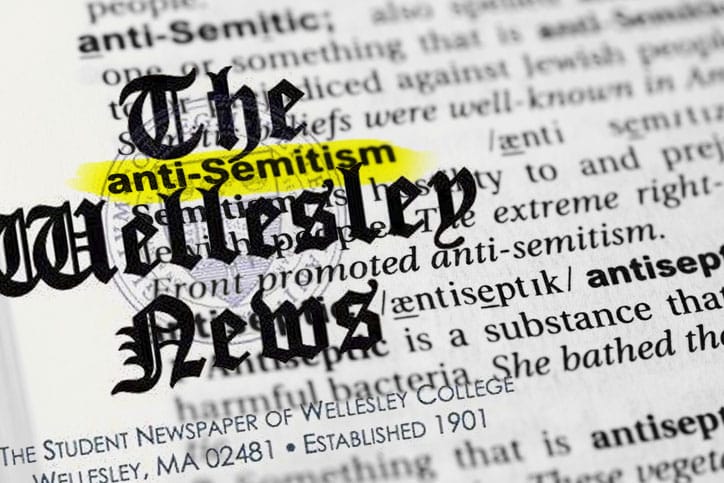
Wellesley News’ Dangerously Slanted Editorial Will Spark Antisemitism

The Wellesley News one-sided, incendiary and misleading call for “the liberation of Palestine” and pledge of support for the Boycott, Divestment, Sanctions (BDS) campaign against Israel, a force the U.S. State Department has labeled “a manifestation of antisemitism” is more than misguided or misleading, it is flat out disgraceful and dangerous.

BDS’ policy of “anti-normalization,” as the ADL notes, “forbids people-to-people exchanges, dialogue opportunities for Israelis and Palestinians or even interactions between ‘pro-Israel’ and ‘pro-Palestine’ groups and advocates unless the parties involved first recognize Israelis as ‘oppressors’ and ‘colonizers.’” It utterly rejects a two-state solution or any sort of peaceful resolution, and it extends that rejection to Jewish individuals and students who support the peaceful existence of one Jewish state alongside the 22 Arab countries in the Middle East.  Just as BDS boils down the entire Middle East conflict into this one-sided and dangerous understanding, so does the Wellesley News.  It dangerously furthers the othering of Jews and takes a stance that will encourage antisemitism.

The editorial board never states how much of historic “Palestine” – which, as the name of a British colony or “Mandate” from 1920-48, included all of modern-day Israel – they would “liberate” from the Jewish state. However, the article’s usage appears to indicate that they consider the entire country “occupied” territory – the position of BDS, which the article explicitly endorses. It also misleadingly calls for “granting Palestinian refugees the right to return to their homes” – but since the refugees from the 1948 Partition of Palestine are the only group considered “refugees” over multiple generations, this is coded language for demographically overwhelming, and ultimately eliminating, the Jewish state. Nor does it mention that most Israelis are descendants of Middle Eastern Jews who were expelled from Muslim-majority countries during and immediately after the 1948 conflict.  In addition, it fails to even acknowledge the number of times Israel has offered land for peace or the challenges Israel faces in protecting its citizens from terrorism.

The article suggests that “Palestinian students on campus, especially international students… may hesitate to speak out for fear of retribution.” The authors do not appear to understand that this is what is currently happening to Jewish students, who again and again are being asked to suppress part of their identity to be welcome in certain spaces, and are being shamed and demonized if they don’t. To prove that point, the editorial board strongly and unequivocally condemns Wellesley’s policy “to encourage more Jewish college students to visit Israel” on Birthright trips. In fact, in September of 2021, a survey of “college students who claim a strong sense of Jewish identity and connection to Israel” by the Louis D. Brandeis Center for Human Rights Under the Law found that 50% felt the need to hide their Jewish identity.

Very dangerously, the editorial board advocates support for the Mapping Project, a map that tracks the Jewish institutions of the Commonwealth of Massachusetts and labels them “highly militarized forces that share resources and information to enforce the intersecting systems of white supremacy and capitalism.” The “highly militarized forces” whose information the map publicizes include teen- and youth-focused organizations like the Hillel Council of New England, the Jewish Teen Foundation of Greater Boston, and even a Jewish high school, Gann Academy, as well as the Synagogue Council of Massachusetts, the Jewish Arts Collaborative, the Jewish Journal – and many more. This is happening as pro-BDS radicals call Jewish community organizations “Zionist organizations hiding behind Judaism. So every single organization on that list is a legitimate target…” and publicly state: “We need to pay attention to the Zionist synagogues. They are your enemies.” As I warned on June 15, “[w]hat the Mapping Project has built is a plan for a pogrom.”

The editorial board concludes by comparing “Israel’s settler-colonial regime” to “Russia’s invasion of Ukraine [and] the fall of Roe v. Wade…” in a further attempt to demonize the Jewish state, and, in turn, Jewish students. The comparisons are wildly inept. Israel, like Ukraine, has been in a struggle for survival for its entire existence against much larger neighbors; it’s no wonder that Ukraine’s President Zelensky has said that he wants his country to become“a ‘‘big Israel’ with its own face[,]” a security-focused democratic state. In Israel, about 98% of those who apply for an abortion receive one, and the government further liberalized an already robust pro-choice policy after Roe was struck down by allowing women “to undergo abortions at their local health centers, rather than at hospitals or surgical clinics.” The column also repeats the widely inaccurate comparison of Israel and South Africa, calling Israel “apartheid” no fewer than four times in a single article. In fact, Israel is the only true democracy in the Middle East, with Arab representation at its highest levels of government, the home of Asia’s largest Pride celebrating the LGBTQ+ community, and has a Jewish population whose majority is from outside Europe, including 160,000 Africans rescued from Ethiopia.  It also completely ignores the idea that Israel celebrates Jewish self-determination and provides a safe haven for Jews who have been discriminated against, persecuted and even annihilated for thousands of years.

Wesley College President Paula A. Johnson strongly condemned the editorial board’s endorsement of BDS and the Mapping Project and should be commended for forcibly speaking out against this dangerous endorsement. While President Johnson understands the danger of the BDS campaign against Israel, the editors of the Wellesley News have been sold a bill of goods by the antisemitic BDS campaign. As I wrote on June 1 after the Harvard Crimson endorsed BDS, “[t]he fact that budding journalists at one of the country’s most selective colleges would spread such a lie is shocking but not surprising… scores of students and faculty have been convinced they are supporting a nonviolent, peaceful movement for Palestinian independence, without understanding what they are truly backing.”

As the AMCHA Initiative’s researchers have found, “[s]chools that are promoting BDS or other kinds of anti-Zionist rhetoric…are three to eight times more likely to have incidents that target Jewish students for harm,” including physical assault, harassment, the suppression of speech, and destruction of property. Perhaps some on the editorial board meant well, but at a time when antisemitism is soaring in the United States – the Anti-Defamation League (ADL) found an all-time high of antisemitic campus incidents in the 2020-21 school year, with 43 percent of Jewish college students personally experiencing or witnessing antisemitic activity – it’s important to present the full picture and not one that is likely to alienate Jewish students, breed anti-Jewish bigotry and ignite a campus firestorm.


Jacob Baime is Chief Executive Officer of the Israel on Campus Coalition (ICC), a leading organization in the fight against anti-Israel activity and antisemitism in the United States. He was also the Area Director of AIPAC’s New England Region and served as Campus Coalition Director for Massachusetts Lieutenant Governor Kerry Healey.

Wellesley News’ Dangerously Slanted Editorial Will Spark Antisemitism Read More »

you-dont-know-schiff

Carrot Top – Part 2

Carrot Top has been a household name for decades. But it’s a rare opportunity to get to know the man behind the bigger-than-life performance. Join us this week for Part Two of the conversation with Mark, Lowell and the legendary, talented, and (as we learned) so down-to-earth Scott “Carrot Top” Thompson!

This week Scott shares memories about his start in Las Vegas, experiences meeting some legendary comedians including Jerry Lewis, Don Rickles and Milton Berle, a funny interaction with Albert Brooks, and the honor of ending up as the cornerstone of a joke by his hero George Carlin.

And if you haven’t already heard it, but sure to listen to Part One as well!
Be sure to check out The Luxor’s or Carrot Top’s website for tickets, and follow him on his social media:
carrottop.com
https://luxor.mgmresorts.com
Instagram @carrottoplive
Twitter @RealCarrotTop

Mark’s books are available for purchase!
Available November 8, 2022.”Why Not: Lessons on Comedy, Courage, and Chutzpah.”
Click on these links to buy:
Amazon
Barnes & Noble
Books-A-Million
Bookshop.org

Read road stories from some of the best comedians of our generation in Mark’s first book  “I Killed: True Stories of the Road from America’s Top Comics” available now!

Please follow “You Don’t Know Schiff” so you don’t miss out on any exciting episodes. Click here to subscribe on Apple Podcasts (and please leave us 5 stars and a positive review – your support means the world to us and it helps us get discovered by new listeners):

Your hosts:
markschiff.com
Twitter: @markschiff
Instagram: markschiff1
 

Lowell Benjamin
Twitter: @lowellcbenjamin
Instagram: @lowellcbenjamin


Carrot Top – Part 2 Read More »

Raising Kids is a Marathon, Not a Sprint

“I can’t get anything done with the kids home. I’ve got to watch them every minute.” I’m sure I said this more than a thousand times when my kids were little. Most little kids — especially toddlers — are pint-sized wrecking crews. They empty cabinets, dump buckets of toys all over the floor, and seize unattended pens as they add a modern art twist to your couches. Ambitious tots search for more dangerous quarry, climbing on chairs to see what will happen when they reach for the crystal vase filled with flowers on the dining room table. Yes, watching over the young and the curious requires vigilance.  Multitaskers beware.

When we supervise, feed, dress, read to, play with, talk to, and cheer the achievements of our little ones, we are fostering their emotional health. 

But even when I’d gripe that I wasn’t “getting anything done” (no doubt echoing the sentiments of millions of other parents), I knew it wasn’t true. Caring for children is the most important job in the world. When we supervise, feed, dress, read to, play with, talk to, and cheer the achievements of our little ones, we are fostering their emotional health.  When they shout, “Watch me, Mommy!” as they climb the jungle gym at the park for the tenth time and we keep smiling and cheering as if we’ve never seen anything so stupendous, we build that child’s sense of self-reliance, competence, and security. This endless cycle of encouragement and love must also include consistent, thoughtful, and loving discipline. These are as vital to building a child’s healthy inner world as food is to maintaining their physical life. Kids who are tragically deprived of this nurturing become lonely, disaffected, insecure, and sometimes dangerous individuals.  
Raising our kids taught us a level of patience and emunah (sustained faith in God) that I believe would have been impossible outside of parenthood. When the kids became teens and the going got tough, Rabbi Moshe Cohen of The Community Shul would reassure us. Counseling patience, he said encouragingly, “This is a marathon, not a sprint.” We nodded, and it became a mantra of sorts. “Think long-term,” my husband reminded me during certain white-knuckle moments that are familiar to nearly all parents. We sought guidance from our wise friends and our wise rabbi. We prayed to God for clarity, stamina, and to guide our children’s steps.  

Now our kids have little kids of their own — lots of them. They drive minivans; their car seats runneth over. Now they are the ones who sometimes say, “I can’t get anything done!” while caring for their children, my grandchildren. But they are. Oh, how they are.

We are blessed that our kids all matured into fantastic, caring, purpose-driven adults. They are dedicated to living the Jewish values we taught them (three of them are professional Jewish educators) and passing them along to their own children. They are devoted husbands and wives and accomplished professionals. These alone are bounteous reasons to be proud of them. But watching them in action as they take care of their own children, reading stories, mediating sibling tiffs, soothing hurts, lavishing praise for a child sharing or for earning a good grade, I am awed. They work hard to be the best parents their children need them to be. Watching them now, I remember our own years of investment in their upbringing. Would these years never end, I wondered? I am overwhelmed with gratitude that we have reaped such incredible dividends, with God’s help.  

We raised our kids in an environment that strongly promoted marriage and family, but we had no guarantee that they would all have chosen it — or been blessed with terrific spouses and healthy children. In contrast, so many young secular adults today push off marriage till around thirty or older. Some dismiss it entirely. Many in Gen Y are sacrificing themselves on the altar of career progress, working grueling hours, leaving little time for relationships. Some now believe that having kids isn’t a climate-friendly choice. But if they stop having kids, who are they saving the planet for? In forgoing marriage and family, I fear they are missing out terribly on life’s greatest opportunities for creativity, growth, challenge — and joy.   

While raising our kids, I always understood that we couldn’t quantify the importance of our sacrifices — I only knew that they were vital. Now I see that it may take until the next generation to fully appreciate the return on the investment.


Judy Gruen’s latest book is “The Skeptic and the Rabbi: Falling in Love with Faith.” 

Raising Kids is a Marathon, Not a Sprint Read More »

Unpacking the Berkeley Controversy

The steady stream of anti-Zionist and antisemitic outrages on U.S. college campuses continues unabated. The most recent controversy to seize public attention has been at the University of California-Berkeley’s law school, where several student organizations have voted to prohibit pro-Israel speakers from participating in their events. But somehow the debate within the Jewish community seems to be about the appropriate level of outrage to direct toward this ban, as opposed to the ugly bigotry at the core of the student groups’ decision.

At best, this is a small number of angry and misguided graduate students who are venting their unhappiness about the geopolitics of the Middle East. At worst, this is an alarming number of supposedly well-educated young people from one of the nation’s most respected law schools creating a quasi-official doctrine that allows them to publicly hate Jews.

The loudest critics of what they see as the school’s insufficiently aggressive action against the ban warn of the potential for a “Jewish-free” zone at Berkeley. While many those advocating for the eradication of pro-Israel sentiments from campus would undoubtedly like to see such a goal achieved, the likelihood of such apartheid actually being achieved is minimal.

But those who seek to minimize the problem do us no favors either. They point out that nine student organizations out of roughly 100 signed onto the ban, a small minority of the school’s enrollees. That data is accurate, but the fact that 11% of the future attorneys attending a law school of this caliber support such abject bigotry should set off considerable alarm bells for anyone who cares about the rights of any minority community – including Jewish Americans.

Both Kenneth Marcus, the founder and chairman of the Brandeis Center for Human Rights Under Law, and Berkeley Law Dean Erwin Chemerinsky care deeply about the safety of Jewish students and the ability of pro-Israel voices to be heard on campus and elsewhere. Marcus is right to shine the spotlight on the escalation of anti-Israel activity at universities across the country. Chemerinsky deserves credit for his work to balance the rights of freedom of speech and association with the need to push back against these repulsive sentiments at his school.

While we argue about the regulations that student organizations should follow, we are overlooking the broader societal and cultural trends that allow such hatred to fester. 

But the dispute between the two men and their respective followers has shifted public attention away from the most menacing threat that the Jewish community faces. While we argue about the regulations that student organizations should follow, we are overlooking the broader societal and cultural trends that allow such hatred to fester. 

Almost all of the Berkeley student groups in question represent various demographic communities that have historically been marginalized in mainstream political conversation. For many years, Jewish organizations worked hard to establish relationships and work together toward common goals so that these other communities saw Jews as a committed and reliable ally. But in recent years, we have allowed those relationships to wither, and as communication and coordination with these communities has fallen off, hostilities toward Jews and Israel from many minority groups and their leaders has rapidly grown.  The result is an environment in which these young law students face no repercussions from their ideological allies for publicly advocating antisemitism but instead believe they will be politically rewarded.

Berkeley Law School is just a symptom (albeit a particularly visible one) of a much larger and more dangerous problem. These students did not develop a hatred of Israel and Jews on their own, but have been indoctrinated by political agitators who see knee-jerk intolerance toward Jews as an important exception to their conveniently selective commitment toward civil rights and social justice. We must fight this menace on every front – including the University of California – but we must also recognize that we will win achieve few meaningful victories until we develop a comprehensive strategy for the much broader and more difficult challenge.

Kenneth Marcus and Erwin Chemerinsky are on the same side of this critically important fight. I am proud to stand with both of them. But let’s remember that we must target our energies toward our common foes rather than each other.


Dan Schnur is a Professor at the University of California – Berkeley, USC and Pepperdine. Join Dan for his weekly webinar “Politics in the Time of Coronavirus” (www/lawac.org) on Tuesdays at 5 PM.

Unpacking the Berkeley Controversy Read More »