fbpx

August 11, 2022

Tu B’Av: The Egalitarian Triumph of Love

Today is Tu B’av (the 15th day of the Hebrew month of Av), also known as the “Jewish Valentine’s Day.” According to the Talmud, Tu B’Av celebrates love and the unity of the Jewish people because it was on this day thousands of years ago that the various tribes of Israel were finally permitted to marry one another. In biblical times, one had to wed within one’s own tribe to ensure that landholdings remained consistent. But at some point in our people’s past, this custom was set aside and we were allowed to marry from any tribe of Israel. Tu B’Av is a celebration then of Jewish unity, of Jewish Peoplehood. We have a shared history and a common destiny that should be celebrated.

Coincidentally, today also marks the fifth anniversary of a frightening and stark reminder of one of the painful ways we Jews are connected: the “Unite the Right” Rally in Charlottesville, Va. I wrote to you about that terrible moment in our nation’s history just a few days after we witnessed with horror the images of neo-Nazis chanting “Jews will not replace us.” Sadly, we sometimes feel most unified and most connected in the face of a common enemy. We have seen, unfortunately but perhaps not surprisingly, an uptick in antisemitism and anti-Israel rhetoric since that time. Despite our hopes and prayers for a more loving, compassionate world where all forms of hatred and xenophobia are but a distant memory, we seem farther away from this goal than ever.

Here’s a teaching from our tradition that can help us move closer to the type of unity that Tu B’Av imagines, if not for the entire world, then at least for our own Jewish family.

At the very heart of our Torah is the commandment: “Love your fellow as yourself, I am the ETERNAL” (Leviticus 19:18). One commentator, Rabbi David of Mikuluv (1864-1936) teaches: “If you love your fellow Jews and regard them ‘as yourself,’ they stand with you on an equal level. You are not above them or greater than them in your attributes and qualities. Rather, they stand right beside you, with you, one next to the other in a row.  Two yehudim (Jews) together like this, whose love is pure and egalitarian, among them dwells the ETERNAL (God’s name, sometimes spelled as two yuds).”

I want to suggest two important takeaways from this lesson. First: We can only truly love others when we value them fully and unconditionally, seeing them—despite flaws or differences—as creatures imbued by the Divine with inherent dignity and worth. Second: We become aware of God’s presence in our world when we build loving relationships based on this core principle.

Some might argue that while this approach might lead to a greater sense of Jewish unity, it could also result in a sense of Jewish superiority that would lead us to believe that we are somehow better than non-Jews, superior in some essential way.

It is indeed through the experience of a loving Jewish community that one becomes more capable of building loving relationships beyond Jewish community.

I don’t see it like that. Instead, my own experience is that being a part of a loving, egalitarian community built on empathy and mutual respect leads one to behave in more compassionate ways with others whom one encounters in the broader world. None of this is mutually exclusive. It is possible to love one’s own family and one’s own people and still have room in one’s heart for loving relationships with others. I would take this one step further: Not only can we love our fellow Jews as well as others; it is indeed through the experience of a loving Jewish community that one becomes more capable of building loving relationships beyond Jewish community.

The hope and promise of Tu B’Av is that in time, with hard work, resilience and a commitment to understanding and valuing others more fully, we can transcend that which divides us and achieve a sense of unity that will enable us to build what Psalm 89 calls Olam Chesed, a world of love sustained by God’s unending love.


Rabbi Yoshi Zweiback is the Senior Rabbi of Stephen Wise Temple in Los Angeles, California.

Tu B’Av: The Egalitarian Triumph of Love Read More »

Consolation, Not Closure

“Closure” has become part of our everyday vocabulary. While the word has its origins in psychology, today it refers to the popular notion that there are rituals and practices that can rid one of grief. What exactly one must do to achieve closure is unclear, but closure is purported to banish the anguish of profound loss and allow one to start over again.

Certainly there are times when we truly need to let go of the past. After ending a relationship or leaving a job, one needs a fresh start. Whatever helps with accomplishing that is certainly useful.

But closure is now considered to be the ultimate goal of mourners as well. Those who have lost beloved relatives are counseled to quickly get over their misery, whether they like it or not.  That’s why I dislike the word “closure”; it is often applied in ways that are self-centered and superficial. Closure comforts the mourner by forgetting the one who is being mourned.

Closure’s popularity has a lot to do with our therapeutic culture, which focuses more on comfort than meaning. Even Jewish mourning rituals are judged by their effectiveness in achieving closure (i.e., shiva is good because it helps with closure, but 12 months of abstaining from celebrations gets in the way of “moving on”).

Champions of closure view grief the same way a child looks at a rainy day: an obstacle to fun that is best removed as soon as possible. I’ve seen good-intentioned people advise grieving families right after the funeral that “they have to move on.” Those who are more psychologically adept will talk about the need to work through the five stages of grief in order to achieve closure, as if you need to get your psychic passport stamped five times before getting released from grief.

The grief-stricken cannot help but remember; for them memory is a compulsion, the central thread in a recurring loop of bereavement. But as the tragedy ages, memory becomes a choice and forgetfulness a possibility. The Talmud remarks that one begins to forget the deceased after 12 months; the mind begins to erase the past to make room for the future. In many ways, closure happens on its own.

Yet there are many Jewish rituals that specifically counter closure. Kaddish, Yizkor, and Yahrzeit are customs meant to reawaken our memories of the deceased. It is not uncommon during Yizkor to see people weeping for parents who had passed away decades earlier. Rav Akiva Eiger suggests that the very purpose of placing a tombstone is to arrest the instinctive process of forgetfulness, which stands as a memorial to the deceased. We always remember, and never move on.

But it is through memory that consolation arrives. At the shiva, visitors sit with the mourners and share memories of the deceased; and when it all ends, they stand up and say “may the Lord console you among the mourners of Zion and Jerusalem.” How does consolation suddenly appear amidst the gloom of a shiva house? By allowing the mourner to continue their connection with the deceased. Mourning is not just an inconvenient emotion; it’s our way of continuing to love, even if the only way we can love is with a broken heart. That love is what offers us consolation.

Mourning is not just an inconvenient emotion; it’s our way of continuing to love, even if the only way we can love is with a broken heart.

Rav Zadok of Lublin and Rabbi Samson Raphael Hirsch both note that the Hebrew word for consolation, “nechama,” can also mean regret. And they explain that the similarity between regret and consolation is that both involve reconsideration of what has occurred. For mourners, the realization that someone is gone, but not forgotten, is profoundly comforting. Even after death their legacy lives on. And at every shiva house, at every yartzeit, we reconnect to those we love, and we are consoled.

Seven months after my mother’s death, my niece gave birth to a baby girl; the baby was to be named on Shabbat morning. That Saturday night, we got a call informing us of the baby’s name. As expected, the baby was named after my mother. I sat down in a corner and cried, overwhelmed by the twin realizations that my mother was both gone, but not forgotten. I cried for my loss, yet at the same time, took enormous pride in the legacy my mother had left us.

It was a moment of grief and consolation. And I am not alone in this emotion; at baby namings and brises, look at the faces of the grandparents, who are crying. These are tears of joy and grief, the tears of true consolation.

This search for consolation is part of the Jewish calendar. We spent the three weeks leading up to Tisha B’Av reenacting the tragedy of the destruction, and then, for the following seven weeks, we read haftarot of consolation.

We spend more time emphasizing consolation than grief, because consolation is a far more challenging task. It is easy to seek closure and leave the past behind. But to carry grief with you and simultaneously have hope and optimism is a far more difficult task.

Yet this is what the Jewish people have done for two millenia. We made sure never to forget; we continued to mourn the churban, the destruction, as if it just happened. We consoled ourselves with memories of Israel and Jerusalem, and dreams of a future redemption.

After 1900 years of exile, we did return home. Israel honors the legacy of two millennia of Jews who kept the memory of their homeland alive. And for the Jewish people, it gives us consolation that their dreams have finally been achieved.

Rabbi Shlomo Riskin tells the following story about an acquaintance, Rav Schwartz, who was a Holocaust survivor who had lost his first wife and children during the war. After the war, he remarried and had two sons; and in 1964, the family made aliyah and moved to Israel. Tragically, the first son was killed in the Six Day War. And toward the end of the Yom Kippur War, their second son, their only remaining son, was killed in action as well. Rabbi Riskin was in Israel, and describes the shiva visit:

The Schwartzes lived at 8 Shimoni Street in a small apartment, and there must have been close to a hundred people who had come to try to console them. The Rav and Rebbetzin, who looked much, much older than I remembered them, were sitting on cushions on the floor.  Everyone else was standing.  The room was heavy with the press of the people and with an ominous and shrieking silence, a silence that seemed to scream out to the very heavens.

The Rav and his wife were sitting and not speaking,  so no one was speaking. I stood in the back of the room for about twenty minutes. I didn’t even know if Rav Schwartz remembered me at all. … I began to leave, and, as I did so, I walked past Rav and Rebbetzin Schwartz, saying what one always says when one leaves a house of mourning: “HaMakom yenachem etchem betoch she’ar avelei Tziyon vee’rushalayim.  May the Almighty console you among the rest of the mourners of Zion and Jerusalem.”

Rav Schwartz looked up at me. “Rav Riskin, yes?” “Yes,” I replied. “Rav Riskin,” he said, “why is the subject of the prayer that you express to a mourner, ‘HaMakom’? ‘HaMakom’ means place. Yes, in this context it’s a synonym for God, because the whole world is God’s place. But wouldn’t it have made more sense for consolers to say ‘HaShem yenachem etchem, ‘May the God of compassion console you,’ or ‘May Elokim, the God of creation console you.’ Why use ‘HaMakom,’ the place?

“I’ll tell you why,” he continued, “I understand it now for the first time. When my family was destroyed in the Holocaust, there was no comforting me; it was so senseless, so absurd. But now that I have lost my only remaining sons and have no chance for other children, I am sad, sad beyond even the ability to speak, but I am comforted nevertheless. At least this time my sons died so that the Jewish people could live. They died in defense of Israel. They died in defense of Yerushalayim. They died in defense of the Jewish future. ‘HaMakom,’ the place:  Jerusalem, Israel, the Jewish State. HaMakom menachem oti, the place comforts me among the mourners of Zion and Jerusalem.

Every time we walk in Israel, we don’t walk alone; there are myriad souls accompanying us: those who prayed for this land, those who dreamed of this land, those who fought for this land stand alongside us every step of the way. The great consolation of Jewish history is that the State of Israel is their eternal legacy. And it is this makom, this place, that truly honors their memories, and they continue to live on in the hearts of those who love Zion and Jerusalem.


Rabbi Chaim Steinmetz is the Senior Rabbi of Congregation Kehilath Jeshurun in New York.

Consolation, Not Closure Read More »

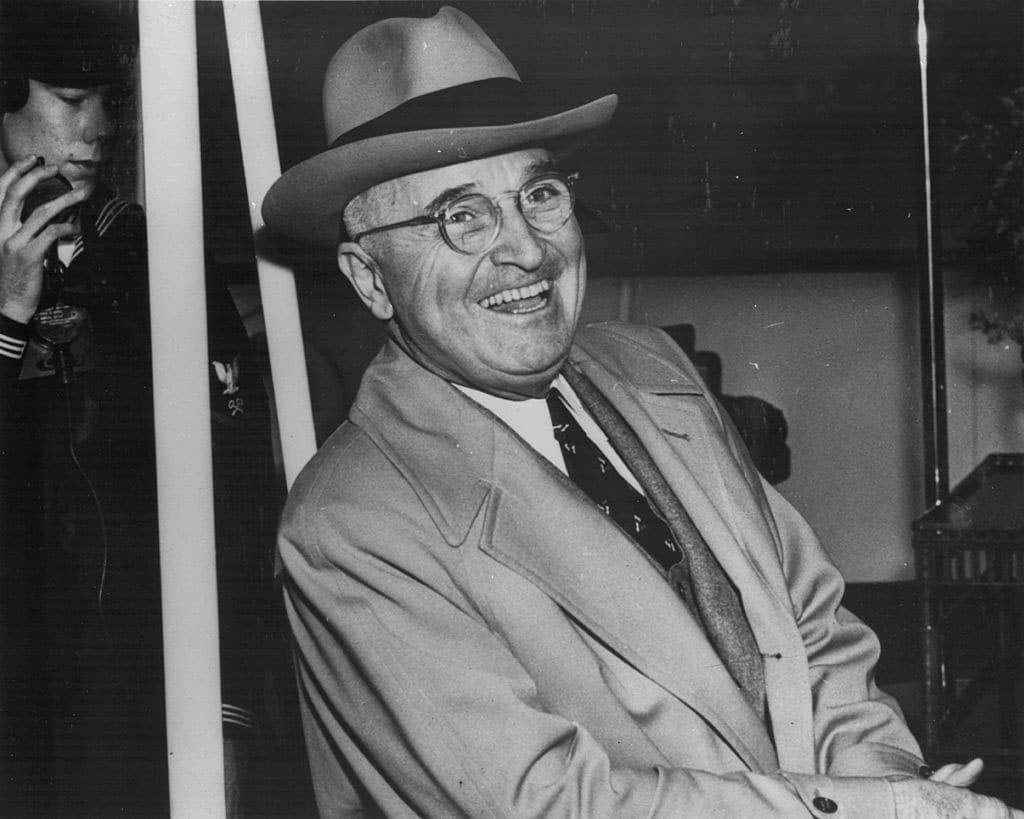
Harry Truman — Ben Azzai’s Kind of Mensch

Harry Truman surely was a mensch,
never creating any White House stench.
Mensch, in case you do not know, means human,

defining in a nutshell Harry Truman.

Explaining his words, “I would give ’em hell,”
he said, “I didn’t give them hell, I just
gave them the truth,” and when he chose to tell

the truth that they thought hell he won their trust.

I don’t know what reward God gave to Truman
for making sure the US was the first
to vote for Israel, deed this great non-Jew man

did uncommanded and quite unrehearsed.

Morley Safer had a segment on David McCullough on “60 Minutes” two days before a presidential election. What the country needs, he implied, is someone like Harry Truman, a man who dealt with problems, preparing to do what was unpopular.

McCullough says: “He told the people the truth—can you imagine? People said; ‘Give them hell!’ I didn’t give them hell. I just told them the truth.”

In “David McCullough, Best-Selling Explorer of America’s Past, Dies at 89,” an obituary of David McCullough by Daniel Lewis in the NYT, 8/8/22, Lewis writes:

He spoke of the founders’ notion of the pursuit of happiness — which, he said, did not mean “long vacations or material possessions or ease.” Rather, he said, “as much as anything it meant the life of the mind and spirit.”

“It meant education,” he added, “and the love of learning, the freedom to think for oneself.”

Personally, he said: “The reward of the work has always been the work itself, and more so the longer I’ve been at it.”

David McCullough’s statement “The reward of the work has always been the work itself” reflects the Rabbis’ statement שכר מצוה מצוח, the reward for a commandment is the performance of the commandment. Avot 4:2 states:

בֶּן עַזַּאי אוֹמֵר, הֱוֵי רָץ לְמִצְוָה קַלָּה כְבַחֲמוּרָה, וּבוֹרֵחַ מִן הָעֲבֵרָה. שֶׁמִּצְוָה גּוֹרֶרֶת מִצְוָה, וַעֲבֵרָה גוֹרֶרֶת עֲבֵרָה. שֶׁשְּׂכַר מִצְוָה, מִצְוָה. וּשְׂכַר עֲבֵרָה, עֲבֵרָה:
Ben Azzai said: Be quick in performing a minor commandment as in the case of a major one, and flee from transgression; For one commandment leads to another commandment, and transgression leads to another transgression; For the reward for performing a commandment is another commandment and the reward for committing a transgression is a transgression.

Gershon Hepner is a poet who has written over 25,000 poems on subjects ranging from music to literature, politics to Torah. He grew up in England and moved to Los Angeles in 1976. Using his varied interests and experiences, he has authored dozens of papers in medical and academic journals, and authored “Legal Friction: Law, Narrative, and Identity Politics in Biblical Israel.” He can be reached at gershonhepner@gmail.com.

Harry Truman — Ben Azzai’s Kind of Mensch Read More »

A Bisl Torah – The Middle Seat

As we flew home to Los Angeles from Philadelphia, we noticed a young girl sitting between an older man and woman.

The girl appeared to be about eleven years old. As she settled in, she introduced herself to the others, explaining that her mother was sitting several rows behind due to some glitches through the airline. I expected the introductions to lull into silence, but that assumption was far from accurate.

The girl delightfully “interviewed” each person, engaging the three of them in a conversation about professions, hobbies, movie and music interests and family dynamics. I couldn’t help but eavesdrop and secretly, wanted to join. Not once did the conversation feel forced nor did I notice either passenger look annoyed. Natural breaks would occur: time to read, watch television or sleep. But rhythmically, they would fall back into step, sharing stories and getting to know each other.

It seems like the inclination on airplanes is the opposite of what I witnessed. Get into your seat, acknowledge your row-mates, and then, never speak again. Slight interruption for asking to use the restroom. But otherwise, don’t make eye contact and maintain as much legroom and armrest control as possible. Engaging in storytelling and finding commonalities is not what we signed up for.

But what if we did? The three passengers were from different states and led very different lives. They didn’t exchange numbers but clearly enjoyed the experience of connecting for a few short hours. The greatest risk each of those passengers took was moving beyond an initial hello. Great risk, great reward.

There is benefit in seeing worth in a stranger. Pirke Avot teaches, “Ben Zoma said: Who is wise? He who learns from every man….” The text does not say, he who learns only from the seatmates worthy to speak with. We have a sacred obligation to see each person, friend, stranger and even foe as someone who will help us gain wisdom. Wisdom as to how to better impact and engage in this world.

In these final weeks of summer, happy flying. Perhaps in between your nap and good book, you just might meet someone that will reveal a lesson worth learning.

But first, you have to say hello.

Shabbat Shalom


Rabbi Nicole Guzik is a rabbi at Sinai Temple. She can be reached at her Facebook page at Rabbi Nicole Guzik or on Instagram @rabbiguzik. For more writings, visit Rabbi Guzik’s blog section from Sinai Temple’s website.

A Bisl Torah – The Middle Seat Read More »

A Moment in Time: Crossing the Line

Dear all,

Shalom from Jerusalem! Ron and I are here exploring the country of our ancestors and of our descendants. We have met with extraordinary people, including colleagues, Rabbinical Students, and family. We have eaten some of the best food on the planet. We have absorbed the shock of air-raid sirens, as Gaza sent hundreds of missiles toward Jerusalem and Tel Aviv. And we have re-energized our commitment to pursing peace in this fragile region of the world.

One highlight of our trip was visiting the Israel Museum here in Jerusalem. Yes, the exhibits are extraordinary, and I probably could have captured dozens of them for my message this week.

But sometimes it’s the simplest things that take me off-guard that give me pause. This time it was a warning sign near an are installation saying “Please Do Not Cross This Line.”

How often do we find ourselves approaching that line?

How often in our relationships?
How often in our communications?
How often in our families?
How often in our negotiations?

How often when we budget our time or our finances?

When is it appropriate to get close, really close to the line?

And when is it actually necessary to cross it?

Life is challenging. In any given moment in time, we find ourselves testing the boundaries. Let’s just make sure that we are doing so for the right reasons!

With love and Shalom,

Rabbi Zach Shapiro

A Moment in Time: Crossing the Line Read More »

BCC Celebrates New Rabbi, Milken Student Completes Prestigious Internship

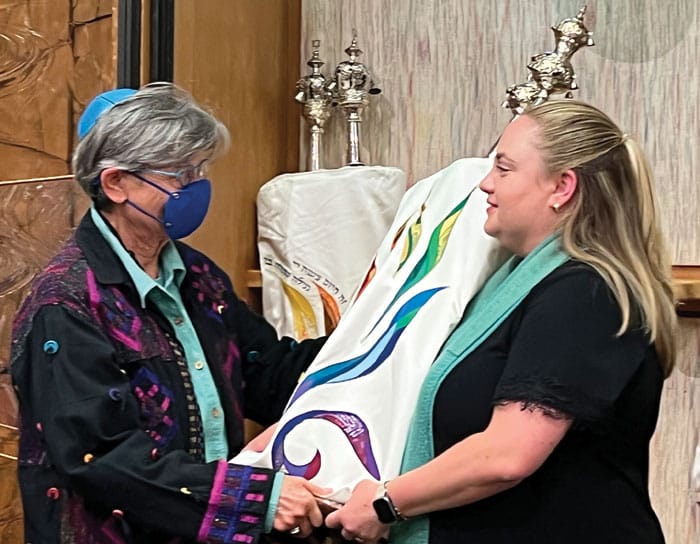
Progressive, LGBTQ+ congregation Beth Chayim Chadashim (BCC) welcomed its new spiritual leader, Rabbi Jillian Cameron, during a recent installation ceremony. 

Participants of the Friday night installation service, held July 29, included BCC Rabbi Emerita Lisa Edwards and BCC Cantor Juval Porat.

Cameron’s rabbi, Rabbi Elyse Frishman, was also in attendance. 

New BCC Rabbi Jillian Cameron enjoys a treat-filled open house. Photo by Jessica Donath

More than 60 people attended the service at BCC in person, and another 40 tuned in on Zoom, “making the installation the Shabbat service with the most attendees post pandemic,” BCC Executive Vice President Jessica Donath told the Journal. 

Cameron is the BCC community’s first permanent rabbi since Edwards, who led BCC for 25 years, retired in 2019. 

Since joining BCC in July 2020, Cameron has ushered the congregation through an uncertain and unprecedented time. 

Festivities celebrating Cameron continued at the synagogue, located on Pico east of La Cienega Boulevard, all weekend long. On Saturday morning, the congregation held a study session with Frishman, editor of the Reform movement’s prayer book, in its parking lot. On Saturday afternoon, a family-friendly open house featured a bounce house, snow cones, the dedication of a time capsule marking the end of BCC’s 50th-anniversary celebration year, havdalah, a tour through the building led by its architects and a light dinner.

BCC was founded in 1972, at a time when gay and lesbian Jews were not welcome at the majority of mainstream American synagogues. The congregation recently celebrated its 50th anniversary year with a gala event.


Milken Community Schools student Seth Cohen participates in the SEES summer internship in Austin, Texas. Courtesy of Milken Community Schools

Seth Cohen, a Milken Community Schools student, was selected for the prestigious Student Enhancement in Earth and Space Science (SEES) summer internship, which was held at the University of Texas at Austin’s Center for Space Research.

As part of the hybrid program, featuring in-person and remote work opportunities, students collaborated with scientists and engineers and conducted authentic research from data received from NASA’s earth observing satellites as well as designing Mars habitats, Lunar Exploration and analysis of images from the International Space Station.

The nationally competitive program, sponsored by NASA’s Texas Space Grant Consortium, selects students who will increase their knowledge of science, technology, engineering, and math through earth and space education. Almost 1100 applications were received for the coveted 92 on-site internship positions. Students worked remotely with their project scientist prior to the on-site internship.

Cohen and the other students came together in-person from July 16-30 in Austin, Texas to conduct experiments, tour facilities, network and conduct research while being mentored by NASA subject matter experts at University of Texas at Austin. The internship culminated with a virtual symposium held Aug. 1-3, during which time project teams presented their research.

BCC Celebrates New Rabbi, Milken Student Completes Prestigious Internship Read More »

Ready, Set, Food! A New Way to Prevent Allergies

It all started with Bamba, a popular Israeli peanut butter snack for kids. This soft food is often given to babies in Israel – and has accidentally prevented them from developing peanut allergies.

According to Daniel Zakowski, co-founder and CEO of Ready, Set, Food! (RSF), an allergen mix-in product, there have been four randomized, controlled trials that have shown that early and frequent feeding of allergens to babies can prevent between 70% and 90% of food allergies.

Based on the trials, new medical guidelines in the United States and abroad say that to prevent food allergies, all babies should start eating allergens early and often, starting at four months and continuing  (with guidance from a doctor) on an ongoing basis.  

“Even now, two-and-a-half years after the guidelines came out, only 15% of new parents knew that they could prevent food allergies by feeding allergens early and often,” Zakowski said.

When his nephew developed severe food allergies five years ago, Zakowski saw not only a good business opportunity, but also a chance to save hundreds of thousands of babies every year in the U.S. from developing food allergies.

“One thing that my grandparents really instilled in me is that each person can make a big difference in the world,” he said. “My grandmother was the first female president of the Jewish Federation and my grandfather was an early president of AIPAC.”

The mission at Ready, Set, Food! is to give parents the tools they need to help ensure their baby has a future of food freedom. 

Zakowski has known co-founder, Dr. Andy Leitner, since they were kids. In the 1990s, they attended Sinai Akiba Academy together and then went to Harvard Westlake, where they were in the “Jewish Awareness Club,” along with one of their early investors, Bryan Berkett. “We had a lot of overlapping time even before we started a company together,” Zakowski said.”I married my wife Jackie Matthew, an Agoura hills native, in 2011, and Andy married Jackie’s sister, Marissa Matthew, in 2014.”

Their kids are around the same ages, as well. Their oldest children are 8 and 7-years-old, and they both have 5 and 3-year-olds; the youngest have used RSF. Leitner’s middle child is the one with the food allergies. 

“Andy had already heard about food allergy prevention,” Zakowski said. “My nephew has eczema, which puts him at a higher risk for food allergies, but my nephew wasn’t ready to eat all of those foods at such a young age. And by the time he was ready, it was already too late.”

Zakowski and Leitner knew they had to make it easier for parents to feed allergenic foods, such as peanuts and eggs to their baby, starting as early as 4 months of age. “It was obvious to us as parents the only thing that babies reliably eat at 4 months of age is a bottle, so we knew we had to make it possible for parents to feed peanuts, eggs and milk to their baby through a bottle,” Zakowski said.

To develop their first product, they worked with two friends from the Jewish community, Dr. Katie Marks-Cogan, who is RSF’s Chief Allergist, and Aaron Rowe, a scientist in Zakowski’s kitchen. After validating the product themselves, they asked friends to try it with their babies.

Over the last several years, Zakowski, who along with his partners went on Shark Tank and raised money from Mark Cuban, have steadily grown their company. 

Over the last several years, Zakowski, who along with his partners went on Shark Tank and raised money from Mark Cuban, have steadily grown their company. By partnering with major healthcare enterprises such as Providence Health, they are helping to educate 250,000 parents per year about food allergy prevention.

 “[Providence Health] actually embedded our educational tools in their electronic medical records, so that every patient visit under the age of one gets educational material,” he said. 

Ready, Set, Food!’s patented system was created to make it very simple for all parents to feed allergens, such as peanuts, eggs and milk, to their baby by including allergens in the foods they’re already eating, whether it’s a bottle of breastmilk/formula, baby oatmeal or snacks. 

Their products range from one that’s just peanut, egg and milk powder that dissolves in a bottle of breastmilk or formula to baby foods with nine allergens pre-mixed inside. They also have a guidance system that helps parents add on more allergens when their babies are ready for food. All products are organic, non-GMO and have no additives.

RSF, which improves kids’ quality of life and saves kids’ lives, also has an education website – PreventAllergies.org – to teach people about food allergy prevention. It also provides DIY recipes.

“Missing the window for early allergen introduction, and having your baby potentially develop severe food allergies, is a choice that sticks with you forever.”
– Daniel Zakowski

“There are many parenting decisions that matter, but often we obsess so much about choices that we won’t remember one year later, let alone by the time they are adults,” Zakowski said. “Missing the window for early allergen introduction, and having your baby potentially develop severe food allergies, is a choice that sticks with you forever.”

Ready, Set, Food! A New Way to Prevent Allergies Read More »

The Ten Celebrity Commandments – A poem for Parsha Vaetchanan

Hear, O Israel, the statutes and ordinances which
I speak in your ears this day, and learn them,
and observe [them] to do them.
-Deuteronomy 5:1

The ten commandments are worth repeating
because they are the famous ones, even though
there are six hundred and three others.

The first ten are the ones whose autographs
you would want if ran into them at the supermarket.
Look, there’s you shall not steal

hanging out by the organic cucumbers.
I saw you shall not covet thy neighbor’s wife
once on a date. I didn’t say anything.

I’m pretty sure I saw you should not murder
getting on a northbound train in San Diego
several years ago. By all accounts, that train

arrived in Santa Barbara without an issue.
I’m already friends with remember the
Sabbath Day and keep it holy, but

I live in L.A. and that’s just the kind of thing
you’d expect. I did go through extraordinary
efforts to have a meet and greet with

honor your father and your mother.
I’m not so much mesmerized by celebrity
but I love their work so much.

I’ve noticed that you shall not bear false witness
hasn’t been getting much work lately.
But I checked their net worth online –

They’ll be fine. You shall not make idols
is really the people’s commandment.
So nice. So approachable.

As for you shall have no other gods before me
honestly I’m a big fan of Their earlier work.
I watch the trades to see what They’re up to.

It’s hard to tell when someone’s been
permanently canceled. I’m hoping for a comeback.
I think we’re all hoping for a comeback.


God Wrestler: a poem for every Torah Portion by Rick LupertLos Angeles poet Rick Lupert created the Poetry Super Highway (an online publication and resource for poets), and hosted the Cobalt Cafe weekly poetry reading for almost 21 years. He’s authored 26 collections of poetry, including “God Wrestler: A Poem for Every Torah Portion“, “I’m a Jew, Are You” (Jewish themed poems) and “Feeding Holy Cats” (Poetry written while a staff member on the first Birthright Israel trip), and most recently “The Tokyo-Van Nuys Express” (Poems written in Japan – Ain’t Got No Press, August 2020) and edited the anthologies “Ekphrastia Gone Wild”, “A Poet’s Haggadah”, and “The Night Goes on All Night.” He writes the daily web comic “Cat and Banana” with fellow Los Angeles poet Brendan Constantine. He’s widely published and reads his poetry wherever they let him.
The Ten Celebrity Commandments – A poem for Parsha Vaetchanan Read More »

In War-Torn Ukraine, Medical Staff Struggle to Treat Cancer With Help of Israeli Experts

To read more articles from The Media Line, click here.

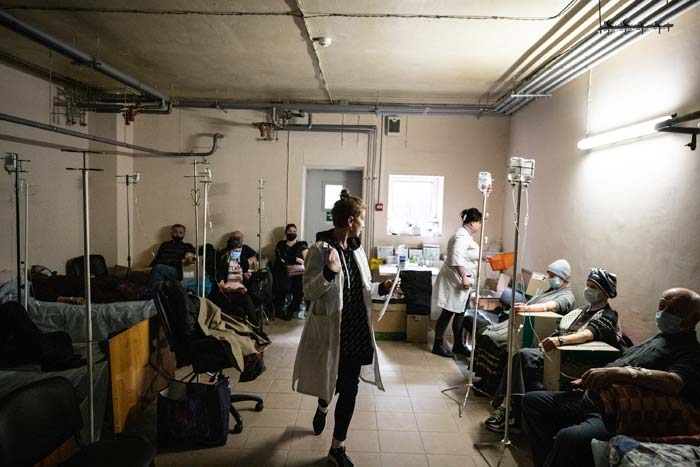
When Dr. Anna Uzlova took part in founding a charity organization for cancer patients in 2020, she thought it would face just the ordinary challenges that come with treating cancer: raising money for expensive treatments, educating about the disease, and helping people get better. She never imagined the turn her work would take due to the Russian military invasion of Ukraine. 

“Our patients now must fight two enemies. The disease, and the invasion. They have no choice but to win both of them,” she told The Media Line, in an interview from the National Care Institute in bombed-out Kiev. “We realized at an early stage that the war is going to go on for a while. So, we decided to continue our efforts to treat cancer patients, and build a nationwide system to save them, under fire.”

In March 2022, one month into the war, an unexpected offer appeared in Uzlova’s inbox. “I got a message from Dr. Polina Stepensky from Israel, offering us help in building a large-scale treatment system, by training medical staff. Of course, we said yes, and in no time the project started.”

 Stepensky is a pediatric oncologist and hematologist at Hadassah University Medical Center-Ein Kerem in Jerusalem, and is considered a groundbreaking researcher in cancer treatment. 

“I saw one of the founders of the charity organization they founded, and I thought to myself: the thing that helped me most as a doctor was training abroad. Maybe I can help them by providing training,” Stepensky told The Media Line. 

But it wasn’t just a regular collegial collaboration. Stepensky was born in the former Soviet Union, in a small village that today is located in Ukraine. This was personal for her. 

“I remember the morning of the attack, the bombs started falling on Kiev at 4 a.m. It threw me back to a song we learned at elementary school, which talks about how Kiev was bombed [by Nazi Germany] at 4 a.m. It was a horrible feeling, knowing all my classmates are running to shelters. So, I thought, maybe I can be of help, in my field of expertise.”

After receiving an OK from Ukraine, Stepensky immediately started to organize the logistics. 

“Everyone was so eager to help. My secretary worked day and night to arrange everything, voluntarily. We collected the money and the necessary permits, and soon enough, we had Ukrainian medical staff on their way here,” she said. 

By May, 2022 the training program was on its way. “The important thing for me was to teach them how to create a holistic system. Doctors are easy to train, that’s not the issue. But a nurse can make a huge difference if they know what they are doing; and social workers as well. They didn’t even have this concept, and they were astonished by what they do,” Stepensky said. 

Another important part of the training had to do with advanced treatment. 

“Here in Hadassah, we have some of the most advanced treatment methods in the world, such as CAR-T (cell therapy). But we also learned how to run treatment protocols in very efficient ways. This could save an enormous amount of money for the health system,” according to Stepensky.

Back in Ukraine, Uzlova explains how crucial it is. 

“The medical system in Ukraine is not far from collapsing. Sure, we had problems in purchasing some of the treatments before the war, because they were always expensive. But after the fights started everything just became harder to do, and way more expensive.”

Stepensky hopes more medical staff from Ukraine can arrive at Hadassah soon for training. 

“The (Hadassah) Women’s Zionist Organization of America granted us another $150,000 from fundraising to keep the program running. I hope it will be enough for another year of training. We have a lot of knowledge to share, and the Ukrainian teams are eager to learn. We are still in close contact with them on a regular basis, to help them improve the system,” she said. 

The support to the project is only growing, and comes from all directions, Stepensky says. 

“There was not one department in the hospital that didn’t open its gates for them, for anything we asked for. We are also in touch with the Israeli embassy in Kiev, to make visa granting faster for future teams,” she said. 

Israel was publicly slammed by Ukraine several times since the war started for not taking a clearer stand on its fight against Russia, and for not supplying it with military aid. Training medical staff, says Stepensky, is another way of providing aid, humanitarian aid. 

“It was important for me to show them how people in Israel support Ukraine, and I’m glad to say it was very easy. When we went to the beach one day, complete strangers who saw us realized they are doctors from Ukraine and immediately asked if they can buy them anything. I told them they can get them an ice cream,” she said, laughing.

“It was a great stay in Israel, and it really helped us to improve our treatment,” Uzlova said. “I believe this cooperation with Hadassah will continue and am looking forward to it. I mean, we need to keep treating patients no matter what, and find ways to do it with less money. And who better than Israelis to teach us how to run a health system under fire?”

Before the war, there were nearly 1 million people in Ukraine with a history of cancer, and about a third of them were receiving active treatment, Uzlova estimates. 

“It’s almost impossible to get data now. We try to focus on areas that aren’t occupied, and right now at least Kiev is a little more stable. It helps, but on the other hand we know that there are many patients in occupied territories who we can’t help. When we receive calls from them our first advice is to try and make it to the free areas in Ukraine,” she said. 

Since the war started, at least three cancer treatment centers have been occupied by the Russian army, in Kherson, Melitopol and Mariupol. 

“When Russia took medical centers, it killed doctors and patients, and by preventing treatment more people die daily. What worries me is that the world is already forgetting about the war. The fight is ongoing, and the medical fight is also ongoing. We need monetary support from our allies, and we need them to remember that nothing is over. It’s a fight for life,” Uzlova said.

In War-Torn Ukraine, Medical Staff Struggle to Treat Cancer With Help of Israeli Experts Read More »

Step Into The Podcast Bus, a New Recording Studio on Wheels

Daniel Lobell has been podcasting since the art form was introduced in 2004. He started the first podcast to feature interviews with comedians, Comical Radio, and has interviewed over 1,000 entertainers, including George Carlin, Chris Rock, Larry King, Marc Maron and Maria Bamford. 

In his latest venture, Lobell, who is also a standup comedian and comic book creator, conducts interviews from his favorite corner in The Podcast Bus, the only mobile recording studio in Los Angeles inside of a converted school bus. 

“For a long time, I’ve had the idea to convert a bus into a studio,” Lobell, who is married to Community Editor Kylie Ora Lobell, told the Journal. “It’s finally come to fruition.”

The bus can record audio and video for four people at a time. It’s fitted out with top-of-the-line equipment, atmospheric lighting and comes complete with a fully stocked mini bar.

The bus can record audio and video for  four people at a time. It’s fitted out with top-of-the-line equipment, atmospheric lighting and comes complete with a fully stocked mini bar.

With the vision of a pioneer, the counsel of friends and a vast amount of technical research and inexhaustible energy, Lobell customized his studio on wheels. “I wanted it to be a certain way,” he said. “It took a lot of time, investment and energy to get it the way you see it today.”

Lobell first had to figure out how to build a spotless, high-tech studio in a compact space. He also needed to install air conditioning on the bus, which could reach over 100 degrees Fahrenheit on hot days. “The A/C needed to be silent,” he said. “You can’t hear it, even though it’s on full blast.”

Lobell, who started out in traditional broadcast radio, covets the freedom podcasting provides. “Broadcast radio, which I also love, was a different thing,” he said. “You would be told, ‘You have to go to commercial break at this time,’ or ‘Your show has to be done at this time,’ whether you get to what you want to do or not.”

When Lobell isn’t working on The Podcast Bus, he’s putting out his autobiographical comic book series, “Fair Enough,” which is in the style of Harvey Pekar’s “American Splendor,” recording his comic book podcast of the same name or doing standup comedy.

There are four microphones in the bus.

“People say, ‘You are doing so many different things,’” Lobell said, who has released two comedy albums on Stand Up! Records. “I would say I am doing only one thing: storytelling. I tell stories on stage, on a mike standing up, on a mike sitting down, by writing the stories, by having them illustrated. It’s all the same skill on different platforms.”

Growing up on Long Island, Lobell, who has lived in Los Angeles for 10 years, would draw comic books and sell them to fellow yeshiva students. With “Fair Enough,” he hires a different artist for each issue.

“I work hand-in-hand with artists after I draw rough sketches of what I want each panel to look like,” he said. “I give detailed notes and, when possible, I give reference photos for them to work from, like from my childhood bedroom, because these are real stories.”  

The outside of The Podcast Bus.

Putting together each comic book takes about a year. So far, he’s released five issues, and his latest one is about his lifelong love for Costco. “Each story takes as many pages as it takes,” he said. “That’s the good thing about not having a publisher to answer to.”

On The Podcast Bus, Lobell will focus on working with professionals who want to start a podcast to promote their business, as well as nonprofit organizations. He is also recording his own show; his latest interview was with Seth Glass, “a wonderful musician, singer, songwriter andguitar player, who has an incredible story,” he said.

“He’s a spiritual guy with such an eclectic knowledge, a student of Shlomo Carlebach and Aryeh Kaplan; a Jewish soul brother. I grew up on his music.”

Lobell also works closely with his chiropractor, Dr. Daniel Rudé, who launched a show called The Wellness Source Podcast.

“He is a great on-air personality,” Lobell said. “I have been producing his podcast from the bus, and I get a lot of joy out of doing that.”

As public as his life is, Lobell insists, “I don’t have to be on the air to enjoy it.”

Step Into The Podcast Bus, a New Recording Studio on Wheels Read More »