fbpx

July 7, 2022

“The Kabbalah of Light” Offers Enlightenment and Hope

It’s time for a dreaming revolution.

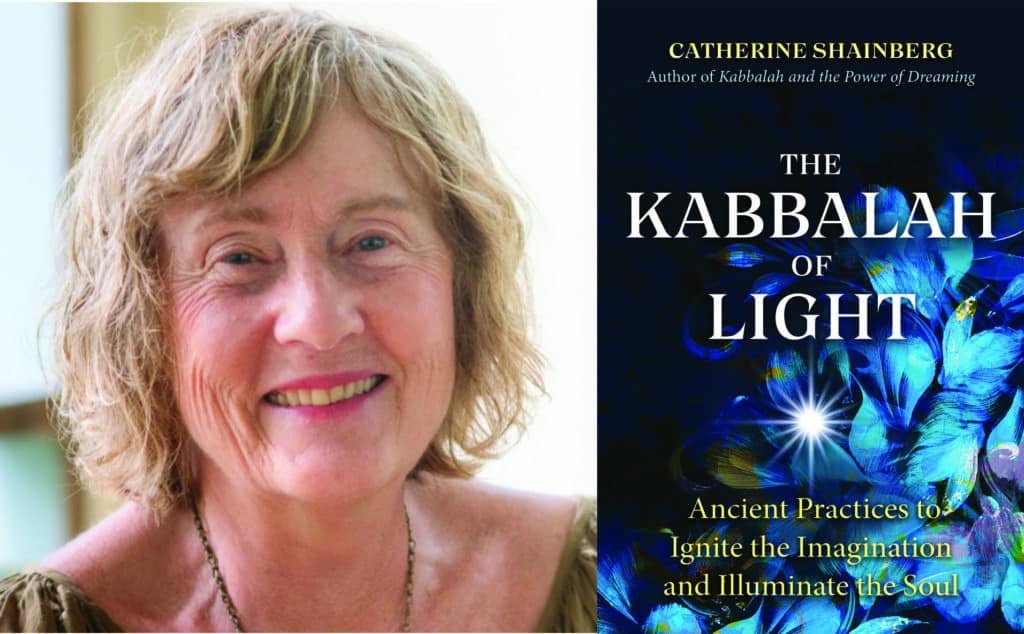
Author Catherine Shainberg, PhD, believes that day dreaming, night dreaming, lucid dreams and visioning can change your life. Her book “The Kabbalah of Light: Ancient Practices to Ignite the Imagination and Illuminate the Soul” offers the tools everyone needs in this time of uncertainty.

“This is a great methodology that has been kept hidden for hundreds of years and transmitted in a small circle,” Shainberg said. “Now the world has changed, and we really need to get tools into people’s hands that can change their lives.”

Shainberg is an internationally renowned transpersonal psychologist, lecturer and award-winning author. For more than 40 years her New York City-based School of Images has helped thousands of people worldwide using her imagery and dream techniques.

Her work – and “The Kabbalah of Light” – are grounded in the ancient Kabbalah of Light tradition, described in the first 28 lines of the Book of Ezekiel. Shainberg integrates its timeless wisdom with modern Western traditions. She offers 150 short exercises to help readers tap into their subconscious, overcome challenges and manifest their ideal lives.

“Nobody knows where the future is going to go, and I think this is hurting people,” Shainberg said. “The inside vision is going to show you what the future is for you, for the world, for your society.”

According to Shainberg, dreams can show you where you are. For instance, you go to sleep with a question or anxiety and wake up with an answer or direction. You can also have a dialogue with your dreams.

According to Shainberg, dreams can show you where you are. For instance, you go to sleep with a question or anxiety and wake up with an answer or direction. You can also have a dialogue with your dreams.

Nightmares, she said, are very useful. When you have a nightmare, rather than be haunted by it, you can protect yourself and confront the “beast.”

Shainberg worked with a client who had a recurring nightmare for 30 years, and no one could help him. He was a Jewish man who dreamt that a Gestapo officer was chasing him. 

“I gave him whatever protections felt good for him and I said to him, ‘Now turn and face him,” Shainberg said. “The Gestapo man said to him, ‘Finally. I’ve been running after you for so many years. I’m exhausted.’ Then they had a conversation, where they agree the war was over, and they didn’t want to do this anymore. And that was the end of his nightmares.”

The tradition in Judaism is to look at your dreams for insight, Shainberg said. 

“There’s a whole section of the Talmud that describes this in detail,” she said. “If there’s a bad dream, we need to speak it out in the synagogue or with three friends. And the three friends hear the dream and then they change it by saying ‘This dream is good’ three times.”

Shainberg’s journey with imagery started in childhood. Her imagination entertained and educated her. Throughout her childhood and early adult years, she lived effectively and successfully in the day-to-day world, but the lure of the inner world remained powerful. 

“I followed the inner promptings for many years,” she said. “They told me ‘go here, go there, go to Israel.’” 

When Shainberg heard the name of the woman who would become her teacher, her “head exploded into light,” so she moved to Jerusalem to meet her.

This was renowned Kabbalist and mystic, Colette Aboulker-Muscat (1909 – 2003); she was Shainberg’s mentor and teacher for more than a decade in Jerusalem. 

When they met, Shainberg told Aboulker-Muscat: I want you to teach me how images move people. 

“She said, ‘I’ve waited for you for a long time,’ and she adopted me as a spiritual daughter,” said Shainberg.

The author, who did not know she was Jewish, learned later in life that her mother’s family was not only Jewish, but also owned the land on which the yeshiva where Isaac the Blind worked.

“After about two years, I had a kind of epiphany in which I saw all the great sages up in the heavens and great letters appearing and they said, ‘Judaism,’” she said. 

Aboulker-Muscat asked if Shainberg would like to know about Judaism and gave her a book to read. Everything Shainberg had written during her exercises and dreams, including the letters and the shapes of the letters, was in that book.

Shainberg converted to Judaism in the Ministry of Religion in Jerusalem in the early 1970s before she discovered her Jewish roots. She was the only woman the rabbi she studied with ever took; he told her she was ready after only three months. 

“I think there are two strands in Judaism,” she said. “You’ve got all the rabbis and the Talmud. But behind that you’ve got an incredible imaginal with the Midrash and all the Kabbalah. The two go together. We have to work two brains at the same time.”

The conscious and subconscious mind need to work together, which is something Shainberg said Jews do very well. 

“We need to be co-creators with God,” Shainberg said. “And so we can do that through the dreaming, through the imaginable work.” 

Just remember: You can’t control it. 

Shainberg said, “You have to look in and ask the question, ‘Where should I go with this?’ And the inside will answer in beautiful, clear, simple ways.”

“The Kabbalah of Light” Offers Enlightenment and Hope Read More »

What Can Happen Here Should Worry Us

The title is provocative, deliberately so, mistakenly so. The book is alarming, properly so, sadly so.

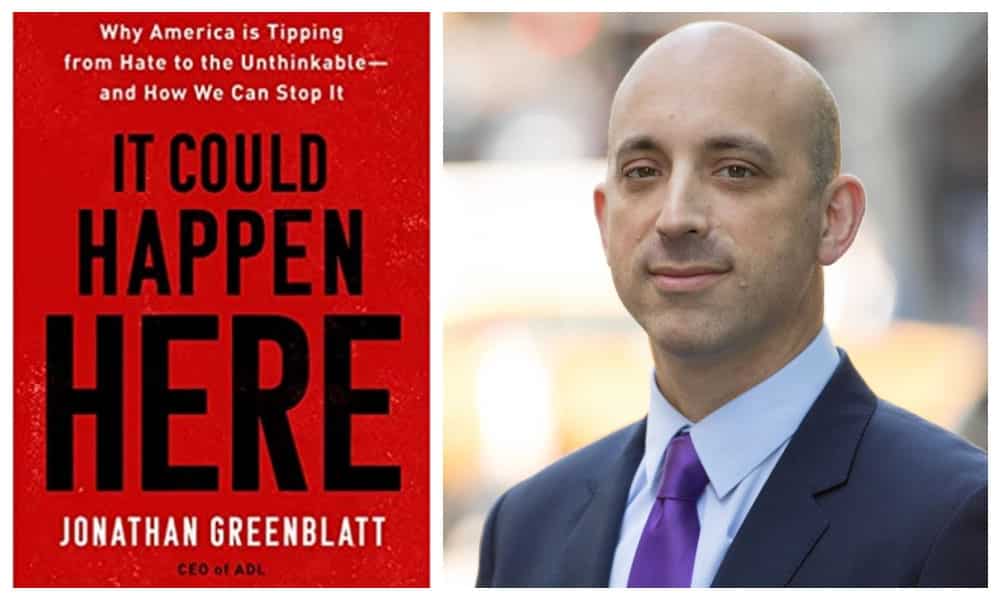
When the CEO of the Anti-Defamation League [ADL], one of the oldest, most distinguished, and most responsible of the Jewish defense agencies, warns us on his book cover that “America is Tipping From Hate to the Unthinkable” and that “It Could Happen Here,” attention must be paid.

“It” is every Jew’s nightmare. No Jew requires an explanation. “It” is the Holocaust. “It” evokes the Holocaust by bullets, the killing fields of German occupied Soviet Union where Jews were slaughtered, often within the vicinity of their homes. The killers were either special mobile killing units, the Wehrmacht [the German army], Axis armies, local gendarmerie, native antisemites, or even neighbors who sought to murder and then inherit their property and their possessions.

“It” evokes trains waiting in towns and cities to deport their Jews to death camps where assembly line factories of death were created to murder the Jews and recycle their possessions and even their bodies into the Nazi war economy.

However bad conditions are in the United States at this trying moment—and I don’t want to minimize for a moment the hatred I witness in our society, the fragility of our democracy, the polarization of our politics, the violence of mass shootings and the venom of our discourse—the United States is not Nazi Germany, not by a long shot. 

But that should not be a source of consolation to any American.

Jonathan Greenblatt is a man to be taken seriously, and so it is unfortunate that in his zeal to draw the attention of his readers and to warn them of what he sees, what he experiences day in and day out in his important, dare one say, indispensable role, he goes to a somewhat irresponsible extreme. Jews, not only Jews, but Americans of all stripes, should be alarmed, but they should not be Holocaust-level panicked.

He surely knows it: Elsewhere in the book he writes: “No expert we spoke with argued that genocide, a hate fueled civil war, or some other breakdown of American society was imminent or even likely.” I concur—still, conditions are deeply disturbing.

So permit me to divide this review into two parts, one to consider what Greenblatt says with such authority and such clarity and the other to assure readers that we are not living at a moment of an impending Holocaust, which should not be confused with the notion that we are not living in a terrible, dangerous hateful time where the turmoil of our society should upset, disturb, alarm, or challenge any thinking person.

A word of history may be in order. What else can the reader expect of this reviewer?

Antisemitism differs with regard to its source—religious, political, social, economic, or racial.

Antisemitism differs with regard to its goal. Religious antisemites seek conversion of the Jews and the end of Judaism. Political antisemites want to reduce the political influence of Jews or, at its most extreme, to expel the Jews and to deny them the rights of citizenship, the right to live among us. Social antisemites want to marginalize the Jews, sideline them from contact with non-Jews in what used to be called the “five o’clock shadow”—no informal relations after hours, no Jews in our clubs, our bars, our golf courses, our neighborhoods and certainly not in our homes. Nazism represented racial antisemitism, defining Jews biologically—not by the identity they affirmed, the religion they practiced, the traditions they held sacred, but by blood. Their goal was at first elimination, and later what was called in “Nazi speak” extermination, which we may call annihilation.

Antisemitism differs in the intensity of the hatred of the Jews. There was a seamlessness to Nazi antisemitism as a national priority from the first of Hitler’s rants in 1919 to his last will and testament. What has made Jews less vulnerable historically in the United States is that the Jews were never on the top of the list of people to be hated, never the first target for venom. They still are not. Let me not compile the list of those who are hated before the Jews. Suffice it to say, it is best not to be the first or second target.

And antisemitism varies according to the stability of society. It is an axiom; the more stable a society, the more secure its Jewish population. And the United States in 2022 is not a stable society. There is an ongoing health crisis, an economic crisis, a crisis of democracy, truth, polarization, the legitimacy of institutions including religious, government, universities, schools, and courts, a demographic crisis. The list can go and on.

Antisemitism varies according to the stability of society. It is an axiom; the more stable a society, the more secure its Jewish population. And the United States in 2022 is not a stable society.

Greenblatt understands that the internet is a megaphone, and the social networks mean that haters and hatred cannot be quarantined. There is a significant support system for haters whose views are reenforced by what they read, with whom they text, with those whose posts they share.

Greenblatt’s book is balanced. Although he served in the Obama administration, and therefore one can reasonably assume that he is a Democrat, he is willing to call out the anti-Zionist progressives or Farrakhan supporting leftists without hesitation or apologies. He is willing to attack cancel culture, especially when directed against Zionists on American campuses, willing to call out the Squad. His advice is sanguine: Let those of the left critique leftist antisemitism and those on the right hold their own accountable. 

As CEO of an organization whose membership and supporters are diverse, he does not shy away from his critique of the Trump administration and of the former President himself for unleashing hatred and for cuddling antisemites and white supremacists even as they were supportive of Israel.

The strongest part of the book—alluded to in the book’s subtitle (“and how we can stop it”)—is Greenblatt’s  prescriptions for action, coalition building and calling out hatred. He is unabashedly determined to protect the safety of Jews, but not Jews alone for he understands that “America could not be safe for Jews unless it is safe for all people.”

The strongest part of the book is Greenblatt’s prescriptions for action, coalition building and calling out hatred. 

He understands antisemitism in the context of societal hatreds and as a global phenomenon. Social change and instability, political unrest, mass unemployment the influx of refugees, the pandemic and wars intensify hatreds and fuel antisemitism. These conditions are made worse by a demagogue who riles up passions, speaks untruths and arouses extremists.

Greenblatt also understands the roots of the chant “Jews will not replace us!” in the fear that a dominant ethnic group has when it loses its majority or dominant status. In the post-World War II world and most especially after the Civil Rights struggle of the 1960s, the United States became a more open, more pluralistic society. Jews were more welcome, glass ceilings were broken, and women and Black people were included. Jews in fact thrived, and so white Christian male dominance was challenged.

Ironically, businesses have adjusted well to the new reality; so too has the U.S. military. Both understand that to achieve their goal, a diverse force must work in harmony toward that common goal. They must pull together and not tear the organization or country apart. 

Occasionally Greenblatt overstates his case. He describes one incident as “a mob waving pro-Palestinian flags attacked a group of Jewish men as they ate dinner in a Los Angeles restaurant.” Still, he is far more measured than the prominent Israeli columnist Caroline Glick, who described an event during the Black Lives Matter protests as a “pogrom” in Los Angeles and then castigated the community for its underreaction, as if she were the great Hebrew poet Chaim Nachman Bialik City of Slaughter responding to the Kishinev pogrom. 

There is a curious, unfortunate omission as Greenblatt distinguishes between legitimate criticism of Israel and antisemitism but does not sufficiently explain how. When IHRA and the Jerusalem Declaration have different and divergent definitions of antisemitism, Greenblatt should have weighed in more deeply on the matter.

He is willing to tell us good news. ADL has conducted a longitudinal study of antisemitism in the United States for generations. In 1964 the percentage of Americans holding antisemitic views was 29%; in 2020, the percentage was but 11%. Yet in 1964 antisemites were reluctant to express their antisemitism, and even more so to act on it. Self-restraint was common: “You may think it but don’t say it.” Today expressions of hatred can be a badge of honor, a mark of authenticity. Yet he notes a tenfold increase in reported antisemitic events within the past five years alone, some of which—but surely not all—he clearly attributes to better reporting.

Religious antisemitism is on the decrease. Christianity has been overtly repentant, more dramatically if quietly so. And there is some evidence that American Muslims have begun to understand that civility in interreligious life is a mark of good citizenship and allows for minority religions to flourish, something Jews learned generations ago.

Greenblatt understands that how a community responds to acts of hatred is important. It can isolate the hater and allow the forces of civility and decency to triumph. Such was surely the case in Pittsburgh after the Tree of Life murders when every facet of society joined together, from government to religious leaders, from sports teams to civic leaders, in acts of solidarity. The aftermath made Pittsburgh stronger and increased intercommunal solidarity.

Greenblatt has been courageous in the battles to get social media to accept responsibilities for the venom that is perpetuated on their sites and reports on his battles with Facebook, his encounters with Mark Zuckerberg and with Fox News, among others. He is candid as to the reasons that ADL and other anti-hate groups have been less successful. There has been no economic punishment for hosting hate speech. The profits are huge.

Greenblatt believes that all of us are responsible for fighting hate in everyday life. He has a skill for condensing into memorable phrases what must be done: Speak up, share facts, show strength. We must mobilize government and religion, create a sense of safety, learn more, complicate thinking, take action.

As Greenblatt clearly demonstrates in this book and as is manifestly apparent in our daily news reports, there is much work to be done and ADL will be there to do it. One comes away from the book with a sense that its leader is responsible and responsive, committed and caring. He understands the problem. That is a good start.


Michael Berenbaum is a Distinguished Professor of Jewish Studies and Director of the Sigi Ziering Institute: Exploring the Ethical and Religious Implications of the Holocaust at American Jewish University. 

What Can Happen Here Should Worry Us Read More »

Passing Through – A poem for Parsha Chukat

You shall not pass through me,
lest I go out towards you with the sword!
-Numbers 20:18

In a television program I am watching
on a premium streaming television network
that you’ve probably heard of

a superhero (because all filmed and
televised entertainment now revolves
around superheroes)

passes through a person so fast
on the streets of New York City
that she, essentially, vaporizes

in front of the onlooking eyes of
her horrified boyfriend. Although I don’t think
the ancient king of Edom saw this episode

one can generally understand
an initial trepidation before letting someone
or a kingdom of someones, pass through.

I personally like to keep the roads clean
and back then, when nothing was paved
you can imagine having to tidy up

two million sets of footprints.
This is the practicality of mine, not yours.
This is what happens when our ownership

takes priority over our humanity.
Nation after nation has said no when
we needed a place to go.

Even boat-loads of Israelites were
turned away from our own land in the forties,
when we needed it the most.

I choose human over passport authentication.
I choose real need over that’s not your water.
I never choose sword for any reason.

(outside of little plastic ones that
occasionally show up in cocktails.
But even then it’s awkward.)

Pass through, my friends.
My fellow humans.
We’re all in this together.


God Wrestler: a poem for every Torah Portion by Rick LupertLos Angeles poet Rick Lupert created the Poetry Super Highway (an online publication and resource for poets), and hosted the Cobalt Cafe weekly poetry reading for almost 21 years. He’s authored 25 collections of poetry, including “God Wrestler: A Poem for Every Torah Portion“, “I’m a Jew, Are You” (Jewish themed poems) and “Feeding Holy Cats” (Poetry written while a staff member on the first Birthright Israel trip), and most recently “The Tokyo-Van Nuys Express” (Poems written in Japan – Ain’t Got No Press, August 2020) and edited the anthologies “Ekphrastia Gone Wild”, “A Poet’s Haggadah”, and “The Night Goes on All Night.” He writes the daily web comic “Cat and Banana” with fellow Los Angeles poet Brendan Constantine. He’s widely published and reads his poetry wherever they let him.

Passing Through – A poem for Parsha Chukat Read More »

Sharon Nazarian Reflects on Her Work at the ADL

It wasn’t always clear that community leader and philanthropist Sharon Nazarian was the right fit for the Anti-Defamation League (ADL). 

When ADL CEO Jonathan Greenblatt recruited her in 2017 for the newly created position of senior vice president of international affairs, her experience had been in academia and philanthropy; she earned a doctorate in political science at USC and led her family’s prominent grantmaking foundation. 

What did she know about antisemitism education and advocacy?

But Nazarian long admired the work of the ADL. That, coupled with the feeling of urgency to combat antisemitism after the tragic events in Charlottesville, Virginia in 2017 – when neo-Nazis marched chanting “Jews will not replace us!” – convinced her to accept the position. 

“What happened in Charlottesville — those images were beyond disturbing and put fear into my heart in ways I haven’t felt since my family immigrated from Iran,” she said. “It was a key factor in my decision to join the ADL.”

Nazarian spoke to the Journal a few days before her final day with the organization, July 1, marking the end of her five-year tenure at the ADL. She highlighted the ADL’s successes fighting antisemitism in Latin America, Europe and the Middle East, and the importance of the ADL sharing its knowhow with communities abroad. 

“The threats facing Jewish communities today are global threats,” she said. “The expertise of the ADL should not only be limited to American audiences and American communities.”

At the ADL, Nazarian acted as a foreign minister of sorts while meeting with heads of state and Jewish community leaders. She has elevated the ADL’s mission of standing up to hatred whenever and wherever it occurred while learning there was much more to the organization than even she knew. 

“What I think most people don’t realize is the breadth of the ADL,” Nazarian said. “Most American Jews and others don’t know the scale of our work internationally, how we show up for Jewish communities internationally on a daily basis and use our voice to advocate.”

The ADL, she said, is data-driven. “We don’t just take positions from our gut. The number of surveys we do, the amount of research and analysis we do—my team and many other units are filled with subject area analysts. Every moment, we have our finger on the pulse on the trends.”

Nazarian has overseen the ADL’s international efforts along with its Israel office while working out of the regional space in Century City. When COVID-19 hit, she transitioned to telecommuting out of her Los Angeles home. Because her work focused primarily on events overseas, workdays the past half-decade have begun at 5 a.m., she said.

The hard work reaped rewards. Under her leadership, the ADL created a first-of-its-kind fully digital antisemitism education product. It has also exported its expertise fighting antisemitism online to partner organizations in Europe and Latin America, which Nazarian said were her two main areas of focus.

Additionally, the ADL signed memorandum-of-understanding agreements with the UK’s Jewish community as well as with Mexico’s Foreign Ministry. In 2019, Nazarian traveled to Mexico City to sign the latter, which helped to protect those of Mexican heritage living in the U.S. against anti-immigrant rhetoric. That same year, Nazarian testified before members of Congress about the spread of white supremacist ideology around the world. 

“I’ve learned how to use the powerful brand ADL in a powerful way,” she said.

Nazarian continues to be troubled by threats against Jews in the Middle East, particularly in her native Iran. A Jewish Iranian-American immigrant, Nazarian experienced antisemitism in her home country before fleeing during the Iranian Revolution. 

Iran, she said, continued to promote dangerous antisemitic ideology from the top down.

“Iran’s nefarious influence is vast,” Nazarian said. “My country of birth is the number one state sponsor of antisemitism around the world, of Holocaust denial, of terrorism. That sphere is still there, and its arm is very long. It reaches into Europe [and] Latin America and threatens Jewish communities, Jewish security and broader societies outside the Middle East.”

While the Biden Administration has been actively trying to rejoin the U.S. in the Joint Comprehensive Plan of Action, also known as the Iranian nuclear agreement, Nazarian wants American leaders to remember that Iran’s threats extend far beyond its potential nuclear capabilities – from its export of terrorism to its inhumane treatment of its own minorities to its calling for Israel’s destruction. 

Even before joining the ADL, Nazarian was passionate about defending Israel, and she praised the work the ADL has done clarifying when criticism of Israel crosses into antisemitism.

“[The] ADL has been on the front lines of being very nuanced in a post-nuanced world,” she said. “We refuse to give into that, and we are very adamant about making sure criticism of Israeli policy is never labeled antisemitic but advocating for the end of the Jewish state is clearly viewed as antisemitic.”

“[The] ADL has been on the front lines of being very nuanced in a post-nuanced world.”
– Sharon Nazarian

After leaving the ADL, she will be returning to running the Younes and Soraya Nazarian Family Foundation, which provides grants to educational initiatives. She will remain involved, however, in ADL’s search for her successor. George Selim, senior vice president for national affairs, is assuming the role in an interim capacity.

With any doubts she had about her place at the ADL long behind her, Nazarian hopes she left a lasting impact on the venerable organization. 

“I think, hopefully, what my collaboration with the ADL will show is that philanthropists, as well as academics and civil society professionals, have skills that could be additives to legacy organizations like the ADL,” she said. “Hopefully, I helped bring the ADL to new levels.”

Sharon Nazarian Reflects on Her Work at the ADL Read More »

A Bisl Torah – Mother Guilt

Our children are at sleepaway camp. So far, we haven’t received any letters in the mail. I sent each kid with pre-addressed, pre-stamped postcards. And each day, my husband and I visit the mailbox and stare at its empty container, a reminder that most likely, those letters aren’t coming our way.

Now, when I explain to family and friends that we are letter-less, the response is, “No letters are a good thing! It means they are having a great time.” But my mom-guilt goes into overdrive, and I can’t help but lay it on thick in my notes.

Dear Kids,

Don’t you think I deserve a letter back? Please write. Remember those stamped cards I spent all day and night pre-addressing? I remember my hand hurting afterwards.

Have the best time ever.

Love, Mommy

While so many have shared that camp is the place that children learn independence and often, come home with a stronger sense of maturity, I am wondering if sleepaway camp is truly, a lesson for parents. In my four-week classroom I am watching the relationships of family change and transform, witnessing the ways in which I rely on my children, and realizing how much guilt plays a factor in family dynamics. Do I really need a letter back from my children? No. Do I miss them? Yes. Do they deserve to be “guilted” into writing me back? No. Is this a lesson in separation and growth for all involved? 100 percent.

The Talmud teaches, “Always have the left hand push them away while the right hand draws them near.” Parenting is juggling. A balance of nudging our kids out of the nest while offering love and support. But the balance applies to adults as well. In all our deep relationships, we too need to be nudged, gaining a sense of individuality while maintaining ties of love and affection…minus the guilt.

May those we love feel embraced without feeling smothered. May those we adore feel care without feeling guilted. And through it all, we will all “grow up”. I won’t expect too many letters…but you better believe my arms will be wide open when my kids run off that bus.

My arms will always be open.

Shabbat Shalom


Rabbi Nicole Guzik is a rabbi at Sinai Temple. She can be reached at her Facebook page at Rabbi Nicole Guzik or on Instagram @rabbiguzik. For more writings, visit Rabbi Guzik’s blog section from Sinai Temple’s website.

A Bisl Torah – Mother Guilt Read More »

A Moment in Time: When do we Wait, and when do we Act?

Dear all,

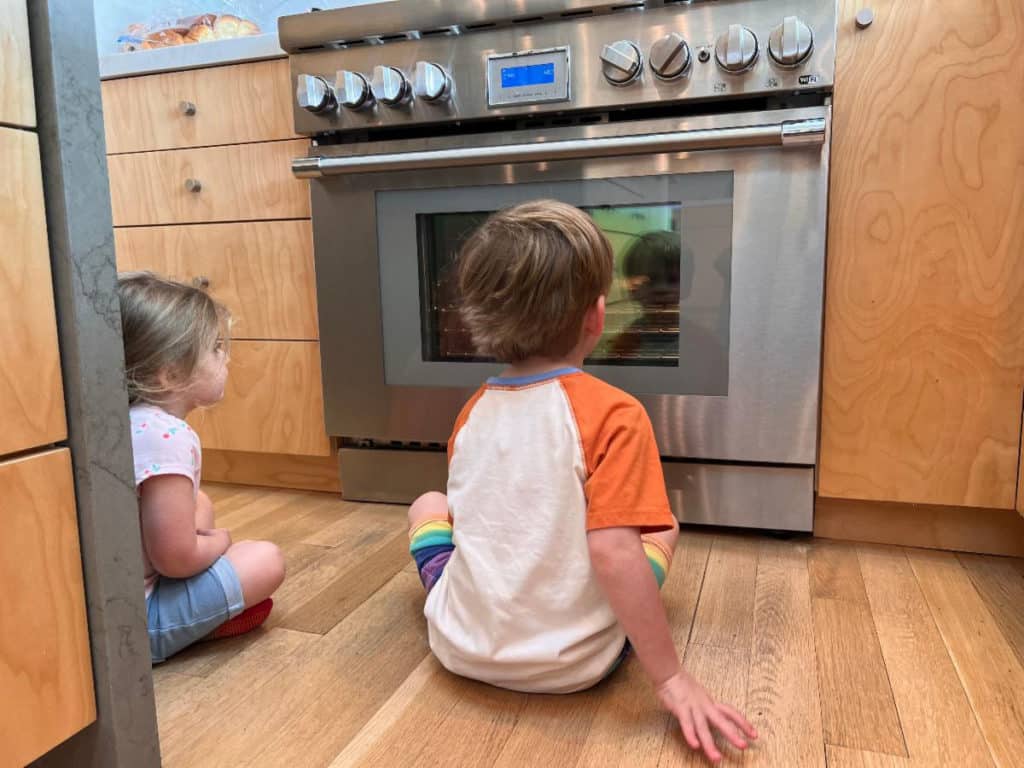
Our family made muffins this week. Maya and Eli enjoyed helping. But they did NOT enjoy waiting for the muffins to bake. Still, we showed them the timer and took the opportunity to share a lesson about the importance of waiting.

But let’s be honest…. Sometimes sitting back and waiting builds character. And sometimes waiting causes our world to suffer.

Do we wait for things to change – or do we act?
Do we wait for gun violence to subside – or do we act?
Do we wait for an emotional wound to heal – or do we act?
Do we wait for having a difficult conversation – or do we act?
Do we wait for a second wind – or do we act?

Do we wait for the Messiah to come – or do we act?

The answer at any given moment in time is not necessarily the same for any of these questions. Sometimes action is NOT prudent. And sometimes waiting gives us perspective. But keep in mind, waiting should never cause us to freeze. And action should never demand tunnel vision.

The muffins were worth the wait. And yes, we were careful to teach the kids not to be too near the oven!

With love and Shalom,

Rabbi Zach Shapiro

A Moment in Time: When do we Wait, and when do we Act? Read More »

Walking the Walk

With Jews with whom they daven very many cannot talk,
and with those whom they like to talk they often cannot daven,
and though those who don’t follow halakhah don’t walk their walk,

they love the food for thought that’s coked in their unkosher oven.

Rabbi David Weiss-Halivni said that when the chips
are down he feels inclined to take the side of people whom
he davens with, depending more on what comes from his lips

to God than words with people with whom he can talk and zoom.

Our minds are flowers, frequently by total strangers pollened,
The benefit of strangeness not outweighed by all its dangers,
generating for the smartest ones a mental cholent,

no longer money changers, checking in as mental changers.

Inspired on 6/30/22 by a talk by Rabbi Daniel Bouskila, who began his brilliant weekly Zoomed discussion of a Shai Agnon story by recalling Rabbi David Weiss-Halivni on the day of the professorial rabbi’s burial in Jerusalem’s Mount of Olives. Rabbi Bouskila quoted Rabbi Weiss-Halivni:

“It is my personal tragedy that the people I daven (pray) with I cannot talk to and the people I talk to I cannot daven with. However, when the chips are down I will always side with the people I daven with. For I can live without talking, I cannot live without davening.”

Gershon Hepner is a poet who has written over 25,000 poems on subjects ranging from music to literature, politics to Torah. He grew up in England and moved to Los Angeles in 1976. Using his varied interests and experiences, he has authored dozens of papers in medical and academic journals, and authored “Legal Friction: Law, Narrative, and Identity Politics in Biblical Israel.” He can be reached at gershonhepner@gmail.com.

Walking the Walk Read More »

Table for Five: Chukat

One verse, five voices. Edited by Salvador Litvak, the Accidental Talmudist

Moses raised his hand and struck the rock with his staff twice, when an abundance of water gushed forth, and the congregation and their livestock drank.

– Num. 20:11


Dr. Rachel Lerner
Dean, School for Jewish Education and Leadership at American Jewish University 

I never understood Moses’ punishment for hitting the rock instead of speaking to it. Moses didn’t quite follow the rules, but the result was the same. Why have such a severe and seemingly unrelated punishment? 

As an educator and a parent, I try to create natural consequences for poor choices. You don’t want to bring your jacket? You will be cold. You don’t do your homework? You get a bad grade on that assignment. Sometimes, behavior is correctable and sometimes, behavior shows you something about a person that cannot be changed. 

Rabbi Lord Jonathan Sacks suggests that Moses hitting the rock instead of speaking to it was a repetition of his action earlier in the Exodus story. He failed to understand that a new action was needed in that moment. God had tried changing Moses’ behavior by asking him to speak to the rock, but Moses showed he could not change. 

The leadership needed to bring the Israelites into the Promised Land was not the leadership needed to take the slaves out of Egypt. Moses was no longer the right leader for the new Israelites, the descendants of the slaves. So the logical consequence of not being an adaptable leader was that God needed to find someone who was. 


David Porush
Student, teacher, and writer at davidporush.com

Chukat seems like a discouraging passage through a parched wasteland. Moses’ two sibs Aaron and Miriam die. Miriam’s Well dries up. Poisonous snakes attack. Moses loses his temper and strikes the rock. Moses begs various kings for passage through their territory, promising that neither the Israelites nor their cattle will drink their water. They refuse and some tribes even wage war on them.

 But the real message of Chukat is symbolized here. A torrent of water gushes from both the rock and Torah’s poetry. The parsha says “water” more than twenty times and alludes to it many times more. The red heifer laws tell us to bathe, cleanse, wash, sprinkle, and dip. There are wells, rivers, brooks, springs, tributaries, and wadis. There’s even a song celebrating wells!

 This verbal stream contrasts to the parched parsha that preceded it. Korach and his heated mob, burning with indignation, bring fire pans as insurrectionist weapons. A heavenly fire consumes them instead, and Aaron burns more incense to quell the plague. Korach never mentions water!

 Why are the floodgates suddenly opened here in Chukat?

 Perhaps because the Torah’s entire tale of liberated slaves is one of thirst slaked literally and spiritually. Israel is fertile with mayim chayim, the living water of sustenance and hope, as Bilam’s blessing tells us next week. Like water from a rock, Israel’s survival is the result of the laws of history and nature flowing to fulfill their destiny, miraculously.


Peretz Rodman
Head of Israel’s Masorti (Conservative) Bet Din

Moshe is annoyed. His patience has been strained by the people’s suggestion that they would have been better off among those killed in earlier misfortunes than living now in the wilderness. Such ingrates! Indignation impels Moshe to strike the rock despite clear instructions to speak to it. 

We are surprised, then, that water still flowed from the rock. Why did striking the rock, contrary to instructions, nonetheless produce results again this time? 

Verse 13 provides the answer: “These are the Waters of Merivah […] through which He affirmed His sanctity.” God was sanctified — his reputation was maintained — through the miracle of the water, despite Moshe having acted improperly. With the staff in his hand, Moshe had forced God’s hand: Were the people to be disappointed, left high and (literally) dry? What purpose would that have served? Their cynical disbelief would have appeared vindicated. 

God comes through with what needs to be done even when God’s servants make a mess of their assignment. Divine beneficence is focused first of all on what the people need. Dealing with the misdeeds of their leaders comes second, although come it does: both Moshe and Aaron are punished by being banned from entering Canaan. 

Would that our leaders learn from God’s example: the needs of the public take precedence. Scoring political points, teaching others a lesson, making an example of those who disobey authority — all these should be subordinate to serving the people wisely and well.


Rabbi Rebecca Schatz
Associate Rabbi, Temple Beth Am 

This popular narrative of a “lesson learned” by Moshe after “striking” the rock with the rod rather than holding up the rod and his other open hand, is sudden and stark. Similar form had been instructed and followed in an earlier instance: In Exodus 7:19, God says, “Take your rod and hold your hand over the water,” after which Moses strikes va’yach the water and turns it to blood — without apparent chastening. And we remember Moshe “striking” the Egyptian taskmaster with his hand. Moshe, like a toddler learning spatial boundaries, uses his hands to get what he wants. Why is striking the rock so infuriating to God? 

Rabbi Shimshon Raphael Hirsch says there is no Godliness in the rod, just a symbolic object used to show faith and devotion. But in the action of wielding the rod as a powerful wand serving the temperament of Moshe, God’s authority is challenged. Moshe is punished in this case for superseding the acknowledgment of God as the author of these events, losing the respect and trust of God and Community. May we each recognize, in our relationships, how our behaviors affect those who are supporting and loving us rather than striking down moments of growth. 


Ilan Reiner
Architect & Author of “Israel History Maps”

Much has been written about why Moses was punished in this incident and forbidden from entering the Promised Land of Israel. At the end of the day, all of the explanations have been challenged by various commentators. We don’t really know what Moses’ actual sin was. 

This story comes after many other stories in which Israel sinned, God was upset and wanted to eradicate them all, Moses begs for forgiveness, and God settles for a “reduced” punishment. However, upon reading this story carefully, you will notice that God isn’t upset with the people. In fact, it seems that God accepts their complaint as a legitimate one. It’s actually Moses who expresses anger at the people. Was it his anger? Or did he think that he was reflecting God’s anger? 

An interesting Midrash says that Moses’ sin wasn’t a specific one, but rather that he couldn’t enter Israel while the entire exodus generation perished in the wilderness. (Like a captain going down with his ship.) As he was the one who led them out of Egypt, it just didn’t seem right that only he crossed the Jordan. This notion reflects a deeper meaning of leadership responsibility. When Moses got upset with the people, he failed to understand that there’s a new generation before him. One that doesn’t want to go back to Egypt, but rather wants to inherit the Promised Land. As such, Moses was no longer fit to lead the next generation into the land of Israel.

Table for Five: Chukat Read More »

A Shared Foodie Experience

I’m not a foodie. My wife is, but finding restaurant experiences we can both truly enjoy is not the easiest thing. I’m pretty straight forward when it comes time to eat: If it tastes good, I’ll order it again next time, and I’m rarely going to order the new, adventurous foods. If pizza, pasta, hot dogs or sandwiches are on the menu, you can safely assume I will order one of them. My wife Adi, on the other hand, connects with food in a way I’ll never fully understand. She wants to try everything new, she lights up at the thought of a Michelin star restaurant, and if food she expects to be great is merely good, I can sense her disappointment. Most of our food-based differences can be chalked up to personality; you’re either a foodie or you’re not.

However, there is one other major variable in this equation: I have always followed the Jewish laws of a kosher diet, but she does not. This is nothing new, and is one of the many issues we discussed ad nauseum when we were dating; I’m a Modern Orthodox Jew, and while she does care about the holidays and traditions, she does not “keep” kosher. I have no interest in changing the religious levels of others, and was not going to date someone on the condition they would become more like myself. We came to common ground about what our house would be (kosher, so anyone could eat there without issue, including myself), and how our children would be raised (also kosher, but neither hiding the decisions of their mother, nor casting judgment upon those choices). While our house is thus a kosher safe haven for me, it’s when we go out that Adi can really get her foodie on.

Adi getting her foodie on

When we’ve traveled to China and Thailand, my kosher and American tongue was both revolted and fascinated watching her and other friends eating everything from tarantulas and scorpions to beetles and bees; whether local street food or delicacies, they were not things I could ingest with a ten-foot pole. But what always made me jealous were the experiences I could see that she and my friends were having. It was not just the tastes of the food, it was the other cultures you’d be sharing with, in a way I could not fully know. There would be nights they would visit a fancy, famous restaurant, and I would stay in the hotel and hear the stories after. And other nights I would join my wife and friends, and watch them taste foods I could never try, while bothering the waiter with endless questions to see what I could safely order. In either scenario, I was an outsider to the foodie experience. An important caveat I must clarify: Within my kosher diet I do allow myself to enjoy vegan or vegetarian food depending on where I am, so it’s not as if I’m eating canned tuna out of my suitcase on these trips, as many “stricter” kosher folks will do.

In May of 2019, we went on an incredible trip to South Africa. There were 18 of us, and it was such a great experience that three years later we still have a “South Africa” WhatsApp group that we message each other on quite often. One of my friends sent a message a few months ago about a new African dinner club experience, and perhaps we should have a mini-reunion and try the food. What happened next was a delightful, memorable, true foodie experience, and I was able to be a part of it!

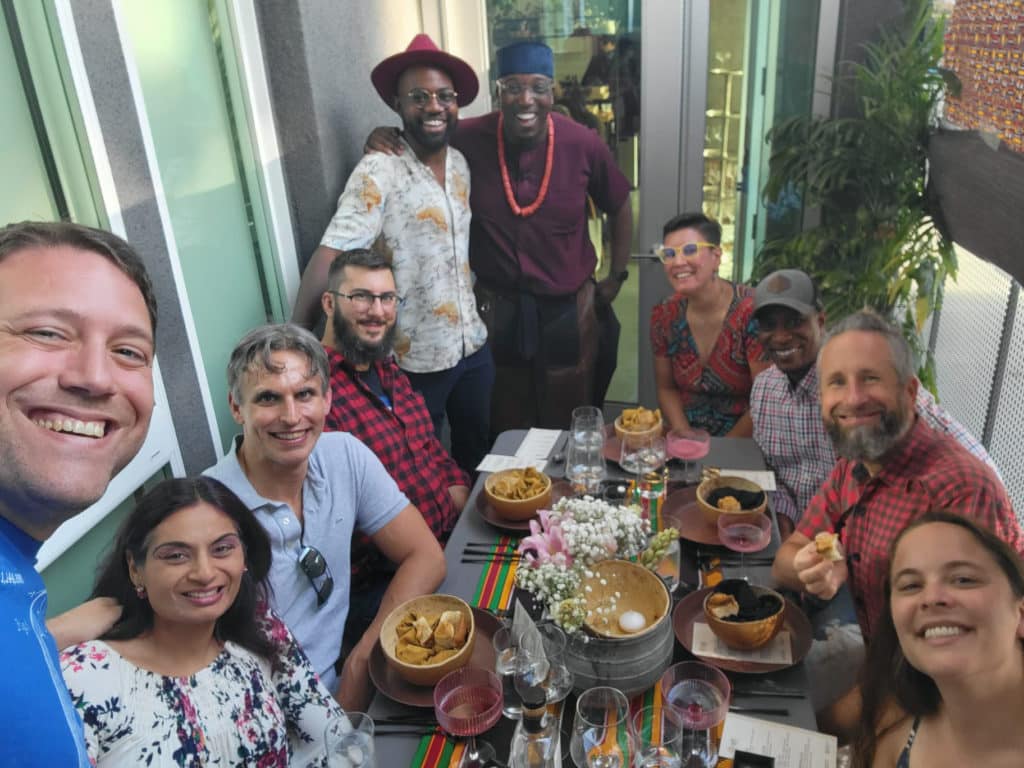
Ilé means “home” in the Nigerian language Yoruba. And it’s taken literally, in Chef Tolu “Eros” Erogbogbo’s sake. Introducing himself as Chef Eros, Ilé is not merely a restaurant, it is a dining experience built into his home. Eating there does not mean ordering food from a menu, it means Chef Eros’s excellent staff will bring everyone their beautifully-plated courses, and you get the pleasure of him introducing each dish to the room before you take a bite. The food is a combination of spices and tastes that remind him of his hometown of Lagos, Nigeria. He brings ingredients over in his suitcase, and his flavors transport you to places introduced by his storytelling. The bread and fresh butter was one of the best breads I’ve ever tasted, and the Pepper Soup made Adi’s eyes roll to the back of her head. She was in total bliss. These courses are small, like tastings, but by the end of the night none of us left hungry. There were eight of us friends enjoying our reunion, among us five had no restrictions, and three of us had combinations of vegan and vegetarian food.

With Chef Eros

It’s currently BYOB, but both water and a lovely hibiscus drink were flowing merrily, and the atmosphere is truly fun and fascinating. In the few months since this has begun, he has enjoyed the company of celebrities and people flying in for the experience. It is in Hollywood, parking is free and easy to find on the street, the staff is friendly and accommodating, and there are different ways to try it.

One of the most amazing things is how easily Chef Eros and his wonderful business partner David Olusoga are able to adapt to the needs of others. They have already had a night for an entirely kosher crowd, describing to me how a mashgiach came to prepare the kitchen and ensure everything would be done appropriately. They told me how happy they would be to create more meals for strictly kosher crowds, and I can see how happy it makes them bringing a bit of their home to our palettes. David visited us often throughout the meal, discussing how these two met and how much they believe in bringing authentic Nigerian food, in this beautiful way, to Los Angeles. I’m so very glad and grateful to have this shared dining experience with my foodie wife.

Feel free to visit their website here, as well as reading this wonderful article written in Eater Los Angeles, with photographs here.


Boaz Hepner works as a Registered Nurse in Saint John’s Health Center, and teaches COVID vaccine education throughout the hospital, and to the community at large. He grew up in LA in Pico/Robertson and lives here with his wife and daughter. He helped clean up the area by adding the dozens of trash cans that can still be seen from Roxbury to La Cienega. He can be found with his family enjoying his passions: his multitude of friends, movies, poker and traveling.

A Shared Foodie Experience Read More »

Review of Matti Friedman’s “Who By Fire: Leonard Cohen in the Sinai”

When many Americans think of entertaining the military troops in a time of war, we recall the USO tours that took place during the Vietnam War and through Operations Desert Storm (Gulf War I), headlined by Bob Hope with an array of American celebrities who performed for the men and women deployed overseas. Those shows were highly produced events, staged with adequate sound systems and proper lighting, in front of audiences of active military men and women, numbering in the thousands.

Contrast those spectacles with the impromptu concerts given by iconic Canadian poet-singer Leonard Cohen through the Sinai Peninsula during the 1973 Yom Kippur War. Cohen’s performances, his state of mind, and the harsh realities of the Yom Kippur War are the subject of Matti Friedman’s recent book, “Who By Fire.”  Friedman toggles back and forth between grueling details of the war, its toll on young soldiers, and Cohen’s music and its impact on those soldiers, as well as the war’s impact on Cohen and his music, including the significance of the liturgy of Yom Kippur. The book is a revealing and absorbing account of those few short weeks when the fate of Israel was at the precipice, but its revelations will stay with the reader for much longer than it takes to read the slim volume.

Friedman had access to one of Cohen’s unpublished manuscripts tucked away with his papers housed at McMaster University in Toronto. The manuscript is part diary, part poetry and part fiction. And, courtesy of the Cohen family, Friedman delved into the pocket notebooks that Cohen carried with him throughout his career. The notebooks are more like journals and enabled Friedman to distinguish between the diary writings and the fictional parts of the manuscript. They also enabled him to find people who were soldiers during the Yom Kippur War and who heard Cohen play in the Sinai.

Cohen’s journey to Israel, which Cohen called his “myth home,” was a type of escape from the life he was living on the Greek island, Hydra, with his then partner and their new-born child and from music. He was among many Israelis who had scattered across the globe urgently trying to get home to return to their units and take their place in the war. His purpose in going was to work on a kibbutz to replace those called to the war, and music was so far from his mind that he didn’t bring a guitar. However, a serendipitous meeting, of which there are several different accounts, at Café Pinati with Israeli singers Ilana Rovina and Oshik Levi led to Cohen joining the informal tour that also included a young Matti Caspi.

Friedman details some of the battles and many of the casualties and the singer’s proximity to both. Most of the concerts were informal and intimate, with soldiers sometimes departing for battle after listening to songs performed by Cohen and the Israeli music artists. Other times, the soldiers had just returned, shell-shocked from watching their friends fall, some literally from the sky. Cohen was known to many Israelis. His songs “Suzanne” and “Bird on a Wire” were familiar to them and many young women had Cohen’s early albums. When he appeared in concert with the other Israeli artists, there was surprise and delight from the soldiers.

There is no doubt that Cohen’s experiences during the Yom Kippur War affected his music.

There is no doubt that Cohen’s experiences during the Yom Kippur War affected his music. The song “Lover, Lover, Lover” comes out of the war concerts. Caspi recalls that Cohen worked on the song, changing the lyrics as the concerts progressed. Friedman identifies a lost verse found in one of the notebooks: “I went down to the desert to help my brothers fight.” But the refrain, “Yes and lover, lover, lover … Come back to me,” is indicative of Cohen’s state of mind. He could not escape his history, his tradition and his duty. And there can be no question that Cohen’s song “Who By Fire,” his take on the Unetaneh Tokef, comes out of his Yom Kippur War experience. As the prayer was being recited in Israel that Oct. 6, 1973, the first indications of attacks in the Sinai and Golan Heights were coming in. “Who will live and who will die … who by fire, who by water.” The Book of Jonah and the priestly blessing, when those members of the priestly tribe—the Cohanim (to which Leonard Cohen belonged)—bless their community also link Cohen inextricably with Yom Kippur.

Friedman’s compelling narrative of a pivotal war that left an indelible mark on a nation, the Jewish people and one musician draws readers in and doesn’t let go of us until the last page has been finished.


Melissa Patack Berenbaum is an attorney living in Los Angeles.

Review of Matti Friedman’s “Who By Fire: Leonard Cohen in the Sinai” Read More »