
October 24, 2018

Satirical Semite: Ode to My Silicon Soul
I wanted The Full American Experience so I can understand your ways, your cultural depths and the achievements of your nation-made-great-again. So I visited a plastic surgeon.
Last month in England, I saw my great aunt and uncle, both in their mid-90s and in love after 60 years together. I got the sense that they don’t look at each other and say, “Wow, you are smoking hot,” but see beyond the surface layer. This is not the Los Angeles way.
England is not obsessed with cosmetic dentistry and plastic surgery. It is not better, just different. When an Englishman “gets some work done,” he is usually having a kitchen remodeled or the toilet unblocked. In L.A., it is a whole other ball of silicon.
I had my appointment with the surgeon in Beverly Hills. He is Jewish. What are the chances of finding a Jewish doctor in Los Angeles? Clearly, this was a sign from God.
My skull was scarred after being hit by a car and undergoing two brain surgeries at Cedars-Sinai Medical Center. It was a horrible experience because they shaved my hair when I’d just had a great haircut. My potential career as a Vogue model was derailed, although I was more eligible for the cast of “Game of Thrones.”
Surgery left me with a 14-inch scar. Not that I am bragging, but my scar is huge.
Logically, if I got reconstructive surgery elsewhere on my head, then it might distract people from my scar, although this logic may be mildly affected by the now-healed brain damage.
I briefly considered a nose job, to get my nose enlarged so I can look more Jewish.
Jennifer Grey famously got her nose done after “Dirty Dancing.” Could he fuse her trimmings onto my proboscis? It may improve my dancing, nobody would put me in the corner and I’d have the time of my life.
Since “a rising tide lifts all boats,” every L.A. resident maximizes their aesthetic potential. The 28th California constitutional amendment is that “a rising tide lifts all faces, bottoms and other bits.”
The newly-facelifted Los Angeles International Airport terminal now requires visitors to walk through a spray-tanning machine before leaving passport control.
One of my doctors said that something in our human DNA can detect if someone has had cosmetic surgery even if we don’t know what they had done. Subconsciously, we can focus on people’s modifications rather than focus on who they are. There is nothing wrong with cosmetic surgery but it raises a rabbinic question. On seeing beautiful people at the beach, should one say the talmudic “beauty” blessing from Tractate Brachot 58b, “Baruch atah HaShem … shekahcha lo baolamo” (“God … has such things in his universe!”)? If there is a double portion of silicon should one say it twice? Does Rabbi Hillel bless right to left and Rabbi Shammai bless left to right? I am too holy and modest to even think about these things.
My time at Cedars-Sinai had some benefits. Its staff is so beautiful that to get hired there, they are interviewed by HR and a casting director.
Doctors resemble models and nurses are drop-dead gorgeous, although I was grateful not to drop dead during surgery.
The nurses’ beauty literally took my breath away, but possibly because I had a collapsed lung.
I made a new friend at Cedars, who I called “Cathy the Catheter.” She was intense but the discomfort was offset by a lovely 28-year-old, blue-eyed Texan nurse who withdrew the catheter. Who needs JDate when there is ICU?
L.A.’s worst cosmetic adjustments are displayed in shul every Shabbat morning, an 11th plague of men older than 45 who douse their hair in boot polish, unaware the color tone mismatches their beard.
My cosmetic surgeon gave me wonderful advice: “Grow your hair and focus on inner happiness regardless of looks.” I’ll do that, but when the time comes, I’ll also visit my hairdresser Roxanne to get a smoothly blended tint. Thank God for hairdressers.
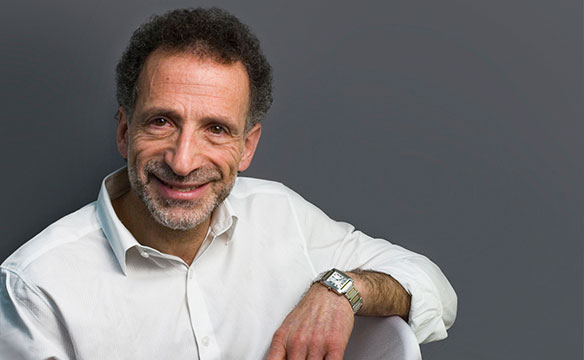
Marcus J. Freed is a Los Angeles-based actor. His website is marcusjfreed.com.
Satirical Semite: Ode to My Silicon Soul Read More »
Four More Campuses Hit by Anti-Semitism
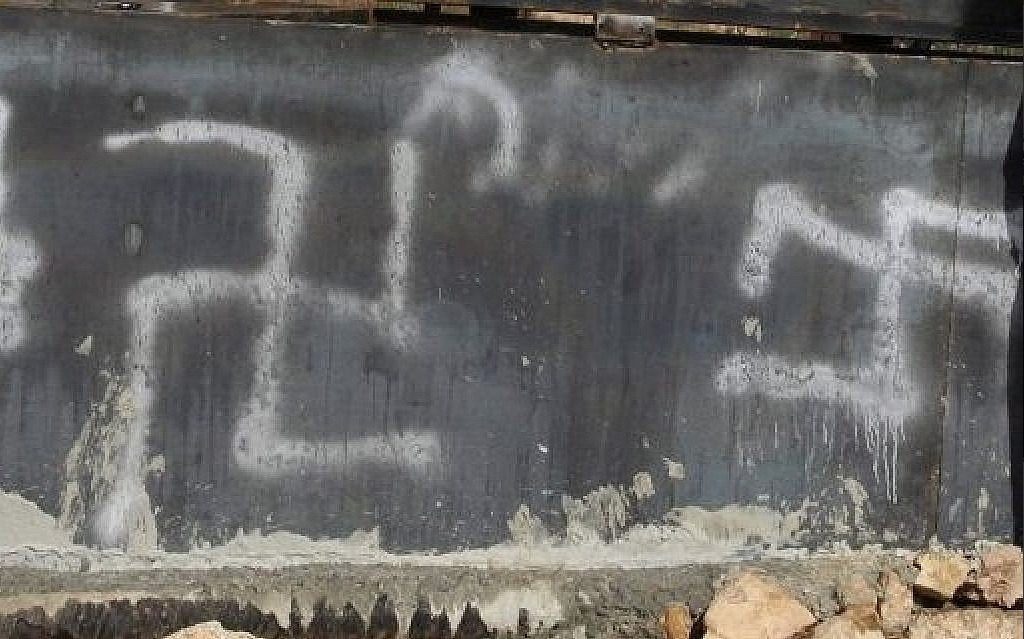
It has emerged again: A group with neo-Nazi sympathies has littered university campuses with anti-Semitic flyers that seek to sow fear and hatred of Jews.
This particular flyer, posted at UC Berkeley, UC Davis and two private colleges in New York, perpetuates the preposterous claim that a Jewish conspiracy was somehow driving the opposition to Brett Kavanaugh’s nomination to the U.S. Supreme Court.
In the handbill, the likeness of Kavanaugh is surrounded by a gallery of U.S. senators of Jewish descent whose foreheads are each marked with a Star of David.
“Every time some anti-white, anti-American, anti-freedom event takes place, you look at it, and it’s Jews behind it,” blares the flyer, which apparently was posted by a group of young, white “American Nationalists” called the Daily Stormer Book Club.
False caricatures and wild conspiracy theories about Jewish control fit neatly within hundreds of years of historical precedent of anti-Semitic thought. The similarly named Nazi weekly newspaper Der Sturmer used caricatures to vilify Jews in the 1930s. The recent news that these hateful flyers have appeared on several college campuses is nothing new, and much like we saw through Europe during the Nazi period. These recycled ideas are the product of Nazi sympathetic agitators who seek to seed hate and discontent.
“False caricatures and wild conspiracy theories about Jewish control fit neatly within hundreds of years of historical precedent of anti-Semitic thought.”
The perpetrators are likely not students, nor is the organization known to be affiliated with any campus groups. This is an insidious infiltration of student life by outside Nazi groups seeking to misinform young people, distort facts and promote hateful ideologies. We at the USC Shoah Foundation remain at the ready to help students mobilize and guard their campuses against these kinds of hateful propaganda campaigns, and give young people the tools they need to be “Stronger Than Hate.”
In the past year, we have created programming and produced classroom-ready resources that directly address these sorts of incidents — incidents that characterize an escalating prevalence of hate speech and identity discord on college campuses across the nation.
Chief among our new resources is the Intercollegiate Diversity Congress, an annual summit that convenes student leaders from across the country at our headquarters to develop action plans that counter hate on their campuses and promote inclusion. We have also produced a suite of no-cost learning activities in IWitness University about civility, empathy and intolerance in co-curricular spaces.
These activities delve unflinchingly into the consequences of unchecked hatred. They also offer ideas on how to harness the power of storytelling to bring about positive change.
This fall, the student government at USC used the activities during an annual orientation event for its 80-plus members. The students responded especially well to a clip of testimony from Silja Vainer, a Holocaust survivor who described the comfort she derived from joining a Jewish-Muslim-Christian interfaith group.
Shany Ebadi, co-chief of diversity on the student government body at USC, said Vainer’s testimony inspired students to develop specific action plans that promote pluralism and diversity. “We went back to our groups and discussed that evolution of the idea of, ‘Let’s not just let the problem simmer, but let’s think about ways to combat it,’ ” she said.
There are doubtless many on campus who are easily impacted by the hate campaigns of groups seeking to draw attention to themselves and stir controversy, but we know from history that caricatures of Jews depicting political power and conspiracy led to horrific consequences. Such threats should be taken seriously, especially as they target young minds at our academies.
The surest way to guard against this brand of hate is through education.
Stephen D. Smith is the Finci Viterbi executive director of the USC Shoah Foundation.
Four More Campuses Hit by Anti-Semitism Read More »

Understanding Autism From a College Student on the Spectrum
There is a lot to know about autism in our society today; I would know, I had to learn after I was diagnosed with autism at 17 years old. There are so many stereotypes and misinformation out there, so I thought I would clear the air.
Hi, I’m Brooke Simtob and I am a freshman at Grand Valley State University. I am going through life like any other college student — and I just happen to be autistic.
Autism Spectrum Disorder is a neurological disorder that is characterized by struggles with social and communication skills, repetitive behaviors and sensory sensitivities. What all these fancy words mean is that autism is when someone’s brain is wired differently than the Average Joe. We can struggle with social skills, like making friends; communicating needs and wants; and doing certain repetitive movements, like rocking back and forth or flapping hands.
Sensory sensitivities mean that an autistic person can sometimes be more sensitive to their surroundings, such as not liking loud noises, being “picky” with food and eating and either seeking or avoiding touch. As this is a spectrum disorder, people can be affected by the struggles in many different ways and in different severities. These differences do NOT make one person’s struggles with autism any less valid than another.
So that is the scientific, “disorder” language that explains autism.
However, autism is much more than deficits. Being autistic means having a different mind than others, which comes with challenges. However, it also can come with great strengths, such as creativity, having bright and out of the box thinking, but with a sometimes-intense focus on a certain thing. This is sometimes called a “special interest” or “obsession,” but it is really just something that we can become really focused and passionate on, leading to great discoveries and creations.
Ellie Hersh, an autistic high schooler from California, explains her experiences being autistic: “[Being autistic] is like being a slightly different species of animal. It’s all fine and nothing’s wrong with you when you’re on your own, but when you interact with all the other animals, all your differences are magnified. Your struggles and abilities just don’t match up.”
Overall, the autistic mind has many challenges to fit in with the outside world, but also great strengths. The best way for an autistic individual to survive and thrive in life is with the right support system set in place along with an accepting community beside them.
My whole life I was told to “fit in” in order to make friends. This is not how this should work. Instead of teaching the autistic kids to “fit in” to make friends, teach their neurotypical peers how to interact and accept those with neurological differences. The more acceptance and understanding there is at a young age, the more grown adults in the future will be accepting and understanding. Keep teaching acceptance to the world around you and everyone will be better off that way.
Chris Bonnello, a former special education teacher in England, has become an autistic advocate and speaker after being diagnosed with autism later in his adult life. He explains in his Facebook blog, “Autistic Not Weird,” the problem with telling autistic people to “fit in.”
“Sometimes, autistic brains are neurologically more susceptible to anxiety issues. But sometimes they’re not,” Bonnello said. “Sometimes, anxiety is just a standard human reaction to growing up being made to believe you are wrong. That your way of experiencing the world is wrong. That we need to find a cure, because your very existence is wrong. Personally, my anxiety issues aren’t some kind of neurological child of my autism. My anxiety was done to me, by those who made me believe I wasn’t good enough.”
“I wish the world knew autistic people have a harder time dealing with the world than the world dealing with autistic people,” – Jessica Elkins
Florida high schooler, Jessica Elkins, has also struggled with being forced to “fit in” with society because she is autistic.
“I wish the world knew autistic people have a harder time dealing with the world than the world dealing with autistic people,” Elkins said.
Today, not everyone is always accepting or understanding of differences, and I have definitely experienced this throughout my life. My peers in high school would tease me for rocking in my chair when I was anxious, and for asking questions in class when the lesson was going too fast for me to follow. My quirks and differences left me friendless for most of middle school and high school. We need a more accepting world where all people, autistic or not, are accepted for who they are.
I have been told my whole life to be something that I am not. My best advice to anyone, regardless of diagnosis, but especially for the autistic people out there, is: be you. Do exactly what you are doing. People will judge, people will stare, but those aren’t the people you want to be friends with anyway. Find the right people, the people that get you and listen to you, the people worthy of getting to know you because they care. You are loved and you are worthy, exactly the way that you are.
Remember to spread kindness and acceptance like confetti. There will be people out there who are different than you, but this does not make them any less human. Accept those who have differences with an open heart and an open mind.
I wish the world knew that autistic people are people at our core, not some alien species that needs to be shunned from society just because we act a little quirky and different. As people, we still crave love and belonging.
Learn more about autism at Autistic Self Advocacy Network, Art of Autism, Autistic Not Weird, and The Autistic Women and Nonbinary Network.
Brooke Simtob is a freshman at Grand Valley State University, in Grand Rapids, Mich. and an autism advocate.
Understanding Autism From a College Student on the Spectrum Read More »

Get a Lot, Then Give It Away
The Jewish Journal’s Oct. 19 edition seemed like a one-trick pony: On page after page, ads expressed the same beautiful sentiment: praise for Jack Nagel, a philanthropist who died Oct. 12 in Los Angeles at the age of 96.
Upon reading the first ad, I felt saddened because of his death. After reading the second ad, I felt proud of his indescribable generosity. And after reading the third ad, I began to feel ashamed that I don’t prioritize giving. The only building that would ever have my name on it would probably be called the Tabby Refael School of Passive-Aggressive Ranting … and Kabob Management.
By the time I had read the Journal cover to cover, I wanted to be like Nagel. We all should have felt this way.
I have a certain vision of myself as a great-grandmother: There I am, seated in a rocking chair surrounded by many Jewish great-grandchildren, my loyal robot dog by my side, telling stories that impart the most important thing elders can teach youth: good values that are hard to argue against.
As my drone butler brings me a cup of Persian tea (without spilling it on my head this time), my great-grandchildren, in all their glorious wisdom, ask me what my life can teach them. Hey, it’s my daydream, and I’m allowed to have unrealistically wise great-grandchildren.
The stories I’ll recount, whether having endowed chairs in Israel studies in the United States; or having brought every remaining Jew out of Iran; or having lavished local Holocaust survivors with amazing accommodations; or having funded centers for education or rehab programs that now bear our family name — every story will exude the same theme: I didn’t keep; I gave.
“By the time I had read the Journal cover to cover, I wanted to be like Jack Nagel. We all should have felt this way.”
I want money. I want lots of it. I want it so I can give it away.
Of course, I’ll put some of it aside for my kids’ (and their kids’) Jewish education, for trips to Israel to reunite with family, for tzedakah globally, and for an occasional, giant tub of saffron and rose water ice cream that I’ll devour in the comfort of my rocking chair and in the company of my robot dog.
Nagel’s great-grandchildren know about his philanthropy but what about every student at YULA in Los Angeles or Bar-Ilan University in Israel?
I’m not suggesting that everyone who has benefited from Jack and his wife Gitta’s generosity tattoo the name “Nagel” on their foreheads. In fact, Judaism reveres anonymous giving. But here’s the problem: Our eyes have become so accustomed to seeing family names on hospital or school buildings, that we seldom stop to really think about what they gave us, whether a good education at Bar-Ilan or access to life-saving care at Shaare Zedek Medical Center in Jerusalem.
At schools, I propose that during orientation or on the first day of the academic year, students are taught about the people, lives and legacies of those whose altruism often has provided the foundation on which they stand — and I’m referring to the literal foundation of the building.
I’m sure that many schools already try to impart these values, but I guarantee that if I show up to a campus and ask students young and old to list even one philanthropic name who made the endeavor possible, there would be a cricket or two chirping.
It’s not the students’ fault. It’s no one’s fault. We simply need to learn how to stop and pause in front of all those lovely, bronze plaques that adorn the walls of schools, hospitals and synagogues, even if the cynic in us wonders whether some well-endowed folks simply liked to see their names on plaques.
I need to go back to thank some kind folks, and so do you, I’ll bet.
After reading through eight ads in the Journal that thanked Jack Nagel, I understood that he didn’t care about names and plaques, but I also got a glimpse of his story: a Holocaust survivor who lost everything and then spent the rest of his life giving everything. Now that is a story that should be taught on the first day of school.
Tabby Refael is a Los Angeles-based writer.
Get a Lot, Then Give It Away Read More »

The Lipstick Proviso and The New Double Standard
Every day when I pick up my 9-year-old son from school, I face the reality that the #MeToo movement is operating in overcorrection mode. The moment we’re off the school premises, Alexander and his friends offer up a litany of injustices.
What are they griping about? Girls.
“They get away with everything!” “The teachers never criticize them!” “If we even ask the girls to stop annoying us, we immediately get screamed at!”
I’ve been hearing these gripes for the past couple of years, but this year they’ve gotten far worse. It seems the younger assistant teachers have it in their heads that boys are inherently bad and girls are inherently good. So, even if a girl misbehaves, it must be a boy’s fault.
This year, the boys started using a new phrase: reverse sexism. (Actually, it first came home as “reverse sex,” and then I figured out what they meant.)
Ballroom dancing class also started this year. At this age, the boys find the girls icky beyond belief, yet they are hyper intrigued with “sexual relations,” as my son puts it. Forcing them “to have physical contact” would probably be the last thing I would add to the mix.
Not surprisingly, many of the boys flat out don’t want to do it. More than anything, they feel resentful: It’s another way the schools are favoring girls.
Given where the national conversation is, one might wonder: Is this really a rational way to improve relations between the sexes? Shouldn’t the idea be to teach respect, not instill resentment?
I suppose one could say it’s a positive that we moved from “girls and boys are exactly the same” to “girls are better than boys,” but in reality, it’s far worse. “Better” was an argument used to deny women rights for hundreds of years.
It’s sad that so few women understand the true meaning of feminism. Democratic Senate candidate Kyrsten Sinema of Arizona in 2006 described stay-at home moms as not just unfeminist but as “leeching off their husbands.”
As a stay-at-home mom who has actually studied feminism, I can confidently tell Sinema that early feminists had no issue with stay-at-home moms — but her own condescension about another woman’s choice is what’s unfeminist.
I’m especially happy to be a stay-at-home mom when my son’s masculinity is being dragged through the mud on a daily basis. Part of the reason the boys complain to me is because I’m there to listen to their complaints. If I had a daughter, I would be there to listen to hers.
The irony is that the true definition of feminism could not be more basic: Feminism means freedom. That’s it. Freedom to choose. A century ago, women could not choose. Now, we can.
But those choices may be different from males’ — what I call the lipstick proviso. Women are different from men — not better, different. In democratic societies, these differences stem from biology (not “the patriarchy”) and reside on a bell curve, meaning some women overlap with some men. Because of these innate biological differences, any numerical mandate, like a recent California law regarding female representation on the boards of publicly- held companies, is ridiculous.
As I write this, I’m on a train to Philadelphia to help my 88-year-old father move to an assisted-living facility. I don’t need to be there; I want to be there. I couldn’t possibly not be there.
I was never taught that this is what daughters do, just as I was never taught to stay home with my son. And contrary to Sinema’s clueless assertion, going to an office would have been much easier in both cases. Other women make different choices. It’s not for me to judge.
Indeed, demeaning my choices — or demeaning the masculinity of my son — is not what real feminists do. I get that many women have had bad experiences with men. But it doesn’t help anyone to globalize that bad experience, to condemn all masculinity as toxic, and to raise a generation of resentful boys.
My dad’s lifelong resilience is part of what I see as the beauty of masculinity. Until women and men fully understand what femininity and masculinity positively bring to the table, we’re not going to fix any problems. In fact, we’re in the process of making them far worse.
Karen Lehrman Bloch is an author and cultural critic living in New York City.
The Lipstick Proviso and The New Double Standard Read More »
Note to the General Assembly: We Need to Listen
“We Need to Talk,” the theme of this year’s Jewish Federations of North America (JFNA) General Assembly in Tel Aviv, sounds like what people usually say before they terminate a relationship. Of course, for Israeli and American Jewry, termination is the last thing on anyone’s mind. The relationship may be strained but a break-up is inconceivable. The very purpose of this annual gathering is to strengthen communal bonds.
As Israeli President Reuven Rivlin said in his welcoming address at the three-day conference on Oct. 21, “We are not strategic allies. We are a family. We are one big family. We don’t have only shared interests — we have a shared faith, history and future.”
This family, though, has become dysfunctional. The relationship between Israel and Diaspora Jewry seems to be getting worse every year.
Chemi Shalev, the Israeli commentator for Haaretz, wrote that the General Assembly’s bold theme was a “desperate plea” to save Israel-U.S. Jewish ties.
In other words, things have gotten so bad and have been allowed to fester for so long that this is no time to mince words. So, we might as well go for an intervention: “Hey, Israel, it’s gone too far. We need to talk.”
Shalev may be right that the theme betrayed a sense of desperation, but that is precisely why it wasn’t the best choice of words. If we are desperate to save a relationship, we shouldn’t use a phrase that reinforces that desperation.
I can appreciate how the organizers needed to show that it’s no longer business as usual in the relationship. As Shalev wrote, “Even if one interprets ‘We need to talk’ in the most positive way possible, it still denotes serious disagreements that can no longer be ignored.”
“Listening is more difficult to do than talking. Jews talk all the time. The problem is that, too often, we talk past each other.“
We can agree, then, that it was time to make a provocative statement that would capture the urgency of the moment. But is “talk” the right word? I don’t think so.
Imagine if the theme would have been, “We need to listen.” That would have been even more provocative, because listening is more difficult to do than talking. Jews talk all the time. The problem is that, too often, we talk past each other.
What we need is not more talking but more listening, from both sides.
Am I making too big a deal of an event slogan? Not if you consider that the theme for such a major gathering is not just for the attendees; it’s also for the whole Jewish world. It sets the tone for the rest of the year. “We need to listen” should become the driving mantra to repair communal bonds throughout all Jewish communities.
I wasn’t at the GA this year, but I hear it had some terrific events and panels. I saw a few online. I’m sure there was a lot of listening. My point is that, in terms of communal aspiration, the word “listening” is more powerful than the word “talking.”
I’m sure the GA’s organizers would agree. In fact, JFNA President Jerry Silverman, in an interview on JPost.com, said that “increased understanding was required both from Israelis and Diaspora Jews of each other’s concerns.”
How do we get to “increased understanding”? Through better and deeper listening.
As we move forward, American Jews could listen better to Israelis’ new security concerns. For example, according to a report this week on Ynet, instead of basing precision missile factories in Syria, Iran is now transferring the missiles directly to Hezbollah. Why is this a potential disaster? Because precision missiles can wreak havoc not just on civilian centers but on military centers, air force bases, power stations and even Israel’s nuclear reactors.
“We should also recognize another imbalance: There is no Israeli GA that shows up in New York or Los Angeles to critique the failures of American Jewry.”
This kind of existential danger ought to put our relationship problems in perspective. It’s not just a talking point on one side of the ledger. It’s fundamental to appreciating the completely different context in which Israelis live.
We in America have every right to express our concerns about Israel’s failures, and we will continue to do so over the coming year. And yes, Israelis should listen. But American Jews can also be better at internalizing the Israeli reality of living in a state of virtual siege, under constant threat of annihilation. If that doesn’t buy a little understanding, I don’t know what does.
We should also recognize another imbalance: There is no Israeli GA that shows up in New York or Los Angeles to critique the failures of American Jewry — like, for example, the failure to address the new generation’s vanishing Jewish identity.
When that day comes, I hope we in America will listen as well as we expect Israelis to listen. After all, we are one big family.
Note to the General Assembly: We Need to Listen Read More »
Meet Ashley Powell, The Jewish Millennial Running for Santa Monica City Council
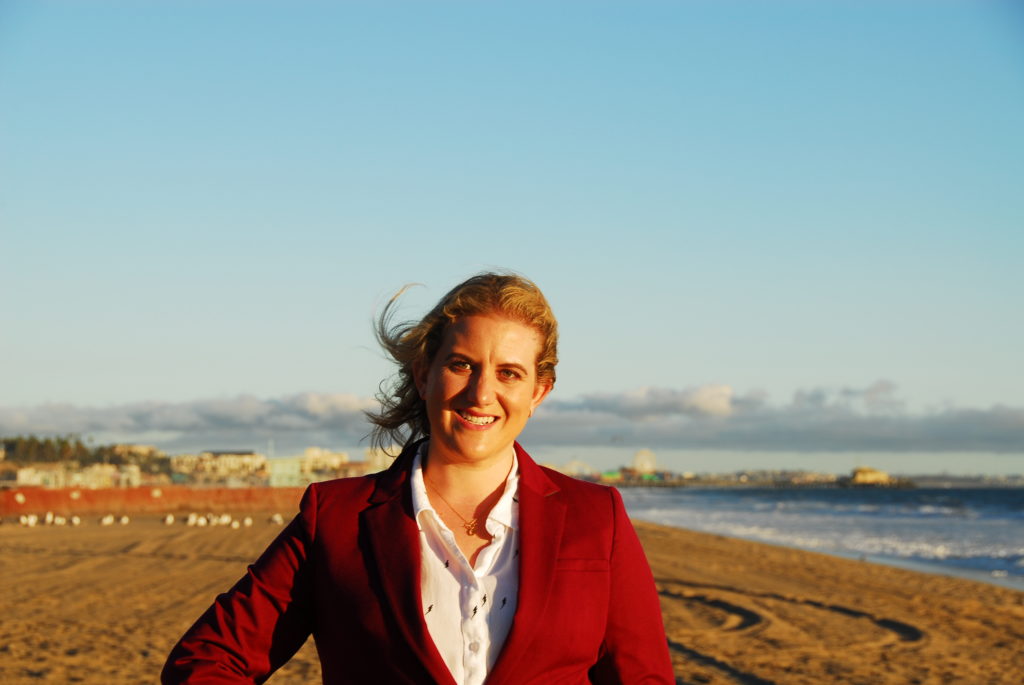
Tikkun Olam (repairing the world) has always played a large role in Ashley Powell’s life. For as long as she can remember she has volunteered with her family, helped the homeless in Santa Monica and on Venice Beach and has been civically active since the first time she voted at 18.
This year, the fourth-generation Angeleno/Santa Monica native is not only focused on repairing the world as a whole, but she’s also on the ground, going door-to-door, campaigning to be Santa Monica’s first Jewish millennial city council member.
The 29 year old attributes her success and stride to her “new spine.”
Last year she underwent spinal reconstruction surgery, her fifth surgery since she was 14. While she was recovering she started planning and getting involved with several nonprofits.
One of the campaigns she worked on was for Harley Rouda, who switched to the Democratic party in order to run against Dana Rohrabacher, who had been in office since 1989 — the year Powell was born.
After spending a day walking around for 10 miles in Orange County, Powell decided she not only had the skills to run a campaign, she now had the endurance.
“I got really into it like I’d never done before,” Powell said. “I remember… I told my surgeon in New York I couldn’t have done anything that I’ve done in the past year if I didn’t have basically a new spine.”
A month later she decided to run for city council.
Many took notice when Powell entered the race. Rather than looking at her experience — which includes being an an alumnus of Santa Monica Community College, Occidental College, the Suzanne Dworak-Peck School of Social Work and the Sol Price School of Public Policy at USC, working on various campaign trails and being the youngest board member of United in Harmony nonprofit organization — it was her age that many chose to recognize.
“I have been ridiculed from the beginning for being the youngest person running, that I’m inexperienced, which is not true…which is not fair because they don’t really say that about men,” she said. “Yesterday I was told that I was too arrogant and I just laughed because I was really insecure growing up. I just changed my mindset that my lack of confidence came from my illness and now I take all these things and I go harder every day.”
For the past year, Powell said she has been listening to the needs of her community by utilizing her social work experience to win this campaign.
She’s also said she is passionate about social rights for everyone and reducing the number of homeless people on the street by increasing outreach programs for those in need.
According to Powell, 70 percent of Santa Monica residents are renters so she also plans to “build affordable housing so we can all afford to live in Santa Monica.”
“There’s no changemaker running,” Powell said. “Look, I’m from Santa Monica I’ve been involved in social justice from a young age and the same issues are still [here] from when I was young… I saw a post from Nextdoor basically saying ‘we gotta get the incumbents out of office who have been there since I was in elementary school.’”
Though Powell considers herself to be a Democrat, this election is nonpartisan. She spent a large portion of her campaign registering both Angelenos and Santa Monicans to vote in the Nov. 6 election.
“I think something about this race is that it’s non-partisan, it doesn’t matter about what party you are, it’s who you are as a person and what you are fighting for.”
Ashley Powell is running in the 2018 Santa Monica City Council race against fellow newcomers Geoffrey Neri, Greg Morena and Scott Bellomo, as well as incumbents Pam O’Connor, Kevin McKeown and Sue Himmelrich.
Meet Ashley Powell, The Jewish Millennial Running for Santa Monica City Council Read More »

These I Remember…. by Isaac Pollak
I have done many taharot in the last 36 years, but there are a handful that stand out, and come back to me again and again, especially during days of Yizkor (remembrance) and Zayin Adar (7th of the month of Aar, when many Chevrai Kadisha choose to acknowledge their members), when my custom is to fast, ask forgiveness, and remember those for whom I have performed this mitzvah.
At those times I particularly recall:
– a 16 year old who drowned
– a 30 year old who died of AIDS
– a 40 year old heir to a Sephardic Rabbinic Dynasty who came to the States for treatment for a blood disease,
– and just a short time ago, an 8 month old little boy who had been abandoned by both parents.
When I think of them, all I can say is that one’s heart goes out, one has no words or explanations, one cries with the families, and one feels G-d’s pain – as G-d says in Psalm 91 “I am with him in distress.” Ps. 91:15.
But at the same time, it makes us appreciate life all that much more, and we – all of us doing G-d’s work, all who serve as part of the Chevrah Kadisha – are better off for it. Despite the pain and sadness we may encounter, we get so much more than we give.
Isaac Pollak is President and CEO of an international marketing business for almost 4 decades at this point. He holds graduate degrees in Marketing, Industrial Psychology, Art History, and Jewish Material Culture from City College, LIU, JTS, and Columbia University. He has been a student in the Gamliel Institute, and serves as a consultant to the institution. He has been the rosh/head of a Chevrah Kadisha on the upper East Side of Manhattan, NYC, for over 3 decades, and is an avid collector of Chevrah Kadisha material cultural items, having several hundred in his own collection. He serves as chairperson of the Acquisition Committee for Traditional Material Culture at the Jewish Museum in NYC. Born and raised in NYC, married, with 3 children and 3 grandchildren. He has written multiple articles for Expired And Inspired over the years.
_____________________
Gamliel Courses
The next course in the cycle of core courses offered by the Gamliel Institute will be Course 4 – Nechama/Comfort. It will be offered online during the Fall from October 9th to December 25th on Tuesday evenings, for 90 minutes each week for 12 weeks. The classes will begin at 5 pm PST/8 pm EST. Primary instructors will be Dan Fendel and Edna Stewart, with guest instructors.
Registration is now open – click here.
The course planned for Winter 2019 is Course 2 – Chevrah Kadisha: Taharah & Shmirah. Plan ahead! You can register online now.
___________
Gamliel Café
Gamliel Students are invited to a free informal online session, held monthly. On the third (3rd) THURSDAY of each month, different person(s) will offer a short teaching or share some thoughts on a topic of interest to them, and those who are online will have a chance to respond, share their own stories and information, and build our Gamliel Institute community connections. This initiative is being headed up by Rena Boroditsky and Rick Light. You should receive email reminders monthly. The next scheduled session of the Gamliel Café is October 18th. More details will be sent out soon.
If you are interested in teaching a session, you can contact us at rboroditsky@jewisgh-funerals.org, rlight@jewish-funerals.org, or info@jewish-funerals.org.
_______________
Gamliel Continuing Education Courses
Gamliel students should be on the lookout for information on a series of Gamliel Continuing Education Courses, advanced sessions focusing in on different topics. These will usually be in groups of three ninety minute sessions (three consecutive Wednesdays) offered roughly twice yearly, with different topics addressed in each series. The goal is to look at these topics in more depth than possible during the core courses. The first course took place in Fall 2017, focusing on Psalms, and the second was on The World to Come and the Zohar.
The next course will be November 28th, December 5th, and December 12th. We will continue to look at death as seen in the Zohar, taught by Beth Huppin.
Registration is required, and there will be a tuition charge of $72 for each three session series. Contact us for information, by email info@jewish-funerals.org, or call 410-733-3700, or simply register online at www.jewish-funerals.org/gamreg/.
You can also register for prior courses and access them via recording.
____________________
Taste of Gamliel Series
The 2018 Taste of Gamliel series has concluded, but it is not too late if you want to access the recordings. You can Register for the 2018 series, Your’re Gonna Miss Me When I’m Gone: Jewish Practices of Remembrance, or any of the series from prior years, and view them in recordings. There are usually five sessions in a series, and each session is approximately 90 minutes.
The 2019 series is being planned now. Registration for Taste of Gamliel is mandatory to access the sessions. The Registration fee of $36 for each series helps us defray the out of pocket costs.
Those registered will be sent the information on how to connect to the sessions. To register, click here: register.
_____________________
DONATIONS
Donations are always needed and most welcome to support the work of Kavod v’Nichum and the Gamliel Institute, helping us to bring you the annual conference, offer community trainings, provide scholarships to students, refurbish and update course materials, expand our teaching, support programs such as Taste of Gamliel, the Gamliel Café, and the Gamliel Continuing Education courses, provide and add to online resources, encourage and support communities in establishing, training, and improving their Chevrah Kadisha, and assist with many other programs and activities. There is a matching donation program in progress so your dollars go further. See the website for details.
You can donate online at http://jewish-funerals.org/gamliel-institute-financial-support or by snail mail to either:
Kavod v’Nichum, or to The Gamliel Institute,
c/o David Zinner, Executive Director, Kavod v’Nichum,
8112 Sea Water Path,
Columbia, MD 21045.
Kavod v’Nichum and the Gamliel Institute] are recognized and registered 501(c)(3) organization, and donations may be tax-deductible to the full extent provided by law. Call 410-733-3700 if you have any questions or want to know more about supporting Kavod v’Nichum or the Gamliel Institute.
You can also become a member (Individual or Group) of Kavod v’Nichum to help support our work. Click here (http://www.jewish-funerals.org/money/).
___________
SUBMISSIONS WELCOME
Please note: this blog depends on you for content. Without you it cannot publish new material. If you have an idea for an entry you would like to submit to this blog, please be in touch. Email J.blair@jewish-funerals.org. We are always interested in original unpublished materials that would be of interest to our readers, relating to the broad topics surrounding the continuum of Jewish preparation, planning, rituals, rites, customs, practices, activities, and celebrations approaching the end of life, at the time of death, during the funeral, in the grief and mourning process, and in comforting those dying and those mourning, as well as the actions and work of those who address those needs, including those serving in Bikkur Cholim, Caring Committees, the Chevrah Kadisha, as Shomrim, funeral providers, in funeral homes and mortuaries, and operators and maintainers of cemeteries.
These I Remember…. by Isaac Pollak Read More »

Can a “Talk” Save American Jews?
A large group of community leaders from the US Jewish community came to Israel this week to hold the convention known as the GA. These leaders have a problem: their slogan for the event was “We Need to Talk,” but it’s hard to talk to Israelis in English. They tend to prefer Hebrew. And another problem: it is not clear what they need to talk about. In midweek I had a meeting with one of the visiting leaders, and he explained that some of the talking ought to be about Israel’s treatment of its foreign workers. In fact, he sent a warning: Israel must absorb the workers and not expel them. That’s none of your business, I provoked him. Get them to come to America, I teased him. He believes that Israel’s policy is immoral. Fine. If that’s what he wants to talk about, he will not find attention here.
The American leadership came to Israel against the backdrop of what feels like a crisis in Israeli-American relations. It came here feeling that the crisis is because of Israel and its bad behavior. It came here to be reinforced by Israelis who think the same. Most of these Israelis simply dislike the Israeli government and therefore are willing to accept any claim of guilt against it on any matter.
The truth of the matter is that this crisis is nothing more than a smokescreen, a distraction – instead of talking about what really matters, we keep talking about small politics of small things. American Jews struggle with profound challenges. The youth are detached from Jewish institutions, distance themselves from the Jewish tribe, and renounce the observance of Jewish tradition. On the way to disengagement, some of them also beat up on Israel. It’s a convenient way to clean the conscience – our challenges are not because of us, they are because of you. Because of Israel. I am sorry to report that Israelis are generally indifferent to these claims, because they don’t face similar challenges. Their identity is stable. Their Judaism is anchored in everyday life.
One can talk from today until next year about all the matters that American Jewish leaders want to talk about. One can look again for a solution for the Western Wall, one can improve Israel’s conversion format, one can offer more candy, more attention, more sympathy. It is impossible for Israel to accept American advice on major matters – security, occupation, immigration. Such “talk” will only make matters worse as it will alienate Israelis and make them turn a deaf ear. Either way, no “talk” can solve Israel’s problems. No “talk” can solve the problems of the American community. All this, as I said, is a distraction from the real challenges of this era.
What is the main challenge? The incoming chairman of the Jewish Agency, Yitzhak Herzog, hinted at a large project he was aiming at – teaching Hebrew to the masses of Jews in the Diaspora. This is a wonderful idea, with limited chances of success. As soon as his proposal was published, American-Jewish intellectuals began to groan. They are not sure if this is really needed, and what Hebrew, biblical or modern, and whether learning Hebrew is a problematic political statement, and whether learning Hebrew will even strengthen Jewish identity. Bottom Line: There was little enthusiasm. Ask why? Maybe because learning Hebrew is difficult. Most of the heads of Jewish organizations who came here this week do not speak Hebrew. They will never speak Hebrew. Learning a language is a demanding task, and Jews in America face a challenge, among other things, because their youngers aren’t interested in demanding commitments.
There is something tempting about the thought that Israel can save American Jews, with some creative project, or a sudden financial investment, or if it changes its foreign policy. I wish Israel were so powerful and influential. I wish the fate of American Jewry depended on Israel’s policies. But the truth is that it is not. Not if we “talk” and not if we remain silent, not if we study Hebrew, and not if we have a new platform at the Western Wall, not if we absorb foreign workers, and not if we dismantle the Chief Rabbinate. Of course, Israel might need to do some, or all, of these. And Israel can make an effort to assist US Jews in overcoming their challenges. But we should all keep our expectations in check. Israel can “talk,” but most of the doing must happen on the other side.
Can a “Talk” Save American Jews? Read More »