fbpx

October 24, 2018

Weekly Parsha: Vayera

One verse, five voices. Edited by Salvador Litvak, Accidental Talmudist

And [Isaac] said, “Here are the fire and the wood, but where is the lamb for the
burnt offering?” – 
Genesis 22:7


Kylie Ora Lobell
Writer

This Torah portion used to disturb me. Avraham and Sarah waited years to have a child, and when they are blessed with Isaac, HaShem commands Avraham to sacrifice his son. Avraham agrees without hesitation. 

Over the years, I’ve read this parsha again and again. And I finally understand why Avraham agreed. 

I converted to Judaism and willingly took on the mitzvot, no matter how nonsensical they were. Give up bacon, my favorite food, because the Torah says to? Yup. Carry during Shabbat only in a place where there are strings surrounding me? Sure. Shake a branch and spend $50 on a fruit for Sukkot? OK! 

I do these seemingly absurd things with enthusiasm because I believe that HaShem wrote the Torah, and I want to follow his word. I am a normal(ish) Jewess, while Avraham was one of the holiest Jews. He had an incredibly close relationship with God. If I am willing to take on laws I don’t understand at my level, you can bet that I would do whatever God said if I had that kind of relationship with him. 

Avraham knew that God does good and only wanted the best for him. I’ve realized how all these mitzvot I took on have improved my life. I feel the holiness when I practice them, even if they don’t logically make sense at the time. Avraham has taught me to have emunah, faith, and follow HaShem, even if I don’t yet know the beautiful journey he’s taking me on. 


Rabbi Adam Kligfeld
Senior Rabbi of Temple Beth Am

Some verses are so raw, so stark, that applying layers of commentary is nearly a disservice. Isaac’s plaintive, almost outrageously innocent question to his father seems to be in that category. We view Isaac as passive and naïve. Not yet picking up on what even we, the reader, know is transpiring. “Dad, I am confused! What do you have in mind for a sacrifice today?” The utter pitifulness of Isaac in the scene perhaps ought to be preserved as is. 

But our tradition never stands still on meaning. The 18th- to 19th-century Apter Rebbe, Rabbi Avraham Yeshoshua Heschel, reads Isaac not as dull or dimwitted, but sharper even than the knife itself. Imagining Avraham anachronistically concerned about halachic, legal details, Isaac reminds his father that if he were to sacrifice him, he would be an onen, mourner, instantly invalidated from continuing to serve God via sacrificial offering. And, Avraham apparently has no other animal to sacrifice. “Have you thought this through, Father? This apparent act of piety will ineluctably distance you from the God you are intending to obey. You will have neither me, nor a substitute offering. Then what?” 

The stakes are rarely as high. But we need to listen to the voices of others, and within our conscience, warning us of the hidden dangers of complete obeisance. And of piety devoid of ethics. Isaac’s brutal and brutally honest cry reverberates before every one of our utterances and acts of devotion. “Then what?” 


Rabbi Reuven Wolf
Director of Maayon Yisroel Chassidic Center

As Abraham and Isaac are en route to Mount Moriah, Isaac is under the assumption that they will be slaughtering an animal as a sacrifice. But then Isaac notices that his father has not brought a sheep to slaughter and realizes that he is actually the intended object of his father’s sacrifice. 

When Isaac realizes this fact, he calls to his father, “avi,” “my father.” Avi is a reference to Abraham’s natural proclivity toward chesed, kindness. Isaac questions his father, saying, “How can you possibly be ready to act in a manner that is so contrary to your nature? As a naturally benevolent person, how can you be prepared to sacrifice your son?”

Abraham responds, “Hineni beni,” “Here I am, my son.” What Abraham means to say is that in order to fulfill God’s will, he has temporarily discarded his own nature and donned a new nature, that of his son, Isaac, who is characterized by an inner strictness, strength and intensity, quite the opposite of Abraham’s natural gentleness.

We all have our natures. We all have boundaries and parameters that make up our unique personality. Most of the time, we can live within those definitions. But sometimes it is necessary to adopt a nature that is foreign to us, to act in ways inconsistent with our personality, to bend and stretch our own self-definition, for the sake of something larger than ourselves.


Cantor Michelle Bider Stone
Director, Los Angeles Shalom Hartman Institute of North America

In the Akedah, the binding of Isaac story, Abraham is celebrated as the man of faith, but who is Abraham the father? 

Abraham makes his way through the narrative almost completely in silence; only Isaac shatters the quiet with this question. Abraham responds that God will provide “the burnt offering, my son.” It is in this moment, Rashi explains, that Isaac realizes that he would be the sacrifice. And then, silence again as they continue on to what appears to be a horrendous, yet inevitable, fate. 

Kierkegaard comments on the Akedah, “Silence is the snare of the demon and the more one keeps silent, the more terrifying the demon becomes.” After the Akedah, Isaac never speaks to Abraham again. Silence begot more silence. 

To me, Abraham’s silence is heartbreaking. How could he not question God when he commands Abraham to kill his son, his only son, the one whom he loves? Is this not the same Abraham who fought for 10 righteous strangers in Sodom? How could he ignore his helpless son in this moment, instead of making him feel loved and cared for? 

Everyone handles emotional pain differently. Abraham’s defense mechanism is detachment. But his pain doesn’t absolve him of his responsibility to his son. In the end, Abraham doesn’t sacrifice Isaac, but, by his silence, he sacrifices their relationship. It is a lesson in the limits of blind faith, how silence exacerbates trauma, and how giving voice to the silenced can repair a rupture.


David Sacks
Happy Minyan of Los Angeles

The first thing we need to know is that Issac was 37 years old at the time of this event. The next thing we need to know is that he already knew the answer to his question. He knew that he was the burnt offering. 

We know this because a little bit later in the Torah, it says that Abraham and Isaac “went together.” This means, that Abraham and Isaac were united in their awesome desire to do the will of God no matter what it took. 

Our rabbis teach that every person must ask themselves the question, “When will my deeds reach the level of my forefathers Abraham, Isaac and Jacob? (Tanna D’vei Eliyahu) Or put another way, how can I offer myself up to God today? 

The Jewish people are living, thank God, during wonderful times. We aren’t hunted, and we don’t confront death on a daily basis. So how do we offer ourselves up to God during our present good times? The answer is not by dying to sanctify God’s name. But by living to sanctify his name. To do that, we must first understand what life is. 

Simply put, life is the canvas we’ve been given to turn our deeds into art. And the greatest art is made when we unify our hearts and minds in the quest of finding God in everything. This is what it means to choose life. And when we do that we sanctify God’s name with every breath. 

Weekly Parsha: Vayera Read More »

Time’s Running Out on Uganda’s Poor ‘Rolex’ Vendors

One of the best ways to get insight into a culture is through its street food. And currently here in Kampala, Uganda, what you discover can leave a bad taste in your mouth.

Food here is eaten sitting down rather than on the go, and roughly 95 percent of the local fare is based on cheap, nutrient-deficient carbohydrates such as cassava or posho, a finely ground maize flour cooked into a thick, white paste and eaten with peas or beans. Even Uganda’s national food, matoke, a variety of banana cooked in its own leaves over charcoal and then mashed and served with a sauce made from ground peanuts (called “gnuts”), is rarely served with protein, although sometimes you can get it with a small amount of bony meat cooked in a watery stew. But there is one notable exception to this rule: the Rolex. While the Swiss watch of that name may be a status symbol for the rich and powerful in the West, a Rolex here is a decidedly different thing. 

Rolex, translated from the local language, means “rolled eggs.” It is essentially an omelet rolled up in a chapati, an Indian flatbread that, when made correctly, has flakey layers like a croissant. The Rolex was the brainchild of a resourceful entrepreneur who set up a stand to feed hungry students at Makerere University, also known as the “Harvard of East Africa.” Until recently — more on that later — you could easily pull up to one of the thousands of Rolex carts that lined every thoroughfare and watch as a nimble-fingered Rolex man (only men make Rolex for some reason) cracked two eggs into a plastic mug and cut in shredded cabbage, tomato and red onion with a rusty knife. He would then cook the omelet on a charcoal stove with an iron plate resting precariously on top. When the omelet had browned on both sides, he would roll it up in the chapati like a burrito before depositing it in a small plastic bag for the ravenous customer — all for a mere 1,500 Ugandan shillings (less than 40 cents).

It may not sound like much, but to the tens of thousands of students on a meager budget, or the expats­­ with nary a fast-food option for miles, the Rolex is the hot, fresh and filling snack that dreams are made of. Its simple concept in this city’s protein-deprived, carbohydrate-laden street food landscape caught on like wildfire.

“It may not sound like much, but to the tens of thousands of students on a meager budget, or the expats­­ with nary a fast-food option for miles, the Rolex is the hot, fresh and filling snack that dreams are made of.”

Kampala, like most other sub-Saharan African cities, has grown exponentially over the past few decades with little to no infrastructure improvements to bear the load. As the middle class has swelled, so has the number of cars and traffic. During the rainy season, the potholed and weathered roads are reduced to rivers of terra-cotta-colored mud and rushing waters. Navigating your car in those conditions — between the reckless boda boda mopeds and the old matatus van “buses” that are rolling deathtraps — is akin to driving in a video game. Add to that mix the fact that most people buy their drivers licenses rather than sit for an examination or pay hefty fees for a legitimate driving school, and you end up with traffic jams that make Los Angeles rush hours seem like moments to put the top down and let the wind blow through your hair. 

Enter government bureaucracy in the form of the Kampala Capital City Authority (KCCA), which recently decided to take the estimated 10,000 Rolex and other street vendors and arrest them for operating without licenses. As a result, thousands of these vendors shut down almost overnight rather than risk being arrested for operating an illegal stand and possibly going to jail. Unlucky vendors could lose not only their stock and carts, but they could also be on the hook to pay a minimum fine of 100,000 Ugandan shillings (about $27), which may as well be $10,000 to a cart owner barely eking out a marginal living from 12-hour workdays. To make matters worse, if the corrupt Ugandan police want to put the squeeze on a particular vendor who is unable to pay their fine (or bribe) on the spot, that vendor can be thrown in jail. A Ugandan jail shares greater similarities with a Third World dog kennel than it does with a place fit for humans.

Consequently, weary vendors can either take their chances at operating an illegal stand or pursue the nearly impossible option of obtaining an extremely expensive KCCA license — which still doesn’t guarantee they won’t be harassed by police. While the logic behind regulating food carts, and the fees charged to vendors to license them may have some merits, the uprooting of thousands of food cart owners in Kampala has contributed to yet another sad downward spiral of poverty and joblessness.

By the way, I still frequent my favorite Rolex vendor as often as I can — when I can find him. These days he’s always moving around to avoid the police.

I fear the writing is on the wall: As Kampala’s skyline continues to expand, its food cart entrepreneurs will soon disappear — perhaps to be replaced by fancy, solar-powered stands run by companies making “legalized” carts. The costs of those units will be well out of reach of any of the original stand owners who support their families on their meager, hard-earned profits. The new model will also create another potential revenue stream for Uganda’s already bloated government officials. 

While some could argue that the government’s action is progress — after all, the legal carts won’t require charcoal, so they won’t pollute the environment; and customers of the carts will benefit from the “health and hygiene” mandate of the city council — I’m reminded that in much of Africa, the story of progress usually spells disaster for those who can least afford it.

Most of the current vendors are as likely to come up with the money to buy a compliant cart as they are to purchase an actual Rolex watch. 

Yes, you can tell a lot about a culture by its street food. For the vendors, their families and their customers in Kampala, the probable demise of the Rolex carts will be hard to swallow.


Yamit Behar Wood, an Israeli-American food and travel writer, is the executive chef at the U.S. Embassy in Kampala, Uganda, and founder of the New York Kitchen Catering Co. 

Time’s Running Out on Uganda’s Poor ‘Rolex’ Vendors Read More »

Can California Embrace Israeli Water Technology?

Even on the heels of California’s historic drought, water use has steadily returned to pre-drought levels, particularly in affluent Southern California communities. In response, Gov. Jerry Brown signed two bills into law — SB 606 and AB 1668 — earlier this year, requiring cities and water districts to set permanent water conservation rules. Cities, water districts and large agricultural water districts now must meet strict annual water budgets, facing fines of $1,000 per day if they don’t meet them, and $10,000 a day during drought emergencies.

Cultural differences aside, Israel and California have many similarities — chief among them an arid Mediterranean climate, topography, seawater access and a wetter north supplying a drier south. Aided by strong trade relations, Sacramento has turned to Jerusalem for drought-management solutions, and private-sector partnerships continue to materialize. 

In 2014, Brown and Israeli Prime Minister Benjamin Netanyahu signed an agreement to facilitate joint projects and research in water conservation and agricultural technology. The following year, Israeli desalination giant IDE Technologies opened the Carlsbad desalination plant just north of San Diego, the biggest facility of its kind in the Western hemisphere. It produces more than 50 million gallons of water per day, supplying San Diego County with 7 percent of its potable water needs. 

California-Israel water partnerships make sense, perhaps more than with any other U.S. state, according to Guy Gutterman, trade officer and director of business development for the Israel Economic Mission of the West Coast. 

“When I talk to the state of Washington on this topic, they just tell me they have no reason to be interested,” Gutterman told the Journal. “I hear that a lot. Not in California.”  

Part of Israel’s Ministry of Economy, the Israel Economic Mission of the West Coast facilitates trade and investment between the Western United States and Israel. Forty similar branches exist around the world, including four stateside. Gutterman covers the water and agriculture sectors across 17 states. 

“We collaborate with our partners, who are Israeli industry startups or rising stars in the water and agriculture sectors, anyone in that ecosystem,” Gutterman said. “We connect them with large corporations for partnerships, utilities, municipalities, venture capital firms — whoever’s interested in Israeli tech. We provide the avenues to partner with them, whether that’s participation in conferences or consumer electronic shows. What’s good is the Israeli water brand is helping us and them gain access, especially in California.” 

Gaining access is a start in a heavily regulated California water distribution system where success is hard to measure, Gutterman said. Bringing Israeli private-sector water innovation to California, no matter how effective, isn’t as simple as it might sound.  

Israel has one water authority — Mekorot — that supplies Israel with 90 percent of its drinking water and operates a cross-country supply network dubbed the National Water Carrier. California has more than 400 water districts, thousands of water agencies, complicated jurisdiction laws, and strict oversight and regulation. 

“There’s a lot of blurring of the lines,” Gutterman said. “That’s why privatization and innovations that come with it are having trouble gaining a foothold. It’s a California industry not known for its innovation. It’s not Google, where you have departments dedicated to innovation.” 

“While this generation might not be able to shift the global consciousness, really, if we want to save the world, so to speak, we have to focus on the next generation.” — Micah Smith

Municipal utilities can be reticient to invest in innovation because doing so puts taxpayer dollars at risk.

David Nahai, former head of the Los Angeles Department of Water and Power (LADWP), the largest municipal utility in the U.S. with more than 4 million residents, didn’t mince words when speaking with a Journal reporter about those challenges. 

“At LADWP, we had our mantra: We don’t want to be first,” he said. “The utility is accountable to its ratepayers, its governance structure, to City Council members. So there is a responsibility to the public that is taken very seriously, and that brings with it a reticence about taking gambles with taxpayer money. And I think emerging companies that want to do business with entities like LADWP need to be cognizant of that.”

Like a herd of wildebeest pondering a river crossing, one must lead and the others may follow. California, and the U.S. as a whole, is a fragmented water marketplace with more than 56,000 water agencies. In California alone, there are thousands, ranging from miniscule mobile-home parks to Nahai’s former agency. There are also more than 900 public wastewater treatment plants in operation statewide. The potential for shouldering risk on the part of utilities is compounded by the difficulty water and agricultural technology companies face in navigating how to market products in such tricky terrain.  

Still, Gutterman and Nahai can tout success stories. Nahai, now an environmental lawyer, activist and private-sector water consultant, serves on various boards, including the Los Angeles Cleantech Incubator (LACI), a nonprofit with a downtown campus funded in part by LADWP that helps clean-technology companies and other entrepreneurs accelerate the commercialization of new products. Nahai has long been a proponent of engaging with Israeli companies, leading research trips to Israel for California leaders and lawmakers during his LADWP tenure. 

“That was always done with the thought of increasing this collaboration and exchanges of ideas between California and Israel, particularly with respect to the water sector,” Nahai said. “In terms of progress, there has been a tremendous amount, but I think we still have a ways to go in terms of increasing the integration of Israeli water technologies in the California water picture.”

Several Israeli companies have benefited from LACI’s offerings. That and other resources, such as entertaining joint ventures or subcontract agreements with entrenched market players helps Israeli companies gain an initial foothold. A prime example is IDE and the partnership it entered with Poseidon Water, an American company, to make the Carlsbad desalination plant a reality. 

“The opportunities and the demand are so rich and expansive that Israeli companies mustn’t be deterred in bringing their capabilities to California.” — David Nahai 

Even in “Sustainable Nation,” Israeli startup Phytech is shown making inroads with its products that conduct direct plant sensing — enabling farmers to improve decision-making, optimize production and reduce risk. But that progress often comes with one farmer at a time. Starting small, getting involved with pilot programs and proving the value of Israeli tech is often a part of the journey. 

Also in the film, Omer Guy, Phytech’s chief agronomist, brings his advanced algorithms to an almond farmer in the Central Valley. The plant sensors monitor the breathing — yes, breathing — of crops, reducing farmers’ guesswork in how to distribute water, a terribly competitive resource in the state’s agricultural hub. 

After incorporating Phytech sensors, the almond farmer in the film increases his crop yield and reduces his water use by 300 gallons per acre. Water for agricultural use accounts for 40 percent of water consumption across California. Imagine a landscape where that type of tech is instituted statewide. 

“The opportunities and the demand are so rich and expansive that Israeli companies mustn’t be deterred in bringing their capabilities to California,” Nahai said. 

James Perry and Utilis, the Israeli company he serves as vice president of business development, remain steadfast in their commitment to the California water marketplace. They even opened offices in San Diego. In 2013, the company’s chief technology officer and co-founder was working with a grant from NASA to search for water on Mars and Venus using remote sensing, a satellite-based technology that sent microwave transmissions long distances through space and cloud-covered gasses. Now, Utilis uses that same deep-space tech to help cash-strapped utilities improve leak detection and maintenance. 

Micah Smith, director of “Sustainable Nation”
Photo courtesy of Jerusalem University

“There are over a quarter of a million breaks in U.S. pipes alone, and hundreds of thousands of gallons of water are lost every single year,” Perry told the Journal. “To put that in perspective, there’s enough water lost in the U.S. piping systems to flow over Niagara Falls for a year. It’s just staggering.”

It all points to a vicious cycle. Over 20 percent of power generated across California goes into water systems that lose vast quantities of water for urban use and agriculture. Metal and PVC piping wasn’t meant to last as long as it has been deployed, Perry said. Utilities are scrambling, allocating maintenance services only when leaks are reported. 

“Most utilities are just overwhelmed with the number of breaks and work orders,” Perry said. “That’s where we come into play, with informed zoning technology that tells them where leaks are coming in instead of blindly waiting for them to surface and trying to go through every single inch of the system. That often takes them to places where they don’t have leaks. We send them to zones where they do have leaks. It’s more efficient and utilizes limited resources. It’s cost effective where the only other options are heavy capital expenditures and you don’t need to do anything special with us. Our services will do it.” 

Perry cites some of the same reasons Gutterman and Nahai bring up as barriers to entry in the California marketplace. He offered a simplification in the vein of Nahai’s old LADWP mantra. “I think what it really boils down to on the side of utilities,” Perry said, “are you willing to bet your career on adopting this new tech?”

He also mentioned special interest groups such as metal companies responsible for outdated piping opposing change in uprooting the system and reporting water losses. However, increased transparency through legislative measures, like a recently signed California Senate bill that, for the first time, will require public utilities to report water losses, may help turn the tide. 

“It’s going to take more innovation on the federal and state level so that utilities are being held accountable and the price of water meets its value. “The fact is it hasn’t, and water has been horribly undervalued,” Perry said. 

Cultural differences aside, Israel and California have many similarities — chief among them being a shared arid Mediterranean climate, topography, seawater access and a wetter north supplying a drier south.

Still, Utilis is being used to analyze thousands of miles of piping in Northern California with the East Bay Municipality Utility District based in the Oakland area, and in Chattanooga, Tenn.; Atlanta; Washington, D.C.; and Cleveland. 

Utilis also has just completed a 12-month pilot program with the city of Duarte, which borders the jurisdiction of LADWP, and will publish results on cost savings, power generation savings and leaks detected early next year.

The elephant in the room is, of course, desalination and the drawing from a seemingly limitless source — the Pacific Ocean. Even Carlsbad’s desalination plant, though a success on many levels, presents ample legitimate environmental concerns, namely the issue of brine disposal. It also required heavy upfront investment and the water it produces costs at least double compared with other sources. 

“That’s exactly why we have so few [desalination plants],” Nahai said. “Water is a very local issue. It’s a global crisis, but solutions have to be found locally. I firmly believe Israel had no choice but to turn to the Mediterranean, and it has done so with enormous success. But Israel did that only after achieving very enviable rates of conversation, after recycling 90 percent of wastewater and exhausting many other avenues. We in Los Angeles haven’t exhausted those avenues. We can do better with conservation, wastewater recycling, aquifer reclamation, storm water recapture and various steps I’ve outlined throughout my career. We haven’t yet fully explored them.” 

But Nahai won’t rule out desalination as the eventual answer to California’s water problems. 

“It may be that, in the future, we’ll have no choice but to exploit the Pacific, as Israel was left no choice but to turn to the Mediterranean. But that day, for us in Los Angeles, is not today.”

In “Sustainable Nation,” Israeli startup Phytech is shown making inroads with its products that conduct direct plant sensing — enabling farmers to improve decision-making, optimize production and reduce risk. 

Until that day comes, Smith said he’s hopeful Israeli tech will continue to find its way into his home state. 

“As a Californian and Israeli, it feels like the perfect match. It’s also good diplomacy. It definitely tickles my Zionist funny bone to see Israeli tech making its way there, helping solve the California water crisis.”

Smith did offer a tongue-in-cheek downside to Israeli assistance.

“It will mean more Israelis moving there to work in the water sector,” he said, laughing. “Californians should be ready for that.”


Read More: How Israel Is Helping the Worldwide Water Shortage

Can California Embrace Israeli Water Technology? Read More »

Man Starts GoFundMe for Family That Lost Home in Gaza Rocket Attack

Screenshot from Twitter.

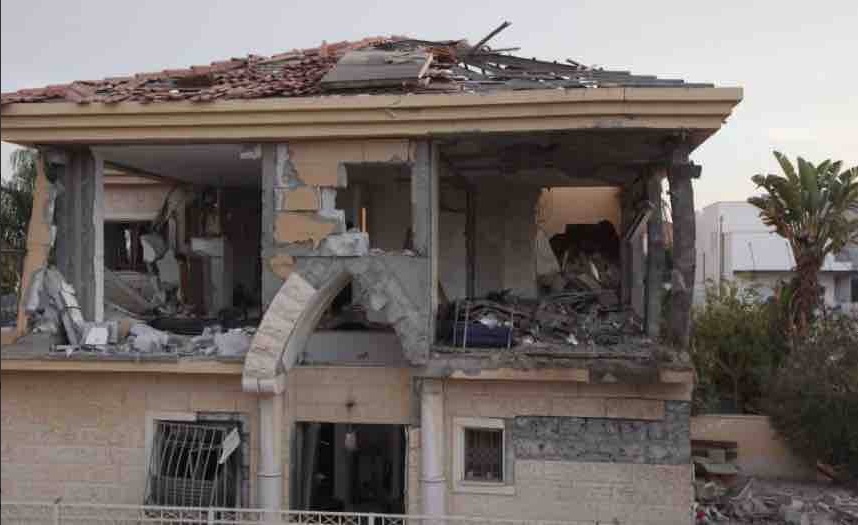
Garrett Davis, who runs a dog care business in Israel, started a GoFundMe on Oct. 17 for a family whose Beersheba home was destroyed from a Gaza rocket that was reportedly accidentally launched due to a lightning strike.

At around 3:40 a.m. Israeli time, Miri Tamano, a single mother, rushed her three boys – ages 8, 9 and 12 – out of their house and into a bomb shelter in less than a minute. Reportedly, as soon as Tamano shut the shelter door, a rocket struck their house, completely destroying it and all of the Tamano family’s possessions inside.

“Everything has been lost,” Tamano said, asking the public for aid since her family needs basic necessities.

Davis, who is close with the Tamano children after being a volunteer teacher at the Tamano boys’ school through the Masa Israel Teaching Fellowship program, decided to help by starting the GoFundMe page, which has raised more than $20,000 as of publication time.

For two straight years, Davis had been starting GoFundMe pages in honor of his brother, Gabriel, who died in January 2014 from an accidental drug overdose, to provide food for the homeless.

“I did start a GoFundMe in memory of my brother a week before the rocket hit,” Davis told the Journal in a phone interview. “When the rocket hit, I automatically closed the one in memory of my brother and I started this one for the family.”

Davis wrote in JNS that when the rocket hit, “I knew I had to do something special—for them, and for Gabe.”

“Thank God that they [the Tamanos] were in their safe room when the rocket struck their house, and are all fine,” Davis wrote. “But an entire story of their house is destroyed.

“So now is time to rebuild, like I rebuilt my life, by turning an ending into a beginning.”

Donations to the Tamano family can be made here.

Man Starts GoFundMe for Family That Lost Home in Gaza Rocket Attack Read More »

How Israel Is Helping the Worldwide Water Shortage

A still from the film “Sustainable Nation”

More than a decade before David Ben-Gurion declared Israeli independence from the confines of a Tel Aviv bomb shelter, he and other luminaries who envisioned a developed, progressive Jewish state knew that water, as much as war, would determine Israel’s survival and viability. 

In 1937, well before they had their ancestral homeland, before they had war on their hands, Jews in the region had Mekorot, a national water authority. Tasked with diverting water from sources such as the Sea of Galilee and the Jordan River in the wetter north to the more barren south, Mekorot executed plans during Israel’s infancy to lay the groundwork for quenching the future nation’s thirst.

Underscoring the importance Israel has always placed on its water sector is its prioritization over other key infrastructure sectors. Water has been piped from north to south for agriculture, energy and drinking since the 1960s; whereas Israeli drivers got their first true nation-length expressway only 10 years ago. 

Prioritizing water is one thing. Succeeding in the water sector amid unfavorable elements is another. Nearly two-thirds of Israel is bone-dry desert, long thought unsuitable for bountiful agricultural yields. Rainfall is scarce and devastating droughts are commonplace. The stakes have always been understood: If Israelis were to thrive, they’d have to evolve, fight the elements and provide water security to a people cornered in one of the most arid strips of land on Earth.

The conditions haven’t gotten any easier. As a result of climate change, Israel’s rainfall has been cut in half since 1948, while its population has increased tenfold. 

“No one should die of thirst,” Yaari says almost pleadingly in the film. “It’s not just.” 

Still, Israel’s story represents a drop in the bucket of the world’s cataclysmic water crisis, a global issue reaching apocalyptic proportions, even in the developed world. This past summer, Cape Town, one of South Africa’s most popular tourist destinations, came within weeks of its self-imposed Day Zero — a day when all of the city’s taps would be shut off and emergency rations would be imposed nationwide.

The crisis was averted, thanks to urgent regulations on water use for baths, flushing toilets and washing clothes. Timely rainfall also helped restore reservoir levels by 20 percent. The South African tourist board now estimates that Cape Town’s Day Zero concerns can be pushed into 2019. Regardless, the situation remains dire.  

Cape Town’s actions will soon be the new normal. According to the World Health Organization, half of the global population will be facing water scarcity by 2025.

As a result, Israel increasingly finds itself in a unique situation. 

By the 1980s, Israel had largely conquered most of its water problems. Its water sector progressed through transformational conservation methods, reuse of wastewater (Israel reuses more than 90 percent of its water; next in the world is Spain at 20 percent), and the pioneering of such methods as drip irrigation. Israel made its desert bloom into a fruitful agricultural powerhouse. More recently, it added desalination of the Mediterranean to the mix to shore up supplies of urban drinking water. By 2014, the same year California declared a state of emergency while reckoning with its region’s worst drought in 1,200 years, Israel became a water-surplus nation, able to export water to neighboring Jordan and Palestinian territories. 

“I think in order to solve the crisis, the people of the world need to work together, and a country like Israel needs to be brought into that discussion more and more because of Israel’s vast experience,” Micah Smith, director of “Sustainable Nation,” a new Israeli documentary that follows three Israelis who are bringing sustainable water solutions to an increasingly thirsty planet using solutions developed in Israel, said in an interview. 

“‘Sustainable Nation’ follows some of the change-makers exporting Israeli water ingenuity to the rest of the world.”

As showcased at a United Nations conference for International Water Day this past March, Israeli water sector entrepreneurs are integral participants in the global water conversation. The conference highlighted how Israeli-developed water technology services were being used in more than 100 countries worldwide. A noticeable absentee from that list was South Africa, due to its frayed diplomatic relations with Israel, which were marred by Pretoria leveling apartheid charges at Jerusalem. 

“South Africa is the negative example in all this,” Smith said, referencing the country’s refusals to accept Israeli aid in the face of its water crisis. A 2016 Johannesburg conference aimed at dealing with the water crisis in South Africa was scrapped because of boycott, divestment and sanctions-backed pressure and other criticism concerning Israel’s inclusion. “It’s tragic to see that people are putting lives at risk rather than bringing people together to solve the world’s water problems,” Smith said.

Smith said he made “Sustainable Nation” to tell Israel’s water story, one that people the world over can learn from. That story, as Clive Lipchin, a South African-born Middle East drought expert puts it in the film, is one of “a people unwilling to accept the status quo.” 

“Sustainable Nation” follows some of the change-makers exporting Israeli water ingenuity to the rest of the world. Produced by Jerusalem U, the nonprofit creative team behind “Beneath the Helmet,” the 2014 documentary about Israel Defense Forces soldiers, Smith’s film intimately portrays several Israeli water-sector innovators attempting to bring their expertise to water-starved or water-challenged parts of the world such as South Asia and Africa. 

Sivan Yaari, CEO of Innovation: Africa, an Israeli NGO, is one of them. Her organization has brought solar-powered water pumps to hundreds of rural African villages. 

“No one should die of thirst,” Yaari says almost pleadingly in the film. “It’s not just.” 

In rural Uganda, where “Sustainable Nation” follows Yaari, matriarchs are responsible for the family unit’s water needs. Mothers often trek at least two or three miles round trip with 20-liter jerry cans for filling about four times a day. A sequence in the film depicts a mother performing the feat with a baby held in a sarong on her back. 

Yaari’s organization surveys villages for water sources, often finding clean water deep in aquifers, then builds towers and installs water tanks equipped with solar pumps. By way of gravity, water flows to taps throughout a village. Local women then become managers and operators of the system, learning accounting techniques, opening bank accounts, and being responsible for maintenance and upkeep with Innovate: Africa personnel monitoring and guiding them remotely from Israel. 

Of her work, Yaari says in the film, “it’s still so small compared to the need.”

Eli Cohen, also profiled in the film, is a prolific aquatic farmer trying to bring his revolutionary natural filtration methods to India. There, tens of millions living along the Ganges River and its tributaries deal with agricultural, domestic and industrial sewage polluting the water supply. Sewage water from murky, archaic “nalas” or drains, runs directly into homes and communal water depots. Despite plenty of rainfall and billions of dollars invested into energy-intensive water treatment methods, India’s water supply remains mired in pollution problems. 

A farmer who ditched working in high-tech to enjoy the serenity of nature in Zippori, Israel, Cohen hopes to bring aquatic planting on a massive scale to India. Applying an energy-free filtration method, plants add oxygen to sewage water, absorb toxins and even heavy metals, and incorporate them into biomass. L’Oreal Israel, the large beauty products manufacturer, pipes its chemical wastewater into Cohen’s majestically designed aquatic plant ponds to meet Israel’s strict wastewater regulations.

In the film, Cohen presents a proposal for treating a portion of the Najafgarh River, a major tributary of the Ganges that 8 million people live on, which is infested with thick, raw sewage. The proposal calls for a series of ponds and parks with floating aquatic plants naturally treating the water. 

“The solutions are so simple,” Cohen says at one point with a hint of exasperation. 

Cohen’s and Yaari’s stories in the film (Cohen’s, an uphill bureaucratic battle with hints of promise; and Yaari’s seemingly a success) hint at a cumbersome truth: We possess the tools to address the world’s water crisis but do we all care enough to act? 

The 38-year-old Smith, who lives in a Jerusalem suburb with his wife and two children, said he finds hope in his kids, who, like many of their Israeli peers, are obsessed with water conservation. 

“I have trouble getting my kids to flush the toilet sometimes because they think it’s a waste of water,” he said. “While this generation might not be able to shift the global consciousness, really, if we want to save the world, so to speak, we have to focus on the next generation.”

After his film’s anticipated festival run next year, about which Smith did not disclose many details, he plans to supplement its availability on streaming platforms with educational screenings at schools. One thing the film outlines is how water conservation has seeped into the consciousness of Israeli society through a series of practical in-home innovations and effective widespread outreach efforts. 

“In the film, Cohen presents a proposal for treating a portion of the Najafgarh River, a major tributary of the Ganges that 8 million people live on, which is infested with thick, raw sewage.“

That has meant, among other things, dual flush toilets and decades-old media campaigns that included humorous television commercials encouraging people to shower together, guilt-inducing public service announcements, and even children’s programming (“Sustainable Nation” features a short clip of a “Sesame Street”-like show in which humans reprimand water-wasting puppets). 

A cultural overhaul toward conservationism took place in the 1980s, coinciding with Israel’s water-sector technology boon. The collective response to water shortages by the public makes Israel unlike most places on Earth — certainly, Smith believes, his birthplace of Los Angeles.  

“I experienced serious culture shock in Israel when it came to water,” said Smith, who made aliyah in his early 20s. Born in Westwood, Smith attended, as he put it, “every Jewish day school in the city.” He can’t remember any attention being paid to water conservation during that time.  

“The relationship to water in [Israel] is so drastically different than back in the States,” he said. “Everyone is taught conservation from a young age. It’s absolutely cultural. The movie is also a way to show places like California that culture can be shifted as well.”


“Sustainable Nation” will have a private screening in Los Angeles on Nov. 12.

Read More: Can California Embrace Israeli Water Technology?

How Israel Is Helping the Worldwide Water Shortage Read More »

Conservative Rabbis Can Now Attend Interfaith Marriages

Conservative rabbis are now allowed to attend interfaith weddings according to the Committee on Jewish Law and Standards.

Though many have found ways to celebrate interfaith simchas since the rule wasn’t strictly enforced, the new rule allows rabbis to attend ceremonies without facing penalties.

The decision was made last Friday, Oct. 19 in a vote of the Rabbinical Assembly’s Committee on JLS, which determines Conservative Jewish legal rulings.

According to a statement provided by the Rabbinical Assembly, the committee’s ruling states “Attendance as a guest at a wedding where only one party is Jewish is not included in this Standard of Religious Practice.”

The decision reverses more than four decades of rumors that the movement’s rabbis would lose their position if they even attended an interfaith wedding.

According to a 2013 Pew Research poll, as of 2005-2013, 58 percent of Jewish marriages have been interfaith marriages. Before 1970 it was 18 percent.

“Reform Judaism continues to be the largest Jewish denominational movement in the United States,” according to the poll. “One-third (35%) of all U.S. Jews identify with the Reform movement, while 18% identify with Conservative Judaism.”

The decision to lift the ban shows American Jews that the Conservative movement is slowing changing the way they look at interfaith marriages in order to make the Jewish community more inclusive.

“This important standard [officiating Jewish couples], however, does not preclude our welcoming and reaching out to intermarried couples and families, as we believe it is also important to create positive rabbinic relationships with both the Jewish and non-Jewish member of such a couple,” the RA said.

To read the full Conservative Movement code of conduct click here.  

Conservative Rabbis Can Now Attend Interfaith Marriages Read More »

Jews, Blinded by Trump

The midterms are coming, and I’m worried about the state of mind of American Jews. 

Not because most of them are going to vote for Democratic candidates, as a survey from last week revealed. That’s to be expected. 

Not because most will vote for Democrats even though Israelis would prefer Republicans to retain control of Congress. There is nothing new in this divide of preferences. 

It’s also not a surprise — and doesn’t much worry me — that most disapprove of President Donald Trump. 

And it’s not a surprise that although pro-Israel, many are critical of some (35 percent) or many (24 percent) of its policies. Join the club: Israelis, too, are critical of some of many of Israel’s policies, while still voting for the same government for quite some time (as to why, read David Suissa’s column “Why Are Israeli Voters So Stubborn?” (Oct. 5). 

No, I’m worried about one question in the survey that was published by the Mellman Group. It is a tricky question to analyze, as it refers to two separate issues: Trump is No. 1, Jerusalem is No. 2. 

“Large Majorities Disapprove of Trump’s Handling of Nearly Every Issue,” declares the summary of the findings. Indeed, the only issue that a majority of American Jews are satisfied with is the handling of U.S.-Israel relations. That’s important because it indicates at least some American Jews retain a grain of common sense even in these highly charged days of partisan politics. How many is “some”? A little more than a half approve of Trump’s handling of the relations: 51 percent. What does the other (almost) half want him to do? What must Trump do to satisfy the discontented half? 

“There is no shame in being honest about your preferences. Israel wants a supportive U.S. president; Trump, thus far, has provided it with one.”

Whatever the answer, the other question I have clearly shows that common sense is out of fashion. It’s the question about Trump’s handling of relocating the American Embassy to Jerusalem. A clear majority of American Jews disapprove of this decision. Does the majority disapprove because it generally disapproves of everything Trump does (except by a scant majority, his handling of U.S.-Israel relations)? Does it disapprove of it because of how Trump made this move specifically? Had he made it in some other fashion, would the majority have approved? Does the majority disapprove of it because it has no desire to see an American Embassy in Jerusalem — or maybe only if and when the Palestinians would agree to such a move (which might be never)?

There are two basic possibilities: Either American Jews don’t understand the significance of the American Embassy’s move to Jerusalem or they are so disenchanted by Trump that even the embassy’s relocation wouldn’t make them squeeze out a compliment about him. Either way, I’m worried. It’s not good for the Jewish people if Jews no longer wish for the main empire of the era to have its embassy in the capital of the Jewish people. It’s also not good for the Jewish people if Jews can no longer see beyond partisan politics. 

In all seriousness, such a response to a simple question about a no-brainer issue is certain to puzzle a vast majority of Jewish Israelis. Among them, more than two-thirds supported the embassy’s move. All its political parties supported it, except for the Arab Party and the small party of the (small) left, Meretz. Their appreciation is shown by the polls proving that Israel is one of few countries to have a positive view of Trump.

Ha, you’d say: Israelis have a positive view of Trump. Shame on them. But no. There is no shame in being honest about your preferences. Israel wants a supportive U.S. president; Trump, thus far, has provided it with one. There is no shame in showing gratitude to a benefactor. 

There is a little shame in blind partisanship, and a little shame in blind disregard for positive action, and a little shame in opposing what Jews have dreamed of for so long. There is shame —  and thus, there’s worry.  

Jews, Blinded by Trump Read More »

Jordan Cancels ‘Island of Peace’ Lease Agreement With Israel

Bending to domestic pressure, including a protest on Oct. 19 that saw Jordanians take to the streets of Amman, Jordan’s King Abdullah II announced the end of a special arrangement that allowed Israel to lease two parcels of land inside the kingdom along the southern border with Israel.

Israel leased the two enclaves — al-Baqoura and al-Immor, also known as the “Island of Peace” in the southern Arava desert — as part of the 1994 Wadi Araba agreement between the two countries.

In a gesture of goodwill following the 1994 Israel – Jordan peace treaty, Jordan allowed Israeli farmers who settled there to continue cultivating the land.

But in recent days, Jordanian rhetoric has shifted. During the Oct. 19 rally, demonstrators, including politicians and trade union representatives, called on the government to “reassert Jordanian sovereignty” over the lands.

According to the 1994 treaty, Jordan agreed to place the two parcels of land under a “special regime.” Israel pledged to recognize Jordanian sovereignty over the land while leasing it for 25 years. Each party, however, reserved the right to terminate the agreement.

King Abdullah said on Oct. 21 that Israel was informed of the decision, stressing that the lands “would remain Jordanian, and Jordan will exercise full sovereignty over them.”

Yehya al-Soud, a Jordanian parliamentarian, told The Media Line that the monarch “responded to his people’s wish and desire,” explaining that the Jordanian constitution allows “the king to decide on either the conclusion or cancellation of agreements” with other states.

In another special arrangement between the two countries, Jordan is responsible for the Waqf — the Jordanian Islamic trust. The Waqf grants the Hashemite kingdom the right to administer and provide funding for Jerusalem’s Muslim sites of worship.

Al-Soud explained that Jordanians are frustrated with the Waqf agreement, which they believe Israel violates on a daily basis.

“Every day Israeli settlers illegally break into Al-Aqsa Mosque, accompanied by high-ranking Israeli security officers,” he contended.

He stressed that the U.S. administration is fully biased toward Israel, and disregards the views of the international community. “It’s time for the whole world to side with the international community,” al-Soud added.

Oraib Rintawi, a Jordanian political analyst, conveyed to The Media Line that “Jordan, in canceling the lease, has completely complied with the terms and mechanisms of the agreement.

 “The Jordanian move could strain Israel-Jordan relations, and it might affect other agreements between the two countries.” — Moeen al-Taher

“Jordan is a country that respects the law and works within it,” he continued, explaining that Amman is not obligated to renew the lease, which ends in late October next year.

“Jordanians are angry with Israel about a range of issues—about how they treat the Palestinians, violate agreements surrounding al-Aqsa Mosque and dealt with the Israeli Embassy incident in Amman,” Rintawi said.

Last year, Israel and Jordan sparred over a confrontation at the Israeli Embassy in Amman in which Ziv Moyal, an Israeli security guard, killed two Jordanians who had allegedly attacked him.

“Logically, Israel has to accept Jordan’s decision [on the lease]. However, knowing the Israeli arrogant mentality, Israel won’t be logical in its response,” Rintawi asserted.

If Israel refuses to abide by Jordan’s decision, he added, “this would show the world that Israel does not have any intention of returning the leased lands.

“It has used the same policy against the Palestinians, occupying their lands in order to create sovereignty. This time they are dealing with us, and Jordan is an independent state with sovereignty and strong international ties.”

Moeen al-Taher, a Jordanian political analyst, told The Media Line that based on its officials statements, Israel could pressure Amman in different ways to come up with a new formula for extending the lease.

“The Jordanian move could strain Israel-Jordan relations, and it might affect other agreements between the two countries. The Jordanian people could put more pressure on the government to cancel other agreements with Israel in the future,” al-Taher said.

Gad Shemron, an Israeli political analyst, told The Media Line that Amman’s decision has nothing to do with how Jordanians feel about Israelis. Instead, it relates to how “King Abdullah II is facing a very poor domestic economy,” he said.

Shemron added that Jordan is also trying to pressure Israel into building a pipeline to transfer water from the Red Sea to the Dead Sea. “It’s pure business,” he concluded. 

Jordan Cancels ‘Island of Peace’ Lease Agreement With Israel Read More »

Will a Leader Soon ‘Corbyn’ the Democrats?

Corbyn — verb: To turn a traditionally pro-Israel party into an anti-Semitic one while insisting you don’t hate Jews, you only hate Israel.

If years from now a candidate “Corbyns” the Democratic Party, some of us will say “I told you so” by remembering 2018’s blame-Israel-first Democratic candidates. Bernie Sanders’ 2016 hostility, Barack Obama’s Israel-related churlishness and Donald Trump’s unbearable pro-Israel bear hug will factor, too. But this autumn’s chill in the air toward Israel feels portentous.

Many progressive British Jews are panicking. Many still won’t vote Conservative. But the Labour Party, once Great Britain’s leading pro-Israel party, is turning anti-Zionist. It’s also turning anti-Semitism-positive if not positively anti-Semitic, reflecting the Jew-hating face of its new leader, Jeremy Corbyn.

Corbyn doesn’t snarl or bark, he oozes. He tries hiding his Jew-hatred behind hip, progressive rhetoric. Corbyn shows how European anti-Semitism has morphed since Hitler. It’s not Nuremburg-style demagoguery. It’s not Durbanite thuggery. It’s Buckingham-Palace-to-Bel-Air snootiness, perfumed by neo-Marxist rhetoric, wearing Banana Republic fatigues and delivered by Clark Kent not Ayatollah Khomeini. (Right-wing anti-Semitism cloaks its snootiness behind Armani suits, super-sized national flags and little “I like Israel” blue-and-white lapel pins.)

Despite this masquerade, mounting evidence confirms the fears of those often labeled “paranoid Jews.” Decades ago, the novelist Cynthia Ozick said that while paranoids think people are out to get them, when they’re not; Jews are narapoid: We think people are out to get us — and they are. Corbyn confirmed it: Those who salute terrorists, who have schoolboy crushes on the sociopaths of Hamas and Hezbollah, who try Nazifying and South Africanizing the Jewish State through sweeping, sloppy, sleazy accusations are Jew-haters at heart.

It took some digging, but eventually, we discovered that beyond Corbyn’s pro-Palestine Valentines festers an old-fashioned, look-down-your-nose-at-those-bloody-Jews Jew-hater. “Zionists,” Corbyn sniffed in 2013, “clearly have two problems. One is they don’t want to study history” — a stunningly ignorant line that overlooks Zionists’ obsessions with returning home, “and secondly,” Corbyn continued, “having lived in this country for a very long time, probably all their lives, they don’t understand English irony either.”

Nevertheless, in this age of all-or-nothing politics, too many British lefties slavishly knuckle-walk behind their Neanderthal leader, justifying his lapses, rationalizing his hatred, mainstreaming his evil. Corbyn’s Labourites are as subservient to their hater-in-chief as Donald Trump Republicans are to their thug-in-chief. Alas, political prostitution is flourishing left and right, on both sides of the Atlantic.

By now, liberal readers must be popping blood-pressure pills as conservative readers risk spilling their coffee while high-fiving one another. In this age of polarized, paint-by-number partisan politics, this column seems poised to predict the Corbyning of the Democratic Party. And here would be the recipe: Take a swipe at Barack Obama as pro-Iran and anti-Israel; bash Democrats for letting their hatred of Trump trump their love of Jerusalem when the American embassy moved to the Jewish people’s capital; highlight the Bernie Sanderistas already in Congress and running this November; then, boom, we’ve got a model anti-Israel political storm.

And, oh, what click-bait that would be. Right-wingers would whip themselves into a frenzy, whacking the left viciously, forwarding the column passionately.

As a historian, however, my crystal ball is cloudier; while as a center fielder my temperament is more constrained. I won’t predict or bash or fulminate. I simply plead with Democrats: “Prove me wrong!”

First, the good news: The American Revolution worked. The United States left the United Kingdom. Great Britain lacks America’s baseline sympathy for Israel that is embedded in the U.S.-Israel relationship’s DNA. The American Israel Public Affairs Committee’s rhetoric of shared interest and shared values has long united Republicans and Democrats, Christians and Jews, with new bonds formed from shared challenges. A Gallup Poll found that 73 percent of Americans sympathize with Israel over the Palestinians proves that Israel enjoys grassroots support; it’s not political Astroturf some big bad lobby imposes.

Israel competes with Great Britain for the honor of being America’s best ally. And American-Israeli history is less complicated. Great Britain’s humiliating retreat from Palestine still stings. Indeed, although Prince William visited that vexing former British colony, Queen Elizabeth never fit the Holy Land into any of her many itineraries since the 1950s — still smarting from those unholy headaches in the 1940s.

Great Britain is also more European, more Muslim-influenced, more Arab-centered in its foreign policy and more steeped in an 800-year-old anti-Semitic past. America lacks such an anti-Semitic pedigree, making its relationship with Israel more solid, more mutual.

Still, bad omens are proliferating. Barack Obama was not anti-Israel, but he often handled the Jewish State coldly, imperiously, bristling around its often equally snippy Prime Minister Benjamin Netanyahu. Obama took the tough-love approach toward Israel and the soft touch toward the Palestinians — stubbornly following that strategy even as it failed.

Obama’s Iran outreach was doubly damaging. His diplomatic naiveté left many Israelis feeling betrayed. Meanwhile, he drove real political wedges between American Jews and Israel by demanding Jewish obeisance when he muscled through the Joint Comprehensive Plan of Action — the Iran nuclear deal.

Donald Trump’s destructive, polarizing presidency is solidifying these wedges: With bipartisanship scorned as wimpy, you must reject whatever your enemy likes. As Democrats recoil from all things Trump, Trump’s warmth toward Israel makes Trump haters foolishly frosty toward Israel and naively nice regarding the Palestinians and Iran.

Many progressives also perceive Israelis as their enemies in two defining struggles. The politics of privilege falsely casts Netanyahu’s right-wing-led Israel as a nation of white winners oppressing powerless people of color — the Palestinians. This demonizes Israel in the second battle, too — the bout over boundaries. To postmodernist universalists, Israel comes across as too nationalist and too religious. For social justice warriors, Israel is a popular target, blocking Jews at the intersection, rejecting anti-Semitism as part of “intersectionality” — the shared experience of oppression — despite every Jew’s advanced degrees in understanding oppression.

The politics of Trump compounded by these particular ideological crusades has produced a looming disaster: Many of the pop stars of the Resistance, 2018’s Democratic congressional candidates representing the freshest anti-Trump political faces, are also anti-Israel.

“Many of the pop stars of the resistance, 2018’s Democratic congressional candidates representing the freshest anti-Trump political faces, are also anti-Israel. “

If today’s Armageddon-oriented, sky-is-falling politics boosts fanatics, left and right, the most zealous left-wing congressional candidates may eventually “Corbyn” the Democratic Party. Michigan’s Rashida Tlaib is a prickly one-stater who vows to oppose aid for Israel — and alienated JStreet, which has long been soft on Dems promising to push Israel around. Pennsylvania’s Scott Wallace has bankrolled supporters of the boycott, divestment and sanctions movement. Minnesota’s Ilhan Omar denounces the “apartheid Israel regime” and hopes Allah will stir the masses against “the evil doings of Israel.” New York’s Alexandria Ocasio-Cortez sloppily equates Ferguson, Mo., and Gaza. And Virginia’s Leslie Cockburn co-authored a crackpot book that, The New York Times wrote, has as its central assumption “that the Israeli-American connection is somewhere behind just about everything that ails us.”

Once upon a time, a midterm election with even one serious anti-Israel Democrat would have been anomalous and scandalous. Today, when Pew Research Center studies estimate that only 19 percent of progressive Democrats are pro-Israel, these anti-Israel fanatics risk pioneering a new normal. This is especially worrying because, as with so many Corbyn allies, and as we saw during the Women’s March led by Linda (Zionism-is-creepy) Sarsour, hatred of Trump trumps loyalty to Israel for most Democrats today.

In this age of Jonestown politics, supporters become contortionists, treating political parties like cults demanding 100 percent loyalty. Today’s psychology demands total fealty, not even holding your nose when something your candidate says stinks. Rather than abandoning Labour or at least admitting that “Corbyn’s anti-Semitism offends me but I’ll vote for him anyway because Conservatives offend me more,” too many supporters end up justifying his Israel hatred and excusing his anti-Semitism. With zero tolerance for ambiguity or your enemies, the supposedly tolerant end up tolerating intolerance.

Clearly, many voters ignore the legendary New York Mayor Ed Koch’s famous challenge: “If you agree with me on nine out of 12 issues, vote for me. If you agree with me on 12 out of 12 issues, see a psychiatrist.”

Moreover, having been caricatured as “privileged” and “white,” many Jews fear confronting women of color, like Sarsour, Omar and Tlaib, who bash Israel. All this Sarsouring — enslaving yourself to a unified theory of politics wherein all principles take a back seat to Trump-bashing — risks Corbyning the Democratic Party. Already the party of Harry Truman and John F. Kennedy, of Lyndon Johnson and Bella Abzug, of Henry M. “Scoop” Jackson and Hubert Humphrey, of Daniel Patrick Moynihan and John L. Lewis — all ardent Zionists — has become the mainstream American political home for anti-Zionists.

True, most Democratic leaders remain pro-Israel, reflecting that resilient American political consensus. And truth is on Israel’s side. For all the current tensions, supporting Israel remains a far more progressive, Democratic, liberal-friendly cause than supporting the terrorist-addicted Palestinians, the theocracy in Iran or any Arab dictatorship. As progressive talk-show host Bill Maher puts it, “Where would you rather live in the Middle East? In Gaza under Sharia law or Tel Aviv?” Political delusions don’t last forever (see communism, facism, Ku Klux Klanism). It’s hard to believe that every generation will condemn Israel as ultranationalist and ultrareligious while giving Palestinians and Islamists a pass. Corbyn’s rise is cautionary not predictive.

Pro-Israel Democrats must save their party from its new pop stars. They should copy something from the Republican playbook. In December 1991, the grand old man of conservatism, William F. Buckley, made it clear there was no room in the conservative tent — and the Republican Party — for anti-Semites, even if they hid behind a façade of anti-Israelism.

Buckley outed his ideological ally Pat Buchanan and another old friend, Joe Sobran, exposing the Jew-hatred in their snarling contempt for Israel. Making the case, Buckley wrote a 40,000-word article in The National Review, which became the book “In Search of Anti-Semitism,” after the initial essay generated the most letters to the editor in the magazine’s history. 

While opposing America’s entering the Gulf War, Buchanan — who by December 1991 was running for president — accused four pro-war individuals of being in the Israel Defense Ministry’s “Amen Corner.” “They have in common many things,” Buckley noted. “The most conspicuous of these is that they are Jewish.”

Still mourning Auschwitz, Buckley said, “I am ready to concede that in our world, in our time, Jews have inherited distinctive immunities.” Even without that indulgence, noting that Israel is the Jewish state, he insisted, “Anyone who gives voice, especially if this is done repeatedly, to opinions distinctively, even uniquely, offensive to the security of settled Jewish sentiment involving religious or ethnic or tribal pride, engages in anti-Semitic activity.”

Assessing Buchanan’s systematic hostility toward Israel, Buckley concluded: “I find it impossible to defend Pat Buchanan against the charge that what he did and said during the period under examination amounted to anti-Semitism, whatever it was that drove him to say and do it; most probably an iconoclastic temperament.”

“I’m in favor of 95 percent of what he’s doing and saying,” Buckley told reporters. “I hope he changes his mind.” But, Buckley — whose father was a bigot — had long been drawing clear red lines. “Charges of anti-Semitism have been a burden historically for the American right,” The Washington Post reported, “and Buckley has worked hard through The National Review to separate mainstream conservatism from that stigma.”

Although Buckley cautioned against the opposite problem — an occasionally obsessive “anti-anti-Semitism” — he targeted those who deserved it. All too presciently, Buckley declared that for the American right — “short of the real fever swamps” — anti-Semitism is “pretty much a nonproblem. On the left, it’s a creeping problem.”

In the 1990s, Buckley did the right thing and burnished his historical reputation. Here, then, is one prediction I will make: History will judge the silence of too many British Labour leaders harshly for wilting in the face of Corbyn’s demagoguery. And we all must ask, especially on the Jewish left: Where is a Democratic Buckley today, a leading non-Jewish intellectual and activist ready to make the case against progressive anti-Semitism — and for progressive Zionism?


Gil Troy is a distinguished scholar of North American history at McGill University in Toronto and author of the recently released “The Zionist Ideas.”

Will a Leader Soon ‘Corbyn’ the Democrats? Read More »

When Crushing Grapes, Strong Stories Emerge

In early October, as we began the cycle of reading the Torah again, I was in a vineyard in Israel, celebrating a friend’s wedding. It was the first marriage for both bride and groom, both in their 40s. Each had many life experiences before they arrived at the wedding canopy. Each had experienced professional transitions, successes and relationship misfires. Each had suffered parental loss and dealt with illness, either their own or someone else’s. Their families, whom I got to know over the day of the wedding and the Shabbat afterward, were filled with joy and stories, some of which they recounted in a manner that indicated they had been told over and over again. Each story gave a clearer picture of that family branch, the roots they had in the towns where they lived and the long-term investment they have in one another, and illustrated that the stories we knew about the bride and groom were only the tip of the iceberg.

The wedding reception was held at the Nevo Winery, a small, lovely boutique establishment located in Moshav Mata in the Jerusalem hills, not too far from Hadassah Medical Center in Ein Kerem. The winery’s origins lie in a story of illness, family, tragedy, passion and recovery. Nevo Chazan, a third-generation resident of the moshav, first started making wine when his Aunt Leah fell ill and needed to stay with them so she could be close to Hadassah, where she was receiving treatment. During her stay, Aunt Leah enjoyed being outside on the moshav; she picked olives and cooked special meals for her family. She told her nephew that she had made wine and offered to teach him how. 

In Israel, “Jewish geography” isn’t just a party game but actual life playing out on city streets and in coffee shops, a reminder of how closely connected we all are. This wedding was no exception. Chazan’s Aunt Leah, now well, visited the newly married couple at the wedding, discovering that a relative of the bride was Leah’s next-door neighbor. When it comes to weddings, you can’t do better than a location that embodies healing, family, connection and celebration. 

“The grapes of a small winery aren’t just grapes — they represent what those grapes might become.”

From these humble, healing roots, a business was born and a passion ignited. Chazan committed serious study to the craft and the winery has become a hidden gem, unknown even to some of Israel’s oenophiles. At 6,000 bottles a year, it doesn’t produce enough wine to sell commercially. So if you want to sip Nevo wines, you have to go to the Nevo Winery.

The grapes of a small winery aren’t just grapes — they represent what those grapes might become, because when you look at grapes after they’ve been crushed, you can barely see their original shapes; they blend together in a bloody pastiche of destruction. Each of those grapes had a story before they all were pulverized into a collective puree. With time, the grapes do not heal, do not reassume their prior shapes and storyvines. But their essence deepens and becomes stronger. Their stories emerge after time in shared captivity, their flavors roam free, mixing with the tales of grapes around them, opening with oxygen and swirling around glasses in moments of celebration.

The grapes’ stories, like many of our own, remain beneath the surface, yet to be told. The process of uncovering stories is a constant journey. We talk to people we thought we knew and learn something new about them; we reread Jewish texts every year because time deepens perspectives and experience.

Which is why every year, we read of Moses standing atop Mount Nebo and gazing into a future land he’d never live to experience. And then we return our weekly readings to the beginning. Back to Bereshit. Genesis. Noach, the flood. Lech Lecha, the first of many goings-out from lands where we were born to pursue the promises of unknown places. And at the Nevo Winery, during the weekend of my friends’ wedding, I learned the lesson afresh: Gazing into the future, you can see a new beginning.

When Crushing Grapes, Strong Stories Emerge Read More »