fbpx

July 26, 2017

Parashat Devarim: Moses’ Legacy Letter

On March 9, 1790 — 14 years after signing the Declaration of Independence — a dying Benjamin Franklin responded to a letter from Yale President Ezra Stiles, who wanted to glean some final wisdom from one of the great founders of the United States.  

“Here is my Creed,” Franklin wrote. “I believe in one God, Creator of the Universe. That He governs it by his providence. … That the most acceptable service we can render to him, is doing good to his other children. That the soul of man is immortal, and will be treated with justice in another life respecting its conduct in this. These I take to be the fundamental principles of all sound religion, and I regard them as you do, in whatever sect I meet with them.”

It is fascinating to me that Franklin, who never stylized himself as dutifully religious, would look to faith upon the mortal turn. There is something sacred about life that draws us closer to transcendence when we reach its margin. We ask ourselves, when we winnow away the day-to-day struggles: What catches flight in the wind never to be thought of again, and what remains for the next generation? What are our most fundamental creeds? What is our personal wisdom we wish to share?

These same questions permeate Devarim, the final book of the Torah. This book is unique in the Torah for its literary style and composition. It has no narrative to speak of and the stories it does tell are in the form of remembrance of times past, a retelling of the history of the people wandering the desert, testing one another and testing God.

The only true narrative is in the final chapter, where Moses climbs the mountain and dies. His impending death dominates the book, as many scholars have pointed out. Taken at face value, the Book of Deuteronomy takes place on a single day, “On the first day of the eleventh month in the fortieth year” (Deuteronomy 1:3), the day of Moses’ death.

Even more than the founders of our country, Moses, the religious personality incarnate, feels the transcendent need to impart his deepest beliefs to the next generation. Moses lifts his weary bones and ascends to speak to the very people he liberated and bore across the desert in partnership with God.

It is here, in Devarim, that Moses spends his last breaths exhorting the people to remember who they are and where they come from. It is in Devarim that we find our only credal statement, the Shema: “Listen, O’Israel, The LORD is our God, the LORD is One.” (Deuteronomy 6:4).

It is in Devarim where Moses lays out his dreams for his people as a nation settled in the land, prosperous because they know they are bound up in history and covenant. It is in Devarim where Moses demonstrates to the people that there is a choice between being blessed and cursed, between life and death, and that we the people are to choose life (Deuteronomy 30:19).

The Book of Devarim is Moses’ legacy letter to the Jewish people that captures his collected wisdom over a lifetime. While none of us will found a nation or be a prophet of God, we do, however, have our own lives to share with others. Every one of us lives out a personal epic story that spans our entire lifetime. As Jews, we come from an ancient and storied people. God willing, each one of us also can become an ancestor, sharing our collected wisdom with our children and grandchildren. What will be your legacy letter? What if you wrote that letter to your descendants now? And perhaps, most important, what if you wrote it to yourself now?  

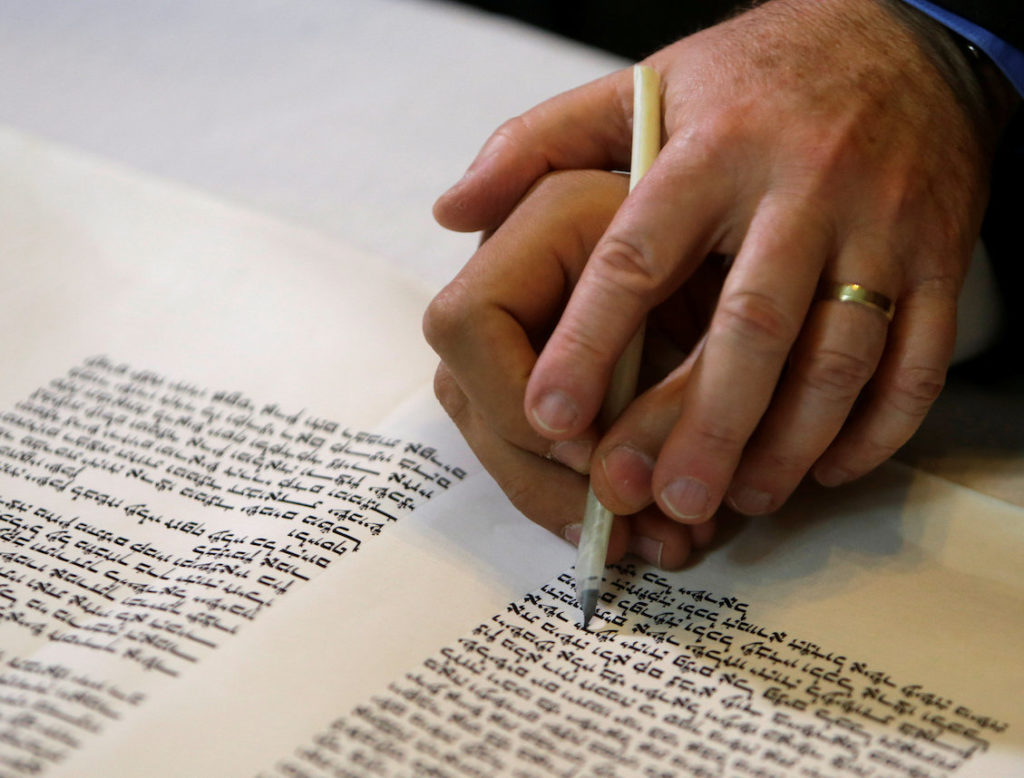
The 613th mitzvah, the very last commandment in the Torah, is to write your own sefer Torah, a sacred scroll, a guidebook for life. Moses fulfills this final mitzvah on the day of his death, sharing his legacy with the next generation. Many of us can’t write the actual words of the Torah, but try to take some time to write your personal version. Like it did for Franklin and Moses, this task can bring clarity of purpose and devotion for these wonderfully short days we spend together in life. You will be glad you did. 


Rabbi Noah Farkas is a clergy member at Valley Beth Shalom in Encino, founder of Netiya and the author of “The Social Action Manual: Six Steps to Repairing the World” (Behrman House).

Parashat Devarim: Moses’ Legacy Letter Read More »

Basking in the ‘GLOW’ of wrestling series and playing Gilda Radner

NAME: Jackie Tohn

AGE: 36

BEST KNOWN FOR: Making the top 36 in Season Eight of
“American Idol” (2009).

LITTLE-KNOWN FACT: “At 18, I came out to L.A. with my agent
and my mom and met Jessica Biel at the TV Guide Awards.
We became fast friends and I moved in with her and her family
in Calabasas almost immediately.”


Jackie Tohn is an actress, stand-up comic, musical comedian and singer-songwriter.

Recently, two Netflix projects have kept her busy: She plays wrestler Melanie in “GLOW,” a Jenji Kohan-produced series based on the Gorgeous Ladies of Wrestling, and comedic icon Gilda Radner in the David Wain-directed “A Futile & Stupid Gesture,” to be released later this year. The Oceanside, N.Y., native is high-energy and independent, qualities that she brought to these and other characters in her filmography — as well as to her Jewish Journal interview at a Silver Lake coffee shop on June 23.

Jewish Journal: How would you characterize your comedy style?

Jackie Tohn: Who I am is Borscht Belty. I’m a Catskills person. I look back at that time and I relate to it: Joan Rivers, Carl Reiner, Mel Brooks, Henny Youngman. I aspire to be a showman. For a long time, that wasn’t cool — it was, the more apathetic you are, that was the sign of a star. I have no aspirations to stand up there and be apathetic and not try. I like the idea that you make an act, you practice your act and now you’re performing for people. That’s why I like a Sarah Silverman: I respond more to people who want to put on a show. The apathy angle doesn’t really work for me. I’m way too excited for that [stuff]. I thought I was too big for myself, for the space, just too much. I was “Jackie Tohn: Not for Everyone.”

JJ: How would you describe your connection to Judaism?

JT: It’s a kishkas connection: It’s in my guts and who I am. I look at Mel Brooks and Gilda and Joan Rivers and even [Jerry] Seinfeld and Larry David — there’s something intangible but something you feel when there’s a Jewish vibe. I look at those people and say, hey, I relate to them. Especially the Jewish culture in comedy — they’re kindred; they could all be members of my family. Culturally, I just feel Jewish. As Jews, we’ve overcome so much and we’ve always been joking. Yiddish is the funniest language: “I can’t make it” becomes “With one tuchis you can’t dance at two weddings.”

JJ: What lessons have you learned from comedy?

JT: One of the most important lessons I’ve learned is the value of support. It’s really easy to cross your arms and say, “That’s not funny; make me laugh.” Those are the worst people to perform for, so I never want to be that person in an audience. I’m lucky to be in a special little part of the comedy community that’s filled with supportive, generous and loving people, and headed by comic and comedy mentor Gerry Katzman — it opened my eyes to the importance of coming from abundance and not scarcity. Just because someone else has a successful thing does not mean that there’s one less thing for me.

JJ: Why is comedy important, especially today?

JT: I was going to say comedy is more important than ever, but it was true, too, when they were making fun of [Richard] Nixon for Watergate. It’s true always, but we’re living now, so it’s always the most important and right now, because that’s all you have. We have to laugh through this. We have to believe that the future is going to be good and funny. With our current political climate and the separations and harsh feelings in the two-party system, we have to take it seriously and get things done, but we have to be laughing. Comedy is a healer.

JJ: How do you stay centered while promoting these high-profile projects?

JT: At the guarantee of sounding cliché, it’s a whirlwind. A friend who’s also an actress advised me to “be where you are.” I think of it every second of the day. “Be present,” of course, we all know that, but “be where you are” changed the verbiage: There’s 9,000 other things to do today, but this is what we’re doing right now.

JJ: What was it like to play Gilda Radner?

JT: I was hyperaware of her and “Saturday Night Live.” Gilda was the first person hired on “SNL.” I had a VHS tape of Gilda’s greatest hits, and I played it on the TV/VCR in my bedroom [growing up]. I was intimately familiar with her work, so when the audition came in, my head popped off and I put it back on. The movie takes place in ’70s, so it’s Gilda, [John] Belushi, [Dan] Aykroyd when they were in Second City. I didn’t have the pressure of having to be Gilda on “SNL.” For the audition, I went in there with costume changes and I did every Gilda character.  

JJ: What’s the most interesting thing about you that most people wouldn’t know?

JT: That I sing and play guitar, or that I’ve been doing this since I was a kid. Or that I moved out to L.A. on a break from college at U. of Delaware.

JJ: What would call your autobiography?

JT: “The Curves in Oceanside Is Buzzing.” When I was on “American Idol,” the show was at its height — even getting eliminated fairly early, I was in 30 million homes a week. And my mother said, “The Curves [women’s gym] in Oceanside was buzzing.”

Basking in the ‘GLOW’ of wrestling series and playing Gilda Radner Read More »

Truly free speech absent at colleges

Words are not violence.

You’d think this truism would be easy for some on the left to swallow; the entire workability of the First Amendment rests on that principle. Because words are not violence, we say that in a civilized society, we should be able to speak freely, that we should be entitled to our opinion, and that anyone who reacts to our words with violence should be punished for that crime.

Yet that perfectly obvious logic seems to elude more and more of the left these days.

Several weeks ago, the Berkeley College Republicans and Young America’s Foundation invited me to campus to speak. For context, I spoke at the college in April 2016; there was no violence, and nary a protester. Instead, I spoke with several hundred students, many of whom disagreed. The event was cordial and friendly and fun.

Last week, UC Berkeley announced that it would not be able to ensure a venue for my scheduled speech in September. Officials said they didn’t have a venue available on the date in question, and then didn’t provide alternative dates. Only after a public hubbub did they pledge to allow me to speak on campus as well as covering the relevant fees.

What changed? Between April 2016 and July 2017, Berkeley saw several major violent protests held by opponents of President Donald Trump. First, in February 2017, alt-right provocateur and Trump acolyte Milo Yiannopoulos was scheduled to speak at the campus. Anti-fascism protesters, allegedly along with some Berkeley students, crashed the venue, began destroying property and setting things on fire, and posed too much of a security risk for the event to continue as planned. Then, in April 2017, Berkeley canceled a planned event with Ann Coulter, moving the date and place for the event, alleging that the university had been “unable to find a safe and suitable venue.” That same month, anti-Trump protesters clashed with pro-Trump protesters who set up shop in Berkeley to stump on behalf of free speech.

Berkeley’s decision-making process has become more and more common across the country. As leftist protesters grow more outrageous, administrators seem more than willing to grant them concessions, up to and including cancellation of events that anger the protesters.

When I spoke at Cal State Los Angeles in February 2016, the administration attempted to cancel the event outright; I showed up, anyway. Protesters blocked the entrances and assaulted students who wanted to come to the event; they pulled the fire alarm. Students had to be spirited into the venue secretly, two-by-two. They eventually were trapped there until the crowd outside dispersed. Meanwhile, the police allegedly were told by the administration to stand down. When I spoke at the University of Wisconsin-Milwaukee, protesters invaded the speech in an attempt to shut it down. When I asked police to remove the protesters, they responded that the administration had told them that if they did that, they’d have to shut down the event entirely.

Too many leftist administrators are playing an inside-outside game in which they capitulate to violent protesters who seek to shut down free debate. They wouldn’t cave to such protesters from the right — if writer Ta-Nehisi Coates were victimized by violent protesters, you can guarantee that administrators would send the cops in force. But violence is a convenient excuse for excluding unwanted viewpoints.

And exclusion of unwanted viewpoints has become nearly universal on college campuses. Administrators now tell students that they can expect college to be a “safe space,” a protected area where they need never feel uncomfortable. To that end, all “microaggressions” must be policed. Microaggressions, as professor Jonathan Haidt of New York University states, are “small actions or word choices that seem on their face to have no malicious intent but that are thought of as a kind of violence nonetheless.” By thinking of words as violence, actual violence can be justified as a natural, decent response to verbiage you don’t like. In fact, one of the professors at Cal State Los Angeles, in anticipation of my speech, posted a note on his door saying as much: “The best response to micro-aggression is macro-aggression.”

We cannot have a political conversation with one another if we’re going to label one another’s arguments a form of brutality, to be prevented at any cost. That merely incentivizes violence as a rational response to words. It actually promotes the logic of violence, since the very act of violence in response to words now can be seen as an expression of righteous indignation: The more violent you are, the worse the microaggression must have been.

Furthermore, the microaggression culture that culminates in leftist rioting on campuses and administrative sycophancy to it generates a generation of mentally unhealthy people. As Haidt states, the use of “trigger warnings” — warnings designed to alert people to the risks of microaggressions — actually make students more paranoid, less prone to engage with the world, unduly emotional and upset. Instead, students should be exposed to ideas with which they disagree, and learn to control their emotional response to them. Get angry, by all means — but speak about your anger, rather than using it as an excuse to avoid thinking about the implications of views you hold or oppose.

I’m currently scheduled to speak at Berkeley in September, after testifying about the dangers of microaggression culture before Congress this week. The administration now says that it’s fully committed to the event moving forward. I certainly hope that’s the case. And I hope that leftists across the country stop burying themselves in the solipsism of the microaggression culture and heed the words of former President Barack Obama: “I don’t agree that you, when you become students at colleges, have to be coddled and protected from different points of view.”

We’ll be a better country if we stop the coddling, fight the violence and begin listening to one another once more. 


Ben Shapiro is editor-in-chief at The Daily Wire, host of the most-listened-to conservative podcast in the nation, “The Ben Shapiro Show,” and author of The New York Times best-seller “Bullies: How the Left’s Culture of Fear Silences Americans.”

Truly free speech absent at colleges Read More »

The worst humanitarian crisis since WWII

The United Nations has declared the worst humanitarian crisis since World War II is taking place in a number of countries in Africa and that twenty million people are at risk of starvation and that the vast majority of the victims of the famine is not as a result of natural disaster, but is a consequence of war and the massive displacement of populations, now numbering 25 million refugees worldwide.

This disturbing report is discussed on today’s “Pod Save the World” broadcast that you can download as an App or listen here – https://getcrookedmedia.com/pod-save-the-world-7cc67d64dd56

 David Miliband, President and CEO of the International Rescue Committee and a former Foreign Secretary of the United Kingdom, speaks with the host of “Pod Save the World,” Tommy Vietor who served under President Obama on the National Security Council.

Mr. Miliband notes that only fifteen percent of Americans are aware of the crisis, but once people become aware of it, it shoots to the top concern they have relative to crisis points in the world. Even the Trump Administration United Nations Ambassador Nikki Haley, to her credit, has said: “This is a crisis that should be leading every newscast and on the front page of every newspaper.” 

What can we do right now to make a difference?

  1. Educate ourselves about this crisis – listening to this podcast is a first step;
  2. To date thirty-five percent of the $6.5 billion needed to head off the famine has been collected. Money does save lives – so we can donate today to the Globalization Emergency Response Coalition – http://www.savethechildren.org/site/c.8rKLIXMGIpI4E/b.9531971/k.5213/Global_Emergency_Response_Coalition.htm (I just did!)
  3. Apply political pressure to our congressional representatives on both sides of the aisle and explain to them if they need explanation that from a geo-strategic point of view America’s withdrawal from many parts of the Muslim world gives the opportunity to malevolent forces there to fill that void and make it more difficult for international famine aid to reach those in need. Our Congressional representatives also need to be reminded that, as Miliband suggests, “We can’t enjoy the blessings of globalization unless we share the burdens of globalization.”
  4. Put pressure on Congress to increase the number of refugees that the United States accepts beyond the 85,000 minimum accepted during Obama administration.

Rabbi Tarfon said – “We are not expected to complete the task [of healing the world] but neither are we free from trying.” (Mishnah Avot 2:21)

The worst humanitarian crisis since WWII Read More »

Temple Mount crisis hinders Trump’s peace efforts

Two weeks ago, sandwiched between Israeli Minister Tzachi Hanegbi and Palestinian Water Authority Head Mazen Ghoneim, President Donald Trump’s envoy to the Middle East Jason Greenblatt proudly lauded a breakthrough on a new Israeli-Palestinian water agreement. Greenblatt declared that the water agreement is “an example of what can be achieved when the sides work together” and reminded that “President Trump has clarified that promoting Israeli-Palestinian peace is one of his highest priorities.”

[This story originally appeared on jewishinsider.com]

However, a mere eight days later, Israelis and Palestinians experienced the most deadly day of the conflict this year with three Israelis brutally stabbed in Halamish and three Palestinians killed while protesting new security measures on the Temple Mount. Prime Minister Benjamin Netanyahu and President Abbas traded insults over who was responsible for the deteriorating crisis over the Temple Mount/Haram al-Sharif compound in Jerusalem. Gone was the momentum and positive atmosphere trumpeted by Washington following the water deal.

For some pro-Israel backers, the Trump administration’s efforts weren’t supportive enough of the Jewish state during the past tumultuous 72 hours. President Trump and Secretary of State Rex Tillerson did not issue a single statement of condemnation after the horrific terror attack in Halamish on Friday nor did they call Netanyahu or Abbas to help mediate the crisis. When the conflict started simmering, the White House released a statement.  “The United States is very concerned about tensions surrounding the Temple Mount/Haram Al-Sharif, a site holy to Jews, Muslims, and Christians, and calls upon the State of Israel and the Hashemite Kingdom of Jordan to make a good faith effort to reduce tensions and to find a solution that assures public safety and the security of the site and maintains the status quo.”

Alan Dershowitz, a former Harvard University law professor, told Jewish Insider that he was “disappointed” that Washington did not back Israel more wholeheartedly. The Trump administration should have “unequivocally come down on the side of Israel and demand that there be metal detectors and videos to indicate that the highest priorities will be to save human lives and that the Palestinian Authority is dead wrong in using these murders as yet another excuse to incite violence,” he asserted.

On Monday night, the Israeli cabinet decided to remove the Israeli security cameras, possibly in part due to U.S. pressure. At the same time, Amman released an Israeli security guard who killed two Jordanians after being stabbed at the Israeli Embassy compound. “I wish the U.S. would take a stronger stance on behalf of the safety and security of Israelis on the Temple Mount,” Dershowitz added. Despite Israel removing the metal detectors, Palestinian religious leaders have continued to object to the Jewish state’s installation of cameras at the sensitive site.

“We encourage efforts that will help calm tensions at the Haram al-Sharif/Temple Mount, but we leave it to the parties to determine what those efforts might be,” State Department spokeswoman Samantha Sutton told Jewish Insider. “We urge the relevant parties to continue their efforts to ensure the safety and security of this holy site. We leave it to the relevant parties to determine the most appropriate measures.”

The Palestinians were also upset with the Trump administration’s efforts. Abbas’ dramatic call to cut security ties with Israel on Friday was partially due to feelings that Washington is not invested in finding a resolution to the ongoing conflict, noted Grant Rumley, a researcher at the Foundation for the Defense of Democracies (FDD). “Abbas wants more involvement from the Trump administration, and not only on the current crisis. They’re looking for a commitment not only to the status quo in Jerusalem but also the status quo in US peacemaking, namely that the two-state solution is the destination for the peace process. Without hearing that publicly, I think Abbas and the Palestinian leadership will continue to be skeptical of the administration,” Rumley added.

With Greenblatt shuttling between the Israeli Prime Minister’s office and the Jordanian capital of Amman, Ofer Zalzberg, a senior Middle East analyst at the International Crisis Group and an expert on the Temple Mount, noted that Washington appears to be overlooking some important new developments. “The administration seems to underestimate the importance of non-state stakeholders in this conflict: Most importantly, the Palestinian protestors and their leadership in East Jerusalem,” Zalzberg explained. “Even if (Jordanian King) Abdullah would accept a formula, it’s far from clear that they would be able to get the public to support them to support it and cease the demonstrations.”

However, for Hussein Ibish, senior resident scholar at the Arab Gulf State Institute, much of the criticism of the Trump administration approach is unfair. The current U.S. policy is “hands-off, but at the same time I’m not sure how effective (former Secretary of State John) Kerry’s approach really was. It’s hard for me to be overly critical of what look likes a slower and more cautious approach,” Ibish noted.

With attention focused on the roots of the current Temple Mount conflict, Zalzberg suggested an alternative approach. “There is an over focus in how to deal with the metal detectors. The site is very volatile there are many other potential grievances. The negotiators now need to think a step ahead: how to brace the site from further crises,” he explained.

Temple Mount crisis hinders Trump’s peace efforts Read More »

Muslims

American Muslims intermarry way less and are far more religious than American Jews

Since it came out in 2013, the “Pew study” — a landmark survey of American Jewish demographics, beliefs and practices — has been at the center of American Jewish scrutiny and handwringing.

Now it’s American Muslims’ turn.

On Wednesday, the Pew Research Center released a survey of American Muslims focusing not only on numbers and their way of life, but also on how the community has responded to the election of President Donald Trump.

Comparing the two studies shows a Muslim sector in America that is more religious, growing faster and feels more embattled than American Jews. But both groups voted for Hillary Clinton.

Here’s how the Jews and Muslims of the United States stack up.

There are more Jews than Muslims in America, but the Muslim population is growing faster.

Pew found that there are about 3.3 million Muslims in the United States, a little more than 1 percent of the population. U.S. Jews, by contrast, stand at 6.3 million — around 2 percent of all Americans.

But Muslims, Pew found, skew younger and have higher birth rates. More than a third of U.S. Muslims are under 30, only 14 percent are over 55 and their birth rate is 2.4, slightly higher than the national average. Most American Jews are over 50 and their birth rate is 1.9. While the median age of U.S. Muslims is 35, the median age of U.S. Jews is 50. Americans in general have a median age of 47.

These numbers explain why a 2015 Pew study found that by 2050, American Muslims will outnumber American Jews. While the Jewish population is expected to stagnate at about 5.4 million, Pew predicts that in a little more than three decades, there will be 8 million Muslims in America.

The respective studies also included some data unique to each religion. While there are sharp internal divides between Shia and Sunni Muslims, Pew did not address the question of “who is a Muslim” as it did with Jewish Americans.

The study reported demographic data that may contradict popular American stereotypes of Muslims. Only 14 percent of Muslim immigrants are from the Middle East, while one-fifth are from South Asia. And the plurality of American Muslims — four in 10 — are white.

Only 13 percent of American Muslims are intermarried.

When Pew released its study of the Jews in 2013, American Jewish leaders began fretting about an intermarriage rate of 58 percent since 2000 — and they haven’t stopped. By that measure, American Muslim leaders can rest easy.

Unlike the majority of American Jews, only 13 percent of American Muslims are intermarried. And the number has declined in recent years: In 2011, the number was 16 percent. The numbers are so low that the word “intermarriage” doesn’t even appear in the survey.

But another statistic shows that American Muslims may be following their Jewish neighbors. Among Muslims born in the U.S., the intermarriage rate is nearly 20 percent.

Most Jews say they don’t face discrimination. Most Muslims say they do.

Another reason for the difference in intermarriage rates could be the discrimination that Jews and Muslims each face in America. Jews, who are more likely to marry outside their group, are also more accepted in America than Muslims.

In an age when Trump the candidate called for a ban on Muslim immigration, the Muslim study focused heavily on Muslim feelings of discrimination and belonging in America. Questions were asked about Islamophobia, anti-Muslim violence, the president, terrorism, extremism and how Muslims feel about being Muslim and American.

In brief, the study found that nearly half of Muslims have faced discrimination in the past year, and 75 percent feel Muslims face a great deal discrimination in America. But nine in 10 feel proud to be American. Three-quarters of American Muslims say violence against civilians can never be justified, as opposed to 59 percent of Americans in general.

In 2013, most Jews said that Jews do not face a lot of discrimination in America, and only 15 percent personally faced discrimination in the year before the survey.

But Pew’s Jewish study was published three years before the spike in anti-Semitism that accompanied the 2016 election. A poll by the Anti-Defamation League published in April revealed starkly different numbers, showing that most Americans were concerned about violence against Jews.

Jews graduate college at higher rates than Muslims and earn more.

The graduation rates and household incomes of American Muslims track with the rest of the country. Like Americans in general, 31 percent of Muslim Americans have graduated college. And a quarter of Muslim Americans earn more than $100,000, similar to the national average. But 40 percent of Muslim households earn less than $30,000 — eight points higher than Americans in general.

Nearly six in 10 American Jews, meanwhile, have graduated college. And 42 percent have household incomes higher than $100,000, while only 20 percent earn less than $30,000.

Muslims are far more religious than Jews, but both say social justice is central.

American Jews and Muslims are particularly different when it comes to religion. While nearly two-thirds of American Muslims say religion is very important to them, only a quarter of Jews do. A third of Jews believe in God, compared to 85 percent of Muslims who said belief in God is essential to being a Muslim. Nearly six in 10 American Muslims say following the Quran is essential to being a Muslim, compared to less than a quarter of American Jews who say the same about Jewish law.

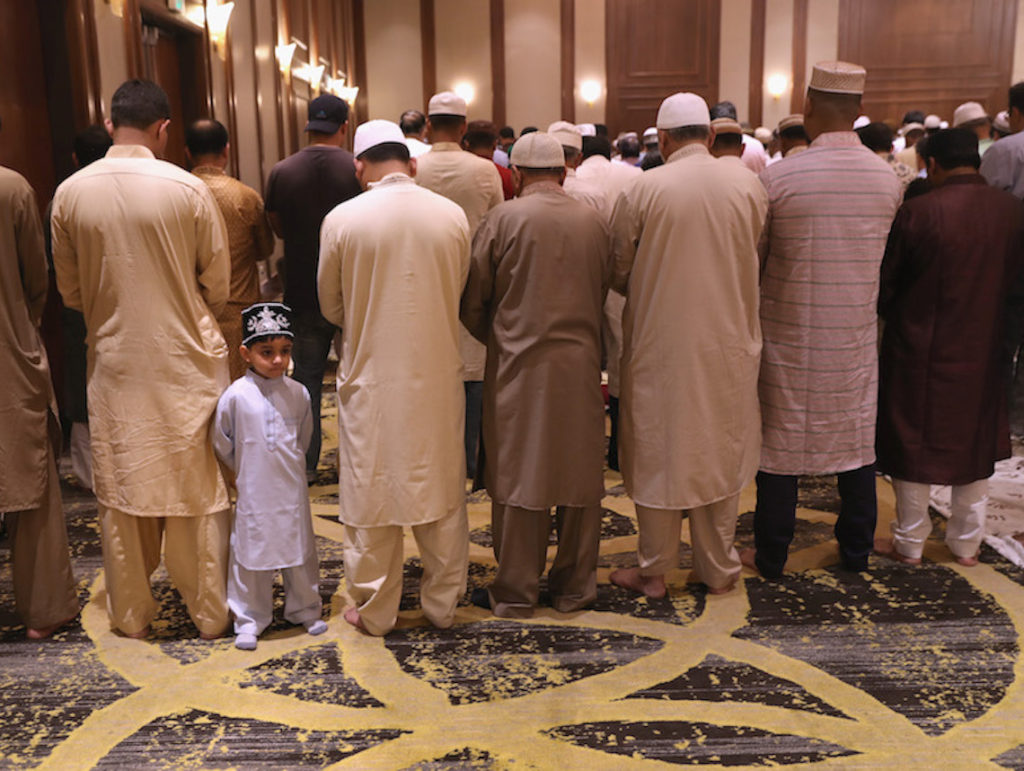
Four in 10 American Muslims attend mosque at least once a week and eight in 10 observe the monthlong fast of Ramadan. By contrast, two-thirds of American Jews attend synagogue less than once a month and only about half fasted on Yom Kippur.

But there are some commonalities, too. Nearly all American Jews and Muslims say they are proud to be Jewish and Muslim, respectively. And both groups prioritize social justice. Solid majorities of Jews (60 percent) and Muslims (69 percent) see “working for justice and equality” as an essential part of their religious identity.

Jews are more liberal than Muslims, but a higher percentage voted for Trump.

American Muslims responded to Trump’s anti-Muslim rhetoric on the campaign trail by voting for Clinton. Nearly 80 percent of American Muslims voted for the Democrat, while only 8 percent backed Trump. By contrast, Clinton earned 70 percent of the Jewish vote, with Trump garnering 25 percent.

But proportionally more American Jews identify as liberal than do American Muslims. While nearly half of American Jews call themselves liberal, only 30 percent of American Muslims do — close to the national average.

But Muslims are trending liberal on at least one issue: A majority believe homosexuality should be accepted in society, compared to just 27 percent who felt that way a decade ago. Four-fifths of American Jews agree.

American Muslims intermarry way less and are far more religious than American Jews Read More »

Singer-Songwriter merges Jewish and gospel influences

Growing up in Norfolk, Va., in a Conservative Jewish home, singer-songwriter Karen Hart was intrigued by how the chants she heard in her synagogue resembled gospel music.

“I never felt connected to the God part,” she said. “What I loved most was listening to the cantor sing. To me, it sounded like the Black singers I was exposed to, the wailing, the sliding from one note to another.”

Hart and I were chatting on the front porch of a Santa Monica house after she had performed in the backyard for the annual music festival held there, “Jeffest.”

My friends Claudia Luther and Tom Trapnell had told me about Hart, who lives near them in the West Los Angeles neighborhood of Mar Vista with her husband, Bryan. I was intrigued by the first song on the CD Tom gave me, “Judah and His Maccabees: A Hanukkah Gospel Story.”

Growing up, I was unhappy about the shortage of winners in Jewish history as well as — admitting my youthful superficiality — on the sports and main news pages of the newspapers. I admired King David and overlooked the Bathsheba episode. I seized on  the story of Judas Maccabee, the Jewish priest who led the Maccabean Revolt against the Seleucid Empire (167-160 B.C.E.) and restored Jewish prayer at the Temple in Jerusalem.

When Claudia and Tom told me about Hart, I said, “I love that story. I have to write about her for the Jewish Journal.”

At her performance on a hot Saturday afternoon, Hart, accompanied by her band, Jennifer Leitham and Randy Drake, demonstrated her lovely voice and a warm manner. It was as if she was inviting the receptive audience to join her at a party. She is reminiscent of her idol, Joni Mitchell, the Canadian singer-songwriter, and part of Hart’s repertoire is a  “Salute to Joni Mitchell.”

Hart told me she studied classical music at East Carolina University and then took off with her dog in a Volkswagen camper to sing and write songs.

“I hit the road and played in any club that would have me,” she said. She’d buy the local paper and look up the clubs. “I’d go into the club, talk to the manager and ask if I could play there,” she said. She made her way to Los Angeles. “If I was going to make it as a songwriter, L.A. was the place to be,” she said.

Then she got a break. Her best friend in B’nai B’rith Girls back in Virginia had a brother who was a movie producer. He was producing a 1985 comedy called “Lust in the Dust,” starring Tab Hunter, Divine and Lainie Kazan, and Hart composed the songs for it, as well as continuing to play clubs. She even ran into Joni Mitchell at a clothing rack in Bullock’s and gave her one of her CDs after a brief and pleasant chat.

A dispute with a manager interrupted her singing career.

“I put down my guitar and didn’t touch it for five years. So I had to make a living. I had heard of word processing,” she said. She said she memorized word processing manuals and eventually developed a business teaching computer skills in what was then a new field.

Eventually, she returned to singing, joining choirs. And she returned to songwriting and thought of her youth.

“I thought the Chanukah music was horrible,” she said. “So I am going to write something for Chanukah but in the Negro spiritual style.”

The result is a rousing piece that sounds great, especially when sung by a choir.

Others have commented on the confluence of the Jewish and African-American experiences as reflected in each group’s music.  In 2010, J. The Jewish News of Northern California wrote about the popularity of Cantor Stephen Saxon, who composed a number of gospel songs based on Friday night prayers.

Black gospel singer Josh Nelson discussed the relationship in an article in the Jewish Chronicle the same year.

Nelson said, “Gospel is closely connected to the African experience of slavery in America. It’s a bittersweet sound because without such hard experience we could never have the good music. That kind of hardship is so close to the Jewish experience. Jewish people have always been isolated within communities in Europe over centuries. The sounds are closely aligned, too — there is a deep similarity between the wailing of the cantors from the shtetls in Europe and the groaning of the African slaves.”

Like these artists, Hart is demonstrating the diversity of American life, performing “Judah and His Maccabees” around the country, showing how two cultures, so different in the popular mind, have much in common.


BILL BOYARSKY is a columnist for the Jewish Journal, Truthdig and L.A. Observed, and the author of “Inventing L.A.: The Chandlers and Their Times” (Angel City Press).

Singer-Songwriter merges Jewish and gospel influences Read More »

Some Jewish business owners wary of L.A. minimum wage increase

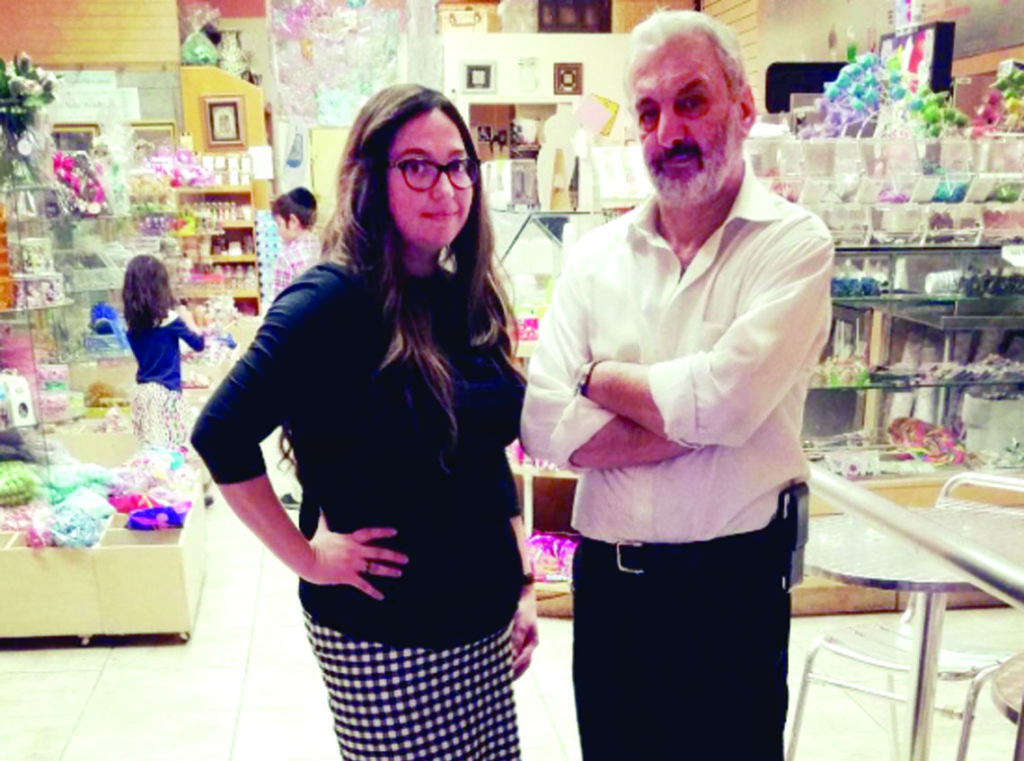
Yehuda Vojdany moved behind the counter of his shop, Munchies, preparing milkshakes, serving ice cream and making phone calls as a crowd of yarmulke-wearing children and men waited in line.

A native of Kurdistan, Vojdany is an Orthodox Jew and keeps his Pico-Robertson candy shop closed for about 60 days a year to honor Jewish holidays. He runs the store with his wife and her mother, and some days they work extra hours to catch up on sales lost to the Jewish holidays.

But it’s not only his observance of Jewish holidays that is reducing his revenue. Vojdany, 54, and other small business owners in the predominantly Jewish Pico-Robertson and Fairfax areas are expressing concern that Los Angeles’ new minimum wage law will hurt their businesses, which already are operating on slim profit margins.

Starting this month, businesses that employ 26 or more workers are required to pay at least $12 an hour, up from $10.50. Owners who employ fewer are required to pay $10.50, an increase of 50 cents an hour.

“The law puts a lot of pressure on us,” Vojdany said. “I’m concerned because I have a family to take care of.”

Vojdany, who has run Munchies for 17 years, employs two part-time workers. He said he might be forced to cut their hours or let one of them go.   

The new law puts extra pressure on Jewish restaurants that already face financial pressures from requirements that they use only kosher ingredients, which generally cost more than non-kosher products.

Alain Cohen, the owner of Got Kosher? restaurant on Pico Boulevard, said his business is stretched thin by trying to keep down its prices. “It’s a challenge to keep the store open,” he said. “Prices on fish and eggs went up. It’s all going to backfire at customers because our prices will gradually increase.”    

The minimum wage increase prompted Cohen to reduce a number of his employees’ hours and ask them to perform additional duties. He also plans to raise his prices on catering.

For now, he is keeping prices in his restaurant unchanged until next year, when they will increase by $1 or $2 per dish. “We have to adjust little by little,” he said, adding that he would hire fewer employees. “I have to find other solutions.” (Cohen declined to say how many workers the business currently employs.)

Kevin Novin, the owner of Elat Market, also on Pico, said the wage hike will have a big impact on pricing. “We have to gradually raise prices by 10 or 20 percent,” he said. “But because there is a lot of competition in this area, we can’t raise prices right now.”

To save on labor and offset costs, Novin said he plans to cut workers’ hours. “We try to cut overtime hours as much as possible,” he said. “But if we need workers, there is nothing we can do.”

For Houman Yadkarim, the owner of Kabob By Faraj Restaurant and Meat Market, raising prices is not always the best solution. “We are working on small margins,” said Yadkarim, who employs 25 full-time and part-time workers at his establishment on Pico Boulevard. “You increase prices more and more and then wonder, ‘How much are people are willing to pay for food?’ ” 

Many businesses will have no choice but to pass on their expenses to customers, he said, adding that he plans to raise prices by 10 or 15 percent. “All these things are burdening small businesses,” Yadkarim said. “Nobody is benefiting from this. People’s purchasing power is going down.”

Some business owners declined to comment for this story because they fear alienating customers who support the wage increase. And not everyone believes the minimum wage hike is a bad idea.

Shushana Djavaheri, the owner of the gift store Marigold Houseware and Gifts, on Pico, said she finds it hard to understand the lament among business owners over the wage increase. “It’s so expensive to live in L.A. and our employees deserve higher wages,” she said, declining to say how many people she employs. “We are not hiring slaves. Honestly, $15 an hour is not that much.”

Chris Tilly, an economist and professor of urban planning at UCLA, says the minimum wage law won’t trigger any big impact that many business owners are anticipating. Business owners in other states that passed minimum wage increases were nervous, Tilly said, but once the laws went into effect, they found ways to adapt to the increases.

In addition, when people earn more money, they tend to spend more, he said.

Despite any financial impact resulting from the new wage law, Vojdany said he never has considered keeping his store open during Rosh Hashanah or Yom Kippur.

“No money in the world will make me open the store during holidays,” he said. “It’s our religion and we don’t even think about it.”  

Some Jewish business owners wary of L.A. minimum wage increase Read More »

Young fashion designers fit the industry’s Jewish tradition

From Isaac Singer and his sewing machines to Levi Strauss and his jeans, through Ralph Lauren, Diane von Furstenberg, Calvin Klein and countless others, the fashion industry — “the rag business,” as it once was called — has a rich Jewish tradition.

In Los Angeles, a new generation is taking part as young designers are beginning to make themselves notable figures on the fashion landscape.

RtA (Road to Awe) is a clothing brand that was started in 2013 by two French-Moroccan Jews: Eli Azran, a Beverly Hills High School graduate, and David Rimokh, a Harvard-Westlake alumnus. In February, just four years after they conceived the brand, they found themselves onstage at New York Fashion Week.

“Lots of people think that we’re fast risers,” said Rimokh, 31. “But four years of sacrifice and grind have been spent building a brand that will stay relevant for a long time. Success didn’t come by accident.”

Before creating RtA, Azran and Rimokh worked for other clothing companies. Though they shared a vision of design that employed an easy, natural style blending shades of black and white, it wasn’t until they joined forces that their dream took physical form.

“Eli has an amazing eye for design,” Rimokh said. “I have really good sourcing capabilities and a degree in finance from Boston University. Both of us knew success would be a process, so we trusted our own paths.”

RtA initially worked with just denim and leather, then expanded the line into full men’s and women’s collections. In growing, the company went from e-commerce and pop-up shops to rack space at various nationwide retailers, such as Barneys, Saks Fifth Avenue and Neiman Marcus. Now, with their own stores in Los Angeles and Miami, the brand has plans to go international.

“It has been a long, humbling journey,” Rimokh said. “We didn’t want immediate success because we wanted to live long and grow, but that makes the process harder. The headaches of wanting to be in this industry can only be made easier with time. Now, we’ve been uplifted by our own success — it’s an addicting business.”

Other young Jewish designers are emerging, too. Mason Spector, 23, and three other L.A. natives started the brand MADHAPPY just over a year ago.

After Beverly [Hills High School], I grew an urge to create that I couldn’t ignore,” said Spector, who joined with one of his best friends, Noah Raf, to build the brand. “With no knowledge, experience or capital, we hit the streets of downtown Los Angeles and began our journey together in 2014.”

One of the key lessons learned, he said, was harnessing the power of social media.

“Building a brand used to revolve around signing with a showroom, racking up wholesale accounts and hiring a PR firm,” he said. “Today, it revolves around Instagram, influencer tags and content. So the fashion industry has become a great outlet for kids to be able to express themselves, learn about business and make money in the process.”

Josh Mehdyzadeh, 20, a Milken Community Schools graduate and current Indiana University business student, launched the hat company 1Time Apparel last year.

When I started 1Time, I wanted each hat to feel personalized,” he said. “I’d lend a personal touch to each one, so that it was yours and no one else’s. I think that creates a community of individuals within a brand, and a conversation between me and my customers.”

Images from MADHAPPY’s Instagram account.

After a year of production, Mehdyzadeh said sales are “upward of $6,000.” While that might not sound impressive, he considers it an accomplishment.

“The journey of a product is a long one, but a rewarding one,” he said. “While I enlist others to embroider the hat, I’m often the one who goes out looking for the specific hats or shirts and their respective colors at stores all across L.A. I’m trying to personally give customers exactly what they want.”

The immediate challenge facing 1Time Apparel is growing its production capacity. Mehdyzadeh said he plans to emphasize an e-commerce store in a way that feels true to his brand’s mission, in much the way Spector did.

Then there’s the possibility a successful social media campaign can overwhelm a vendor with requests, a demand a brand is not always prepared to meet.

“We run production with numbers that we know we can sell,” Spector said. “But when there are many links in the production chain, things can get tough.”

Several weeks ago, after the launch of MADHAPPY’s pop-up store on Robertson Boulevard, one of the company’s most promising days became one of its most difficult. 

“We got an order from an international store for 300 hoodies, only to find that over 100 of them were damaged, and we had four days to clean and repair all of the pieces and get them ready to be shipped,” Spector said. “Things like that are just chaotic, especially as we’re still trying to establish a strong foundation.”

Despite the pressures, the early success of the young designers has caught the attention of veterans in the field.

“These kids have come out of school with a creative edge and with a special connection to technology,” said Camille Bergher, a 23-year veteran in the fashion industry and current creative director of the apparel design and manufacturing company Topson Downs. “They’re already masters of e-commerce, so young businesses like RtA are coming up fast and spreading their presence effectively. My businesses had to evolve immensely to even join the tech world.”

Bergher attributes the attraction of the fashion industry among L.A. Jewish millennials to the decades of Jewish involvement in the industry’s tradition.

“I feel like the stories of today’s young designers are so similar to mine,” she said. “I was raised in the Fiorucci store that my mother brought to Beverly Hills. And when it came my turn to follow in my mother’s footsteps, my family showed me an open door to my dreams and allowed me to be passionate. I think there’s something about living in this city, being part of the generation-to-generation values of Jewish families, that makes fashion such a rich field.”

Like Bergher, Rimokh’s fashion education evolved from his parents — his father was a handbag manufacturer. But more than learning to build a brand, he picked up universal values.

My parents taught me to be humble and respect elders, which was some Jewish wisdom from my dad,” Rimokh said. “There’s a lot of times I could be arrogant or boast about success, but I know that things change quickly, so I’ve combined everything I’ve learned as a Jewish kid with everything I’ve learned as a grower in the fashion business.”

Young fashion designers fit the industry’s Jewish tradition Read More »

L.A. rabbi arrested in Washington for protesting health care bill

Rabbi Sharon Brous of the Los Angeles congregation IKAR was arrested July 18 with about a dozen other faith leaders outside the Washington, D.C., office of Senate Majority Leader Mitch McConnell (R-Ky.) while protesting Republican efforts to dismantle the Affordable Care Act, also known as Obamacare.

Brous and the other clergy members were arrested for refusing police orders to disperse, according to United States Capitol Police. They were singing, praying and giving speeches before they were arrested, Brous said.

“I did find it to be ironic that it is illegal to stand in the hallway of the Senate building and it’s not illegal to plot how to make cancer patients lose their chemotherapy,” Brous told the Journal in a phone interview.

Brous said she traveled to the nation’s capital to protest Republican health care legislation because she felt obligated as a person of faith, but also because both of her parents are cancer survivors and another close relative is fighting cancer, and she believes proposed bills would deny vital services to cancer patients and others facing grave illnesses.

The most recent Congressional Budget Office review of Republican health care legislation estimated that the Obamacare Repeal Reconciliation Act of 2017 would result in 32 million people losing health care. As Senate majority leader, McConnell is responsible for steering Republican efforts to pass the legislation.

“As people of faith, we are called to operate in a way that is just and right and compassionate in all cases, but we’re asked to have special care for the most vulnerable,” Brous said. “And this does exactly the opposite.”

Brous said the protest was organized by members of the interfaith Auburn Senior Fellows program, including the Rev. William Barber II of Greenleaf Christian Church in Goldsboro, N.C., and Sister Simone Campbell, executive director of Network, a Catholic social justice lobby.

Among those also arrested was Rabbi Alana Suskin of Americans for Peace Now, a group that opposes Israeli military control of Gaza and the West Bank.

Brous said there will be more demonstrations if Republicans persist with their efforts. The July 18 arrests came as one of several waves of protest. At least 11 faith leaders were arrested five days earlier, also in front of McConnell’s office.

“You call yourself religious people and you put your hands on a Bible when you swear the oath of office,” she said of Republican lawmakers. “And you’re undermining everything that we as people of faith hold to be true.”

She and the other protesters arrested with her were released the same day after paying a $50 fine, according to Capitol Police.

L.A. rabbi arrested in Washington for protesting health care bill Read More »