Since it came out in 2013, the “Pew study” — a landmark survey of American Jewish demographics, beliefs and practices — has been at the center of American Jewish scrutiny and handwringing.
Now it’s American Muslims’ turn.
On Wednesday, the Pew Research Center released a survey of American Muslims focusing not only on numbers and their way of life, but also on how the community has responded to the election of President Donald Trump.
Comparing the two studies shows a Muslim sector in America that is more religious, growing faster and feels more embattled than American Jews. But both groups voted for Hillary Clinton.
Here’s how the Jews and Muslims of the United States stack up.
There are more Jews than Muslims in America, but the Muslim population is growing faster.
Pew found that there are about 3.3 million Muslims in the United States, a little more than 1 percent of the population. U.S. Jews, by contrast, stand at 6.3 million — around 2 percent of all Americans.
But Muslims, Pew found, skew younger and have higher birth rates. More than a third of U.S. Muslims are under 30, only 14 percent are over 55 and their birth rate is 2.4, slightly higher than the national average. Most American Jews are over 50 and their birth rate is 1.9. While the median age of U.S. Muslims is 35, the median age of U.S. Jews is 50. Americans in general have a median age of 47.
These numbers explain why a 2015 Pew study found that by 2050, American Muslims will outnumber American Jews. While the Jewish population is expected to stagnate at about 5.4 million, Pew predicts that in a little more than three decades, there will be 8 million Muslims in America.
The respective studies also included some data unique to each religion. While there are sharp internal divides between Shia and Sunni Muslims, Pew did not address the question of “who is a Muslim” as it did with Jewish Americans.
The study reported demographic data that may contradict popular American stereotypes of Muslims. Only 14 percent of Muslim immigrants are from the Middle East, while one-fifth are from South Asia. And the plurality of American Muslims — four in 10 — are white.
Only 13 percent of American Muslims are intermarried.
When Pew released its study of the Jews in 2013, American Jewish leaders began fretting about an intermarriage rate of 58 percent since 2000 — and they haven’t stopped. By that measure, American Muslim leaders can rest easy.
Unlike the majority of American Jews, only 13 percent of American Muslims are intermarried. And the number has declined in recent years: In 2011, the number was 16 percent. The numbers are so low that the word “intermarriage” doesn’t even appear in the survey.
But another statistic shows that American Muslims may be following their Jewish neighbors. Among Muslims born in the U.S., the intermarriage rate is nearly 20 percent.
Most Jews say they don’t face discrimination. Most Muslims say they do.
Another reason for the difference in intermarriage rates could be the discrimination that Jews and Muslims each face in America. Jews, who are more likely to marry outside their group, are also more accepted in America than Muslims.
In an age when Trump the candidate called for a ban on Muslim immigration, the Muslim study focused heavily on Muslim feelings of discrimination and belonging in America. Questions were asked about Islamophobia, anti-Muslim violence, the president, terrorism, extremism and how Muslims feel about being Muslim and American.
In brief, the study found that nearly half of Muslims have faced discrimination in the past year, and 75 percent feel Muslims face a great deal discrimination in America. But nine in 10 feel proud to be American. Three-quarters of American Muslims say violence against civilians can never be justified, as opposed to 59 percent of Americans in general.
In 2013, most Jews said that Jews do not face a lot of discrimination in America, and only 15 percent personally faced discrimination in the year before the survey.
But Pew’s Jewish study was published three years before the spike in anti-Semitism that accompanied the 2016 election. A poll by the Anti-Defamation League published in April revealed starkly different numbers, showing that most Americans were concerned about violence against Jews.
Jews graduate college at higher rates than Muslims and earn more.
The graduation rates and household incomes of American Muslims track with the rest of the country. Like Americans in general, 31 percent of Muslim Americans have graduated college. And a quarter of Muslim Americans earn more than $100,000, similar to the national average. But 40 percent of Muslim households earn less than $30,000 — eight points higher than Americans in general.
Nearly six in 10 American Jews, meanwhile, have graduated college. And 42 percent have household incomes higher than $100,000, while only 20 percent earn less than $30,000.
Muslims are far more religious than Jews, but both say social justice is central.
American Jews and Muslims are particularly different when it comes to religion. While nearly two-thirds of American Muslims say religion is very important to them, only a quarter of Jews do. A third of Jews believe in God, compared to 85 percent of Muslims who said belief in God is essential to being a Muslim. Nearly six in 10 American Muslims say following the Quran is essential to being a Muslim, compared to less than a quarter of American Jews who say the same about Jewish law.
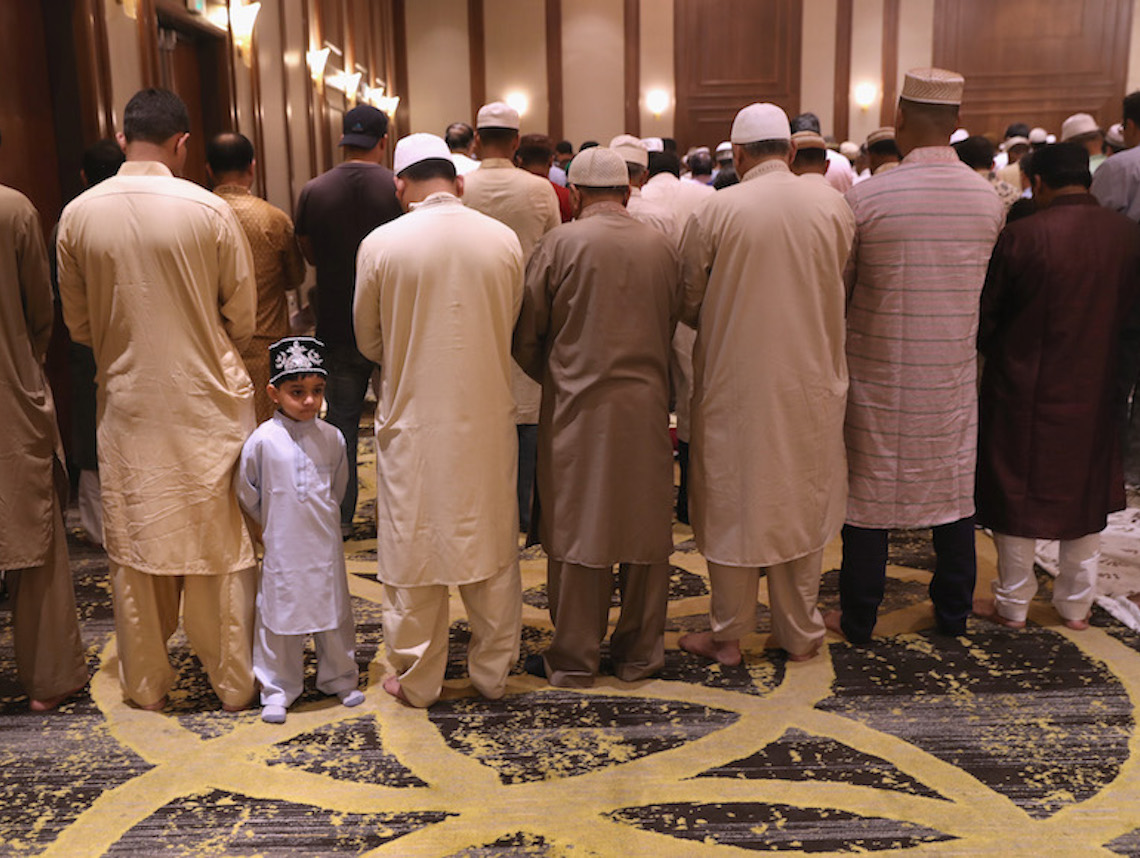
Four in 10 American Muslims attend mosque at least once a week and eight in 10 observe the monthlong fast of Ramadan. By contrast, two-thirds of American Jews attend synagogue less than once a month and only about half fasted on Yom Kippur.
But there are some commonalities, too. Nearly all American Jews and Muslims say they are proud to be Jewish and Muslim, respectively. And both groups prioritize social justice. Solid majorities of Jews (60 percent) and Muslims (69 percent) see “working for justice and equality” as an essential part of their religious identity.
Jews are more liberal than Muslims, but a higher percentage voted for Trump.
American Muslims responded to Trump’s anti-Muslim rhetoric on the campaign trail by voting for Clinton. Nearly 80 percent of American Muslims voted for the Democrat, while only 8 percent backed Trump. By contrast, Clinton earned 70 percent of the Jewish vote, with Trump garnering 25 percent.
But proportionally more American Jews identify as liberal than do American Muslims. While nearly half of American Jews call themselves liberal, only 30 percent of American Muslims do — close to the national average.
But Muslims are trending liberal on at least one issue: A majority believe homosexuality should be accepted in society, compared to just 27 percent who felt that way a decade ago. Four-fifths of American Jews agree.