fbpx

July 26, 2017

Charity reaches out to families grieving stillborn or neonatal death

By the time Maytal Shainberg got home from the hospital, her baby’s room had been cleared out, the crib disassembled and the toys returned. Every sign of the firstborn son she had carried for 39 weeks — who emerged without a heartbeat — was gone.

But the pain didn’t go away, and neither did the diaper coupons that continued to arrive in the mail. While such tragedy is not unheard of, Maytal and her husband, David, found many members in their Orthodox community ill-prepared to respond. Orthodox Jewish law, it turns out, offers little ritual direction when it comes to mourning in such circumstances.

And so, in many ways, when it came to coping with their loss, the Shainbergs were on their own — socially, religiously and logistically. “We had to invent the process for ourselves,” David said recently over lunch with Maytal in their Beverlywood home. “That shouldn’t be the case.”

In December 2015, six months after their baby was stillborn, the couple launched Forever My Angel (forevermyangel.org), a charity that springs into action when a local Jewish family of any denomination experiences a stillbirth or a neonatal death. The organization primarily provides practical help, such as coordinating meal trains, running errands and dismantling baby furniture. Its website includes advice for offering appropriate condolences. (Don’t start with “At least,” it says.)

“It’s logistical support for people who want to grieve,” Maytal said, “and partly a Hail Mary to the community, [that] we need to start thinking about this differently and treating these people differently, and not making everyone feel like this is something that should be swept under the rug or be embarrassed about. Because it’s life.”

Although Judaism has a robust tradition when it comes to mourning the death of an immediate family member, the same practices are not required when an infant does not live 30 days after birth — the age at which a child becomes viable according to halachah, or Jewish law. So in the case of a stillbirth, for example, relatives need not tear clothing, sit shivah, or say Kaddish.

But there’s no rule forbidding those things, either, which places the situation in a gray area.

“You can certainly mourn but there are no rituals required for it,” said Rabbi Elazar Muskin of Young Israel of Century City and president of the Rabbinical Council of America. “The halachah’s perspective is, let’s move on. Life didn’t happen here — let’s move on and try to create another life, if you will, that will be viable.”

That perspective, David Shainberg said, dates to a time when the infant mortality rate was significantly higher, women played a more domestic role in the household and Jewish populations often faced existential threats. “That’s been the M.O. for hundreds of years: push forward and get through it as fast as possible, wipe it under the rug” and try to conceive again, he said. “The world is different now, and I don’t know that halachah has evolved in this regard.”

Rabbi Abner Weiss of Westwood Village Synagogue said the community often fails these families. But he said that the halachah’s job is to establish only a minimum legal set of parameters for grieving.

“It doesn’t legislate for a maximum set of emotion,” Weiss said, adding “there’s no reason that one cannot observe ritually or express ritually one’s feeling.”

A lack of prescribed practices for Orthodox families, on the other hand, could be helpful for those who don’t want to dwell on a pregnancy with an unsuccessful outcome. “What’s required is a sense of balance,” Weiss said. “A necessity to express the grief and a balance so that they’re able to go on in a healthy way.”

For Maytal, that means lighting a candle in memory of her son every Friday night. Still, the Shainbergs said that without a halachic framework to guide the community, people who would support a family after a stillbirth don’t know whether or how to step in.

Looking up resources in the wake of their own tragedy, the Shainbergs said they found numerous support groups. But there had been a void when it came to logistical services that helped them live day to day.

“The charity was a response to what I felt like I needed,” Maytal said. “What I really need is someone to return the baby gift I just got. Or someone to go to Whole Foods to get milk because I want coffee and I don’t have any more milk, and I can’t bring myself to get in the car and drive right now.”

As such, everything provided by the charity and its website is geared toward acts of service and easing some of the everyday stresses grieving families face, Forever My Angel aims to enable them to focus on the act of mourning. The charity helps families across the spectrum of Jewish religious affiliation.

To that effect, Forever My Angel volunteers baby-sit, walk dogs, mop floors and drive carpools. The organization, which relies on donations from the Shainbergs’ friends and family, also can offer financial coverage for the hospital stay and funeral. The website explains what a mother should expect physically in the aftermath. And advice about the proper way to offer condolences is designed to protect a suffering couple from further agony.

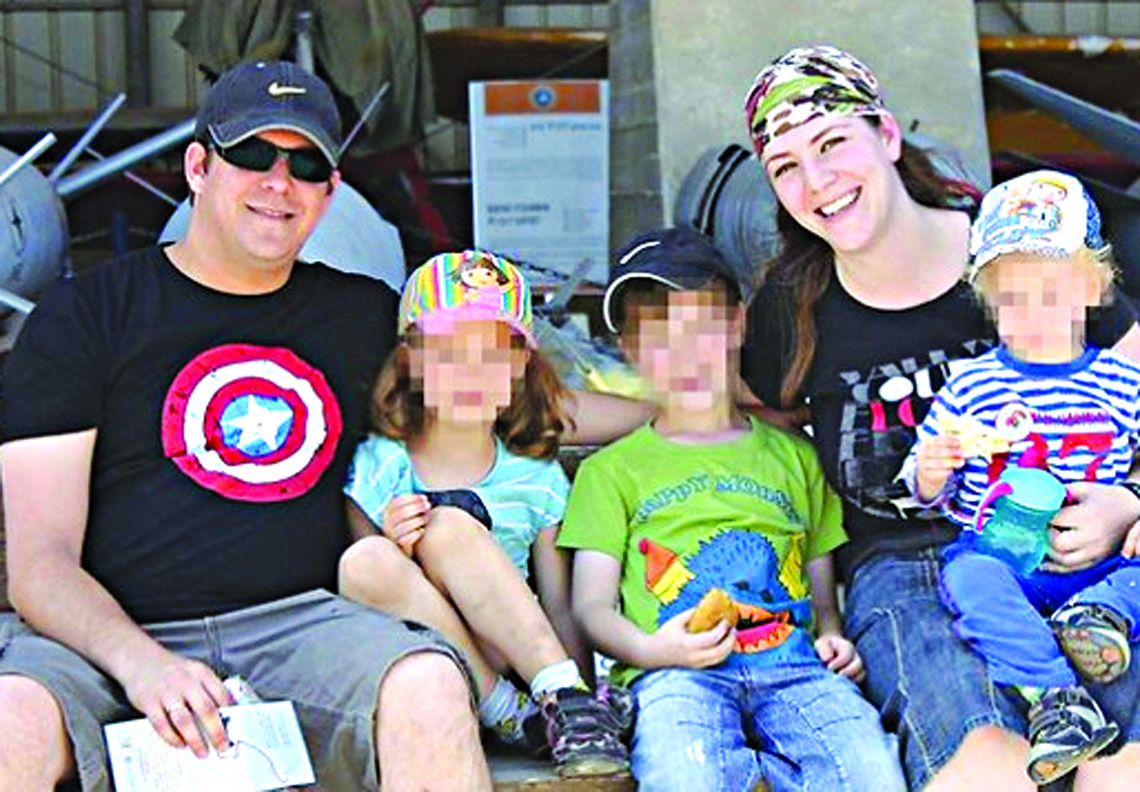
Maytal and David Shainberg — with their 1-year-old son, Isaiah. Photo by Cyndi Bemel

There also are concrete suggestions for the hospital stay: Transfer out of the labor and delivery unit; ask the hospital for a memory box; spend time with the baby; consider choosing a name for him or her. (The Shainbergs named their firstborn but keep it private.)

Rabbi Jason Weiner, head chaplain at Cedars-Sinai Medical Center, said he is consulted on a case of stillbirth or fetal demise about once every six weeks and said reactions vary. Sometimes, he said, a husband and wife will respond differently. “I don’t give blanket or cookie-cutter advice,” he said. “It depends on the situation. And it also depends on their questions. My goal with a patient is to learn about what it’s like to be them at that moment.”

Forever My Angel can put grieving couples in touch with others who actually do know the feeling. By building a network of Jewish families who have experienced a pregnancy with an unsuccessful outcome, the charity has at its disposal a chorus of voices that show it’s OK to talk about what happened.

Upon receiving a referral from hospital chaplains or through word of mouth, David said, “it’s pencils down at work” for the couple, who run the charity by themselves in addition to their day jobs. David, 35, works in private equity, and Maytal, 30, works in financial technology. The couple reaches out personally to each couple, offering first empathy, then assistance.

Lemor Greer was nearly 42 weeks pregnant in May 2016 when her firstborn son lost his heartbeat. Forever My Angel organized a meal train, covered the baby’s funeral, and paid for a year of therapy, and the Shainbergs visited the Greers on the Greers’ first day back from the hospital.

“It’s such a big help that they take away all of those tasks and leave you with to deal with the emotional stuff, which is really what you should be exerting your energy on,” said Shuki Greer, Lemor’s husband.

The support group has made it possible for the Shainbergs to help Jewish families beyond their volunteer network. They have provided contacts to families in New York and Israel.

“We want to pull back this veneer of embarrassment and secrecy,” David said. “You shouldn’t have to pretend it doesn’t exist and try to face as few people in the Jewish community as possible until you get pregnant again.”

Maytal has since given birth to her second child, Isaiah, who recently celebrated his first birthday. She currently is pregnant with a third child. Mother’s Day is still hard for her, she said. So is Yizkor, the memorial service that she is not required to attend.

“There should be two kids running [around] out there,” she said. “It’s a constant reminder. We’re second-time parents but having first-time experiences. I feel like this should be easier. I feel like we’ll feel this way forever.” 

Charity reaches out to families grieving stillborn or neonatal death Read More »

U.S. anti-boycott bill not as bad as some critics say

A bill being weighed in Congress that would target boycotts of Israel and its settlements is sparking widespread outrage, especially after investigative journalist Glenn Greenwald claimed it “criminalizes free speech.” The post relied on a letter from the American Civil Liberties Union (ACLU) expressing First Amendment concerns over the Israel Anti-Boycott Act. By contrast, the co-sponsors of the bill insist that it in no way hampers free speech.

So, who is right?

Statutory analysis is complex under the best of circumstances, and the Israeli-Palestinian conflict does not tend to bring out people’s sense of care and nuance. What has been largely missing from the discussion over the Israel Anti-Boycott Act is a close, careful reading of the bill’s text and relevant statutory law — a non-hyperbolic read, but also a non-apologetic one. In short: This law has issues. It poses genuine speech concerns, and it seems to respond to a nonexistent problem. But the more extreme claims that it bans boycotts of Israel are untrue.

A bit of background can help set the stage. While Arab countries have boycotted Israel since before there was an Israel, in the 1970s they became far more aggressive in demanding that their trading partners join them in refusing to do business with Israel. They imposed a secondary boycott whereby companies had to prove they weren’t doing business with Israel in order to do business with the Arab countries.

In response, the United States passed a law prohibiting several actions if they were taken “with intent to comply with, further, or support any boycott fostered or imposed by a foreign country against a country which is friendly to the United States.” These included:

• Discriminating against a person “on the basis of race, religion, sex, or national origin.”

• Providing information “with respect to the race, religion, sex, or national origin” of any American person or their employees.

• Providing information regarding whether one had any business dealings with the boycotted country.

And, of course:

• Boycotting the country.

This law has been upheld against First Amendment challenges. And the most anodyne way of describing the new bill is to say it merely extends the pre-existing ban on boycotting an ally of the United States at the behest of a foreign country (e.g., Qatar) to include doing so at the behest of an International Governmental Organization (IGO), e.g., the European Union (EU) or United Nations (U.N.)

Importantly, neither the current law nor the proposed one bans boycotts of Israel generally. The existing anti-boycott law only prohibits actions taken “with intent to comply with, further, or support any boycott fostered or imposed by a foreign country.” Obviously, it is not generally unlawful to say whether one has business dealings with Israel. And likewise, even under this law, it is not illegal to boycott Israel — unless the reason you’re doing it is to comply with a foreign country’s demand that you do so.

If one says, “I boycott Israel because I think Israel is terrible,” that remains perfectly lawful (the ACLU is simply wrong when it suggests that the law targets those who boycott Israel “because of a political viewpoint opposed to Israeli policies”). In fact, if one says, “I boycott Israel because the Palestinian Campaign for the Academic and Cultural Boycott of Israel (PACBI) tells me to,” that’s entirely lawful, too (PACBI is neither a foreign government nor an IGO). Only boycotts done at the behest of the EU or the U.N. would be newly prohibited by the law.

The ACLU’s letter suggests that this represents unlawful viewpoint discrimination. But many laws are like this: They prohibit certain actions only when they are taken with a particular intent. For example, it is illegal to fire a Latino employee if one is motivated by racial prejudice against Latinos. Both the action and the intent are perfectly lawful on their own — it is not illegal to harbor racial prejudice, and it is not illegal to fire employees — but conjoined together they become illicit. One could characterize this as (to quote the ACLU’s letter) punishing persons “based solely on their point of view” — the same action, taken with a different (non-prejudiced) viewpoint, is lawful — but doing so would throw the entirety of American anti-discrimination law into question.

Understanding the proposed anti-boycott measure requires grasping this distinction. Critics see provisions that target “support [for] any boycott fostered or imposed by any international governmental organization against Israel,” and assume that this motive alone is being criminalized. But a close parsing of the text — and in fairness, the paragraph in question is a convoluted nightmare — shows that this phrase does not prohibit supporting a boycott of Israel, it only prohibits those aforementioned actions (e.g., discrimination against an employee, certifying one does no business with Israelis) if one is doing so to support a boycott call from a foreign government or, now, IGO.

But just because the hyperbolic reactions are off base does not mean the law is worth backing. There is a legitimate free speech objection in how the law treats “support” for an IGO’s announced boycott. Whereas in current law the term “support” for a boycott is modulated by terms like “comply with” or “further” — suggesting more than pure expressive sympathy — in the new bill the term “support” stands unadorned. This poses a significant risk of chilling speech because whether or not Israel boycotters are doing so because they personally find the nation terrible versus because they wish to “support” a U.N. declaration that Israel is terrible often will be quite blurry. In any event, it’s not clear why that should be legally dispositive.

Other new language regarding statutory penalties — I do not believe the bill carries the risk of imprisonment, but it would be simple for its writers to make this clear — and how “requests” for a boycott are treated also are troublesome and at the very least need reworking.

Even if these flaws were all fixed, however, there would still be a substantial difference of context: Namely, there is no serious threat that either the U.N. or the EU will call for a secondary boycott. Whereas the current law reasonably is categorized as a shield for American corporations — protecting them from being forced by foreign diktat into a boycott they do not actually endorse — this law is not responsive to any such threat.

That may or may not affect the First Amendment analysis, but it significantly undermines the law’s policy rationale. Most of the litigation over the current law came because companies were providing documentation to Arab countries showing that they were boycotting Israel in order to avoid the former nations’ secondary boycott. But if the U.N. or EU are not imposing a secondary boycott, there would be no occasion to furnish this information and thus virtually no situation where anyone could violate the law unless they admitted “we are boycotting Israel because the U.N. said to.”

Laws can be bad without being apocalyptic and inadvisable without being unconstitutional. Discussions of Israel-Palestine, in particular, suffer from a marked propensity from people on all sides to abandon care and perspective as they race to extremes. This bill does not do the more outrageous things it stands accused of. That does not mean it is well drafted, necessary or worth the tempest it is stirring up. 


David Schraub is a lecturer at the law school and senior research fellow at the California Constitution Center at the UC Berkeley School of Law and a doctoral candidate in political science at Berkeley. He writes the blog The Debate Link, where a version of this article first appeared.

U.S. anti-boycott bill not as bad as some critics say Read More »

Lessons from the house of mourning in Halamish

Three days after an Israeli father and two of his children were stabbed to death on Shabbat by a Palestinian in a West Bank settlement, I found myself with 16 other progressive rabbis sitting shivah for the deceased, the Salomons, in a Charedi neighborhood.

It was perhaps the hardest moment of a recent visit to Israel — sitting with the other Americans, our shoulders, heads and legs covered as we paid our respects to this grieving family. We stood out among the others and were stared at by many, and yet, we found many surprising similarities between us and were received by the family with such grace and warmth and real gratitude that it moves me deeply just to recall it.

I have been coming to Israel for more than 20 years, and these visits have never been picture perfect. I lived here as a rabbinical student in the 1990s, during the huge marches for peace, which then brought about the tragic assassination of Yitzhak Rabin after he signed the Oslo peace accords. Shortly after I arrived with a group from my congregation in 2006, the second Lebanon war broke out. And a few years ago, when I brought another group, our ice-breaker the first morning ended with the sound of sirens and instructions to head to shelters because missiles had been launched and Iron Dome activated.

I’m used to arriving in Israel and having things change dramatically within hours or days, but I was hoping this time would be different. It wasn’t.

As Tisha b’Av approaches — it begins the evening of July 31 — I am keenly aware of the dual realities that animate Israeli life. The destruction of the Temples in flames, the massacre of other Jews in so many other times and places, all of the hatred that has been and still is directed at us as a people is real and palpable here as Israel continues to fight for legitimacy and the safety of her people. It pervades every political conversation, every heated argument, every major decision. The pain of the past and the fear our people have internalized, coupled with the fact that this is the Middle East, makes this place a tinderbox ready to ignite at any moment.

It took no time for me to be reminded of all this when I came last week for the American Israel Education Foundation Rabbinic Seminar to travel across the country with colleagues and learn from experts about the complex issues at play here. We arrived hearing that the government had rescinded the agreement that took years to craft, granting egalitarian services at the Western Wall. Local people and delegations from the United States turned out and protested the government’s reversal of policy.

But that was just the beginning. The big news as we arrived was the government response to a challenge from the Israel Religious Action Center, opposing government discrimination against gay and lesbian couples wanting to adopt children. The government alleged that being raised by a same-sex couple would prove harmful to a child because it would “load extra baggage on the child.” As a social liberal and as a lesbian mother, this was particularly painful and disappointing for me, as it was for all of our delegation.

We stood out among the others and were stared at by many, and yet, we were received by the family with such grace and warmth and real gratitude.

Immediately, 90,000 people signed a petition against the decision, including professional organizations of psychologists, mental health professionals, social workers and others. They argued that all research proves that children are better off in a loving home with loving parents of any kind. What amazed me was that, in Tel Aviv, 15,000 people turned out to protest the government’s position. I was deeply moved by how far ahead of the government so much of the Israeli public is on issues like this.

But as soon as there is a march to further the cause of social justice, there is another mass gathering resulting from another kind of deep tension here. Israeli Jews, Israeli Arabs and Palestinians we’ve met with all agree on one thing: Narratives and symbols have great power here in Jerusalem and go beyond reason to powerful emotion very quickly. Actions taken even for good reasons become flash points because they trigger a deeper struggle — the struggle between two peoples and the narratives that express their existential understandings of themselves and their place in the world. And this is what is at the heart of what’s been happening recently on the Temple Mount.

On July 14, two Israeli Arabs murdered two Israeli Druze police officers guarding the Temple Mount. As a result, the government decided to place metal detectors at the entrance to the area. The decision to physically put them in place just hours after the shooting prompted a heated reaction from Palestinians, who saw this as a breach of the status quo at their holy site. Protecting Israelis from those who would murder them makes sense, and the Israeli government has every right to take any action it deems necessary to protect its citizens. What is so sad and shortsighted is that the decision was implemented in a way that completely ignored how this action would be perceived and used by extreme elements within the Arab world.

And it was used: Extremists claimed that Jews were preventing Muslims from praying at Al-Aqsa and called on their faithful to protest in massive numbers. Clashes with police happened on a large scale hours after 15,000 Israelis marched for LGBT adoption rights in Tel Aviv.  

After incitement by Hamas and other radical groups, thousands of Palestinians clashed with police July 21 in the West Bank, and three Palestinians were killed. Later that night, a 19-year-old Palestinian climbed the fence of a Jewish settlement in the West Bank where three generations of the Salomons were celebrating Shabbat and the birth of a new baby. The suspect stabbed three people to death and wounded another, leaving a bloody scene in his wake.

In the same 24 hours, Israel moved from a place with an active debate that would be celebrated in any democracy about social policy to a place where one action that should have made sense tore apart society.

The scene of the Halamish attack. Photo courtesy of IDF

The deep divides between the secular and religious, Palestinians and Israelis, haves and have-nots, hawks and doves will not be bridged in our lifetimes — if ever. As a wise teacher told us on this trip, the oldest Hebrew texts talk about peace and justice in terms of seeking, not of achieving. We are not a people of arrival but of journey “toward.” If there is a people who can model for the world that humans can vigorously pursue ideals they know they never will see fully realized, it is the Jewish people. If there is any country that can make titanic struggles into creative new paradigms, it is Israel.

Our teacher also taught us that he does not view the glass as half full but believes it is important to celebrate that the opportunity exists to pour water into the glass. We break a glass at every Jewish wedding to symbolize what is still broken in our world.

Tisha b’Av reminds us of this so well. What I love about Israel and her people is that even with all that I’ve described, there is a spirit of innovation, creativity, lust for life and defiant hope that also is ingrained in our people. While biblical Israelite religion was destroyed when the Temple burned, Rabbinic Judaism was born at the same time. With every tragedy and act of brutality that happens here, something new and unanticipated is created.

May we have the continued strength to crush glass at our most joyful times so that we remain mindful of the shattered and broken world we live in, the world of conflicting and sometimes flammable confrontation with one another. May we also bless the fact that we are given a glass and the opportunity, as our wise teacher said, to pour water into it at all.

Amid all of the tension and all the misunderstanding and mistrust in Israel these days, our experience of sitting with the Salomons, people in such pain, as a sacred act is an example of the only solution — encountering one another as human beings. As someone very wise once said, “If our hearts must break, let them break open.”


Rabbi Amy Bernstein is senior rabbi at Kehillat Israel Reconstructionist Congregation of Pacific Palisades.

Lessons from the house of mourning in Halamish Read More »

The Mahmoud Abbas exchange, part 2: On peace agreements with Arab autocrats

Amir Tibon is an Israeli journalist who covers Washington, D.C. for Haaretz newspaper. Prior to Haaretz, Tibon was the diplomatic correspondent for Walla News, a leading Israeli news website. His writing on Israel, the peace process and the Middle East has appeared in Foreign Affairs, Politico Magazine, The New Yorker, The Atlantic, Tablet Magazine, The New Republic, The Huffington Post, The American Interest, and The Jerusalem Report.

Grant Rumley is a research fellow at the Foundation for Defense of Democracies, where he focuses on Palestinian politics. Rumley has published in leading media outlets, including Foreign Affairs and Foreign Policy, and contributed commentary to The New York Times, Reuters, and Newsweek. Prior to joining FDD, Rumley was a visiting fellow at Mitvim, The Israeli Institute for Regional Foreign Policies. While in Jerusalem, Grant also founded and edited The Jerusalem Review of Near East Affairs. Previously, Grant served as a consultant in Washington on issues related to counter-terrorism, the Middle East, and war-gaming strategies.

The following exchange will focus on Tibon and Rumley’s new book The Last Palestinian: The Rise and Reign of Mahmoud Abbas (Prometheus Books, 2017). You can find part one here.

***

Dear Amir and Grant,

I’d like to start this round from the last paragraph of your first answer:

The two Arab leaders who have actually signed peace agreements with Israel – King Hussein of Jordan and President Anwar Sadat of Egypt – weren’t great believers in democratic institutions, to say the least. But fairly or not, history will most likely remember them by their diplomatic achievements rather than their heavy-handed governing styles at home. Sadly, as of today, the same cannot be said about Mahmoud Abbas.

The fact that Israel’s two long-lasting peace agreements were signed with non-democratic autocrats is a curious point. Considering that the opposition Abbas has faced in Palestine has never consisted of peace-loving democrats, but of Islamic extremists, and that regional autocrats seem to be the lesser of two evils in today’s Middle East – has Abbas’ autocratic consolidation of power necessarily been a negative development from Israel’s perspective? Moreover, had Abbas been a powerful autocrat before 2007, would he not have been more capable of implementing the vision he started out advocating?

Can Israel ever hope for something better than a regional autocrat with a genuine interest in peace?

Yours,

Shmuel

***

Dear Shmuel,

The question of democratic versus autocratic legitimacy when it comes to the peace process doesn’t have a clear-cut answer, in our opinion. On the one hand, peace agreements between democratic societies are likelier to withstand the test of time. On the other hand, autocrats with strong grips on their respective societies have historically been the only ones able to sign a treaty with Israel.

It’s important to note that the question of how democratic, or undemocratic, Palestinian politics are, isn’t a question for Israel to answer, but for the Palestinians themselves. Israel didn’t comment on the state of democracy in Egypt and Jordan when it signed peace agreements with these countries, and it would be delighted to sign a peace agreement with Saudi Arabia tomorrow morning – assuming the Saudis gave up some of their demands – despite that country’s awful civil rights record. What Israel, or at least the Israelis who want an agreement, seeks in a Palestinian partner is someone who can be trusted and has the ability to deliver.

Our reading of the last two decades of peace talks is that a Palestinian leader needs both the willingness to sign an agreement and the ability to implement it in order to reach a deal. Arafat had the latter, but couldn’t bring himself to accept the former. Abbas may have been the opposite: willing to sign in a vacuum, but unable to implement an agreement once he comes to power and loses Gaza. Arafat’s legitimacy derived not merely from being the father of the modern Palestinian national movement but also from his control over nearly every major decision. Abbas’ legitimacy came from his democratic mandate in winning the 2005 presidential election, yet those same voters dealt his legitimacy a fatal blow in 2006 when they chose Hamas over Abbas’ Fatah party. The setback reverberated in Washington, where both the Bush and Obama administrations largely abandoned any push for future Palestinian elections.

Yet Palestinians have a rich societal history of placing a premium on democratic institutions. Trade unions, labor groups, civil society, political parties – all have a long track record of valuing democratic elections. When Abbas told Palestinians at his first inaugural address in 2005 that this would be a year of Palestinian elections, he had a receptive audience. And it’s this same audience that’s seen him rule by executive decree since 2009, when his four-year presidential term expired. It’s this lack of democracy, when even local city council elections are delayed repeatedly, which plays a role in widening the gap between Abbas and his people.

This is not an argument for holding elections right now – Fatah is in disarray and could well lose again to Hamas – but it is an argument to not fear elections. Palestinians in both the West Bank and Gaza have lived the past decade with autocratic leaders without a meaningful say in who their representatives are. Polls indicate a majority in each area are tired of their current leaders. A new Palestinian leadership, with a democratic majority and a mandate to negotiate peace with Israel, would arguably have more legitimacy than the current autocratic rulers in the West Bank and Gaza.

However unlikely such a scenario is right now, it’s not an impossibility. Palestinian Basic Law calls for presidential elections sixty days after the president vacates the seat. When Abbas does vacate the presidency, there will be voices calling for national elections in both the West Bank and Gaza for a new president. Whether these calls are answered will be the truest test of Palestinian commitment to democracy, and whether or not a leader can campaign on making peace with Israel, and win.


The Mahmoud Abbas exchange, part 2: On peace agreements with Arab autocrats Read More »

Films present dark side of Israeli policies

In 2013, two Israeli films — “5 Broken Cameras” and “The Gatekeepers” — were nominated for an Academy Award for feature-length documentary. It was a great kavod to the Jewish state, no doubt.

Except that supporters of Israel had mixed feelings about these films. “How can we defend Israel,” they moaned, “when Israelis themselves produce such damning films?”

And, as we learned earlier this month at the Jerusalem Film Festival, which screened “West of the Jordan River” and “Born in Deir Yassin,” that was just the beginning of the cinematic self-criticism. 

In 2013, it was clear that both Israeli Oscar contenders were not the products of the Israeli Foreign Ministry or of any pro-Israeli advocacy group, for that matter. “5 Broken Cameras” details the travails of the Palestinian village Bil’in with the defense barrier, the Israel Defense Forces and the neighboring settlers. In “The Gatekeepers,” five former heads of Israel’s Shin Bet secret service reflect candidly on their years of chasing Palestinian terrorists and Jewish extremists. There is a consensus among these five experienced men: Occupation corrupts Israeli society, and it is in the best interest of Israel to make peace with the Palestinians.

Israeli journalist Igal Sarna was shocked by “5 Broken Cameras,” writing in Al-Monitor in 2012, “What I saw scared me and caused me shame, as an Israeli who loves his country, because these actions of occupation and expropriation, uprooting of olive trees and land theft — are our actions, our stupidity.” On the other hand, J.J. Surbeck, executive director of the nonprofit T.E.A.M. (Training and Education About the Middle East) called it “a manipulative pro-Palestinian movie” that contains “manipulative emotional content to better rile viewers against Israel.”

While die-hard supporters of Israel could perhaps dismiss “5 Broken Cameras” as a propaganda film colluded by Emad Burnat and Guy Davidi, its Palestinian and Israeli directors, “The Gatekeepers” was a tougher case to handle. As director Dror Moreh said in an interview, the criticism these security chiefs had expressed “didn’t come from the leftists, it came from the heart of the defense establishment. If they say such things, then, OK, there must be something to it.”

Yet “5 Broken Cameras” and “The Gatekeepers” were only a harbinger for more films looking critically at the Israeli-Palestinian conflict. The 34th Jerusalem Film Festival, which ran from July 13-23, fired another salvo of films that will undoubtedly frustrate people who hate to see any artistic questioning of Israel’s policies and conduct.

“West of the Jordan River,” a documentary directed by Amos Gitai, tells the stories of Israelis and Palestinians, who — with the absence of any political solution — struggle daily with the hardships of life in the West Bank. Gitai last dealt with this issue 35 years ago with his documentary “Field Diary,” which at the time didn’t win him many friends. Here, he makes no bones about where he stands. Talking to i24News in May, he said that “[we] are not in a good moment of history. …  I would say this is a film by Israeli citizens concerned about the direction that the country is taking. … I think I have to take my responsibility as a citizen and talk to the world.”

He did talk to the world in May at the prestigious Cannes International Film Festival, where his film was screened. Variety magazine mentioned that Gitai went out of his way to grant Deputy Minister of Foreign Affairs Tzipi Hotovely a chance to air her “relatively mystical approach to Israeli geopolitics,” but then contrasted it with his 1994 interview with the pragmatic Yitzhak Rabin. And anyway, says Variety, the film reflects “Gitai’s clear anti-government position.”

If this is bad enough news for people who believe that we shouldn’t air our dirty laundry, then they are up to an even harsher blow with “Born in Deir Yassin.” Director Neta Shoshani took on one of the most sensitive landmarks of the Israeli-Palestinian conflict — the bloody conquest of the Arab village Deir Yassin on the western outskirts of Jerusalem in April 1948 by Etzel (the Irgun) and Lehi (the Stern Gang). After the death of 110 of the villagers — many of them the elderly, women and children — the Arab population panicked and started to flee Palestine, thus becoming refugees for generations.

Shoshani interviewed the people who had taken part in the operation in 1948 and again, like in “The Gatekeepers,” these are far from being leftists or liberals. Now in their early 90s and obviously still haunted by the gory scenes of the battle, these men proudly defended their brutal acts by saying — not without justice — that it was “either us or them.”

It’s not only pro-Israel advocates in the Diaspora who resent these kinds of films that seem to badmouth the beloved Jewish state. Last year, Israeli Culture Minister Miri Regev proposed a bill, referred to as “Loyalty in Culture,” which conditions state funding to cultural institutions on the respect they show to Israel. And recently, she demanded that movie foundations hand over information about lectors who had discussed movie-funding proposals over the past five years and the reasons they gave for their decisions.

My advice to anyone startled by these films is to take a deep breath and relax. The Israel that survived a surprise attack on both fronts in the Yom Kippur War surely can survive these critical films. Furthermore, this is a cleansing process that shows the self-confidence and maturity of Israeli society, which is ready to confront unpleasant chapters of its history. When a reconciliation with the Palestinians finally is reached, these films will be remembered as the first positive steps.

But when will Palestinian films begin to echo some soul searching on the other side, confessing atrocities and admitting the rejection of any compromise? Probably not so fast.

And yet, this year’s Jerusalem Film Festival also included “Gaza Surf Club,” which tells the story of Palestinian youth in that Godforsaken place, who instead of joining Hamas, becoming suicide bombers or butchering a Jewish family with a knife, are poised to become world-renowned surfers. In our gloomy environment, this looked to me like a little sign of hope.

Am I daydreaming here? Maybe, but isn’t that what movies are made for? 


Uri Dromi is director general of the Jerusalem Press Club. He served as spokesman of the Yitzhak Rabin and Shimon Peres governments from 1992 to 1996, during the Oslo peace process.

Films present dark side of Israeli policies Read More »

LACMA exhibit turns spotlight on theatrical side of Marc Chagall

Marc Chagall is best known for his fantastical paintings of folkloric shtetl scenes, circus performers, flying goats and, yes, a fiddler on a roof. His use of light and color and his romantic portrayals of Eastern European Jewish life have made him a beloved artist.

Lesser known among Chagall’s work are the richly detailed costumes and backdrops he created for ballet, theater and opera companies. Those pieces finally get their turn in the limelight in “Chagall: Fantasies for the Stage,” on view at the Los Angeles County Museum of Art (LACMA) beginning July 31.

“Our desire from the beginning was not just to do another large-scale Chagall exhibition but rather to focus on a lesser-known aspect of his production,” said Stephanie Barron, senior curator of modern art at LACMA.

“Chagall: Fantasies for the Stage” concentrates on four theatrical productions created over a quarter-century: the ballets “Aleko,” “The Firebird” and “Daphnis and Chloe,” and the opera “The Magic Flute.” All were created during and after World War II while the artist was in exile in New York.

Featured in the show are 145 objects, including 41 brightly painted costumes as well as preparatory sketches and rare 1942 film footage of the original performance of “Aleko.”

Chagall was at the forefront of artists collaborating with the ballet, theater and opera by creating fantastical and visually stunning backdrops and costumes. His work with theatrical companies and opera houses in Russia, Mexico, New York and Paris included painting sets for Sergei Diaghilev’s Ballets Russes traveling dance company as early as 1911.

Chagall’s costumes for the Ballet de l’Opéra de Paris’ “Daphnis and Chloe” (1959)
© 2017 Artists Rights Society (ARS), New York/ADAGP, Paris, photo © 2017 Museum Associates/LACMA

“Chagall: Fantasies for the Stage” was organized with the help of museums in Montreal, Paris and Roubaix in northern France, and with the support of the Chagall estate.

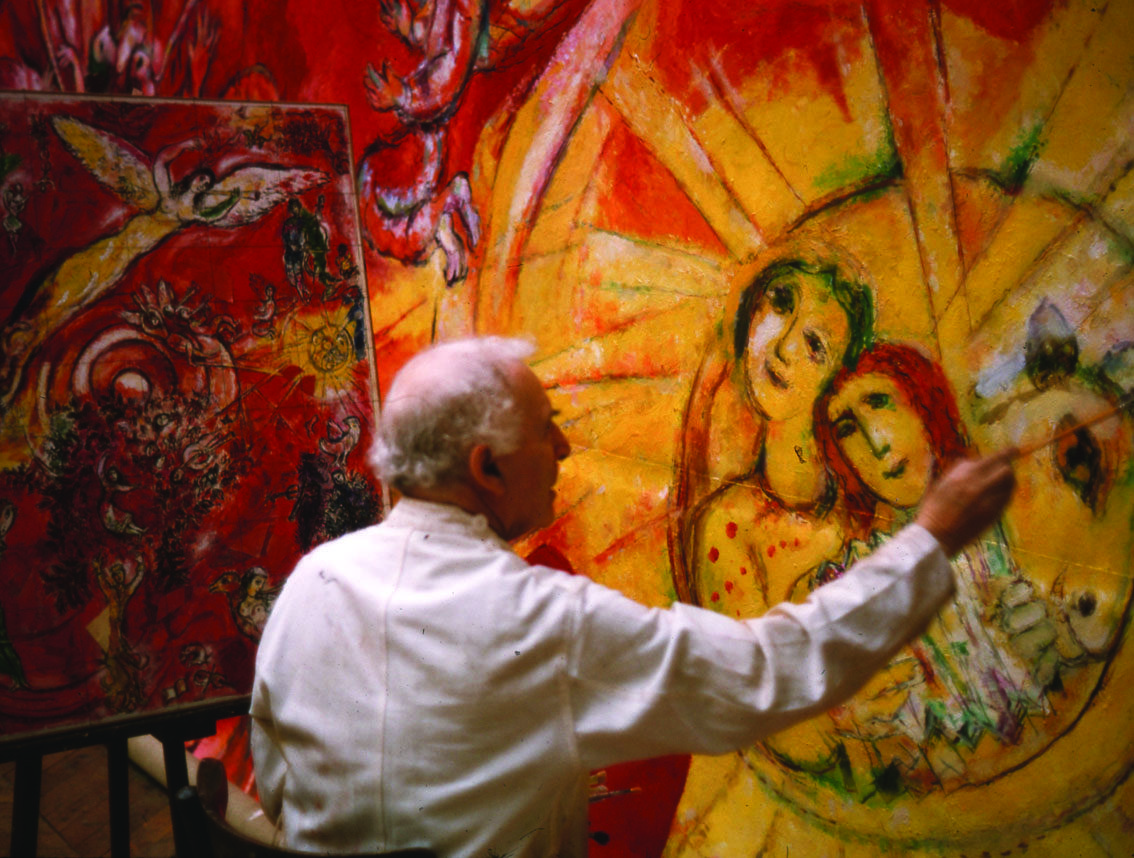
Chagall worked in many formats, including stained glass, ceramics, book illustrations and tapestries. But one common theme was the appearance of musicians. His granddaughter Bella Meyer told the Journal that music always was an important part of her grandfather’s creative process.

“He always had records or a radio in his art studio, and very often worked while listening to music,” she said. “Most of the time, it was Mozart. And he would talk about music. He loved music.”

Meyer recalled her earliest memories of her grandfather.

“We’d go with my mother to his studio, and that’s where he would be,” she said. “After his happy and gleeful welcome, he would sit back and paint. I have many memories watching him paint.”

Barron organized the show with help from the museum’s costume and textile curators, and she leaned on their expertise to display the work.

“It’s one thing to hang a painting, put up a sculpture, do a drawing. But how you present costumes is a very complicated series of decisions that don’t happen at the last minute,” she said.

Barron previously has tapped Los Angeles luminaries like Frank Gehry and John Baldessari to install exhibitions. For this show, she turned to local opera designer Yuval Sharon and projection designer Jason H. Thompson. Sharon is the founder and artistic director of the experimental opera company The Industry and has grabbed headlines for his immersive productions staged in moving cars and at Union Station. But this was Sharon’s first time designing a museum exhibition. Barron wanted to emphasize the theatricality of Chagall’s costumes in a way that looked different than LACMA’s previous costume exhibitions, like “Reigning Men” and “Fashioning Fashion.”

“Yuval came up with this idea, which of course makes so much sense, to actually put them on stages. Normally, costumes are on platforms,” she said. “These are actually real stages with footlights and curtains and sound that comes out of the footlights and floorboards, instead of a painted deck like we usually do in museum exhibitions. So you walk in and there’s no question that you’re in a theatrical space.”

The exhibition is organized chronologically, with each of the four shows given its own area. Each section includes musical accompaniment. Also included are many of Chagall’s iconic paintings of musicians and theatrical scenes, as well as a series of video interviews featuring contemporary artists, costume designers and opera professionals.

Chagall was born in Vitebsk, Russia (present-day Belarus), in 1887. He developed an interest in theater at a young age, creating set designs for the Ballets Russes and murals and set pieces for the Moscow State Jewish Theatre.

He and his family, who were Jewish, fled Nazi-occupied France and immigrated to New York in 1941. The following year, the Ballet Theatre of New York (now American Ballet Theatre) commissioned him to design the scenery and costumes for “Aleko,” a new ballet based on Alexander Pushkin’s poem “The Gypsies” and set to Tchaikovsky’s “Trio in A Minor.”

Visitors may notice a Mexican style in the hand-painted costumes and preparatory studies. That’s because “Aleko” was supposed to debut in New York but union rules didn’t allow Chagall to paint the backdrops himself, so he and the Ballet Theatre completed work on the production in Mexico. It premiered in Mexico City, went to New York and was performed at the Hollywood Bowl in the summer of 1943.

“Aleko” led to Chagall’s second commission, in 1945, from the Ballet Theatre, of Igor Stravinsky’s iconic ballet “The Firebird,” which had premiered in Paris in 1910 at the Ballets Russes. In grief over the recent death of his beloved wife, Bella, Chagall and his daughter, Ida, threw themselves into the project, designing more than 80 costumes for “The Firebird.” The depictions of animals and monsters were beautiful and strange. It debuted at the Metropolitan Opera House in New York to great critical acclaim.

The eight costumes from “The Firebird” in the exhibition only surfaced thanks to some serious sleuthing by Barron.

In recent Chagall retrospectives, “The Firebird” was represented by only a single costume. The others could not be found. Barron and fellow LACMA curator Kay Spilker, with the help of Bella Meyer, went to the storage archives of the New York City Ballet last summer and located and negotiated the loan of “The Firebird” costumes.

“The Firebird” has stayed in the New York City Ballet’s repertoire with newer costumes. LACMA is showing the originals.

In 1956, the Ballet de l’Opéra de Paris commissioned Chagall to design new sets and costumes for Maurice Ravel’s ballet “Daphnis and Chloe.” Based on a story by a Greek poet, the blue and earthy oranges and browns of the costumes and sets were inspired by Chagall’s own visits to Greece.

Chagall’s only opera production was Mozart’s “The Magic Flute,” commissioned by the Metropolitan Opera for its inaugural season at Lincoln Center in New York in 1967. It was a complex project, with 14 sets and dozens of costumes that took him three years to make.

Chagall’s imaginative work for the stage, along with his many commissioned murals and other decorative projects, helped make him an international celebrity. But to Bella Meyer, he always was just her grandfather.

“I had no idea that he was famous. I was probably a bit naive. There could have been many hints. My mother would take us to every big opening. She would always make sure we would have a nice dress on,” Meyer said. “Everyone would call him “maître,” master. That seemed to me normal, not that it happened to any of us, but I had no understanding that he was known outside of our immediate world. I adored him as a very special, dreamlike, fantastical person. That’s how I always saw him.

“I was a teenager when it dawned on me that he might actually be famous. But he was my grandpa. He was the most humble of people.”

“Chagall: Fantasies for the Stage” will be on display from July 31 through Jan. 7 at LACMA, 5905 Wilshire Blvd., Los Angeles.  

LACMA exhibit turns spotlight on theatrical side of Marc Chagall Read More »

‘What She Ate’ offers food for thought on lives of six notable women

In the closing days of the Third Reich, Eva Braun kept drinking Champagne and eating German apple cake. ‘What She was desperate to maintain a semblance of normalcy as bombs fell around the Berlin bunker where she and Adolf Hitler hid. When Albert Speer, Hitler’s favorite architect, visited them, he recalled Eva offering him Champagne and sweets, and she expressed concern that he hadn’t eaten recently.

It may seem glib to discuss the dining habits of Nazi commanders and their companions while that same regime intentionally starved millions. But food played the role of promise and propaganda during World War II. “The Führer repeatedly said, and I repeat after him, if anyone has to go hungry, it shall not be the Germans but other peoples,” Hermann Göring announced in 1942, and indeed, almost half of what Germany consumed during the war came from the countries it occupied.

Culinary historian Laura Shapiro’s new book, “What She Ate,” profiles six women in history and tells their life stories through their relationships with food. Braun is the least empathetic, as she lived “encased in a sphere of make-believe morality” until her death, Shapiro writes. But for Braun, like others, food took on a deeper significance.

The subjects include Rosa Lewis, a British chef known as the “Queen of Cooks,” who used food to climb the social ladder and was rumored to have had an affair with Edward VII before he ascended to the throne in the United Kingdom. There’s also Helen Gurley Brown, the longtime Cosmopolitan editor and the author of “Sex and the Single Girl.” Brown had a complex relationship with food and often turned to dieting, eating celery sticks and sugar-free Jell-O, and proclaiming that “skinny to me is sacred.”

The impetus for “What She Ate” came from a passage Shapiro discovered in a biography of Dorothy Wordsworth, devoted sister to William Wordsworth, the Romantic poet. She kept house for her brother in the quiet and beautiful Lake District of England. Their idyllic country life changed when William married and Dorothy wound up living in a distant village with her nephew. Shapiro was surprised to read that a cook served them a dinner of black pudding, a type of blood sausage.

“It’s kind of a mess of blood and oatmeal. I mean, it’s a beloved British thing and they still eat it with great pleasure, but it sure didn’t sound like Dorothy Wordsworth to me,” Shapiro said in a phone interview.

Dorothy’s journals from her time living with William are filled with references to the gooseberry tarts and gingerbread she baked, the rum she bottled and the apples she picked from the orchard. She would recall visits from friends, the meals they shared and the poetry that was read. “Cooking, for Dorothy, was inextricable from her life with William: to serve him food was to reinforce all the emotions that bound them,” Shapiro writes. But in her later years, as Dorothy descended into sickness and dementia, the black pudding seemed to symbolize her decline.

Shapiro had the idea to look at other women’s lives through the food they prepared and ate. She avoided culinary professionals, instead choosing women who weren’t necessarily known for what they ate. “You don’t have to have written a cookbook to have a relationship with food,” she said.

The novelist Barbara Pym didn’t write cookbooks; she wrote widely praised works of fiction that featured spinsters, clergy and sessions of afternoon tea. The tea “plays so many symbolic roles that another writer would have had to create a whole slew of walk-on characters to say what Barbara says with a cup,” Shapiro writes.

The novels Pym published from the 1950s through the ’70s are full of food, and Shapiro works like a forensic scientist to figure out how “boiled chicken with white sauce” might have been prepared. Pym’s characters ate well, despite the low opinion foreigners are thought to have of British cooking, and she enjoyed describing their meals in her novels, even if her publishers and editors didn’t see the need for it.

“What is wrong with being obsessed with trivia?” Pym asked in her notebook, and Shapiro could have wondered the same thing.

Food was of minimal importance to Eleanor Roosevelt, or at least that’s what everyone around the first lady believed. “By all accounts, the food in the Roosevelt White House was the worst in the history of the presidency,” Shapiro writes, and most people who were invited for a meal there knew to eat beforehand.

Shapiro offers several explanations for Eleanor’s disdain for homemaking, including her frustration with her overbearing mother-in-law, her husband’s infidelities and a lack of interest in the traditional duties of the first lady.

Eleanor Roosevelt hired an inexperienced housekeeper to oversee the White House kitchen, resulting in barely edible meals like Jellied Bouillon Salad and Eggs Mexican (rice topped with bananas and fried eggs). Roosevelt often was traveling across the country to campaign for minimum-wage laws and equal pay for women, and food was the last of her concerns. She also developed an interest in the burgeoning field of home economics, in which food was utilitarian, and the priority was cost and nourishment, not taste or enjoyment.

Shapiro does find some cases, though, in which Roosevelt did enjoy food, and they all took place outside of the White House. At a weekend in the country with some women friends, she wrote that she enjoyed making salads and setting a pretty table. For an intimate friend and former bodyguard, Earl Miller, she happily baked biscuits and made him an applesauce cake. When she wasn’t “the President’s wife,” Shapiro writes, Eleanor Roosevelt “learned what food could mean when love did the cooking.”

The book’s afterword includes Shapiro’s effort to reconcile her own experience with food. She married in the 1970s and moved with her husband to India, where she was surprised to find herself desperate to fill a traditional domestic role of cooking American dishes for her husband.

“It was a wonderful time to be a feminist,” she said. “So there I was, a very happy, hard-working feminist. I found myself married and plummeted back into the 1950s, which was not an image or a world that I ever wanted to be in.”

Soon she learned to master vegetable curries and fried veggie pakoras, based on recipes in the Time-Life book “The Cooking of India.” Like the six women she profiles in “What She Ate,” Shapiro learned that understanding her relationship with food could help untangle other anxieties about career, family and the meaning of home. 

‘What She Ate’ offers food for thought on lives of six notable women Read More »

Boycott, divestment and sanctions of free speech: Against the anti-BDS bill

Freedom of speech is an unquestioned birthright for Americans, and it is among the principles we feel most strongly about modeling for the rest of the world. The recent attempts by the Trump administration to curtail freedom of the press has many on both the left and the right justifiably up in arms at the assault on one of the founding ideals of our nation. So it comes as a political sucker punch that 43 senators on both sides of the aisle have come together to support a bill that clearly intends to chill Americans’ right to peacefully protest.

The bill, S720, co-authored by Ben Cardin (D-Md.) and Rob Portman (R-Ohio), titled the Israel Anti-Boycott Act, would expand the existing criminalization of U.S. corporations that participate in foreign-led boycotts against American allies to also include boycotts that originate from the United Nations. The title and key proponents of the bill, AIPAC chief among them, clearly intend it as a defense against the Boycott, Divestment and Sanctions (BDS) movement, which opposes Israeli occupation of the West Bank. As others have noted, the U.N. actually never called for a commercial boycott of Israel, and instead only urged companies in 2016 to “avoid, identify, assess and address any adverse human rights impacts related to their activities.” In other words, this bill purports to offer a solution for a problem that does not exist.

That this legislation offers no concrete policy solutions only makes the fervent support of its passage all the more troubling. Whether the bill actually criminalizes the right of individual Americans to participate in BDS (and the vagueness of potential interpretations should itself be a red flag), the message is clear: Americans should think twice before exercising their constitutionally protected free speech. No matter what we may think about the merits or motivations behind the BDS movement, we should be able to agree that the decision of how Americans choose to use their wallets should be left entirely up to them.

S720 not only betrays basic American values of freedom of speech, it also diminishes America’s already battered moral standing on the world stage by making the hypocrisy of our Middle East policy crystal clear. The United States has long desired to be a beacon of functional democracy and freedom , and an alternative model to the type of despotic tyranny that plagues the region. Yet with the passage of this bill, we would send the exact opposite message to the world, that the peaceful critique of a nation’s policies should in itself be a reprehensible and potentially criminal act. If President Donald Trump were to propose a domestic abridgement of free speech of this magnitude (not so far-fetched a scenario in the age of presidential smears against our free press), the majority of those same senators supporting this deeply flawed legislation would rightfully oppose such an action with every moral fiber of their being.

But this bill follows a disturbing pattern of the double standard that is applied to nonviolent protests by marginalized communities. Many on the right (and even some on the left) have criticized the Black Lives Matter movement as “violent,” suggesting that nonviolent protests would be more palatable to get their point across. Yet when San Francisco 49ers quarterback Colin Kaepernick, who is African-American, knelt during the national anthem, he was criticized for being “combative” and “unpatriotic.” Likewise, the BDS movement is entirely peaceful, noncombative and (one could argue because it uses capital to achieve its goals) a most American form of protest. But by targeting these forms of expression, the Senate is leaving those who support the movement few options for lawful dissent.

This bill is so far removed from traditional American values that even J Street, a perennial critic of the BDS movement, has condemned it in a statement saying that it would “undermine decades of U.S. policy toward the Israeli-Palestinian conflict, bolster the settlement enterprise and harm the prospects for a two-state solution.” The statement goes on to recommend that Senators “consult with free speech experts on possible Constitutional concerns with the bill.”

The Israeli-Palestinian conflict — and specifically the issue of the West Bank — is complex, and reasonable people can disagree about solutions and strategies. But no good has ever come from criminalizing peaceful protest, whether through substance or intent, or the exercise of free speech, and it will not be any different in this case. As long as we continue speaking to one another and making our opinions heard, there always is a chance to find common ground.


Salam Al-Marayati is the president of the Muslim Public Affairs Council.

Boycott, divestment and sanctions of free speech: Against the anti-BDS bill Read More »