fbpx

March 29, 2017

Survivor Celina Biniaz: The youngest of Schindler’s Jews

“Get in rows. March,” the block leader ordered the nearly 300 women in the Auschwitz barracks who had arrived from the Plaszow concentration camp only weeks earlier, in mid-October 1944.

Thirteen-year-old Celina Karp dutifully obeyed, though this was the first time in Auschwitz that she had been separated from her mother, who earlier that morning had volunteered to peel potatoes, along with 29 others, hoping to pilfer a few skins.

Celina and the others were marched to another barracks, where they were ordered to strip and form a single line. Dr. Josef Mengele stood facing them, pointing with a yellow pencil in one direction or another as each prisoner drew near. Most were shunted to his left, rapidly exiting the barracks. Celina was directed to his right, frightened to find herself on the wrong side. Then unexpectedly, Mengele ordered Celina’s group to repeat the inspection. This time, as Celina approached Mengele — “I don’t know what made me do it,” she recalled — she looked up at him and said, “Lassen sie mich.” (“Let me go.”)

He pointed to his left. She grabbed her dress and ran out, crying hysterically. “I’m 13 years old and I’ve just been given life by Dr. Mengele,” she recalled.

That was just one of the twists that allowed Celina to survive. Perhaps more famously, Celina is alive today, at age 85, because of the actions of Oskar Schindler, the Czech businessman memorialized in Steven Spielberg’s 1993 film “Schindler’s List.” She is the youngest of the roughly 1,200 Jews Schindler rescued.

But she credits Spielberg, who brought to the screen so many of the horrendous incidents that she witnessed, with enabling her to speak about those experiences.

“I always tell Steven Spielberg that he gave me a voice,” she said. “I say, ‘You are my second Schindler. He gave me life, but you gave me a voice. Because for 40 years, I never was able to talk about it because I didn’t think that anybody would understand.’ ”

Celina Biniaz, since her marriage in 1953, was born in Krakow, Poland, on May 28, 1931, the only child of Ignac and Felicia Karp.

Both parents were accountants, and the family was comfortably middle class, living in a mixed neighborhood in a two-room apartment with a kitchen and bathroom. They celebrated Jewish holidays but were not strictly Orthodox. 

After Germany attacked Poland on Sept. 1, 1939, Celina’s parents decided that she would have to relinquish her beloved puppy, a white Spitz. Several days later, as they took the dog to the animal shelter, they saw from a distance three bombs fall on the radio station — the beginning of the Nazi occupation of Krakow — and ducked into a nearby building. They then continued to the shelter, where Celina painfully surrendered her dog.

Celina was eager to enter third grade, but schools didn’t open that fall. Additionally, Jews couldn’t work, and Ignac joined the many Jewish men who began walking eastward, fearing capture by the Germans. But as winter approached, he returned.

By that time, the Jews were being conscripted into slave labor. Celina and her parents worked, shoveling snow.

By late fall 1940, the Karp family, along with most of Krakow’s Jews, had been relocated to a ghetto in the city’s Podgorze section. Celina’s parents, who were given blue cards, or work permits, were assigned to work at a factory outside the ghetto that was owned by Julius Madritsch.

Madritsch, a 34-year-old businessman and anti-Nazi from Vienna, had been named administrator of the F.A. Hogo shirt factory in Krakow, which he relocated to Podgorze and converted to sewing army uniforms. Ignac, who had been an accountant for F.A. Hogo, became Madritsch’s accountant, helping him manage the business. Felicia worked as a bookkeeper.

Celina, meanwhile, worked in the ghetto, making envelopes and brushes. But as roundups increased, Celina’s parents, worried she would be apprehended, procured a blue card for her, falsifying her age as 12, two years older than she was. Celina joined her parents at the factory, sewing uniforms.

“[Madritsch] was an amazing human being,” Celina said. He and Raimund Titsch, his factory manager, hired as many Jewish workers as possible, training them and providing them with extra food and medications.

When the Krakow ghetto was liquidated on March 13 and 14, 1943, those working in the Madritsch factory, who were essential to the war effort, were transferred to Plaszow, which was then a labor camp, rather than deported to a concentration camp.

During the liquidation, Celina witnessed German soldiers swinging infants by the feet, bashing their heads against stone walls. “I kept asking my mother, ‘How could God allow this?’ ” she said. “I lost my faith.” The experience also reinforced her fear of authority, which has never left her.

In Plaszow, Celina and her mother lived in a women’s barracks, walking to and from the factory daily in groups of five. She often saw her father there.

Inside the camp, however, where Amon Goeth was the commandant, fear ruled. “He was a beast,” Celina said. She witnessed hangings, shootings and beatings.

During one of the selections, Celina watched as the Germans rounded up 10 or 15 children. They then trucked them up a hillside and shot them, while the German lullaby “Gute Nacht, Mutter” (“Good Night, Mother”) played on the camp loudspeakers. “So sadistic,” Celina said. “You can’t imagine.”

During that time, six children managed to hide in the latrines. Madritsch’s workers later smuggled them out to the factory under big coats, two with Celina’s group, and they were placed with Catholic families.

In September 1943, a new edict forbade prisoners from leaving Plaszow’s confines. In response, Madritsch opened a factory inside the camp.

A year later, as the Russians approached, the Germans ordered all factories in the Krakow area closed. Schindler suggested that Madritsch, who had become his friend, join him in relocating his factory to Czechoslovakia. Madritsch declined, but sent 50 or more of his workers, including Celina and her parents, with Schindler’s group.

The men were shipped out first. Two weeks later, the 300 women were loaded into cattle cars. A day and a half later, in mid-October 1944, the train came to a screeching halt. As the door banged open, the women heard, “Raus, raus” (“out, out”) and dogs barking. “All of a sudden, we realized we’re someplace we’re not supposed to be,” Celina said. “Auschwitz.”

The women were marched into a barracks marked “sauna” (bath) and told to strip. Celina’s hair was clipped very short, others were shaved, and all were shoved into the shower room. “This is when we don’t know … is it going to be water or gas?” Celina said. She was incredulous when water burst from the showerheads. “That meant we had another day.”

The women were given dresses and taken to a barracks. Mostly they remained inside, except for the three times a day they stood in roll call, often for hours in the cold.

A few weeks after Celina’s run-in with Mengele, the women were unexpectedly loaded into cattle cars, pulling into the town of Brunnlitz, 140 miles northeast of Prague, three days later. Schindler had secured their release with bribes.

The women slept in the attic of the factory, where components of V2 rockets were manufactured. “Schindler told us from the very beginning that nothing was going to leave that factory that would be useable,” Celina said. With her small hands, she was put to work cleaning the insides of the large machinery. She also worked on a lathe and a calibrating machine.

On May 7, 1945, Germany surrendered. Schindler escaped, but not before giving each family two bolts of fabric and five pairs of scissors to use as barter.

Two days later, the Soviets officially liberated the prisoners, and Celina and her parents walked and hitchhiked back to Krakow, a two-week journey. Celina was almost 14. She weighed 70 pounds.

Celina spent the summer being tutored and was accepted into high school in September. But four weeks later, a pogrom hit eastern Poland, and the Karps fled.

They were smuggled over the border into Slovakia and eventually reached the displaced persons camp in Landsberg, Germany. But after two weeks, having had enough camp life, they moved to Mindelheim, a small community about 20 miles east, where they shared an attic apartment with the widow of a Nazi.

Celina attended school in a semi-cloistered convent where an elderly nun, Mater Leontina, 90, taught her German and English. “She was the first human being who accepted me for who I was, a 14-year-old girl who needed help,” she said. Celina studied with her from December 1945 until May 1947, when she left for the U.S., and the two continued to correspond until Mater Leontina’s death at age 94.

Ignac’s brother, David Karp, who had sent affidavits for the family, met them when their ship docked in New York in June 1947 and drove them to Des Moines, Iowa, where he lived. Celina attended summer school, entering North High School for her senior year.

She attended Grinnell College, majoring in philosophy, and then Columbia University in New York, where she earned a master’s degree in education and where, in the international dormitory, she met Amir Biniaz. They married on Sept. 12, 1953, and moved to Wantagh, a town on Long Island, where Amir opened a dental practice.

In 1963, when their children — Robert was born in 1954, Susan in 1958 — were older, Celina began teaching elementary and learning disabled students. She retired in 1992. A year later, they moved to Camarillo, Calif. They now have four grandchildren.

The Holocaust taught Celina that “Evil can happen anywhere, with any human being, if you give it a chance.” But when Celina speaks about her experiences, which she has done since becoming active in the USC Shoah Foundation when it opened in 1994, she tells people:

“Don’t hate. Try to see the good in people. Nobody is better than anyone else.”

Survivor Celina Biniaz: The youngest of Schindler’s Jews Read More »
Traveling through time in search of Jewish cooking with Joan Nathan

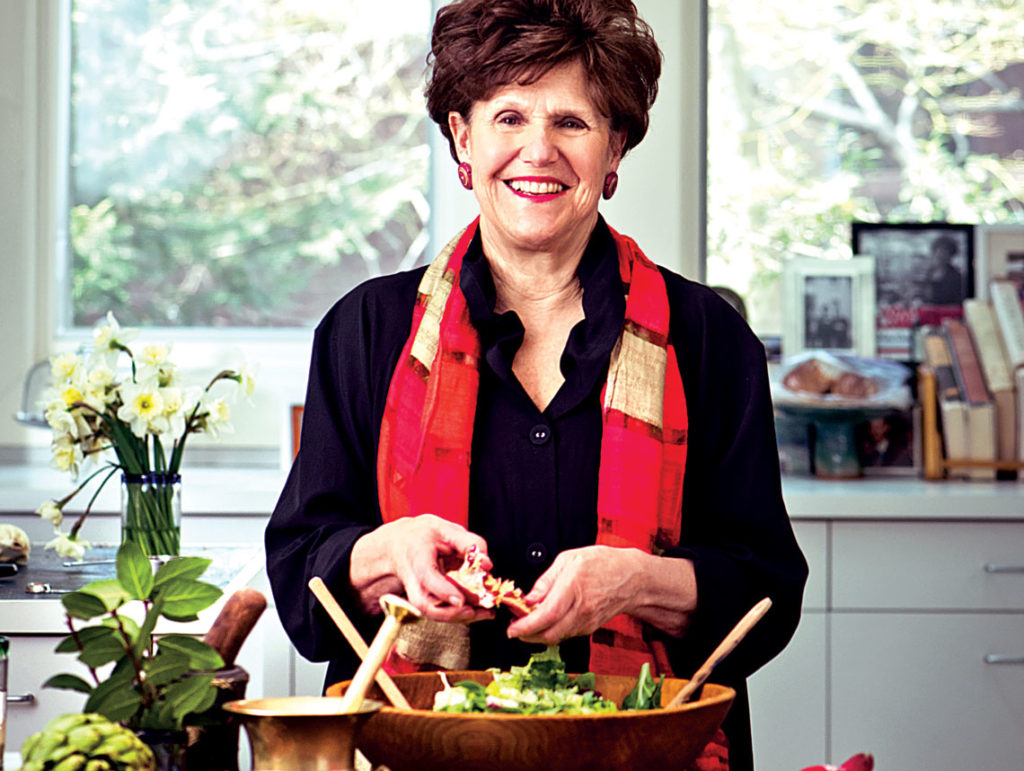
The acclaimed cookbook author Joan Nathan has done more than perhaps anyone to popularize Jewish cooking in America. Her latest book, “King Solomon’s Table,” digs deeper into Jewish history, uncovering connections between cultures to reveal that Jewish cooking is more complicated — and delicious — than we ever realized.

“By having a knowledge of the history, I think I understood what Jewish food was in a different way,” Nathan said in an interview with the Journal in anticipation of the book’s publication and two upcoming local appearances.

[Recipes from “King Solomon’s Table”]

Her journey of discovery reaches back to biblical times and the reign of King Solomon, who sent explorers to various parts of his kingdom to bring back spices and jewels. Nathan finds that Jewish merchants and traders brought these exotic ingredients into their home countries, and these flavors were intermingled with the culinary traditions of their home communities. This culinary cross-pollination resulted in dishes that still are eaten today.

In the universe of Jewish food, Nathan is the Big Bang. Her 10 previous books include six about Jewish cuisine and two on Israeli cuisine. The two James Beard award-winning books, “Jewish Cooking in America” and “The New American Cooking,” have become essential reference books for preparing Jewish meals for holidays and throughout the year. It is unlikely that any hip artisan deli owner or new-wave Jewish food blogger didn’t at some point dig deep into Nathan’s works for inspiration, ingredients or proportions. 

Nathan, 74, lives in Washington, D.C., and on Martha’s Vineyard with her husband, the prominent lawyer Allan Gerson, and is the mother of three adult children. She also hosted a nationally syndicated PBS television series about Jewish cooking, and writes regularly for The New York Times, Tablet magazine and other publications.

Her latest book will be published just in time for Passover, when Jews remember the Exodus story and connect it to other stories of displacement and diaspora. The publication also coincides with stepped-up immigration raids in the United States and a backlash against refugees in Europe.

“Every cuisine is helped by immigrants,” Nathan said. “In writing this book, I began to realize that after 1965, when immigration opened up all over the world — to immigrants from Southeast Asia, from Russia, from all parts of the world — it embellished Jewish food, because we had Afghani immigrants, Uzbek immigrants, Azerbaijani immigrants. And so, in most cases, I tried to go around the world to try this food, but because I couldn’t get to Uzbekistan and Azerbaijan, I could get those in Brooklyn and L.A.”

Her new book includes more than 170 recipes that traverse the globe. They include her takes on classics like Yemenite chicken soup, bourekas, hummus and hamantashen, as well as modern riffs on traditional dishes such as shakshuka, herbed labneh and Baghdadi chicken. There also are recipes that combine cultures, like Syrian-Mexican chicken with apricot, tamarind and chipotle sauce.

Nathan’s voracious appetite for stories shines through every anecdote and historical gem in the book.

Nathan’s voracious appetite for stories shines through every anecdote and historical gem in the book. “King Solomon’s Table” is as much a kitchen reference guide as it is a page-turner about Jewish history and culture told through food.

Take the macaroon, a cookie many enjoy during Passover. The treat has roots in the fertile valley between the Tigris and Euphrates rivers, in what is now southern Iraq. It’s made with almonds, sugar, rosewater and sometimes eggs blended together with cardamom. Macaroons have become a Purim and Passover staple for Iraqi and Iranian Jews, though they’ve picked up flavors as Jews have spread across the globe. Nathan’s cookbook includes a recipe for walnut-almond macaroons with a raspberry jam thumbprint.

Nathan leaves no stone unturned when sniffing out Jewish culinary history. Her research trips uncover Jewish connections from China and India to Mexico and Iran. Jews lived along the Silk Road and adopted kreplach from the Chinese wonton. She includes a recipe for Sri Lankan breakfast buns with cinnamon-laced onion confit, adapted from a bun she found at a roadside stand in Sri Lanka, where a small Jewish community once lived.

Another example is chicken paprikash, a favorite dish among Hungarian Jews. In her research, Nathan realized the paprika was probably brought by Sephardic Jewish merchants from the New World. Similarly, knödel originated in Alsace-Lorraine and southern Germany and later became kneidlach, or matzo balls.

“I remember when I was much younger and I was hiking in the Alps and, in a hut at the top, there was this huge knödel in the soup, and I thought, Oh, my God, matzo balls! And the matzo balls that we have in America are not like what they were in Europe,” Nathan said.

At times, it feels like the definition of “Jewish food” stretches so wide that it seems to lose meaning, but, Nathan says, “the core, even if you don’t agree with it, are the dietary laws” along with the foods traditional to the Jewish holidays.

Another thing that sets apart Jewish cooking from, say, Italian cooking, is that Jewish merchants brought back spices from other lands and incorporated them into the foods of their home countries. So the recipes have a multilayered aspect that merges different cultures’ flavors.

The way Jewish food spans place and time was evident during Nathan’s keynote address earlier this month at a symposium called “Jewish Food in the Global South.” She hosted a cooking class and made carciofi alla giudia, fried artichokes Jewish style; fessenjan, a traditional chicken-and-walnut stew made with pomegranate and served with saffron rice; and upside-down fruit cobbler. She also discussed the evolution of schnecken, a kind of sweet bun. In Arkansas, Jews replaced the walnuts used in Germany with pecans.

“King Solomon’s Table” is as much a kitchen reference guide as it is a page-turner about Jewish history and culture

She also revealed a recipe for a Lithuanian stuffed matzo ball she discovered in Mississippi. It was made in a muffin tin and stuffed with meat and cinnamon. “A Lithuanian immigrant brought that recipe in the 19th century and made it in a wood stove,” she said.

In writing the book, Nathan’s voyage of discovery also landed her at the Babylonian Collection in the Sterling Memorial Library at Yale University, where she was able to (very carefully) handle three clay tablets from about 1700 B.C.E. These earliest known “cookbooks” had chiseled on them 44 recipes inscribed in cuneiform in the Akkadian language.

Nathan spends a fair amount of time in Los Angeles, where she interacts with Persian Jews eating fessenjan and gondi kashi, a rice dish filled with spices, herbs, meat, beets and fava beans. Her recipe for sweet-and-sour Persian stuffed grape leaves begins with a delightful anecdote about walking into Maryam Maddahi’s home in Beverly Hills, where she heard Persian music and found 60 family members singing, dancing, talking mostly in Farsi and snacking on platters of pistachios and dates. The grape leaves described in her book come stuffed with raisins, barberries, apricots and golden plums.

Another cross-cultural recipe included in the book is chilaquiles, using fried pieces of either corn tortillas or matzos. Los Angeles Times food critic Jonathan Gold told Nathan he prepares the dish for his family for breakfast, referring to it as “Mexican matzo brei.”

Jewish cooking is not static. Nathan finds infinite variations on traditional recipes. Potato kugel may be of Eastern European origin, but it morphed into noodle kugel in America. Nathan’s recipe calls for adding leeks to potato kugel, and recently she met a woman who says she makes it regularly with sweet potatoes.

“King Solomon said there’s nothing new under the sun,” Nathan said. “Well, let me tell you, we’re using chickpeas the way they used them in the ancient world. We’re using pomegranate syrup. Of course, it’s processed pomegranate syrup, but that’s what they used. Date jam, which is the jam used in the Bible. We are now rediscovering all these ingredients.”

Joan Nathan’s cookbook “King Solomon’s Table: A Culinary Exploration of Jewish Cooking From Around the World” (Knopf, 382 pages, $35) will be published on April 4. She’ll speak with KCRW’s Evan Kleiman at 2 p.m. on April 6, at the Skirball Cultural Center, and with the Los Angeles Times’ Jonathan Gold at 7:30 p.m. on April 6, at Wilshire Boulevard Temple’s Irmas Campus.

Traveling through time in search of Jewish cooking with Joan Nathan Read More »

Children’s books offer new ways to enjoy the holiday

New Passover books for children include a variety of themes that previously have not been explored. There’s a picture book about a Jewish Argentine gaucho, a visit to Moses in a 3-D time machine, and an examination of what it would be like to hold a seder when a grandparent is ill.

Consider these as Passover gifts for some of the youngest participants at your seder this year:

“The Passover Cowboy” by Barbara Diamond Goldin. Illustrated by Gina Capaldi. Apples & Honey Press, 2017.

This Passover-themed story takes place in the early years of the 20th century in Argentina, where (we learn from the author’s note) 25,000 Russian Jews settled with the help of German-Jewish philanthropist Baron Maurice de Hirsch. Young Jacob is learning how to ride horses like his new friend Benito, and even though Jacob has been in the country for less than a year, he is doing his best to become a typical Argentine gaucho. His mother even offers him a special Passover gift of bombachas — loose, wide pants for riding horses. When Benito arrives as a guest at the family’s seder, he brings Jacob another coveted gift — a lasso to signify that Jacob has been accepted in his new country. The watercolor illustrations are heavily researched and depict the period and the holiday celebration beautifully. 

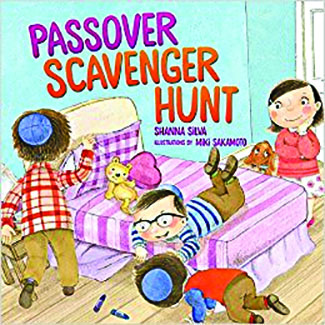
“Passover Scavenger Hunt” by Shanna Silva. Illustrated by Miki Sakamoto. Kar-Ben Publishing, 2017.

book-passover-scav-huntGreat Uncle Harry is terrible at hiding the afikomen. All the kids anticipate his usual hiding places, and so the search isn’t very fun. But young Rachel hatches a clever plan and offers him the option to let her hide the matzo this year. She then creates a family scavenger hunt containing a variety of rhyming clues. With each solved riddle, the other children get a part of a puzzle that, when pieced together, contains the biggest clue about where the afikomen is hidden. Information regarding the symbols on the seder plate is included within the clues, and even Uncle Harry is in on the merriment by the end. A fun game that could become a future family tradition.
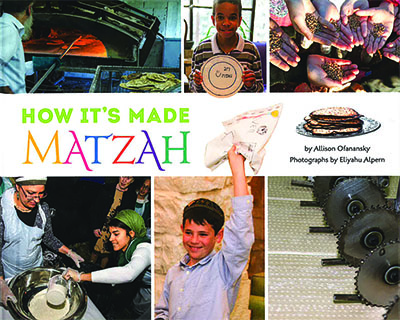
“How It’s Made: Matzah” by Allison Ofanansky. Photographs by Eliyahu Alpern. Apples & Honey, 2017.

book-matzahLast year, we learned from this same author-photographer team how a Torah is made. Now, kids get to meet the people who make matzo (heralded as “the ultimate fast food”), either by hand or by machine, but always within 18 minutes. One of the matzah-makers states, “Making matzah teaches us to work together. It is not possible to make matzah alone.” These books are special because of their innovative graphic design, various Passover do-it-yourself projects and depictions of diversity throughout more than 100 engaging photos. Plus, there is a recipe for homemade matzo and, of course, a recommendation to “Watch the clock!”

“The Family (and Frog!) Haggadah” by Rabbi Ron Isaacs and Karen Rostoker-Gruber. Illustrations by Jackie Urbanovic. Behrman House, 2017.

book-frog-haggadahIf your haggadah is too dull for the kids at your seder table, consider this charming new offering that features the talkative Frog commenting on the traditional text. Large, engaging photos — often paired with interesting family discussion-starters — ensure that this year will be more fun for everyone. Frog is depicted as hopping from page to page as he spreads his froggie puns and wisecracks. Examples include finding a “piece of toadst” while searching for chametz, and penciling in (with green crayon, of course) a suggestion to include a “Frog’s cup” along with Elijah’s. But the strengths of this family-friendly haggadah are in the flow of its storytelling, its compelling content and design, and the inclusion of Hebrew transliterations. The content is mostly English, but main passages such as blessings, the Four Questions, the Ten Plagues and parts of songs are included in Hebrew.

“Meeting Moses” by Robert Chasin. Illustrated by Matt Roussel. Meeting Bible Heroes Publishing, 2017.

book-meeting-mosesThe Exodus story meets H.G. Wells in this tale of Max and his professor dad, who has invented a time-traveling machine. The standout 3-D illustrations will highly engage children. They remind the reader of a mix of Claymation and a video game, and seem to be partially painted and partially computer-generated. The story follows Max, who has inadvertently taken the time machine to ancient Egypt. By the Nile River, he meets young Moses and young Ramses with Pharaoh’s daughter and is taken to meet Pharaoh. Max is imprisoned, but then freed by Moses. The two travel through time together to Mount Sinai so Max can show Moses what his future will be. Exciting illustrations depict the burning bush, how the stone tablets could have been written, the golden calf, and Moses breaking the tablets. Max eventually gets back home to the present day by tricking Pharaoh and using the convenient “rewind” button to delete the experience from the memories of those he left behind. (It should be noted that the author used the term “Old Testament” to refer to the Hebrew Bible.) The book is available inexpensively in e-book format from the author’s website as well as in a hardcover version.
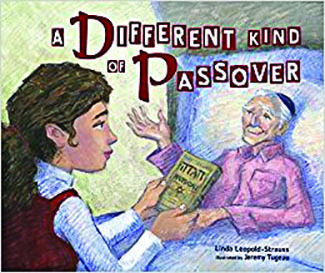
“A Different Kind of Passover” by Linda Leopold-Strauss. Illustrated by Jeremy Tugeau. Kar-Ben Publishing, 2017.

book-different-passA young girl practices the Four Questions in Hebrew and travels, as usual, to her grandparents’ house for the seder with her extended family. She loves the repetition of the yearly rituals, but this year her “heart hurts” because Grandpa was in the hospital recently and cannot leave his bed to lead the seder. She cleverly solves the problem of how Grandpa still can be included with the rest of the family and learns that when things change, they also can remain the same in many ways. The well-written and poignant tale provides us with a young person’s view of the meaning of joyful Passover family traditions.


Children’s books offer new ways to enjoy the holiday Read More »

Passover recipes from ‘King Solomon’s Table’ by Joan Nathan

HUEVOS HAMINADOS CON SPINACI

Long-Cooked Hard-Boiled Eggs with Spinach

Yield: 12 to 16 servings

– 12 to 16 large eggs, preferably fresh from a farmers’ market
– 4 tablespoons olive oil
– 1 large red onion, peeled and coarsely chopped (1 1/2 cups)
– 1 tablespoon sea salt
– 1 teaspoon freshly ground black pepper
– 1 1/2 pounds spinach, fresh or frozen (thawed and drained if frozen)

Put the eggs in a cooking pot and add water to cover by about 2 inches. Then add the olive oil, onions, salt and pepper. Bring to a boil over medium-high heat, then lower heat and simmer for 30 minutes. Cool and remove the eggs with a slotted spoon. Tap the eggs gently against the counter and peel under cold running water, keeping them as whole as possible.

Return the peeled eggs to the pot with the seasoned water and simmer very slowly uncovered for at least 2 hours, or until the water is almost evaporated and the onions almost dissolved. The eggs will become dark and creamy as the cooking water evaporates and they absorb all the flavoring.

Remove the eggs carefully to a bowl, rubbing into the cooking liquid any of the cream that forms on the outside. Heat the remaining cooking liquid over medium heat, bring to a simmer, and add the spinach. Cook the spinach until most of the liquid is reduced, stirring occasionally with a wooden spoon, about 30 minutes, or until the spinach is creamy and well cooked. Serve a dollop of spinach with a hard-boiled egg on top as the first part of the Seder meal or as a first course of any meal.

NOTE: To see if the eggs are really boiled, remove one egg from the water and spin it on a flat cutting board. If it twirls in one place, it is hard-boiled. If it wobbles all over the board, it is not cooked yet and the weight isn’t distributed evenly. The easiest way of peeling a hot hard-boiled egg is to put it under cold water between your hands and rub it quickly until it cracks, then peel under the running water.

To prepare the symbolic egg for the Passover Seder plate, boil the egg in its shell, dry it, and then light a match underneath to char it.

Excerpted from “King Solomon’s Table” by Joan Nathan. Copyright © 2017 by Random House. Excerpted by permission of Alfred A. Knopf, a division of Random House LLC. All rights reserved. No part of this excerpt may be reproduced or reprinted without permission in writing from the publisher.

Passover recipes from ‘King Solomon’s Table’ by Joan Nathan Read More »

‘He’s not all bad’: A Democrat defends Trump

Ever since Donald Trump was elected president, I’ve been trying to decipher the indecipherable psyche of The Trump Voter.

I want to understand how a person of conscience could have voted for him and how such a person would defend the actions of his office. 

So I did a little research project by calling my Uncle Rich, a 76-year-old cardiologist and Trump supporter. As far as I know, he’s sane, rational and verifiably humane since he’s spent the last 47 years saving people’s lives.

Uncle Rich and I have been arguing about politics since I was 15. Last week, he emailed me an article about Trump doubling down against anti-Israel bias at the United Nations under the subject line: “He’s not all bad.” I gritted my teeth, took a deep breath and invited him to argue with me a little more — if not for the sake of heaven, then at least for the sake of my column.

First, I asked why on earth he’s a Republican.

“I am a registered Democrat and have been since I was 21,” he declared.

“I have voted both ways. I’m a great believer that America comes first and the parties come second. So, I’m open-minded to any candidate — Republican, Democrat, Black, white, Jewish, woman, etc.”

I asked him to describe his paramount political values, but he said they change with each election cycle. In 2016, his top concerns were: terrorism, the economy and health care.

“In the beginning, I was a little bit ambivalent about [Trump],” he admitted. “But as time went on, I began to see that he was serious. And he was willing to step out of an unbelievably successful business and into a job that I don’t know if I envy. I began to say, ‘Wow.’

“I felt this was a man who really recognized the problem of terrorism. I liked that he was vigorous and emphatic on the necessity of vetting people, particularly from certain areas. You know, profiling is a term I think gets a bum rap.”

This is only one area where Uncle Rich and I part ways. To me, profiling is a form of legalized discrimination that contributes in no small part to the mass incarceration of people of color and the poor.

“I profile in medicine,” he said. “If I see a person of a certain background, I’ll order certain tests based on their background. To say there aren’t certain groups of people who are more likely to be terrorists, that’s foolish. We need to be exquisitely careful in order to avoid a situation of tremendous, tremendous terror …

“As far as [economics], the man is a financial success.”

Never mind his bankruptcies? Or his record of failing to pay employees what he owed them?

“I’m a businessman myself. When I started in medicine, we were told not to be businessmen. We were told, ‘You’re a doctor, and you’ll work for oranges and grapefruits,’ which I would have. We were discouraged from negotiating with a hospital, for example. ‘Just take the job.’ [Trump] is a negotiator, and I became a negotiator.”

If Trump was such a negotiating wizard, I asked, what about his signature failure to “repeal and replace” Obamacare?

“Health care is an extremely complicated issue. At the end of the day, I think Republicans and Democrats want the same things: quality care, access and preventative medicine. Obamacare had great ideas — who could argue with what I just said? The problem is cost. This is a business problem.”

I argue it’s also a moral problem. Part of the reason the legislation failed is because its underlining interests were providing tax cuts for the wealthy and eliminating vital health care services for the nation’s most vulnerable: the old and the poor.

“I don’t think Mr. Trump wants a program where someone who is 64 can afford health care and someone who is 65 can’t. What makes America great is that we have the ability to create a system with some equality. Certainly, you’re going to have concierge medicine the way you can have a Mercedes or you can have a Chevy — but a Chevy is a good car!”

Then why don’t more rich people drive Chevys?

Still, I countered, the Great Negotiator failed to unify his party and pass his first major piece of legislation.

“You want to feel good about the fact that you were right? Come on! He’s been in office for three months. If you tell me three years from now that he’s failed in all his legislation, I’ll say, ‘You know, you’re right, I made a mistake.’ But not three months in.”

Well, what about Trump’s Russia ties? Should he get a pass on that, too?

“I’m not bothered yet because I come from a school of medicine where you have to deal with results. If we find out that Trump did things undercover with the Russians, then I’m gonna be upset about it. But I’m not gonna get caught up in the rumor mill. This stuff is still unsettled.”

It’s clear that where I see moral and legal transgression, my uncle sees a man who hasn’t yet hit his stride. Surely, though, he wouldn’t defend the terrible things Trump has said maligning women, immigrants and Muslims.

“He’s sometimes quick to speak,” Uncle Rich allowed. “He’s a hand-to-mouth guy, and sometimes what he says doesn’t go completely to his brain.

“What I was thinking when that was going on was: If we lived in a dictatorship, I would have been much more worried about Donald Trump than I am in the system we are in, which is a checks-and-balances system. Because a man who sometimes speaks like that may try to act like that.” 

Finally, Uncle Rich, we agree.


Danielle Berrin is a senior writer and columnist at the Jewish Journal.

‘He’s not all bad’: A Democrat defends Trump Read More »

Moving and Shaking: IFF holds annual luncheon, synagogues collect items for refugees, Saban on Walk of Fame

Meir Fenigstein, founder and executive director of the Isra-Fest Foundation, which brings Israeli films to Los Angeles each year as part of the Israel Film Festival (IFF), knows how to thank his supporters. Several months before each festival, he invites them to a luncheon at the Four Seasons hotel in Beverly Hills.

Fenigstein made aliyah with his family three years ago after residing in Los Angeles for many years. He continues to run the IFF from his new home in Israel and through frequent visits to L.A.

This year, the luncheon honored David Shore, creator of the television show “House” and a board member at Save a Child’s Heart, with the IFF Visionary Award; Adam Berkowitz, co-head of the television department at Creative Artists Agency, who has been instrumental in selling numerous TV shows, including “Seinfeld” and two Israeli series, “The Greenhouse” and “Fauda,” with the IFF Career Achievement Award; and Holocaust survivor and philanthropist Max Webb with the IFF Lifetime Achievement Award.

Webb delivered the most moving speech of the event, recounting his 12 years in labor camps and six concentration camps, and the promise he made to himself, his mother and to God. “I made a vow that if I get out of this hell, I’ll help others in need, the Jewish people and Israel,” Webb said.

After building a real estate empire in California, he kept true to his promise and donated millions of dollars to charity organizations, hospitals and the State of Israel.

During the event, Webb celebrated his 100th birthday (his actual birthday is March 2) and blew out candles on a cake presented to him by Fenigstein, while guests sang “Happy Birthday.”

IFF will take place Nov. 7-22 at various Laemmle Theaters in Los Angeles.

— Ayala Or-El, Contributing Writer


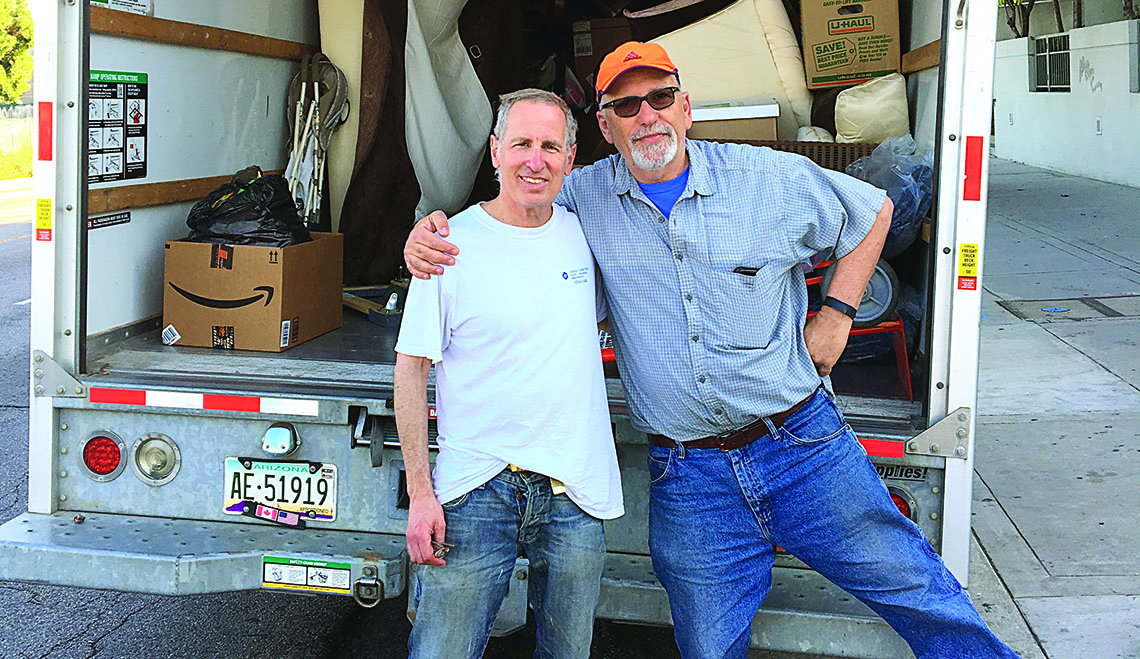
Temple Beth Am members Gary Bachrach (left) and Mathis Chazanov pose behind of a U-Haul truck loaded with donated household items for refugee resettlement in San Diego.  Photo by Tyson Roberts.
Temple Beth Am members Gary Bachrach (left) and Mathis Chazanov pose behind of a U-Haul truck loaded with donated household items for refugee resettlement in San Diego. Photo by Tyson Roberts.

What began as a partnership between Temple Beth Am and B’nai David-Judea to collect household items for refugee resettlement in San Diego grew into a community-wide effort involving six local Jewish organizations, with a daylong collection effort on March 16 dubbed “Project Hope.”

A rented truck driven by Beth Am member Tyson Roberts began to make its rounds at 7 a.m., stopping at private homes as well as multiple synagogues. Community members donated furniture, toiletries and other everyday necessities. The following day, Roberts delivered the donations to Jewish Family Service of San Diego (JFSSD), which helps resettle refugees from around the world. By March 17, some of the items collected already had furnished apartments for two Afghan families, JFSSD said.

Temple Beth Am’s Refugee Taskforce led the collection drive, partnering with Camp Gilboa. Roberts’ daughter, Shoshana Roberts, spearheaded Camp Gilboa’s involvement as her bat mitzvah project, working with the camp’s executive director, Dalit Shlapobersky.

The other Jewish institutions involved were IKAR, Temple Mishkon Tephilo in Venice and Kehilat Israel in the Pacific Palisades.

The effort collected dining sets, sofas, armchairs, toaster and microwaves ovens, a crib and more. It was the second iteration of Project Hope, following a previous collection last August.

Tyson Roberts said he hopes to hold a third donation drive this summer. “A lot of people, as I was loading the truck, were like, ‘Wait, I still have stuff!’ ” he said.

More information and a list of items requested by the JFSSD can be found online at tbala.org/get-involved/project-hope.

— Eitan Arom, Staff Writer


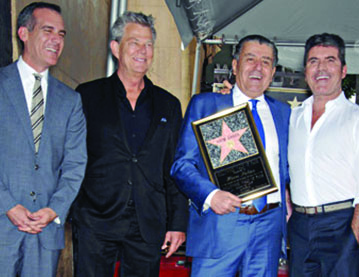
From left: Mayor Eric Garcetti, David Foster, Haim Saban and Simon Cowell come together to celebrate Saban receiving a star on the Hollywood Walk of Fame. Photo courtesy of Hollywood Chamber of Commerce.

The Hollywood Chamber of Commerce honored Haim Saban with a star on the Walk of Fame in front of the Egyptian Theatre at 6712 Hollywood Blvd.

Lionsgate, the film studio behind “Saban’s Power Rangers,” now in theaters, nominated Saban, an Israeli-American media producer, businessman and philanthropist, for the honor.

Saban, the creator of the “Power Rangers” television show, expressed his gratitude to Lionsgate during the March 22 ceremony “for your belief in the ‘Power Rangers’ franchise, and for your unconditional support for the launch of the ‘Power Rangers’ movie … [which,] Baruch Ha-Shem, with God’s help, will be a resounding success.”

The fee for installing a star on the Walk of Fame is $40,000 and the sponsor of the nominee is responsible for the cost. The money benefits the nonprofit Hollywood Historic Trust.

Attendees included Hollywood Chamber of Commerce President and CEO Leron Gubler, Los Angeles Mayor Eric Garcetti, musician David Foster and former “American Idol” judge Simon Cowell.

Saban is a member in the Hollywood Walk of Fame Class of 2017 in the Television category, joining Sarah Silverman, Jeffrey Tambor and George Segal.

Bill and Hillary Clinton congratulated Saban for receiving a star on the Walk of Fame in a letter that was published on the website of Variety. “This well-deserved honor is not only a testament to your decades of groundbreaking contributions in the entertainment industry,” the letter from the former U.S. president and his wife, the former senator and presidential candidate, says, “but to your enduring generosity and efforts to advance good causes across America and around the world.”


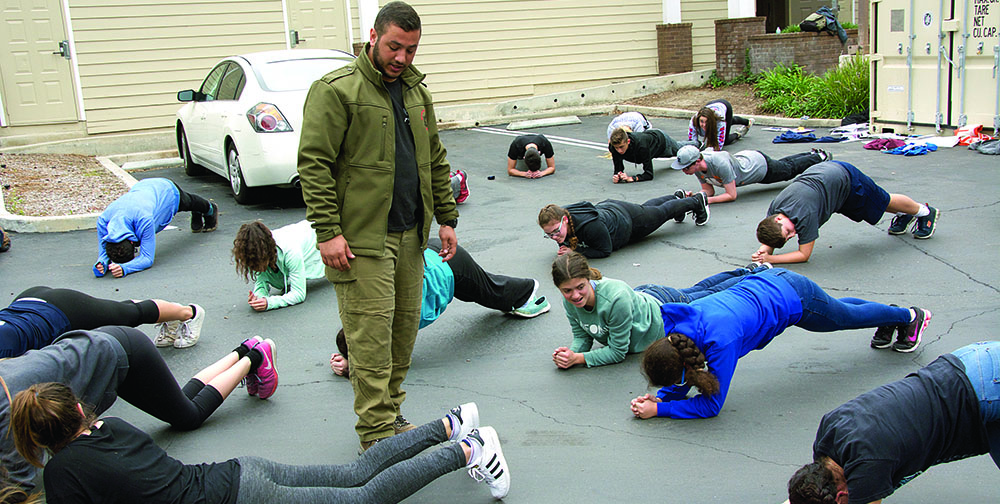
Sean Phil, an Agoura Hills resident and former Israel Defense Forces officer, leads a training exercise for teenage students at “Israel 200.” Photo courtesy of CTeen Conejo.

Feb. 5 Israel solidarity event titled “Israel 200” — which aimed to draw 200 student attendees — attracted 120 teenage students in grades 8 through 12 to Chabad of North Ranch. The event featured workshops, a buffet lunch and discussions that included “Israel — Why Should I Care?”

Organizers were Rabbi Mendy Friedman and Mushka Friedman, co-directors of CTeen Conejo.

“We may be thousands of miles away [from Israel], but the events going on there are of utmost importance to Jews and people of conscience all over, including teens,” Mushka Friedman said in a statement.

Speakers were from StandWithUs, the Jewish National Fund and other organizations, including Israel Defense Forces (Ret.) Sgt. Benjamin Anthony, founder of Our Soldiers Speak. Additionally, students participated in a boot camp training that “pushed them to discover inner strengths and the ability to go beyond themselves,” a press release said.

CTeen Conejo describes itself as “a community organization under the auspices of Chabad that is dedicated to encouraging teens to make the world a better place.”


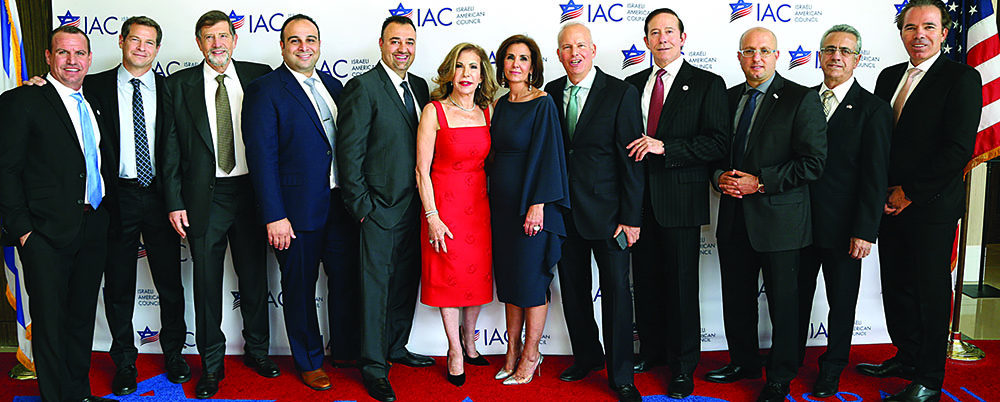
From left: Erez Goldman, Oded Krashinsky, Naty Saidoff, Michael Michalov, Guy Bachar, Miri Shepher, Mazal Hadad, Danny Alpert, Adam Milstein, Tamir Cohen, Amnon Mizrahi and Shawn Evenhaim attend the Israeli American Council gala. Photo by Linda Kasian.

More than 1,000 people attended the ninth annual Israeli American Council (IAC) gala dinner at the Beverly Hilton hotel on March 19.

Guests included Sheldon and Miriam Adelson, whose support has helped the IAC open 12 regional offices across the United States since a group of Israeli-American leaders founded the organization a decade ago in Los Angeles.

IAC has grown steadily since its establishment, holding community events such as the Celebrate Israel festival and operating a variety of programs, including Eitanim, which connects high school students to Israel as they prepare for college and develop professional skills.

IAC National Chairman Adam Milstein discussed the importance of the organization for the future generations of Israeli Americans.

“As I think about the future and look 10, 20, 50 years down the line, I’m not sure if I will be here, but I know the IAC will be. We are creating a grass-roots movement that will last for generations for Israel, for America and for the Jewish people,” he said.

Additional speakers included Los Angeles Mayor Eric Garcetti, who was introduced as the city’s first Jewish mayor; radio host and Journal columnist Dennis Prager; and Holocaust survivor David Wiener, who was the gala honoree in recognition of his philanthropy and passionate involvement with many organizations that support Israel and Jewish life.

Wiener told his heart-wrenching story of survival, saying, “The best day of my life was the day the State of Israel was established.”

Mentalist Lior Suchard emceed the evening. During his performance, he guessed correctly the name of one woman’s first love, one of his many mind-reading tricks.

During the fundraising portion of the evening, attendees pledged more than $2 million in support of the organization, including IAC board member Naty Saidoff’s pledge of almost $600,000.

— Ayala Or-El, Contributing Writer

Moving & Shaking highlights events, honors and simchas. Got a tip? Email ryant@jewishjournal.com. n

Moving and Shaking: IFF holds annual luncheon, synagogues collect items for refugees, Saban on Walk of Fame Read More »

Distress, relief felt after arrest of Jewish teen in bomb threats

Ultimately, the important thing to Tony Regenstreif isn’t why someone was making threatening calls to Jewish institutions across the country, including the Westside Jewish Community Center (JCC). He just hopes that the recent arrest of an Israeli-American teenager in the matter means his 3-year-old daughter, Molli, won’t be evacuated again from the facility, where she is a preschooler.

“Mostly I’m just grateful that it’s over,” the attorney said.

“This is one thing we don’t have to worry about right now and I feel gratitude for the people who stopped it,” he added.

His remarks followed news March 23 of the arrest of Michael Kaydar, a Jewish Israeli-American teenager, on suspicion of perpetrating more than 100 bomb threats against a variety of Jewish institutions in the United States.

Regenstreif wasn’t alone in welcoming the arrest of Kaydar, an 18-year-old Israeli native, even as it remained unclear whether the individual was responsible for the recent threats against the Westside JCC and the Alpert Jewish Community Center in Long Beach.

“I’m hopeful that this brings closure to what has been a very difficult ordeal for Jews and Jewish community centers across North America,” Brian Greene, director of the Westside JCC, said in a phone interview March 23.

The Westside JCC received two threats, one on Feb. 27 over the phone and another on March 9 via email. Those incidents led to the facility raising approximately $50,000 in funds toward enhancing security, according to a JCC statement.

The JCC in Long Beach received two separate threats as well, on Jan. 31 and Feb. 27.

A spokesperson in the national press office of the FBI said in an email to the Journal that it was unable to confirm if Kaydar had a role in the instances targeting the local JCCs.

“At this time we cannot confirm specific details on the threats,” a March 28 email from the FBI’s national press office said.

Since Jan. 4, there have been more than 160 threats against Jewish community centers, day schools and other institutions. The threats have been a mix of live and prerecorded phone calls and emails. All of them have turned out to be hoaxes.

Kaydar is the second person to be arrested on suspicion of carrying out these threats in 2017. The first was Juan Thompson, a former journalist who’d been fired for fabricating quotes. He is accused of placing eight threats against Jewish community centers, apparently in an attempt to get back at an ex-girlfriend.

“Early this morning in Israel, the FBI and Israeli National Police worked jointly to locate and arrest the individual suspected for threats to Jewish organizations across the United States and in other parts of the world,” a March 23 FBI statement said. “Investigating hate crimes is a top priority for the FBI, and we will continue to work to make sure all races and religions feel safe in their communities and in their places of worship.” 

The arrest took place at Kaydar’s home in Ashkelon. Kaydar’s father (the FBI was unable to confirm his name) reportedly knew of his son’s activity and was arrested, as well. Authorities discovered the suspect was using advanced communications technology — including SpoofCard, which disguises the phone number of outgoing calls — to carry out the threats.

The suspect’s lawyer has said Kaydar suffers from a mental health condition that prevented him from serving in the Israeli army and that led to him being homeschooled. Kaydar also has been accused of making threats in New Zealand and Australia.

JCC Association of North America President and CEO Doron Krakow applauded law enforcement in a statement, but said the arrest still was distressing.

“We are troubled to learn that the individual suspected of making these threats against Jewish Community Centers, which play a central role in the Jewish community, as well as serve as inclusive and welcoming places for all — is reportedly Jewish,” he stated.

The actions should nevertheless amount to a hate crime, as they involved the intentional terrorizing of Jewish communities, according to Anti-Defamation League Senior Associate Director Alison Mayersohn.

“We don’t know what motivated the alleged perpetrator, but when a perpetrator targets an institution specifically because it is a Jewish institution, that’s a hate crime, and we consider the act anti-Semitic. The ADL does not believe the perpetrator’s religion or nationality is relevant,” she said.

Another parent of a preschooler at the Westside JCC, Amanda Perez, said she was struck by the news reports that Kaydar may suffer from mental illness.

“I was surprised, but beyond that I just felt sad. I was happy they found someone. From the bit I know about it, it seems like he’s a very ill person. I felt sad for his illness,” the JCC board member said. “I was saddened that he was able to threaten so many places.”

Distress, relief felt after arrest of Jewish teen in bomb threats Read More »

High school pupils enact scenes from survivor stories

“David Lenga?”

Gavin Graham, 17, stood up.

“I am David,” he said.

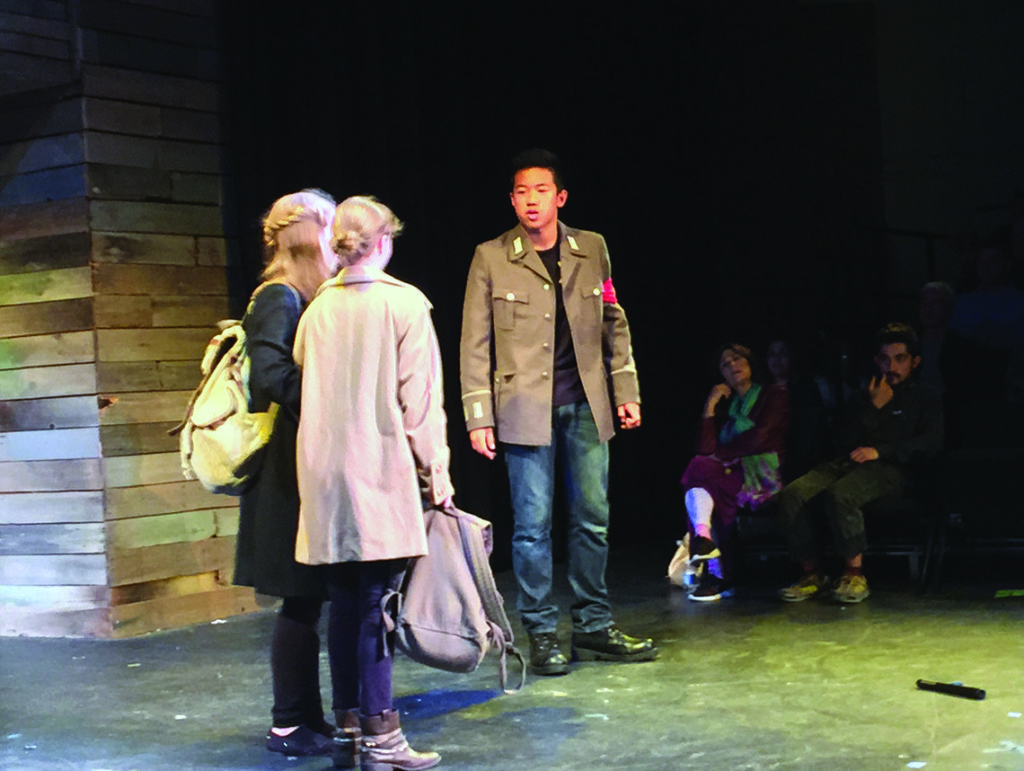
The other student, playing a Nazi trooper — a tall, bespectacled girl in an overcoat with a felt swastika band around the upper arm — looked him over.

“Run,” she said. “Just run and don’t come back.”

It would have been a tense scene to act out in any theater — perhaps the most fraught moment in the Holocaust story of a man who never saw his younger brother again after being sent away, mysteriously, miraculously, from the deportation center where they were being held.

But the scene was made all the more nerve-racking for the teenagers bringing it to life due to the fact that there, in the second row, among the almost 150 who gathered in the theater of the Santa Monica High School (Samohi) Humanities Center to watch the show, sat David Lenga, in the flesh.

“It was definitely a ton of pressure,” Graham said after the show.

The “Voices of Survivors” performance on March 22, the first of its kind in Los Angeles, was the culmination of an eight-week collaboration between Samohi’s theater department and the Los Angeles Museum of the Holocaust (LAMOTH). The project paired four Holocaust survivors with groups of students who acted out scenes from their harrowing stories of survival.

“It was heart-wrenching,” said Lenga, a spry 89, of watching his story performed. “When I saw it depicted here, it really all came back.”

But he said it was worth it, for the sake of teaching the students to be vigilant against the creeping signs of dictatorship and tyranny even in the modern age. And in the end, despite the minimal props and stage elements and the students’ lack of acting experience, he felt they did well.

“I had my doubts they could carry it out, because it’s so difficult and so wrenching,” he said, holding a bouquet of flowers they presented to him after taking their final bow. “But they really did a good job. They really did.”

Preparation began eight weeks earlier when the 35 students in Samohi’s introductory acting class, most of whom are  not Jewish, visited the museum to learn about the Holocaust and how to interview survivors. The following week, over three days, they met with the four survivors — Lenga, Avraham Perlmutter, Edith Frankie and Erika Fabian — to hear  their accounts.

“As a high school teacher, I very rarely see that kind of silence from students,” Samohi theater director Kate Barraza said of the encounter.

LAMOTH furnished educational material while a mentor from Writer’s Room  Productions, a writing education organization, assisted each of the four groups in scripting their scenes. Students wrote, directed and eventually performed each story, handling the details down to lighting
and sound.

“It really came entirely from the students’ hearts,” LAMOTH creative programs director Rachel Fidler, who headed up the museum’s participation, said at the event.

The performances drew on some of the more tense scenes from each survivor’s account, such as Fabian unsuccessfully trying to cross the border from communist  Czechoslovakia into Austria after World War II with her mother and sister, and Perlmutter jumping from a moving van to escape Nazi captivity.

The program was meant to have students not just hear from survivors but also engage with their stories.

“You can see the numbers and the pictures, but to have the guy in front of you that it happened to — that’s really an experience,” Graham said.

Frankie, 85, is so used to telling her tale to students and other groups, that it didn’t faze her to see it performed.

“It was pretty true to my story,” she said of the performance.

Clutching the bouquet the student performers had presented to her, she sat outside the theater with LAMOTH special projects coordinator Michael Morgenstern dutifully manning her wheelchair as she waited for her son to drive her home.

“I always say, ‘If I touched only one student with my story, then I did my  purpose.’”

High school pupils enact scenes from survivor stories Read More »

New Haggadot bring fresh takes to the table

Jews sit around the seder table every Passover and use a book called the haggadah for guidance through the story of the Exodus. While some purists may prefer a traditional text, Jews are increasingly adding haggadot to their tables that reflect the Passover story through different lenses — from contemporary social justice activism and feminism to pop culture and humor.

Here are some of this year’s new haggadot and supplements.

“For This We Left Egypt? A Passover Haggadah for Jews and Those Who Love Them” by Dave Barry, Alan Zweibel and Adam Mansbach.

Anyone familiar with the pedigree of the authors likely would expect this small volume to include more irreverence and humor than education, and they would be correct. Barry has written humorous newspaper columns for more than 30 years; Zweibel wrote for “Saturday Night Live,” “Curb Your Enthusiasm” and “It’s Garry Shandling’s Show”; and Mansbach wrote the book “Go the F— to Sleep” and the screenplay for “Barry.” They draw on their collective and diverse humor experience to retell the Passover story. The narrative, thematically based on the order of the seder, includes a surprising number of “Godfather” references, including the burning issue of which of the Four Questions was asked — and why — by each and of Vito Corleone’s four children, Sonny, Fredo, Michael and Connie.

“The (Unofficial) Hogwarts Haggadah” by Moshe Rosenberg.

pass-hag-hogwartsThe rabbi, educator and author of “Morality for Muggles: Ethics in the Bible and the World of Harry Potter” takes the Passover story out for a wizardly whirl, comparing the Boy Who Lived to the original iconoclast, Abraham. This haggadah also points out contrasts between what it means to be Voldemort’s “most faithful servant” and what it means to be a servant of God in Jewish texts, and parallels between the Exodus narrative and Harry’s emergence from the Muggle world (where he was forced to live in a room under the stairs) into a world of wizardry and freedom.

“From Ancient Egypt to Modern Israel: The 3,000-Year Journey of the Jewish People” by StandWithUs (over3000years.org).

pass-hag-3000This haggadah “not only teaches about the suffering during slavery and miraculous exodus from Egypt, it also celebrates the 3,000-year-old connection of the Jewish people to the land of Israel,” StandWithUs co-founder Jerry Rothstein told the Journal, pointing to “original artwork, traditional text in Hebrew and English, and stirring quotes, all meant to inspire people of all ages about the Jewish connection to our ancestral homeland, Israel.” The center pages are full-color depictions of Israel as a place for Jews who “barely survived, but never lost hope.” It charts the journey from modern Israel’s emergence after the Holocaust and the 1948 War of Independence through the intifadas, culminating in Israel’s modern identity as “Startup Nation.” It also includes readings from a variety of sources, including Rev. Martin Luther King Jr., Shimon Peres and Mark Twain.

“AJWS Global Justice Haggadah: Next Year in a Just Worldby the American Jewish World Service (ajws.org/haggadah).

pass-hag-world (1)American Jewish World Service (AJWS) this year focuses its haggadah on connecting the traditional story of Passover, with its narrative arc of slavery, to freedom and the social activism responsibility of contemporary American Jews. For example, the four cups of wine are meant to symbolize a four-part framework for social justice activism: awakening, solidarity, action and freedom. The collection of sources contains original readings, discussion questions and quotes from leading Jewish public figures, including Supreme Court Justice Ruth Bader Ginsburg and actor Mandy Patinkin.
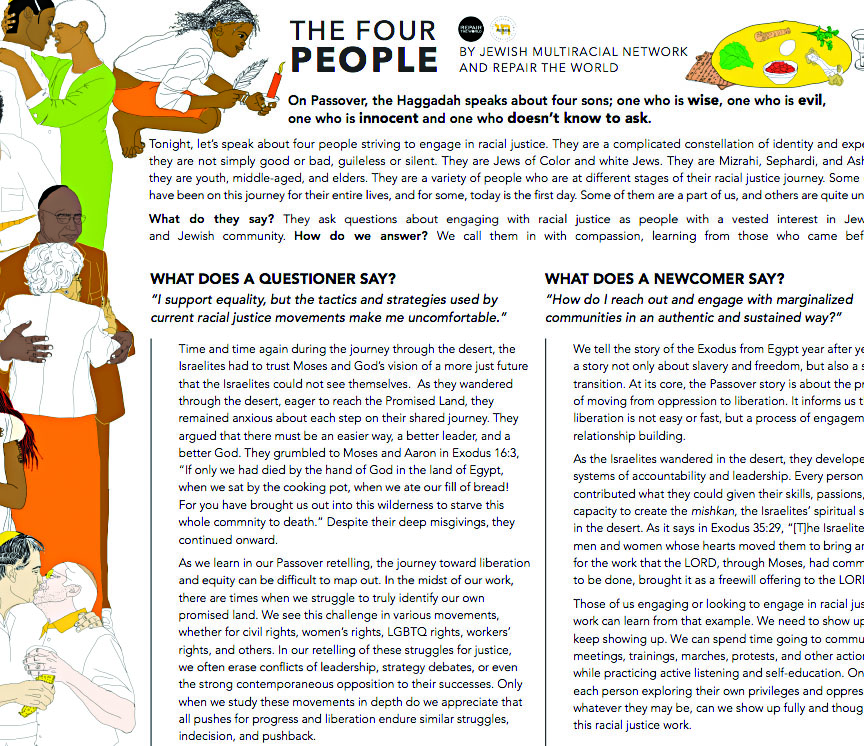
“The Four People” by Repair the World and the Jewish Multiracial Network (werepair.org/wp-content/uploads/2017/03/The-Four-People.pdf).

pas-fourpeopleThis Passover supplement is meant to spur challenging and meaningful conversations on racial justice. In presenting four people, all on their own racial justice journeys, questions reflect multiple perspectives, various backgrounds, different races and different ages. Through the lens of “What would a questioner/newcomer/Jew of color/avoider say?” the supplement tackles some of today’s activism challenges, examining how people can move toward equality if the tactics and strategies used by racial justice movements make them uncomfortable, how newcomers engage with marginalized communities, and how to overcome fear and start conversations about race.

 HIAS (formerly the Hebrew Immigrant Aid Society) Haggadah supplement (hias.org/sites/default/files/hias_2017_haggadah_supplement.pdf)

pass-hag-suppIn light of the debate over President Donald Trump’s executive orders banning refugees, the HIAS supplement focuses on the international refugee experience, relating it to the story of Jews fleeing slavery and searching for safety. Through readings, activities and a guide to aid people in refugee advocacy, it incorporates stories from some of the thousands of refugees HIAS has helped resettle across the United States, and encourages seder participants to identify their own opinions and to work toward creating a group narrative.

Do It Yourself: Haggadot.com

pass-hag-diyThose who prefer their own mix of readings and activities on various themes can cull custom content for personalized haggadot on Haggadot.com. Site founder Eileen Levinson said that this year marks a considerable rise in feminist, activist and political content on the site, where users can create, upload and share their content with others. Some recently uploaded examples of this year’s content include the Beyonceder, a mashup of Beyoncé lyrics and Passover images; updates to the “Women’s Seder Haggadah,” including text and images about and from the Women’s Marches in January; and the creation of the Baltimore Social Justice Seder, focusing on criminal justice reforms and racial bias in incarceration.

New Haggadot bring fresh takes to the table Read More »

Episode 31 – Tokyo Vice: A Jewish journalist against the Yakuza with Jake Adelstein

To many of us, Japan is still a mystery wrapped in an enigma. Mysterious of all is the Yakuza, Japan’s notorious crime organization, which has been growing and spreading dread for decades.

When Jake Adelstein, a nice Jewish boy from Minnesota, decided to leave everything behind and follow his passion and fascination to Japan, he didn’t know much about the Yakuza either. But soon enough, he learned more than he’d ever imagined he would. Pursuing a career as a Tokyo investigative crime reporter, he wrote in Japanese for one of the country’s most prestigious newspapers.

Jake visited Israel recently for the first time, as a guest of Penn Publishing, who just printed his 2010 book Tokyo Vice. The book tells the mind boggling real-life incidents that took place throughout Jake’s impressive and dramatic career. 2NJB sat with him to talk Japan, Yakuza, and journalism.

Get the book
Jake’s Twitter

Episode 31 – Tokyo Vice: A Jewish journalist against the Yakuza with Jake Adelstein Read More »