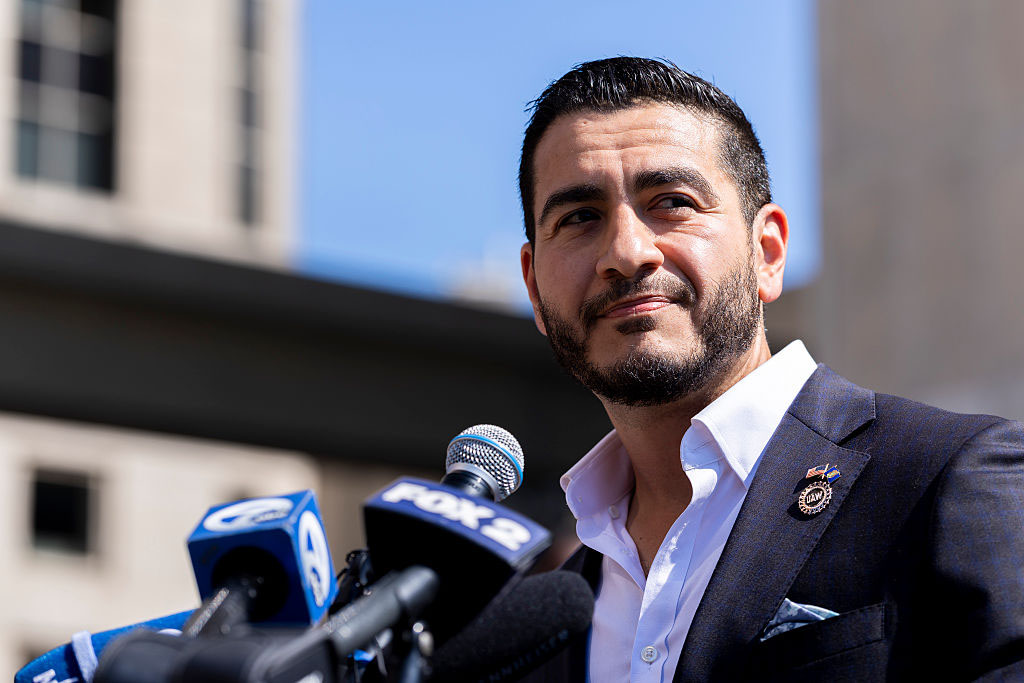
The chant coming from Bet Tzedek Legal Services employees and their supporters as they marched on the streets of Koreatown on Aug. 22 was unified: “All day, all night, health care is a human right.”
For the past several months, the employees have been fighting with the pro bono legal firm’s management over proposed increases to the cost of their employer-sponsored health care, and they have been hitting the streets to make themselves heard.
“We’re here to tell Bet Tzedek that we can go forward, even during difficult [economic] times, without destroying [workers’ health care],” said Marc Bender, a litigation and training supervisor, while leading a picket line on Aug. 22. The demonstration took place outside of the office building at 3250 Wilshire Blvd., where Bet Tzedek’s offices are located. Employees also demonstrated Sept. 11 in the same location. They marched and carried picket signs that read: “Don’t Bleed Our Health Care,” “Protect Our Families” and “Si, Se Puede!” (“Yes, We Can!”).
Bet Tzedek (“House of Justice”) provides services to the poor and underserved in Los Angeles. Lawyers, legal secretaries, paralegals and clerical workers, who make up its 51 non-managerial employees, are unionized members of Bet Tzedek Legal Services Union/American Federation of State, County and Municipal Employees Local 946.
The two sides began disagreeing over health insurance costs in the spring, several months after employees’ previous contract expired on Dec. 31, 2012. Management and employees have agreed to extend the terms of the previous contract while they negotiate, said Elissa Barrett, vice president and general counsel at the nonprofit.
Bet Tzedek employees expressed satisfaction with the existing amount they have to pay toward their health care premiums. Currently, employees are fully covered as individals, and are required to pay $20 monthly for a spouse or $30 monthly for a family, if they choose HMO coverage. Juana Mijares, an intake supervisor, earns $49,000 annually and said coverage for her family of five could cost her $650 monthly under a proposal she said the company is making.
Barrett declined to specify the details of management’s proposals. “That’s a subject of negotiation,” she said.
Increases to staff members’ contributions to their health care are necessary for the financial health of the organization, according to Barrett. Health care costs have been increasing over the past several years, leaving Bet Tzedek no choice but to pass a greater portion of the costs of insurance on to to its employees
“Our staff works very hard, they do a fantastic job, we value them greatly, [but] if we did not believe it was necessary for the survival and sustainability of this organization to tackle this health care issue, we wouldn’t be bringing it this strongly to the negotiating table,” she said.
The midweek August protest took place after work hours. Approximately 35 people marched at Wilshire Boulevard and New Hampshire Avenue. Among them was L.A. City Councilman Paul Koretz.
The ongoing disagreement between employees and management has attracted the attention of leaders in the local social justice moment. Those who turned out last month included Leslie Gersicoff, executive director of Jewish Labor Committee Western Region, and Rabbi Jonathan Klein, executive director of Clergy and Laity United for Economic Justice.
Meanwhile, Barrett told the Journal that the employees’ side has “refused to engage, refused to negotiate,” despite Bet Tzedek management offering three different proposals regarding employees’ health care premiums.
“I remain stubbornly hopeful that we will be able to get down to business at the bargaining table and see if there is a solution that we can all live with,” she said.