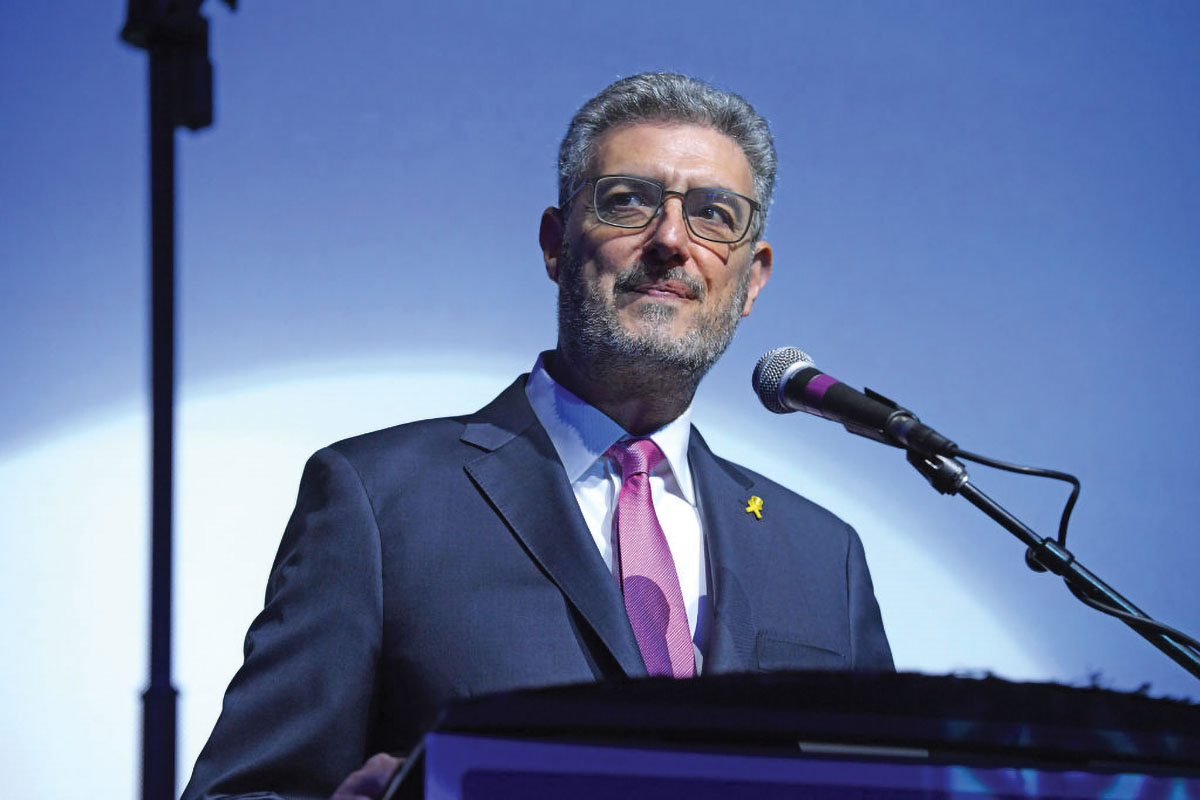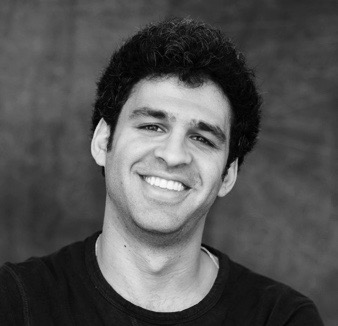

CNN newsman Wolf Blitzer, one of the world’s most recognizable journalists, has personal and professional connections to the Holocaust and Israel.
Blitzer’s paternal grandparents died in Auschwitz. His parents, both survivors from Poland, immigrated to the United States after the war, following the 1948 passage of the Displaced Person’s Act, which opened America’s borders to Europeans persecuted by the Nazis.
Blitzer, 69, was born in Germany and raised in Buffalo, N.Y. He was a reporter in Israel before joining the staff of CNN in 1990.
After being honored Nov. 5 by the Los Angeles Museum of the Holocaust, Blitzer discussed today’s Muslim refugees, being a Jewish journalist at a time of rising anti-Semitism, his favorite journalism movie and more.
Jewish Journal: Can you compare the plight of Jewish refugees after the Holocaust with today’s Muslim refugees from Syria?
Wolf Blitzer: As a son of Holocaust survivors who came to the United States as refugees after World War II, I strongly believe in refugee resettlement. This country welcomed my parents, who went on to establish a wonderful life in Buffalo, N.Y. My parents, like other Holocaust refugees, were thoroughly vetted by U.S. officials before they were granted entry visas. My dad told me about the questions he was asked. They were so grateful to this country and went on to become great American patriots.
JJ: How comparable are the situations?
WB: Refugees are refugees even as there are, of course, different degrees of oppression that made them refugees. Surviving genocide and mass murder, for example, is different than surviving a civil war. But make no mistake: Both are awful and brutal.
JJ: What can be done about Holocaust denial in the Muslim world?
WB: The best way to deal with Holocaust denial is to get the truth out there — whether it’s here in the United States or elsewhere around the world, including in the Muslim world. And that’s where Holocaust survivors play such a critical role. They survived the horror and their stories are so powerful. Unfortunately, they are now in their 80s and 90s and there are fewer survivors every year. Their personal stories and testimony — shared at Holocaust museums on video — will remain and should be told in the Muslim world and everywhere else.
JJ: Before joining CNN, you worked at The Jerusalem Post and at Reuters’ Tel-Aviv bureau. How was the transition to CNN?
WB: It was very smooth. The folks at CNN are so nice. They really spent some time helping me during the transition. I was a print reporter and the hardest thing was learning how to write for television. It’s different than writing for newspapers or magazines. But in the end, it’s all about being a reporter and gathering the news. Those techniques are the same. My first day at CNN was May 8, 1990 — and Saddam Hussein invaded Kuwait a few weeks later in August. I was CNN’s Pentagon correspondent, so I had no choice but to learn all about broadcast journalism very quickly.
JJ: Do Jewish journalists have special responsibilities at a time when anti-Semitism in on the rise?
WB: Our responsibility is the traditional responsibility: report the news honestly and fairly and get the job done. That’s what we’ve done for my whole career, that’s what journalists do and that’s what the viewers, readers and the listeners deserve — factual, honest reporting.
“Occasionally we make a mistake. If we have to correct something, we correct it, then we move on.”
JJ: In the age of “fake news,” and with President Donald Trump calling CNN fake news, how can journalists ensure that the public can continue to trust the media?
WB: Just keep doing our job and don’t get distracted. Just report the news and be honest and responsible. Look, we’re the first draft of history. Occasionally, we make a mistake. If we have to correct something, we correct it, then we move on. But it’s not that complicated: just report the news. That’s what we try to do.
JJ: What’s your favorite journalism movie?
WB: “All the President’s Men.”
JJ: What’s the likelihood of an Israeli-Palestinian peace agreement?
WB: We’ve been working on that a long time. Let’s see what happens.