On a recent sunny afternoon, City of Hope, a National Cancer Institute-designated Comprehensive Cancer Center, celebrated the unveiling of its newly restored campus synagogue. Now dubbed the La Kretz House of Hope, the chapel has been renamed for philanthropist Morton La Kretz, who donated $1 million toward the project in 2009.
Built in 1940 on the City of Hope’s Duarte campus, some 20 miles east of Los Angeles, the chapel was originally designed by Harry Herzog and called Beth Hatikvah, or House of Hope. It initially stood on a 10-acre property devoted to cancer research and patient care. Today, the La Kretz House of Hope is in the same location, but now stands between a Japanese Zen garden on one side, and a statue of Pope John Paul II on the other, on grounds stretching across some 100 acres.
Herzog had been a patient at City of Hope, and his design is complemented by the artwork of another former patient from the 1950s, Janos “John” Bernat, who painted the two murals adorning the walls of the synagogue. They, too, have just been restored.
In honor of their father’s contribution to City of Hope, Bernat’s children, Tom Bernat and Suzanne Bernat Droney, attended the opening ceremony. They told of his years at City of Hope, saying he had a studio on the grounds and ultimately worked as the facility’s medical illustrator.
The two-year restoration by architectural firm DLR Group brought the building’s exterior back to its original appearance, while the interior has been updated to give it a more contemporary feel. Electric yahrzeit lights line donor-recognition plaques on the walls, and an interactive monitor displays names of those being remembered. As Rabbi Mark Diamond, executive vice president of the Board of Rabbis of Southern California, explained, “It’s not easy to take a traditional religious space and give it a modern, sacred look.”
Despite the Jewish affiliation of the synagogue, the City of Hope chaplains are eager to use the space for interfaith services and holidays, as well as make it available for select lectures and meetings.
The space will be open to the entire City of Hope community as “a place where everyone is welcome,” Dr. Michael Friedman, president and chief executive officer of the nonprofit facility, said in his opening remarks at the ceremony. Historically, the chapel often has been used as an interfaith space, and with the completion of the restoration, it has been rededicated to the patients, families and staff as a place “for moments of gathering, solitude and spiritual reflection.”
Also in attendance was Dr. Eugene Roberts, director emeritus of neurobiology at the Bechman Research Institute of City of Hope, who joined the staff in 1954 as the chairman of biochemistry at Beckman. Roberts had worked closely with Bernat over the years, as both his doctor and colleague, and he shared many stories about the legacy of the House of Hope.
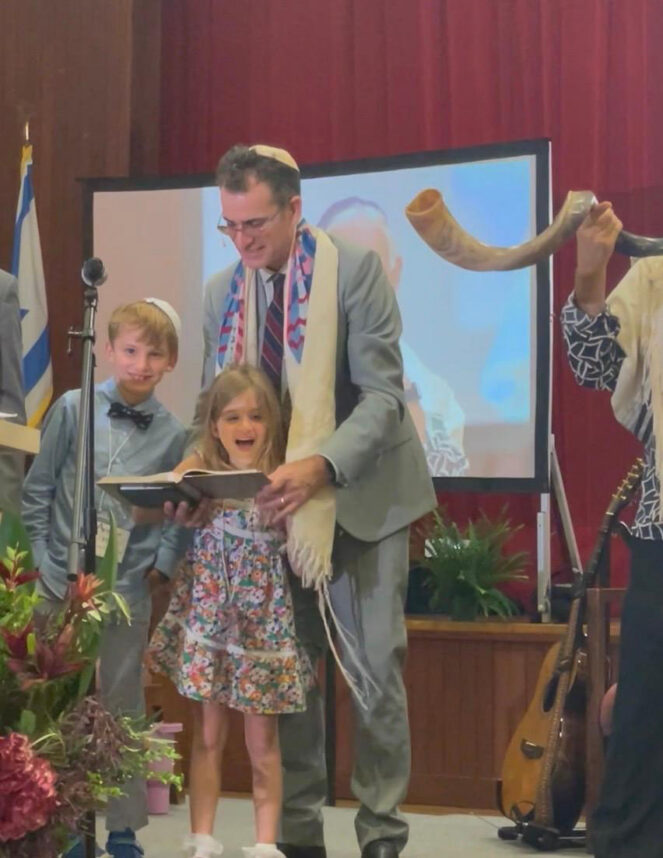
To dedicate the newly renovated space, Rabbi Olga Bluman, a member of City of Hope’s spiritual care staff who consulted throughout the renovation process, led a short ceremony to bless the synagogue. Rabbis Gilbert Kollin and Joshua Levine Grater, as well as Cantor Ruth Harris, all of the Pasadena Jewish Temple & Center, accompanied Bluman in leading the prayers. Together, they blessed the temple by reaffixing the mezuzah and returning the Torahs to the ark, as is tradition since King Solomon sanctified the First Temple of Jerusalem.
“In Judaism, the building itself is not inherently holy. It is our souls that make a synagogue holy,” Diamond said. In an attempt to do just that, members of the community filled the room and sang prayers in honor of those in need of healing.
The La Kretz House of Hope, which has stood as an institutional landmark for more than 70 years, is open weekdays from 8 a.m. to 5 p.m. and upon special request.