In the early decades of the 20th century, Austrian-Jewish writer Stefan Zweig was one of the world’s most popular, prolific and translated authors.
In 1934, discerning the dark political clouds drifting across the border form Nazi Germany, Zweig left his beloved Vienna and went into permanent exile — first in England, then in the United States before finally settling in Brazil.
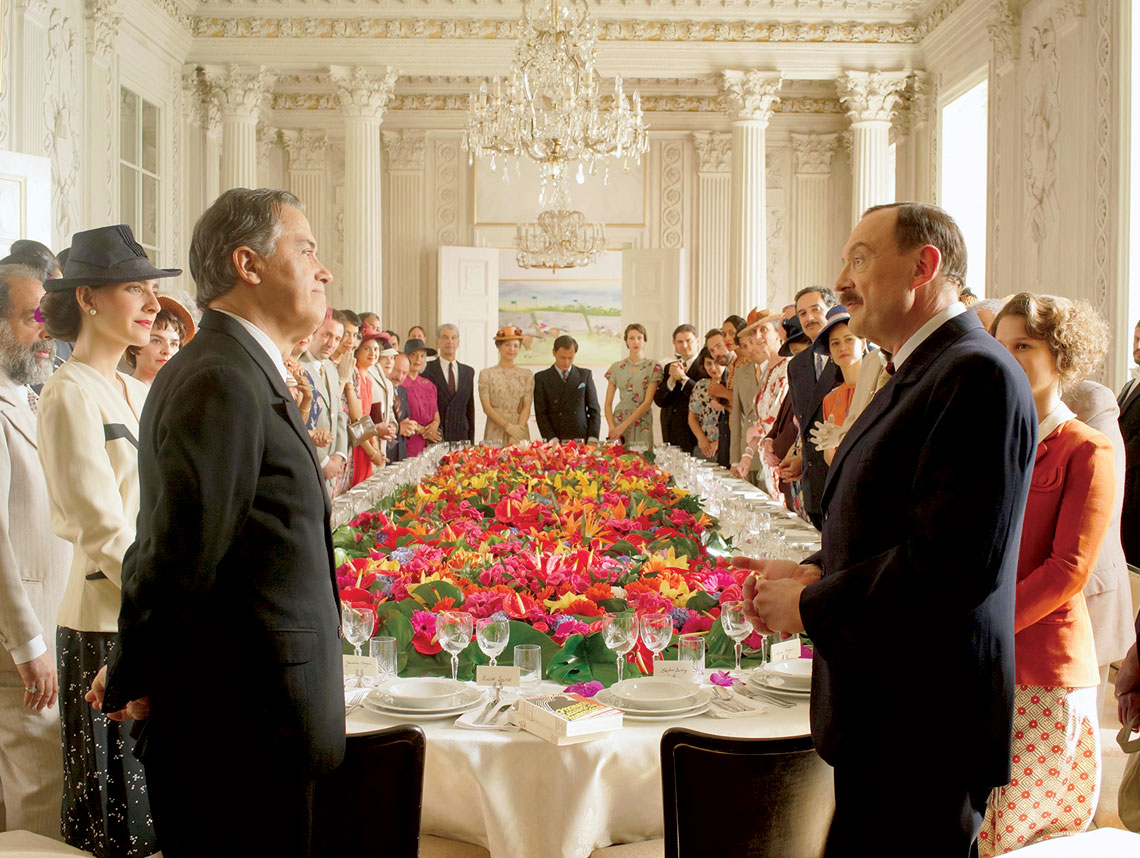
In the film “Stefan Zweig: Farewell to Europe,” German writer-director Maria Schrader follows the geographic and psychological route of Zweig’s exile, from initial celebrity status to his despairing end.
Although he traveled widely, Zweig chose to move to Brazil, a nation he visualized as the country of the future. The film opens with a lavish reception for Zweig at which members of Rio de Janeiro’s elite vie for a word with the world-famous author and even, for the lucky ones, his autograph.
In 1936, Zweig attended the PEN Congress in Buenos Aires, at which the literary and human rights organization for poets, essayists and novelists welcomed him as a literary star. However, one incident there, depicted in the film, made him the object of lifelong controversy and criticism.
After one conference speaker after another denounced the Hitler regime in Germany for its persecution of dissenting writers and forcing Jewish ones into exile, Zweig is asked at a press conference for his comment. The writer responds by declaring, “I would never speak out against any country. And I’ll make no exceptions. … I cannot write out of hatred. … And if my silence is a sign of weakness, I am afraid I must live with that stigma.”
Schrader analyzed Zweig’s pronounce-ment in a phone interview with the Journal. “Zweig was a radical pacifist and he refused to use language to condemn any country,” the director said. “He felt it was the duty of the intellectual to achieve an understanding of any opponent.”
Zweig considered himself mainly as a universal humanist but never renounced his Jewish heritage. He spent considerable effort and money to help Jewish writers reach the U.S. and a number of his short stories focused on Jewish themes and characters.
Schrader, who is not Jewish, has had a successful career as an actress, screenwriter and director, with strong artistic ties to Israel and Jewish life in Germany. Her debut film, “Love Life,” was based on the novel of Israeli author Zeruya Shalev and was shot in Israel. She directed an episode in the documentary “24h Jerusalem” as well as the film “Meshugge.” In “Rosenstrasse,” she played a German woman who stands up against the Nazis after they arrest her Jewish husband.
Dominating “Farewell to Europe” is veteran actor Josef Hader as Zweig, with Barbara Sukowa and Aenne Schwarz as his first and second wives, respectively.
The movie is not entirely without humor. In one scene, as Zweig and his spouse tour the Brazilian hinterland, they are met in one small town by a flustered mayor and welcoming musical ensemble, consisting of a trumpet and an off-key tuba, playing “On the Beautiful Blue Danube.”
Overall, this is a thought-provoking, somber film, culminating in the 1942 double suicide of Zweig and his second wife, Charlotte Altmann, in the Brazilian town of Petropolis. Zweig left a farewell note explaining that at the age of 60, he lacked the strength to build a new life “now that the world of my language has disappeared for me and that my spiritual land, Europe, is destroying itself.”
He concluded by writing, “I greet all my friends. May they still see the dawn after the long night. I am too impatient, I go before them.”
Schrader said she sees some parallels between Zweig’s era in the 1930s and ’40s and the present time.
“Hitler came to power by promising to drastically change Germany,” she said. “Today, many people in Europe and the United States seem to feel again that any change is better than staying with the status quo. In Europe, countries are turning to the right politically and the American president wants to build a wall between countries.”
At Zweig’s memorial service in Los Angeles, not depicted in the movie, fellow author and exile Franz Werfel eulogized Zweig by saying, “His heart, spoiled by humanist optimism, suddenly realized the entire, piercing, unsolvable tragedy of the human being on Earth.”
“Stefan Zweig: Farewell to Europe” opens June 16 at Laemmle’s Royal Theatre in West Los Angeles.