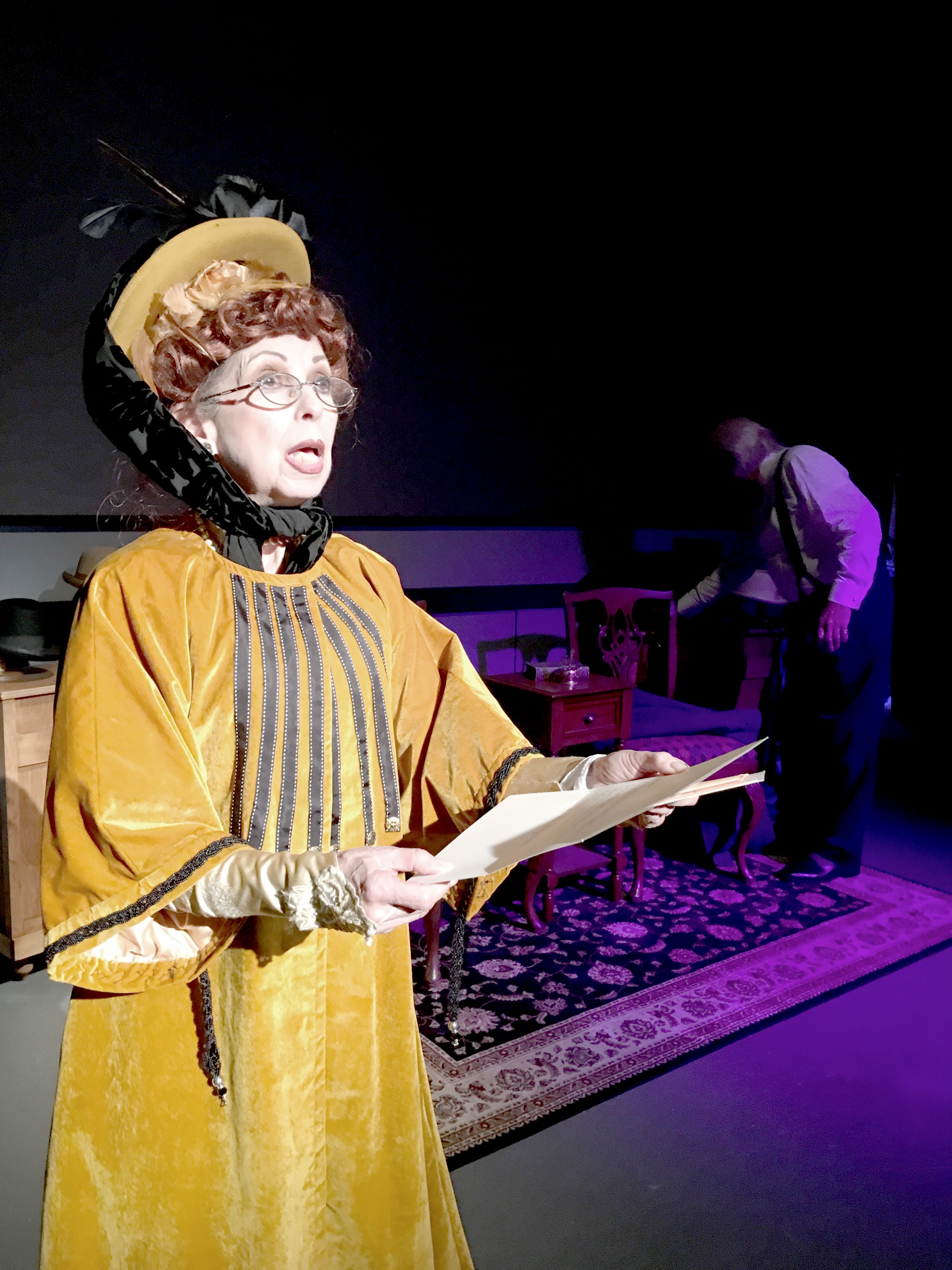
The Santa Monica Playhouse was packed for the opening night of “Aleichem Sholom,” the fifth piece in a five-play cycle about the Yiddish writer Sholom Aleichem.
The play is based on his writings and letters, but Aleichem is probably best known as the author of the Tevye stories on which “Fiddler on the Roof” was based.
“Aleichem Sholom” was adapted for the stage by Santa Monica Playhouse’s co-artistic directors and husband and wife, Chris DeCarlo and Evelyn Rudie, who play Aleichem and his wife, Olga.
The play opens with a beautiful black-and-white line drawing of a city street by Victor Sonora and the words “Sept 22, 1913, Warsaw.” Throughout the play, the drawings change, connecting the audience to the simplicity and innocence of Aleichem’s characters and the printed works in which they first appeared.
Some of the best lines come from Aleichem himself, or sound like they could have: “Just because a rose smells better than cabbage, doesn’t mean it will make a better soup!”
The play itself is episodic, and it was hard to hear many of the lyrics in the half-dozen songs (some of which Aleichem wrote himself), which may have been due to a problem with the microphone on opening night.
Neither of these issues seemed to bother the audience, who laughed and clapped. Several stood at the end for an ovation. It made me think of the heyday of vaudeville in New York, and how exciting and reassuring it must have felt for dazed immigrants on the Lower East Side to hear the language of their childhoods spoken, the cadence and jokes and zeitgeist.
It’s grounding to see this part of our shared past re-created in sunny Santa Monica, whether or not we actually grew up on tales of shtetl life. These stories of inequity and triumph, love and laughter, family and religion are part of our heritage and identity, and connect us to a part of ourselves.
The most impressive thing about the show is that it’s part of a project of 40-plus years to bring Jewish theater to life at the playhouse, called the Jewish Heritage Project.
Rudie and DeCarlo met at the playhouse in their teens. They officially formed the Jewish Heritage series in 1973 when they took over as co-directors from founder Ted Roter, who was the son of a Holocaust survivor and had already been producing works based on Aleichem’s writings.
Today, the couple remains focused on celebrating and preserving Jewish culture and heritage, and developing new, unique works. They seek submissions for the Jewish Heritage Project and for the regular season.
Sholom Aleichem was popular in his own time and remains so today. For more on the author, check out the 2011 documentary “Sholom Aleichem: Laughing in the Darkness.”
Rudie pointed to the universality of Aleichem’s tales as the root of their appeal, and the reason she and DeCarlo focus on them. “We wanted to establish a tradition here of passing on stories about the common person. If you think about a people that hasn’t had roots or a homeland, what binds them together is their stories, their oral tradition. So much theater blossoms from that.”
“Aleichem Sholom” runs through June 25 at the Santa Monica Playhouse, 1211 Fourth St. santamonicaplayhouse.com.
Wendy Paris is a writer living in Los Angeles. She is the author of “Splitopia: Dispatches From Today’s Good Divorce and How to Part Well.”