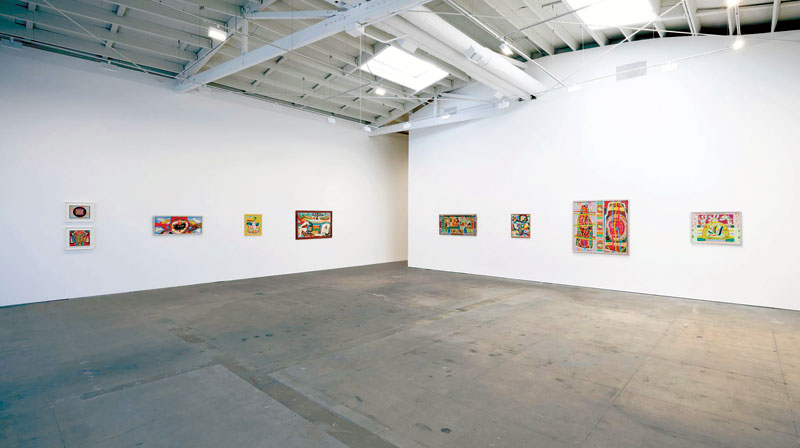
For most artists, it takes years to gain recognition for their art. Sometimes, this acknowledgment comes only after they pass away. However, for Peter Krasnow (1886-1979), fame arrived early in his life. His work was showcased in some of the world’s top museums and galleries. But while fame pursued him, he tried to avoid it. Now, 28 pieces by this fascinating artist are on display at the Babst Gallery on Fairfax Avenue in Los Angeles, spanning works from 1916 to 1979.
Krasnow was born in Novohrad-Volynskyi, Ukraine. He emigrated to the United States in 1907 at age 20 to escape the pogroms, eventually moving to LA in 1922. There, he became friends with intellectuals and artists of the time, including Edward Weston, Rudolf Schindler and Richard Neutra. Although Krasnow achieved critical success with exhibitions at early iterations of the Whitney Museum (1922) and LACMA (1922 and 1928), he largely avoided the commercial art world during his lifetime.
Gallery owner Helen Babst, who co-owns the gallery with Mario DeFlice, said she was captivated by Krasnow’s life story and his art and decided to bring his work to her gallery.
“I always like to showcase artists who are truly remarkable yet somewhat forgotten,” she said. “Although he might not be widely famous, many artists have drawn inspiration from his work. He exhibited in numerous museums both during and after his lifetime.”
“I always like to showcase artists who are truly remarkable yet somewhat forgotten.” – Helen Babst
After completing his studies at the Art Institute of Chicago in 1915, Krasnow moved to New York, where he married Rose Bloom, a poet and scholar. It was there that he had his first major exhibition at the Whitney. In 1922, the couple drove cross-country to California and settled in Glendale, where he built his home and studio. Despite the consistent recognition of his work in prestigious museums, Krasnow wasn’t earning a living as an artist.
“He refused to sell during his lifetime, selling only to friends,” Babst explained. “His wife supported him by working as a teacher of Jewish history and folklore. Every time he gained fame or received attention, he withdrew. After his work was exhibited at the Whitney in New York, he left for California. When he had a solo exhibition at the Legion of Honor in San Francisco, he moved to Paris.”
In Paris, many people tried to introduce him to influential curators, but he declined. Nevertheless, the prestigious Galerie Pierre chose to exhibit his work in 1934, which marked his cue to leave once again—back to Atwater Village, California.
“He had an impostor syndrome,” Babst said. “Only later did he feel that his work truly deserved the fame and attention it received.”
His return to the U.S. was probably influenced more by the rise in antisemitism in Europe. In 1937, he found out the Jewish ghetto he was from was destroyed.
“He made a series of ink on paper art work talking about that, even though he himself wasn’t there or experienced that,” said Babst. “After Pearl Harbor he wasn’t painting at all for a while, he did sculptures. He realized that the old language of painting couldn’t describe the horrors of what was happening and so he came up with new language of paintings: he mixed colors. He didn’t want to do death for the rest of his life. He continued with light and beautiful colorful paintings that were so different from the ones before Pearl Harbor.”
Krasnow and his wife never had children, but their great-nieces and great-nephews attended the opening of the exhibit honoring their beloved uncle.
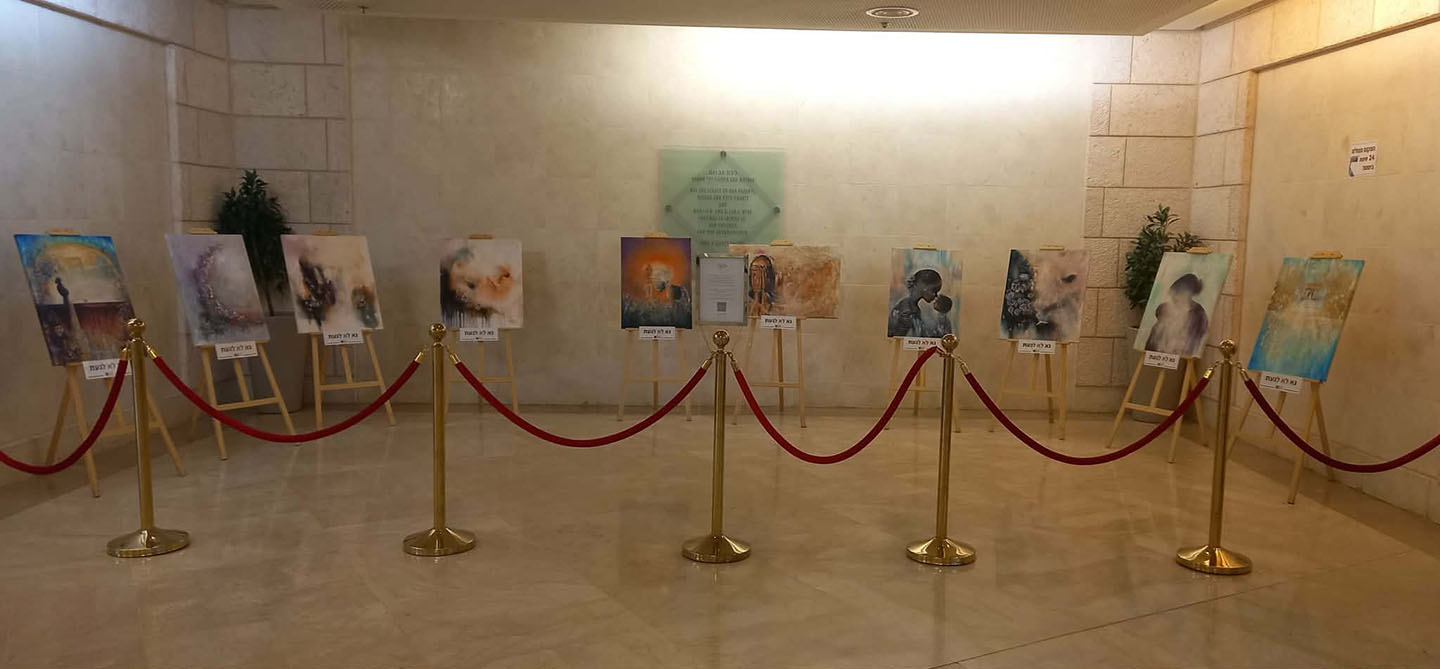
The exhibition spans three rooms and includes early portraits, never-before-seen ink drawings created in response to the horrors of World War II and a series of colorful abstract paintings he began right after Pearl Harbor. Inspired by Jewish mysticism and the Southern California landscape, Krasnow’s paintings, as he wrote, “breathed joy and light—color structures instead of battle scenes, symmetry to repair broken worlds. A means of protest to ease the pain. When despair reached its highest-zero point—it can hurt no more, and life persists.”
Exhibit runs until November 9 at Babst Gallery, 413 S Fairfax Ave, Los Angeles, CA 90036