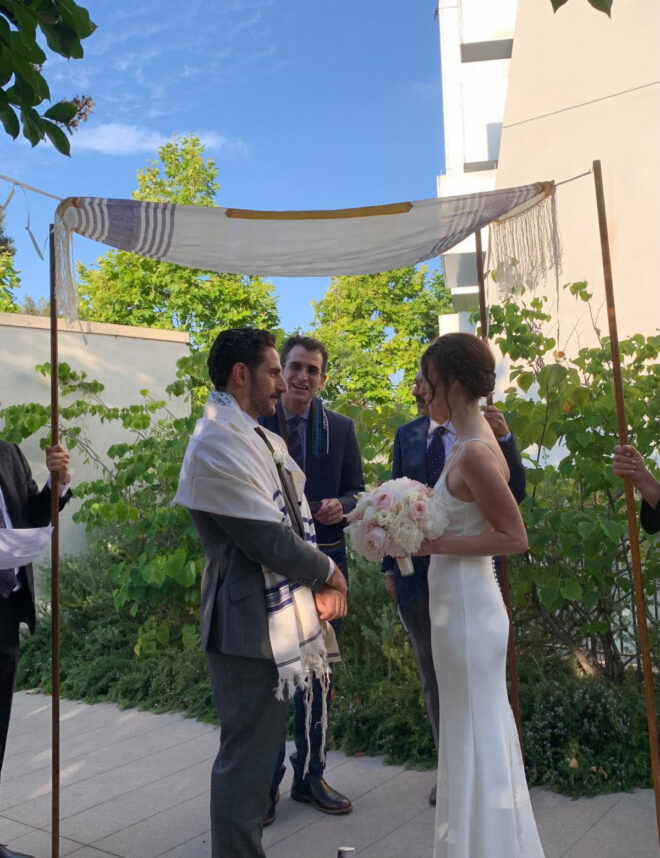
Imagine standing under a beautiful, hand-embroidered chuppah that 25 years earlier your parents stood under as they became husband and wife. That is the legacy Los Angeles artist Robin Van Zak hopes to create every time she designs a one-of-a-kind heirloom lace bridal canopy.
The idea of passing down wedding keepsakes is not new, but it’s not commonly associated with the ceremonial chuppah. While many brides preserve their wedding gowns with the hope of one day passing it down to their daughter, the chuppah is often tucked away and rarely seen again. A family chuppah provides the perfect opportunity to create a “living” memory that can be shared from generation to generation.
Most couples understand what the bridal canopy represents, but its origins are more literal than many may realize. The chuppah’s roots go back to talmudic times, when, as explained by author Sol Zim in the “Joy of the Jewish Wedding,” after the ceremony, the groom “brought his bride into a ‘chupa,’ special living quarters arranged for the couple in the home of the groom’s parents.” By the 14th century, as the expense associated with building a separate space for the couple became too costly, the contemporary ceremonial chuppah, representing the new home that the couple would share as husband and wife, was born.
Because its beginnings are based in a life-cycle event, a bridal canopy that is shared among relatives highlights the importance of family. The simplicity of its frame comprised of four poles, four open sides and a cloth covering on top draw the wedding guests in, while at the same time provide an element of privacy for the couple. It’s as if they are embraced and protected by those who stood under the canopy before them.
For Van Zak, the idea for a multigenerational chuppah was born when her sister announced she was getting married. She wanted to create something special for her, something that was personal and representative of their family, something that could be shared for generations to come.
“I focused on the chuppah, because I have seen so many made out of flowers that cost tens of thousands of dollars and are thrown away by the end of the night. I thought this was a perfect opportunity to blend traditional elements with a contemporary flair,” she said.
After the wedding, a cloth patch was sewn into a corner listing the couple’s name and wedding date. Since then, at least one more name and date has been added, and its designer takes pride in knowing more will be added in years to come.
Van Zak focuses on finding premium lace, creating delicate designs that evoke a sense of romance and warmth. Each creation takes days to complete and brings a level of romance and elegance to a wedding symbol steeped in tradition.
Chuppahs have the ability to alter the mood of the ceremony and claim a far greater role than many couples might realize.
“The chuppah is the centerpiece of the wedding ceremony,” said Debbie Geller, owner of Geller Events, a boutique wedding and event planning company. “The bulk of the wedding photographs are taken there, and more than any other element of the wedding, it demonstrates the tone of the couple itself, whether traditional, modern, simple or elaborate.”
Rabbi Stewart Vogel of Temple Aliyah in Woodland Hills, who has officiated hundreds of weddings, speculates that “the people who take the time to create a personalized chuppah are probably people who are more likely to put more time and energy into their home — to recognize the importance of proactively creating the home that they want to create to reflect their values.”
Couples who are trying to decide if a living chuppah is right for them should take a tip from Van Zak herself, who uses inspiration as her guide in their creation.
“It’s when I see beautiful lace that I start the process,” she said. “I treat them as pieces of art; it’s my passion.”
What will inspire the couple as they stand there declaring their love and commitment? If it is finding comfort when looking up and knowing a piece of their love will be shared with their children and their children’s children, then a living chuppah is the perfect fit.
Allison Krumholz is a professional freelance writer who writes on a diversity of topics and has written for several publications, including Inside Weddings. She lives in Los Angeles.