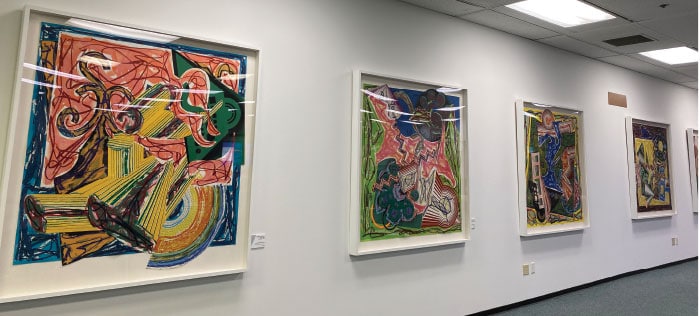
American artist Frank Stella’s “Had Gadya” series has arrived at the Hebrew Union College – Jewish Institute of Religion (HUC-JIR) in Los Angeles. This vivid collection of prints is Stella’s interpretation of Russian avant-garde artist El Lissitzky’s 1919 illustrations of the traditional Passover song.
Stella’s prints, which are expressive in color, movement, energy and joy, are installed around the gallery space in order of the song, right to left, just as it would be read in Hebrew. It is a way to mark Passover, especially in this limbo moment between pre- and post-COVID living.
“It feels to me the last two years has been a real-life living of the ‘Had Gadya’ story,” Anne Hromadka Greenwald, curator of the exhibit at HUC-JIR, told the Journal. “After two years of the pandemic, we have suffered losses, great and small: from milestones delayed and families kept apart, to grief for millions of friends, relatives and neighbors struck down by this modern plague.”
Stella’s prints, which are expressive in color, movement, energy and joy, are installed around the gallery space in order of the song, right to left, just as it would be read in Hebrew.
Like the snowballing tragedy of “Had Gadya,” floods and fires, political upheaval and racist violence have compounded the pandemic. And just when we think it can’t get worse, the next wave hits.
Typically in rhymes, where each verse builds on the one before, the stories get progressively worse. Think, “There was an old lady who swallowed a fly.” “Had Gadya” ends with God killing the Angel of Death; death does not win.
“I think the world needs to learn there will be an end to this,” Greenwald said. “There is hope on the horizon and we need to maintain faith.”
Known for painting and printmaking, Stella was traveling in Israel when, in 1981, he encountered Lissitzky’s work at the Tel Aviv Art Museum. Though not Jewish, Stella often explored folklore and Jewish bodies of work. He was inspired by Lissitzky’s illustrations of “Had Gadya” and his purposeful use of repetition.
When Stella returned to New York in 1982, he decided to create a conversation through art based on what he saw. The vivid abstractions from this print series, created over two years, combine various printmaking techniques: lithography, linoleum block, silkscreen and rubber relief with collage elements and hand-coloring. “Had Gadya” debuted at the Tel Aviv Art Museum in 1984, and has since exhibited throughout the United States.
Cathee Weiss, director of development, Western Region, for HUC-JIR, first saw this exhibit at Temple Har Shalom in Park City, Utah, on February 14, 2020. Josh Holo, the dean of HUC-JIR, was invited to speak there based on a request from Leona AronoffSadacca, a member of Hebrew Union College’s Board of Advisors.
“It was breathtaking and it took me a minute to realize what I was looking at,” Weiss told the Journal. “I knew Stella’s work but not the collection in front of me, and certainly did not know about the historical reference and El Lizzitsky. As I hummed the Shabbos melodies, I was mesmerized by the art outside.”
After the service, Elissa Oshinsky, the collector, introduced herself and said, “It is my dream to bring this collection to HUC.” Weiss replied without a beat, “I can make that dream a reality.”
Weiss believes an institution with the history, quality and outreach of HUC-JIR deserves to partake in an exhibition of this ilk.
“The work is inspirational for our students: our community’s future rabbis, cantors, educators and nonprofit professionals, [and] inspirational for all who would see it,” she said. “What an opportunity to take in the work of such a powerful artist. This is what brings meaning to our work, our journey here.”
Stella’s “Had Gadya” is available for individual and group viewing at the LA Skirball Campus by appointment through January 1, 2023. It will then be displayed at the Skirball Museum in Cincinnati through May 2023 and then at the Heller Museum in New York in the spring of 2024. To set up a viewing in LA, please contact cweiss@huc.edu.