fbpx

April 14, 2022

Truth and Truthiness: The Changing Public Discourse About Masks and Vaccines

Truth can ambush you. Just ask my patient Bill. Last Father’s Day, Bill’s kids chipped in for a 23andMe kit to investigate his family genetics. When the results came back, his ethnic background looked different than what he expected. After a second check to confirm the findings, Bill found a connection to a cousin. It was a surprise as Bill had only one cousin that he knew of, not this second one that showed up on the genetic test. So, who was this mystery relative? It turned out not to be a cousin at all. It was his half-brother.

Bill wasn’t ready to contact this newly discovered sibling. With some internet research he learned that his half-brother’s father worked as a lobbyist for the airline industry. Bill’s mother, who passed away several years ago, worked as an executive for an airline. It didn’t take much imagination to figure out the rest. Bill’s biological father wasn’t the dad who raised him. Some Father’s Day gift, no?

Despite his discomfort, Bill didn’t dispute the findings. The truth of DNA science is broadly accepted even though other science in areas like vaccines and masking generates much skepticism. Why is that? DNA’s acceptance is probably due in part to the high profile “parlor trick” of criminal identification. Just as DNA ferrets out family relationships, it can also reach back in time to strip hidden villains of anonymity. The case of the notorious rapist, Joseph DeAngelo, showed how even a partial match to a distant relative can quickly heat up a cold case. Once a DNA identification occurs, the fact that the rest of the evidence tends to fall into place validates the DNA process. Few people, perhaps other than the criminal, would challenge the scientific validity of such searches.

Unfortunately, winning public acceptance for the science behind vaccines and masking practices has not been as easy. For starters, there’s no “parlor trick” like using DNA to ID crooks. There are only dry statistics on the frequency of illness, hospitalization and side effects. And the public’s view of statistics recalls 19th-century British Prime Minister Disraeli’s reflections on “lies, damn lies and statistics.”

Unfortunately, winning public acceptance for the science behind vaccines and masking practices has not been as easy.

Even prior to COVID-19 ours has not been an era for facing stark reality. In 2005 comic and television host Stephen Colbert coined the term “truthiness” to describe the private and secure certainty that resides in one’s gut, independent of mere facts. We saw “truthiness” take center stage during the pandemic as a virtual army of often ill-informed Americans not only challenged scientific truth about vaccines but also promoted a “truthy” narrative on largely discredited alternatives like hydroxychloroquine and ivermectin.

In the political sphere, the ”truthiness” of voter fraud allegations was accepted by many as tainting the 2020 presidential election even though the objective evidence showed that the election was fair and by historic standards not even remarkably close. Do facts matter? Take Georgia, the state with the victor’s smallest margin. Prior to the election, multiple polls showed a toss-up. So, a loss should not have surprised partisans of either side. Although the vote broke nearly 50% to 50%, the margin of 0.23% amounted to nearly 12,000 votes. Those alleging fraud might consider the plausibility of a political organization conspiring to steal more than 12,000 votes without leaving a trace of hard evidence.

Daniel Kahneman, author of the landmark “Thinking Fast and Slow” won a Nobel Prize for his research with Amos Tversky showing just how flawed our “truthy” intuition can be. Although useful in emergencies, our instincts and “gut feelings” turn out to be flawed no matter how reliable they seem.

We need to be skeptical, even of ourselves.

As Bill’s case shows, undesirable truths may cause us discomfort more often than they “set us free.”  Still, in the long run we must realize we will make better decisions and be better off if we take our truth “straight up.” That’s what science itself seeks to do. In both politics and science, we would be better served by talking less about our specific beliefs and looking more carefully at how we come to accept what we believe to be true. Truth and justice should be the American Way, not truthiness.


Daniel Stone is Regional Medical Director of Cedars-Sinai Valley Network and a practicing internist and geriatrician with Cedars Sinai Medical Group. The views expressed in this column do not necessarily reflect those of Cedars-Sinai.

Truth and Truthiness: The Changing Public Discourse About Masks and Vaccines Read More »
Princeton BDS Referendum Vote in Dispute

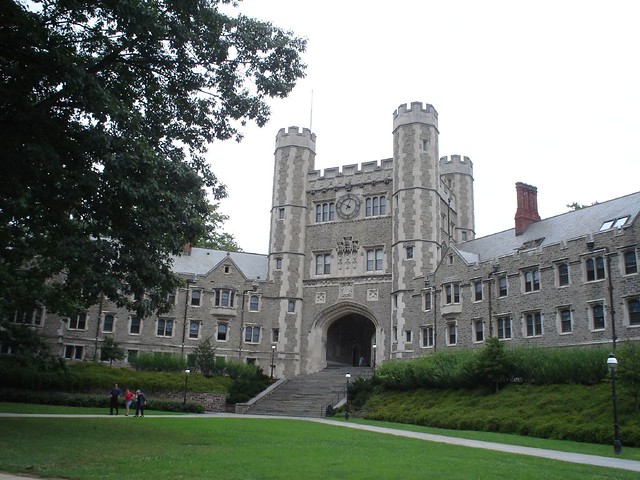
There is currently a dispute over whether or not a referendum supporting the Boycott, Divestment and Sanctions (BDS) movement passed the Princeton University student body or not.

The referendum asked if the university should “immediately halt usage of all Caterpillar machinery in all ongoing construction projects given the violent role that Caterpillar machinery has play in the mass demolition of Palestinian homes, the murder of Palestinians and other innocent people.” It received 44% of support from the student body, while 40% voted against it and 16% abstained during the voting window of April 11-13.

Both Jewish Insider (JI) and The Princeton Tory, a conservative student newspaper, reported that this would mean the referendum failed because the abstention votes would put the opposition in the majority; however, The Daily Princetonian student newspaper reported that under the Undergraduate Student Government (USG) constitution, abstention votes are not counted toward the majority, which would mean that the referendum passed.

Student Myles McKnight argued in an email to the USG that the abstention votes should count, pointing to text messages from USG Chief Elections Manager Brian Li to Tigers for Israel President Jared Stone stating that the abstention votes would in fact be counted toward the majority. Based on what Li had said to Stone, Tigers for Israel had tailored their strategy toward urging students to officially abstain from voting on the referendum. “Their campaign strategy was materially different than it would have been had Brian informed Jared of a different counting procedure,” McKnight wrote, per The Daily Princetonian.

Both pro-Israel and pro-Palestinian groups are claiming victory. President of the Princeton Committee on Palestine Eric Periman, who sponsored the referendum, told The Daily Princetonian he was “incredibly enthusiastic about the results.” He added that the campaign for the referendum “was always about raising awareness about the violation of Palestinian human rights and the ways that Princeton is complicit in those violations of human rights.”

Israel on Campus Coalition CEO Jacob Baime said in a statement, “This is an encouraging outcome for anyone who wants Princeton to remain a safe and equitable place for all. Despite the misinformation and dangerous rhetoric employed by anti-Israel activists during this campaign, 56% of students chose not to support an antisemitic BDS referendum. The Princeton community spoke loud and clear that the road to peace between Israelis and Palestinians is paved with dialogue and cooperation, not division and intolerance.”

An official result will be announced by the USG on April 15.

Princeton BDS Referendum Vote in Dispute Read More »

Mah Nishtanah – A new poem for Passover

Why is this night different from all other nights?

I’ve always read this as Why
and always knew the answer had
something to do with being free.

But then one branch of Judaism
suggested it might be How
as if the why is a given.

I believe in how and why.
I believe in words and how
they mean different things.

I believe it’s all because
we used to be slaves
and now we are free.


On all other nights, we eat leavened foods and matzah.

Why on this night, only matzah?

In the supermarket
even in my non-Jewish neighborhood
you can buy cake you can eat on Passover.

Are we tricking ourselves with this?
Are we evading the very spirit of
having only eighteen minutes
to vacate the narrow place?

The answer, I think,
is not the answer, but
the fact that we bothered
to ask the question.

On all other nights, we eat all vegetables.
Why, on this night, maror (bitter herbs)?

Nothing makes my wife happier than vegetables.
(This is not intentional commentary on our marriage.)
So if a dinner comes along that doesn’t have one
all is lost.

A bitter one is fine.
If we have to eat a bitter one on this night
that’s fine.

Some folks go their whole lives avoiding vegetables.
Even an American President decried broccoli once.
Even others find bitterness a delicacy.

As the horseradish enters your mouth
try to remember how lucky you are
to have anything to put there at all.

On all other nights, we don’t dip even once.
Why on this night do we dip twice?

I’d like to tell you the answer
but that comes later in the order.
But know this – numbers are important.
We use four, and ten, and forty a lot.
I hear thirteen and six hundred and thirteen
are planning a royal wedding.
So let two have its moment.
You can’t do anything the first time
only once. Think of how much you notice
the second time around.
Think of what that tastes like
when it’s familiar.

On all other nights, we eat either sitting upright or reclining.
Why on this night do we all recline?

I work from home in a comfy chair
that arrived on the premises before I did
and spend a much higher percentage of my time
than the average person, reclining.
But this isn’t about me (even though
tradition tells me I was there.)
This is about all of us. All of us
more comfortable than any slave ever was.
All of us on our pillows filled with
gratitude at how lucky we are to be
in     this     exact     position.


God Wrestler: a poem for every Torah Portion by Rick LupertLos Angeles poet Rick Lupert created the Poetry Super Highway (an online publication and resource for poets), and hosted the Cobalt Cafe weekly poetry reading for almost 21 years. He’s authored 25 collections of poetry, including “God Wrestler: A Poem for Every Torah Portion“, “I’m a Jew, Are You” (Jewish themed poems) and “Feeding Holy Cats” (Poetry written while a staff member on the first Birthright Israel trip), and most recently “The Tokyo-Van Nuys Express” (Poems written in Japan – Ain’t Got No Press, August 2020) and edited the anthologies “Ekphrastia Gone Wild”, “A Poet’s Haggadah”, and “The Night Goes on All Night.” He writes the daily web comic “Cat and Banana” with fellow Los Angeles poet Brendan Constantine. He’s widely published and reads his poetry wherever they let him.
Mah Nishtanah – A new poem for Passover Read More »

Twisting the Holocaust to Fit a Narrative

With the approach of Holocaust Memorial Day (Yom HaShoah) comes yet another wave of attempts to distort the Holocaust in order to advance various political or social agendas.

The tensions surrounding the Coronavirus pandemic have become a breeding ground for wildly inappropriate Holocaust-related analogies. U.S. Congresswoman Marjorie Taylor Greene (R-Georgia) has taken to calling advocates of Covid-19 immunizations “vaccine Nazis.” Her colleague Lauren Bobert (R-Colorado) has denounced vaccine supporters as “needle Nazis.”

Some protesters against Covid-related restrictions have been wearing yellow stars of David intended to resemble those that the Nazis forced Jews to wear. Top-rated Fox television host Tucker Carlson has compared the vaccine to Nazi medical experiments.

Although many of these offensive and inaccurate analogies emanate from one side of the political spectrum, they are by no means exclusive to that camp. On the left, Robert F. Kennedy, Jr. recently claimed that public health measures to combat Covid are even more onerous than what the victims of the Nazis endured. “Even in Hitler’s Germany, you could cross the Alps into Switzerland,” he said. “You could hide in an attic like Anne Frank did.” Kennedy later apologized; but the damage—in terms of his impact on the public—was already done.

A different kind of Holocaust distortion will soon be coming to America’s television screens, courtesy of noted filmmaker Ken Burns. He says his forthcoming documentary is intended to “dispel the myth” that during the Holocaust, “Americans looked on with callous indifference.”

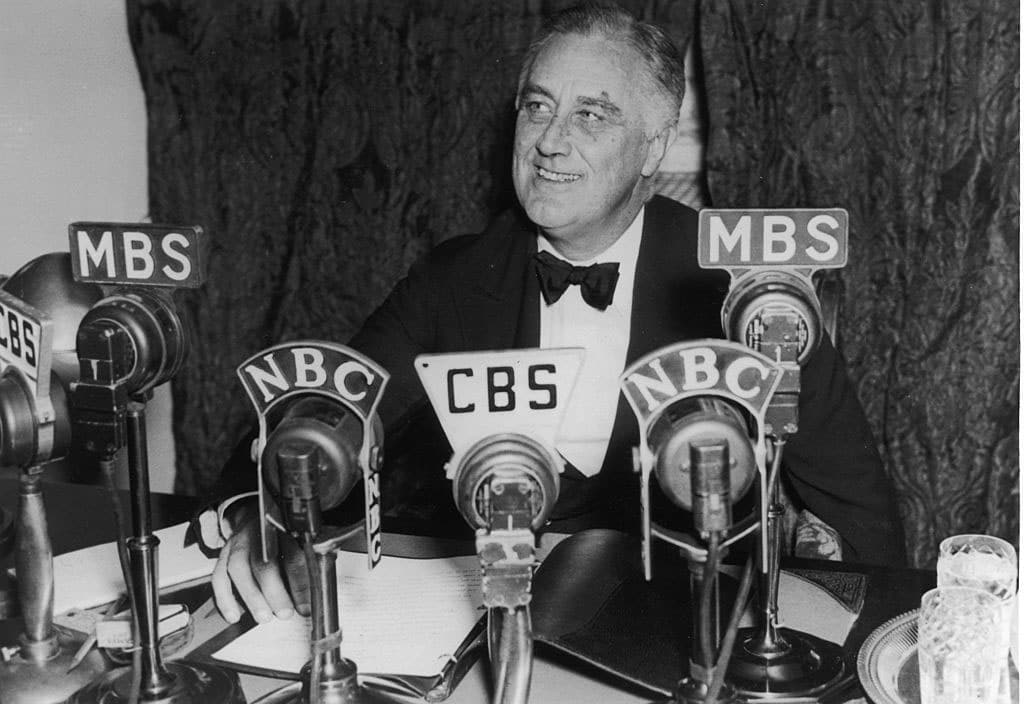
When Burns tackled this subject previously, it was obvious that his lens was distorted by a narrow partisan perspective. His 2014 PBS series, “The Roosevelts: An Intimate History,” dealt in part with President Franklin D. Roosevelt’s response to the Holocaust. It badly misrepresented the historical record.

Burns blamed America’s harsh immigration restrictions on Congress and public opinion, failing to note that FDR suppressed immigration far below what the law allowed (in most years from 1933-1945, the quota for immigrants from Germany was less than 25% filled). Burns also falsely credited Roosevelt with creating and funding the War Refugee Board, when FDR actually tried to prevent its creation and gave it only token funding (90% of its budget was provided by American Jewish organizations).

Burns blamed America’s harsh immigration restrictions on Congress and public opinion, failing to note that FDR suppressed immigration far below what the law allowed.

Burns’s 2014 film did not mention any of FDR’s fifteen hostile statements about Jews, which historians have amply documented. Ironically, the scriptwriter for that film was Geoffrey C. Ward, a Roosevelt biographer who was one of the first to document the president’s anti-Jewish “humor.” In his 1989 book, Ward revealed that on multiple occasions, Roosevelt told “mildly anti-Semitic stories in the White House,” in which “the protagonists were always Lower East Side Jews with heavy accents…” Ward also documented additional examples of FDR’s “jokes” about Jews. Yet he omitted them from the 2014 film.

Subsequently, other historians revealed remarks by Roosevelt in which he spoke disdainfully of “Jewish blood”; asserted that antisemitism in Poland was caused by the practices of Jewish businessmen; advocated quotas to restrict the admission of Jews to Harvard; and said (in 1943!) that antisemitism in Nazi Germany was “understandable” because there had been too many Jews in various German professions.

It will be interesting to see if any of Roosevelt’s statements about Jews make it into Burns’ forthcoming documentary, because according to the advance publicity, Geoffrey Ward has written the script for that one, too. A director with a partisan agenda and a scriptwriter who has withheld evidence that he himself uncovered—that’s quite a combination.

Meanwhile, another type of distortion is rearing its ugly head, this in time in connection with the Russian invasion of Ukraine. Whether Russia’s slaughter of civilians in Ukraine will reach the level of genocide remains to be determined, but there is no doubt that widespread atrocities have occurred—no doubt, that is, except among a handful of extremists with loud megaphones in the American media.

Widely-published leftwing journalist Glenn Greenwald recently charged that “Twitter experts eager to start WW3 [are] emotionally demanding that the US go to war with Russia due to horrifying yet context-and-evidence-free photos and videos posted by Ukrainian officials.”

Greenwald’s claim echoes a recent assertion by a prominent voice at the other end of the political spectrum, Fox’s Greg Gutfeld, the most-watched host in late-night television. He claimed that news stories showing the suffering of Ukrainian civilians have sped up and are accumulating to create a narrative — and they only go in one direction…an image is taken and then played over and over and over again to create some kind of emotional response out of you.” According to Gutfeld, that “narrative” may be “leading” America toward “World War III.”

Isolationists, whether from the far left or far right, are understandably jittery about a world war. We all are. But to allege that the news reports of Russian atrocities are part of a conspiracy by the media to drag America into the Ukraine war is outrageous. And it’s eerily reminiscent of isolationists’ accusations in the 1930s that Jews were exaggerating Nazi atrocities in order to drag America into a war with Germany.

Holocaust Memorial Day should be an occasion for remembering the Holocaust and the lessons to be learned from it. Instead, sadly, we find our attention diverted by those who are exploiting or distorting that history—or even doubting atrocities that are taking place right now—in order to advance narrow partisan agendas.


Dr. Medoff is founding director of The David S. Wyman Institute for Holocaust Studies and author of more than 20 books about Jewish history and the Holocaust. His latest is America and the Holocaust: A Documentary History, published by the Jewish Publication Society & University of Nebraska Press.

Twisting the Holocaust to Fit a Narrative Read More »

Going Beyond Disability Awareness to Inclusion

February is well behind us, which means Jewish Disability Awareness and Inclusion Month is, too. Many of us, myself included, participated in, attended and helped plan JDAIM programs and panels or wrote articles. Assumptions were challenged, implied bias discussed, awareness created and calls to action were made.

Now, what?

If you were one of those who attended a program, webinar or event for Jewish Disability Awareness and Inclusion month through an organization, synagogue or school, that’s great! If you left one of those events, programs or webinars with questions and wanted to learn more, or if you looked around at the culture, accessibility, or policies practiced by your business, school, synagogue or organization and thought about reevaluating, even better!

But if you left those places, satisfied that you now have a clear understanding of the challenges faced by disabled individuals, well, that’s not so good. Here’s why:

If the only person you heard from during JDAIM was an able-bodied person who provides services to disabled people, or if the speaker was a parent or sibling of someone who was disabled, then you definitely didn’t get the whole story.

Certainly, there are able-bodied experts in the field who definitely “get it”: They have studied and interacted with disabled people, are strong advocates and have good information to impart. They may have told you about accessibility and programs that support individuals with disabilities, or raised the issue of inclusion and other issues that confront our population. But they haven’t lived the experience.

Programs that don’t include the voices of those with the lived experience of disability are missing their heart and soul, and the audiences of these programs are being short-changed. Many of these kinds of programs perpetuate the misconception that we, disabled people, need to be taken care of or, worse, that our voices don’t matter.

Programs that don’t include the voices of those with the lived experience of disability are missing their heart and soul, and the audiences of these programs are being short-changed.

Our voices make an impact. Hearing from me and from others who are disabled about how the lack of accessibility impacts our lives at work, school or in other arenas of life is the only authentic information, and at the very least should be included alongside the non-disabled professionals or family members. Otherwise, it’s like hearing from a man who watched the birth of his child trying to describe labor pains.

When you plan your JDAIM program next year, include a disabled person in the entire process—planning, implementation and execution. The result will be a richer, more impactful and relevant presentation that may not only raise awareness, but also inspire your audience to act.

The goal of JDAIM is “to raise awareness and foster inclusion of people with disabilities.” From my perspective, this goal is at once too broad and oversimplified and does not go far enough. We have to get beyond awareness, beyond “fostering” inclusion.

Of course, starting with awareness allows us then to challenge and influence assumptions. But the end goal must be actual inclusion and belonging for people with disabilities. We must get to the point where people with disabilities experience equity and are included as a matter of course in all aspects of society.

Let me be clear about something: It is not my blindness that disables me. It is, in fact, society that disables me. It is people’s attitudes and assumptions. It is the perception that being disabled is something bad, abnormal, to be feared or pitied rather than just another part of the human experience.  It is the challenge of attitudes, stigmas and access that disables me and other people with disabilities.

In order to promote access, we must have a societal mind shift. We must stop seeing disability as a deficit to overcome. We must acknowledge people with disabilities as equal members of society with the rights and options to participate in all aspects of it.

Making spaces accessible is not the hard part. We already have the technology. We know how to make physical spaces and web sites accessible. The hard part is changing mindsets, re-setting long-held ideas and even unintentional biases. We must change attitudes, eliminate stigmas, and acknowledge that a moral and just society creates equity for all its members.

This is a journey for society: Some people start with basic awareness and progress by means of informal education and experience; they may need only help and encouragement. Others need real persuasion and formal education. It is not only non-disabled people who must take this journey or people who don’t have a family member or loved one who is disabled. Even disabled people and those with a disabled family member need to take this journey to realize their own voices and participation in the process.

Individuals should look at their spaces: Do you see disabled people in your spaces?

Individuals should look at their spaces: Do you see disabled people in your spaces? Are they represented at tables of power and influence? Do they help establish employment practices and participate in conversations about diversity, equity, and inclusion? What can you, as an individual, do to welcome people with disabilities as your friends, co-workers, neighbors?

Let’s examine the culture of our communities, businesses, schools, synagogues and organizations. Let’s change our attitudes. Let’s create access that makes all of life’s spaces welcoming ones that value all participants. Let’s listen to the actual voices of disability, include us in all the conversations, decision-making and opportunities for ways to shape the future. Including all people creates value.

Let’s create an inclusive, equitable, valuable society together. Let’s go beyond disability awareness, and let’s get to real inclusion!


Michelle Friedman is the board chair of Keshet in Chicago, a member of Disability Lead, speaker, author and disability advocate.

Going Beyond Disability Awareness to Inclusion Read More »

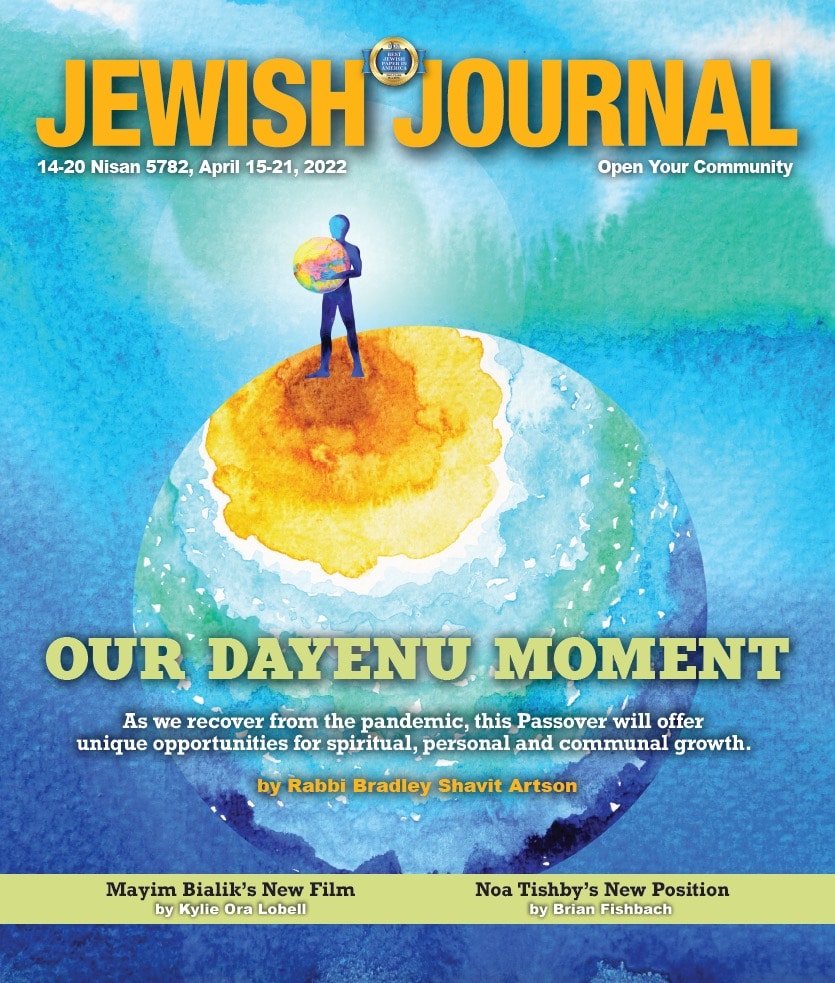
Print Issue: Our Dayenu Moment | Apr. 15, 2022

CLICK HERE FOR FULLSCREEN VERSION

Print Issue: Our Dayenu Moment | Apr. 15, 2022 Read More »

L.A. Federation Stages Pre-Passover Program, Day Schools Support Ukraine

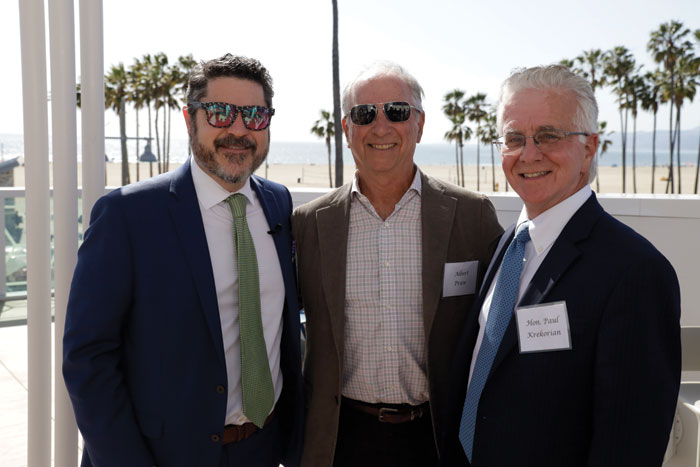
The Jewish Federation of Greater Los Angeles held a special pre-Passover program at its BAR Center at the Beach in Venice highlighting the holiday’s evergreen messages of perseverance and exodus. 

Attendees at the April 7 gathering included L.A. Federation CEO Rabbi Noah Farkas and Rabbi Ilana Grinblat, vice president of community engagement for the Board of Rabbis of Southern California. The two oversaw the afternoon’s activities, designed by the L.A. Federation with the hope of inspiring inclusiveness, togetherness and for others to recreate during the Passover holiday.

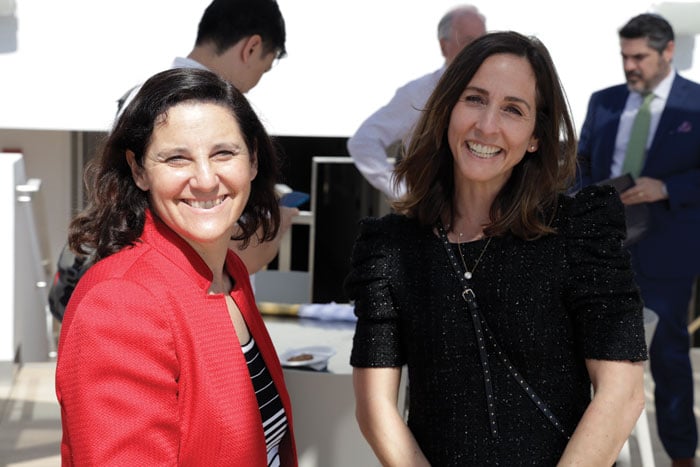
From left: Jewish Federation of Greater Los Angeles Rabbi Ilana Grinblat and Joanna Mendelson, senior vice president of community engagement at the Federation, attended the pre-Passover program at the beach. Photo by Howard Pasamanick

There were four stations at the event, each with interactive projects relating to Passover while providing participants the chance to get to know each other on a deeper level. The stations were called “Breaking the ‘Ashkenormative’ Wall”; “Recognizing and Celebrating Diversity in L.A. and Israel”; “The Universal Connectivity of Music” and “Connection and Action.”

“The goal of this program was to forge bonds between diverse communities using the power of our history and storytelling to inspire progress,” Farkas said. “We must step outside our comfort zone to achieve freedom for all – both Jews and non-Jews. We all must work together to achieve the kind of Los Angeles and world that we want to live in – one that honors the human dignity of each person.”

Many elected officials and community leaders turned out, including L.A. Federation Board Chair Albert Praw, L.A. City Councilmembers Paul Koretz and Paul Krekorian, City Controller Ron Galperin, Capri Maddox, executive director of the Los Angeles City Civil, Human Rights and Equity Department, educator Sharon Furman-Lee, IKAR board member Michelle Rosenthal and Holocaust Museum Los Angeles vice president of community engagement and exhibits Jordanna Gessler.


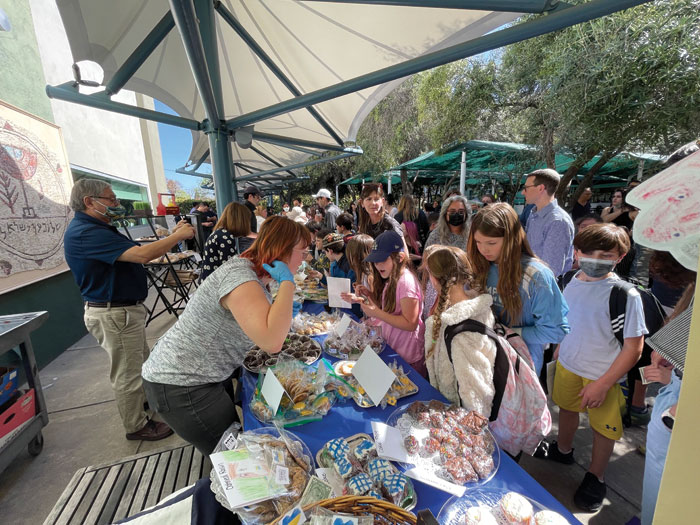
Gideon Hausner Jewish Day School in Palo Alto, CA holds a fundraising bake sale benefiting Ukrainian refugees. Courtesy of Gideon Hausner Jewish Day School

Bel Air-based Reform community Stephen Wise Temple recently garnered the attention of CBS News Los Angeles for its effort raising funds for United Hatzalah’s Operation Orange Wings.

“I know all of our students and families are deeply moved to participate in this,” Head of School Tami Weiser told the local news station.

Since Russia’s invasion of Ukraine began, United Hatzalah has been sending charter planes with medics and medical supplies from Israel to Moldova, then flying Ukrainian refugees from Moldova and surrounding countries back to Israel on each flight’s return journey.

To date, Stephen Wise Temple, in partnership with Congregation B’nai Jeshrun in New Jersey, has raised more than $200,000. The effort kicked off after Stephen Wise Temple congregant Dina Aspen urged her community to expand its support for Ukraine beyond education and general advocacy, according to the Stephen Wise Temple website. 

“For us as a religious institution that cares about compassion and about loving the other, we feel compelled—we have no other choice than to try to save lives,” Stephen Wise Temple Senior Rabbi Yoshi Zweiback told CBS News. 

In response to Russia’s invasion of Ukraine, which started in February, Jewish day schools and synagogues across California have been stepping up to help the Ukrainian people. On a recent Shabbat afternoon, elementary school students at Gideon Hausner Jewish Day School in Palo Alto organized a fundraising bake sale benefitting Ukrainian refugees, with cupcakes, cookies and other tasty goodies for sale. Students at the TK-8 school also wrote letters to Ukrainian children, and a school parent coordinated a collection drive of hygiene items and medical supplies. 

“There’s been a lot of learning, a lot of discussion and a feeling of this is a moment when we have to act,” Daniel Lehmann, head of the Northern California school, said in an interview. He declined to share how much the April 1 bake sale raised, saying, “It’s more focused on the effort and the process.”

L.A. Federation Stages Pre-Passover Program, Day Schools Support Ukraine Read More »

On Impermanence: The Two Sanctuaries

The Exodus story — recounted each year at Pesach seders around the world — tells the story of the Israelites’ two great sanctuaries. 

The first is the Tabernacle — constructed by the Israelites in the Sinai desert after their deliverance from Egyptian slavery. 

The second is the Temple — built on Mount Moriah in Jerusalem after the Israelites had settled in the Promised Land.

Each sanctuary represents an entire worldview — a hashkafa, or way of seeing … they present an entangled unity — a double helix of spiritual DNA.

Each sanctuary represents an entire worldview—a hashkafa, or way of seeing. This is not to say, however, that these sanctuaries represent two different Judaisms. Rather, they present an entangled unity — a double helix of spiritual DNA which winds its way through every level of Jewish thought, practice, ritual, and history.

The Tabernacle was built for a people on the go, and was thus designed with modularity in mind. Its sacred furnishings were outfitted with rings so that they could be hoisted onto carrying poles and moved through the desert. The Israelites would set up camp where God told them to set up camp. There they would stay until they received the sign to move on. The location of the Tabernacle, therefore, was not static. It was ever in flux in accordance with the evolution and revelation of God’s desire. 

The Temple, on the other hand, was built for a people rooted in a particular land. Its place was the holy mountain at the center of that land’s capital — Jerusalem. Unlike the portable Tabernacle, the Temple was not to be moved so much as an inch. As Maimonides stresses in the Mishneh Torah, “The altar is placed extremely precisely and may never ever be placed anywhere else …” (Laws of the Chosen Temple 2:1). 

Schematically, both sanctuaries looked the same. They consisted of an outer courtyard where sacrifices were offered; an inner sanctuary called the Kodesh (the Holy), which contained a number of sacred vessels; and then, behind a curtain, an small innermost sanctum called the Kodesh Ha’Kodashim (the Holy of Holies), where God’s very presence was encountered. 

The Holy of Holies of the Tabernacle, however, was not the same as the Holy of Holies of the Temple. 

After all, during the time of the Tabernacle, any space could become the Holy of Holies if that’s where the sanctuary was assembled. What made that space holy, then, was the act of framing. In the openness of the desert, it was through putting up walls that the necessary conditions for the encounter with God — intimacy, enclosure, acoustics — were created. 

We are told that there, in the Holy of Holies of the Tabernacle, the voice of God would emanate from between the statues of the winged cherubim that sat perched above the Ark of the Covenant. This, too, can be seen as an act of framing. The curved wings of the statues become a miniature bandshell in which the voice of God can reverberate and become audible. 

This is a non-essentialist view of sacred space, much in keeping with the rest of the Book of Exodus. When God descends in a cloud on Mount Sinai, for instance, Mount Sinai becomes holy ground. Its base is cordoned off so that no Israelites will draw too close or let their livestock graze there. When God is not on the mountain, however, these restrictions are lifted. Without the presence of God, Sinai is once again just a mountain. 

Dennis Jarvis/Flickr

A different conception of sacred space is employed for the Holy of Holies of the Temple in Jerusalem. There, it was the space itself that was considered sacred. Referred to in Deuteronomy as “the place that God will choose,” it was in fact the place that God chose again and again and again. Mount Moriah (also known as the Temple Mount) is said to be the site where Abraham was tested, where Jacob dreamed, and where the dust for Adam’s body was gathered. 

Even more fundamental than all this, the Holy of Holies was said to be the very navel of the world — site of the foundation stone, from which the rest of the world grew outward like a plant from a seed. 

This is an essentialist way of understanding sacred space. The holy mountain’s holiness is intrinsic to its precise location, irrespective of what happens there or how it is framed. 

As Jews, the memory of these two sanctuaries is our birthright. One is temporary and the other permanent, one moveable and the other rooted, one circumstantial and the other essentialist — but in all final reckonings, the distinctions between them begin to fall away. 

The Temple — that great house of permanence, fell to the flames of Jerusalem’s destruction in the year 70 AD, proving to have been temporary all along. The Judaism that one can take on the go, meanwhile, has proved enduring.

That things come to an end, it seems, is the only thing that never comes to an end. In this sense, impermanence is the signature of eternity. 

The builder of the Temple, King Solomon, is said to have asked his wise men to find him a piece of wisdom that would always be true. They returned to him and said “this too shall pass,” which he had engraved on a ring to look at in good times and in bad. That things come to an end, it seems, is the only thing that never comes to an end. In this sense, impermanence is the signature of eternity. 

The Holy of Holies of the Temple — that square of unbounded space left abandoned on the Temple Mount — is said to have endured in that spot ever since. Though the walls that once framed it have long ago crumbled, it nevertheless remains — an indestructible rectangular prism of charged space invisible to the eye. 

Perhaps this is how it should be — a sign to believers of that which is invulnerable to the assault of the sword and the aggressions of time. 

Or perhaps it is only there because we left it there. Like a treasured item left behind in an old home, it remains there on the Temple Mount because we somehow forgot to pack it up and take it with us when we went — or, as it were, we forgot that it could be packed in the first place. 

But perhaps also it’s not there at all. Perhaps our only real sanctuary is the one that can be taken on the road, the one that puts on no airs of permanence or essentialism. Its courtyard is formed by the individuals who come together to pray or learn together. It is both eternal and ephemeral — a sacred paradox. Its holy of holies is the human heart.


Matthew Schultz is the author of the essay collection “What Came Before” (2020). He is a rabbinical student at Hebrew College in Newton, Massachusetts.

On Impermanence: The Two Sanctuaries Read More »

A Bisl Torah – What’s Missing?

One of the main themes of Passover is humility. We eat matza that is flattened as a reminder to calm down our often puffed up egos. But I think we forget to concentrate on that which is missing: the yeast.

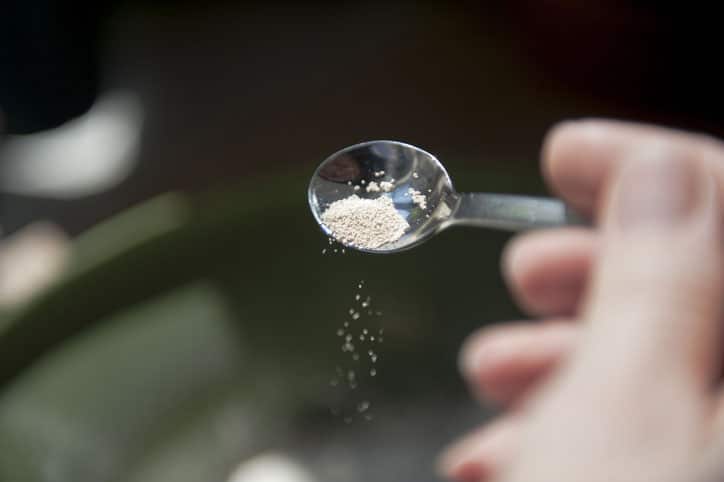
As many bakers witness, yeast is activated by triggering agents. Hot water and sugar allow those familiar bubbles to emerge in the beginning process of baking bread or challah. It takes an activator for the dough to rise. There are particular ingredients that cause the yeast if you will, to come alive.

Spiritually, our egos may not be so different. When engaged with what feels like threatening situations, our chests puff out, activated to protect our seemingly fragile hearts. When someone shakes up what feels comfortable, disturbs the status quo, pushes boundaries or offers what may be an unwelcome change, we react. We rise up, sometimes with anger, bravado, words we didn’t mean, actions we later regret. We’re activated. And sometimes, we’re out of control.

Passover is a lens into those agents that trigger activation. The personalities that tend to cause our hearts to race. The environments that confuse us. The patterned moments that turn us into characters we don’t recognize. What agents should we name, remove or even confront so that we remain steady, calm, humble and true to ourselves?

Matza is the goal. But imagine the impact Passover will have if we consider how matza is made. Not letting the ever present yeast and activating agents in our world control who we are and who we want to be.

Enjoy your matza-filled Pesach. Crunchy, humbling, and good for the soul.

Shabbat Shalom and Chag Sameach


Rabbi Nicole Guzik is a rabbi at Sinai Temple. She can be reached at her Facebook page at Rabbi Nicole Guzik or on Instagram @rabbiguzik. For more writings, visit Rabbi Guzik’s blog section from Sinai Temple’s website.

A Bisl Torah – What’s Missing? Read More »

A Moment in Time: Passover – It Doesn’t Need to be Perfect

Dear all,

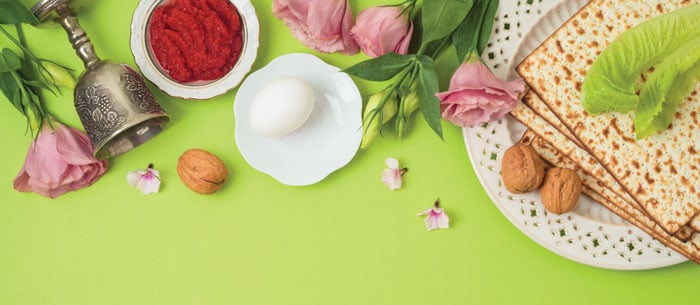
I was very proud when I took this photo of our Passover Seder Plate last year.

But then I realized there were items I had forgotten to include. It was not perfect.

I was then reminded of a conversation I had with a person during her process converting to Judaism. I asked her to share her favorite Jewish Holy Day or Festival.

She responded “Passover.”

It’s not uncommon. After all, Passover is about families and friends joining to over a meal that recalls our shared history while imploring us to make the world better for all people.

But that’s not why Passover was her favorite Festival. She then explained: “At the end of seder, we always say, ‘Next year in Jerusalem.’ In other words, we may not have everything perfect this year. You see …. there are always ways to improve. We are all a work in process.

I loved that.

Passover is not about perfection. It’s about our journey.

It’s not about the final product. it’s about understanding where we are in this moment in time.

Ron, Maya, Eli, and I wish you and all you love a season of goodness.

With love and Shalom,

Rabbi Zach Shapiro

A Moment in Time: Passover – It Doesn’t Need to be Perfect Read More »