fbpx

April 14, 2022

Table for Five: Passover

One verse, five voices. Edited by Salvador Litvak, the Accidental Talmudist

Even if all of us were wise, all of us understanding, all of us knowing the Torah, we would still be obligated to discuss the Exodus from Egypt; and everyone who discusses the Exodus from Egypt at length is praiseworthy.

-From The Passover Haggadah


Rabbi/Cantor Eva Robbins
Co-rabbi N’vay Shalom, Faculty AJRCA

The experience of sitting at a table with friends and family and reading the Haggadah touches the heart more than mind. For even if every aspect of intellect and experience is refined, something deeper is calling on us, and that is worthy of praise. In Kabbalah, Wisdom or Chochma is right-brain. 

Understanding, Bina, is the left-brain. Knowing, Da-at, includes deeper perceptions as well as the place of communication. And Experience, Z’keynim, connotes years of living. All of these remain mind-based unless we open our heart as well. 

Ultimately, the Seder teaches something important – to be able to feel and viscerally understand what it means to be a slave so we are able to identify with another. Further in the Haggadah we are reminded that it is an obligation to see ourselves “as if,” “K’ilu,” we had personally come out of Egypt. This tiny word has great import. It is a deep teaching of the importance of empathy, the ability to put ourselves in someone else’s shoes. It means being able to understand by feeling what another feels. Being able to identify with another is at the very core of our values to “love another as ourselves.” 

I believe this is one of the great teachings of this holiday – to hold this awareness in our hearts, not just in our minds, even as we discuss the story. This is a praiseworthy endeavor. Empathy is the driver of the Jewish response to any form of slavery and all forms of inhumanity.


Rabbi Avraham Greenstein
AJRCA Professor of Hebrew

These words declare our intention on Passover night to perform the mitzvah of recalling the exodus from Egypt and, more importantly, recounting the story of the Exodus to the next generation. Whereas we are obligated to recall the Exodus every day, it is a special mitzvah to do so at the Seder. However, on Passover night we are not to suffice with a mere mention: we are obligated to discuss the Exodus and are encouraged to do so at length. 

This section of the Haggadah invites us to renew our conversation about freedom from Egypt, to find new profundity and meaning in it. We search into ourselves for the ways in which our habits, expectations, and even our successes and unchallenged wisdom have come to confine us and to define us in a manner that, upon reflection, can feel trite and oppressive. We must accordingly offer hope to the next generation that God will provide us the tools, insight, and opportunities to claim a freeing sense of Jewish identity and to perform mitzvot with fresh joy and sincere devotion. 

Along with the promise of inner freedom is the gratitude and recognition that our circumstances can change for the better at any minute, and that our suffering need not last forever. Akin to the minimalistic bread that is Matzah, we are working to achieve a crisp simplicity, to pare ourselves of both our disappointments and our triumphs. We look forward to an end to our pain and to even greater triumphs. 


Rabbi Elliot Dorff
American Jewish University

American Jews like to think of the American and Jewish sides of their identity as being congruent. In many ways, that is true. Both systems of thought, for example, emphasize government by law, such that even society’s authorities are limited in their powers by its rules. Both, although for different reasons, respect and protect each individual to a much greater extent than dictatorships or communist nations do. 

These similarities, though, should not blind us to important differences between American and Jewish perspectives on life. One example is what freedom means in the two traditions. The American concept of freedom is that I, as an individual, have the right to do anything I want to do as long as I do not harm you. 

In contrast, when the Passover liturgy proclaims it as “the time of our freedom,” it is referring to freedom from slavery in Egypt. The Hebrew word for Egypt is Mitzrayim, straits, called that because the Nile empties into the Mediterranean not as one river but in a series of straits. Jews then can and do interpret the Passover story as celebrating not only freedom from physical slavery, but also slavery from the other straits of life – poverty, illness, prejudice, war, ignorance, etc. That freedom, though, is not intended to enable me to do whatever I want; it is instead to enable me, along with all Jews, to fulfil the commandments we received at Sinai as a free nation. That gives me not liberties, but duties.


David Sacks
Podcasts “Spiritual Tools for an Outrageous World” weekly

Can all the oceans of the world fit into a single cup? No? Then how can our minds which are finite, contain the infinity of Hashem? 

The simple answer is that our minds can’t. Or as a friend once asked me, “Can an ant outthink a man?” When I said, “No”, he said, “Then how can man outthink G-d?” 

This means that if you take all the knowledge that mankind has amassed throughout the ages: computers, space travel, and medical breakthroughs — it doesn’t even come close to knowing all the things that there are left to know. 

Let’s think about this on a personal level. 

For all the blessings that Hashem is giving us that we know about – there are even more blessings (way way more) that Hashem is blessing us with that we aren’t aware of. 

Because of this, I’ve started thanking Hashem not only for the things that I know about, but for all the things that He’s doing that I have no concept of, which I’m sure are even greater! 

Rav Soloveitchik explains that during the first part of the seder we thank Hashem for taking us out of Egypt. After dinner we complete the Hallel prayer and thank Hashem for bringing the Great Redemption. A redemption that will reveal a magnitude of kindness that is beyond what we can fully grasp! 

Therefore, it’s impossible to say enough! 

But seder night we get to try! 

And that’s yet another gift we can be endlessly thankful for. 


Chana Margulies
Author of “Jumping in Puddles,” chanamargulies.org

The Rebbe teaches us that Egypt represents cognitive dissonance. Mitzrayim, Hebrew for Egypt, means “maytzarim”, blockages. Signifying the blockage between the head and the heart. I may know the right thing to do, but there is an obstacle stopping me from putting that knowledge into action. Hence, even the wisest of people need to recite the Passover Haggadah. It is equally a biblical command regardless of one’s status.

The reason being, the only way out of Egypt is with G-d’s help, we cannot free ourselves of this dissonance, this blockage, on our own. We need a biblical command, the seder, to break free. Rabbi Shais Taub says AA is not a self-help program. Alcohol is a self-help program. AA is a G-d help program. It is realizing no matter how clever or resourceful I am, I need a higher power to experience freedom. 

In the Exodus we see G-d’s power over nature. That is the power energizing a commandment, which is the infinite power that I need to break through any personal blockage. Chassidus teaches that as we recite Shema Israel we are experiencing a personal Exodus. We are taking what we know intellectually, that we exist in G-d, G-d is all and all is G-d, and expressing it into action through the words of the shema, which impacts our actions the rest of the day. A commandment from our higher power empowers us to fuse our minds and heart and live as wholesome, emotionally free, healthy human beings. 

Table for Five: Passover Read More »
Passover: Peoplehood Meets Ideahood

You may have noticed that in recent years, the term “Jewish peoplehood” has grown in prominence. Google the term and you’ll see a slew of scholarly articles, conferences and even organizations connected to the idea. In Jewish communal circles, at a time when more and more people are moving away from religion, peoplehood is the latest attempt to keep Jews connected Jewishly.

This is not hard to explain. Peoplehood, which is a more sophisticated way of expressing the colloquial “MOT” (member of the tribe), is an easy, undemanding connector. It requires little action. It says “you belong to a people.” With identity politics all the rage, and attention spans shrinking, Jewish peoplehood provides the easy identity of belonging.

The Passover seder is the Super Bowl of Jewish peoplehood. It’s quite astonishing to imagine that on one night, virtually every Jew on the planet will sit down and commemorate the story of their ancestors. 

The Passover seder is the Super Bowl of Jewish peoplehood. It’s quite astonishing to imagine that on one night, virtually every Jew on the planet will sit down and commemorate the story of their ancestors. Think of your own great-great-great-great-great grandparents. Is there any doubt that they too sat down for their own seders, if only by candlelight? 

“Pesach is the Independence Day of the Jewish people,” Rabbi Donniel Hartman writes. “It is when God’s promise to Abraham to turn his descendants into a great nation comes to fruition.”

This identity, Hartman adds, precedes our religious faith: “In a Jewish world where all too often one’s particular denomination or religious practice serves as a wall between oneself and fellow Jews, where the central question is often in whose house one does not eat, or in which synagogue one does not pray, the ethos of Pesach calls out and reminds one that Jewish peoplehood comes first.”

But if peoplehood comes first, another indispensable pillar of Jewish identity is not far behind, what one might call “ideahood.”

Jewish ideahood is the software that has guided the hardware of peoplehood. It’s hard to conceive that peoplehood could have lasted so long without the great ideas that have nourished and sustained it. If peoplehood asks, “Who are we?” ideahood asks, “Why are we?”

Jewish ideahood is the software that has guided the hardware of peoplehood. It’s hard to conceive that peoplehood could have lasted so long without the great ideas that have nourished and sustained it. If peoplehood asks, “Who are we?” ideahood asks, “Why are we?”

Ironically, perhaps the ultimate Jewish idea has been the very continuation of our people since that fateful day 3,300 years ago when we received the Torah at Sinai. Just thinking of those 3,300 years—the long periods of persecution and the countless close calls with extinction—can be exhausting. It’s clear we could not have survived without the ideas that emanated from the Torah and became our daily wisdom. 

If peoplehood is the first, less demanding step, ideahood is the more demanding one. We must look for the ideas that engage our membership. It’s not enough to belong, we must also do. If peoplehood is the noun, ideahood becomes the verb.

The Passover seder marries both pillars of Jewish identity — the hardware of peoplehood and the software of ideahood.

The very body language of the seder speaks to peoplehood. Regardless of which Haggadah we use—from funny to solemn— we’re infused with a sense of belonging to this ancient people whose story we retell from one generation to the next.

Ideahood is more about questioning: What ideas best extract meaning from the Passover story? How do these ideas differ for each person at the seder table? How do we teach them to our children? What role do our ancestors play?

Indeed I think often of my ancestors, so allow me to finish with a personal story.

I’ve always known that my grandmother (on my mother’s side) was born in Casablanca premature and fragile. We called her a “miracle baby” because she ended up having eleven children and a few hundred descendants (most of whom are in Israel). But we also knew something else: my grandmother’s mother died at delivery, which sadly was not uncommon in those days.

This mother who died at delivery never had a name — until last week. On a whim I asked my mother if she remembered her name.

“Shaba,” she replied.

Just like that, simply by hearing her name, my great-grandmother weirdly came to life, like a bright candle that suddenly appears in a dark room.

So, we’ve decided to dedicate our family seder this year to Shaba, the great-grandmother whose name I never knew, the young woman who surely must have suffered as she delivered a tiny baby for her final act, a baby that has brought so much life into this world.

I don’t know if Shaba ever considered things like peoplehood or ideahood, but I do know that, just like our ancestors who never missed a seder table, she embodied both.

Happy Passover.

Passover: Peoplehood Meets Ideahood Read More »

A Tale of Two Briskets

Traditional food is the hub of any Jewish holiday, and you can’t get more traditional than brisket. 

Brisket is particularly welcome at Passover for one simple reason: No bread? No problem.

“A Jewish feast without bread or breading or stuffing or noodles is hard to find,” Challah Guru Mandy Silverman of Mandylicious told the Journal. “Sweet noodle kugel, challah, bagels, babka [and] rugelach are all forbidden, but brisket is easy to prepare without any of those things. So you get a traditional Jewish dish that is warm and delicious, and can even be made ahead. That is gold.”

Silverman says brisket falls under the category of “Traditional Jewish Foods My Bubby Used to Make and One Day I Hope to be Able to Make Almost as Good as She Did.” 

Silverman says brisket falls under the category of “Traditional Jewish Foods My Bubby Used to Make and One Day I Hope to be Able to Make Almost as Good as She Did.” While some may say the secret to making the perfect, moist brisket is to have someone else make it for you, Silverman is certain everyone can make an awesome brisket. 

“I tend to treat brisket the way I used to treat challah,” she said. “That it is a sacred dish: complicated, time-consuming and, if you mess it up, it will be so sad.” 

Sliverman said she used to overcomplicate her brisket. She read way too many recipes and, for the longest time, never felt that her brisket measured up. After being around the brisket block a few times, she said the two biggest things you need to do when making a brisket are: 

• Use a fattier brisket. The “first cut” briskets often set you up for failure. They are not as fatty and therefore lead to a tougher, chewier brisket.

• Cook low and slow. When briskets are cooked on a low heat for a longer period of time, it makes them so soft, and the flavor gets all the way through. Plus, “you save a ton of money on air freshener because Eau de Brisket will permeate your home for a good long time.”

Silverman says her brisket is very forgiving. Because she makes it in a crockpot, there is no need to continually baste or check on it. You just throw everything in the crockpot and it is perfect every single time. 

Silverman serves her brisket pulled.  The meat can be served in a variety of nontraditional ways. 

Mandy Silverman, Mandylicious

“I love serving it over mashed potatoes and doing a mashed potato brisket bowl, [on] a plain piece of matzah with a drizzle of horseradish mayo or, of course, just straight up,” she said. Her recipe “cannot be beat.”

Mandylicious’s Not Your Bubby’s Pulled BBQ Brisket

5 lb brisket (try to avoid first-cut briskets)
1 3/4 cup BBQ sauce
3 tablespoons dark brown sugar
1 tablespoon red wine vinegar
2 tsp seasoned salt
1 tsp garlic powder
1/2 tsp black pepper
1 tsp onion powder
1 large onion, sliced
Additional garlic powder and seasoned salt for sprinkling

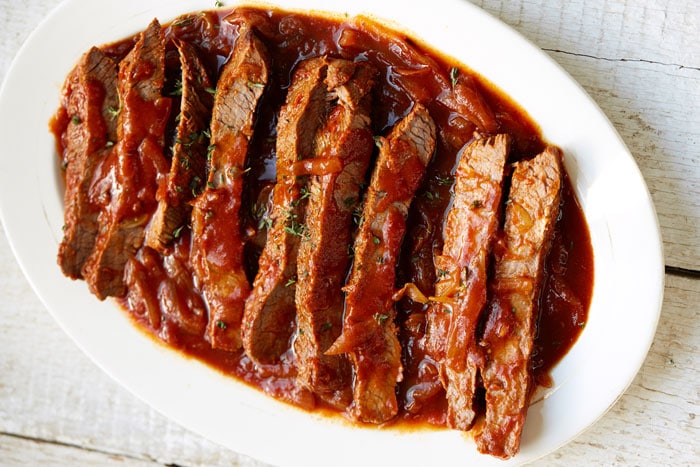
Pat the brisket dry. Liberally season both sides of the brisket with garlic powder and seasoned salt. Place the sliced onions on the bottom of the crockpot. Place the brisket fat side up on top of the onions, mix together remaining ingredients and pour on top of brisket. Cook on low for nine to 11 hours or high for five to six. Let it cool completely. Remove from sauce. 

It can be enjoyed as is with gravy on the side, or you can use two forks to gently pull the beef and ladle remaining gravy on top.

***

Chef Rob Rosenthal, AKA Short Order Dad, loves any holiday where food is the centerpiece. He said he also believes that brisket is “hard to screw up.” It can feed a lot of people, makes your house smell really good and is even better the next day.

“The secret is simple: a long leisurely braise in flavor-filled liquid that results in soft and succulent meat loaded with savory, oniony gravy,” Rosenthal, who “makes food fun” as a speaker, journalist, author, instructor and podcaster, told the Journal.

Kids and grownups alike will love his mouthwateringly delicious, fall-off-the-bone (even though there isn’t a bone), tender brisket. 

Rosenthal’s extremely adaptable recipe transforms an ordinary piece of meat into an extraordinary meal.

Chef Rob Rosenthal, Photo courtesy of Short Order Dad

Rob Rosenthal’s Braised Brisket of Beef 

1 beef brisket (about 3 pounds)
2 garlic cloves, peeled and sliced thinly
1 tablespoon salt
Ground black pepper to taste
2 tablespoons vegetable oil
4 large onions, peeled and sliced
3 cups of beef or vegetable broth
10-ounce can crushed tomatoes or 1 small can tomato paste
½ teaspoon cayenne pepper or hot Hungarian paprika (optional, but nice if you like a little kick)

Pat the brisket dry. With the tip of a sharp knife, make slits on both sides of the meat and stuff with thin slices of garlic. The more you like garlic, the more slits you’ll make. Season each side very generously with 2/3 of the salt and pepper.

Place oil in a large, heavy bottomed pot over medium-high flame. When hot, brown the brisket on both sides, lowering heat as necessary so as not to burn. You’re looking for a nice brown color.

When browned, add broth, onions, remaining salt, tomato product and cayenne if you’re using it. There should be enough liquid to cover about 2/3 of the brisket. If you need more liquid, you can  use more broth. Stir and bring mixture to boil, and then lower the flame so that broth remains “simmering”—that is, not vigorous, but still moving gently. Cover the pot. You can leave it on top of the stove or place in a 325-degree preheated oven.

Cook until meat is very tender but not totally falling apart, at least two hours. More is fine. Just make sure to check along the way to ensure that you still have sufficient liquid in the pot to partially cover the meat. Add more if necessary.

Remove brisket to a carving board and cover it with aluminum foil. Now look at the remaining oniony broth/gravy and decide if you like what you see or you would like it to be thicker. If there is a lot of liquid, you can reduce it considerably by putting it back on the stovetop, at a higher temperature, and cook until it reaches the consistency you desire. This can take a good 20 to 30 minutes if you have a lot of liquid in the pot. Taste and adjust seasoning, adding more salt or pepper if necessary. Then slice brisket against the grain and top with onion gravy.

Serve alongside something that will welcome all the sauce, like mashed potatoes, and some bagged salad greens with a sprinkle of olive oil, lemon and salt.

Note: Once you understand the basic technique of searing and braising, you can customize your own version with a variety of flavorful additions that excite you:  cloves of garlic, herbs like thyme or rosemary, spices such as cumin, cinnamon or curry powder, dried apricots or carrots and parsnips added during the last hour of cooking.

A Tale of Two Briskets Read More »

Inviting the Refugee Child to Our Seder Tables

Each year at our seders, we remember the four children; the Wise child, the Rebellious child, the Simple child, and the child who does not know how to ask. This year, let us also invite into our seder the voice of the Refugee Child.

The Refugee Child asks, “Who will keep me safe and when can I go home?”

Our remembrance of the Exodus at Passover obligates us to hear the Refugee Child’s cries and ensure that they do not go unanswered. Though these cries break our hearts, we commit that we will not turn away. In the words of Pirkei Avot (Ethics of the Fathers): Though we are not required to finish the work, we are not free to desist from it.

The following can be read at the end of the “Four Children” section of the Seder.

The Fifth Child: The Refugee Child  

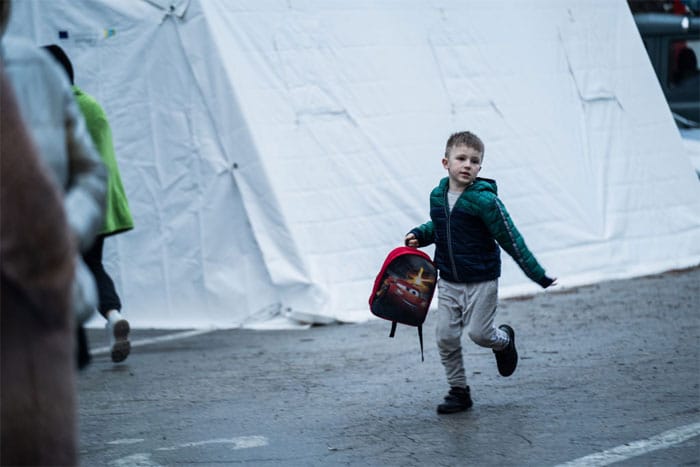
The Refugee Child, one of the world’s most vulnerable people, has no home to shelter them, no society to protect them, and in some cases, no family to love them. In 2020, over 33 million children around the world (in addition to others including up to 4.5 million Ukrainian children in just the past several weeks) were forcibly displaced by conflict, famine, and disaster.

The Passover Haggadah traces the Israelites’ enslavement in Egypt back to Joseph and his brothers, whose desperation caused them to journey there because “the famine was severe in the land of Canaan.” This eternal story describes the risks faced by displaced people, especially children, who are vulnerable to human trafficking, a modern word for enslavement.

By reading the Haggadah at the Passover Seder, we acknowledge that the Exodus is not only a story from ancient times but a story for all times … The Refugee Child, one of the world’s most vulnerable people, has no home to shelter them, no society to protect them, and in some cases, no family to love them.

 By reading the Haggadah at the Passover Seder, we acknowledge that the Exodus is not only a story from ancient times but a story for all times. The Haggadah instructs that “in every generation we must see ourselves as if we personally left Egypt” and “in every generation tyrants will rise up against us to destroy us.”

 While the Haggadah attributes the triumphant outcome of the Exodus story to miracles, the Torah clearly demonstrates that it was only through human beings acting on behalf of an unaccompanied child — the remarkable courage of Moses’s mother, Yocheved, and sister, Miriam, and the empathy of Pharaoh’s daughter — that the journey from slavery to freedom could be set in motion.

Not merely in every generation, but every year, new tyrants arise against people around the world, and more innocent children become refugees. This Passover, we must not stop at seeing ourselves as the children of Israel who were slaves in Egypt. This year, we must act with the courage of Yocheved and Miriam and the caring of Pharaoh’s daughter to raise our voices, devote our resources, and advocate passionately for concrete steps to bring the world’s refugee children to safety.


Rabbi Julie Schonfeld, MPH, is the CEO Emeritus of the Rabbinical Assembly, the international association of Conservative rabbis.

Inviting the Refugee Child to Our Seder Tables Read More »

The Story of “REBECCA! Mother of Two Dynasties”

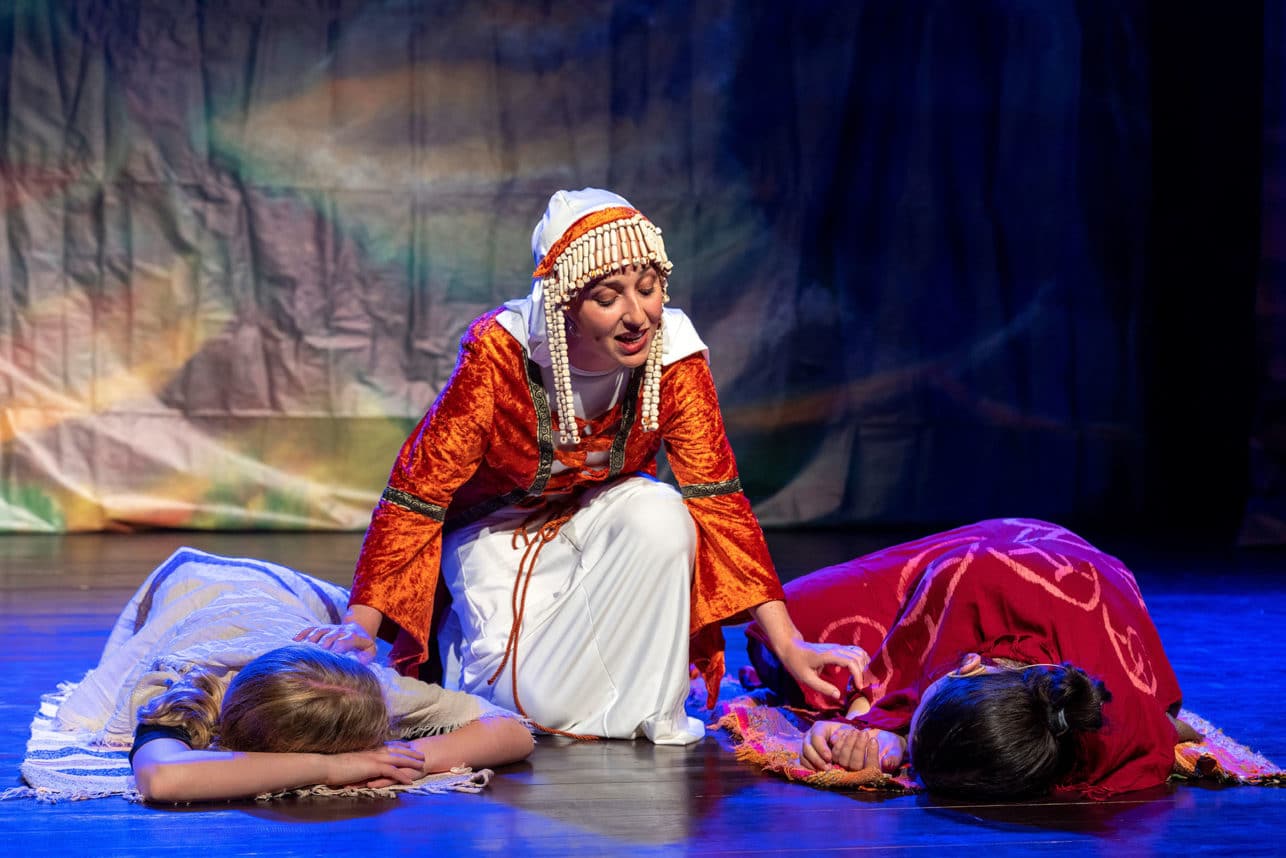
Raise Your Spirits (RYS) Theatre released, in the days leading up to Pesach, the video (for women only) and audio recording (for everyone) of our latest biblical operetta, “REBECCA! Mother of Two Dynasties.” It is a story of great faith, love, courage, and the hope of reconciliation between the descendants of two brothers.

Rabbanit Shani Taragin, after viewing the performance in Jerusalem, exclaimed, “Every student of Torah should see this show!”

When the COVID lockdowns began, almost all the theater troupes in Israel (and most of the world) shut down, but we kept going. And now, Baruch Hashem, we can share the fruits of our labor with the rest of the world.

The show grew out of four years of learning p’shat, the commentaries and midrash. The first song I wrote in 2017, “Here am I!” (“Hineni” in Hebrew) was inspired by Dr. Bryna Jocheved Levy, my Tanach teacher in Matan, who told me that there is a midrash that when Rivka and Yitzhak were childless for twenty years, he took her up on Mount Moriah to pray for a child. 

I wrote “Here am I,” while I was going through chemotherapy treatment for breast cancer. It is especially meaningful to me that today, more than five years later, I too can say, Baruch Hashem, “Here am I.”

Two years later I was joined in the writing by Tamar Kamins, who also contributed some of the melodies, and the composing and arranging was by Mitch Clyman, who has also composed for four other RYS shows. Both Tamar and I are graduates of the Tanach department of the Michlala (Jerusalem College for Women).

Our goal was to perform “REBECCA!” in 2020 but COVID got in the way.

As director, I made a decision to proceed with the project. 

Our chairwoman and my co-producer, Tammy Rubin, agreed, as did our music director, Elisheva Savir, and our choreographer, Ashira Allon, both of whom came up with creative ways to teach songs and dances via Zoom. 

As time went on, so did the uncertainty. In addition to Zoom, we sometimes were allowed to rehearse face to face but masked, socially distanced, and not more than ten in a room at our local Gush Etzion community center. Sometimes we rehearsed outside in the open air.

But we kept going.

Rivka sings to two children. Photo by Rebecca Kowalsky.

One of the comical scenes of the play is “Lentil Stew,” in which dancing lentils (costumed in large round multi-colored polygal circles) sing and dance as Yaakov convinces Eisav to sell him his birthright. In a song called “Letting Go,” we hear a deeply moving, imagined conversation between Rivka’s mother and Devorah, her handmaiden, who accompanies Rivka, with Eliezer, on the way to meet Yitzhak. They are accompanied by dancing camels. In “Two Children” Rivka sings a lullaby to the young twins, in which she wonders:

We nurture them and teach them

Our words to each the same

But do they hear them differently?

How else can you explain

Why one boy is so gentle 

The other is so rough

I know that we must love each one

But is our love enough?

The “Blessings” scene includes all the dilemmas and heartbreak, including a howl from Eisav that shakes the rafters, in the fraught story of the brachot given to Yaakov and Eisav.

The “Blessings” scene includes all the dilemmas and heartbreak, including a howl from Eisav that shakes the rafters, in the fraught story of the brachot given to Yaakov and Eisav. There is a magnificent modern dance scene to accompany “Jacob’s Ladder,” and Lavan, seen earlier in the show, reappears as Yaakov pleas for the hand of Rachel, and that drama plays out with four wives and many children eventually on stage. In the “Finale,” a rousing spiritual number that is a reprise of “Here am I,” we raise and try to answer, with the help of the Netziv, Rav Kook and the prophet Zephaniah, the question: Can there be reconciliation in the future?

There are 22 scenes and songs, and the full video and audio recording also include p’sukim prefacing some scenes, and occasionally short-spoken texts.

How it all began

We have a history of continuing, in the face of crises, in Raise Your Spirits.

We began our theatre in 2001, during a bloody intifada, when I joined two friends, Sharon Katz and Arlene Chertoff, in putting on “Joseph and the Amazing Technicolor Dreamcoat” to raise our spirits (which became the name of our theatre company). We thought we would perform two or three times. And now, in the last 21 years, we’ve staged 12 productions, including eight original shows, one revue and two revivals, and we’ve performed for more than 50,000 people – all women in Israel, and licensed performances to mixed groups in schools, camps and shuls abroad. 

We continued to perform, through the years, during wars and military operations. We took our shows to Gush Katif and the Northern Shomron before the Disengagement in 2005. Last May, during Operation Guardian of the Walls, when more than 4,000 rockets fell on Israel, an actress from Be’er Sheva said to us before one of our Zoom rehearsals, “If I disappear from the screen, it’s because I’m running with my kids to a bomb shelter.” Three of our actresses contracted COVID during the rehearsal period but, miraculously, everyone was healthy for the performances in June, November and December 2021.

To order REBECCA! go to our home page at: www.RaiseYourSpirits.org. The proceeds will help us to continue to create and perform Torah musicals so that “Torah will go forth from Zion and Jerusalem” through theater, song and dance.

May we all merit to a happy and kosher Pesach, one that will bring the final redemption, and see the words of Zephaniah realized: “For then I will convert the peoples to a pure language that all of them call in the name of the Lord, to worship Him of one accord.”


Toby Klein Greenwald is an award-winning journalist and theatre director and editor-in-chief of WholeFamily.com. REBECCA! was produced with the encouragement and support of the Matanel Foundation (www.Matanel.org)

The Story of “REBECCA! Mother of Two Dynasties” Read More »

Frank Stella’s “Had Gadya” Series Comes to Hebrew Union College

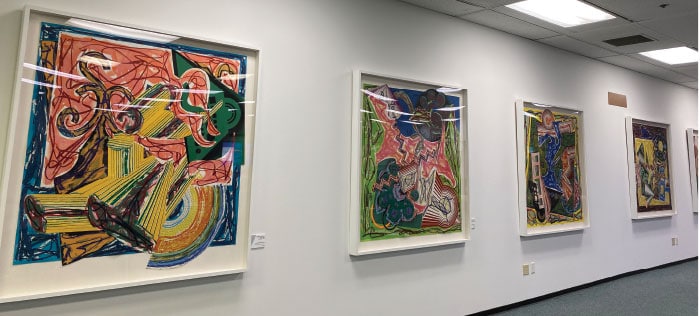
American artist Frank Stella’s “Had Gadya” series has arrived at the Hebrew Union College – Jewish Institute of Religion (HUC-JIR) in Los Angeles. This vivid collection of prints is Stella’s interpretation of Russian avant-garde artist El Lissitzky’s 1919 illustrations of the traditional Passover song.

Stella’s prints, which are expressive in color, movement, energy and joy, are installed around the gallery space in order of the song, right to left, just as it would be read in Hebrew. It is a way to mark Passover, especially in this limbo moment between pre- and post-COVID living.

“It feels to me the last two years has been a real-life living of the ‘Had Gadya’ story,” Anne Hromadka Greenwald, curator of the exhibit at HUC-JIR, told the Journal. “After two years of the pandemic, we have suffered losses, great and small: from milestones delayed and families kept apart, to grief for millions of friends, relatives and neighbors struck down by this modern plague.”

Stella’s prints, which are expressive in color, movement, energy and joy, are installed around the gallery space in order of the song, right to left, just as it would be read in Hebrew.

Like the snowballing tragedy of “Had Gadya,” floods and fires, political upheaval and racist violence have compounded the pandemic. And just when we think it can’t get worse, the next wave hits.

Typically in rhymes, where each verse builds on the one before, the stories get progressively worse. Think, “There was an old lady who swallowed a fly.” “Had Gadya” ends with God killing the Angel of Death; death does not win.

“I think the world needs to learn there will be an end to this,” Greenwald said. “There is hope on the horizon and we need to maintain faith.”

Known for painting and printmaking, Stella was traveling in Israel when, in 1981, he encountered Lissitzky’s work at the Tel Aviv Art Museum. Though not Jewish, Stella often explored folklore and Jewish bodies of work. He was inspired by Lissitzky’s illustrations of “Had Gadya” and his purposeful use of repetition.

When Stella returned to New York in 1982, he decided to create a conversation through art based on what he saw. The vivid abstractions from this print series, created over two years, combine various printmaking techniques: lithography, linoleum block, silkscreen and rubber relief with collage elements and hand-coloring. “Had Gadya” debuted at the Tel Aviv Art Museum in 1984, and has since exhibited throughout the United States.

Cathee Weiss, director of development, Western Region, for HUC-JIR, first saw this exhibit at Temple Har Shalom in Park City, Utah, on February 14, 2020. Josh Holo, the dean of HUC-JIR, was invited to speak there based on a request from Leona AronoffSadacca, a member of Hebrew Union College’s Board of Advisors. 

“It was breathtaking and it took me a minute to realize what I was looking at,” Weiss told the Journal. “I knew Stella’s work but not the collection in front of me, and certainly did not know about the historical reference and El Lizzitsky. As I hummed the Shabbos melodies, I was mesmerized by the art outside.” 

After the service, Elissa Oshinsky, the collector, introduced herself and said, “It is my dream to bring this collection to HUC.” Weiss replied without a beat, “I can make that dream a reality.”

Weiss believes an institution with the history, quality and outreach of HUC-JIR deserves to partake in an exhibition of this ilk.  

“The work is inspirational for our students: our community’s future rabbis, cantors, educators and nonprofit professionals, [and] inspirational for all who would see it,” she said. “What an opportunity to take in the work of such a powerful artist. This is what brings meaning to our work, our journey here.”

Stella’s “Had Gadya” is available for individual and group viewing at the LA Skirball Campus by appointment through January 1, 2023. It will then be displayed at the Skirball Museum in Cincinnati through May 2023 and then at the Heller Museum in New York in the spring of 2024. To set up a viewing in LA, please contact cweiss@huc.edu.

Frank Stella’s “Had Gadya” Series Comes to Hebrew Union College Read More »

Chicago to Hollywood to Encino: Rabbi Nolan Lebovitz’s Route to VBS

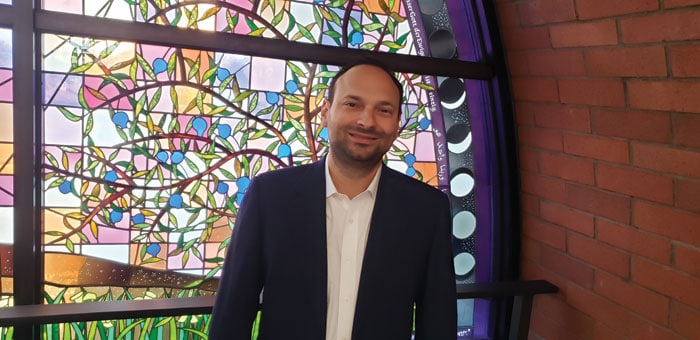
Life is about to change for the congregants at Valley Beth Shalom, one of the largest Conservative synagogues in the United States, when the new senior rabbi, Nolan Lebovitz, takes over in July. 

“I bring creativity and innovation,” said Lebovitz, who was formerly rabbi at Adat Shalom on Westwood Boulevard. VBS announced his hiring on April 7.

He succeeds longtime Senior Rabbi Ed Feinstein,  who is stepping back, not away. Feinstein, who joined VBS in 1993 and was senior rabbi for 17 years, followed the late legendary Rabbi Harold Schulweis. 

Lebovitz, who spent his first 10 years working in Hollywood writing and directing suspense and horror films, introduces a distinctly different vibe to the community.  “I value creative sensibility, connection to Jewish identity in music, cooking, dancing, singing, the way we think of services – and definitely technology,” he said.

Zoom, the instant best friend of many throughout the pandemic, was only the beginning.

“Technology will allow Valley Beth Shalom to teach its congregants from the moment they wake up in the morning through the day,” said the 42-year-old Lebovitz. “Until they go to sleep, they will be able to connect to the Torah of Valley Beth Shalom, to the teachers and rabbis here and to the programs. The way we use technology will define how synagogues relate to their congregants in the future.”

 The Chicago native, who moved to Southern California to enroll in USC’s Film School, is planning far beyond the walls of Valley Beth Shalom, its 1,500 member families and Encino. He intends to reach members and non-members, residents across the Valley, and even people outside of California relying on the teachings, messaging and education Valley Beth Shalom, which opened in 1950, offers to enrich their lives.

“We are delighted to welcome Rabbi Lebovitz, his wife Blair, and his children Shelby, Simon and Maddy to this very special community,” said Jeff Goss, president of Valley Beth Shalom. “We are confident that we have found the very best rabbi to lead our shul into the future.”

“I did not expect at that moment that the VBS wheel would turn to me. I am thrilled it did because this is the opportunity of a lifetime.” – Rabbi Lebovitz

Last spring, Rabbi Noah Farkas, Feinstein’s apparent successor, left VBS to become CEO/President of the Jewish Federation of Greater Los Angeles. Moving to the Valley was not on Lebovitz’s mind at the time. “I did not expect at that moment that the VBS wheel would turn to me,” he said. “I am thrilled it did because this is the opportunity of a lifetime.”

Before delving into how and why he decided to close the Hollywood portion of his life journey, Lebovitz provided an instant summary.

“This is all recounted in my first documentary, ‘Roadmap Genesis,’” he said. “By the way, along with my ‘Roadmap Jerusalem,’ both are available on Amazon Prime, YouTube and various platforms.”

A dozen years ago, after Lebovitz had achieved “a certain level of success” writing and directing, a deeply reflective moment unexpectedly occurred. 

A dozen years ago, after Lebovitz had achieved “a certain level of success” writing and directing, a deeply reflective moment unexpectedly occurred. 

“I had gotten married and had my first child, my daughter, who now is about to have her Bat Mitzvah,” he recalled. “I was holding her as an infant when one of the scariest movies, ‘The Ring,’ came on the television. I was holding her ears. Even as a Hollywood writer-director, I didn’t want what I was watching on television to scar the neshama of this angel I was holding in my arms … to scar her in any way.”

This unexpected intrusion into Lebovitz’s comfortable, sailing-along lifestyle caused him to confront himself: “What am I doing with my life if this is what I am doing during the day?”

The rabbi, who grew up in a traditionally observant home, quickly added that he was not disparaging anyone who makes horror films. 

“For me, though, I needed more,” he said. “I am a grandchild of four survivors of the Shoah. One of the great honors of my life was being born into a family where all four of my grandparents survived and prevailed over the Shoah.”

For those who believe everything happens for a reason, the next scene in Lebovitz’s life will resonate. “I don’t think it was an accident that one day I was coming out of a Hollywood meeting at Factor’s Deli,” he said. Standing in a long valet line, Lebovitz surveyed his surroundings. “I ended up walking next door to the Mitzvah Store, which still was on Pico,” he said. “Thank God, Rabbi (Shimon) Kraft was behind the counter that day.”

Lebovitz, a lover of bookstores, was searching for books on philosophy and self-help. Frustrated, he asked Rabbi Kraft, “What should I be reading?”“He looked at me as if I had asked the dumbest question,” recalled Lebovitz. “He said ‘You should be reading the Chumash (Torah).’”

Lebovitz went home and opened the Chumash to the Torah portion of the week, Lech Lecha, about Abraham and Sara’s journey to a place they did not know. 

“This resonated in my kishkes the way it didn’t when I was forced to memorize portions in the second grade,” he said. “Suddenly, as a father, as a husband, as someone on a journey, the story spoke to me. Week after week, I would read the parsha, and then I would come back to Rabbi Kraft and ask what I should read next.”

Kraft recommended Rashi. “I did, even though I didn’t know what Rashi was talking about,” said Lebovitz. Kraft told Lebovitz, “At a point, you need a teacher.”

This led him to the Ziegler School of Rabbinic Studies at American Jewish University, and then at Adat Shalom. And now, this golden moment: his VBS hiring. 

Lebovitz said, “Both personally and professionally, it feels amazing to have found VBS, my ‘forever’ synagogue community. I am really looking forward to moving to the Valley and joining VBS in July.”

Chicago to Hollywood to Encino: Rabbi Nolan Lebovitz’s Route to VBS Read More »

Passover Comedy “When Do We Eat?” Still Puts the “Fun” in Dysfunctional Seder

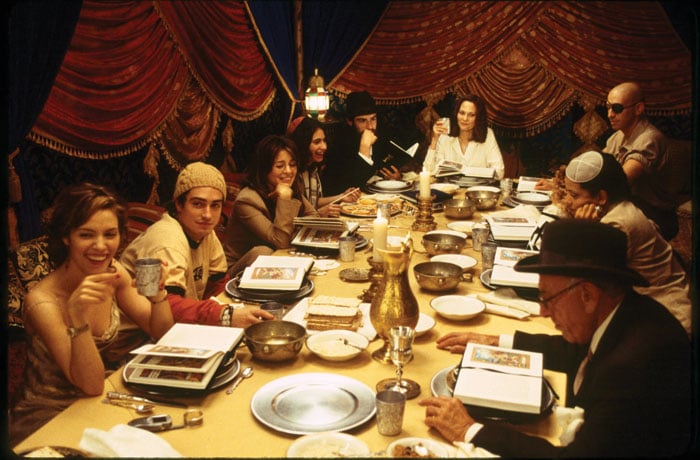
When husband and wife team Salvador Litvak and Nina Davidovich Litvak released their Passover comedy “When Do We Eat?” in 2005, they knew they had created something special.  Seventeen years later, the film still attracts a cult following, especially in the Jewish community. 

The movie is about the Stuckmans, a large, dysfunctional family attempting to have a Passover seder after the patriarch accidentally gets high on ecstasy.  The Stuckmans also have a difficult time expressing love to each other. Underneath the bickering and quips, there’s a deep-seated need between each family member to address the wounds they have inflicted on each other over the years. These are difficult topics to discuss, but the film manages to depict the process as a farcical comedy.

“There’s this enhanced expectation of what a family seder should be like. And everybody starts to fall short of that right away.” – Salvador Litvak

“Why would [a family seder] be difficult? They’re people you care about, they’re people who know you, but maybe not as well as they should,” Salvador told the Journal. “There’s this enhanced expectation of what a family seder should be like. And everybody starts to fall short of that right away. I don’t know if it’s guilt or frustration or anxiety, but it’s coupled with what everybody thinks the seder should be like.”

Like a Passover seder, “When Do We Eat?” is full of symbolism. The family name “Stuckman” symbolizes how stuck each family member is at addressing their problems with one another. Some of the problems between family members are quite perilous, and some whimsical. 

The surly Ira Stuckman, played by Academy Award nominee Michael Lerner, runs a factory that manufactures Christmas ornaments and is often bemoaning family members for bilking him for “his” money. His father Arthur, played by the late Jack Klugman, is a Holocaust survivor who carries a suitcase everywhere he goes in case Nazis rise again. He often berates the family for not adhering to Jewish traditions, and is repulsed by the family not doing the seder completely in Hebrew. There’s also the daughter Nikki (Shiri Appleby), who is a sex therapist and takes phone calls at the seder table. One of her brothers, Ethan (Max Greenfield), has become Hasidic after several spectacular business blunders. He also hits on his cousin. 

Several more characters at the Stuckman seder table have unresolved grudges and resentments with each other. As the seder begins, it becomes apparent that it won’t end quietly. 

“When we set out to write the movie, we knew that for the Stuckmans, this is not the same seder as every other year,” Salvador said. “It’s a unique seder in their family history. When we set out to design the family, an idea we really liked is that at Yom Kippur we recite the ‘13 Attributes of Mercy.’ Each of the characters in the movie was deficient in one of those qualities. We figured if each of them can have some growth in those attributes, at the end of the day, the divine presence would bring that forward.” 

The film is a depiction of how trauma can be passed down from generation to generation. Salvador and Nina carefully address this through a pile of crude and sometimes uncomfortable laughs.

Sal Litvak on the set of “When Do We Eat?”

“It was very hard in the past for people to understand whether this film was a comedy or about Holocaust descendants,” Nina told the Journal. “We feel like comedy shouldn’t be so segmented. This movie came out before ‘Borat,’ and it was considered very edgy and extreme at the time. I do think that comedy culture and Jewish presence have become bigger and people are more used to crassness, but I don’t think it’s as shocking [now] as when it came out.”

Both Nina and Salvador insist that their childhood seders resembled nothing like that of the Stuckmans. Salvador’s grandmother lost her husband in the Holocaust. She even carried Salvador’s infant mother through the Theresienstadt Ghetto in what’s now the Czech Republic. His grandmother never remarried, and the absence of his grandfather was always present, particularly with an empty chair at Passover seders.

If there is one lesson to take from “When Do We Eat?” it’s the importance of presence. Throughout the film, the words “here” and “here and now” are used several times. The film shows just how valuable it is to listen, be distraction-free and face the demons that fester inside of you. 

Both Salvador and Nina are thrilled that audiences still find joy in watching the Stuckman family seder in “When Do We Eat?” And the screenwriter couple is excited about their next film, titled “Guns and Moses.”

It’s a thriller about a string of murders that appear to be hate crimes, so the rabbi of the targeted community investigates and finds a far more sinister conspiracy. It’s currently in pre-production. But until then, they plan to be present at their own Passover seders so they don’t resemble the Struckmans. 

Salvador, who runs the Accidental Talmudist and edits the Journal’s “Table for Five,” offered advice on making anyone’s seder experience more meaningful and possibly even transformative.

“We always tell our guests to think before you come to the seder, ‘What is your Pharaoh? What is your behavior that you have been enslaved to that you’re trying to break and haven’t had success with?’” he said. “Perhaps this will be the year, just as G-d redeemed us from slavery thousands of years ago, that G-d can give you the power to be redeemed from your own Pharaoh this year.’”

“When Do We Eat?” can be streamed on Amazon Prime Video, Apple TV+ and several other outlets that can be found on whendoweeat.com 

Passover Comedy “When Do We Eat?” Still Puts the “Fun” in Dysfunctional Seder Read More »

Rabbi Rebecca Schatz, the Listening Rabbi

When Rabbi Rebecca Schatz studied with Rabbi Sherre Hirsch for her bat mitzvah at Sinai Temple, she was the first female rabbi Schatz had ever learned Torah with. 

“I saw a little bit of myself in [Hirsch’s] ability to teach Torah and work with students and have that impact,” Schatz, who is assistant rabbi at Temple Beth Am in Pico-Robertson, said. “Also, as a 12-year-old girl, I was excited by her office and the fact that she got to wear fun clothes and be on the bimah.”

When the time came to pick a career, Schatz knew she wanted to be a rabbi. She attended the Ziegler School of Rabbinic Studies at American Jewish University, and interned at Temple Beth Am in Pico-Robertson and Peninsula Sinai Congregation in Foster City, Calif. Upon graduation in 2017, she served as Assistant Rabbi and Education Director at PSC and created a mother-daughter b’not mitzvah program called Kol Banot. 

In 2019, she returned to Temple Beth Am, where she is now the Assistant Rabbi and serves 900 families. She also teaches a sixth grade Mishnah class at Pressman Academy, the day school connected to Temple Beth Am. Whenever Schatz teaches, she remembers what she learned from Hirsch all those years ago.

“She allowed me to dictate how I was going to learn Torah as opposed to telling me what to do,” she said. “That was very different from the way I studied Torah before. I felt like I was part of the process, and it’s how I continue to teach Judaism.”

Though Schatz has multiple roles at Temple Beth Am, her bread and butter is the one-on-one meetings she has with members.

“When you work in a community of 900 families, you won’t know everyone,” she said. “Being able to work one on one, especially for life cycles, you get to know what people are concerned about, what parents’ deepest hopes are for their child if it’s a baby naming and how a kid learns if you are working with them for their bar or bat mitzvah. You get to know them on a more intimate level than when you are standing on a bimah or teaching.”

When meeting with people, Schatz said she also has the opportunity to learn about where they are at in their Jewish journeys. She listens with an open mind, as opposed to telling them what to do. 

When meeting with people, Schatz said she also has the opportunity to learn about where they are at in their Jewish journeys. She listens with an open mind, as opposed to telling them what to do. 

“If someone is asking me a question about keeping Shabbat or kashrut, I can hear them where they are and not impose a type of Judaism on them,” she said. “I get to the heart of why they feel that way and teach them how their type of Judaism can still be meaningful in our community.”  

One Jewish teaching that deeply resonates with Schatz is from Perkei Avot’s Chapter 1: Mishna 6, where Rabbi Yehoshua ben Perachia says, “Make for yourself a Rav, acquire for yourself a friend and judge every person favorably.”

“I do this very often, whether the person I’m meeting is an actual rabbi or a student who taught me something,” Schatz said. “You make them into a sage, and you end up with a friend and confidante who you can learn from. They are a fountain of Torah for you.” 

And, of course, it works the other way as well.

“I want to be a light to guide people through whatever they are working on.”

“It is such an honor to be called someone’s rabbi,” said Schatz. “I want to be a light to guide people through whatever they are working on.”

Fast Takes With Rebecca Schatz

Jewish Journal: What’s your favorite Jewish holiday?

Rebecca Schatz: Passover. It goes along with why I wanted to be a rabbi. It’s a holiday about teaching and bringing people into a tradition as opposed to pushing people out. The idea of being experiential and taking wine out of a cup for a plague, it’s all very visceral. 

JJ: What’s your favorite Pesach food? 

RS: My dad’s fried matzah. It’s very savory matzah brei with onion powder and garlic. It’s not very eggy.

JJ: Which Haggadah do you like the best? 

RS: David Moss wrote a very beautiful Haggadah. I have an entire shelf of Haggadot.

Rabbi Rebecca Schatz, the Listening Rabbi Read More »

Limits for Growth: A Dayenu Kind of Pesach for a Dayenu Kind of Year

We are, none of us, perfect. We are, each of us, flawed and frail, having been raised by imperfect people, taught by imperfect teachers, part of imperfect and flawed institutions — how could we not be? On top of the normal existential challenges of being human and being Jewish, these last several years have piled unique burdens on us all: fear of contagion and disease; extreme isolation and loneliness; businesses and agencies struggling to reinvent themselves and many, many of them closing entirely. Domestically we have witnessed extreme partisanship unlike any we have ever seen, and globally we all face the terrifying prospect of runaway climate change. More recently, the world has witnessed the eruption of a Russian assault against Ukraine that rumbles with threats to all eastern Europe and the risk of nuclear conflict for the world. 

These have been particularly brutal times. 

And yet, there are also moments where the light shines so intensely, so truly, that had we lived only for those moments, our lives would be more than justified. Passover brings with it the timely and timeless reminder that the robust affirmation of gratitude, training ourselves to notice and articulate the blessings, remains a powerful antidote to despair, isolation, tyranny and terror.

The Hebrew word for Egypt, “Mitzrayim,” means “narrow place.” In the middle of the Seder’s tale of brutal slavery and the horrendous oppression our ancestors endured, Jewish tradition asks us to lift our gaze above the narrow, constricted world of slavery, to elevate our present through transformative affirmations of gratitude and hope. 

It all happens in one of the Seder’s most popular songs, “Dayenu.” Its fifteen stanzas correspond to fifteen elements (corresponding to the 15 steps in the Temple on which the Levites and pilgrims would chant the 15 psalms of ascent (Psalm 120 – 134).  The very words plant us in the center of Jerusalem, on Zion’s hill.

These psalms are known as “Ma’alot” songs.

It’s no coincidence that the opening refrain of “Dayenu” is “How many acts of kindness (Ma’alot) has God performed for us.” For each new occasion …”Dayenu” asks us to notice, to acknowledge, to thank out loud.

It’s no coincidence that the opening refrain of “Dayenu” is “How many acts of kindness (Ma’alot) has God performed for us.” For each new occasion — taking us out of Mitzrayim, dividing the sea, feeding us for 40 years, giving us Shabbat, bringing us to Sinai, giving us Torah, bringing us to the Land of Israel — “Dayenu” asks us to notice, to acknowledge, to thank out loud.

Especially now, in the latter days of COVID, as the world mobilizes to resist the tyranny of Vladimir Putin, as western democracies struggle to slow down climate change and work to restore civil dialogue, it is more important than ever to notice the occasions, large and small, when we know we are blessed.

Those moments are “Dayenu” moments—moments in which our ancestors taught us to say, “Had it only been for this moment, dayenu, it would have been enough.” Reb Yechiel Michael, the author of the “Likkutim Yekarim,” writes: “There are times when you are in an ordinary state of mind, and you feel you cannot draw near to God. But then in an instant, the light of your soul will be kindled, and you will go up to the highest world. You are like one who has been given a ladder. The light that shines in you is a gift from above.”

People who acknowledge blessing can tap into a resilient strength they will need for tomorrow’s challenges. We know the challenges and opportunities are coming. Can we focus on the blessings and the light needed to rise to meet them with courage?

We all have such moments, and our task as Jews, our task as people who love God and Torah, is to train ourselves to notice these moments. We do so to fortify ourselves for the struggles ahead. People who acknowledge blessing can tap into a resilient strength they will need for tomorrow’s challenges. We know the challenges and opportunities are coming. Can we focus on the blessings and the light needed to rise to meet them with courage?

The Blessings That Grow from Limits

One of the sources of blessing and light, paradoxically, are the limits themselves. We tend to obsess about the constraints imposed by limits without noticing how sometimes having fewer options and possibilities permits us to focus finally on what matters most, what gets lost in the glitter and busyness of the everyday. This renewed clarity flows from the imposed limits, in life as it does in ritual. 

One of the sources of blessing and light, paradoxically, are the limits themselves.

When I think back to pre-COVID days, I think of lives filled with social obligations and professional appointments. My rabbinic life involved frequent flights to communities around North America, Europe, and Israel. I loved (and love) those encounters, but it took COVID forcing me to shelter at home to realize how much I also love spending time with my wife, my kids, my family, my garden. Staying home gave me the gift of an hour-and-a-half of what used to be commute time. My daily prayer life improved, my exercise became more extensive and more regular. The constraints of the pandemic forced me to recenter and refocus. It allowed me to reclaim lost parts of myself, marginalized priorities now returned to center stage. 

Had the virus only reduced my travel, but not let me reconnect with loved ones, “Dayenu”!

Passover offers other poignant examples of the blessings that flow from narrow places. This is evident in our telling of the story and in the beautiful mitzvot of the festival.

Think, for a moment, of the instant when the Children of Israel reached the sea. Facing threatening waves cresting before them, surrounded by pharaoh’s murderous armies catching up from behind, can anyone doubt that the extent of their gratitude — their “Dayenu” moment — rocketed out of the despair and panic they had to endure? So focused (and relieved) are they that they start to dance and sing as soon as they reach dry land on the other side. 

Had the sea split and they had not been led across on dry land, “Dayenu”!

Recall the constraints that give the Seder meal its shape: no leavened bread on the table or in the house. That encompassing restriction birthed all the special foods for which Passover is known, starting with the ubiquitous matzah, and blossoming out in entire cookbooks of matzah-inspired foods for every palate. We are told we cannot eat after we distribute the fragments of the Afikomen, giving shape to the end of the Seder rituals. And we are mandated a series of unusual food items as symbols of the evening and our liberation, spawning a stunning diversity of beautiful Seder plates.

Had we gathered with loved ones to retell the tale and not inherited an international collection of distinctive foods, “Dayenu”!

As with the process of evolution, where the limits that life has to confront generate the very adaptations that make diverse and complex life possible, so it is that the very constraints of COVID, on the one hand, and Passover, on the other, generate so much of the silver lining that has surprised us along the way. 

This is so even when we have been unhappy with the constraints, and sometimes especially when we’re dissatisfied. 

The Sacred Role of Dissatisfaction

One of the challenges in discussing “Dayenu” moments is that it is easy, particularly for a rabbi, to fail to give due recognition to the sacred role of dissatisfaction. I am not saying that we should walk around all the time “Dayenu”-ing everything that happens. There are times when discontent is the call of the hour and the command of God. To be tolerant of the indifference, laziness and greed that is clogging and soiling our planet’s ability to sustain life is not only a mistake; it is a sin. To be selfishly content in a world of injustice, of Putin’s invasion, of the continuing threat of COVID, a world of starvation and poverty, is not a mark of spiritual evolution; it is a sin.  

Knowing our predilection for indifference and false bravado, the poet Louis Untermeyer offered the prayer:  

Ever insurgent let me be,

Make me more daring than devout;

From sleek contentment keep me free

And fill me with a buoyant doubt.

There is a sacred role for buoyant doubt, even as a part of this year’s “Dayenu” songs.

What I am speaking of is a higher contentment that comes to us as a gift, an act of liberation from the consuming addictions of ambition and adulation, wealth, and fame. That is a worthy “Dayenu.”

What I am speaking of is a higher contentment that comes to us as a gift, an act of liberation from the consuming addictions of ambition and adulation, wealth, and fame. That is a worthy “Dayenu.” That is the moment we are fully aware of the work that yet needs to be done. We simultaneously hold on to the twin poles of “There’s work to be done!” and “It’s enough! I do not need anything else.” Such a “Dayenu” reflects a transformative blend of joy and contentment. And here I caution: In an age in which we are told that spirituality requires constant work, in my life, “Dayenu” moments require enormous prior preparation, but when the moments come, they come unanticipated, effortlessly, and uninvited. They require only openness. As Rabbi Abraham Abulafia writes in “Chayyei Ha-Olam Ha-Ba”: “Rejoice in what you have and know that God loves you.”  

Benjavisa/Getty Images

Rejoicing in love doesn’t take work. It simply takes not fighting so hard. The story is told of the spiritual seeker who spent every day of life running toward God. Finally at the Gates of Paradise, the seeker says: “Ribbono Shel Olam! I spent my entire life running after you; why did I never find you?” And God says: “I was trying to catch up with you the whole time.” The moment of “Dayenu” is a gift. It requires nothing more than standing still and being open, noticing what has been given to us as an act of love. It is not a prize to be won by aggressive behavior, by greater striving, but simply a willingness to experience joy and to love. As Shlomo ibn Gabirol writes in his “Tikkun Middot Ha-Nefesh,” “The fruit of contentment is tranquility.  The greatest riches are contentment and patience.”

Can we train ourselves in this year of COVID and invasion to also cultivate contentment, resolve and patience? Can we teach ourselves to recognize the pure hesed that is ours at this moment and at every moment? Can we cultivate hearts of wonder and joy, aware of the privileges that are ours without our having earned them? Can we discipline our ability to love freely and to forgive freely those whose lives we share? Can we celebrate our own greatness? Love our own beauty? And because we are able to love ourselves with hesed, with “Dayenu”, we must muster the energy it takes to do the work of teshuvah, to grow toward the light; and because we love and forgive ourselves, then to be able to turn to those around us and also love them and fight for them? Can we open our hearts to feel this day, this moment, as “Dayenu”?

We stand on the brink of a momentous time, an opportunity to energize our communities, to revitalize democracy, to fight for survival and for peace.

It all begins with awareness, with noticing all that we have, with gratitude. It is an unspeakable privilege to be alive here, now. 

We stand on the brink of a momentous time, an opportunity to energize our communities, to revitalize democracy, to fight for survival and for peace. And it all begins with awareness, with noticing all that we have, with gratitude. It is an unspeakable privilege to be alive here, now. 

The poet e.e. Cummings puts these “Dayenu” sentiments into words better than mine:

i thank You God for most this amazing
day: for the leaping greenly spirits of trees
and a blue true dream of sky; and for everything
which is natural which is infinite which is yes
(i who have died am alive again today,
“and this is the sun’s birthday; this is the birth
day of life and of love and wings: and of the gay
great happening illimitably earth)”
how should tasting, touching hearing seeing
breathing any – lifted from the no
of all nothing – human merely being
doubt unimaginable You?
(now the ears of my ears awake and
now the eyes of my eyes are opened)

I bless us all at this season of freedom with ears open to hearing, with eyes open to seeing, with hearts open to love and forgiveness and growth and learning. I bless us all, that when we step into our homes and schools and workplaces, look at our families, colleagues and communities, when we have the privilege to study a little Torah, to observe a mitzvah, to commune with nature or walk the streets of Jerusalem that we are able to exclaim, “dayenu.”

I bless us all that in in our homes and in our social life, in our commitment to making the world a place of wholeness and healing and inclusion, that we create such moments for ourselves and for others, such that this world reveals itself to be a great cosmic chorus of “”Dayenu,” and we are the singers in the choir.


Bradley Shavit Artson, a contributing writer to the Jewish Journal, is Abner and Roslyn Goldstine Dean’s Chair of the Ziegler School of Rabbinic Studies, American Jewish University. He is also Dean of the Zecharias Frankel College, training Masorti/Conservative rabbis for Europe.

Limits for Growth: A Dayenu Kind of Pesach for a Dayenu Kind of Year Read More »