

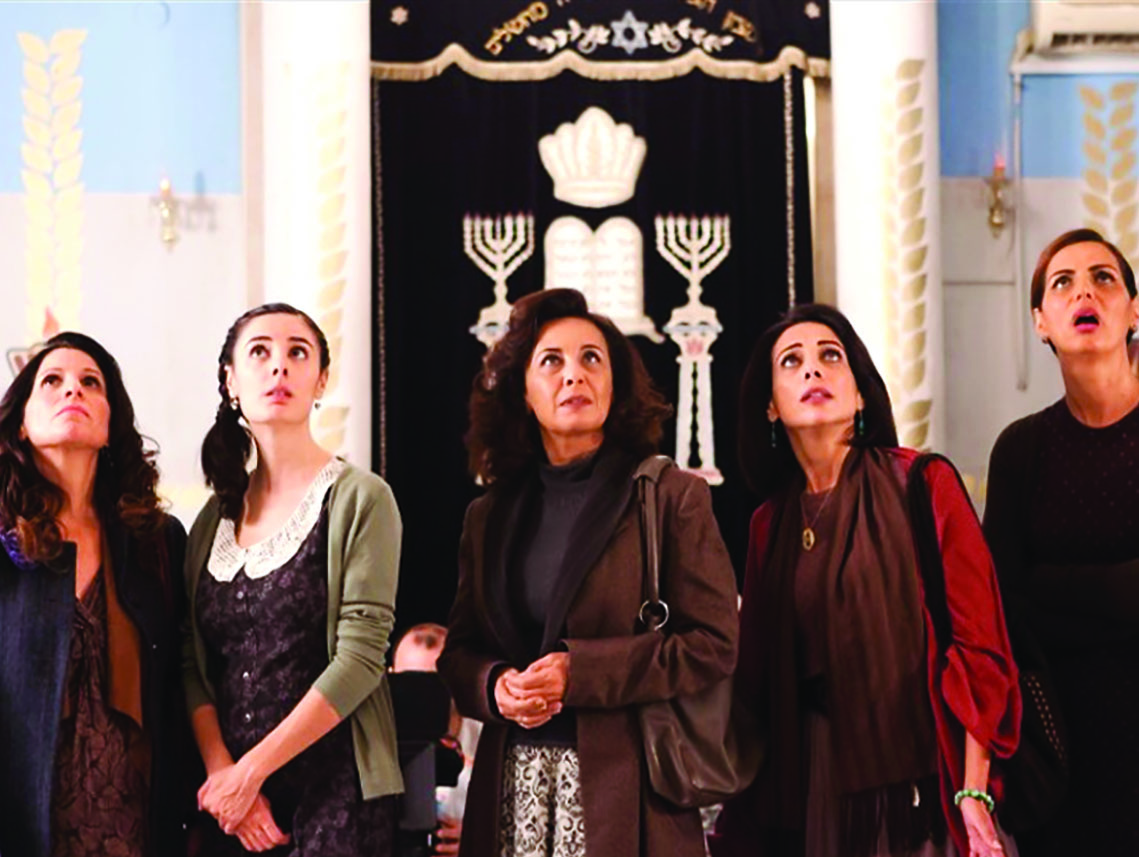
The Bukharim Quarter of Jerusalem, the locale for the movie “The Women’s Balcony,” was settled by Jews from Central Asia in the 1870s and ’80s.
Their synagogue was the center of their spiritual and communal life, and they and their descendants took their religion seriously, though not rigidly, making allowances for human weaknesses and personal quirks.
During the past 30 or so years, the once tolerant and easy-going neighborhood — like other parts of Jerusalem — has been changed by an influx of ultra-Orthodox Charedim, and in the Israeli film, we sense the beginning of the transition.
The demographic transformation of Israel’s capital is a weighty topic, but the message is conveyed with a great deal of humor, leavened by the always-popular topic of the war between the genders.
As the film opens, neighbors are hurrying along the cobble-stoned streets to join in a bar mitzvah celebration, with the women and their husbands carrying pots of home-cooked food — no catering at a fancy hotel in those rugged times three decades ago.
At the synagogue, the men sit downstairs, stealing occasional glances at the women up in the balcony, who enthusiastically throw candy as the bar mitzvah boy approaches the bimah.
Precisely at this happy moment, the balcony collapses, seriously injuring the rabbi’s wife and putting the rabbi himself and the building out of commission for the time being.
In these dire straits, the young charismatic Rabbi David (Aviv Alush) appears as a savior, offering the congregation temporary quarters and himself as the interim spiritual leader. But soon the congregation learns that the new rabbi’s service comes at a price. He preaches that the crashed balcony was God’s punishment for the immodest garments worn by the women and urges the men to buy scarves to cover the hair of their wives and daughters.
Tension rises when Rabbi David, who also has put himself in charge of repairing the synagogue, decides to dispense with the balcony altogether and exiles the women to a shuttered ante room, out of sight of the men.
When the women protest and go about raising their own money for a new balcony, Rabbi David underhandedly diverts the money for the purchase of new Torah scrolls. The docile men heed the rabbi’s edicts, but the women, led by the formidable Etti (Evelin Hagoel), organize a resistance movement.
They take a leaf from the women in Aristophanes’ ancient Greek comedy “Lysistrata,” who ended the endless war between Athens and Sparta by denying sex to their husbands and lovers until the men agreed to stop fighting. Though the concept of a sex strike is “not something one can say out loud in a religious community,” Emil Ben-Shimon, the film’s director, observed in a phone interview, the women achieved the same result by moving out of their houses.
Forced to choose between their wives and the unbending rabbi, the men folk finally grow a spine and bid farewell to Rabbi David.
Ben-Shimon, 41, has had a successful 15-year career in Israeli television as writer and director, but always dreamed of making a feature movie. Finally, he asked his ex-wife, Shlomit Nehama, to write the screenplay and set about finding the right neighborhood to re-create the Bukharim enclave of 30 years ago.
Ben-Shimon, who lives in Jaffa, said, “I was shocked to see that about 90 percent of the residents of the old Bukharim neighborhood were now Charedim and there were separate sidewalks for men and women. … People looked at me as if to say, ‘What are you doing here?’ ”
The director noted that “The Women’s Balcony” was last year’s biggest box-office hit in Israel and that “audiences loved it.” However, there was no feedback from the Charedi community “since its members usually don’t go to movies. … Their rabbis won’t let them,” Ben-Shimon said.
It took the director about three years to complete the film and he has started work on his next project, which probably will be set in Jaffa.
“The Women’s Balcony” opens March 3 at Laemmle’s Royal in West Los Angeles and the Town Center in Encino.
































