fbpx

February 22, 2017

Young renegade, longtime leader vie in 3-way council race for District 5

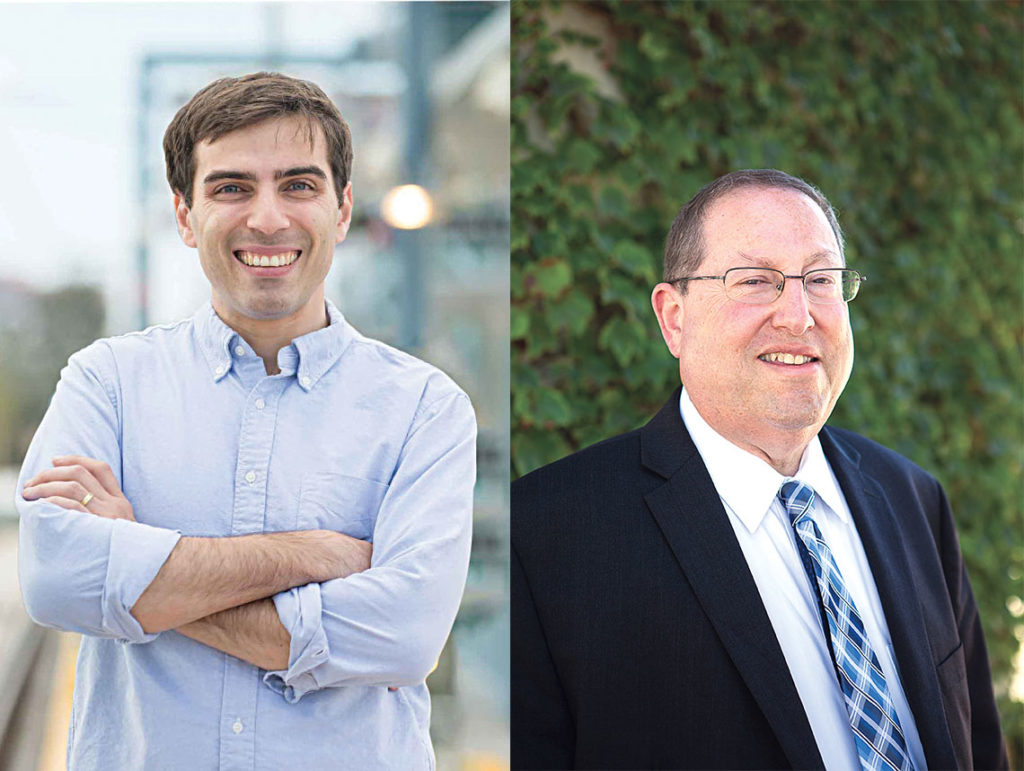
Attorney Jesse Creed is hoping for an upset win in the March 7 primary for Los Angeles Council District 5, a race pitting him against two-term incumbent Paul Koretz, 61, a familiar face in the organized Jewish community and longtime leader in the city.

If that sounds far-fetched, Creed, 31, says he is inspired by former Jewish elected officials Zev Yaroslavsky and Roz Wyman, who were in their 20s when they first won seats to represent the district.

“This district is famous for electing young renegades,” Creed said in a phone interview. “Roz Wyman was 22. Zev was 26… This district confounds, it absolutely confounds. I’d be the youngest person serving on the city council today.”

An oddly configured district that includes neighborhoods on the Westside, the San Fernando Valley, Bel Air, Westwood and Pico-Robertson, among others, District 5 is approximately 20 percent Jewish, according to estimates by Creed and Koretz. The district has been represented by a Jewish councilmember since 1953, the year Wyman was elected.

Creed and Koretz participated in a candidates’ forum on Feb. 12 at Leo Baeck Temple and agreed to be interviewed for this story.

Koretz and Creed have more than Judaism in common: They are both Democrats -— though L.A. City Council is a nonpartisan position — and both oppose Measure S, which would place a maximum two-year moratorium on certain development projects in the city.

Supporters of Measure S argue its passage would combat the interests of billionaire developers whose projects cause traffic and disrupt neighborhoods. Opponents say the measure would worsen the affordable housing shortage in Los Angeles and lead to fewer construction jobs.

While Koretz has not publicly opposed the measure, he said in the interview he plans to vote against it. He said passage could kill the plan for George Lucas’ Museum of Narrative Art at Exposition Park, and the moratorium could potentially last longer than two years, leading to negative economic consequences for the city.

Creed attributed his opposition to the city’s affordable housing crisis. “If it was just on the Westside, I would have a different opinion, but at this point I’m not willing to put any gas on the fire of this housing shortage we have in this city,” Creed said at Leo Baeck Temple.

Mark Herd, who has run unsuccessfully for national and state offices as a Libertarian, is also competing for the seat. He appeared at the Leo Baeck Temple forum, which was moderated by KCRW’s Warren Olney, but declined to be interviewed for this story after he was unhappy with his portrayal in a Los Angeles Times editorial that endorsed Koretz.

At the forum, Herd offered support for Measure S, saying it would reduce traffic gridlock and help maintain the character of neighborhoods. “I hate to say it, but it’s the only solution on March 7,” Herd said. “So, if you like gridlock and don’t care about your specific [neighborhood plans] … then vote no on Measure S.”

Koretz told Olney that one area he would like to focus on is climate change if he is elected for a third, and final, term.

“I’m going to be laser-focused on having L.A. become the leader in fighting climate change, not only in the city of Los Angeles but so that will reflect nationally and worldwide,” he said.

Due to changes in the election schedule, the winner of the race will serve 5 1/2 years rather than the customary four, a change to eliminate local odd-year elections and improve voter turnout.

A candidate exceeding 50 percent of the vote will win; otherwise, the top two finishers will face each other in a May 16 runoff.

During the campaign, Creed has criticized Koretz’s relationship with political donors. He said he believes Koretz is too beholden to real estate developers.

As of Jan. 21, Koretz’s campaign had raised more than $387,000, while Creed’s campaign had raised just over $264,000, according to the L.A. City Ethics Commission.

Koretz has emphasized Creed’s lack of experience and his lack of attachment in the district, where he has never even coached a baseball team, as Koretz framed it at Leo Baeck Temple.

Creed, who left the law firm Munger, Tolles & Olson to devote himself full time to the campaign, has touted his effort toward expanding housing for veterans at the West Los Angeles Veteran’s Administration (VA) campus, which is not within the fifth district. He was brought in to implement the settlement agreement between the VA and veterans who had sued it.

Other issues addressed during the campaign have included homelessness, mansionization and traffic reduction. Mansionization is the practice of homeowners expanding the size of their houses beyond the character of the neighborhood.

“I think every district needs to chip in to help with the homelessness crisis,” said Creed, a Toronto native who was raised in a Conservative household.

Creed attended high school at Palisades Charter High School and was involved with the Chabad movement. During a phone interview, he recalled how he was unaware that he had Crohn’s disease at the time of his bar mitzvah, which was held at Mishkon Tephilo in Venice.

“I was incredibly ill, so a lot of it I don’t really remember,” he said. “I felt like there was a muse coming through me, inspiring me to recite my haftorah and then it disappeared. I just had to do it.”

A summa cum laude graduate of Princeton University and Columbia Law School, where he was a top graduate in his class, Creed has been endorsed by philanthropist Bruce Corwin as well as several entertainment industry figures, including Renee Zellweger.

Creed attributes his success at school and as a lawyer to hard work.

“Everything I accomplished I earned it by working harder than anybody else around me and I want to work harder than anybody else for you,” he said to the audience at Leo Baeck.

He said his history of adjusting to new communities as his family moved from place to place would serve him well if elected.

“Having been an outsider in many points in my life … makes me fiercely independent in many ways and gives me the courage to stand up to power, like I’m doing in this race,” he said.

Koretz’s father escaped Nazi Germany and was a Democratic activist who introduced Koretz to politics when he was a boy. The councilman’s role in Los Angeles civic life dates back to campaigning for the incorporation of the City of West Hollywood in 1984. Around that time, he met his wife, Gail, through a Jewish dating service he described as “primitive,” which had advertised in the Jewish Journal. They have been married 30 years.

He served on the West Hollywood City Council and in the California State Assembly prior to his election to the City Council.

A fan of Ray Bradbury fiction, Koretz said he’d wanted to be a science fiction writer before he became a politician.

“West Hollywood happened,” he said, “and I haven’t written any fiction in over 30 years.”

Young renegade, longtime leader vie in 3-way council race for District 5 Read More »

Pence visits vandalized cemetery, condemns threats to JCCs

Vice President Mike Pence visited a vandalized Jewish cemetery near St. Louis after giving a speech in Missouri touching on a spate of recent anti-Semitic attacks.

Pence in his address Wednesday at the Fabick CAT headquarters talked about the vandalism and a series of bomb threats leveled at Jewish community centers across the country in recent weeks. The day before, President Donald Trump condemned anti-Semitism in remarks at the National Museum of African American History and Culture in Washington, D.C.

On Monday, 154 headstones were knocked over or damaged in the older section of the 129-year-old Chesed Shel Emeth Cemetery in University City, where the majority of the burials were between 1890 and 1940.

“That, along with other recent threats to Jewish community centers around the country,” Pence said, “declare to all a sad reminder of the work that still must be done to root out hate and prejudice and evil. We condemn this vile act of vandalism and those who perpetrated it in the strongest possible terms.”

Photographs showed Pence in shirt-sleeves wielding a rake and picking up branches during cleanup efforts at the cemetery led by Missouri Gov. Eric Greitens, who is Jewish.

University City Police investigating the vandalism have yet to determine whether it was a random act or a case of anti-Semitism, according to the St. Louis Jewish Light.

Andrew Rehfeld, president and CEO of the Jewish Federation of St. Louis, told the Jewish Light that the community should stop guessing at the motivations for these incidents and start looking at the effect.

“The chief culminating effect of all these incidents is a clear targeting of Jewish community institutions,” Rehfeld said. “That’s the pattern that is emerging and we need to contain it.”

He added that the federation is evaluating its ability to support “a much broader security function. We’re looking at a much more significant investment in it.”

Pence visits vandalized cemetery, condemns threats to JCCs Read More »

As president battles press, public loses

Journalism is no place for the sensitive. So when President Donald Trump said the press “is the enemy of the American people,” I didn’t retreat to a crying couch or whine.

I saw it as a warning from one enemy to another. We’re not the enemy of the American people. Rather, the press is the enemy of Trump, just as he is the enemy of journalists.

The press wants to know about his secretive dealings with Russia, his plan to dismantle Obamacare, what he intends to do about immigrants and other matters.  This isn’t idle curiosity or an effort to take down Trump. It’s the job of journalists to tell the American people what’s going on.

Trump opposes that. He is trying to silence reporters with the powerful tools he has at hand, possibly even prosecuting reporters and their sources in the manner of dictator-President Recep Tayyip Erdogan of Turkey. To Trump, news is what he spews out, as he did at his interminable press conference earlier in the month.

Thus there is no chance of détente between the enemy camps. With that in mind, I thought it would be helpful to readers to explain what reporters do and why it is important to people.

My workweek is divided between writing for the Jewish Journal, the websites Truthdig and LAObserved and the UCLA quarterly Blueprint. I am also working on a memoir, “An American Journalist.” I’ll give you a few examples of what I do.

My columns for the Journal deal mostly with Jewish community news; I try to dig into the community and find good works that have been ignored. I discover them through a web of contacts built up over the years. For example, during the recession, Jewish Family Service of Los Angeles led me to the new Jewish unemployed, often professional people who had been donors to charities but now depended on them. This gave me a view of the recession not seen in most mainstream publications. A column on rising rents facing elderly Jewish tenants took me to three Jewish social service agencies and to the representative of a developer seeking a rent increase.

Truthdig is different. It is a progressive website featuring national and international news. I express my liberal opinions but try to back them up with reporting. When Bernie Sanders’ national campaign staff did not return calls, I looked up the local campaign operation on Facebook, finding events and people who told me what was happening in the campaign. To write about the recent Women’s March, I pushed my way into a packed Metrorail train and through downtown crowds, interviewing people and shooting pictures with my iPhone, an effort I thought was pretty good for an 82-year-old.

This is conventional newsgathering. Reporters, if they stay in the business, enjoy the challenge. And they know the skills and determination developed in finding and writing about recipients of a Jewish charity are the same ones required in finding praiseworthy public-spirited citizens and officials — and nailing crooked campaign donors at city halls and the Capitol in Sacramento. Reporters are put to their greatest test in penetrating the maze of elected officials and bureaucrats in Washington, D.C., experts in obfuscating.

Documents help penetrate the maze. So do interviews with officials, elected and non-elected. Part of a reporter’s skill is getting such people to talk — and to tell the truth. But sometimes it is too dangerous for these sources to risk their jobs. Yet the information is too important to remain hidden. So the official leaks it to a reporter with the promise of confidentiality.

The promise isn’t given lightly. The reporter must find out if the source is truthful — not an easy task. The source must trust the reporter enough to believe he or she will go to jail to protect his or her confidentiality.

Some leaks are self-serving. They are a great way to sideline a career rival. And that seems to be at the heart of some of the leaks from this unruly administration. But a growing number of news accounts indicate that many leaks come from intelligence officials and others concerned with dealings Trump and his staff had with the Russians before and after the inauguration. That’s serious. It’s the reason, I think, Trump has labeled the press an enemy of the American people.

But here’s my point: Turning the public against the press is a threat to democracy.  “If you want to preserve democracy as we know it, you have to have a free and, many times, adversarial press,” said Republican Sen. John McCain of Arizona.  “And without it, I am afraid that we would lose so much of our individual liberties over time. That’s how dictatorships get started.”

The public, if one poll is to be believed, narrowly says the Trump administration is more believable than the press. The survey, by Fox News, also showed a sharp partisan split with Republicans trusting Trump over the media by a wide margin, and Democrats similarly backing the press over Trump.

Hopefully, more McCains will emerge among the Republican majority in Congress. Until that happens, reporters had better remain insensitive to Trump and his talk of enemies as they push ahead in a search for the truth.


BILL BOYARSKY is a columnist for the Jewish Journal, Truthdig and L.A. Observed, and the author of “Inventing L.A.: The Chandlers and Their Times” (Angel City Press).

As president battles press, public loses Read More »

“Gefilte” Ceviche

Many people just don’t like gefilte fish, especially the jarred commercial stuff. If you live where there is fresh fish and great produce, like, say LA, you can make what most people do like: ceviche. Gefilte means “stuffed.” Here, the fish is stuffed beneath a smooth avocado puree. This recipe, adapted from Casa Crespo in Oaxaca, uses far less fish than gringo versions, so is lighter and less fish-intensive.

Gefilte Ceviche

½ lb halibut fillet or sea bass fillet or red snapper fillet, cut into ½ in cubes*

1 ½ cups fresh-squeezed lime juice

2 ripe tomatoes, chopped

½ cup chopped onion

1/3 cup chopped fresh cilantro

3 pickled jalapeño chilies, chopped

1/3 cup green olives, chopped

1/3 cup capers, chopped

½ teaspoon dried oregano

½ teaspoon salt

½ teaspoon ground black pepper

1/3 cup olive oil

Topping:

1-2 ripe avocados, cubed

1 t. fresh lime juice

1/2 t. salt

cilantro for garnish.


Place the fish in a glass bowl, cover with the lime juice and marinate at room temperature for ½ an hour up to two hours.

Chop the tomatoes, removing the seeds. Place in a large glass bowl, add the onion, cilantro, chilies, olives, capers, pepper, salt, oregano and olive oil and combine.

Rinse the fish 3 times in cold water. Add the fish to the tomato mixture. Add more salt and pepper if needed.

To make the topping, combine avocados with salt and lime juice. Puree in blender or by hand, adding just enough water to make a thick smooth puree.

To serve, fill a pretty glass or ramekin with some ceviche. Top with  pureed avocado. Using the back of a knife or spatula, smooth over top to “seal” glass. Garnish with a cilantro leaf.

*If you can’t find fresh, high quality ocean fish, do not make this. Do not use cod, swordfish or other species prone to parasites.

“Gefilte” Ceviche Read More »

If at first you don’t succeed, do a podcast about it

In the spring of 2016, Sara Singer Schiff and Bipasha Shom applied to a program sponsored by National Public Radio that offered to teach participants how to produce a podcast. The two looked forward to visiting NPR headquarters in Washington, D.C., and learning from the best.

They never made it. NPR turned them down.

Looking back on it, that rejection may have been the perfect preparation for the podcast they went ahead and made anyway: “The Other F Word: Conversations About Failure.”

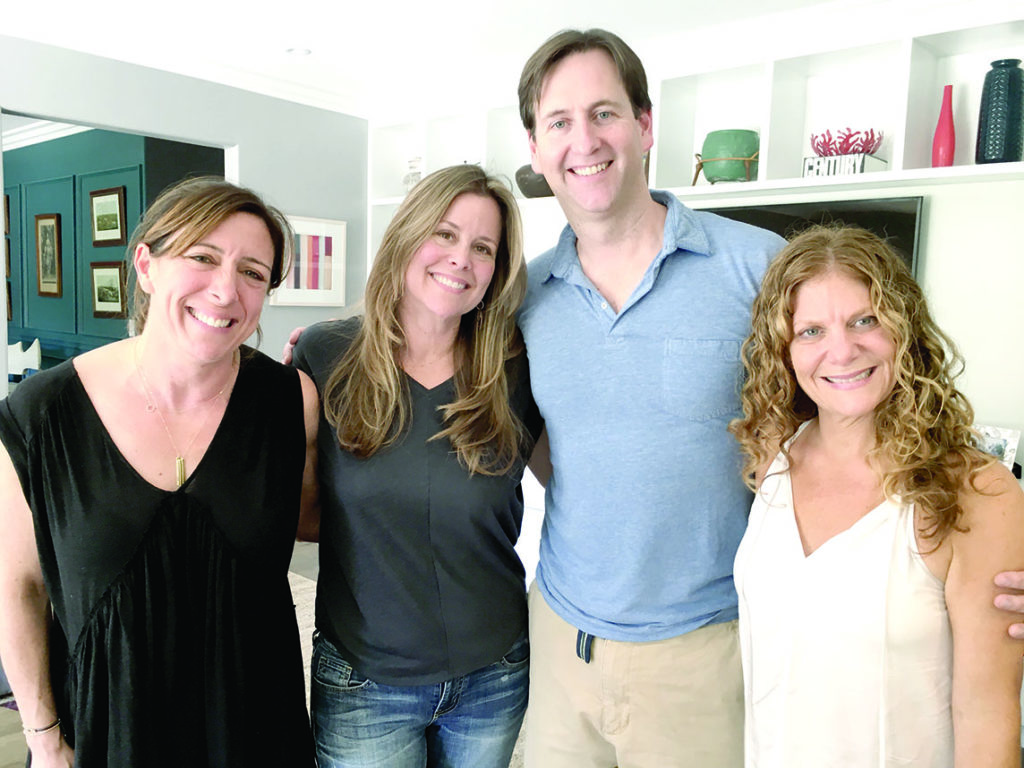
The hosts of the podcast, which debuted in October, are Schiff, 45, a full-time mom with a background in television distribution; Melissa Brohner-Schneider, 48, a marriage and family therapist; and Morgan Simpson, 42, a filmmaker and actor. Shom, 48, a film editor, produces the show.

Why did they think they could have success with failure?

“Failure right now is kind of trendy,” Shom said. “It’s in the zeitgeist. And there are so many angles to it. Talking about failure can really make people feel uncomfortable. But unless we all share our stories, we’re under the misguided impression that we’re suffering alone. Ultimately, we’d like people to know that failure is something that’s not just a part of life but in many ways essential to growing and learning as a human being.”

Schiff was responsible for bringing everyone together. She knew Shom and Simpson through schools their kids attended, and she met Brohner-Schneider when their kids were on the same soccer team. 

“It was like a blind date,” said Brohner-Schneider, whose family worships at Nachshon Minyan in Encino. But they “immediately jelled,” said Schiff, who calls her family “Reform cultural Jews.” Simpson is Episcopalian and Shom is not religious.

Because the foursome knew they would be asking others to open up about their personal failures, they figured they should start by sharing their own struggles. So, for the debut episode — recorded in the kitchen of Schiff’s Studio City home, like most episodes — they took turns talking about their own failures.

Simpson discussed the film he poured so much time and energy into, only to have it fizzle, with one “scathing” review seemingly overpowering several good ones.

Brohner-Schneider recalled attending seven colleges and universities before earning her undergraduate degree.

Schiff revealed the shame she felt in getting diverted from her professional goals and the fear she now has pursuing her dream career of journalism in her mid-40s.

And Shom, who prefers her usual role behind the scenes, shared her story of starting a children’s clothing line that struggled with sales and then collapsed when a bogus sales rep she hired stole her products and disappeared.

Listening to the podcast is like hanging with a group of friends who tell their stories with honesty and humor. This same openness is what the four hosts look for when booking guests.

“We want guests who have self-awareness, insight and are comfortable … showing vulnerability,” Brohner-Schneider said.

Some guests are regular folks talking about their struggles, like couple Jenn and Eddie Gonzalez, who discussed infertility and their eventual decision to adopt.

Other guests are experts in their fields, such as Nina Savelle-Rocklin, author of “Food for Thought: Perspectives on Eating Disorders,” who spoke about the inevitability of diets failing and making peace with food.

And because this is Los Angeles and “The Other F Word” crew has entertainment industry connections, quite a few guests have come from that world, including actors Jon Cryer, Greg Grunberg, Tony Hale and Sharon Stone. Television writer Elizabeth Craft talked about her fear of being fired and how she overcame it. Tom Kenny, the voice of cartoon character SpongeBob SquarePants, recalled coming close to a job on “Saturday Night Live” many years back and how, in retrospect, it might have been for the best that he didn’t land it.

For now, the podcast is a labor of love, albeit one that has grown a nice little audience. The 5-month-old show is getting around 20,000 downloads a month and has reached a popularity ranking as high as No. 4 in the self-help category on iTunes.

“I feel like people, probably because of the work I do, are busting at the seams — not only to talk about [failure] but to hear other people talk about it,” Brohner-Schneider said.

Still, after some awkward exchanges early on, she and her colleagues quickly learned to be strategic in how they approach potential guests.

“I’ve learned to reframe it,” Brohner-Schneider said. “Like, ‘Because you’re so successful, along the way we figured you’ve encountered some failure. And maybe you can talk about it to inspire others.’”

If at first you don’t succeed, do a podcast about it Read More »

What America needs: Thousands of Jew-haters

One would think that before admitting tens, let alone hundreds, of thousands of Muslims from the Middle East and North Africa (MENA), Americans might look at what bringing in millions of Muslims has done for Europe. One would also assume that American Jews would want to know how this surge in MENA Muslims has affected Jews in European countries.

But one would be wrong.

Such an approach would be rational. But for most people, the rational has no chance against the emotional.

A thousand rabbis signed a petition to bring large numbers of MENA Muslims into the United States; and virtually all Jewish organizations outside of the Zionist Organization of America (and some within Orthodoxy) have condemned the Donald Trump administration for enacting a temporary halt in accepting travelers and refugees from seven (of the world’s more than 50) Muslim-majority countries that currently have hostile, dysfunctional or nonexistent governments, for the purpose of creating a more thorough screening process.

Do these rabbis and lay leaders know what is happening in Europe?

Do these rabbis and other Jewish leaders know what it feels like to be a Jew in formerly tolerant Sweden?

Last year, the Jerusalem Post published an article about a Jewish couple who had lived in Sweden since the middle of World War II. They were Danish Jews who, as children, were smuggled into Sweden. Their gratitude to Sweden (and, of course, Denmark) has been immense.

But they have now left the homeland that saved them to live in Spain. The city in which they lived, Malmo, has become so saturated with Jew-hatred that they can no longer live there. It was caused by, in the words of the husband, Dan, “the adverse effects of accepting half-a-million immigrants from the Middle East, who plainly weren’t interested in adopting Sweden’s values and Swedish culture.”

He added that “the politicians, the media, the intellectuals … they all played their parts in pandering to this dangerous ideology and, sadly, it’s changing the fabric of Swedish society irreversibly.”

The Jerusalem Post continued: “Karla [the wife], who’d sat passively, occasionally nodding in agreement at Dan’s analysis, then interrupted, saying, ‘If you disagree with the establishment, you’re immediately called a racist or fascist.’ ” (Sound familiar?)

According to the British newspaper The Telegraph, the anti-Semitism in Malmo is so dangerous that the Danish-Jewish star of a very popular Scandinavian TV show left the show.

“Anti-semitism,” the Telegraph reports, “has become so bad in Malmo, the Swedish city where the hit television drama ‘The Bridge’ is set, that it contributed to actor Kim Bodnia’s decision to quit the show.

“Jewish people in Malmo,” the Telegraph report continued, “have long complained of growing harassment in the city, where 43 percent of the population have a non-Swedish background, with Iraqis, Lebanese and stateless Palestinians some of the largest groups. The Jewish community centre in the city is heavily fortified, with security doors and bollards on the outside pavement to prevent car bombs.”

Do American-Jewish leaders know that, for the first time since the end of World War II, the Jews of France fear to walk in public wearing a kippah or a Star of David necklace? If the rabbis and Jewish lay leaders know this, what do they assume — that Catholic or secular French anti-Semitism has dramatically spiked? Or would they acknowledge that this is a result of Muslim anti-Semitism in France?

Do these rabbis and other Jewish leaders know how much the presence of large numbers of Muslims in Europe has contributed to Israel-hatred in many European countries — especially on campuses? If they don’t, all they need to do is examine the situation on American campuses, where many Jewish students feel more uncomfortable than at any time in American history — all because of the left and Muslim student activists.

An article on the Huffington Post, presumably another racist and xenophobic website, reports:

“Migrants streaming into Europe from the Middle East are bringing with them virulent anti-Semitism which is erupting from Scandinavia to France to Germany. …

“While all of the incoming refugees and migrants, fleeing Syria, Iraq, Afghanistan and other Muslim lands, may not hold anti-Jewish views, an extremely large number do — simply as a result of being raised in places where anti-Jewish vitriol is poured out in TV, newspapers, schools and mosques. …

“ ‘There is no future for Jews in Europe,’ said the chief Rabbi of Brussels. … ”

So how is one to explain the widespread American-Jewish support for bringing in a massive number of people, many of whom will bring in anti-Jew, anti-Israel and anti-West values?

First, they are staggeringly naïve, believing, for example, that marching with signs at airports that read, “We love Muslims” will change those Muslims who hate Jews into Muslims who love Jews.

Second, never underestimate the power of feeling good about yourself for the left; that is, after all, where the self-esteem movement originated. And it feels very good for these Jews to be able to say, “Look, world — you abandoned us in the 1930s, but we’re better than you.”

And third, when American Jews abandoned liberalism for leftism, they became less Jewish, less Zionist, and more foolish.

Just ask the Jews of Sweden and France.


Dennis Prager’s nationally syndicated radio talk show is heard in Los Angeles on KRLA (AM 870) 9 a.m. to noon. His latest project is the internet-based Prager University (prageru.com).

What America needs: Thousands of Jew-haters Read More »

Two online parenting resources provide community and more

Being a new parent can be isolating and overwhelming, feelings that don’t always disappear as kids grow older.

For Los Angeles-area parents, two online forums, Peachhead and Jen’s List, are easing the burden, helping to navigate the challenges and provide a sense of community.

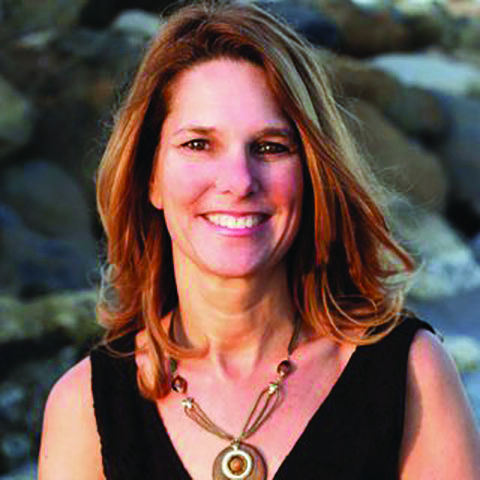
com-linda-perry-peachtreePeachhead got its start 20 years ago, when its founder, Linda Perry, 51, had her first child, a daughter. After completing a three-month “mommy and me” program, she found that some of the moms wanted to stay in touch and continue getting together. Perry, a Reform Jew, got their email addresses.

With a daughter who was not content to chill at home, Perry was constantly out and about. She started emailing the group on a regular basis, telling the moms about different neighborhood activities and where she and her daughter would be at a particular time. Her friends forwarded the emails to their friends. The list rapidly grew.

Today, with about 16,000 members, Peachhead (peachheadfamilies.com) has become a vibrant forum — mostly for moms, although dads are welcome — to share advice on a wide array of subjects. Every month, there are upward of 1,000 posts.

Joining the Yahoo-supported group is free, and subscribers have several options, including a daily digest, typically one to four daily emails that aggregate approximately a dozen posts into easy-to-read collections. One recent digest included an appeal for homeopathic remedies for reflux, a reader seeking a recommendation for help assembling a trampoline and a call for a Sunday-night sitter. Perry generates revenue from ads priced between $100 and $200.

“This group is for anything you would ask a friend or neighbor, not limited to parenting stuff,” said Perry, who also works as a legal assistant. But subjects related to parenting tend to be the most discussed. Among the most popular topics are sleep issues, nursing challenges, tantrums, how to handle kids when they talk back, computer use and at what age kids should get cellphones.

“This group is for anything you would ask a friend or neighbor, not limited to parenting stuff.” – Linda Perry, peachhead founder

Only politics is strictly off limits. And if things ever get too heated, which they do on occasion — around the topic of vaccinations, for example — Perry moves the conversation to a debates and discussions subgroup.

Why the name Peachhead? It’s not a reference to the super-soft pates of newborns, Perry said. Rather, her husband was a fan of the Allman Brothers, and one of their early albums was called “Eat a Peach.” Fans were known as Peachheads. Mystery solved.

Like Perry, Jen Levinson did not set out to create a business. In 2005, as a mother of one boy and 19 weeks pregnant with twins, she was put on strict bed rest.

“I’m a total Type A personality,” said Levinson, 46, now the mother of five, all boys. “I do much better with a lot to do. I could not just sit there.”

So she devoured newspapers and magazines. When she saw a cute baby product or read an article that resonated with her, she sent it to a handful of other mom friends.

Soon, her emails grew more elaborate. And Levinson, whose family worships at Valley Outreach Synagogue in Chatsworth, started hearing from people she didn’t know, asking to be added to her email list. Turns out, her friends were sharing her emails with other moms. Four years later, she was sending her daily email, which the community named Jen’s List, to 6,000 people.

“It was strictly a labor of love,” she said — at least it was at the beginning. With another set of twins on the way, her husband, Mike Levinson, encouraged her to continue the project, and they brainstormed ways to monetize the operation.

She started selling daily sponsorships for $195, a price she has maintained. And she no longer publishes on weekends.

Though Jen’s List (jenslist.com) does not have the dialogue exchange of Peachhead, it does have a conversational feel. The emails reach about 20,000 subscribers throughout Los Angeles, more than half in the Conejo and San Fernando Valleys, and include such personal recommendations from Levinson as a summer camp, a bar mitzvah tutor and a plumber. There is also a “Today in History” section. And Levinson allows subscribers one free post a month.

Levinson and Perry say the most satisfying aspect of their respective forums is helping people.

“Without sounding corny,” Levinson said, “it brings me joy.”

Two online parenting resources provide community and more Read More »

Yes on Measure S: My Jewish values guide my political choices

I always look back to my Southern Jewish roots when I have to make important decisions in my life, whether they are personal or political, professional or social.

Since I moved to Los Angeles, I have relied on those values established as the daughter of a Rabbi in Augusta, Georgia. (Yes, there are plenty of Jews in Augusta.) During these particularly conflicting times in our nation and our community, I apply them now more than ever.

Measure S is on the March 7 Los Angeles ballot. As the President of the Pacific Palisades Residents Association, I have become deeply involved in our community and realize the importance of helping pass Yes on Measure S.

Measure S is really about social justice as it gets to the core of how we want to live in our city. It challenges how we want our elected officials to perform and behave. It questions how we want our city to look and function in the future. My values not only encourage community engagement, but community discussion and decisions with conscience. That’s what Measure S promotes.

Measure S will demand that our officials take important planning decisions back to the community–engaging residents during the evenings and weekends when people can attend. Holding meetings downtown in the morning during the work week is a clever way to keep the people’s voices to a minimum. It accommodates the developers and their lobbyists, not the public.

The current system of land use decisions in our city is broken. While many developers follow appropriate planning rules, some mega-developers get their way by showering campaign contributions on politicians who then find it hard to say “no”. Developers are allowed to choose their own paid consultants to do the environmental studies for their mega-developments, and lobbyists have all the advantages over the community in pushing these development projects through City Hall.

Measure S will ban our elected officials from helping developers who have given them money get around our zoning rules. While campaign contributions are legal, too often they pave the way for developers to receive special “spot zoning” privileges, allowing for height changes and zoning changes that often don’t fit the scale or safety codes of the neighborhood.

As a grassroots volunteer on the Measure S campaign, I have seen the untruths and fake news that the opposition has spread. Accusing Measure S of bringing doom and gloom to Los Angeles. Ending all affordable housing. Ending housing for seniors. Causing an economic recession. But these are scare tactics: unfounded claims spreading fear and anxiety with no real proof. Just as mega-developers hire consultants whose “studies” conveniently support their bids for mega-developments, so mega-developers themselves funded the so-called “study” that conveniently supports their claims regarding Measure S.

Contrary to what the opponents of Measure S say, Measure S will not end construction of affordable housing, which is critical for seniors and low-income individuals. Roughly 95% of development projects in Los Angeles conform to existing zoning and will not be impeded. Local construction jobs will not evaporate, and Los Angeles will not be plunged into recession.

Measure S will stop, for a brief period of two years, those projects that require a zone change or “spot zoning” – which adds up to only about 5% of all development. It is true that this will briefly stop the mega-developers from building more luxury apartments and hotels, but these don’t help us solve our affordable housing problem in any way.

In fact, “affordable housing” is often a cover for hugely profitable mega-developments that require a General Plan Amendment or zone change. Developers promise city officials that they will mix in affordable housing with their luxury units so all will be well. The reality is that once people are pushed out of their rent-stabilized units, they are lost. But the mega-developments remain. The current system has failed in dealing with our city’s affordable housing problem, and should not be relied upon to fix it.

Importantly, Measure S will also require the update of our General Plan and Community Plans that have not been updated for 20 years. The primary purpose of the General Plan, including Community Plans, is not to enrich real estate investors.  It is to properly govern and plan Los Angeles.  We need judicious assessment of infrastructure and public services, so the community can understand how developments will impact our health and safety.

We must update our plans so we can prepare properly for the future – planning for flooding, earthquakes and other unforeseen emergencies. We want to make sure that roads are planned properly around new developments, rather than creating more hazards to accommodate large, over-sized buildings.

Pursuing justice has become part of who I am. While Measure S may not be perfect, it is a big improvement over the current broken, unjust system of land use decisions. Measure S will stop the back room deals. It will bring us together in dynamic and constructive discussion about our neighborhoods. Finally, it will bring the kind of transparency we need and deserve from our City leaders.

Sarah Conner is a wife, mother, entrepreneur and philanthropist. She currently is President of the Pacific Palisades Residents Association, a 60 year old nonprofit dedicated to protecting the environment of Pacific Palisades and surrounding areas. She was an organizer for Save the Bluffs, a movement that successfully opposed non-conforming development on the coastal bluffs of Los Angeles. In her Jewish community affiliation, she is Chair of the Board of the American Technion Society, Southern California Chapter, a National Board Member of the American Technion Society, and an Advisor for TAMID at USC.

Yes on Measure S: My Jewish values guide my political choices Read More »

GRAMMY 2017 RECAP: MEAL AND A SPIEL KNOWS HOW TO PARTY!

The Grammy Awards is THE biggest night of the year for the music industry. For the entire weekend, nominees and celebrities are invited to wine and dine at all kinds of exclusive events. And guess who catered one such VIP luxury lounge AND took home the award for Best Menu of the Year?? Oh yeah baby, yours truly!

And boy did we serve it to them. We’re talking made-to-order latkes, my famous Jewish Sicilian chicken meatballs, and No-Noodle Lasagna from my first ever online cooking course, coming soon!! And for dessert we served McConnell’s sweet cream ice cream (family owned in Santa Barbara by my dear lifelong friend Michael Palmer and his wife Eva) with Meal and a Spiel specialty blood orange olive oil drizzle from Chacewater Winery. YUM. Palettes were singing, hot latkes were flying off the pan, it was beautiful.

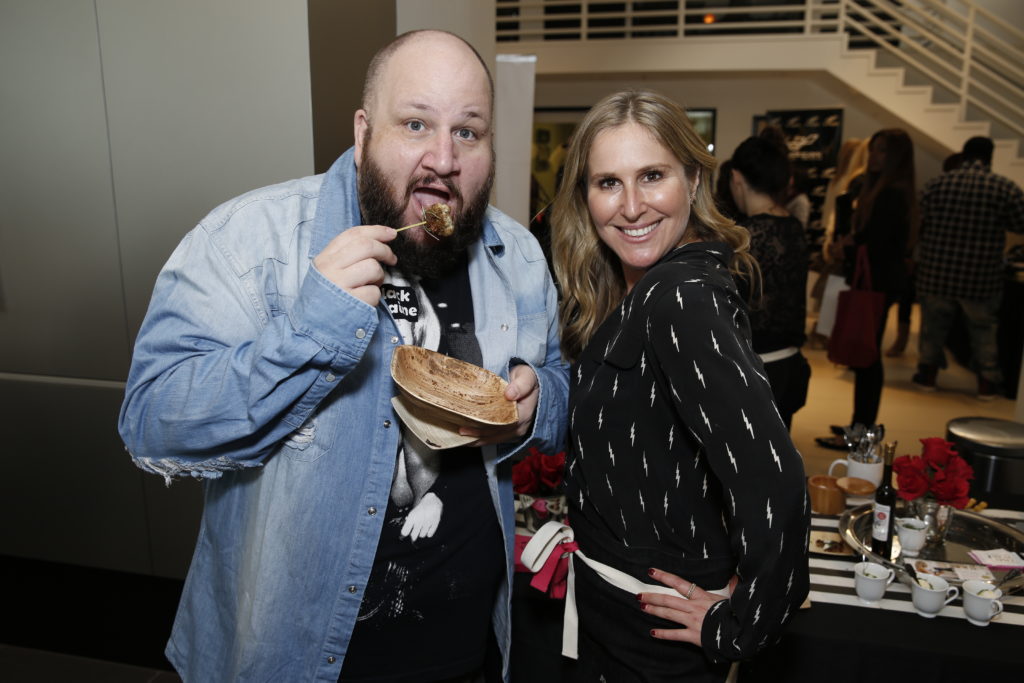
Not to mention there was all the schmoozing I got to do with Hollywood’s finest. Like Kandi Burruss from Real Housewives of Atlanta, Stephen Kramer Glickman from the Warner Bros animated film Storks, and many others. Definitely going to pencil in the Grammys for next year.

kandi-grammys

Kandi Burruss, Songwriter/ Producer/Real Housewife of Atlanta

stephen-glickman-grammys

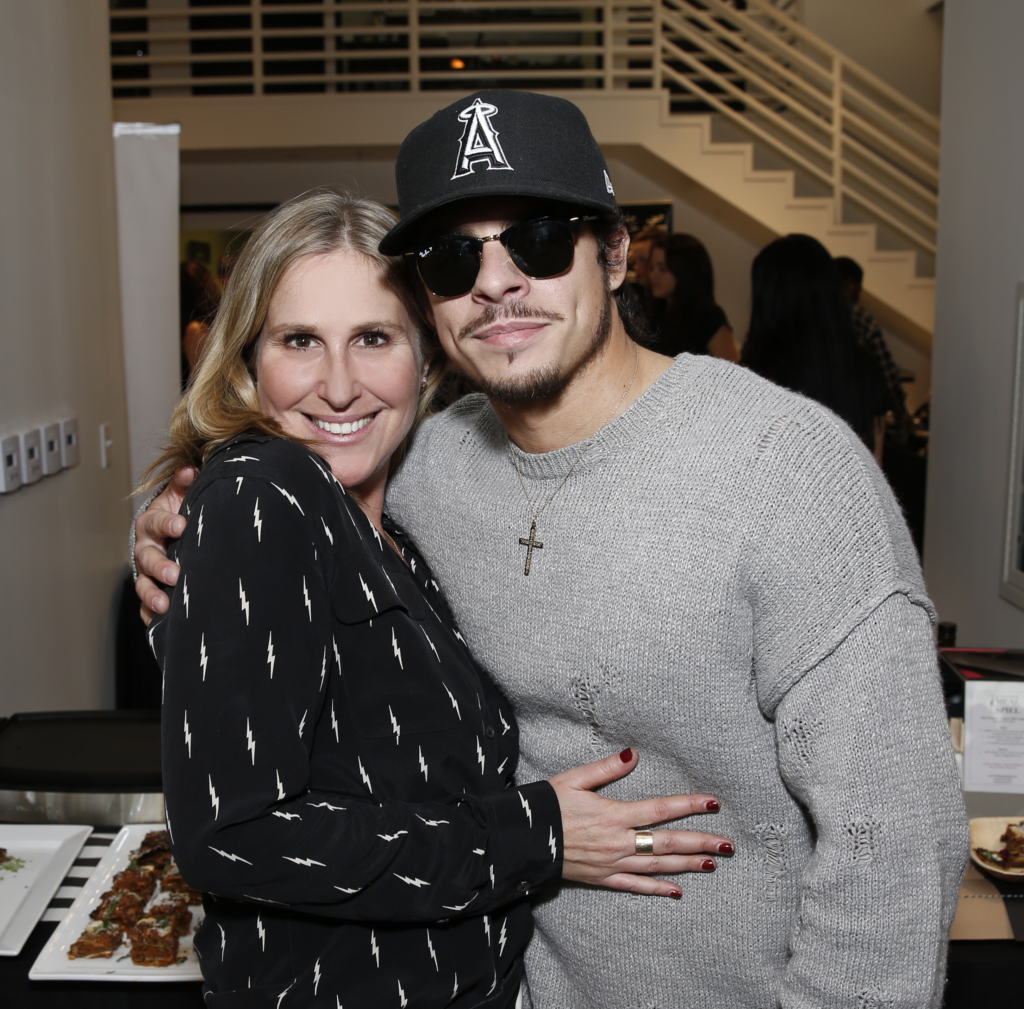
Two funny Jews: Stephen Kramer Glickman, Storks & Elana Horwich, Miss Meal and a Spiel

casper-grammys

Casper Smart, Creative Director

drew-chadwich-grammys

Drew Chadwick, Music Artist

chetti-grammys

Chetti, Singer/Songwriter/Recording Artist

pandora-grammys

Pandora Vanderpump, Vanderpump Rules

GRAMMY 2017 RECAP: MEAL AND A SPIEL KNOWS HOW TO PARTY! Read More »

Getting the Most out of Your Car and Your Business – Understanding Lease Terms

Leasing has become one of the most popular ways for people to acquire the use of high-cost items. Car leases and commercial leases are the two most popular types of leases. Here is a description of what they are and their most popular types.

A lease is a contract by which one party conveys land, property, services, auto, etc., to another for a specified time, usually in return for a periodic payment. The receiving party is called the lessee and the conveying party is called the lessor.

Property Leases

Property rental is always managed by a lease agreement. The tenant, in this case, is the lessee, and the landlord is the lessor. A lease typically guarantees that the lessee pays a specific amount of rent to the landlord for a specific number of years or months. The landlord agrees to provide the property in a specified condition, and under terms of the contract and the tenant agrees to pay the amount and follow the terms and conditions as specified in the contract. If either party does not hold up their end of the contract, there are consequences. There are two types of standard property leases:

  • Gross Lease: A gross lease typically means that the landlord pays for the building’s property taxes, insurance, and maintenance. It can, however, be modified so that the tenant pays for specific expenses such as utility bills. This type of lease can be erratic for tenants and needs to be reviewed carefully because often a landlord will overvalue costs to ensure all bills associated with the property are covered.
  • Net Lease: There are several different types of net leases. For example, a triple net lease means that the tenant has to pay for taxes, insurance, and maintenance in addition to rent. A double net lease only requires the tenant to pay taxes and insurance on top of rent, and a net lease means the tenant has to pay some or all of the taxes, insurance or maintenance. These leases allow the tenant to have some control over costs associated with the property (water, electric, etc.) and can often save the tenant some monthly costs. But again a tenant needs to be careful about calculating its overall cost.

Car Leases

More and more people are choosing to lease rather than purchase their automobile. Car leases typically run 36, 48, 60 or 72 months, allow the lessee to drive a certain amount of miles per year, and at the end of the term, the car is returned to the lessor. Leasing is available for both new and used cars. There are two types of car leases generally available:

  1. Closed-End: A closed-end lease is by far the most popular type of car lease. It allows lessees to return a vehicle at the end of the lease and either walk away or buy the vehicle for a pre-arranged amount. Unless there is physical damage to the car, excessive wear and tear or the agreed upon mileage allowance in the lease agreement exceeded, there are no additional charges due. All car manufacturers and many leasing companies offer closed-end leases for cars.
  2. Residual Obligation (Open End): An open-end lease carries the risk for the Lessee. The vehicle is leased and the lessee makes scheduled payments like in a closed-end lease. These payments are calculated based on the estimated value of the car when it will be returned. If the car’s value is less than estimated, the lessee must make up the difference when the car is returned. Open-end leases may have smaller monthly payments, but again there is a risk that there will be a lump sum payment (or additional monthly payments) due when the car is returned. The complexity of this calculation makes this type of lease substantially less popular than a closed-end lease

Leases are legally binding contracts and consumers should always fully understand the terms of a lease agreement before signing it.

Getting the Most out of Your Car and Your Business – Understanding Lease Terms Read More »