fbpx

February 22, 2017

Slain Israeli soldier’s art inspires parents’ mission

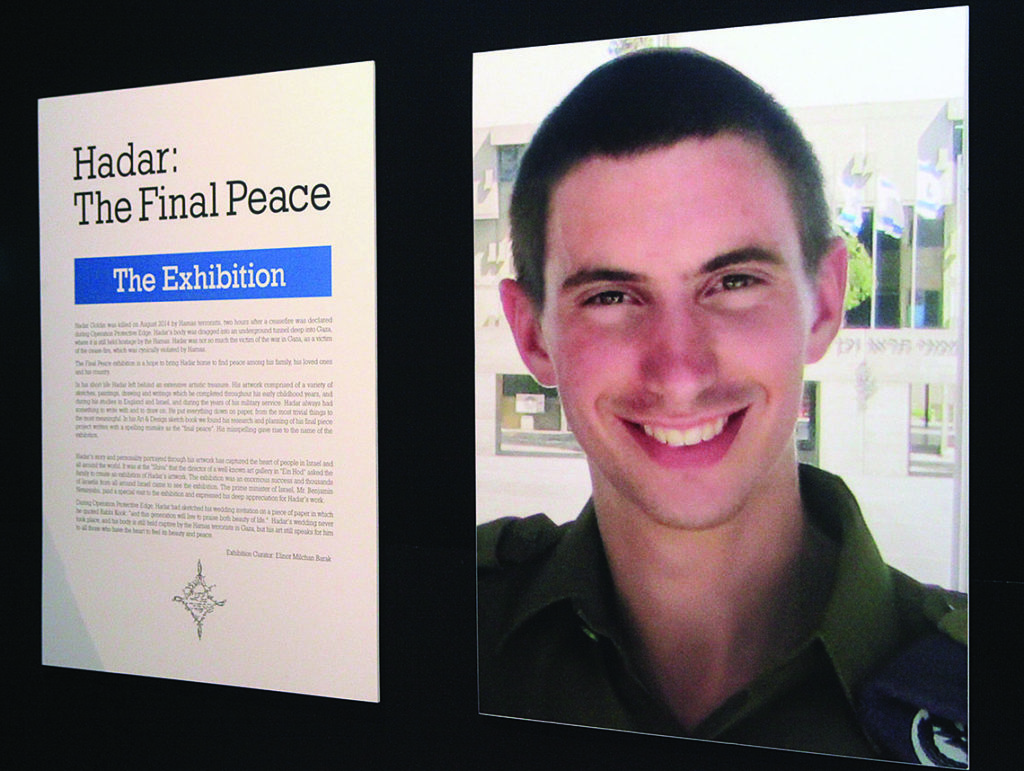
Leah and Simcha Goldin are grieving parents. Frustrated, vocal and driven, they have traveled from the Knesset to the United Nations to, just last week, the Museum of Tolerance in Los Angeles, bringing with them a traveling collection of their son’s artwork known as “Hadar Goldin: The Final Peace” to bring attention to his plight.

“It is our mission to bring Hadar home,” Leah said with a straight-ahead gaze, her voice shrouded in a thick Israeli accent.

Bring Hadar home.

Leah Goldin has uttered those words too many times since August 2014, when her son first went missing.

When Hadar comes home, they will not embrace, as mother and son ought after being separated for so long. There will be a ceremony and, most likely, a press conference. But Hadar’s remains will be in a coffin with an Israeli flag draped over it. A grave will be filled, topped with tilled soil. This is what “Bring Hadar home” means.

Of course, that’s if Hadar comes home. But to Leah, a doctor of computer science, and her husband, Simcha, a professor at Tel Aviv University, there is no “if”: They have dedicated themselves to make sure that day comes.

“Hadar is a victim of a cease-fire, rather than a victim of a war,” his mother said, nearly three years after that breach of cease-fire, which took her son’s life.

On Aug. 1, 2014, after a flare-up of escalations between Israel and Hamas during Operation Protective Edge, then-U.S. Secretary of State John Kerry and then-U.N. Secretary-General Ban Ki-moon announced a 72-hour humanitarian cease-fire. Two hours into that ceasefire, Hamas ambushed Israeli soldiers in the southern border town of Rafas, a raid resulting in Hadar’s death and the kidnapping of his body, which was dragged back to Gaza through a network of underground tunnels. He was a lieutenant in the Israel Defense Forces at the time.

During that summer conflict, the body of staff Sgt. Oron Shaul also was captured. Both bodies are still in Hamas’ custody, and the Goldins want the international community to pressure Hamas for the return of their son’s body.

So it’s through Hadar’s traveling collection of art — with pieces ranging in style from expressionist paintings to daily life sketches to journal entries — that the Goldins hope to make strides on the matter. They first got the idea to put together a collection while sitting shivah for their son, after being approached by art curators from Ein Hod  (an artists village near Haifa). “And they advised us to put up an exhibition; we didn’t realize we could do it,” said Leah.

In September, the collection was on view at the United Nations in New York during the General Assembly. “Since this cease-fire was brokered by John Kerry, secretary of state, and Ban Ki-moon, general-secretary of the U.N., they should be held responsible. They should be accountable for his return,” Leah said. Neither Kerry nor Ban came to the exhibition, she said.

“And they knew about the exhibition,” Leah added. “I cannot tell you why they did not want to go. You should ask them.”

“It’s a question of responsibility,” Simcha added.

“And accountability,” Leah said. “Sometimes if you don’t face it, it’s a way to say, ‘I don’t know about it. It does not exist.’ But it does exist. It exists with the exhibition, with showing Hadar’s portrait, with his uniform,” she said.
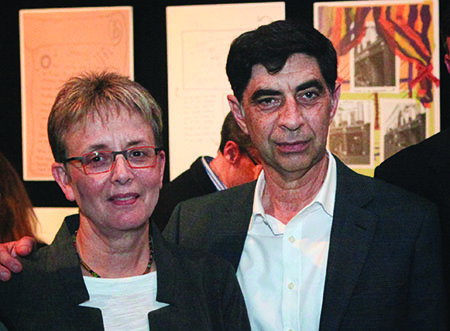
art-parents-exhibitThe Goldins have traveled to New York, Miami and Los Angeles, lobbying for the return of their son’s body.

“We are looking for ways to raise it as an American issue. And by that, getting the support of the U.S. administration to motivate Hamas to bring Hadar home,” Leah said.

At the collection’s opening Feb 15 at the Museum of Tolerance, Rabbi Marvin Hier, founder of the Simon Wiesenthal Center and its Museum of Tolerance, delivered a sermon, referring to a passage from Exodus, where Moses made an oath to carry his ancestor’s bone into the Promised Land.

“We have the obligation to retrieve the bones of our lost brother like Moshe Rabbeinu,” his voice, a desperate plea, echoed through the microphone. “We must do everything we can.”

On Feb. 20, the collection moved from the Museum of Tolerance back to Israel, traveling, yet again, to the Knesset before going  to the Opera Tower in Tel Aviv. The Goldins are asking the community for help.

“We’ll appreciate any advice and any help to resolve it and bring some closure to our case,” Leah said.

Plain and simple, they want to give their son a proper Jewish burial.

Who was Hadar Goldin? He was a son, a brother, a fiance, an intellectual, and an artist. He was a voracious reader, a fan of J.R.R. Tolkien, and an espresso drinker.

“I used to do still photography until Hadar took my camera when he was a teenager,” his mother said, “and then he was the one behind the camera.”

Hadar observed the world. Ever since he was a kid, he liked to draw and write. He was a doodler, illustrating scenes of daily life, jazz on a street, caricatures of people he knew. He’d draw in pocket notebooks, on scraps of paper, whatever he could find. On the back of an equipment list while stationed near Gaza, he drew his wedding invitation, a scene portraying his fiance and himself in a house, ripened pomegranates in the trees. He painted oil-on-canvas scenes of a man fishing; deer in a pasture; the war-torn skyline.

Hadar Goldin was 23 years old when he died, three weeks before his wedding.

There is a piece in the collection that hangs in Simcha’s study at home when it isn’t traveling with the exhibition.

“You need to see it,” Simcha said. “It’s a long debate whether it’s a bird or something else.”

It looks like a dove, hovering over a lake, its wings stretched out in full extension. An orange sun bleeds into the sky as a girl, doused in a powdery white light, watches from a distance.

“The sad thing is it’s only the potential. He was killed, so you can only see his potential on the walls. It’s very sad. It’s very painful,” Simcha said about his son’s artwork.

“But on the other hand, it’s there. It’s unique. It’s nice,” he said. “It’s fantastic.”


Correction: 3/1 – This story originally said Leah Goldin is a computer programmer – she is a doctor of computer science.

Slain Israeli soldier’s art inspires parents’ mission Read More »

On the front lines of Israel’s weaponry

The challenges of defending the Jewish state get very real in the pages of “The Weapon Wizards: How Israel Became a High-Tech Military Superpower” by Yaakov Katz and Amir Bohbot (St. Martin’s Press). Although Israel is already known and praised as “the startup nation” — the seedbed of high technology — the story of its weapons development and deployment is especially fascinating and highly consequential.

Both authors are Israeli journalists who specialize in military coverage, and they recognize that advanced weaponry is just one element of Israel’s defense strategy. “Israel relies heavily on the reputation of deterrence it has worked hard to create over the years,” they explain. “We believe that this deterrence rests on three key pillars — Israel’s purported nuclear weapons capability, its strategic alliance with the United States and the conventional capabilities of the IDF [Israel Defense Forces].” It is the third pillar that is the focus of “The Weapon Wizards.”

“Conventional,” of course, means non-nuclear, but the weaponry itself is cutting-edge. Former IDF chief of staff Benny Gantz, for example, acknowledges that Israel’s adversaries are well-armed and that fresh attacks are unpredictable but inevitable. “We will win though,” he tells the authors, “because our soldiers will be prepared and will have the best technology to assist them.”

The tradition is deeply rooted in Zionism. At a hilltop kibbutz near Rehovot in 1945, several years before statehood, a secret ammunition factory was established so that the Jewish fighters would be properly armed despite the ban on weaponry imposed by the British occupation of Palestine. It was literally an underground facility, buried deep underneath the laundry room of the kibbutz, and sunlamps were installed so that “the ‘kibbutzniks’ making the bullets looked tanned, as if they had been out in the fields all day.” The ruse was necessary because one of the customers of the laundry was the local British army base.

By the way, Southern California — and Los Angeles’ own Lou Lenart and Al Schwimmer — figure in the stories that are told here. During the War of Independence, Lenart flew combat missions in a Czech fighter, and Schwimmer participated in the smuggling of refurbished British warplanes from Burbank to Israel in crates marked “Refrigeration Equipment.” But the whole point of “The Weapon Wizards” is that Israel resolutely set out to become a weapons developer and manufacturer in its own right, starting before statehood and continuing with ever-greater sophistication to this day.

“To survive, the Jewish state could not rely solely on foreign assistance,” the authors write. “It needed to find a way to develop its own R&D and production capabilities. It was a matter of survival.”

As early as 1969, for example, an Israeli officer on the embattled Suez Canal longed for a way to conduct surveillance on the Egyptian positions. He had seen a newsreel that included a segment about a boy who received a remote-controled (RC) model airplane as a bar mitzvah gift, and the officer bought an RC plane of his own, installed a camera, and tested the new device by asking Israeli anti-aircraft gunners to try to shoot it down. The toy airplane survived its test flight, and the drone was born. When the United States later ran into serious problems with its own drone program, “the US finally decided to ask Israel for help,” the authors write.

Israel has long distinguished itself for its mastery of small arms. The American-made M-16, for example, has not only been replaced in the IDF with an Israeli-made assault rifle called the Tavor, but the same weapon is now exported to countries around the world, “from Colombia to Azerbaijan and Macedonia to Brazil.”  But much of its genius is applied to nonlethal technology that has come to be crucial in combat, including drones and spy satellites, and protective armor that has reinvented the tank as an effective battlefield weapon. There’s also the Iron Dome anti-missile defense system, and the cyber-weapon called Stuxnet, which was co-developed by Israel and the United States and reportedly destroyed some 1,000 centrifuges in Iran’s uranium enrichment facilities.

Even more remarkable is the stroke of genius that inspired the IDF to recruit soldiers with autism to scrutinize the imagery collected by drones and satellites. Recognizing that individuals with autism often possess “remarkable visual and analytical capabilities,” they are trained to pore over the raw data and pick out the nuggets of intelligence. “If a bush moves a few feet or a building is slightly enlarged, they will pick up on it,” the authors explain. “To the average eye, these topographic changes might seem natural and be missed. But for [the autistic soldiers] they could mean that a rocket launcher or an arms cache is present but hidden.”

Israel’s accomplishments in weapons development can be explained by one of the hard facts of life in the Jewish state — almost everyone serves in the military, and the military is regularly called on to fight. “This means that engineers who work for defense companies meet soldiers not just in boardroom meetings to look over new weapons designs, but also during reserve stints, when they themselves put on uniforms and become soldiers again,” the authors write. As one weapons-maker puts it: “We know what it means to sit in a military vehicle, what it’s like to hit an explosive device or take a burst of gunfire.”

On the front lines of Israel’s weaponry Read More »

Blowing up his set, a choreographer steps beyond his Indian-Jewish roots

The dancer and choreographer Lionel Popkin, who is of Jewish and Indian descent, finds inspiration in his mixed heritage — two cultures that emphasize dance as a form of social expression. His projects take on big topics, like historic legacy and cultural appropriation, but are infused with whimsy and playfulness.

The L.A. premiere of his latest piece, “Inflatable Trio,” will be staged at the Skirball Cultural Center on Feb. 23, with additional performances the following two nights. Discussions will be held after the first two performances.

“Inflatable Trio” dissects the daily rituals of life and of home. The performance takes place on and around an inflatable plastic living room set, the type you might find in a college dorm room. The three dancers — Popkin, Carolyn Hall and Samantha Mohr — deflate, refill and rearrange the pieces throughout the show. They wrestle with them, jump on them, throw them around and drape themselves on top of them.

The dancers’ interactions with the plastic furniture suggests the impermanence and ever-changing nature of our domestic and social lives. It’s also a meditation on breath and breathing, an act that’s central to life and to dance.

“The piece itself became a question of: What are the systems of support that we use, in terms of how we buoy ourselves up, and how effective or how fragile those are,” Popkin said. “The furniture itself looks very solid. But as soon as you pull the plug, it just completely vanishes. And that became a metaphor for how we intake air and support ourselves and then how it expels and we siphon out like a balloon.”

In some sections of the piece, the dancers butt up against one another, wrestle and roll around — scenes that are both intimate and confrontational. In other sections, they take the place of the inflatable furniture and hold one another up in an intricate and constantly shifting arrangement.

Popkin spoke on the phone from Oberlin, Ohio, where he was working with Tom Lopez, who teaches at the Oberlin Conservatory of Music and composed the music for “Inflatable Trio.” The multimedia performances also feature video art by Cari Ann Shim Sham and costume design by Maria Garcia.

Popkin, 47, was born and raised in Bloomington, Ind. His father is a Jew from New York and his mother is Indian.

“By traditional law I’m not Jewish, because my mother wasn’t, but she was still the president of the local Hadassah chapter, in her sari and everything,” Popkin said.

His family attended synagogue, he became bar mitzvah, was part of the Zionist youth movement Young Judaea, and attended Tel Yehudah, a summer camp in the Catskills.

“When I was at camp there was a lot of Israeli folk dancing. That was done a huge amount and I enjoyed it. I loved it,” he said.

When asked what it was like to grow up with his feet in two cultures, Popkin pointed out that it was more like three cultures.

“There is the iconography and imagery and food of India, the religious and social aspect of the Jewish community in Indiana, and then there was also Midwestern America,” he said. “For me, it just created this sense that there’s always another way to look at things. And as an artist, that seems to be an incredibly important principle.”

Popkin’s work often grapples with these issues of cultural identity. His multimedia work “Ruth Doesn’t Live Here Anymore” considers the legacy of modern-dance pioneer Ruth St. Denis, who was born in New Jersey but borrowed heavily from South Asian cultures in her solos. In the piece, Popkin uses a leaf blower to blow items of clothing around the stage, a metaphor for St. Denis’s habit of incorporating styles from different cultures into her work. The piece asks whether it’s ever appropriate for someone to appropriate styles of art that are native to a culture different from the artist’s. It also takes on the issue of how European cultures often stereotype Eastern cultures in ways that can be patronizing.

“I lived in India for about six or seven months when I was in college and I realized how American I am, even though in Indiana, I didn’t feel very American, because I’m the son of immigrants and there was a sense of displacement, of not quite getting involved in the local culture,” he said.

Popkin started training in college and joined the Trisha Brown Dance Company in New York. He currently serves as the chair of the Department of World Arts and Cultures/Dance at UCLA, where he has been a professor of choreography and performance for the past decade.

Popkin’s choreography has been presented at local venues including the Getty Museum, REDCAT and Highways Performance Space and Gallery. His work also has been performed around the world, at Danspace Project and Abrons Arts Center in New York, London’s Palace Theatre and the Guangdong Dance Festival in China, to name a few.

After choreographing a decade’s worth of performances that examined his mother’s Indian heritage, culminating with “Ruth Doesn’t Live Here Anymore,” Popkin sees “Inflatable Trio” as a shift from a broader cultural perspective toward our everyday relationships.

“My past work has been much more about cultural identity,” he said. “I wanted to create this domestic setting and see what it was like to work within a close family unit.”

Lionel Popkin’s “Inflatable Trio” will be performed Feb. 23-25 at the Skirball Cultural Center. For more information, visit this story online at jewishjournal.com.

Blowing up his set, a choreographer steps beyond his Indian-Jewish roots Read More »

Israeli Chamber Project sets sights small for UCLA program

When members of the Israeli Chamber Project take the stage at the Jan Popper Theater in UCLA’s Schoenberg Music Building on Feb. 26, their interactions may provide a timely, if unintentional, example for U.S. residents and elected officials to follow amid today’s divisive political culture.

The ensemble’s leaderless music-making process — in the words of one of its pianists, Assaff Weisman — is comparable to the flexibility that successful politics demands.

“The ever-changing role of who leads a piece requires consensus and great respect for each other,” Weisman said. “When we’re on stage, we share in the duties of leadership to make a cohesive whole. Everybody contributes.”

Founded in 2008, the Project consists of distinguished 30-something musicians who get together throughout the year for chamber concerts and educational and outreach programs in Israel, the U.S. and other countries. It currently has 11 members, plus guest artists, who are deployed in different numbers and configurations depending on the program.

At UCLA, three Project members — Weisman, Carmit Zori on violin and Sivan Magen on harp — will take turns performing duets by J. S. Bach, Sebastian Currier, Carlos Salzedo, Claude Debussy and Béla Bartók.

Weisman, who offstage leads the group as its executive director, said “project” is the important word in its name. “We see our mission as ongoing, not finite,” he said. “We’re all about bringing music to as wide a public as possible.”

The UCLA concert, which will begin with Bach’s early 18th-century Sonata for Harpsichord and Violin in B Minor (BMV 1014), arranged for harp by Magen, follows the ensemble’s usual innovative programming of old and new music, except that this time it is traveling light.

“We’re doing a series of duos, which is unusual for us,” Weisman said. “We usually travel with a bigger group.”

Currier’s “Night Time” Suite for harp and violin from 2000, which follows Bach’s sonata, has a special place in the ensemble’s repertory — they performed it for their debut at Weill Recital Hall at Carnegie Hall in 2012.

“The suite’s five short movements traverse different stages of the night,” Weisman said. “They are restless, quietly introspective pieces full of mystery.”

Weisman said he is especially excited about Salzedo’s 1922 Sonata for Harp and Piano. Indeed, the program at UCLA should be a feast for lovers of that ethereal instrument. Salzedo, a French harpist, pianist, composer and conductor from a Sephardic family, who died in 1961, also founded the harp program at the Institute of Musical Art in New York, which became The Juilliard School.

“There are not many works for harp and piano, and this is one of the best,” Weisman said. “It hardly ever gets performed. We try to take risks, and whether we’re performing old or new music, we push the envelope when we can.”

The idea for the Project came from its founder, Tibi Cziger, an Israeli clarinetist who is now its artistic director. Cziger, like Weisman, began his music studies in Israel and continued them at Juilliard.

“There was little to no support for the arts in Israel, so Tibi saw another way for us to develop our careers and address the musical brain-drain at home,” Weisman said. “Our mission became to give back to the places where we started — Tel Aviv, Jerusalem and the Haifa area — and to address a situation where musicians are compelled to find a career path elsewhere.”

Weisman recalled the group’s first tour of Israel, during which the musicians found themselves performing a folk piece by Bartók in a small jazz club in the middle of the Negev Desert.

“Children came with their parents and grandparents, and they sat on the floor,” Weisman said. “There was an upright piano that didn’t function well, but I made do. We played Bartók’s ‘Contrasts,’ a trio for clarinet, violin and piano. They were engaged. We saw that as proof that even a challenging piece can go over well in the strangest places.”

As cultural ambassadors, the ensemble has worked with a diverse cross-section of Israeli society, including the Orthodox, Israeli Arabs and Russian immigrants. Its impact and excellence was recognized in 2011 when it was named the winner of the Israeli Ministry of Culture Outstanding Ensemble Award.

In addition to their performances, the Project’s members also give master classes throughout Israel, as well as in the U.S. and Canada. In 2016, the group made its debut in China.

Another part of the group’s mission is supporting the next generation of composers by commissioning new works. In June, it will perform the premiere of a clarinet quintet by Menachem Wiesenberg, and in 2018 it will debut a new work for harp, strings and clarinet by Gilad Cohen.

After its performance at UCLA, the ensemble is scheduled to travel to Israel for a series of concerts from March 21-25, to New York for concerts in April, then back to Israel for a tour in June.

Weisman said the focus of the ensemble’s work and discussions in Israel is usually centered on music, not politics.

“Our interactions with all segments of Israel’s diverse society have always been filled with mutual respect and understanding,” Weisman said. “I find people are happy to leave politics at the door. But by focusing on music, we can, at least momentarily, break down some of the barriers of cultural identity, language and religion.”

The Israeli Chamber Project performs Feb. 26 at 2 p.m. as part of the free Chamber Music at the Clark series at the Jan Popper Theater in the Schoenberg Music Building at UCLA, 445 Charles E. Young Drive, East. Tickets are awarded by lottery. For information on how to enter the lottery, go to 1718.ucla.edu/lottery-info.

Israeli Chamber Project sets sights small for UCLA program Read More »

Is Trump worse than a liar?

Midway through the annual Daniel Pearl Memorial Lecture at UCLA last week on “Maintaining Intellectual Integrity in the Age of Trump,” Wall Street Journal foreign affairs columnist and Pulitzer Prize winner Bret Stephens tried to summarize his in-depth analysis of President Trump’s dicey relationship with the truth.

“If I had to sum it up in a single sentence,” he said, “this would be it: Truth is what you can get away with.”

When I heard that, a light bulb went off. I thought of a book I read years ago, “On Bullshit,” by former Princeton professor and moral philosopher Harry Frankfurt.

One of the key insights in the book is that bullshit is a greater enemy of the truth than lies are. “It is impossible for someone to lie unless he thinks he knows the truth,” Frankfurt writes. “Producing bullshit requires no such conviction.”

In other words, for the bullshitter, the truth is not just what he gets away with, but what he gets away from. A person who lies, Frankfurt writes, is “responding to the truth, and he is to that extent respectful of it.” For the bullshitter, however, “all these bets are off: he is neither on the side of the true nor on the side of the false. His eye is not on the facts at all…”

Trump’s dismissal of facts has been so blatant that the media has had no compunction calling out his lies. In his lecture, Stephens noted that the term “lies” is so serious that his paper prefers less loaded, more factual terms like “falsehoods.”

And yet, as serious as lying is, when I reflect on Frankfurt’s insights, I can see how a bullshit artist like Trump could be even worse than a liar– and more dangerous.

Liars are rational. They lie deliberately, parsing their words carefully, knowing what they’re hiding. A bullshitter, Frankfurt writes, “does not care whether the things he says describe reality correctly. He just picks them out, or makes them up, to suit his purpose.”

Why is this so dangerous? Because when you are so untethered from facts, you create your own reality. In Trump’s reality, there is no sense of proportion, no possibility of shame, no need for knowledge. There is only the need to feel like a winner, to be on top, to intimidate your opponent. For this purpose, bullshit is the blunt instrument of choice.

Liars are rational. They lie deliberately, parsing their words carefully, knowing what they’re hiding.

Think back to Trump’s now infamous White House press conference of Feb. 16. He’s toying with the press, insulting and mocking them. He’s not slyly dissembling, as liars do. He’s unleashing one piece of bullshit after another. When he bullshits about his chaotic administration being “a fine-tuned machine” or CNN being “very fake news,” it’s as if he’s crushing a winner down the line in a tense tennis match.

When you crave the ecstasy of winning, the stronger the enemy, the greater the ecstasy. After vanquishing 16 Republican rivals and the formidable Clinton machine, Trump is now aiming his bullshit artillery at the mainstream media. The fact that he may be undermining a pillar of civil society in the process does not really register in his “I’m winning” reality.

In Trump’s mind, he already has won the ultimate contest of becoming the most important person on earth. That means he can call his own rules and his own truth. It means he can get away from the facts and get away with it.

The danger going forward is that Trump will continue to wallow in this alternate reality, drifting even further from the tedious and demanding responsibility of running the country.

We’re already seeing the signs. Instead of engaging with Congress to prepare for the complex task of shaping legislation, Trump is signing executive orders he hardly reads, having loud phone calls with world leaders, jousting with the “opposition” press and appearing at campaign-type rallies, all marks of a happy-go-lucky bullshitter in chief.

It’s still possible, of course, that despite all the bullshit, some good can come out. Trump may deter evil regimes, support key allies, negotiate better deals, destroy ISIS and add millions of jobs. If he gets out of the way, some members of his team may score a few policy victories.

But let’s be frank – for any initiative that will demand deep and grounded thinking from the man on top, it will be touch and go. Trump’s style, which was ideal for the drama of campaigning, is poorly suited for the taxing work of governing.

Trump has brought his bullshit ways into the White House, creating a chaotic reality show that chronicles his alternate reality. As long as he keeps believing in this reality, and getting away with it, all we can expect is that, for better or for worse, the show will go on.


David Suissa is president of TRIBE Media Corp./Jewish Journal and can be reached at davids@jewishjournal.com.

Is Trump worse than a liar? Read More »

Israeli comedy probes religious and gender conflicts

The Bukharim Quarter of Jerusalem, the locale for the movie “The Women’s Balcony,” was settled by Jews from Central Asia in the 1870s and ’80s.

Their synagogue was the center of their spiritual and communal life, and they and their descendants took their religion seriously, though not rigidly, making allowances for human weaknesses and personal quirks.

During the past 30 or so years, the once tolerant and easy-going neighborhood — like other parts of Jerusalem — has been changed by an influx of ultra-Orthodox Charedim, and in the Israeli film, we sense the beginning of the transition.

The demographic transformation of Israel’s capital is a weighty topic, but the message is conveyed with a great deal of humor, leavened by the always-popular topic of the war between the genders.

As the film opens, neighbors are hurrying along the cobble-stoned streets to join in a bar mitzvah celebration, with the women and their husbands carrying pots of home-cooked food — no catering at a fancy hotel in those rugged times three decades ago.

At the synagogue, the men sit downstairs, stealing occasional glances at the women up in the balcony, who enthusiastically throw candy as the bar mitzvah boy approaches the bimah.

Precisely at this happy moment, the balcony collapses, seriously injuring the rabbi’s wife and putting the rabbi himself and the building out of commission for the time being.

In these dire straits, the young charismatic Rabbi David (Aviv Alush) appears as a savior, offering the congregation temporary quarters and himself as the interim spiritual leader. But soon the congregation learns that the new rabbi’s service comes at a price. He preaches that the crashed balcony was God’s punishment for the immodest garments worn by the women and urges the men to buy scarves to cover the hair of their wives and daughters.

Tension rises when Rabbi David, who also has put himself in charge of repairing the synagogue, decides to dispense with the balcony altogether and exiles the women to a shuttered ante room, out of sight of the men.

When the women protest and go about raising their own money for a new balcony, Rabbi David underhandedly diverts the money for the purchase of new Torah scrolls. The docile men heed the rabbi’s edicts, but the women, led by the formidable Etti (Evelin Hagoel), organize a resistance movement.

They take a leaf from the women in Aristophanes’ ancient Greek comedy “Lysistrata,” who ended the endless war between Athens and Sparta by denying sex to their husbands and lovers until the men agreed to stop fighting. Though the concept of a sex strike is “not something one can say out loud in a religious community,” Emil Ben-Shimon, the film’s director, observed in a phone interview, the women achieved the same result by moving out of their houses.

Forced to choose between their wives and the unbending rabbi, the men folk finally grow a spine and bid farewell to Rabbi David.

Ben-Shimon, 41, has had a successful 15-year career in Israeli television as writer and director, but always dreamed of making a feature movie. Finally, he asked his ex-wife, Shlomit Nehama, to write the screenplay and set about finding the right neighborhood to re-create the Bukharim enclave of 30 years ago.

Ben-Shimon, who lives in Jaffa, said, “I was shocked to see that about 90 percent of the residents of the old Bukharim neighborhood were now Charedim and there were separate sidewalks for men and women. … People looked at me as if to say, ‘What are you doing here?’ ”

The director noted that “The Women’s Balcony” was last year’s biggest box-office hit in Israel and that “audiences loved it.” However, there was no feedback from the Charedi community “since its members usually don’t go to movies. … Their rabbis won’t let them,” Ben-Shimon said.

It took the director about three years to complete the film and he has started work on his next project, which probably will be set in Jaffa.

“The Women’s Balcony” opens March 3 at Laemmle’s Royal in West Los Angeles and the Town Center in Encino. 

Israeli comedy probes religious and gender conflicts Read More »

Searching for truth in an age of lies

Let’s give it up for truth. C’mon, a nice hand. It gave us a lot of good years.

Back in the day, Truth began with a capital T, and it came straight from God. Then science had a long run with it. The Enlightenment. Good times. But modernity was no piece of cake for truth. All that everything-is-relative business was shattering. As for post-modernity, let’s just say that everything-is-politics hasn’t been pretty, either. In a few thousand years, we’ve gone from Truth, to truth, to your truth and my truth, and now to the so-called truth, when everything is entertainment and the capital T goes on Twitter. No wonder truth is taking the buyout.  Let’s wish it all the best.

Last week, old school truth had its last hurrah — three hurrahs, actually: one in the East Room, one at Fox and one on Facebook. Each was prompted by an existential threat to truth, and all were ultimately about attention.

At the White House, the event was President Donald Trump’s 77-minute news conference. It was irresistible theater with the press providing the conflict, the technology feeding the spectacle to our screens and the infotainment industry monetizing our eyeballs.

At 20th Century Fox, the event was the viral marketing campaign for “A Cure for Wellness,” a movie about a fake cure that the studio promoted by faking a fake news controversy, which became a real controversy when real news hammered the campaign as an assault on journalism.

On Facebook, the event was the release of “Building Global Community,” a 5,800-word open letter from Mark Zuckerberg about the responsibility of one of the planet’s largest publishers for distributing and profiting from sensational, delicious, dangerously polarizing and totally fabricated stories.

At his news conference, Trump stated yet again that his 304-vote Electoral College tally was the biggest since Ronald Reagan. The reporters, many of whom had had it up to here with Trump’s factual negligence, were determined to answer his attack on the media by challenging his credibility. That’s what NBC’s Peter Alexander did when he respectfully ripped the president a new one. He reeled off the 365 electoral votes that Barack Obama got in 2008, and the 332 in 2012, and he mentioned the 426 that George H.W. Bush got in 1988.

“Why should Americans trust you when you have accused the information they receive of being fake,” Alexander asked, “when you’re providing information that’s fake?”

I would have loved it if Alexander had triggered a “Perry Mason” turn from Trump: “I admit it! I killed the truth! It had it coming!” If Alexander wasn’t expecting that, perhaps he anticipated that the notoriously thin-skinned president would lash out, which he did — but not until the next day, when he tweeted that the “FAKE NEWS media” — he identified them as The New York Times, NBC News, ABC, CBS and CNN — “is the enemy of the American People!”

What Alexander got from Trump in the East Room was this: “Well, I don’t know. I was given that information. I was given — actually, I’ve seen that information around.”

Throwing his staff under the bus, Trump brushed off his credibility problem by taking his own accountability off the table. You can’t call him a liar for trusting those “best people” he’s surrounded himself with. Worse, with five words, Trump put the journalistic norms of verification and attribution in play. “I’ve seen that information around” amounts to, “It must be true — I saw it on the internet.” It also means, “Believe me.” Forget the assessment of evidence; forget weighing the independence and the track record of sources. For Trump, extreme vetting of information consists of watching Sean Hannity and Bill O’Reilly, reading Breitbart and Infowars and basking in the buzz in the Mar-a-Lago dining room.

In that world, the old sorting categories are toast. Instead of true and false, there’s true and alt-true; there’s facts and (in Kellyanne Conway’s creepy coinage) alternate facts. Fox News is good news; bad news is fake news. Trump knows the currency of news isn’t accuracy — it’s attention. The more he tweets, the more the echo chamber uncritically amplifies him, and the more unearned gravitas his falsehoods acquire. Virality is the new veracity.

Which takes us to the Fox lot. The studio that marketed “A Cure for Wellness” by manufacturing fake fake news — you read that right — is part of the same corporation responsible for Fox News’ “fair and balanced” fakery. (If this kinship is a coincidence, randomness has a droll sense of humor.) The movie’s social media strategy was to disguise ads for the film as editorial content and post them on fabricated websites with names like the New York Morning Post and the Houston Leader.

This scam was inspired by other scammers like the Macedonian teenagers who created NewYorkTimesPolitics.com and USAPolitics.co to propagate fake stories like “Clinton Indicted” as aggregation bait for alt-right sites, as link bait for the Facebook pages of Hillary haters and as a cash cow courtesy of Google’s AdSense. Talk about meta: The movie’s fake news sites carried fake stories like “Trump Orders CDC to Remove all Vaccination Related Information from Website,” which included real Trump tweets drawing a fake connection between vaccinations and autism.

The New York Times — “enemy of the American People” — ran two big negative stories within two days about the Fox campaign, which was yanked. But the idea that Facebook is a breeding ground for untruths was a motive for Zuckerberg, leapfrogging over Twitter’s dithering on the issue, to address a problem increasingly faced by its users: With universal access to unlimited content, how can you tell what’s true?

Most of us inhabit filter bubbles. Generally, we consume news whose framing and viewpoints we believe to be fair. At the same time, we’re suckers for sensationalism; stories arousing emotions like fear and disgust are great at grabbing our attention. But democracy is strongest and community is most robust when we’re exposed to quality information from a variety of different perspectives. To protect its users, should Facebook more aggressively screen out fake news? If “Pope Endorses Trump” gets banned, why shouldn’t “Trump’s Margin Biggest Since Reagan”?  Even when a story is accurate, showing someone an article whose perspective is opposite their own only makes them dig their heels in deeper. Should Facebook push back against polarization?

Zuckerberg answers these questions not by calling for new codes of conduct, but by promising new software code. In a world of inconceivable diversity, algorithms are more practical than ethics. Let the platform’s news feed show you a range of perspectives, not just the poles, so you can see where you fit on the spectrum. When stories spread, couple them with what fact-checking sites say about them, so text carries a context along with content. Let the analytics discover which stories are most shared without being read, most driven by attention-hijacking headlines; see if the data point to publishers who are gaming the system; and nail them.

None of this affects Facebook’s raid on the struggling news business’ bottom line. But what appeals to me about this approach is its reliance on intelligence more than on morality. Ever since Truth became truths, people have been searching for common values that don’t depend on divine authority. “The best life is not the moral life, but the life based on the use of reason” — that’s Israel Drazin’s gloss on Moses Maimonides.

Give truth a gold watch for its long service to civilization, but don’t leave the adjudicator position vacant. Education, media literacy, critical thinking, breadth of sources, caliber of intelligence, quality of craft — there’s no shortcut to information you can rely on.

Thinking is hard. Truth is complicated. Focus is fragile. No question: Tweets are superb at stealing our attention, but it’s no accident that birdbrain is not a compliment.


Marty Kaplan holds the Norman Lear chair at the USC Annenberg School for Communication and Journalism. Reach him at martyk@jewishjournal.com. 

Searching for truth in an age of lies Read More »

A Moment In Time: Do NOT Set Yourself on Fire

Dear all,
I saw this sign posted recently while touring the backstage of a theatre.  At first I chuckled at the absurdity of the warning. It’s common sense, right?
But I’ve been thinking about it all week.  Sometimes we need reminders, gentle or abrupt, about things that should be common sense, and yet seem to get lost in the course of our day:
  •  Do not be quick to judge another
  •  Look both ways
  •  Step to the side when an elevator door opens
  • Do not insult others
  • Save room for dessert (that’s a given, right?!)
  •  Make time to do the important things in life
  •  Call your mother/ brother/ college friend/ aunt-  they would LOVE to hear from you
Yes – it all seems so obvious.  But it often takes a moment in time to remind ourselves not only to think about these things – but to DO them.
With love and Shalom,
Rabbi Zach Shapiro

A Moment In Time: Do NOT Set Yourself on Fire Read More »

ADL headquarters in NY hit with bomb threat

The national offices of the Anti-Defamation League in New York received a bomb threat from an anonymous caller.

New York City Patch reported that the threat was called into ADL’s Manhattan headquarters at about 11:08 a.m. Wednesday, according to police. Neither the report nor the ADL said whether the building was evacuated.

Three days earlier, 11 Jewish community centers across the country were evacuated after bomb threats were called in — the fourth wave of such threats in five weeks. The threats turned out to be hoaxes but forced the evacuation of many buildings.

Two days ago, up to 200 headstones were overturned at a St. Louis-area Jewish cemetery.

“While there is no information at this time to indicate that this is more than a threat, we are taking it very seriously,” ADL CEO Jonathan Greenblatt said in a statement. “We are working with law enforcement officials to determine if it is connected to similar threats against Jewish institutions across the country.

“This is not the first time that ADL has been targeted, and it will not deter us in our efforts to combat anti-Semitism and hate against people of all races and religions.”

ADL headquarters in NY hit with bomb threat Read More »


la-times-logo
Trump’s too little, too late response to anti-Semitism

By David A. Lehrer                                                                                   February 21, 2017

The headlines blared out “Trump Speaks Out Against Anti-Semitism” as President Trump condemned anti-Semitism after touring the National Museum of African American History and Culture on Tuesday.

“This tour,” he said, “was a meaningful reminder of why we have to fight bigotry, intolerance and hatred in all of its very ugly forms. The anti-Semitic threats targeting our Jewish community and community centers are horrible and are painful and a very sad reminder of the work that still must be done to root out hate and prejudice and evil.”
Undoubtedly, some Jewish and civil rights organizations will praise Trump for his long-awaited statement. The fact that “it was like pulling teeth” [as the Washington Post noted] to “finally” elicit a condemnation that should be about the easiest thing a politician has to do, makes it nearly meaningless.

The issue is not whether Trump is an anti-Semite or is capable of mouthing a boilerplate rejection of hate – that is simply too low a bar. It should be the minimum expected of a leader in 21st century America. Who but vulgar extremists and bigots would publicly take him to task for denouncing anti-Semitism?

The real issue with Trump is that his world view and his conduct are the swamp from which bigotry and hate emerge.

The president has scurrilously attacked the media. He relies on baseless Internet conspiracy theorists (e.g. Breitbart News and Alex Jones) for his most bizarre assertions. He shamelessly cites apocryphal dangers (“rising crime rates” domestically, “rapist” immigrants here and abroad, Muslim demonstrators on 9/11).

Trump continually stereotypes individuals (the African American reporter who “must” know the Congressional Black Caucus members; the Orthodox Jewish reporter who was assumed to be asking a hostile question last week). He betrays a deep lack of intellectual rigor (“well that’s what they told me” in responding to his erroneous claim of a “historic” electoral college victory). He trumpets themes that invoke historic bigotries (“America First”) and omits a mention of Jews from his Holocaust Remembrance Day declaration. In all this, he gives aid and comfort to haters and wackos.

None of this can be ameliorated by his seemingly sudden epiphany that anti-Semitism is “painful” and “sad.” His chief strategist and senior counselor, Stephen K. Bannon, the former Breitbart head, made a career out of similar distortions and lies. If Bannon’s self-proclaimed goal remains “to bring everything crashing down and destroy all of today’s establishment,” he would be more than willing to have Trump briefly bow in the direction of civility and then go on his merry way to undermine the mores that have become the hallmark of American presidents over recent decades – tolerance, care in use of language and respectful and accurate discourse.

We have truly reached a nadir of lowered expectations if Trump’s trite condemnation of anti-Semitism is allowed to sanitize his tawdry record of employing the tools and methodology of haters – that is what would be “horrible” and “painful.”

David A. Lehrer is president of Community Advocates Inc., a human relations organization in Los Angeles.

Read More »