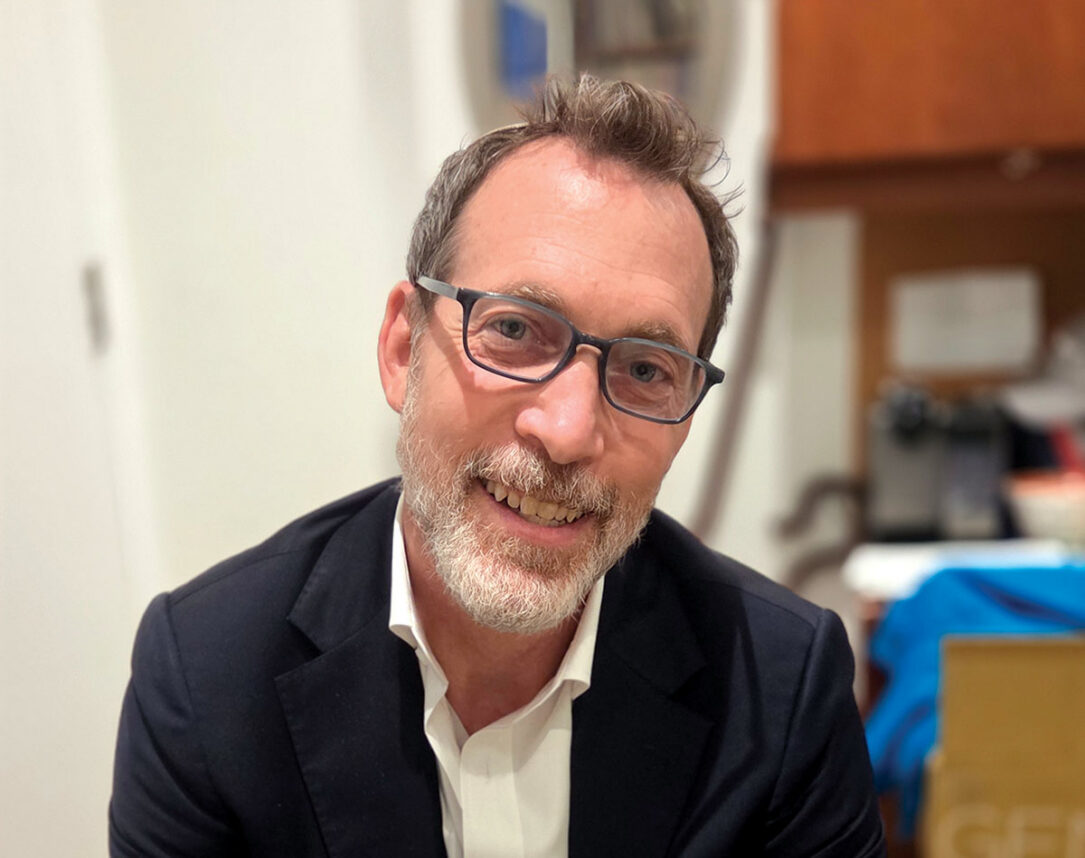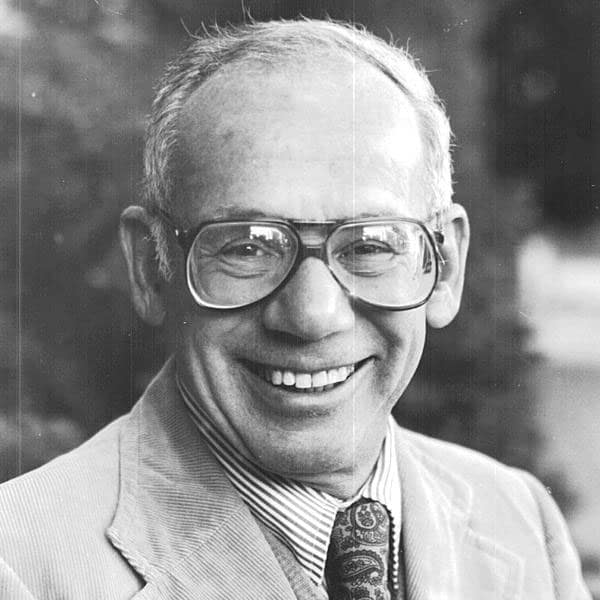
Daniel Burman, the Jewish-Argentine writer and director of “The Tenth Man,” was once offered a film project by a Hollywood studio, but he declined.
“I don’t like late parties and I’m usually in bed by 9 p.m.,” he said, explaining his disinclination to spend much time in our party town during an interview, via a Spanish-English translator.
Burman (pronounced Boorman), 42, sounds kind of laid back, at least in contrast to the stereotype of the frenzied Hollywood (read: Jewish) director, and his new movie partakes somewhat of the same quality.
The movie’s Spanish title, “El Rey del Once” (The King of Once), refers to the Buenos Aires district of Once, the Argentine equivalent of New York’s old Lower East Side, where immigrant Jews from Eastern Europe lived among their own while their children became part of the new homeland.
All of the film’s main characters, and the actors who portray them, are Jewish, starting with Ariel (Alan Sabbagh), a somewhat pudgy, 40-year-old bachelor. He now works as an economist in New York but has returned to the old neighborhood during the week of Purim, mainly to connect with his father, who goes by the single name of Usher.
When Ariel was growing up, his father was always too busy as a Jewish community organizer and as the fallback 10th man for every funeral and other minyan to pay much attention to the boy.
“Why does death always require a quorum of 10 men?” the neglected Ariel wonders.
Usher, who is never seen but constantly gives directions and assignments to Ariel via cellphone, is now head of Once’s Jewish welfare agency. If the movie’s Usher and his staff seem real, it’s because they are the actual people who work at the agency.
Always short of funds, the agency’s operation relies on makeshift solutions, such as sending a hungry petitioner to a nearby bar mitzvah celebration to gorge himself.
Another assignment for Ariel, via Usher’s cellphone, is to clean up the apartment of a recently deceased woman with instructions to scour her medicine cabinet for drugs that might be useful to a future agency client — and don’t pay any attention to the expiration date.
Ariel is also dispatched to a hospital to persuade a patient, a giant of a man, to finally take a shower.
It turns out that there is method to Usher’s series of assignments: By sending his unmarried assistant Eva (Julieta Zylberberg) to the same place as Ariel, he hopes something will click between them. Eva is pretty, prim and devoutly Orthodox. She also goes to the mikvah, where Ariel spies on her, admires her backside and the relationship grows warmer.
Throughout the film, the action is accompanied by a rich menu of Jewish songs, dances and rituals to gladden the heart of even the most casual member of the tribe.
In the movie’s final scene, during a Purim celebration, Ariel cruises down the street in an old convertible — the King of Once, with a paper crown on his head.
While Hollywood and European films on the Jewish experience frequently touch on the problems of subtle or pronounced anti-Semitism, this is not the case for Argentine movies.
Although in the past, during the Peron dictatorship and Argentina’s “dirty war,” many Jews suffered and a considerable number immigrated to Israel, the situation has changed drastically, Burman said.
“Judaism and the Jewish identity are very natural to me and I haven’t experienced any anti-Semitism,” Burman, the son of Polish-Jewish immigrants, observed, although added, “Perhaps there has been some discrimination and I just didn’t realize it. I am happy to have been born in an age when I can live as a Jew without fears for my survival.”
“The Tenth Man” opens Aug. 5 at Laemmle’s Royal Theater in West Los Angeles and Town Center in Encino.