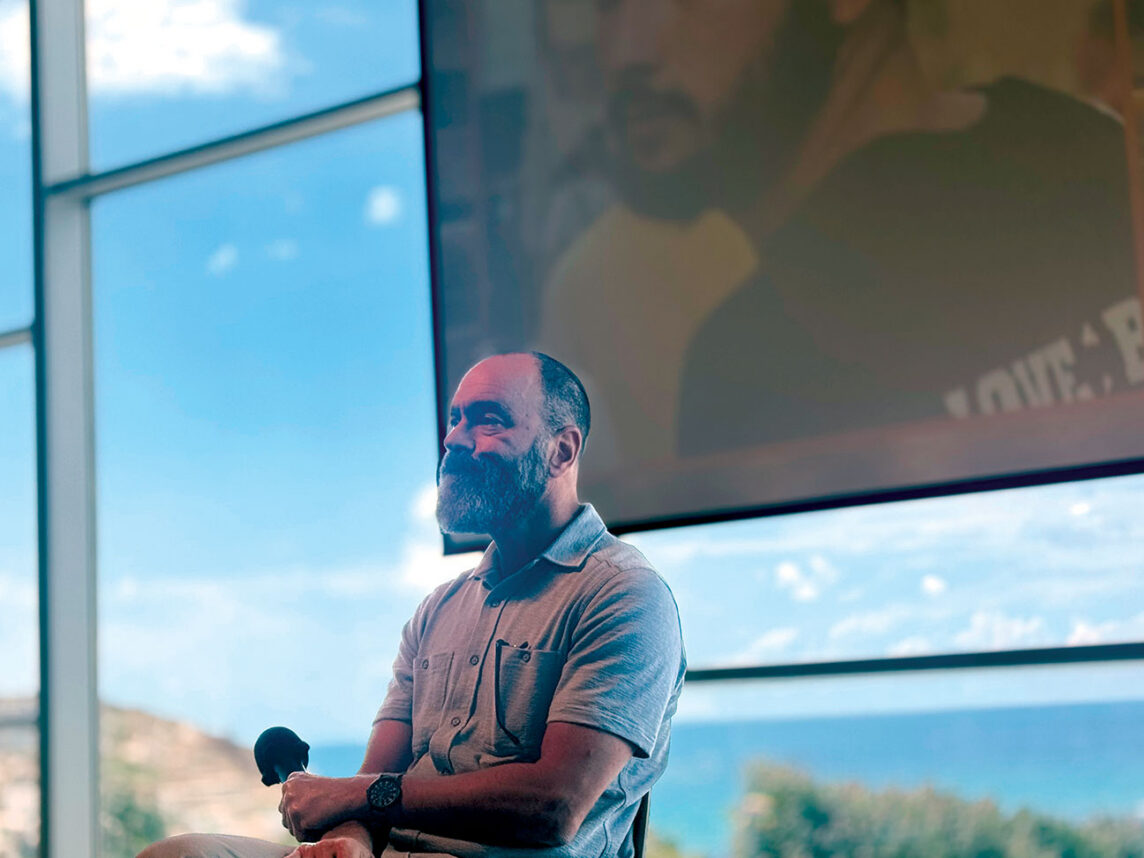

In a discussion with Jewish leaders at the Simon Wiesenthal Center’s Museum of Tolerance on June 18, German President Frank-Walter Steinmeier discussed a range of issues, with a focus on the Iran nuclear deal and the rise in anti-Semitism in parts of Europe.
On the Iran deal, Steinmeier acknowledged it would be difficult for Europe to continue to uphold the deal because President Donald Trump, in walking away from the agreement, had laid out secondary sanctions on companies doing business with Tehran. He also said he didn’t think the Iranian mullahs would relinquish their grip on power anytime soon.
Steinmeier was Germany’s chief negotiator when the Iran deal was forged in November 2013. In October 2015, Steinmeier hailed the agreement as “an opening for further diplomatic endeavors.” On May 6, Steinmeier told ARD, a German public news outlet, that former U.S. Secretary of State John Kerry was correct in saying that the deal avoided war.
“One has to remember what could happen if this agreement collapses again and new re-armament takes place in the Middle East,” Steinmeier told ARD.
Two days after Steinmeier made those remarks, Trump announced the U.S. was exiting the Iran deal, arguing that it enriched and emboldened Iran’s reign of terror in the Middle East. After his announcement, Simon Wiesenthal Center Dean Rabbi Marvin Hier and Associate Dean and Global Social Action Director Rabbi Abraham Cooper praised Trump’s decision.
“Leaving the status quo with Iran awash with billions of U.S. taxpayers’ cash would only ensure a growing circle of violence and terrorism in the region and ultimately could help pave the way for a nuclear arsenal that could reach our shores,” Hier and Cooper said in a statement.
During his visit, Steinmeier, together with a German delegation that included Germany’s ambassador to the U.S. and 10 members of the federal parliament, took a tour of the museum led by Hier, Cooper, the Wiesenthal Center’s Executive Director Rabbi Meyer May and Board Chairman Larry Mizel.
Steinmeier became the first German official to read a letter at the museum written by Adolf Hitler in 1919, in which Hitler first outlined his plans for the annihilation of the Jews.
Steinmeier became the first German official to read a letter at the museum written by Adolf Hitler in 1919, in which Hitler first outlined his plans for the annihilation of the Jews.
Hier told the delegation that Hitler wrote the letter when he was working for the Bavarian army’s propaganda section. Asked to respond to a Bavarian army undercover agent – — Adolf Gemlich — whether Jews were responsible for backstabbing Germany during World War I, Hitler wrote a four-page letter to Gemlich that read in part: “Anti-Semitism stemming from purely emotive reasons will always find its expression in the form of pogroms. But anti-Semitism based on reason must lead to the systematic legal combating and removal of the rights of the Jew, which he alone of the foreigners living among us possesses (legislation to make them aliens). Its final aim, however, must be the uncompromising removal of the Jews altogether. Both are possible only under a government of national strength.”
About 22 years later, Hier said, those words became a “horrifying reality for Jews in Germany.”
In response to today’s rise in anti-Semitism, including a June 8 Al Quds Day protests in Berlin with 1,600 protestors showing support for the Iranian regime and calling for the destruction of Israel, Steinmeier said that Germany expects newcomers to understand Germany’s past and to abide by the laws of the nation, including the protection of its Jewish minority.
At the end of his visit, Steinmeier told reporters:
“Germany and the United States are bound by our eagerness to develop democracy, so we are looking not only backward to the past, we are looking to the future where digitalized communication will influence our daily life and our societies, and will change for sure the liberal democracies.”