

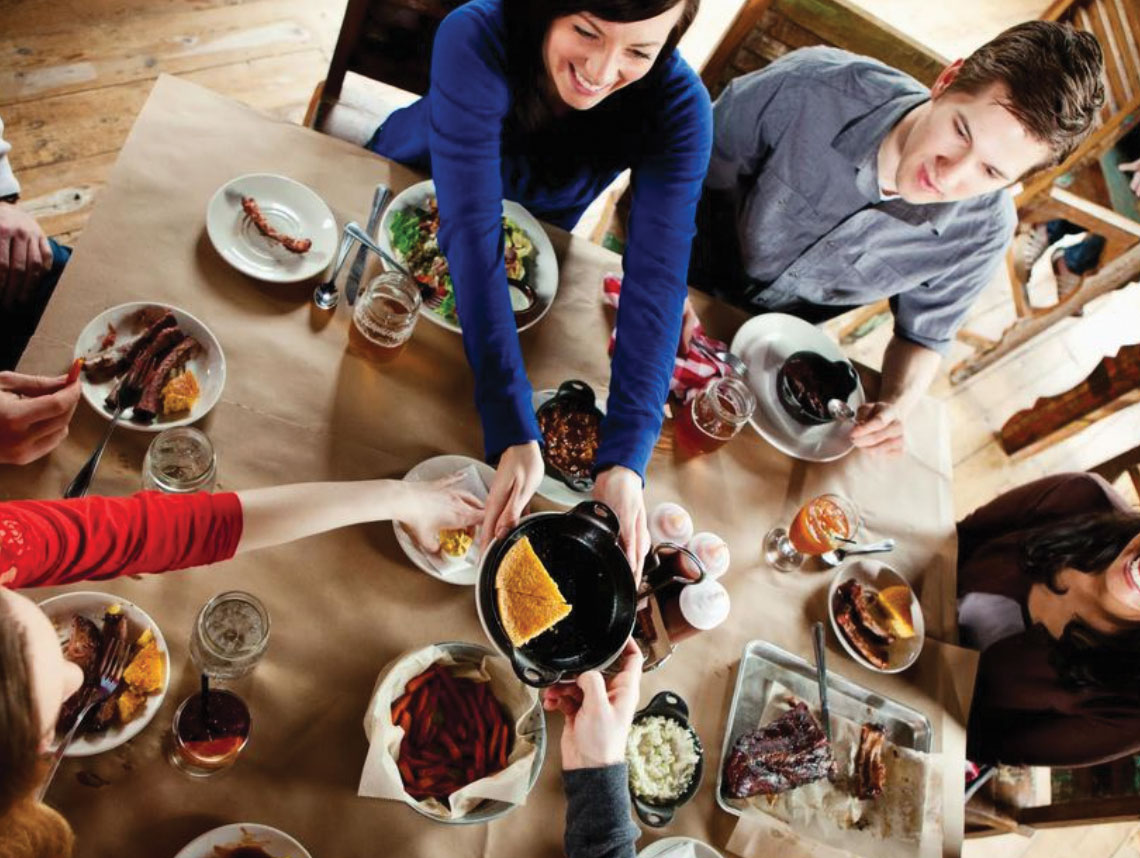
“A New Way to Friday” is the slogan of OneTable, a website and app designed to help millennials find a Shabbat dinner in major cities, including Los Angeles, San Francisco, Atlanta, Boston, Chicago, New York and Washington, D.C.
“We wanted to make sure our users could utilize our services to get Shabbat dinners happening around the country, so we started developing this app to make that easier,” said Al Rosenberg, a OneTable spokeswoman.
OneTable was launched as a nonprofit in 2014 by a group of foundations and philanthropic groups. So far this year, its members have hosted 2,700 Shabbat dinners for 33,000 guests.
“We open hubs in major cities by finding local funders,” Rosenberg said. “Each city has its own flavor and interests because of the different funders. The hub we are opening in Los Angeles soon will be funded by a couple of different people to work with the community.”
Founders of OneTable are The Steinhardt Foundation for Jewish Life and The Paul E. Singer Foundation. The organization’s website also lists several other national and regional supporters.
Analucia Lopezrevoredo, OneTable’s senior manager of the West Coast, said she hopes to expand OneTable into all regions of Los Angeles County.
“We are reaching as far as Pasadena and Santa Monica, and up to the north to Malibu, and are hoping to expand in the [San Fernando] Valley,” Lopezrevoredo said.
So far in the L.A. region, 150 hosts are combining efforts to hold about four dinners every Friday.
OneTable primarily targets millennials who find themselves lacking affiliation with a Jewish institution. The organization provides coaching for hosts to address any questions or challenges that might arise during a Shabbat dinner.
“Our coaches are freelance employees who we hire when our hosts need some extra support, either learning a Jewish ritual or how to cook,” Rosenberg said. “We have 150 coaches across the country and get engaged when we have a new host.”
Coaching and OneTable’s “nosh:pitality” events bring together people in their 20s and 30s to learn traditions such as how to bake challah and how to create a community. The nosh:pitality events are run by hub managers.
“We invite anywhere from 10 to 30 people to come do fun events,” Rosenberg said. “Oftentimes, it is pasta-making or learning to roll your own sushi or Jewish learning components. They [the attendees] will learn skills there and go on to host their own Shabbats.”
Prospective hosts are required to apply through the OneTable website at OneTable.org, where they are asked questions about why they want to host Shabbat dinners. Then they are matched with the local hub managers to have a conversation about what a host wants to bring to their Shabbat and where they may need help. If people are not in a OneTable hub, they are connected with national hub managers.
“I have hosted two dinners and it was an incredibly special experience,” said Izzy Pollak of Los Angeles. “I was raised mildly Jewish [Reform]…. I didn’t have it [Shabbat] every Friday, and it wasn’t beaten into my head, and I didn’t always value it growing up, but these last two experiences after Birthright … and coming back from Israel and the ‘Shabbat of a Lifetime’ book contextualized the prayers. When I was bringing our group through the prayers of the evening it was really nice.”
A OneTable member can hold three types of Shabbat dinners: by invitation only, through the approval of the host, or a dinner open to the public. The idea is to accommodate the preferences of the host. OneTable provides the host with grants of $15 for each person attending the Shabbat dinner, up to 10 guests. Additional money is available if the cost of the dinner is higher.
Dinner options include kosher and vegetarian choices and whether alcohol will be part of the meal. Dinners are not denomination specific, but ultimately, it is the host’s choice to decide the kind of Shabbat dinner to organize.
While dinners tend to draw mostly locals, OneTable has seen a recent increase in people using the service when they happen to be passing through a city looking for a Shabbat dinner.
“In the beginning, we had imagined that the people who would be the most interested would be the middle-of-the-road people who sometimes attend temple but not all the time,” Rosenberg said. “But it has been a huge spectrum. We have some Orthodox dinners and we have some dinners from people who have not done anything Jewish since they were a child.”
An earlier version of this story incorrectly cited the website and app’s founders. They are the Steinhardt Foundation for Jewish Life and the Paul E. Singer Foundation.

































