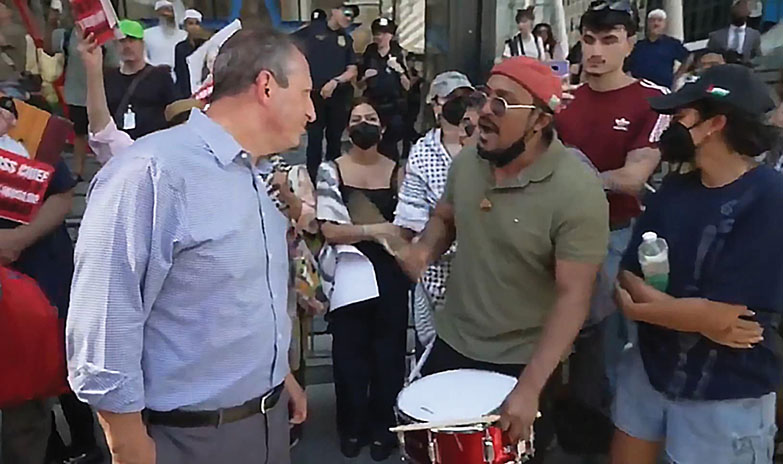
There are two ways of looking at the violence that wracks Israel and the Palestinian autonomous zones. One is that it proves the peace process must stop. The other is that it proves the process must continue.Which conclusion people reach no doubt depends on conclusions they reached long before the rioting that has claimed 53 lives as of Tuesday and left scores wounded. To polemicists and true believers on either side, the street battles are simply more evidence of the justness of their cause.
For these people, everything is fodder. The widely broadcast image of 12-year-old Muhammed al-Durah, crouched in terror behind his father just before he was shot dead by Israelis in the crossfire between Israeli and Palestinian troops, would seem to stand apart as a symbol of any conflict’s cruel human price. Al-Durah was a fifth grader; a good student; a boy who, according to The New York Times, raised pet birds; and, along with the rest of his friends, threw rocks at Israeli troops. To many Palestinians, he’s a martyr whose death cries out for yet more blood. To some Jews, he’s a victim of a madness Yasser Arafat chose to unleash.
But to more dispassionate observers, the peace process has always been about demographics, not blame. What matters, in the end, is not who got there first, who hates whom more, or even into whose ear God whispered and when. What matters, as Prof. Steven Spiegel points out (p. 6), is the fact that millions of Arabs and millions of Jews have to find a way to share a very small piece of earth. They do not have to be friends, but they have to be neighbors. Riots, rhetoric, even – God forbid – war will never change that fact, only return the antagonists, time and again, to face it anew.
Does Israel want to be a smaller democratic state with a largely Jewish population? Or does it want to become an apartheid regime controlling a rebellious population of Arabs in the territories who want no part of it? Do the Palestinians want to lose more generations to fighting and occupation, or do they want independence and a shot at normalcy? The smoke and headlines will go away, those questions won’t.What is telling about the reaction of Jews in Los Angeles to the violence in Israel is how little of the discussion in synagogues, by e-mail and on the street focuses on assigning blame. Leaders and pundits point fingers, while we, from a safe distance, have long ago decided to concentrate less on, “Who started it?” and more on, “When will it end?” We are sad, we are anxious, we wish this New Year could be the time to celebrate a peace deal that seemed possible at the start of the Camp David talks last August. Instead, we go into shul on Yom Kippur and pray, Maybe next year.
Feed a Child, Starve a Seagull
Last week, at least 100 people converged at Venice Beach on the second day of Rosh Hashanah for Mishkon Tephilo’s tashlich service. According to the ritual, they tossed scraps of bread into the ocean, symbolizing a fresh year of transgressions for which they seek forgiveness. As soon as Rabbi Dan Shevitz began intoning the liturgy, seagulls filled the sky above the breakers. “Like swallows returning to Capistrano,” a congregant said. “The birds probably have tashlich on their biological clock,” another laughed.This year, as in the past, there were plenty of scraps of bread to feed on. We resolve to do better, but every year we find ourselves with plenty of reasons to cast our bread upon the waters. Even the birds know that by now.And come next year, we will be back, have no doubt about it, with a fresh list. In 5761, the November election, the fight over vouchers, the mayor’s race, not to mention the normal tensions of Jewish communal life and the strains of family and work, will provide ample opportunity for new transgressions. The cycle suggests that the struggle to be stainless and sin-free is a losing battle. But the holiday’s liturgy gives us an out: Acts of kindness, it says, help balance the scales. It’s no accident that ancient synagogue mosaics represent this month with the astrological symbol of Libra.Some of us manage, through acts of transcendent humanity, to tip the scales in our balance. For one striking example, read the story of Christina Wright on p. 14. For the rest of us, there are smaller ways to make a difference.You might think of that when attending services Sunday and Monday. More than 700 synagogues around the country have teamed with L.A.-based MAZON: A Jewish Response to Hunger, which since 1985 has distributed $23 million to nonprofit hunger relief agencies around the world, feeding people of all backgrounds. At your Yom Kippur services, you should be able to fill out a pledge card to MAZON (or try www.mazon.org), donating to the organization what you would ordinarily spend on food that day. In this town, where a slab of ahi can set you back $30, that number could add up. A MAZON donation is a good way to wipe the slate clean for the New Year, before it starts filling up again.