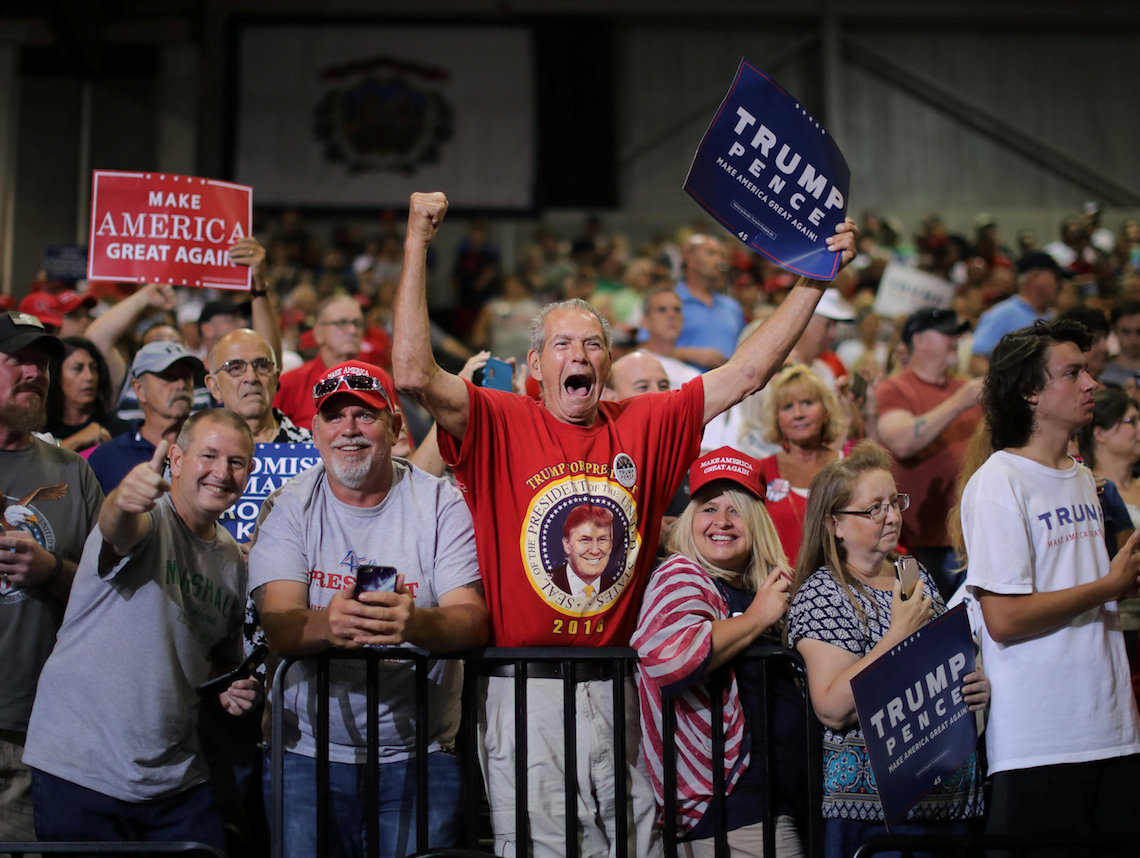
Do you ever find yourself wondering what the story is with those thrilled faces behind Donald Trump at his rallies?
Unlike us, they’re not spies in a house of horrors.
That sea of Make America Great Again hats doesn’t give them the creeps. When Trump cues them, as he did in Phoenix on Aug. 22, to jeer John McCain, no ambivalence about belittling a war hero battling brain cancer tempers their contempt. When Trump whines and whinges about the coverage his Charlottesville rant got, they realize, and don’t care, that he’s rewriting what he said — they heard him confer moral equivalence on neo-Nazis and anti-Nazis. But his act entertains them, and their complicity in his edits adds a perverse pleasure to the press hatred he rouses in them.
Who are these people?
They can’t all be the 9% of Americans who believe that holding white supremacist or neo-Nazi views is acceptable.
But there’s a decent chance they’re among the 62 percent of Trump voters who think millions of illegal votes won Hillary Clinton the popular vote; the 54 percent of his voters who say the most oppressed religious group in America is Christian; the 52 percent who believe Barack Obama was born in Kenya; the 46 percent who believe Clinton ran a satanic child-sex ring in the basement of a Washington, D.C., pizza parlor; the 45 percent who say the racial group facing the most discrimination in America is white people; and the 40 percent whose main source of news is Fox News.
I get that Trump’s base feels marginalized, left behind by a minimum-wage economy, powerless to control their futures, dissed by urban elites. I know why they’re fed up with partisan gridlock (I am, too); I see why they’d favor a business brand over a political name as president. They’re disgusted by the corruption in Washington (ditto); no wonder they’re drawn to a bull who’d break some china and a bully who’d break some heads.
But after seven months of lying, sleaziness, impulsiveness, laziness, vengeance, arrogance, ineptness, ignorance, nepotism, self-love and Putin love, how can 3 out of 4 Republican voters still be sticking with him? How come those faces I see on TV don’t see the nightmare I see? (I don’t mean that bizarre “Blacks for Trump” guy; I mean the rest of them.)
That’s what I’m wrestling with. Here’s what I got:
It’s not because they’re stupid. It’s because they’re human. It’s not because they’re so different from me. It’s because they’re so much like me.
But here’s what makes that hard to swallow: I can’t muster the humility to believe we’re both wrong, and I can’t summon the relativism to believe we’re both right. But believing that I’m right and they’re wrong, as I do, gets me laughably crosswise with everything I know about human cognition.
Homo sapiens have refined a method of study and understanding — science — that’s reaped powerful knowledge about the world. But the more we’ve used science to study ourselves, to probe the neurobiology of how we think and what we feel, the more inescapable it’s become that “rational” is too flattering a term to describe what makes humans tick, even when we’re at our best.
It’s not pretty to admit, but no matter how practiced we are at critical thinking, how hip we are to the social construction of reality, how savvy we are about manipulation and framing, we still conflate what we want to be true with what actually is true. Our minds unconsciously invent retroactive rationales — we reverse-engineer justifications — for what our bodies already have made us think, say and do. What we call reason turns out to be a byproduct of our addiction to feel-good chemicals like dopamine, serotonin and oxytocin.
Human cognition is a captive of confirmation bias: We seek out and believe information that reinforces what people like us already believe. Confronted by evidence that contradicts what we think, we double down; confronted by chance, we confect necessity. Instead of changing our minds, we tell ourselves stories and cling fast to our tribal identities. A universe that’s run by luck is terrifying, but a good narrative imposes causality on randomness, finds patterns in chaos and purpose in lives. Our hunger for knowledge isn’t as strong as our yearning to belong, to defeat fear and loneliness with affiliation and family. We may call the baskets into which we sort facts “true” and “false,” but at bottom they’re euphemisms for “us” and “other.”
And yet my awareness of the limitations of logic, my appreciation for the ways human hardwiring privileges feelings over facts — they don’t inoculate me from maintaining that Trump is objectively unfit for office. I can’t let neuroscience discount my claim to truth-value: I don’t think calling Trump a liar illustrates confirmation bias at work. The reason the people I see at Trump rallies on my TV screen believe the psychopath at the podium is telling the truth may well be their membership in Tribe Trump. That explanation may nudge my empathy for them upward, but it doesn’t dampen my conviction that I’m right and they’re wrong, and it doesn’t make their belief in the falsehoods he spews any less scary.
Science may be humbling, but humility doesn’t make me feel like a dope when I call out dopiness when I see it.
MARTY KAPLAN is the Norman Lear professor at the USC Annenberg School for Communication and Journalism. Reach him at martyk@jewishjournal.com.