With a couple of weeks left before we choose our next president, I’ve been reflecting on how the process has affected me, both as a Jew and as an American.
The biggest thing I have learned is that certain emotions have the power to close my mind and make me intolerant. Because I’m crazy in love for Israel, I’m a blind supporter of President Bush. His evangelical, visceral connection to Israel is what I’ve been yearning for for as long as I can remember. No matter how hard other presidents tried, it just wasn’t the same.
Thus, it was not a great leap to convince myself that Iraq was the right war at the right place at the right time. If anything contradicted my view on this subject, I would easily dismiss it. Whatever confirmed my view, I just lapped up. Supporting Bush just felt good.
So when I was invited last week by the American Jewish Committee to speak on the U.S. election in the context of Jewish and Israeli interests, I figured it would be a no-brainer. I was introduced as the right-wing speaker who would “balance out” the left-wing speaker who came next. All I had to do was just give my spiel on why they should vote the way I would.
There was only one problem: I wasn’t so sure anymore. A day earlier, I got ambushed by a story in the Oct. 10 New York Times Sunday Magazine. Call me crazy, but I read something diametrically opposed to my beliefs, and it made sense. Too much sense. The possibility that I might have missed the boat on Iraq gave me this odd mixture of sick-to-my-stomach and utter fascination.
So there I was in front of a big crowd, all expecting a pro-Bush rant. What’s a shaken-up right-winger to do? I decided to jump and put myself at the mercy of my true feelings.
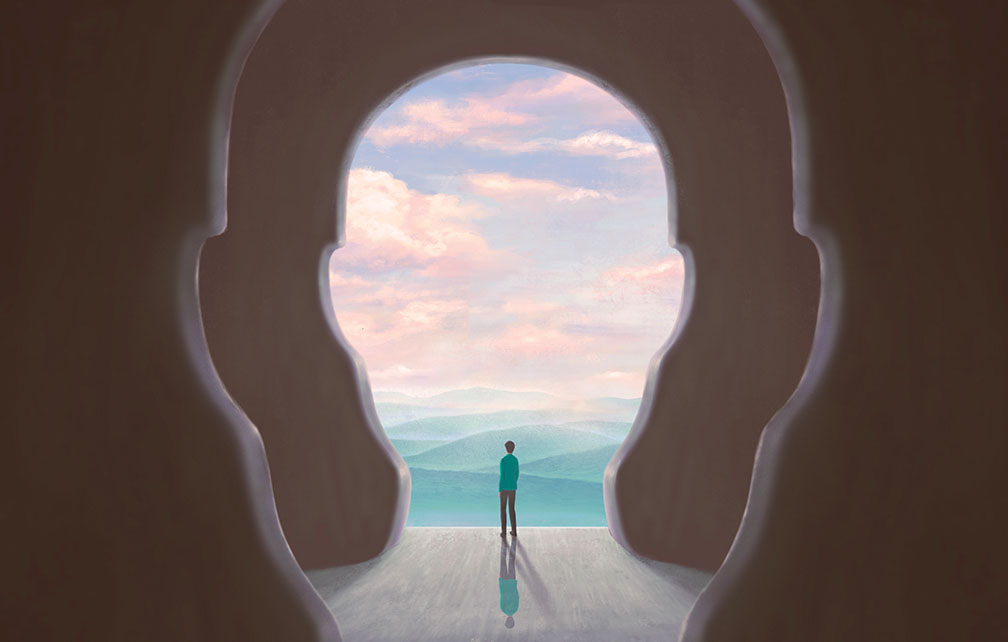
I shared my story. I told them that there was something more important on my mind than simply who to vote for on Nov. 2. I explained how my beliefs were shaken by a magazine article. My talk became not about the value of a vote but the Jewish value of keeping an open mind.
In a nutshell, the article, “Kerry’s Undeclared War,” which profiled Sen. John Kerry, made a compelling case that a loud, dramatic war on terrorism is more likely to backfire than a more subtle yet lethal approach. I was intrigued by the idea that high drama might feed the neurosis of a suicidal, pathological enemy. It didn’t necessarily change my mind — it still might — but it did something more important: it opened it. In a potent way, the challenge to my strong view made me feel more alive, more Jewish.
It also made me realize how I let my emotional connection to Israel and to Bush sucker me into the vortex of easy, simplified partisan battles; how I’ve let it close my mind.
Sometimes I think that our first goal in life is to look for things that make us feel good. With life and the world around us so often chaotic and dangerous, we prefer to look for whatever will assuage our insecurities, rather than anything that might challenge our views and force us to confront our inner doubts.
There is a theory in organizational behavior that says when you interview someone for a job, most people make their decision in the first few minutes and spend the rest of the time trying to confirm it. This is what seems to have happened to America in this election season.
The large majority of people quickly made up their minds and now look for confirmation that will make them feel good about being right. The national pastime has become to dig in our heels.
Keeping an open mind while still having strong views is uncomfortable. It’s not sexy or dramatic. It requires us to live with paradox, to accept being challenged, to push ourselves.
I was challenged by a magazine article and forced to dig deep and deal with my discomfort. But as a committed Jew, that was the point: What is the Jewish way if not to go deep?
Did our ancestors not dig deep when they debated for 600 years to interpret God’s message and give us the Talmud? Did they not show us that we can have a point of view without being dogmatic? That there is divinity itself in the difficult acts of engaging, exploring, challenging and, ultimately, connecting with each other?
The sages of the Talmud did not write to make us feel good. The arguments and counterarguments and counter-counterarguments that crowd its 40 volumes is what has kept Judaism alive until today. And if we follow its paradoxical example of principled open-mindedness, we will always feel alive as individuals and as one community.
The problem is that our need for easy comforts has trumped our deeper need to grow by gaining knowledge. The right-winger who only watches Fox TV is only getting her daily fix. The liberal who only reads Tikkun magazine is feasting on candy that will nourish his self-righteousness. We consume comforting opinions and then repitch them to each other like walking commercials.
We are left with a strident, superficial national debate that more closely resembles a boxing match. What matters most is not whether I gain new knowledge, but: Who won the debate? Who landed a knockout punch? Will my side win?
The most startling fact in the New York Times article was that Kerry could not go too public with his real view on fighting terror, because it might be unpopular and hurt his chances. Never mind that it would deepen the debate and show sincerity; the point is only to win.
Some of my ideological friends say that when the stakes are so high, we cannot afford to be too open-minded. For the Israeli settlers who adamantly oppose the evacuation of settlements, open-mindedness is not an option. For the Bush supporters who are adamant that his way is the best way to fight terrorism, being open to alternate views is simply showing weakness.
My view is the opposite: The higher the stakes, the deeper the debate must go. Ultimately, the danger of a dogmatic, simplified debate is that it leads to dogmatic, simplified solutions.
By digging in our heels and closing our minds, we only encourage our leaders to feed us lollipops. The more undecided, open-minded and probing voters are, the deeper the candidates will go; the deeper the solutions will be.
In the Jewish tradition, deep debate is integral to our survival. It leads not only to better ideas but also to a more vibrant religion and a healthier nation.
But the heart is a powerful drug. I’ve seen in the past year how my emotional connection to the Holy Land has turned me into someone I always try not to be: close-minded and intolerant of dissenting views.
There are certainly some things I will always feel strongly about, but I will not let those feelings turn off my mind.
I still don’t know who I’ll vote for, but I know now that I won’t let my heart do it alone. And I confess, that feels pretty good.
David Suissa is the founder and editor-in-chief of OLAM magazine and the founder of meals4israel.com. You can e-mail him at editor@olam.org.