What do Oscar-bait dramas, B-horror films, superhero flicks and quirky comedies have in common?
Nazis.
Heroes face off against mutant Nazis in the Marvel Universe. One of the superhero saga’s directors, Taika Waititi, is playing Adolf Hitler in his upcoming satire “Jojo Rabbit.” Between “Ida,” “The Pianist,” “Schindler’s List,” “Sophie’s Choice,” “The Reader,” “Inglourious Basterds” and “The Imitation Game,” an ever-widening range of films with Third Reich antagonists have swept up Academy Awards.
Nazis are “the unquestioned consensus villains of the 20th century” according to Thomas Doherty, professor of American Studies at Brandeis University. Doherty is a cultural historian and the film review editor for the Journal of American History who authored “Hollywood and Hitler.”
As the number of living Holocaust survivors dwindle, it seems that Hollywood’s infatuation with Nazi adversaries will outlive the people who faced them in real life.
Filmmakers have deemed Hitler’s regime the perfect antagonist, given the lack of gray area surrounding their cruelty. However, the saturation of Nazism in our cinematic culture encourages the overuse of the rhetorics of our culture.
Nazi foils are particularly handy in establishing the moral righteousness of protagonists in film and television, unlike other American wartime enemies.
“The reason it’s particularly congenial to film is you have this absolutely clear moral trajectory in any sort of conflict, which is rare,” Doherty said. “Even if you go to the Japanese theater, you’ve got the dual racism on both sides that is operating. You have dual guilt about the internment camps and Hiroshima and Nagasaki; it’s not quite as clear a moral template as the allies and the Nazis.”
Nazis are also simply cinematic.
“They’ve got the regalia, the uniforms, and are personified by a series of villains you love to hate,” Doherty said. “The parts are just so deliciously sinister that we almost embrace them.”
“That’s kind of what Nazis have become onscreen — these
scene-stealing villains.” — Thomas Doherty
This infatuation is not lost on filmmakers. In fact, according to Doherty, Quentin Tarantino has directly addressed this trope.
“The Tarantino movie ‘Inglourious Basterds’ is so instructive. What that movie is really about — it’s not about historical Nazism at all — but it’s about our kind of love affair with the Nazis on screen,” Doherty explained. “And it is a love affair because whether it’s the Nazi villains in ‘Casablanca’ or even ‘Schindler’s List,’ it’s the way Ralph Fiennes comes in and steals the movie from Ben Kingsley and Liam Neeson.”
You don’t have to enjoy this dynamic to acknowledge it exists.
“There’s something really perverse about that, but that’s kind of what Nazis have become onscreen — these scene-stealing villains,” Doherty noted.
Hans Landa, “Inglourious Basterds’ ” Jew-hunter, is not only the most obvious example of a seductively sinister Nazi but also the most awarded. Christoph Waltz won the Cannes Film Festival’s best actor award, and the BAFTA, Screen Actors Guild, Critics’ Choice, Golden Globe and Academy Award for best supporting actor for the role.
It’s extremely rare for an actor to become a champion in both the worlds of French, British and American film but Waltz’s depiction of a terrifying Nazi was irresistible to all.
What also seems irresistible to many is comparing contemporary people to Nazis.
“Anytime someone says something wrong that you disagree with, ‘he’s a Nazi,’ right?” Doherty said. “The easy resort to these metaphors that we see in so much of our corrupted public discourse does make a generation forget what Auschwitz was actually like or the Nazis actually did. It just becomes a convenient shorthand for a villain of choice.”
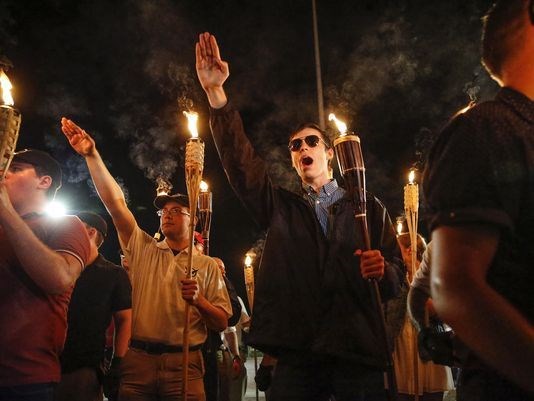
The diminishing returns on Nazi comparisons and imagery make it harder to grapple with their resurgence today.
Ariel Sobel is a screenwriter, filmmaker and activist.