Two weeks ago, I co-wrote an Open Letter to the Charles E. Smith Jewish Day School in the Washington, D.C. area raising concerns about the school’s “Diversity, Equity, Inclusion and Justice” (DEIJ) program. Like so many others, the school’s diversity program does not provide alternative perspectives to the typical “anti-racist” point of view. My co-author and I, both of whom had children graduate from the school, regard this “pedagogy” as a form of indoctrination.
I decided to post this Open Letter on JEDLAB, a Jewish educators Facebook group with 12,000 members. I was active in the early days of JEDLAB, a space where innovative educators shared and discussed cutting edge ideas and approaches often at odds with the Jewish educational establishment. I loved it so much I even interviewed the founder in eJewish Philanthropy.
It seemed a perfect forum for generating interesting and important discussion about emerging diversity programs in Jewish educational settings.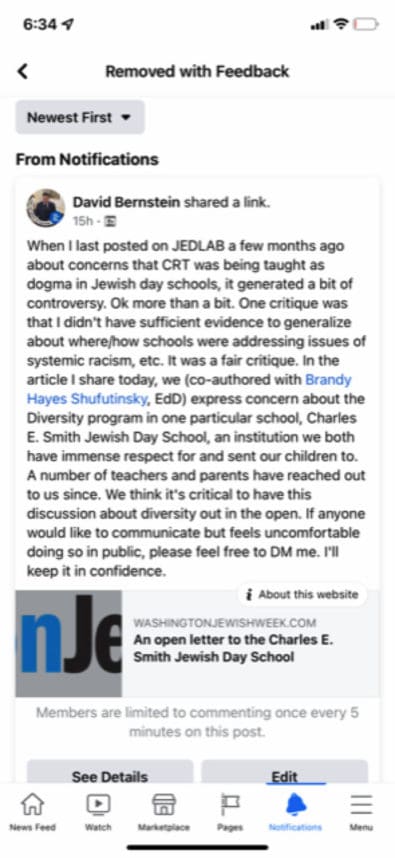
Apparently, however, DEIJ initiatives in Jewish schools are not open for discussion.
Almost immediately, a member of the Facebook group pronounced the post “racist.” The member said I had no business posting my views there. Several others piled on, also calling the post “racist” and urging its immediate removal. Not a single person took exception or came to my defense (except, of course, in private messages). The comment from the member accusing me of promulgating racism had numerous “likes,” including one from a mainstream Jewish professional who is a self-proclaimed moderate on the subject. His vote of support for this vitriol suggests otherwise.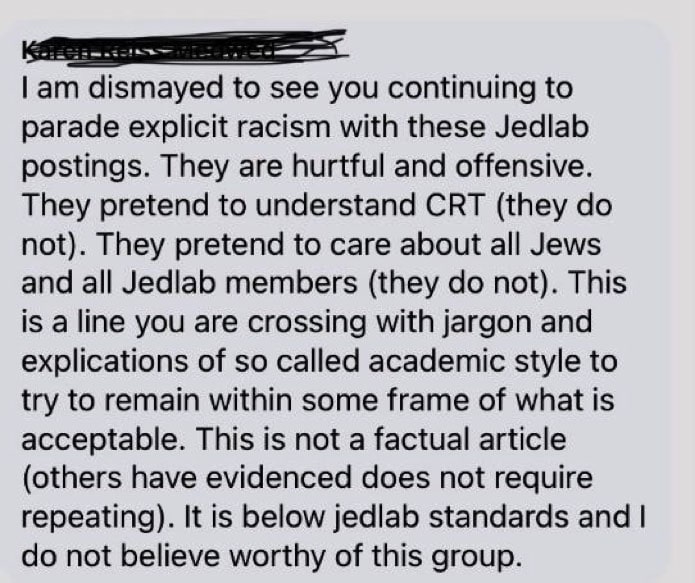
About an hour after posting, the post was removed without explanation by the administrators of the group. There are two possible explanations: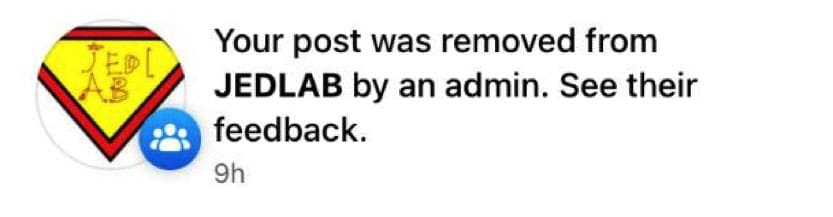
The first is that the administrators agreed that raising concerns about the “anti-racist” perspective being taught to kids is inherently racist. Ibrahim X. Kendi has spoken, and we must all fall in line.
If that’s the case, I despair over the future of Jewish education.
A second possibility is that the administrators received complaints that my ideas make the space “unsafe” for participants. This, of course, meant that the administrators had to silence someone with a different point of view. This is the “heckler’s veto”: a few shrill voices who protest a particular viewpoint get spineless institutions to stifle debate.
This is the “heckler’s veto”: a few shrill voices who protest a particular viewpoint get spineless institutions to stifle speech.
If that’s the case, I again despair over the future of Jewish education.
Our kids must be educated in a culture and sensibility that values Makhloket Leshem Shamayim—arguments for the sake of heaven. This sensibility welcomes—even encourages—debate among people with different points of view. The Jewish tendency to question and engage in intellectual discourse is one of the great qualities of the Jewish tradition. Why would anyone, least of all Jewish educators, try to blot this out? Don’t we want our kids to be critical thinkers and challenge the status quo?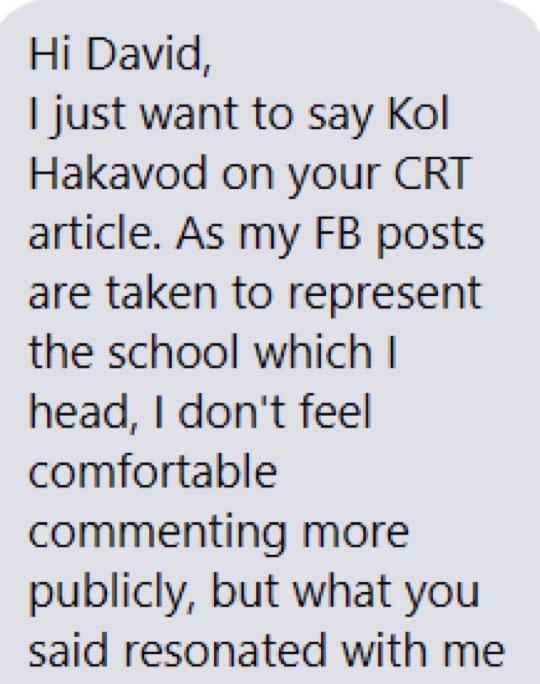
Of course, there are many Jewish educators and parents who do value discussion among people with different viewpoints. A headmaster of a pluralistic Jewish school direct messaged me on Facebook and thanked me for raising the topic. One prominent professor called to say “I wanted to kiss you.” Numerous Jewish day school teachers reached out to me and my co-author of the Open Letter, thanking us for giving a voice to their concerns. These teachers cannot speak publicly themselves because, well, they fear they will be cancelled, just like my Facebook post.
These teachers cannot speak publicly themselves because, well, they fear they will be cancelled, just like my Facebook post.
How is that good for the Jews?
David Bernstein is the Founder of Jewish Institute for Liberal Value (JILV.org). Follow him on Twitter @DavidLBernstein.

Cancel Culture, Jewish Educators Style
David Bernstein
Two weeks ago, I co-wrote an Open Letter to the Charles E. Smith Jewish Day School in the Washington, D.C. area raising concerns about the school’s “Diversity, Equity, Inclusion and Justice” (DEIJ) program. Like so many others, the school’s diversity program does not provide alternative perspectives to the typical “anti-racist” point of view. My co-author and I, both of whom had children graduate from the school, regard this “pedagogy” as a form of indoctrination.
I decided to post this Open Letter on JEDLAB, a Jewish educators Facebook group with 12,000 members. I was active in the early days of JEDLAB, a space where innovative educators shared and discussed cutting edge ideas and approaches often at odds with the Jewish educational establishment. I loved it so much I even interviewed the founder in eJewish Philanthropy.
It seemed a perfect forum for generating interesting and important discussion about emerging diversity programs in Jewish educational settings.
Apparently, however, DEIJ initiatives in Jewish schools are not open for discussion.
Almost immediately, a member of the Facebook group pronounced the post “racist.” The member said I had no business posting my views there. Several others piled on, also calling the post “racist” and urging its immediate removal. Not a single person took exception or came to my defense (except, of course, in private messages). The comment from the member accusing me of promulgating racism had numerous “likes,” including one from a mainstream Jewish professional who is a self-proclaimed moderate on the subject. His vote of support for this vitriol suggests otherwise.
About an hour after posting, the post was removed without explanation by the administrators of the group. There are two possible explanations:
The first is that the administrators agreed that raising concerns about the “anti-racist” perspective being taught to kids is inherently racist. Ibrahim X. Kendi has spoken, and we must all fall in line.
If that’s the case, I despair over the future of Jewish education.
A second possibility is that the administrators received complaints that my ideas make the space “unsafe” for participants. This, of course, meant that the administrators had to silence someone with a different point of view. This is the “heckler’s veto”: a few shrill voices who protest a particular viewpoint get spineless institutions to stifle debate.
If that’s the case, I again despair over the future of Jewish education.
Our kids must be educated in a culture and sensibility that values Makhloket Leshem Shamayim—arguments for the sake of heaven. This sensibility welcomes—even encourages—debate among people with different points of view. The Jewish tendency to question and engage in intellectual discourse is one of the great qualities of the Jewish tradition. Why would anyone, least of all Jewish educators, try to blot this out? Don’t we want our kids to be critical thinkers and challenge the status quo?
Of course, there are many Jewish educators and parents who do value discussion among people with different viewpoints. A headmaster of a pluralistic Jewish school direct messaged me on Facebook and thanked me for raising the topic. One prominent professor called to say “I wanted to kiss you.” Numerous Jewish day school teachers reached out to me and my co-author of the Open Letter, thanking us for giving a voice to their concerns. These teachers cannot speak publicly themselves because, well, they fear they will be cancelled, just like my Facebook post.
How is that good for the Jews?
David Bernstein is the Founder of Jewish Institute for Liberal Value (JILV.org). Follow him on Twitter @DavidLBernstein.
Did you enjoy this article?
You'll love our roundtable.
Editor's Picks
Israel and the Internet Wars – A Professional Social Media Review
The Invisible Student: A Tale of Homelessness at UCLA and USC
What Ever Happened to the LA Times?
Who Are the Jews On Joe Biden’s Cabinet?
You’re Not a Bad Jewish Mom If Your Kid Wants Santa Claus to Come to Your House
No Labels: The Group Fighting for the Political Center
Latest Articles
Bass, Raman, Israel
Torah Portion: B’ray’sheet
The Genocide Case Against Hamas
The Match That Oct. 7 Struck
Will Sept. 30 Go Down in History Like Oct. 7?
This Just Makes It Worse
Oct. 7 Makes Me Grateful for the Secular Calendar
It’s hard to imagine commemorating such a dark event on a day of joy. The cognitive dissonance would be unbearable.
October 7th and the Secret of Simchat Torah
In the last three years, so many heroic people have decided that October 7th will not be the tragic end.
Rabbis of LA | Rabbi’s Heroic Friend Remembers Oct. 7
First of two parts
EarlyJ Invests More Than $510,000 to Expand Jewish Parenting Centers Across California
Their goal is to ensure Jewish preschools become community hubs for families, starting in the earliest stages of parenthood.
Our Eyes Blink — A poem for Parsha Vezot Hab’rachah
My son turned eighteen yesterday…
AFHU Bel Air Affaire, Los Angeles Jewish Film Fest Screening
Notable people and events in the Jewish LA community.
A Moment in Time: Give a Child a Summer to Remember
A Bisl Torah ~ Fragility Beckons Daily Courage
Sukkot emphasizes that which we intrinsically know. We go outside and show the world that no matter the environment, we will express our Judaism with pride and joy.
October Seventh and the Reversal Caused by Sukkot
The Antisemitism You Won’t Hear About in the News
Liat Cohen-Reeis, director of the Antisemitism Task Force at StandWithUs San Diego, has tried to bring local news media’s attention to antisemitic incidents, but has encountered disinterest.
Print Issue: Crisis of Truth | October 2, 2026
An uproar over an article showing discrimination against Jewish and Israeli writers dramatizes how ideology and politics prevail over truth.
A Free Makeover: A Bath, a Haircut and a Second Chance
At the shelters, the grooming does more than make the dogs look and smell better.
Rochelle Furstenberg, Iconic Writer, Editor, Passes Away in Jerusalem
Furstenberg has been an iconic writer and editor in Israeli and American publications for decades, including for the L.A. Jewish Journal, and her death, even at the age of 90, on the eve of Rosh Hashana, deeply moved Jerusalemites who knew her.
What Kind of Judaism Do We Want After Oct. 7?
Arthur Green, “Can Judaism Be Saved: Its Future After Gaza” (Teaneck, NJ: Ben Yehuda Press, 2025) pp. 139.
Your Organization Doesn’t Need a Chatbot. It Needs Its Hours Back.
The point of all this isn’t to replace the people who keep our institutions running. It’s to give them back the hours they spend being human copy machines, so they can spend those hours on the work only people can do.
The Architecture of L’Dor Vador: How Physical Structures Shape Jewish Values and Intergenerational Life
This is more than a proposal to construct apartments. It is an invitation to reconsider what a Jewish institution can be.
Stuffed with Spice and Simcha
The custom of eating stuffed vegetables on Simchat Torah is to symbolize the scrolls of the Torah filled with the wisdom of the holy text.
Table for Five: Simchat Torah
Exclusive After-Party
Crisis of Truth
An uproar over an article showing discrimination against Jewish and Israeli writers dramatizes how ideology and politics prevail over truth.
Rosner’s Domain | Election Day Will Just Be a Beginning
Israelis are an impatient bunch, but their political processes can drag on and on – and on.
More news and opinions than at a Shabbat dinner, right in your inbox.