fbpx

October 22, 2021

VA Tech Graduate Student Senate Passes BDS Resolution

The Virginia Tech (VT) Graduate and Professional Student Senate (GPSS) passed a resolution endorsing a boycott of Israel during their October 21 meeting.

The resolution called for a “boycott of all Israeli academic institutions complicit in maintaining the Israeli occupation and the denial of basic Palestinian rights” and to divest from “all institutional investments from companies that profit from the Israeli occupation and apartheid.” It also accused Israel of “ethnic cleansing” against the Palestinians when the Jewish State was founded in 1948 and continually perpetuating “colonial violence” against the Palestinians today.

Alums for Campus Fairness condemned the resolution as “shameful” and meeting “the internationally accepted definition of antisemitism” in an October 22 statement. “As alumni, we value VT not only as a world-class academic institution, but as a safe, welcoming place for Jewish students. That is why we are calling on the VT administration to condemn this egregious resolution and move swiftly to adopt the [International Holocaust Remembrance Alliance’s] working definition of antisemitism as countless other universities and institutions have already done.”

StandWithUs CEO and Co-Founder Roz Rothstein similarly tweeted that the resolution was “antisemitic.” “Hopefully the university admin will speak out against this egregious resolution!”


AMCHA Initiative also tweeted that in calling for an academic boycott, the resolution “subverts the educational opportunities and academic freedom of students at Virginia Tech. This is #antisemitism.”

Prior to the resolution’s passage, the American Jewish Committee (AJC) tweeted that they were “outraged” that the resolution was even being voted upon at all. “Restricting academic freedom stands in opposition to the values of higher education. AJC calls on the university administration to condemn this resolution.”


The university and GPSS did not respond to the Journal’s requests for comment.


VA Tech Graduate Student Senate Passes BDS Resolution Read More »

Sunrise Movement Calls DC Chapter “Antisemitic” for Refusing to Participate in Rally Over “Zionist Organizations”

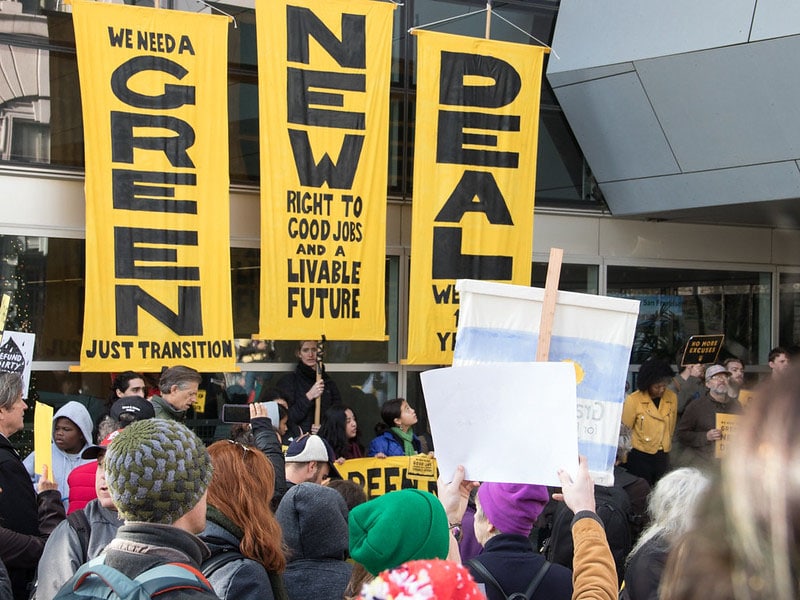
The national Sunrise Movement climate group denounced their Washington, D.C. chapter for being “antisemitic” in their refusal to participate in an October 23 voting rights rally because of “Zionist organizations.”

Sunrise DC cited the participation of the Jewish Council of Public Affairs (JCPA), National Council of Jewish Women (NCJW) and Religious Action Center of Reform Judaism (RAC) in the October 23 Freedom to Vote Relay – Rally at the Finish Line as being “in alignment with and in support of Zionism and the State of Israel.” “Given our commitment to racial justice, self-governance, and indigenous sovereignty, we oppose Zionism and any state that enforces that ideology,” they said in a statement. Sunrise Movement issued an October 21 statement saying they “reject all forms of discrimination, including antisemitism and anti-Palestinian racism” and that they “will always welcome anyone who acts on our principles and chooses to join the fight for collective liberation.”

But some Jewish groups, including the Anti-Defamation League (ADL) and the Jewish Democratic Council of America, argued that Sunrise’s statement wasn’t enough because it didn’t explicitly call out the inherent antisemitism in Sunrise DC’s desire to single out and exclude Jewish organizations. The Forward reported that Sunrise Movement issued a tweet condemning their DC’s chapter antisemitism after meeting with the JCPA, NCJW and RAC.

“To be clear, Sunrise DC’s statement and actions are not in line with our values,” the tweet read, which also included a photo of the organization’s October 21 statement. “Singling out Jewish organizations for removal from a coalition, despite others holding similar views, is antisemitic and unacceptable.”

Sheila Katz, who heads the NCJW, told The Forward that their meeting with Sunrise had “very productive dialogue and it resulted in an amended statement naming what happened as antisemitic.”

ADL CEO Jonathan Greenblatt tweeted that Sunrise provided a “helpful clarification” but “we remain concerned that these litmus tests targeting Jewish groups are becoming increasingly common. To be clear: excluding groups solely because they support Israel is antisemitic.”

Stop Antisemitism tweeted that Sunrise should “include your twitter caption in your statement,” “remove those responsible from your DC hub responsible for the antisemitism,” and “start actively working with the Jewish groups isolated, as well as others, to rectify this to make sure it doesn’t happen again.”

Joel M. Petlin, Superintendent for the Kiryas Joel School District, tweeted: “Usually the organizational statement is better than a mere Tweet, because it’s not limited to 280 words. In Sunrise’s case, it was the opposite. The Tweet called out Antisemitism. The statement amounted to an *All Lives Matter*. That’s not really a condemnation of Antisemitism.”

Sunrise DC tweeted, “We’ve been taking time to reflect, learn, and think carefully on what has transpired since we released our statement. We have been in conversation with our membership and local community and will be commenting further in the near future.”


Sunrise Movement Calls DC Chapter “Antisemitic” for Refusing to Participate in Rally Over “Zionist Organizations” Read More »

Ruminations on Highway 61 (Shabbat Vayeira 2021)

(adapted from earlier versions)


Highway 61 runs down from the city of Wyoming in Minnesota, and down to New Orleans. It also runs through a desolate region alongside where the rivers of dread and destiny merge.

It is the road where, according to Bob Dylan, God wanted the killing of Abe’s son done, a road from which there was nowhere to run.  Those lyrics were planted in my unconscious when I was a kid. Hearing the song, I could imagine a father on a bleak road confronted by a bent God coming out of rainstorm, a God bent on murder. I could not see the son. I could not see the father’s face, either. Something terrible was going to happen that no one wanted, maybe not even the God who demanded it. The archetypal idea of “Highway 61” took root.

I found myself using this idea of “Highway 61” to describe events where something deep was happening, from the tragic to the surreal, and unknown parts of us would be called up to handle this surreal reality.

I have officiated at many funerals, some gut wrenching and awful. Good people gone way before their time or at exactly the wrong time. Cancer, accidents, murders, suicides. I taught my students training to be clergy that we have to hold it together. Especially when you find yourself screaming inside that ‘this just can’t be happening’ because you’ve soaked up so much of the grieving family’s pain, so much pain that for a moment you have become one of them.

I taught them:  you have to steel yourself just enough to do what you went there to do. – your duty to the family. Help the family lay their loved one into the ground and guide them in lifting that torn and stunned departed soul up into the embrace of a healing and loving Presence. And stay with them a while on a wretched stretch of Highway 61.

I feel Highway 61 when I help a person who I am counseling see that they have to make the decision – what kind of person do they want to become? It is no longer about the argument, or the past, or who is to blame – there is an existential moment right now, “Who are you to become?” There is no more guidance. One is alone in determing the future of our life’s meaning. In the deep, tortured and reflective moment that follows, I can almost hear the wind whistle on Highway 61. Turn back, or go forward.

I think of the God of the Bible, realizing again that he has gone too far. Staring speechless at what Abraham is about to do. Abraham is having an out of body experience – “am I really going to do this?”  Isaac, both bewildered but somehow knowing the truth – “If this is who my father is and this is what my father’s God is, I want out of here. Go ahead.”

A dreadful silence on Highway 61. An angel shows up, just in time. Snaps them all out of the trauma that has frozen them in time. Brings them to their senses. The knife clatters to the ground. Abraham cannot speak. God turns away, in shame. The angel unties Isaac, who asks, “What just happened?” and the angel says, “I’ll explain later, but it’s not over.” They all walk their different ways down roads that turn off from Highway 61, fairly sure that they, or someone they know, will be back soon.

The angel turns to us the readers and says, “We’re not done with Highway 61.”


Read More »

Sharansky: Calling Anti-Vaxxers “Refuseniks” Cheapens Original Term

Last February, a woman named Hila who lives in Tel Aviv spoke to Reuters about her decision to not receive the COVID-19 vaccine, claiming she’s “already at peace” with the fact that she will be unable to enter certain venues in Israel.

In reporting on the story, Reuters referred to “Israeli vaccine refuseniks,” Since then the term has taken off, especially in Europe, with the U.K.’s Daily Mail recently publishing an op-ed titled, “When Will Covid Vaccine Refuseniks See Sense and Get a Jab?” The Daily Mail now routinely refers to “refuseniks” when covering stories related to those who opt out of the COVID-19 vaccine.

What’s wrong with this picture?

In an interview, we asked the quintessential refusenik, Natan Sharansky, who spent nine years in Soviet prisons, to describe the historical origin of the term:

“Half a century ago, a modest Russian language teacher from London, Michael Sherbourne, started making regular phone calls to the Jewish activists in Moscow,” Sharansky said. “He coined the term to describe these people who were refused to get visas to leave for Israel — ‘refusenik,’ connecting the English verb ‘refuse’ with the Russian suffix ‘nik,’ like ‘sputnik.’ With time, his telephone calls would become one of the major lines of global communication between Jewish activists on both sides of the Iron Curtain.”

Despite this singular history, from reputable media outlets to social media, “refusenik” is quickly gaining acceptance as a term for “anti-vaxxers,” though there doesn’t seem to be consensus on whether the latter term refers to those who specifically opt out of COVID-19 vaccines, or who reject all forms of vaccination.

On Twitter, a cursory search for the words “refusenik anti-vaxxers” shows a slew of references; there is even a growing number of Twitter handles that include the word “refusenik,” but have nothing to do with the former Soviet Union. This includes the notorious antisemitic conspiracy theorist Gareth Icke, who, on Twitter, describes himself as a “refusenik.”

For the original refuseniks and other activists and sympathizers, the glib appropriation of such a historically meaningful term is painful. The term “became the symbol of people refusing to accept the rules of the totalitarian regime,” said Sharansky. “It was the term that became the code word for the biggest mobilization of the Jewish people and freedom-loving people from all over the world in order to bring down the Iron Curtain.”

The term “became the symbol of people refusing to accept the rules of the totalitarian regime,” said Sharansky. “It was the term that became the code word for the biggest mobilization of the Jewish people and freedom-loving people from all over the world in order to bring down the Iron Curtain.”

While the term has been misappropriated for decades, it’s the normalization of “refusenik” today, against the backdrop of a polarizing pandemic, that has ultimately magnified its scope. In the U.K., the word seems to have entered common parlance as a reference to anyone who refuses to comply with an action; the Guardian’s Mattha Bushby even used it to describe those who turned down state honors by Queen Elizabeth. In September 2020, Hugo Rifkind of The Times and Mark Davenport of the BBC both referred to those who refused to wear facemasks to protect against COVID-19 as “refuseniks.” One month later, the London-based New Statesman called then-President Donald Trump the “refusenik-in-chief” for suggesting he wouldn’t leave office.

“It took incredible bravery for Soviet Jews to apply for an exit visa,” said filmmaker Laura Bialis, who wrote, directed, and co-produced the 2008 feature-length documentary, “Refusenik.” “They risked losing financial stability, their jobs — but still they applied to try to leave an oppressive regime which discriminated against them and prohibited them from practicing Judaism. In taking this step, they also contributed to a heroic cause against a totalitarian state and for the benefit of all.”

Bialis sees a clear distinction between Jews who risked their lives and those who choose to not receive COVID-19 vaccines: “I find it disturbing that this word has been appropriated to describe anti-vaxxers, who are clearly putting themselves above their communities and helping to proliferate a virus that continues to infect and kill people around the world,” she said.

Zev Yaroslavsky, a former Los Angeles County supervisor and councilmember, and a leading American activist in the fight to free Soviet Jewry in the 1970s, agreed. “The word isn’t copyrighted, but this is a bastardization of that term,” he told the Journal. “A refusenik was someone who was refused by the Soviet government the right to exercise their human right under the United Nations Declaration of Human Right for emigration. In that case, it was an oppressor that was refusing an aspiring emigre to exercise his or her human rights.”

With regard to using the term, “refusenik,” in connection with COVID-19, Yaroslavsky believes the tables have turned: “If anything, an anti-vaxxer is more analogous to the Soviet authorities than to the aspiring emigres; it’s the anti-vaxxers who are the threat to the society and the rights of every human being to be free from disease, including measles mumps, chicken pox, and whooping cough.”

But Naya Lekht, a Los Angeles-based scholar and activist who escaped Ukraine in the 1980s, sees things differently. Lekht believes that Jews from the former USSR who now live in the United States are more wary about a vaccine mandate than other populations. “Anybody who lived in a totalitarian state like the former USSR is concerned about how this vaccine may become a mandate, rather than an individual choice,” said Lekht. “Of course,” she continued, “those who don’t want the COVID-19 vaccine are not refuseniks; that’s ridiculous. Here in the U.S, you are the one who is refusing; in the Soviet Union, it was the state refusing you. But there’s a common denominator — the fear of a big state.”
Lekht, whose doctoral dissertation from UCLA focused on antisemitic literature in the Soviet Union during the Holocaust, has also studied Soviet totalitarian. “Many Russian Jews in the U.S. are just concerned that a forced vaccine opens the door for other mandates,” she said.

Gal Beckerman, author of “When They Come for Us, We’ll Be Gone: The Epic Struggle to Save Soviet Jewry,” views the current use of “refuseniks” as the antithesis of the original term. “I find it disturbing; it’s this weird semantic drift,” he said, adding, “‘Refuseniks’ were people who wanted freer, more authentic life as Jews, and as a result, became pariahs in their own society, losing jobs, friends, and being kicked out of their apartments; they became the underclass in a perpetual state of waiting to leave.

Ever the realist, Sharansky has one request of those who misappropriate “refusenik”: “Please,” he urged, “[at least] use this word in your mundane needs with irony and humor in order not to lose the real sense of proportion.”

“‘Refusenik,’ at a basic level, meant the state was refusing you; today, it’s transformed into an individual refusing to do something,” Beckerman continued. “This shifts the agency involved in the term; it was never intended for people who themselves refused something. That people now use it for something else violates the memory of what it was originally meant to refer to.”

Ultimately, it may be too late to prevent “refusenik” from entering everyday vernacular. “There has been a real competition for who will make this noble word cheaper,” said Sharansky. “Today, it can even mean teenagers who are refused service at a bar because of their age.”

But ever the realist, Sharansky has one request of those who misappropriate “refusenik”: “Please,” he urged, “[at least] use this word in your mundane needs with irony and humor in order not to lose the real sense of proportion.”


Tabby Refael is a Los Angeles-based writer, speaker, and civic action advocate. Follow her on Twitter @RefaelTabby

Sharansky: Calling Anti-Vaxxers “Refuseniks” Cheapens Original Term Read More »

Cancel Culture, Jewish Educators Style

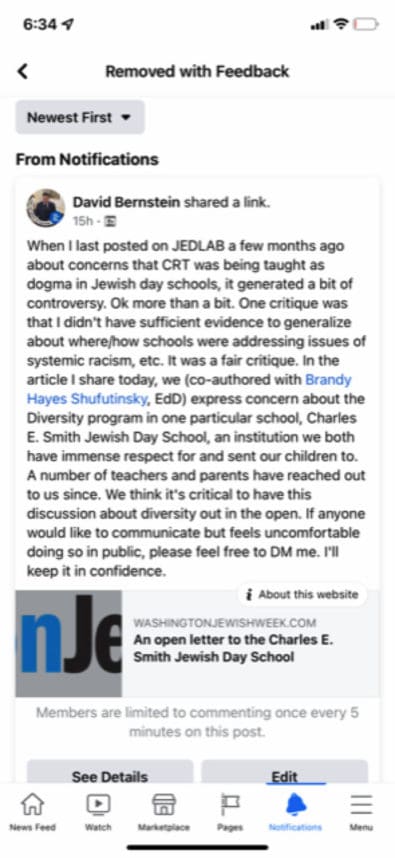
Two weeks ago, I co-wrote an Open Letter to the Charles E. Smith Jewish Day School in the Washington, D.C. area raising concerns about the school’s “Diversity, Equity, Inclusion and Justice” (DEIJ) program. Like so many others, the school’s diversity program does not provide alternative perspectives to the typical “anti-racist” point of view. My co-author and I, both of whom had children graduate from the school, regard this “pedagogy” as a form of indoctrination.

I decided to post this Open Letter on JEDLAB, a Jewish educators Facebook group with 12,000 members. I was active in the early days of JEDLAB, a space where innovative educators shared and discussed cutting edge ideas and approaches often at odds with the Jewish educational establishment. I loved it so much I even interviewed the founder in eJewish Philanthropy.

It seemed a perfect forum for generating interesting and important discussion about emerging diversity programs in Jewish educational settings.

Apparently, however, DEIJ initiatives in Jewish schools are not open for discussion.

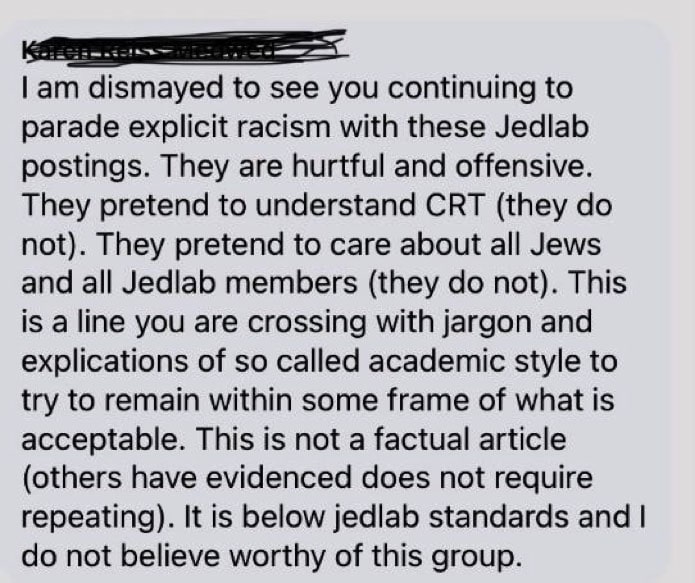
Almost immediately, a member of the Facebook group pronounced the post “racist.” The member said I had no business posting my views there. Several others piled on, also calling the post “racist” and urging its immediate removal. Not a single person took exception or came to my defense  (except, of course, in private messages). The comment from the member accusing me of promulgating racism had numerous “likes,” including one from a mainstream Jewish professional who is a self-proclaimed moderate on the subject. His vote of support for this vitriol suggests otherwise.

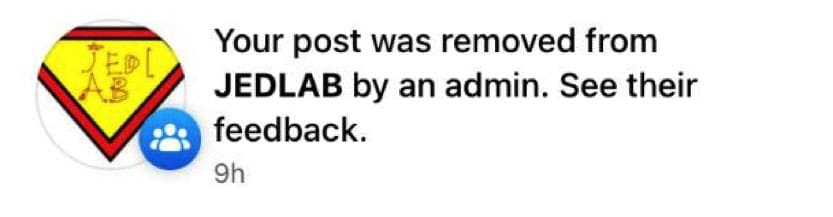
About an hour after posting, the post was removed without explanation by the administrators of the group. There are two possible explanations:

The first is that the administrators agreed that raising concerns about the “anti-racist” perspective being taught to kids is inherently racist. Ibrahim X. Kendi has spoken, and we must all fall in line.

If that’s the case, I despair over the future of Jewish education.

A second possibility is that the administrators received complaints that my ideas make the space “unsafe” for participants. This, of course, meant that the administrators had to silence someone with a different point of view. This is the “heckler’s veto”: a few shrill voices who protest a particular viewpoint get spineless institutions to stifle debate.

This is the “heckler’s veto”: a few shrill voices who protest a particular viewpoint get spineless institutions to stifle speech.

If that’s the case, I again despair over the future of Jewish education.

Our kids must be educated in a culture and sensibility that values Makhloket Leshem Shamayim—arguments for the sake of heaven. This sensibility welcomes—even encourages—debate among people with different points of view. The Jewish tendency to question and engage in intellectual discourse is one of the great qualities of the Jewish tradition. Why would anyone, least of all Jewish educators, try to blot this out? Don’t we want our kids to be critical thinkers and challenge the status quo?

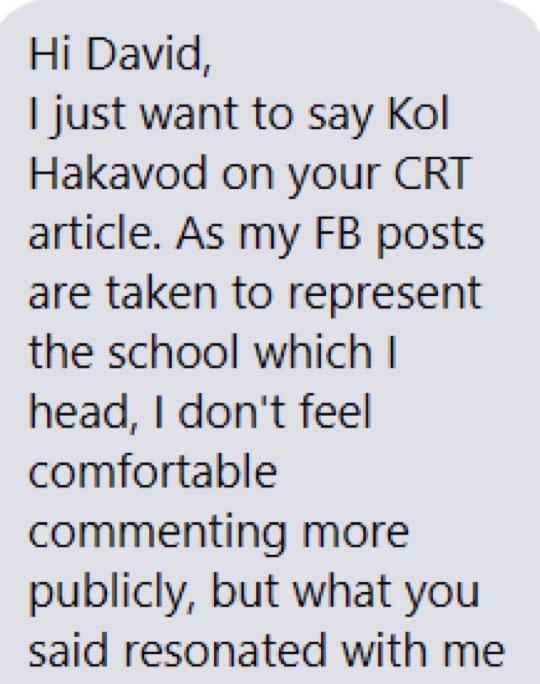
Of course, there are many Jewish educators and parents who do value discussion among people with different viewpoints. A headmaster of a pluralistic Jewish school direct messaged me on Facebook and thanked me for raising the topic. One prominent professor called to say “I wanted to kiss you.” Numerous Jewish day school teachers reached out to me and my co-author of the Open Letter, thanking us for giving a voice to their concerns. These teachers cannot speak publicly themselves because, well, they fear they will be cancelled, just like my Facebook post.

These teachers cannot speak publicly themselves because, well, they fear they will be cancelled, just like my Facebook post.

How is that good for the Jews?


David Bernstein is the Founder of Jewish Institute for Liberal Value (JILV.org). Follow him on Twitter @DavidLBernstein. 

Cancel Culture, Jewish Educators Style Read More »

Unscrolled Vayera: How To Do Nothing

Parashat Vayera begins with the passage: “The LORD appeared to him by the terebinths of Mamre; he was sitting at the entrance of the tent as the day grew hot.” (Genesis 18:1)

In this simple phrase, there is something delightful and unexpected: idleness. At the day’s hottest hour, in the shade of the terebinth trees, Abraham sits and does nothing.

This is almost unheard of in Judaism. As a rabbi I knew some years ago once put it, “Life is work.”  When he said this, I had the same objection that you are probably having right now: what about Shabbat?

“Shabbat is work, too,” he clarified. “Just a different kind.”

Now that I am Shabbat observant, I understand what he means. On Shabbat we ask God to grant us a “rest of love and generousness – a rest of truth and faith.” That said, it is a day of great busyness which involves hosting guests and being hosted; going to synagogue and praying for hours; and walking long distances which one might have otherwise driven. It is a day of great spiritual power, yes. But idleness? No.

If Shabbat is a busy day, however, how much more so the days of the week, when we rush from place to place, swamped with obligations and eager to fill any miniscule crack in our schedules with a moment of blissfully mind-numbing screen time.

Considering this, when, if ever, to we get to be idle? When do we get to really and truly do nothing?

Doing nothing has been on my mind since reading the book, “How to Do Nothing” by Jenny Odell. The book is a powerful manifesto on the need to recalibrate our faculties of attention, turning away from digital media and consumer culture and tuning into nature, our communities, our selves, and one another.

Much of the book centers on Odell’s home city of Berkeley, her favorite parks, and her most treasured spots to go birdwatching. For her, the process of disconnecting is in truth a process of connecting with her surroundings. “I stopped looking at my phone because I was looking at something else, something so absorbing that I couldn’t look away.”

Doing nothing, Odell realizes, is not really about “doing nothing.” It is, however, about doing nothing productive – nothing monetizable or brandable or Instagram-worthy. Nothing that can be checked off a list. Nothing terribly goal-oriented. It is about simply being alive and paying attention to the world we live in.

It is about simply being alive and paying attention to the world we live in.

Picture Abraham again as he lingered in idleness under the sheltering branches of the terebinths. Imagine now the sounds that he heard, the birds that he saw in the sky, the curious images that passed through his field of vision as he stared out at the horizon, the thoughts that meandered and circled about in his mind.

It was to this idle Abraham that God appeared in the first passage of the portion, but what happens next is mysterious. No words are spoken. No actions recorded. In the very next line, Abraham looks up and sees three men approaching from the distance, and the story moves on. One is left with the unsettling suspicion that this passage about God appearing doesn’t belong – that it is the opening line of an aborted storyline that was cut from the final draft, though perhaps we can look at it another way.

The commentaries tell us that this was a bikur holim – a visit to the sick. Abraham was only three days out from his circumcision and not feeling very vital or well. And so, God came to visit him.

There is a temptation when visiting the ill to try and cheer them up, or else to try and find the perfect comforting or inspiring words that will make it all better. The wisest among us, however, know that sometimes it’s ok to come and say nothing at all – to simply be there.

So God and Abraham sit together in the shade, finding comfort in one another’s quiet company. In a moment, the three men on the horizon will arrive. After that, nothing will be quiet. The action of the portion will begin, and an action-packed portion it is.

But just for now, God and Abraham can take a moment to simply be — to connect with one another and with the world itself.

In other words, to do nothing.


Matthew Schultz is the author of the essay collection “What Came Before” (2020). He is a rabbinical student at Hebrew College in Newton, Massachusetts.

Unscrolled Vayera: How To Do Nothing Read More »