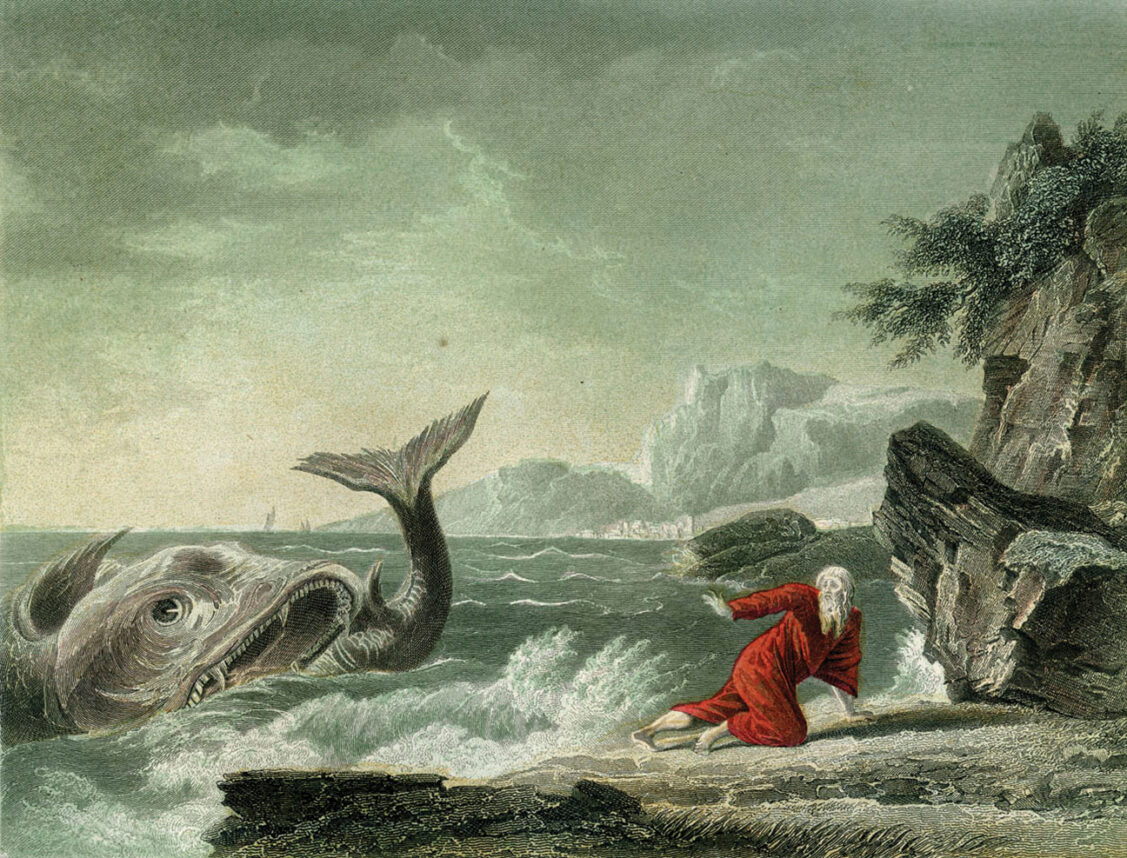
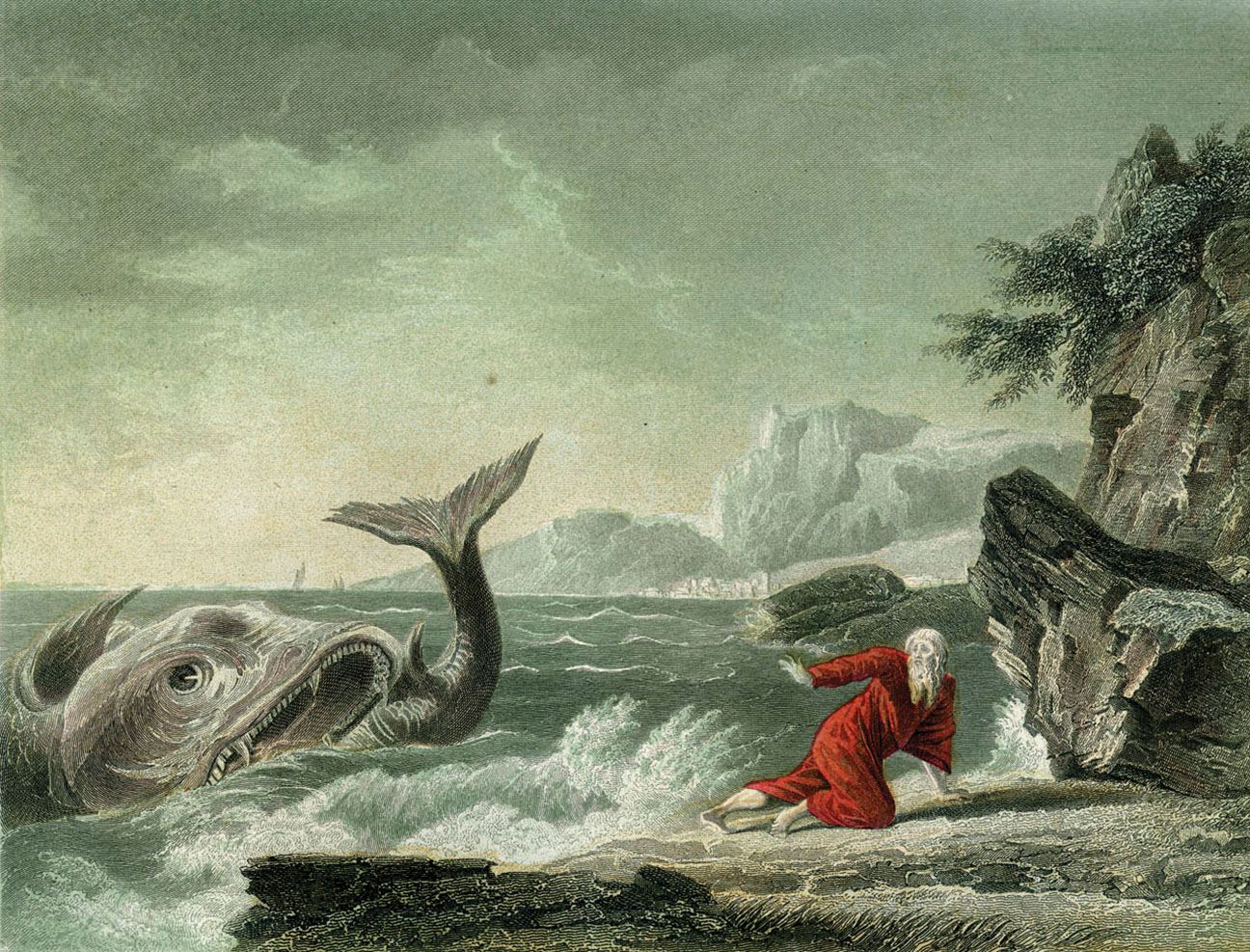
Headlining an upcoming blockbuster film is only the latest high-profile appearance by the ancient Jewish prophet whose story is read on the afternoon of Yom Kippur.
In its article hyping the October release of the MTV Films-produced “Whalefall,” the entertainment website AV Club proclaimed “The under-the-sea survival thriller turns ‘Weapons’’ [star] Austin Abrams into a modern-day Jonah.” While exactly how heavily the action-adventure movie about a young man who tries to psychologically reconcile his relationship with his demanding father while simultaneously trying to escape the belly of a whale will draw from the biblical text remains to be seen, the United States has long seen the tale of Jonah’s survival as a malleable metaphor for the American national character.
Jonah appears numerous times as a literary motif in Thomas Morton’s satirical poem “New English Canaan” published in 1637. In the preface, as the scholar Israel Benporat has documented, Morton compares himself to Jonah and analogizes the sinning people of Nineveh to New England, writing: “Jonas [Jonah], thou hast done well, to call these men / Home to repentance, with thy painefull pen.” The provocateur of the Pilgrims teased his antagonists by calling them to “Repent you cruell Seperatists, repent; there are as yet but 40 Days … repent you cruell Schismaticks, repent.” The Pilgrims, in turn, dubbed Morton “the Lord of Misrule,” perceiving him to be among the sinners, like those Jonah was meant to reform.
Decades later, the prominent preacher Joseph Sewell, who had declined the presidency of his alma mater, Harvard, delivered a fast-day sermon before the Massachusetts governor and the house of representatives on Dec. 3, 1740. In his remarks, titled “Nineveh’s Repentance and Deliverance,” the reverend encouraged his listeners to turn their sinning hearts to God. After all, “Thus did the men of Nineveh, nor did their king refuse to humble himself and lie in the dust before that Almighty God, who threatned [sic] to destroy them. The order given [in response to Jonah’s call for repentance] was, ‘Let Man and Beast be covered with Sackcloth, and cry mightily to God.’ This then is a moral duty incumbent on all as God shall call.” The hope was that this occasion of national introspection through abstaining from food for a day would elicit the Lord’s favor. After all, “God’s ancient people,” that is, the Jews, “practised it.”
Following the Revolution, Jonah accompanied the fight for Abolition. Herman Melville, it has often been argued, offered his beloved novelistic whale-centered warning, published in 1851, as a biblical rebuke against self-destructive slavery. As Ilana Pardes has put it, “’Moby-Dick’ ends with Ishmael’s reflections on a buoyant coffin in the midst of the sea. He is the only Jonah who survives to deliver a prophetic warning to antebellum America-Nineveh of the terrible disaster that lies ahead.” George C. Rable, in his “God’s Almost Chosen Peoples: A Religious History of the American Civil War,” paraphrases a Congregationalist minister as detailing how since the ship of state was foundering, the solution was to “toss overboard the Jonah of slavery before God’s wrath dashed the vessel upon the rocks.” A slave spiritual asked, “He deliver’d Daniel from the lion’s den / And Jonah from the belly of the whale / And the Hebrew children from the fi’ry furnace / And why not every man?”
In the 20th century, Jonah appeared in both the courtroom and political controversies.
During the 1925 Scopes Monkey Trial, Clarence Darrow quipped at William Jennings Bryan: “But when you read that Jonah swallowed the whale — or that the whale swallowed Jonah — excuse me please … how do you literally interpret that?” To which Bryan replied, “When I read that a big fish swallowed Jonah — it does not say whale … That is my recollection of it. A big fish, and I believe it, and I believe in a God who can make a whale and can make a man and make both what He pleases.”
In that century’s second half, lamenting the civilian casualties of the Vietnam War, Rabbi Abraham Joshua Heschel bellowed, “Jonah is running to Tarshish while Nineveh is tottering on the brink. Are we not all guilty of Jonah’s failure?”
The sea-faring seer hasn’t stopped swimming in the 21st century.
In 2007, the historian Michael Oren penned an op-ed for The Wall Street Journal titled “Jonah’s Dilemma,” in which he noted how the eponymous book “conveys crucial lessons for all Americans as they grapple with crises in Iraq and elsewhere in the Middle East and yearn for far-sighted leadership.” He saw in Jonah’s hesitancy to spare a sinning nation a parallel to the politics of his own moment, in which “policy makers must decide between costly actions and inaction, the price of which, though potentially higher, will ultimately remain unknown — a truly Jonah-like dilemma.”
In 2014, novelist Joshua Feldman published “The Book of Jonah,” a fictional account of Jonah Jacobstein, a successful young Manhattan corporate lawyer on the verge of making partner, whose life is thrown into turmoil after experiencing a divine vision.
More recently, following President Biden’s disastrous 2024 debate performance, The Forward ran an essay which noted how “God had to remind Jonah that he wasn’t the only character who mattered in his own story. Can anyone convince Biden of the same?” After all, the author saw Jonah’s initial recalcitrance and Biden’s hesitancy to leave the race as two stories of “an entire society, versus one man’s ego.”
Just last year, Apple released a television show titled “Government Cheese,” starring David Oyelowo as an ex-con looking to restart his life, which contains so many references to Scripture that The Hollywood Reporter, not known for its biblical literacy, praised how “the Book of Jonah is a useful condiment to flavor their themes tied to the absurdities of faith and fate” in the series.
Furthermore, selections from Jonah’s chapters will be required reading for Texas’ public school children as part of the recent overhaul of the state’s education requirements.
When Jonah makes his appearance on the holiest day of the year, he is meant to remind Jews across the globe of the remarkable grace of repentance. At the same time, his tale’s American reception has rippled through a remarkable range of contexts – offering insight into communal politics, national spiritual introspection, the Bible’s historicity, the ethics of warfare, Middle Eastern strategy, electoral tactics and the ever-present desire for each of us to be granted a second chance.
Rabbi Dr. Stuart Halpern is Senior Adviser to the Provost of Yeshiva University and Deputy Director of Y.U.’s Straus Center for Torah and Western Thought. His books include the newly released “Jewish Roots of American Liberty,” “The Promise of Liberty: A Passover Haggada,” “Esther in America,” “Gleanings: Reflections on Ruth” and “Proclaim Liberty Throughout the Land: The Hebrew Bible in the United States.”