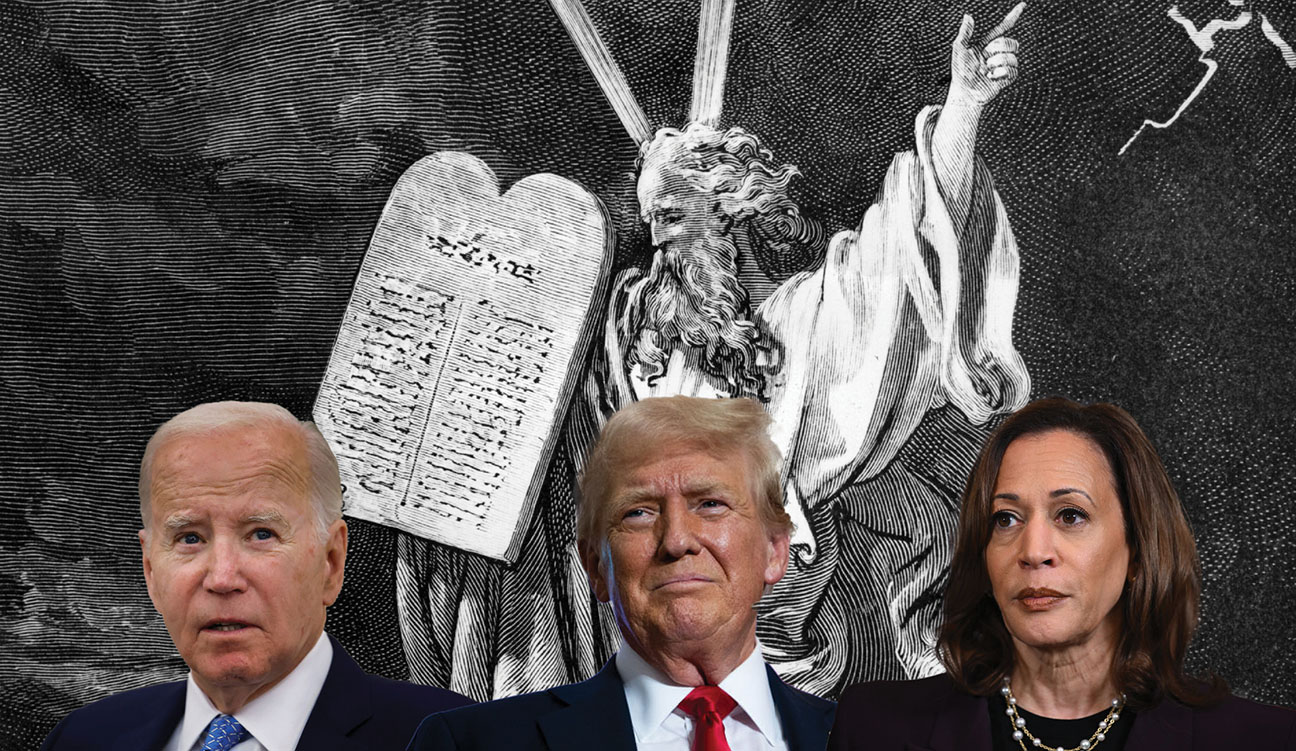
“If the Lord Almighty came down and said, ‘Joe, get out of the race,’ I’d get out of the race. The Lord Almighty’s not coming down,” President Biden remarked after calls came for him to step aside following his dismal debate performance in June — a statement he later presumably came to regret. “God alone,” Donald Trump, in turn, reassured Americans, “prevented the unthinkable from happening,” following an assassin’s attempt on his life. Kamala Harris hasn’t yet alluded to hearkening to the heavens — but there’s still time.
While the role of providence in these politicians’ journeys will no doubt continue to be debated by pundits, it is worth revisiting the model of Moses, whose farewell address in the book of Deuteronomy we’ve been reading in synagogue these past weeks.
Recapping one of the legendary Israelite leader’s finest moments, in the midrashic collection known as Numbers Rabbah recounts the following conversation between Moses and God:
“He [Moses] said to him: You have taught me. He said before Him: ‘Master of the universe, from where do Israel know what they have done [in worshiping the Golden Calf]? Did they not grow in Egypt, and all of Egypt are idolaters.
“When You gave the Torah, You did not give it to them, and they were not standing there, as it is stated: ‘The people stood at a distance’ (Exodus 20:18), and You gave it only to me, as it is stated: ‘To Moses, He said: Ascend to the Lord’ (Exodus 24:1).
“When You gave the commandments, You did not give them to them. You did not say: ‘I am the Lord your God [eloheikhem],’ but rather: ‘I am the Lord your God [elohekha]’ (Exodus 20:2).
“You said it to me. Did I, perhaps, sin [by making these arguments]? The Holy One blessed be He said to him: ‘As you live, you have spoken well. You have taught Me. From now on I will speak with the expression: ‘I am the Lord your God [eloheikhem].’”
In a radical reading of Moses’ argument to God to spare His misstepping people, the rabbis have the national leader use what seems to be rhetorical hairsplitting — arguing that God’s usage of the singular instead of plural in certain key contexts should legally spare Israel from certain demise. But one can glean key lessons in leadership between the grammatical nuances.
The first is that the people emerged from a surrounding context that left them with moral murkiness. Steeped in the paganism of Egyptian idolatry, it wouldn’t be fair, Moses argues, to judge them for current mistakes. Give them time to mature as they march toward the Promised Land, and spiritual improvement will no doubt follow.
The second element of Moses’ argument is assuming responsibility for the implementation of God’s law — the Torah and the commandments. When the people violate expected norms, Moses seeks not to finger-point but to shoulder responsibility. Law flows through the leader not to provide him with personal loopholes for avoidance but as a means of modeling how society as a whole should civilly function.
When the people violate expected norms, Moses seeks not to finger-point but to shoulder responsibility. Law flows through the leader not to provide him with personal loopholes for avoidance but as a means of modeling how society as a whole should civilly function.
Lastly, Moses expresses humble uncertainty. While he is aware of his exclusive positioning as political sovereign, he acknowledges that ultimate justice lies in the heavens whose ways are not always knowable to mankind.
As Elana Stein Hain notes in her analysis of this midrashic passage in her book “Circumventing the Law,” “The interaction between Moses and God is not about a shrewd textual reading. It is about the newly minted relationship and religious identity of the Israelites that God wishes to encourage. And it is about the ongoing relationship between Moses and God as well as Moses and the Israelites.”
In other words, there is a tripartite dynamic at play. The leader’s primary objective should be ensuring a positive relationship between the people and God, powered through his own personal relationship with the divine. All three parties — God, nation and political leader — in this way share in a covenantal commitment to the other.
As Americans continue to look toward the heavens for a satisfying, safe, or at the very least sane resolution to this election cycle, we would be wise to look once more to the Moses model.
As Americans continue to look toward the heavens for a satisfying, safe, or at the very least sane resolution to this election cycle, we would be wise to look once more to the Moses model. If our eyes are set on spiritual refinement, loyalty to the law, collective responsibility and most of all humility, we may very well emerge renewed from this months-long season of malaise, with heaven’s help.
Rabbi Dr. Stuart Halpern is Senior Adviser to the Provost of Yeshiva University and Deputy Director of Y.U.’s Straus Center for Torah and Western Thought. His books include “The Promise of Liberty: A Passover Haggada,” which examines the Exodus story’s impact on the United States, “Esther in America,” “Gleanings: Reflections on Ruth” and “Proclaim Liberty Throughout the Land: The Hebrew Bible in the United States.”