My daughter has always been the squeamish type. Once, when she was about 4 years old, we were talking about the exodus from Egypt — the dark night of watching, when God told the Israelites to slaughter lambs and smear the blood on the doorposts of their houses so that the Holy One would “pass over” and spare their firstborn from destruction.
My firstborn child had always listened to this story with some trepidation. But, this time, she had a new anxiety. “Why did they have to kill all the lambs?” she asked. “Why did God need to see all that blood? Couldn’t they just put little signs in front of their house, like our Westec sign?”
To a little girl, I guess, Westec represents more security than the protective blood of the Passover sacrifice. I knew, at that moment, that a child who mourns for the death of lambs is wishing for her own kind of security system — and, with all my heart, I wanted to give it to her.
The blood of the Passover lamb, we are taught, was smeared on “the two doorposts of the house.” And a midrash says: Who were the two doorposts? They were Moses and Aaron, who together supported the House of Israel. In a sense, that’s our job as parents, too — to act as pillars for our children, to hold up their house and give them a sense that the world is a stable, coherent place.
The Passover festival reminds us, more than any other, of the daunting responsibility that rests on our shoulders when we bring Jewish children into the world. An old rabbinic pun translates “Pesach” as a combination of two Hebrew words: “peh sach: the mouth speaks.” And this festival is certainly about conversation as much as anything else — an intergenerational conversation that touches on profound spiritual matters.
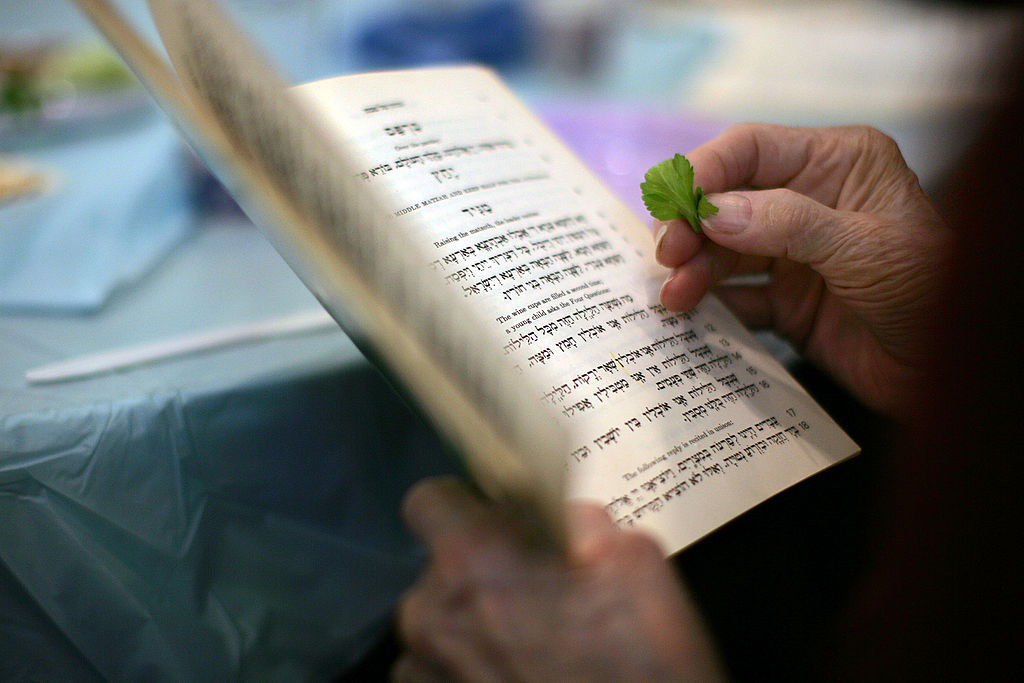
Haggadah means “telling,” and we parents are supposed to be the tellers of the Jewish tale. “When, in time to come, your child asks you, ‘What does this mean?’ you shall say: ‘It was with a mighty hand that Adonai brought us out of Egypt” (Exodus 13:14). Pesach is about children who have questions, and parents and grandparents who have answers; it celebrates the power of adults to make the world intelligible to the young.
“You shall tell your children and your children’s children how I displayed My signs among the Egyptians — so that you may know that I am the Lord” (Exodus 10:2). Rabbi Joshua of Belz taught: The verse says, “You shall tell” and “you shall know” — to teach us that if parents want to implant faith in their children, they must “know” God themselves; their own faith must be strong and secure.
But another commentator asks: Why, in this verse, does “you shall tell” precede “you shall know”? It is because parents do not always have clear answers — and in that case, the “telling” must precede the “knowing.” For, miraculously, in struggling to teach our children, we sometimes end up teaching ourselves; in seeking to give them strength, we find ourselves the recipients. In rising to the challenge of our children’s questions, our own hearts and minds are stretched; as we strive to be the parents they deserve, our own understanding can deepen and our own beliefs take shape.
The strength we bring to our sons and daughters need not be the strength of certainty. It’s just as important to show them the strength it takes to live without clear answers, the faith it takes to keep trying to do good even in a dark and dangerous world.
My daughter is a teen-ager now, and she still wonders why so much innocent blood gets spilled. For now, the best I can offer her is a Jewish security system: “peh sach” — a mouth that speaks about important things without pretending to know all the answers. Honest, heartfelt conversation that binds the generations together.
Rabbi Janet Ross Marder is director of the Union of American Hebrew Congregations, Pacific Southwest Council.