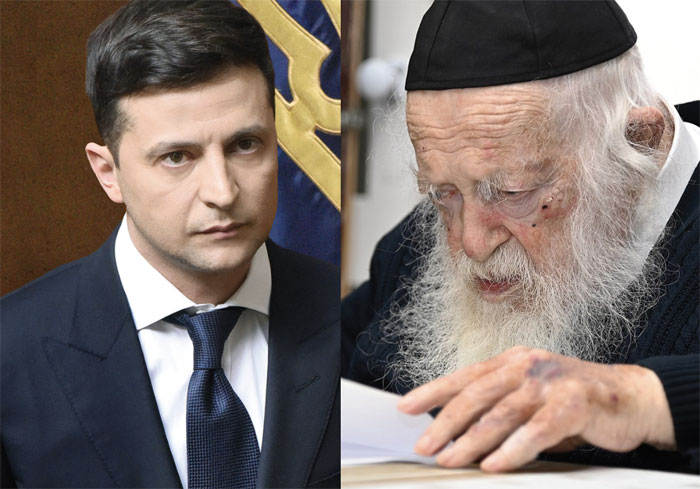
They are two Jews with extraordinary stories, and on one Sunday they jointly captured the attention of Israelis. Volodymyr Oleksandrovych Zelensky is the president of Ukraine. Shmaryahu Yosef Chaim Kanievsky was a rabbi. On Sunday afternoon, hundreds of thousands of Israelis participated in the funeral of Rabbi Kanievsky, bringing Israel to a standstill. On Sunday evening, millions of Israelis were glued to their TV screens, to watch Zelensky speak live to Israel’s parliament, the Knesset.
Two Jews, of two very different backgrounds, of two very different generations, with two very different stories – proving one point: there’s nothing more surprising, more dramatic, more unsettling and yet exhilarating than the story of our people. As one Jew bravely leads a nation, whose past is burdened by outbursts of deadly anti-Semitism, into battle – another Jew is leaving this world having led a Jewish movement whose story of near-extinction and resurrection is almost miraculous.
Two Jews, of two very different backgrounds, of two very different generations, with two very different stories – proving one point: there’s nothing more surprising, more dramatic, more unsettling and yet exhilarating than the story of our people.
You probably know more about Zelensky than about Kanievsky, so let me share some background about the latter. He was the spiritual leader of Israel’s Haredi world in the last few years: old, scholarly, devoted to his study. It is impossible not to admire the fact that he was recognized by his community as a leader, not because he has a cushy bank account, nor because he has a glorious castle, nor because he speaks well in public, nor because he has an active TikTok account. It is impossible not to admire a community that has named as its leader the one who is immersed in learning, humble in his ways.
Rabbi Kanievsky saw in his long life the ultra-Orthodox Torah world fading, then almost becoming extinct, and then, like the phoenix, gaining strength and dynamism like never before. If the rabbi reflected on his life toward the end, he had good reason to look at it with satisfaction. The enterprise of which he was a part, the enterprise in which he invested his energy and wisdom, is a successful enterprise. In the 1920s, when Kanievsky was born, the world of Torah was in slow decline. New winds blowing in Europe eroded its appeal. When Kanievsky grew up and was already in Palestine, the world of Torah was annihilated by the Nazis. Fast forward another seventy years and look at what Kanievsky and his colleagues built. A thriving world of learning, of community, of social and political power. One can look at this world with a critical eye. There are many reasons to be critical of this world. But there is no denying that Kanievsky and his friends’ enterprise is a dramatic success. Every fifteen years or so, the number of ultra-Orthodox Israelis doubles. It is an Israeli success story.
Zelensky seems as removed from Torah as they come. And yet, as he was speaking to the Knesset on Sunday, he drew of a shared Jewish experience in the hope of finding a receptive ear. “Our people are now scattered around the world”, Zelensky said, referring to Ukrainians. “They are looking for security. They are looking for a way to stay in peace. As you once searched”. Note the “our” – for Ukrainians. Note the “you” – for Jews. Zelensky was walking a fine line, not always successfully, as he was trying to draw parallels between the fate of Jews back in the mid 20th century and the fate of Ukrainians today. Some Israeli parliamentarians took him to task because of it, criticizing his heavy-handed reconstruction of history in his quest to serve his goal.
The speech was not well planned. Its content was somewhat awkward, its purpose unclear. Was Zelensky hoping to shame Israel into doing more for Ukraine? Make the people force their leaders to change their policies? If this is what he intended to do, he was wrong in his calculations, both for substantive and structural reasons. Israel’s Knesset is not like the U.S. Congress. It has very little sway over foreign policy. Israel’s public is generally supportive of the current policies. And using the Shoah to make a point is almost always a mistake for a foreign leader.
And yet, the speech touched a nerve, as did the funeral a few hours later. Zelensky and Kanievsky are not your ordinary Jews. Most of us prefer our Jewishness to be more modern than Kanievsky’s. Most of us prefer to be more Jewishly connected than Zelensky. These two Jews represent two very different ways of living as a Jew in today’s world. And yet, they share one quality that is awe-inspiring: They were — they are — not afraid to be what they want to be.
Something I wrote in Hebrew
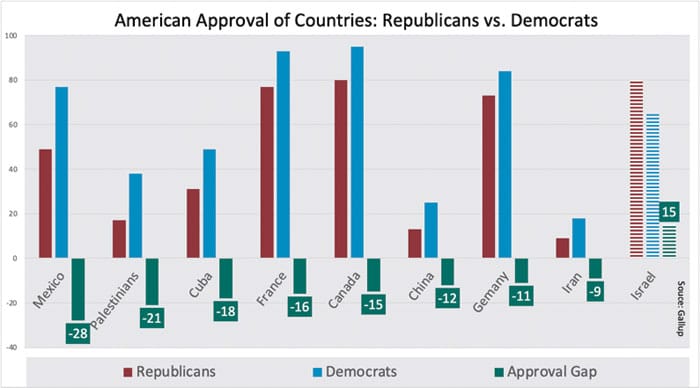
What Gallup publishes makes it possible to look at the question of the Republican-Democratic gap from the right perspective. What is the right perspective? It is the recognition that there is a fundamental gap in the worldview of Democrats and Republicans that affects their attitude toward very many countries, and not just Israel. That is, it is not that Israel is some special case, where an unbearable gap is created between two political camps, while other countries enjoy bipartisan support. The gap is a widespread component in the American arena as it appears today. The gap is a given. Evidence: There is a 15% gap in the approval of Democrats and Republicans of Israel. There is an identical gap, 15%, in the approval of Democrats and Republicans of Canada. Canada! Would you assume that sleepy Canada is a controversial country? Probably not. Still, the gap in its approval rating is the same as it is of Israel’s.
A week’s numbers
To complement the above-mentioned gap in approval of various countries, here are some numbers:
A reader’s response:
Roi Ellenson asks: “Is it true that the US intends to delist Iran’s Revolutionary Guards as terror organization?” Answer: Yes, quite puzzlingly, this indeed seems possible. Are you going to do something about it?
Shmuel Rosner is senior political editor. For more analysis of Israeli and international politics, visit Rosner’s Domain at jewishjournal.com/rosnersdomain.