Last Tuesday evening, we had dinner with Dick Morris. Can youthink of a more fitting person to dine with during these days ofatonement? Dick Morris: one-time adviser to the president of theUnited States. Widely credited with winning President Clinton’sre-election. Caught on a tabloid video, sucking a prostitute’s toesin a Washington hotel room. Admitted to letting his special friendlisten in as he consulted with the commander in chief. Fired. Mockedgleefully by the media. Told to take a hike by his attorney wife,Eileen McGann. Dick Morris is the poster boy for atonement.
But he is also the bad boy of American politics. In one fellheadline, he went from the epitome of brains and ambition to the verysymbol of overreaching ego. His was a distinctly American Jewish takeon Greek tragedy.
But Morris, regardless of his sins, remains brilliant — you don’twipe out a computer’s memory just by spinning down its hard drive. Aswitnessed by our dinner at Campanile, Morris can still dissect thebody politic better than any pundit, academician or politician.
Our conversation, part of a media round table sponsored by MichaelLevine Communications and Campanile, was off the record. (Anon-the-record interview will soon follow in these pages.) But in thespirit of the High Holidays, it’s fair to report that Morris hasspent much of the past year speaking with clergy, therapists andfellow 12-steppers — looking for spiritual insights into a lifederailed. Reports in New York Jewish press that he is converting toCatholicism are absolutely false, he told Up Front. He has met with”every rabbi in New York City,” as well as with ministers andpriests, in order to gain spiritual insight, not to switch teams.
And perhaps it’s beginning to work. Sitting beside Morris duringthe dinner, speaking her mind too, was his wife, McGann. Recently,she came back to him. Happy New Year.
Just Like Old Times

Remember “Religion on the Line”? The late-Sunday-evening radiocall-in show, hosted by Dennis Prager, brought together a panel ofJewish, Christian and Moslem religious leaders to discuss God,abortion, suffering, joy — all the big ones. The powers that be atKABC Talkradio — the same geniuses who yanked Michael Jackson fromhis daily slot — decided to further deprive Angelenos of significantintellectual discussion by pulling the plug on Prager’s noble effortas well.
Michael Levine, publicist and author, is one of those who mournthe passing of “Religion on the Line.” He has put together a seriesof panel discussions at the University of Judaism entitled “TheThought Forum,” which, he told Up Front, he hopes will serve as akind of live substitute for the spirited — and spiritual — show.Each panel will feature religious personalities from around theSouthland responding to one another and to audience questions.
On Nov. 2, the Rev. Cecil Murray, Rabbi Elliot Dorff, FatherMichael Manning, Dr. Maher Hathout, Vidal Sassoon and Pat Boone willdiscuss the death penalty. On Nov. 16, Murray, Manning, RabbisMordecai Finley and Gary Greenebaum, Dr. Hassan Hathout, Phil Blazerand Charlton Heston will examine “God and Forgiveness.” And on Dec.7, the topic will be “Why Bad Things Happen to Good People,” withRabbi Edward Feinstein, Manning, Murray, Dr. Gasser Hathout, JohnDart and Keith Atkinson.
Tickets cost $12 per evening or $30 for the series. And you won’t– alas — be able to hear it on the radio. Call (310) 476-9777 fortickets and information.
“Thought Forum” guests will include Rev. Cecil Murray.
It’s Not the Fortune Cookies
If Jewish civilization is 6,000 years old, asks Jackie Mason, andChinese civilization is 4,000 years old, where did Jews eat for 2,000years?
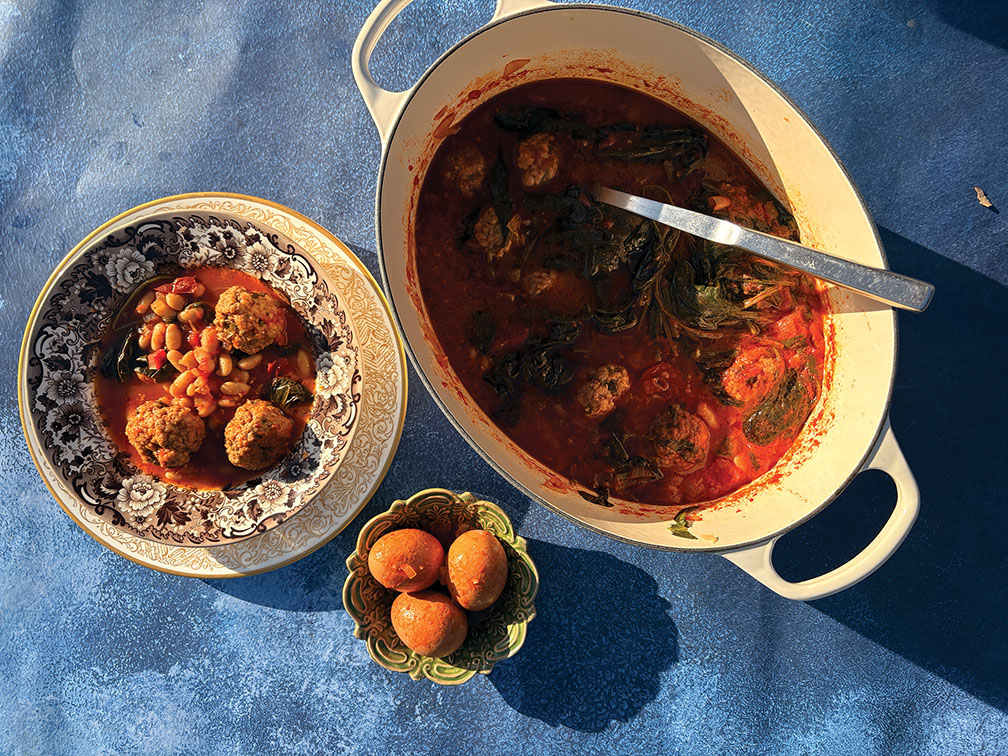
Thumbing through Ken Hom’s new cookbook, “Easy Family Recipes froma Chinese-American Child-hood” (Knopf, $27.50), we came across thefirst serious discus-sion we’ve seen of the seemingly geneticpredilec-tion of Jews toward Chinese food. On page 203, Hom reviewssome theories: that Jews sense the Chinese are the Lost Tribe; thatJews consumed Chinese food because its lack of dairy products made itunlikely they’d mix meat with milk; that within the confines of aChinese restaurant, Jews could experience the outside world withoutcoming across anti-Semitism.
Hom dismisses most of these as the reason. More likely isthat on Sunday, most Christian-owned restaurants were closed, leavingChinese the only choice. And Chinese food — “savory, aromatic andwell-seasoned”– made it popular among Jews who could easily switchfrom kreplach to won ton. But the larger truth is thateveryone likes Chinese food. Full of homey recipes such asbeef with broccoli and crunchy fish with tender eggplant, Hom’s bookmakes it easy to understand why.