There are different sorts of happiness.
There is a quiet happiness, an inner sense of bliss, the innocent joy of a small child, one of wonderment and gratitude — a happiness to carry with you at all times.
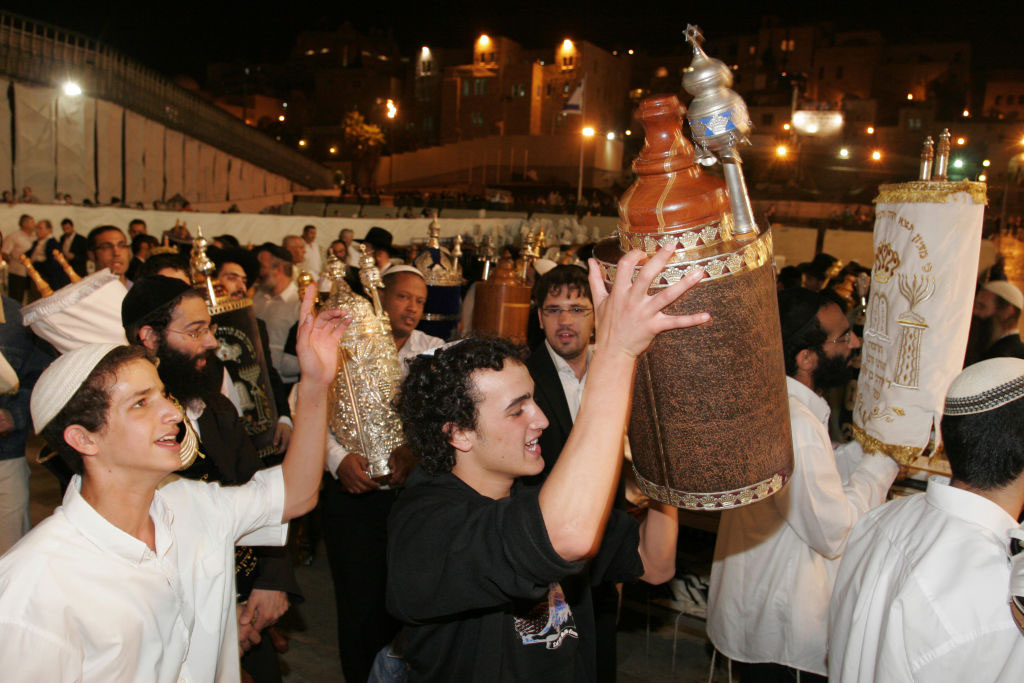
Then there is the seasonal happiness that blooms for all to see, bursting out in song, in dance and in celebration of Sukkot, Simchat Torah — all the festivals of the Jewish calendar — as well as a wedding, a birth, or any occasion that provides a time to feast and rejoice with family and friends.
All very sensible, normal sorts of happiness.
Purim is not normal. It’s nuts. A rational person is hard put to celebrate Purim, as are all those who believe they know who they are. Because the joy of Purim means to leave all that behind.
Purim is the ultimate joy, and the only way to experience that joy is to break out of yourself — not by making yourself happy, not by doing things you enjoy, and not by sticking to your life, your friends, your family and being the person you are so comfortable being.
No. By playing the clown, by taking the risk of making yourself look like a total idiot, by allowing the insanity within you to burst out, you can bring smiles to strangers on the street and uplift all those around you — even those who had lost all hope for joy.
The light of Purim knows no bounds.
Why Purim? What happened in Shushan that is cause for such madness?
Purim is the day the Jewish people took ownership of their Jewishness, at a time when it was utter madness to do so.
That’s the subtext to the Megillah that is often ignored. We’re told that Haman’s decree of total annihilation was upon the “Yehudim” — the Jews. The implication is that any Jew could easily slip out of this predicament. Any Jew could be totally clear of danger by just saying, “What, me Jewish? I speak Farsi. I dress Farsi. I eat Farsi food. I celebrate Farsi celebrations. I’m just another Farsi like you.”
Purim is not normal. It’s nuts. A rational person is hard put to celebrate Purim, as are all those who believe they know who they are.
And that, it could be argued, would be the sensible thing to do. You’ve lost your land. Your temple lies in ruins. What gives you a right to exist? What sense does it make to have “laws that are different from all other people” while you are “scattered among the nations”? Why identify with your people, practices and beliefs when that identity means only persecution and hatred?
God has abandoned you, for heaven’s sake!
Given all that, what the Jews did was absurd. They said, “We are Jews. We were born Jews. We will die Jews.” They fasted and prayed, and then fought for their lives. Why? There is no explanation. But we are still here. Absurdly.
I identify with that. In a certain way, it happened again with my generation.
I am a child of the post-Holocaust. My generation is made up of those raised on the image of the Jew as a skeleton behind the barbed wire of Auschwitz.
When there was a Holocaust documentary on TV, I had to watch it. At the local Jewish Community Center lounge where I went to hang out with friends, the entire back wall was covered with a mural of those deathly figures. When I was schlepped to the synagogue for whatever occasion, I doubt the rabbi ever delivered a sermon without mentioning the 6 million.
The message was drilled, pounded and welded relentlessly into our little minds, until it became part of our neural circuits: We are the people they hate. If someone is looking for a people to persecute, to blame, to despise, to obliterate from the face of the earth, here we are.
As for God and our religion, there was only one conclusion a sensible person could come to: God had abandoned us and the deal was off.
Please tell me why any kid would want to stay in this club?
And then something crazy happened. Barely a quarter-century had passed since the implementation of the Final Solution, and a Jewish renewal began to flourish. We returned, perhaps not in droves, but with pride, with chutzpah, with love — madly embracing that which our parents and grandparents had quite reasonably dropped by the wayside.
Why? I don’t know. We are a crazy people. We can’t let go of our God.
In the Babylonian Talmud, Rava says, “On Purim, you must get drunk until you don’t know the difference between ‘Cursed is Haman’ and ‘Blessed is Mordechai.’ ”
We are drunk with wine — a deep, rich wine aged over millennia. The wine of a love that can never be lost, of a marriage that can never be broken.
So, What Should You Do On Purim?
Send gifts of food to random Jews you don’t know — just because they are your fellow Jews.
Listen to the Megillah, by night and by day, and make a fool of yourself booing Haman.
Feast with your friends and family and total strangers — and don’t worry about what anyone thinks of you.
Most important, go to those who are forgotten — on the street, in retirement homes, in prison cells, in jobs they can’t take a day off from to celebrate — people locked into believing they are defined by those things and unable to escape. Make a total fool of yourself, and bring those people the liberation of joy.
Tzvi Freeman is an author and senior editor at Chabad.org.