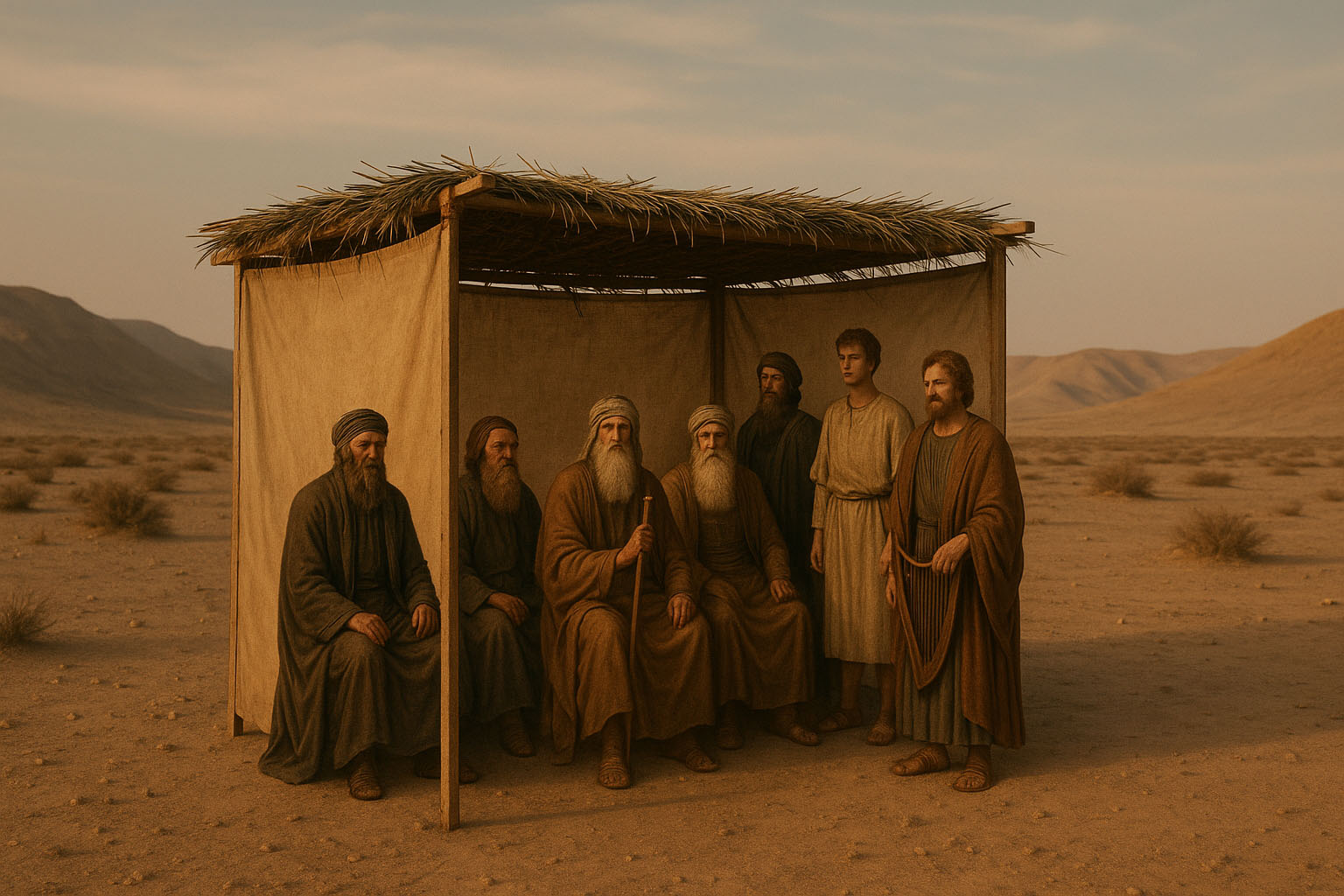
The custom of ushpizin is a bit curious. Ushpizin is the Aramaic word for guests; and as we enter the sukkah, we read a brief prayer inviting seven visitors from Jewish history: Abraham, Isaac and Jacob, Moses, Aaron, Joseph and David. Each night features one of the seven guests.
Ushpizin was originally a Kabbalistic custom and is first mentioned in the Zohar. The sukkah is a place where we greet the Shekhinah; and when doing so, we join our spiritual founding fathers in standing before the divine presence. Yet, despite its esoteric roots, ushpizin has become a universal custom.
This custom has inspired multiple variations of new ushpizin; there is an egalitarian list that includes seven female personalities from the Tanakh. Other lists supplement the original one with a list of great Chasidic rabbis or Roshei Yeshiva. There are do-it-yourself lists, where families choose the seven personalities from history they would most want to invite to join them in the Sukkah, such as Theodor Herzl or Rashi. Last year, one organization circulated a list of seven heroes who fell in battle in Swords of Iron to invite in as our contemporary ushpizin.
It is often difficult to understand why certain customs become popular and others disappear. But in the case of ushpizin, its popularity offers a powerful insight; connecting one generation to the next is the very purpose of the sukkah.
Maimonides offers a fascinating interpretation of the Sukkah. Its purpose is to remind us how miserable the 40 years in the desert were. Maimonides writes, “one leaves his house to dwell in sukkot, as do the destitute who live in deserts and wastelands, in order to recall that such was our state in ancient times … when I brought them out of the land of Egypt … And from that situation we went on to dwelling in splendid homes, upon the best and most fertile lands, through God’s kindness.”
The sukkah is there to offer a contrast between the difficulties of the past and the comfort of the present. Maimonides compares the sukkah to the bitter herbs on Passover, which symbolize the 400 years of slavery in Egypt; similarly, the sukkah reminds us of wandering 40 years in a desolate desert. And that is why the sukkah is featured during the Chag HaAsif, the Festival of Ingathering. The farmer, after harvesting his crop, enters the sukkah to remember the difficulties of his ancestors in order to fully appreciate the bounty that God has given him.
But there is something troubling about this explanation; it marginalizes the have-nots of Jewish history. What about the lost generations of Jewish history, such as the 400 years of Jewish slaves who never left Egypt? What about the generation that actually lived in Sukkot in the desert, but never made it to the Promised Land? Are their experiences worthless, negated by the curse of exile?
The generation of the desert would be homeless in such a sukkah. The desolation of the desert was their fate, and they had very little to celebrate.
Fundamentally, this is a question about redemption: How does one celebrate their own good fortune at returning from exile, knowing that so many generations of our ancestors lived lives of misery?
This is why one needs to see the sukkah through a different lens: the unity of generations. Rabbi Joseph B. Soloveitchik wrote, “The first concept of immortality as coined by Judaism is the continuation of a historical existence throughout the ages.” Individuals may pass away, but their contributions remain alive within the community, which never dies. To be a part of Knesset Yisrael, the Jewish people, is to merge one’s individual existence with that of the nation’s past and future. And in doing so, generations of past, present and future become one.
No generation is left behind. Isaiah (56:3-5) speaks about the eunuchs who had joined the Jewish people, who considered themselves a “withered tree” because they could not have children of their own. He comforts them by saying that God will give them “a place and a name (yad vashem) better than that of sons and daughters; I will give them an everlasting name that shall not be cut off.” The eunuchs will not be forgotten, and will have a permanent place in the holy of holies.
The legacy of past generations is never forgotten. Our ancestors are always at our side; they dreamed of our success, and we are only here because of their sacrifices.
Maimonides is correct that the sukkah reminds us of the distress and destitution of the generation of the desert. But the purpose of the sukkah is not to serve as a contrast with the past, but rather to connect us to our past. We sit in the sukkah to include those who lived lives of destitution, in order to give a better future for their descendants.
Or, to put it more directly: The most important guests of the Sukkah are the generation of the desert. At the harvest season we invite them to share in our joy, because it belongs to them more than it belongs to us. We would not be here without their determination to survive for 40 years in the desert.
And when they visit our sukkah, we will tell them that their sacrifices were worthwhile, and share with them what we have achieved.
The timeless guests that visit the sukkah are not just from the past; we celebrate with future generations as well. In the worst of times, Jews huddled in their sukkot, imagining that one day their years of wandering in the wilderness would be over. They prayed their sacrifices would allow their descendants to make their way to the Promised Land.
Yehuda Avner writes about a trip he took with Golda Meir to the Golan Heights, a few days after the outbreak of the Yom Kippur War. It was the holiday of Sukkot, and the soldiers were saying their prayers inside a sukkah. Golda stood at the back of the sukkah, and after the prayers, spoke to the men about their service and their lives. Before leaving, she asked if anyone had a question. Avner writes:
“One tank crew member in his mid-twenties raised his hand. … ‘I have a question,’ he said in a voice husky with exhaustion. ‘My father was killed in the 1948 war, and we won. My uncle was killed in the 1956 war, and we won. My brother lost an arm in the 1967 war, and we won. Last week I lost my best friend over there’ –he was pointing to the battlefield—and we’re winning. But is all our sacrifice worthwhile, Golda?”
Golda responded with compassion, explaining how she grieves for each fallen soldier. But then she returned to the question posed, to explain why these hard sacrifices were truly worthwhile. Golda offered the following answer:
“In 1948, in this season of the year, I arrived in Moscow as Israel’s first ambassador to the Soviet Union. The State of Israel was brand new … They had been cut off from their fellow Jews for 30 years, since the Communist Revolution of 1917. Stalin had proclaimed war against Judaism. He declared Zionism a crime. Hebrew was banned. Torah study was banned. One was sent to the gulag or to Siberia for far less…
“The news of our arrival in Moscow spread quickly, so that when we went to the Great Synagogue of Moscow for the festivals, the street in front of the synagogue was jam-packed. Close to 50,000 people were waiting for us: old people and teenagers, babies carried in parents’ arms, even officers in army uniforms. Despite all the risks… these Jews had come to celebrate the Jewish state’s establishment and to demonstrate their kinship with us … I was caught up in a torrent of love so strong it literally took my breath away. People surged around me, stretching out their hands, and crying, ‘Shulam aleichem Goldele, (‘Welcome Golda’), ‘Goldele, leben zols du.’ (‘Golda, a long life to you’).’ ‘Gutt yomtov Goldele.’ (‘Happy Festival, Golda’). And all I could say over and over again was, ‘A dank eich vos ihr seit gebliben Yidden.’ (‘Thank you for having remained Jews.’). And some cried back to me, ‘Vir danken Medinas Yisroel.’ (‘We thank the State of Israel.’).
“And that was when I knew for sure that our sacrifices are not in vain.”
Standing in a sukkah, Golda Meir offers an answer that is as old as the sukkah itself: One generation of Jews sacrifices for another, but when we triumph, it belongs to every generation.
Past, present and future sit together in the sukkah. We are joined by those who didn’t make it; from the generation of the desert, to those who lived through the worst moments of Jewish history, from the Churban to the Crusades and the Holocaust. The Jews who never got out of the Soviet Union, and the soldiers who never returned from the Golan Heights join us. Those who never came home from the Nova Festival and the hostages who were murdered in Gaza join us; and in the sukkah, they greet the fallen heroes who went to save them and the State of Israel.
We invite all of these ushpizin in. The sukkah is their home, a place where the destitute of Jewish history visit their descendants to take naches in their achievements. And together with them, we turn to the future, and pray that our children will inherit a world filled with peace and goodness.
Chag Sameach!
Rabbi Chaim Steinmetz is the Senior Rabbi of Congregation Kehilath Jeshurun in New York.