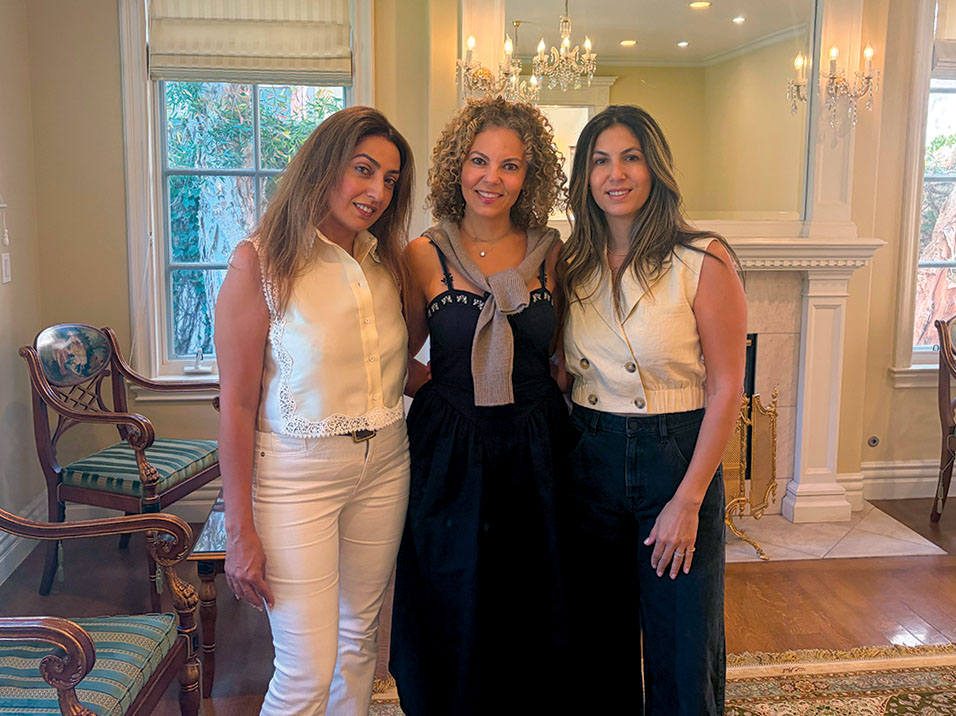

Rotem Weinner Shapira’s official title is director of Lion of Judah Israel (LOJI). The organization is the Israeli arm of a global philanthropic community of Jewish women that funds projects and nongovernment organizations geared to improving the lives and rights of women and girls. In reality, however, being LOJI’s only paid employee, Weinner Shapira is Jill-of-all-trades, with fundraiser, event producer, graphic artist and video editor among the many hats she wears.
“I believe that when women [come] together, they have special powers,” she said. “Things happen differently when the space is shared with men.”
LOJI hosts events for its community of some 160 women donors. Weinner Shapira says these are key to the foundation’s continued success because it affords them a space to just be themselves. “These are women who spend all day juggling their philanthropy, their businesses, their families, husbands, grandchildren but where are they themselves? Where are their souls?”
With a focus that changes every few years, LOJI is currently homing in on three fields: violence against women, pensioners and women with disabilities. The communal fund has enabled issues that fall under the radar to gain exposure. One example is a project LOJI did in conjunction with Maslan, the sexual violence crisis center, training medical teams in hospitals and staff in senior citizens’ centers how to deal with women who have either experienced sexual abuse in the past or have suffered it in later years. The project also highlighted the abuse of Holocaust survivors by their caretakers. “We want these women to finish their lives with honor,” Weinner Shapira said.
Weinner Shapira became LOJI’s director 11 years ago after returning to Israel from the United States, where she was an emissary in Pittsburgh. Even though her master’s specialized in American-Jewish studies, Weinner Shapira admits that she knew nothing about Jewish-American communal life before moving stateside. “I was amazed to see women reading the Torah and wearing a tallit,” she said, adding that Israelis are largely ill-informed about streams of Judaism outside Orthodoxy, since, unlike in the U.S., they comprise the fringes of Israeli society.
“I believe that when women [come] together they have special powers. Things happen differently when the space is shared with men.”
The growing disconnect between young American Jews and their peers in Israel is something that has to be tackled head-on, Weinner Shapira says, and it shouldn’t be the one-way street it currently is. “I think Taglit (Birthright) should be both ways, to make sure young Israelis get to know young American Jews.”
Weinner Shapira’s views on life and her career have evolved since taking the helm at LOJI, enabling her to navigate through different worlds. “I was born to be a bridge,” she said. This stems, in part, from her parents’ diverse economic backgrounds. “One grandmother gave me 500 shekels on my birthday while the other gave me chocolate,” she quipped.
Weinner Shapira and her husband also decided to become more observant. Four months ago, the secular couple decided to begin keeping Shabbat. Asked how her three children under the age of 10 are accepting such a drastic change, Weinner Shapira beams. “They’re all over it. It’s the most amazing thing that’s ever happened to us,” she said. “They’re suddenly discovering one another.”
Her views on her professional worth have also been transformed. “There was the Rotem of the Foundation who was a professional, a kind of prophet, and there was the Rotem who came home crying to her husband,” she said. “I will do all the work but it doesn’t matter if I don’t get the credit. I don’t care. Now I understand that there is a place to feel proud of myself.” n