fbpx

April 10, 2019

Philip Roth’s ‘The Plot Against America’ Becomes HBO Miniseries

“The Plot Against America,” Philip Roth’s 2004 novel set in an alternate history in which Charles Lindbergh defeated Franklin D. Roosevelt and turns America into a Fascist, anti-Semitic state where Jews are openly persecuted, will become a six-part HBO miniseries.

Winona Ryder (“Stranger Things”), Morgan Spector (“Homeland”), and Zoe Kazan (“The Ballad of Buster Scruggs”) play members of the Levin family, and John Turturro plays Lionel Bengelsdorf, a Conservative rabbi who becomes a key figure in the new administration. David Simon and Ed Burns are adapting the novel and will produce, and Roth is among the executive producers.

Ryder will return to Netflix for the fourth season of “Stranger Things” on July 4, and Spector will star with Gina Torres in the “Suits” spinoff “Pearson” on USA later this year. Turturro will next be seen in Sundance TV’s “In the Name of the Rose,” based on the novel by Umberto Eco. It premieres May 23.

Philip Roth’s ‘The Plot Against America’ Becomes HBO Miniseries Read More »

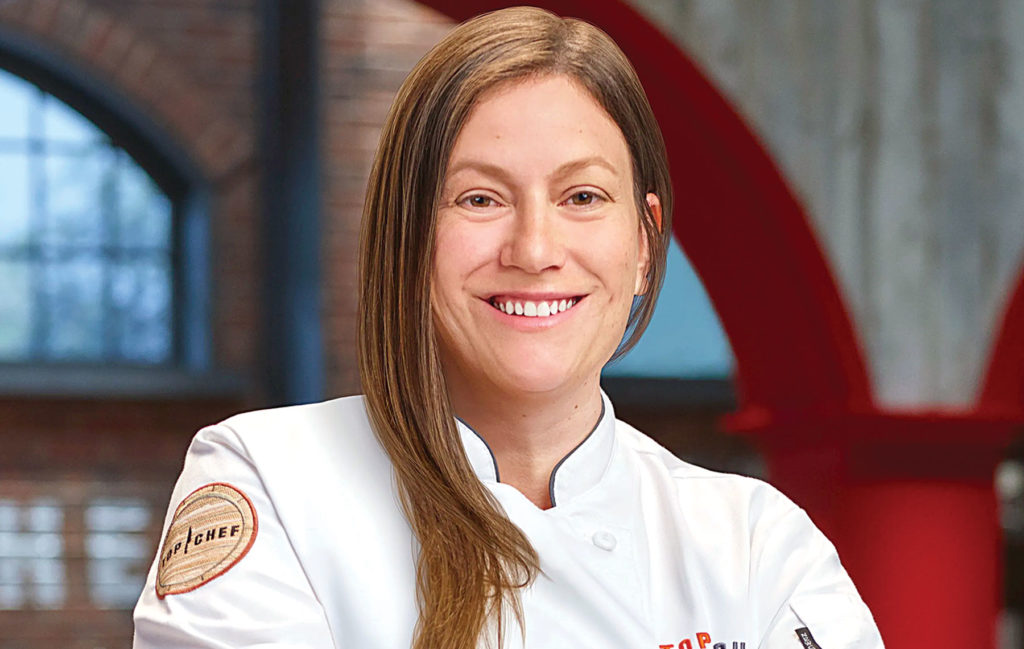
‘Top Chef’ Sara Bradley’s Winning Matzo Ball Soup

Sara Bradley won a challenge on “Top Chef” with this matzo ball soup recipe that sent her to the finals.

Chicken Brine

6 to 8 chicken thighs
1 Tbsp fennel seed
1/2 cup salt
1/4 cup sugar
2 quarts water
2 bay leaves
2 Tbsp dried ground mustard
2 Tbsp cooking oil

  1. In a pot, toast the fennel seeds.  Add the salt, sugar, water and bay leaves.  Simmer for 5 minutes. Let cool before pouring over chicken thighs.  Let brine overnight.
  2. Pat thighs dry and rub with mustard and veg oil.  Roast on 325 F for 20-25 minutes or until internal temp is 165.  
  3. Once cool, pick the meat from the bones.  You can add the juices and bones to your broth for flavor or keep everything separate for vegetarians.  This meat will be added to the chili broth during the cooking of the matzo balls.

Mushroom Broth

2 Tbsp Szechuan peppercorns
2-inch ginger chopped
1 head garlic split
1 yellow onion chopped
1/2 head celery chopped
2 large cloves black garlic smashed
4 quarts chicken stock, can use vegetable
5 to 10 dried shiitakes
4×4 inch piece kombu

  1. In a large pot, lightly toast the peppercorns.  Add all the chopped vegetables (except the dried shiitakes and kombu).  Add the stock, simmer for 30 minutes. Add the shiitakes and kombu and let steep 30 more minutes.  
  2. Season with kosher salt.  Don’t be scared of the amount of salt it will take.  
  3. Strain.  This can be made a couple of days before needed if desired.

Matzo Balls

(yields 15 golf ball sized matzo balls, those balls will double in size when cooked)

2 cups matzo meal
1 tsp ground black pepper
1 tsp ground fennel seed
1-2 Tbsp salt
1 Tbsp + ½ tsp baking powder
6 whole eggs
6 Tbsp vegetable oil or schmaltz (make sure the chicken fat is liquid when you add)
salt to taste
2-4 oz of club soda

The trick to a good matzo ball is to not overmix and do not let the mix sit around very long after it is made.  We set a timer for 20 minutes, then start to roll the balls. Do not over roll or compress the matzo balls. Just enough to have them stick together.

  1. Mix all of your dry ingredients in one bowl.
  2. Mix your eggs and oil in another bowl.
  3. Gently stir the wet into the dry.  Mix until just coming together. Do not overmix.  Taste for seasoning.
  4. Fold in the club soda.  Let sit for 20 minutes.

While the balls are resting, you should be cooking your chili broth.

Chili Broth

6 quarts water
1 Tbsp piri piri seasoning (can use red chili flake or omit if you don’t want it spicy)
3 to 4 stalks of celery, cut into large pieces
1 yellow onion, skinned and quartered
2 to 3 carrots, peeled and cut into large pieces.
3-4 heads of small bok choy, separate the leaves
5-6 shiitake mushrooms, sliced ¼ inch thick

  1. In pot large enough for balls to double in size, simmer the piri piri, celery, onion, and carrot for about 5-10 minutes.  They shouldn’t be tender yet. Season with salt. Bring to a boil and add your mixed matzo balls one by one.
  2. Simmer the matzo balls for 20 minutes covered.  It is important to make sure the broth is moving and that the heat isn’t too low.  
  3. Add the bok choy, mushrooms, and chicken thighs during the last five minutes of cooking.
  4. We always like to let our matzo balls rest in the broth for 15-20 minutes before serving.

To serve: Scoop out balls, veggies, and meat from chili broth.  Pour hot mushroom broth over balls.

‘Top Chef’ Sara Bradley’s Winning Matzo Ball Soup Read More »

Dave Barry, Alan Zweibel Share Friendship, Laughter and the Stage

Last Tuesday I was delighted to attend the Dave Barry and Alan Zweibel talk hosted by Live Talks Los Angeles at the Ann and Jerry Moss Theatre in Santa Monica. Barry is a widely popular, best-selling author and columnist who is now touring with a new book: Lessons from Lucy: The Simple Joys of an Old, Happy Dog. Barry, author of Dave Barry Turns 40 and many other books and columns, was awarded the Pulitzer Prize for Commentary and the Walter Cronkite Award for Excellence in Journalism.

Alan Zweibel is an award-winning author and producer, and one of the original writers on Saturday Night Live. He also co-created and produced It’s Garry Shandling’s Show, and others. Zweibel is the author of several books, including Bunny Bunny: A Sort Of Love Story about Gilda Radner. On Saturday Night Live he wrote some of the iconic early sketches such as John Belushi’s samurai sketch that are now classics.

Both were relaxed and naturally, easily amusing on-stage; and after their long friendship, displayed good-natured ribbing back and forth. Ted Habte-Gabr, the founder and producer of Live Talks LA, introduced the pair, also a long-time friend of theirs. Ted met Dave many years ago when running the speakers series at the University of Iowa as a student. Dave was an early guest. At that time Dave was running for President, something he does habitually. His slogan “It’s Time We Demanded Less” has new meaning these days!

Alan and Dave themselves met in Washington DC at an after party when Steve Martin was given the Mark Twain Award. They are both in the band Rock Bottom Remainders, a band that is proudly terrible and composted mostly of fellow writers. Soon after meeting, the two soon collaborated on a book Lunatics, and other works, each while also separately developing their comic writing and books through the years.

Alan spoke proudly and humorously of his Jewish background; he was raised in the faith and continues to practice it as an adult. Dave was raised Christian, and is not particularly religious now, but his wife and children are Jewish. Dave had a most amusing story about his grandson’s bris that left the audience in stitches.

Alan started in comedy writing jokes for the Catskills comedians at $7 a joke. An early one is about the sperm bank. It’s the only bank where you actually loose interest after making a deposit!

Alan pursued comedy after not making it into law school, and met Billy Crystal early on and then Lorne Michaels, which led him to Saturday Night Live. An early joke he showed Lorne Michaels was about the post office making a commemorative stamp for prostitutes. It’s 10 cents a stamp, but if you want to lick it it’s 25 cents!

Dave also talked at length about his new book, Lessons from Lucy, saying what prompted him to write the book was he turned 70 last year and his dog Lucy was 10, which is 70 in dog years. Lessons from his beloved pouch in the book include letting go of anger, living in the moment, being kind to your loved ones, etc. He also discussed the last chapter of his book, which unlike the rest of his comic writing, turns quite poignant. He writes movingly of his daughter’s severe health struggles and paralysis shortly before entering college. Happily she has now recovered and is a student at Duke University.

All in all, a lighthearted and very entertaining evening with two of the funniest buddies on the planet.

Dave Barry, Alan Zweibel Share Friendship, Laughter and the Stage Read More »

UCSB Divestment Vote to Happen Tonight [UPDATE: Vote Fails]

UC Santa Barbara’s (UCSB) Associated Students Senate will be voting on a resolution to divest from companies that conduct business with Israel at 6:30 p.m. on April 10.

The student-run Daily Nexus reports that the resolution, which is being spearheaded by the campus Students for Justice in Palestine (SJP), calls on the university to divest from 13 companies – including Boeing, Caterpillar and General Electric – that “profit from human rights violations in Israel/Palestine.”

A student involved with the Associated Students department, who wished to remain anonymous for safety reasons, told the Journal in a phone interview that the vote seems to be evenly split and could come down to Internal Vice President Steven Ho breaking the tie. According to the student, Ho supported the Boycott, Divestment and Sanctions (BDS) movement in 2018 as a student senator. Ho didn’t respond to the Journal’s request for comment on how he would vote on the 2019 divestment resolution.

UCSB is the only UC campus that hasn’t passed a divestment resolution; pro-Israel writer Noah Pollak tweeted that if divestment were to pass at UCSB, the BDS community will likely target the UC Board of Regents next:

https://twitter.com/NoahPollak/status/1115837302134145025

UCSB student Sarah Mehrnia wrote in a letter to the editor in the Daily Nexus that she felt “directly targeted by this resolution” given that her parents fled to Israel to escape the 1979 Iranian revolution.

“Many Jewish Israelis are people of color who came from Middle Eastern countries where their families faced persecution and discrimination, and Israel was the only place where they could find refuge,” Mehrnia wrote. “The descendants of these refugees make up the vibrant and diverse society that is Israel. For us, Israel is a safe haven and the embodiment of our liberation. This resolution attempts to erase this history.”

Mehrnia added, “Instead of advancing a one-sided resolution, we should be supporting initiatives that promote a better life for Palestinians and Israelis. Instead of divesting, we should be investing in collaboration and coexistence. Instead of dictating a political solution to a faraway conflict, we should be coming together to bridge our gaps and better understand one another here at UCSB. This resolution impedes progress towards justice and the goal of peace for both Israelis and Palestinians. It promotes a dangerous pattern that divides our campus, stifles dialogue, and creates a hostile atmosphere at UCSB.”

UCSB Chancellor Henry Yang was one of the 10 UC chancellors to sign a pledge opposing academic boycotts of Israel. The university did not respond to the Journal’s request for comment on the divestment resolution.

UPDATE: The divestment failed by a vote of 14-10. More information can be read here.

UCSB Divestment Vote to Happen Tonight [UPDATE: Vote Fails] Read More »

House GOP Push for Vote on Bill to Protect States That Penalize BDS Supporters

WASHINGTON (JTA) — Top Republicans in the U.S. House of Representatives are joining in an effort to force a vote on a bill that targets Israel boycotters.

Rep. Steve Scalise, R-La., the House’s second-ranked Republican, on Wednesday announced plans to force a rule change that would bring to the floor a broad Middle East policy bill. The law would protect U.S. states that penalize businesses that participate in the Boycott, Divestment and Sanctions movement targeting Israel. It already passed the Senate, but many Democrats have renounced it as an infringement of civil liberties.

“The House must follow the Senate’s lead and take immediate action to support our allies and combat the BDS movement that aims to delegitimize and economically isolate Israel,” Scalise said in a statement.

The broader bill includes codification of $38 billion in defense assistance for Israel, assistance for Jordan and new sanctions on Syria’s government — elements most Democrats support. But House Speaker Nancy Pelosi, D-Calif., wants to break up the bill into its separate components to keep the anti-BDS language from coming to the floor.

Joining Scalise in launching the effort are Rep. Michael McCaul, R-Tex., the top Republican on the Foreign Affairs Committee, and the two Jewish Republicans in Congress, Lee Zeldin of New York and David Kustoff of Tennessee.

Republicans need a majority of the House, or at least 218 members, to sign on to the request in order to force the floor vote. Scalise can count on all but two or three of the 197 Republicans and would have to get another 20 or so Democrats to sign on.

House GOP Push for Vote on Bill to Protect States That Penalize BDS Supporters Read More »

Sara Bradley on Growing up Jewish in Kentucky and Her ‘Top Chef’-Winning Matzo Ball Soup

In “Top Chef: Kentucky,” Season 16 of Bravo’s culinary competition, local restaurateur Sara Bradley impressed the judges with dishes influenced by her Southern and Jewish roots, most notably a matzo ball soup recipe that won the challenge and sent her to the final. She ultimately lost the title to Kelsey Clark, but Bradley’s Paducah, Ky., restaurant Freight House, is doing blockbuster business since her TV appearance. While juggling a busy schedule, preparing for Passover and awaiting the birth of her first child — a girl — with husband Austin Martin in May, Bradley took time out to speak with the Journal.

Jewish Journal: Did being from Kentucky give you a home turf advantage on “Top Chef” or increase the pressure? 

Sara Bradley: A bit of both. I might have had the inside scoop because I knew the area, but it was added pressure because you don’t want to disappoint your state, friends or family.

JJ: Did your love of cooking begin in your mother’s kitchen?

SB: Yes. She was a huge influence. She taught us to cook and she always made these extravagant desserts. We ate things that were a blend of Southern and Jewish. My father’s mother also had a lot to do with how I cook now. We made potato latkes and ate them with apple butter — applesauce cooked down with cinnamon and a bit of fat in it.

JJ: How did your culinary career begin?

SB: I always wanted to cook and had jobs in kitchens in high school and college. After college, I worked as a researcher in statistical psychology at a psychiatric hospital and at a restaurant. The restaurant was much more fun. My grandfather Julius Cohen gave me the money for culinary school. I worked in New York and Chicago before coming home to Paducah and opening Freight House in September 2015. 

JJ: What type of cuisine?

SB: It reflects my Southern, Jewish and frugal roots. We don’t waste anything here. We serve a lot of liver [and] beef tongue. We source as much as we can locally. We’re very seasonal and change the menu frequently. Right now through the end of April you can try the finale meal that I cooked in Macao. We’re listed as one of America’s great bourbon bars.

[At my restaurant in Kentucky] we used to call them cracker dumplings because matzo balls sounded so foreign. But since [“Top Chef”] aired, we call them matzo balls. People are so excited to try them.” 

JJ: Your mother works with you there.

SB: Yes. Today she’s making bourbon chocolate chess pies and key lime pistachio cheesecakes. It felt really good to have her there with me in Macaou and to win felt even better! I wasn’t worried about the flavor profile [of the matzo balls]. It was the technique that I was worried about screwing up and having them come out hard, like matzo rocks.

JJ: Is the matzo ball soup on the Freight House menu?

SB: Yes. We used to call them cracker dumplings because matzo balls sounded so foreign. But since the show aired we call them matzo balls. People are so excited to try them. 

JJ: What was it like growing up Jewish in the South? What’s your family background?

SB: My mother’s grandparents were from Poland and Prussia. My great-grandfather opened a hardware store in Paducah — E.A. Cohen & Son — later my grandfather’s. My parents met when they were both working in Lexington, Ky., and married 43 years ago. My father is not Jewish. He is spiritual but not a religious man. My brother, sister and I were raised Jewish. I went to Sunday school, had a bat mitzvah at 12, a confirmation at 16. I went to a Jewish summer camp every year. My mother had some very religious relatives, so I also went to black-hat weddings. Being Jewish was a major part of how I identified. There was only one other Jewish family with kids my age in Paducah and we were very close. As a child, I embraced being a minority, being different. Judaism is more than a religion. It’s your heritage, it’s your culture, it’s a whole mentality.

JJ: Your husband isn’t Jewish. Did you have a Jewish wedding?

SB: Yes, but not that traditional. We both stomped glasses. We had a ketubah, we danced the horah, we did all the things that were culturally significant and important to me. We had it at an old greenhouse and we had food trucks, an open bar, a vintage bourbon tasting, a great band. We had about 300 people there. 

JJ: How did you meet?

SB: Through a mutual friend. He’s an attorney and a cattle farmer. We met at a brewery and talked about farming for hours. We’ve been inseparable since. 

JJ: How will you celebrate Passover?

SB: Paducah has a small synagogue and no full-time rabbi. A rabbi comes from the rabbinical school in Cincinnati for the High Holy Days, and about once a month, so we’ll go to synagogue. My husband loves Passover and all the food I make: gefilte fish, matzo balls, red horseradish, matzo brei. 

JJ: You’re expecting your first child. Is it important to raise her with Jewish traditions?

SB: Yes. I want to give her the same choice that my parents gave me — they presented me with the information and let me make my own decision. I wanted to do that for my child too. I can’t imagine that she won’t go to the same Jewish summer camp I went to. It was such an important part of my life. 

JJ: Do you have any plans to open more restaurants?

SB: I have dreams of owning a meat-and-three, a traditional type of Southern restaurant: a meat and two or three sides. But with the baby, that’s down the line.

JJ: What did “Top Chef” teach you?

SB: If you have a dream, you should go for it. If I hadn’t done this, I wouldn’t have improved my life and the lives of all of my employees. Don’t hold back.

For Sara Bradley’s matzo ball soup recipe, click here. 

Sara Bradley on Growing up Jewish in Kentucky and Her ‘Top Chef’-Winning Matzo Ball Soup Read More »

Parting of the Red Sea Placemats

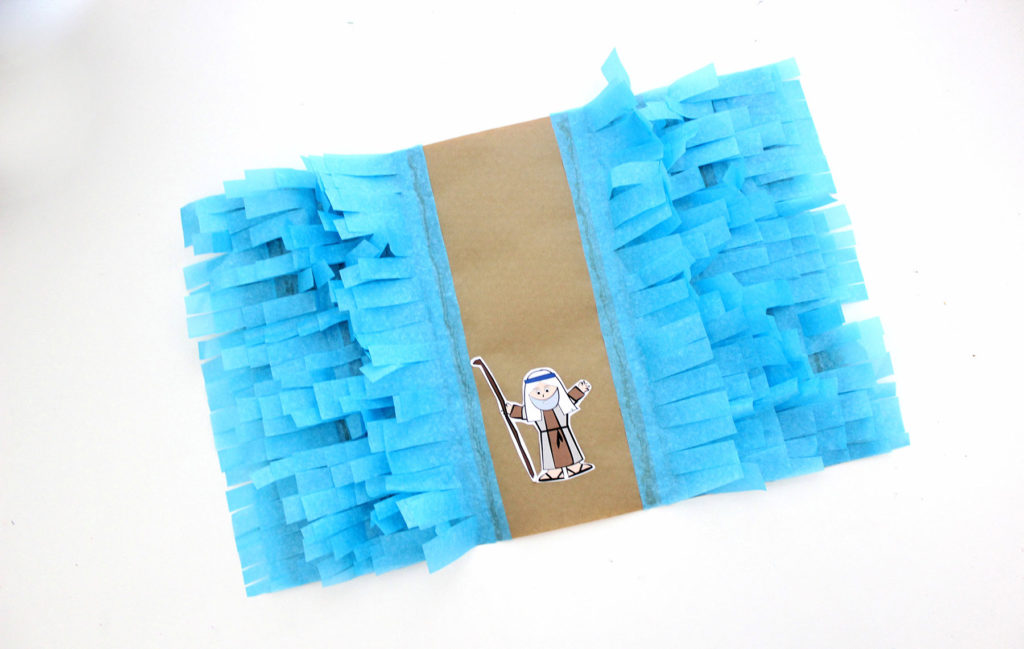
Moses’ parting of the Red Sea? That was a miracle. Getting kids to put down their cellphones and actually engage in the Exodus story during Passover? Now, that’s a modern-day miracle. And with these fun and easy-to-make placemats, kids can re-create this pivotal event while helping to decorate the seder table. 


1. Trim a piece of brown-colored butcher or construction paper to about 12 by 18 inches. You can also recycle brown paper grocery bags.


2. Cut blue tissue paper into 3-by-12-inch strips. Cut slits about every half inch, crosswise along the strips, making sure you don’t cut all the way through the paper. Fold back some of the cuts to fluff up the strips.


3. Glue the tissue paper strips vertically to the left and right sides of the butcher paper. Position the paper so that the slits face outward toward the sides so the “water” is parted from the middle and going outward. Overlap the strips as you go. I glued eight strips to both sides of the placemat.


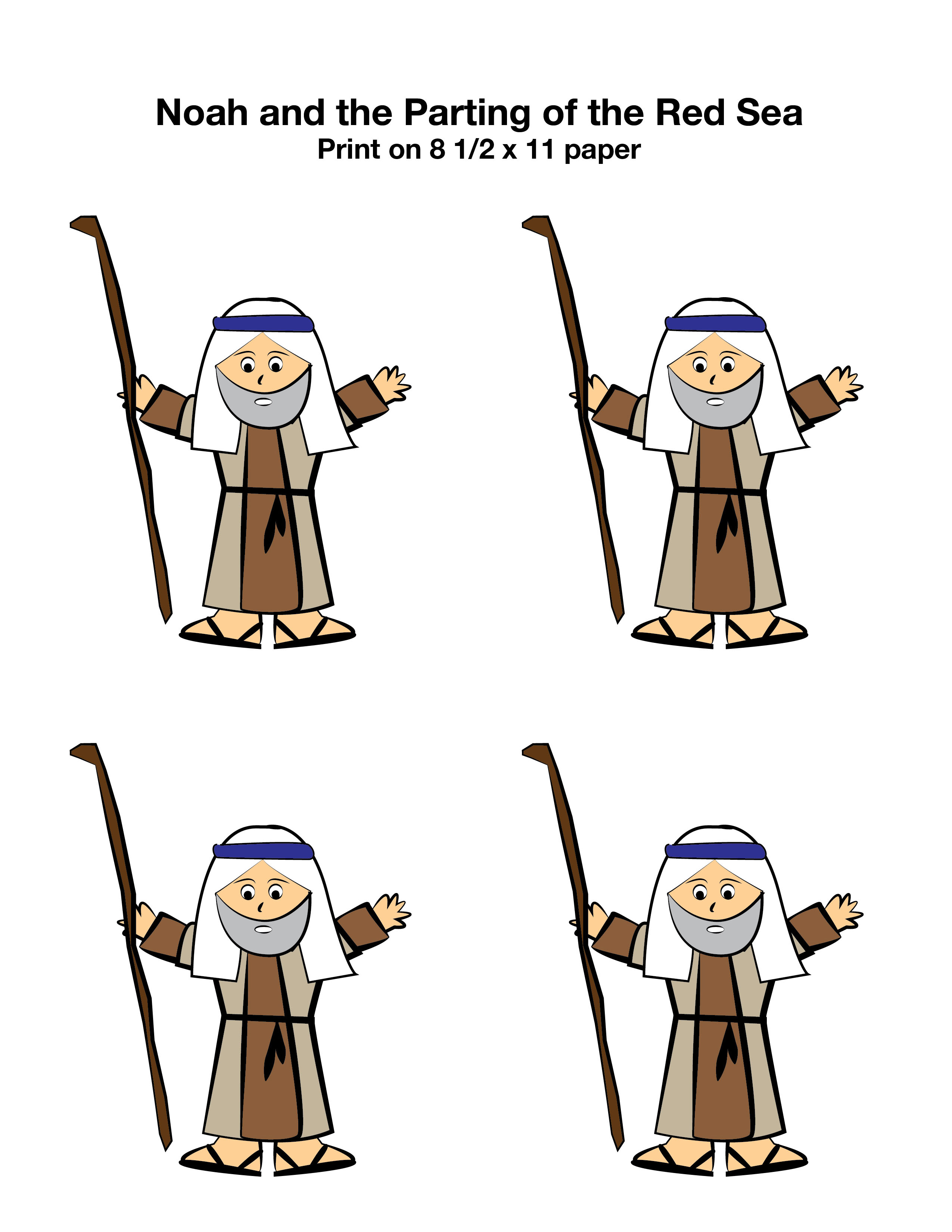
4. Download the image of Moses from this tutorial here and cut it out. (Eagle-eyed crafters may recognize the picture as the one I drew for the Jonah and the Whale tissue holder — but with a staff.) Glue Moses to the placemat and fluff up the tissue paper once more.


Jonathan Fong is the author of “Flowers That Wow” and “Parties That Wow,” and host of “Style With a Smile” on YouTube. You can see more of his do-it-yourself projects at jonathanfongstyle.com.

Parting of the Red Sea Placemats Read More »

Obituaries: April 12

Bernard Beiner died Jan. 6 at 89. Survived by daughters Cheri, Michelle, Lory Heron, Melanie Teller, Mindy Kulhanek; 6 grandchildren. Chevra Kadisha

 Sam Bell died March 8 at age 89. Survived by daughters Frances (Mike), Helen (Stephen); 4 grandchildren; 1 great-grandchild. Mount Sinai

 Nina Bruck died March 1 at 93. Survived by daughters Selene (Greg), Helaine (Glenn); 2 grandchildren. Hillside

Ethel Cohn died March 6 at 93. Survived by daughters Francine (Ron), Janice, Dana (Roger); son Andy (Vivian); 8 grandchildren; 11 great-grandchildren. Hillside

Goldyne Diamond died March 15 at 97. Survived by daughters Leslie, Adrian; son Michael; 5 grandchildren; 8 great-grandchildren. Hillside

Goldeen Fellman died Feb. 28 at 95. Survived by nephew Randall. Hillside

Mary Lou Greer died March 3 at 88. Survived by sons Charles (Marchele), Mark (Wendy), Sheldon; 7 grandchildren; 6 great-grandchildren. Hillside

Caryl Gross died March 9 at 93. Survived by son N. David (Holly). Hillside

Selma Hochman died Feb. 28 at 91. Survived by daughter Valarie (Ernest) Sofianos; sons David (Kathleen) Donner, Andrew (Jamie), Mitchell Donner; 10 grandchildren; 21 great-grandchildren. Mount Sinai

Mary Jaffe died March 8 at 96. Survived by daughter JoAnne (Barry); son Jay (Denise); brother Jake; 4 grandchildren; 2 great-grandchildren. Hillside

Jacqueline Josephs-Klein died March 3 at 89. Survived by daughter Joan; 1 grandchild; 3 great-grandchildren. Hillside

Ben Kalmuk died March 6 at 90. Survived by daughter Ellen (Dan); son Robert; 1 grandchild. Hillside

Minnie Kaplan died Feb. 28 at 101. Survived by daughters Nicole (Ed), Joan; 5 grandchildren; 5 great-grandchildren.
Hillside

Charlotte Lane died Feb. 28 at 79. Survived by husband Tom; daughter Adrienne (Daryl) Seltzer; 3 grandchildren; brother-in-law Charles. Mount Sinai

Max Leigh died Feb. 28 at 99. Survived by wife Inna Bender-Leigh. Mount Sinai

Leon Levitt died March 2 at 96. Survived by wife Kathryn; daughter Anna; sons Daniel (Alajandra), David (Susannah), Alan, Noah; 7 grandchildren; 6 great-grandchildren. Hillside

Joseph Lewit died March 4 at 98. Survived by daughter Sandra (Kenneth); 2 grandchildren. Hillside

Don Maniloff died Feb. 24 at 84. Survived by sister Corinne Wegner. Mount Sinai

Richard Maullin died March 6 at 78. Survived by wife Michele; daughters Celine (Jet), Natalie (Hugh). Hillside

Henry Oster died March 17 at 90. Survived by wife Susie; daughters Lisa, Harriet; sons David, Bruce, Andrew; 7 grandchildren.

Philip Palbaum died March 1 at 86. Survived by wife Joyce; daughter Rochelle (Irving) Ameti; sons Bryan (Stacy), Wayne (Bonnie); 8 grandchildren; 2 great-grandchildren. Mount Sinai 

Shelton Samuel Pepper died Feb. 27 at 99. Survived by wife Doris; daughter Pam Fender; stepdaughter Pam Balton; sons Ken, Jon; 6 grandchildren; 5 great-grandchildren. Mount Sinai

Alfred Rosenberg died Jan. 20 at 91. Survived by daughter Lisa (Thomas) Barbarick; sons David (Margaret), Michael (Cathy); 7 grandchildren; 1 great-grandchild. Mount Sinai

Jeanne Rosenberg died Aug. 12, 2008, at 77. Survived by daughter Lisa (Thomas) Barbarick; sons David (Margaret), Michael (Cathy); 7 grandchildren; sisters Rita Bloom, Adelaide Pall. Mount Sinai 

Estherae Sanford died March 2 at 86. Survived by daughter Kathi; 22 grandchildren, great-grandchildren, great-great grandchildren. Mount Sinai 

Joseph Schneider died March 3 at 94. Survived by daughter Lori (David) Parris; sons Gary, Mark; 6 grandchildren. Mount Sinai

Mollyann Schroeder died Feb. 26 at 82. Survived by husband Charles; daughter Michele (David); son Marc (Stephanie); 3 grandchildren; brother Michael (Shila). Hillside

Irene Sherman died March 14 at 93. Survived by daughter Harriet (Larry); son Norman (Carolyn); stepbrother Sumner; 2 grandchildren; 1 great-grandchild. Hillside 

Yakov Sosinov died March 1 at 95. Survived by daughter Zoya; 2 grandchildren. Mount Sinai 

Roslyn Steinhauser died Feb. 25 at 91. Survived by husband Warren; daughters Susan (Daniel) Steinhauser Greenberg, Debra (Ted) Thompson; son Steven (Branwen); 2 grandchildren. Mount Sinai 

Marcel Tanner died Feb. 23 at 97. Survived by wife Rosslyn; daughters Lilly Ann, Evelyn; son Sigmund; stepdaughter Susan; stepson Steven; 3 grandchildren; 3 great-grandchildren. Hillside 

Ruth Shirley Turkell died March 1 at 98. Survived by daughter Renee (Harold) Brook; son Jeffrey (Catherine); 4 grandchildren. Mount Sinai 

Monica Von Neumann died March 5 at 54. Survived by daughter Dorian; mother Martha. Hillside

Zunilda Wagmeister died March 11 at 92. Survived by daughter Sylvia (Edward); son Claudio (Esther); 3 grandchildren; 7 great-grandchildren. Hillside

Sylvia Weinberg died Feb. 27 at 97. Survived by daughter Laurie (Stuart); sons Neil (Miriam), Richard (Bernadette); 4 grandchildren. Hillside

Myrna Winer died Feb. 26 at 83. Survived by daughters Elizabeth (John) Eversen, Kathryn (David) Masci; son Roger (Lynn); 5 grandchildren; brothers Terry (Lynn), Jon (Joanna Lucchesi). Mount Sinai 

Youssef Yamin-Kachani died March 3 at 92. Survived by wife Parvin; daughters Soriya Mobasser, Miriam Feltrin; son Solly Yamin; 5 grandchildren; brother Nasser (Heideh) Yamin. Mount Sinai n


Obituaries: April 12 Read More »

A Graphic-Novel Haggadah, Three Picture Books and Two Award Winners for Kids

There’s a new graphic novel haggadah out this season, along with new picture books about the holiday. For older readers, included here are two award-winning Jewish-themed children’s novels that are highly recommended.

Haggadah:

“Passover Haggadah Graphic Novel” by Jordan B. Gorfinkel. English translation by David Olivestone. Illustrated by Erez Zadok. Koren Publishers, Jerusalem, 2019.
It’s best to let Jordan Gorfinkel, the creator and writer of this graphic-novel approach to the haggadah, explain his intent through the words of his narrators, a family of human-like goats from the “Had Gadya” song: “We’re connecting a new generation to our living history, by illustrating the fully unabridged, authentic text in the sequential storytelling style of comics — a Jewish innovation, you know. Everything you need to conduct your seder is right here — the Hebrew and transliteration of the text pages and the English translation in the word balloons on the art pages. It’s all kosher … for Passover.  Any time there’s a seder ritual to perform, we’ll pop in and provide instructions.” 

And thus, it begins — a highly engaging and truly instructive text that zips in and out of depictions of modern, multicultural families celebrating seders mingled together with fabulous artistic scenes of the Hebrews’ struggle in ancient Egypt. There’s a lot happening on each page, but the flow is impressive and well thought-out.

The narration is serious, but little jokes of familiarity aimed toward children are scattered throughout the illustrations. For example, in a drawing of the first of the four questions asking why we eat only matzo tonight instead of bread, we see a boy spreading Nutella on his matzo only to throw his hands up in frustration when it breaks easily. When his sister then asks why we eat bitter vegetables, a cousin snickers at the exaggerated disgust she displays upon tasting maror.

Even the staid recitation of quotes from Rabbi Eleazar ben Azarya and Ben Zoma take on new and relevant meanings through illustrations of other historical rescues of Jews throughout our long history. The “Four Sons” are translated as the “Four Types of Children”: Astute, Rebellious, Innocent and “One Who Cannot Even Put Thoughts Into Words,” demonstrating how the graphic-novel format can deliver a striking emotional effect. Ditto the Ten Plagues, where a picture is surely what’s needed to convey the heft of this part of the story. 

Erez Zadok, the talented illustrator, provides gems on almost every page that reflect the universality of the text throughout the ages. Whether it’s a small panel of the “Four Mothers” from the “Echad Mi Yode’ah” song appearing as four heads on Mount Rushmore, or Jews from history crossing the Red Sea. This full-page spread depicts that scene as reflected in a sort of FaceTime iPhone app that serves to amplify the well-known words: “In every generation, we must imagine that we ourselves actually left Egypt.” Young people will be particularly engaged by this graphic-novel version of the haggadah and surely be enticed to read it on “all other nights.”

Picture Books:

“Around the Passover Table” by Tracy Newman. Illustrated by Adriana Santos. Albert Whitman, 2019.
Here is a bouncy and straightforward explanation of what happens at a seder that is aimed at very young children. An extended family arrives at the grandparents’ home for the seder, and eventually everyone is happily seated with a pillow at their backs, drinking “yummy” grape juice and going through the rituals most prized by children. The dog, cat and goldfish illustrations in the background steal the show. The text rhymes but not in typical couplet form, and therefore has a more appealing rhythm. (“And now welcome guests to drink from their cups/We swing the door wide/Ask Elijah inside/Fill Miriam’s cup/Lift it high. Lift it up.”) All men wear kippot and women are modestly and colorfully dressed. The end glossary provides definitions of key terms. Overall, the book is appealing and upbeat and provides many instances for adults to comment on each ritual or Hebrew term to offer more context if needed.

“Pippa’s Passover Plate” by Vivian Kirkfield. Illustrated by Jill Weber. Holiday House, 2019.
Passover will arrive at sunset, but poor Pippa the Mouse seems to have misplaced the seder plate, and that won’t do. In this sweet rhyming story, preschool age readers will follow Pippa on her search to find it.  She must conquer her fears, however, because each creature she approaches (cat, snake and owl) is also a mouse’s natural enemy. “Quiver! Quaver! Shiver! Shake! Snakes make Pippa cringe and quake.” In a nod to the benefits of bravery, Pippa offers friendship and outgoing gestures to these animals and they respond with kindness, eventually getting an invitation to Pippa’s seder when her plate has been found. The naïve-style art here truly stands out, providing multiple occasions for young children to find hidden animals among the bright outdoor scenes of nature. Kids will also find it amusing that the culprit is the goldfish, who is then invited to the seder and is depicted literally as a fish out of water.

“The Best Four Questions” by Rachelle Burk. Illustrated by Melanie Florian. Kar-Ben, 2019.
Young Marcy has just learned how to read, so she is excited that she gets to ask the four questions at this year’s seder. Her older brother smirks and opines that she will surely mess it up. Unfortunately for her, she is unaware that the four questions at the seder are actually quite specific. So Marcy spends much time thinking up fabulous kid-like questions that she is curious about: “How many matzah balls are there in Grandma’s soup? Why does Uncle Benjy always fall asleep during the seder? Is horseradish made from horses?” Happily, everyone at the table takes turns answering Marcy’s earnestly asked questions until she turns to her older brother for a bit of help with reading the real ones from the haggadah. Bright, engaging illustrations combined with kid-pleasing humor and helpful information about Passover rituals make this a fun read-aloud.

Middle-Grade Novels for Older Children:

“Sweep: The Story of a Girl and Her Monster” by Jonathan Auxier. Abrams, 2018.
This recent winner of the Sydney Taylor Award from the Association of Jewish Libraries (and finalist for the National Jewish Book Award) is the adventurous story of a spunky but impoverished orphan girl in Victorian London and the golem who saves her life. Nan Sparrow, the young chimney sweep exploited through virtual enslavement by a cruel master, is befriended by a magical golem who springs to life one day from a special lump of clay that she has kept in her pocket for years. It was a gift bestowed upon her by the one adult who once cared for her but has now mysteriously disappeared. Charlie, as the golem is eventually called, uses his immense strength and powers to save Nan and her powerless chimney sweep pals from cruel bosses and bullying children. The Jewish themes include both Nan’s budding friendship with Esther Bloom, a once-observant Jewish teacher whose kindnesses inspire Nan to overcome her harsh circumstances; and her relationship with Toby, a scrappy Jewish vagabond who manages to survive the oppressive world of London’s child labor by his wits alone. The writing is luminous; kids will be searching for their flashlights in order to read under the covers each night in anticipation of Nan and Charlie’s exciting adventures. 

“All Three Stooges” by Erica S. Perl. Knopf Books for Young Readers, 2018.
A humorous book with a dark theme was this year’s deserving winner of the National Jewish Book Award (from the Jewish Book Council) and a Sydney Taylor Award Honoree. Noah and his best friend, Dash, are typical seventh graders trying to juggle family life, friendships, girls and their upcoming bar mitzvahs. Noah idolizes Dash’s dad, Gil (Noah has two moms), and is unaware that he suffers from depression. Gil and the two boys share a crazy sense of humor, and Noah is seemingly on track to become a stand-up comedian through his fervent studies of old comedy records and YouTube clips. When the tragedy of Gil’s death by suicide occurs, Noah is unsure how to console his pal or if joking around can still form the basis of their friendship. The (non-stereotypical) depiction of the understanding and funny rabbi helping the boys prepare for their bar mitzvahs is particularly welcome. The author has taken on the difficult subject of how to be a friend to someone who has experienced loss, which serves to be quite instructive for young readers. The inclusion of so much humor, history of Jewish comedians, and plain, old seventh-grade angst makes this book a standout title that deals with an important subject.


Lisa Silverman is the director of the Burton Sperber Jewish Community Library located at American Jewish University.

A Graphic-Novel Haggadah, Three Picture Books and Two Award Winners for Kids Read More »

Authors Get Creative in New Haggadahs

An emoji can be seen as a contemporary revival of the hieroglyphics that were so prominent in ancient Egypt. And so, as we recall the flight from Mitzrayim during our third-millennium seders, what could be more appropriate than “The Emoji Haggadah” (KTAV), which tells the tale entirely in playful and inventive images? It’s the handiwork of Martin Bodek, a Brooklyn-based freelance writer and co-founder of TheKnish.com, which has been described as “a Jewish version of The Onion.” 

To be sure, “The Emoji Haggadah” is more of a game than a haggadah, but it will surely engage the lively interest of younger participants and enliven the seder for everyone even if, on the other hand, the challenge of decipherment isn’t going to make your seder any shorter. But, just as the Rosetta Stone was the key to decoding Egyptian hieroglyphics, the author provides some helpful tips for translation as well as the complete text of a traditional haggadah in both Hebrew and English.

The Jewish Journey Haggadah: Connecting the Generations,” by Rabbanit Adena Berkowitz (with photographs by Shira Hecht-Koller) (Gefen), can be described as a user-friendly and full-service haggadah. Berkowitz provides all of the fundamentals — the Hebrew text, a complete transliteration and an English translation. But she also enriches the traditional elements of the haggadah with songs, stories and commentary that are meant to catch and hold the interest of adults and children alike while deepening their understanding of the meanings of Jewish tradition. Along the way, she allows us to see the essential role of women in the Exodus, and she provides a rich selection of talking points for conversation and debate around the seder table. In a sense, that’s her life’s work between covers; Berkowitz, a New York-based psychotherapist, is Scholar in Residence and co-founder of Kol HaNeshamah, an organization whose mission is “re-energizing the spiritual lives of both not-yet-affiliated and affiliated Jews.”

For families with a short attention span, there’s always “30 Minute Seder: The Haggadah That Blends Brevity With Tradition,” written by Robert Kopman and illustrated by Bil Yanok (30 Minute Seder). Lest we equate haste with irreverence, the publisher assures us that “30 Minute Seder” is “fun yet reverent” and “rabbinically approved.” Inevitably and intentionally, much of the traditional seder is left on the cutting room floor along with the question, “When do we eat?” But it has found its readership as evidenced by the fact that “30 Minute Haggadah” is a registered trademark, and the product line includes a large-print edition, a 12-copy value pack and even the “60 Minute Seder” for the slightly more patient seder-goers. 

The Amazon listing for “The Jewish Journey Haggadah” includes a crack about families for whom “a Haggadah distributed by a leading coffee company might suffice.” That’s a reference to the classic Maxwell House haggadah that has become a Passover tradition in itself. As it turns out, however, Maxwell House has issued a limited edition of its iconic haggadah in a nod to a celebrated Jewish figure in current popular culture, Midge, the main character in the Amazon Prime series “The Marvelous Mrs. Maisel.” Except for the title, “Midge’s Haggadah,” and a few interior touches (such as simulated wine stains and a handwritten recipe), it’s the classic 1958 edition with a new cover. And don’t try to actually buy “Midge’s Haggadah” on Amazon, where prices approaching $1,000 are quoted for used copies. Since “Midge’s Haggadah” is strictly a marketing gimmick, it is available for free when you purchase select Maxwell House products on Amazon.

Watch the Journal review “Midge’s Haggadah” here. 

Perhaps the most elegant haggadah of all is the newly published “The Lombard Haggadah,” by Milvia Bollati, Marc Michael Epstein and Flora Casen (Paul Holberton Publishing), which reproduces a manuscript copy of a haggadah first created in the late 14th century and illustrated over the next 700 years with 75 marginal illuminations in watercolors. “The Lombard Haggadah” was the earliest stand-alone haggadah from the Jewish community in Italy, and its significance is explained by the scholars who have studied its origins, iconography and historical context. The book has been published in conjunction with an exhibition of the original manuscript at a gallery in New York City, the first time “The Lombard Haggadah” has been displayed since the Paris world’s fair in 1900. While it is not serviceable at the seder table, it is an example of enduring function of the haggadah as a medium of both literary and artistic innovation.

By contrast, “The Yada-Yada Hagaddah: A Sitcom Seder,” by Dave Cowen (Cowen), is pure parody, a follow-up to Cowen’s 2018 Amazon best-seller, “The Trump Passover Haggadah.” As the title suggests, the haggadah owes as much to “Seinfeld” as to the Book of Exodus, and its function at the seder table is to provide a few moments of hilarity between the traditional readings. Guests can take the roles of Jerry, George, Elaine and Kramer in performing the comedic scripts that Cowen has created. “Because this is a parody that transforms the copyrighted material [in ‘Seinfeld’] into a teaching tool for Judaism,” Larry David is made to say, “it’s kosher.” And, for all of its high spirits, the author is careful to refer to the Almighty as “G-D,” which suggests that he may be willing to push the envelope on copyright law but not Jewish tradition.

Finally, I join my colleague, Lisa Silverman, in calling attention to the “Passover Haggadah Graphic Novel,” written by Jordan B. Gorfinkel and illustrated by Erez Zadok (Koren), which is the world’s first haggadah in a comic book format. Not unlike the “Emoji Haggadah,” the author and illustrator have retold an ancient tale in a thoroughly modern medium, and their work is both provocative and eye-pleasing. You can read Lisa’s review of the “Passover Haggadah Graphic Novel” on page 59.


Jonathan Kirsch, author and publishing attorney, is the book editor of the Jewish Journal.

Authors Get Creative in New Haggadahs Read More »