fbpx

April 10, 2019

A Healthy, Happy Passover

Passover is truly a celebration. It’s a labor of love, but a labor nonetheless. Each year, we clean and shop and prep and cook our way to the seder. As I write out my menus and shopping lists, I make sure I have something for everyone, always blending the traditional with the new. And like every year, I’ll probably make the same classic meat and chicken dishes that most everyone loves, and watch them get eaten to the last morsel.

But this year, I’m planning a quiet shift, a move toward an especially healthy and fresh Passover filled with more vegetables, more crisp and more crunch. 

So what led me to this greener Passover? Was it all the winter rains that blessed us and our wildflowers this season? Was it learning from those vegetarian, gluten-free and low-carb guests who graced our table this year? Was it perhaps the memory of a little too much meat and matzo at seders past? Or was it maybe all of the above? 

Perhaps this move in a healthy and liberating direction is a little like the Exodus, freeing us from the weight of a heavy cuisine and leading us to a lighter and more natural way to eat. It is my goal to create a meaningful and healthful Passover for everyone, one that is rich in symbolism and yet fresher, lighter and more joyful than ever. Have a healthy, happy Passover, and live it up!

For starters, instead of using lots of little dishes and serving bowls, I’ll serve all of our symbolic seder foods artfully composed on one big board. If you don’t have a big board, a large tray or kale covered cookie sheet pan will work just fine. I’m calling this my Seder Board, not to be confused with the time-honored Seder Plate at the head of the table. This Seder Board will be my centerpiece. It will be placed in the middle of my seder table, for everyone to behold and share, according to the order of the haggadah service. Seder foods vary from one tradition to another, so please use all your favorites. 

THE SEDER BOARD

(Serves 10)

1. Karpas and hazeret (vegetables to dip): I like to include fresh Italian parsley (1 to 2 bunches, carefully cleaned), fennel (two large bulbs sliced carefully, plus one small bulb for decoration), celery (separated into stalks, fresh and clean with leaves on or off, according to preference) and dipping liquids in small glass cups: salt water (6 ounces) and Passover apple cider vinegar (6 ounces). (Dipping liquids may vary by tradition. Ashkefardically speaking, we’ll include both Ashkenazi salt water and Balkan/Ladino Sephardic vinegar.

2. Maror (bitter herbs): Romaine lettuce (two large heads of carefully cleaned whole leaves), one head of separated green endive leaves and one head of separated red endive leaves or Treviso (if you can find Treviso, it’s more dramatic). And for a huge jolt of color, include red horseradish. If you use other bitter herbs, display them beautifully, too.

3. Charoset: About 1 cup each of Turkish charoset and Lebanese charoset (recipes for each version to follow). 

4. Eggs: White and mahogany hardboiled eggs, one per person. (We eat the usual white hardboiled eggs alongside our special and dramatic-looking mahogany brown eggs that get their rich color by being slowly boiled with lots of brown onion skins.) 

Turkish and Lebanese Charoset

TURKISH CHAROSET(Adapted from “Sephardic Holiday Cooking,” by Gilda Angel) 

1 pound pitted dates, checked and       coarsely chopped
1 cup seedless black raisins, soaked and rinsed
1/2 cup pitted prunes
1/2 cup dried or fresh apricots
1/2 cup sugar (optional)
1 green apple, peeled, cored and cubed
1 orange, peeled, pitted and cubed
2 tablespoons lemon juice or 1 tablespoon Passover apple cider vinegar
2 tablespoons water
1/2 teaspoon ground cinnamon
1/2 cup coarsely ground walnuts

In a saucepan, combine the dates, raisins, prunes, apricots, sugar (optional), apple and orange cubes, lemon juice or vinegar, water and cinnamon. Cook over low heat, stirring often, until the charoset is soft, about 20 minutes. Add an additional tablespoon of water here and there if necessary to prevent the charoset from sticking to the pan and burning. Remove from the heat and stir in the walnuts. Coarsely chop in a food processor to create a chunky paste (this symbolizes mortar). This may be frozen.

Garnish with a big curl of orange or lemon zest. 

Makes about 1 1/2 quarts.

LEBANESE CHAROSET
1/2 pound pitted dates, checked and coarsely chopped
1/2 pound seedless black raisins, rinsed
Water
Walnut halves or blanched almonds for garnish (optional) 

Rinse the raisins and dates thoroughly with cold water. Drain. Combine the raisins and dates in a large bowl with 2 or more cups of water, to cover. Cover the bowl with plastic wrap and allow the fruit to soak about 8 hours or overnight. 

By morning, the fruit will have absorbed all of the water. If there is excess juice, reserve it.

Place the fruit in a sauce pan and simmer until the liquid has evaporated, leaving a jam-like mixture. Cool.

Place the cooked fruit in the work bowl of a food processor and pulse until the charoset is coarsely but uniformly chopped. If the mixture seems too thick, thin with some of the reserved juice, adding a teaspoon at a time. Cover and refrigerate for at least one hour, or up to three days, before serving. Serve at room temperature.

Garnish with walnut halves or blanched almonds. This may be frozen.

Makes about 1 pint.

Pasticcio di Cavofiore

Pasticcio is about as close to kugel as we get in my Ashkephardic home. Instead of lots of eggs and margarine or oil, this kugel has no eggs and only a little olive oil. It’s low in carbohydrates, and the recipe can be doubled or tripled. The pasticcio can be frozen to be thawed and reheated later. It can be served with meat entrees such as brisket or chicken, or topped with a hearty vegetarian sauté such as shallots, cremini and shiitake mushrooms, with Italian parsley and garlic.

PASTICCIO DI CAVOFIORE (CAULIFLOWER PIE)

(Adapted from “The Classic Cuisine of the Italian Jews,” by Etta Servi Machlin)

2 large or 4 small heads of cauliflower, washed, trimmed and separated into separate florets; cut stems into 1/2-inch cubes
2 tablespoons olive oil, plus oil to grease the pans
3 cloves minced garlic
Kosher salt, to taste
White or cayenne pepper, to taste
2 eggs and 2 egg whites
2 tablespoons matzo cake meal (optional, for gluten free)
2 tablespoons matzo meal (optional for gluten free)
1 tablespoon pine nuts (optional garnish)

Steam the cauliflower pieces at a simmer until tender, about 20-25 minutes, drain and reserve.

In a deep frying pan, gently heat the olive oil and add the minced garlic. Sauté until the garlic just begins to give off its fragrance, being careful not to let it color. Add the steamed cauliflower and mash it with a potato masher or fork until it forms a slightly lumpy puree. Continue cooking the puree until the liquid has evaporated and it is very thick. Season to taste with kosher salt and white or cayenne pepper.

Preheat the oven to 425 F.

Slightly beat eggs and egg whites to blend. Add the beaten eggs and matzo cake meal to the cauliflower puree and stir to combine.

Grease two pie pans with olive oil and dust with matzo meal. Spoon the cauliflower mixture into the prepared pans evenly, dimple the top with the back of a spoon and drizzle with a little olive oil. Sprinkle with matzo meal and pine nuts.

Bake in the center of the oven for about 30 minutes or until golden brown. Pies can be served immediately or reheated before serving. Pies also can be frozen, double wrapped in aluminum foil. 

Makes two 9-inch pies, which each serve 8-10.

Confetti Quinoa Pilaf

Confetti Quinoa Pilaf is a colorful and versatile choice for people who eat quinoa on Passover. One approach to this kind of pilaf is to make straight quinoa for one meal, and then for the next meal, just sauté the pilaf ingredients and add them to the leftover cooked quinoa. This quinoa can be served alone or topped with a chicken breast or a salmon steak. For a dairy meal, Confetti Quinoa Pilaf can be topped with a fried slab of Halloumi cheese.

CONFETTI QUINOA PILAF
4 cups water
1 teaspoon kosher salt
1 teaspoon onion soup mix (or salt)
1 tablespoon canola oil
2 cups quinoa
2 tablespoons olive oil
1 small brown onion or two shallots, peeled, halved lengthwise and thinly sliced
1/2 teaspoon dried or fresh thyme
1/4 teaspoon chile flakes
1/4 teaspoon minced garlic
1/2 cup dried shiitake mushrooms, rehydrated, cleaned, stems removed or 6 ounces sliced cremini mushrooms
1/2 cup Craisins or raisins
1/2 cup toasted slivered almonds
6 ounces spinach or baby kale leaves, sliced thinly
Salt and pepper, to taste

In a large saucepan, bring water, kosher salt, onion soup mix and canola oil to a boil. Add the quinoa, return to a boil, cover the pot and simmer 20 minutes. Let it rest for 5 minutes, then fluff with a fork. Reserve.

In a large Dutch oven, heat olive oil over a low flame. Add the onion or shallot slices, thyme and chile flakes. Sauté gently until the onions or shallots are translucent and fragrant.

Add the garlic and stir. Add the mushrooms, Craisins or raisins and almonds and stir. Add the cooked quinoa and spinach or kale leaves and stir just enough to heat the quinoa and distribute the spinach. Season to taste. Serve hot or at room temperature.

Serves 8-10.

Zebra Meringues

Pareve Custard Cups With Roasted Blueberries are rich little custards that are equally at home in custard cups, small plastic cups, Moroccan tea glasses or small wine glasses. Add this garnish of some roasted blueberries for some ultra-vivid color and a flavor spark. And as long as you’re making those custards, which use only egg yolks, it also makes perfect sense to me to make Zebra Meringues, which use those egg whites. 

ZEBRA MERINGUES WITH ORANGE-INFUSED BITTERSWEET CHOCOLATE SWIRLS

MERINGUE:
4 large egg whites, room temperature
1 1/4 cup superfine sugar
Pinch of salt
1/2 teaspoon almond or vanilla extract (or both)
1 teaspoon strained lemon juice or white vinegar
2 tablespoons potato starch
4 tablespoons boiling water

TOPPING:
1/4 cup chocolate chips
2 tablespoons of hot water or coffee
1 large curl of orange zest
Garnishes can include berries, sorbet, ice cream or shavings of bittersweet chocolate.

Preheat oven to 225 F.

Draw one dozen 3-inch circles on the back of a sheet of baking parchment. Flip over the baking parchment, place it on a large baking sheet. Put the parchment on the pan and spray very lightly with non-stick baking spray. 

Place all meringue ingredients into the bowl of an electric mixer and beat on high speed until mixture is very stiff and glossy, about 7-10 minutes.

While the meringue is being mixed, place the chocolate chips, orange zest and water or coffee in a small cup and microwave, covered, for 25 seconds. Allow the chocolate mixture to sit for a couple of minutes, remove the rind and whisk chocolate and water together until smooth. 

Place a tiny bit of meringue under each corner of the parchment to keep it from moving on the pan.

Working quickly, pipe or spoon 12 mounds of meringue onto prepared parchment. Lightly drizzle each mound with a small amount of the melted chocolate and swirl with a skewer or toothpick.

Bake in the center of the preheated oven for 1 hour, 15 minutes.

Completely cool the meringues and then peel them off the parchment. If placed in an airtight container, the meringues may be stored frozen for up to two weeks. 

Makes 12 individual meringues.

Vanilla Custards With Roasted Blueberries

(From a recipe on Smitten Kitchen, adapted to be pareve and kosher for Passover.)

CUSTARDS
1 1/3 cup almond milk
Seeds from 1/4 to 1/2 vanilla bean or 1 teaspoon pure vanilla extract
4 large egg yolks
1/4 cup granulated sugar
3 tablespoons potato starch

BERRIES
1 cup fresh blueberries
1 1/2 teaspoons granulated sugar
Juice from a wedge lemon, or to taste

In a small saucepan, combine almond milk and vanilla bean seeds (if using extract instead, don’t add it yet). Heat the mixture until it is warm, then pour it in a cup with a spout, and reserve. 

In an electric mixer, beat egg yolks and sugar vigorously, until it pales in color and a ribbon of batter falls off your whisk when you lift it from the bowl; this will take a few minutes by hand or a minute or two with an electric mixer. Whisk in the potato starch until fully incorporated.

With the mixer on low, very gradually drizzle the warm milk mixture into the egg yolk mixture. Once you’ve added about one-quarter of the milk, you can add the rest in a thin stream. Pour the custard into a saucepan.

Over medium low heat, whisk the custard constantly, until it barely begins to bubble. Turn the heat to low and continue to whisk 1-2 more minutes, until quite thick. Remove from the heat and immediately stir in vanilla extract (if using) until combined.

Press the custard through a fine-mesh strainer, pour it into a glass measuring cup and carefully press a film of plastic wrap against the top of the custard so it doesn’t form a film as it cools. Refrigerate until ready to serve. The custard will keep in fridge for up to two days.

For the topping, preheat oven to 450°F.

Place blueberries in a heatproof, shallow roasting dish and sprinkle with the sugar.

Roast for 5-6 minutes, rolling around once or twice during to ensure they roast evenly. If desired, add a squeeze of lemon juice to the berries when they come out of the oven.

Spoon the custard into small cups and top with roasted blueberries.

Makes 4 small custard cup servings. This recipe can be doubled.


Debby Segura lives in Los Angeles. She designs dinnerware and textiles, and teaches
cooking classes. See more recipes at debbysegura.com.

A Healthy, Happy Passover Read More »

Matzo Mezze for Passover Brunch

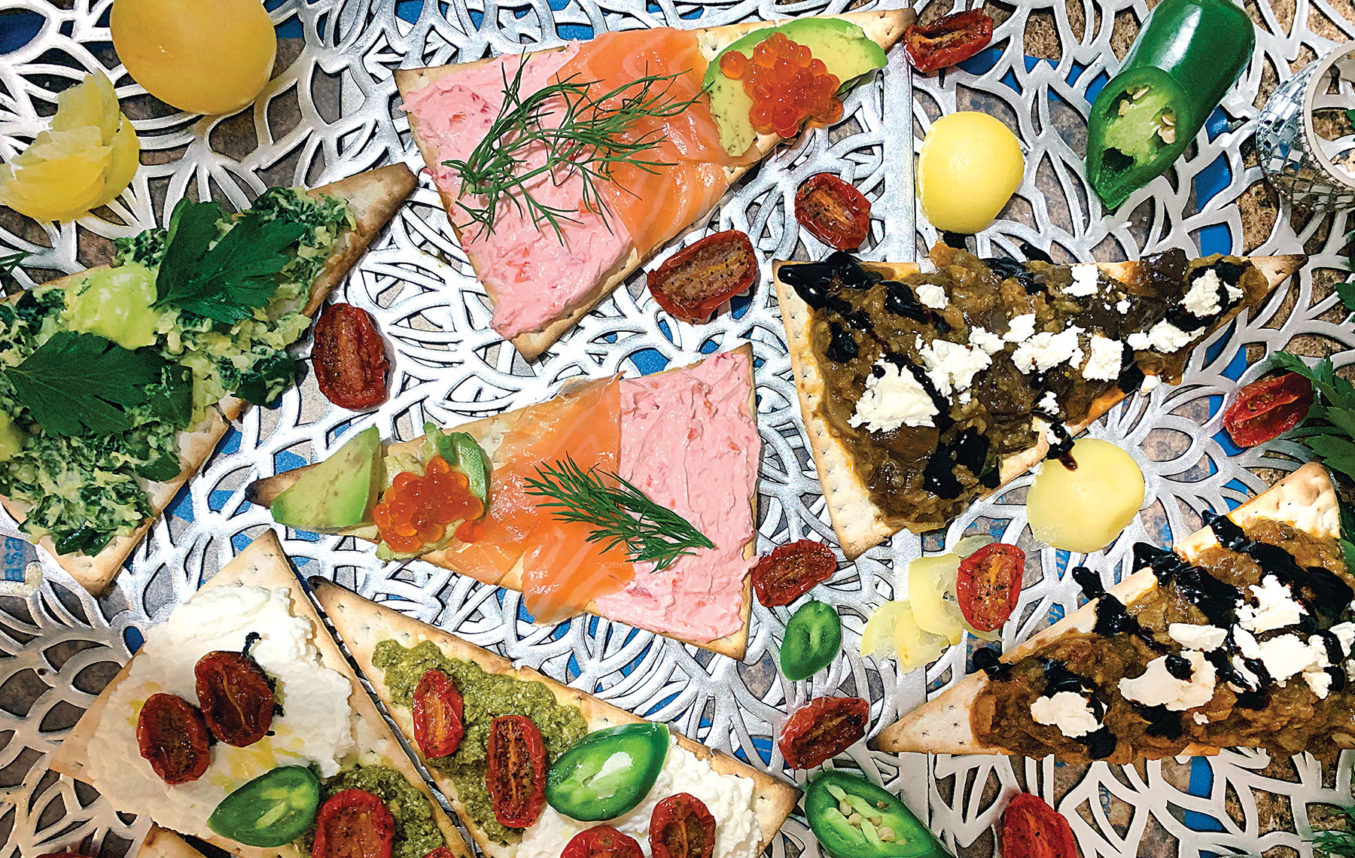
When people complain about not eating bread or flour-based products during Passover week, I confess that I don’t know what they’re talking about. To me, Passover is a perfect opportunity to eat my favorite thing: finger food in the form of open-faced matzo sandwiches with Mediterranean toppings. What’s better than a crispy cracker loaded up with zingy condiments with interesting flavor combinations? And who doesn’t love a casual finger food celebration after all the formal sit-down structured meals? 

Traditions typically dictate Passover food. Most families tend to make the same thing every year — bubbe’s brisket, mom’s kugel or auntie’s tzimmes — so the rebel in me likes to get creative with the rest of the week’s meals. Each year, I try to outdo my toppings from the previous year, but this year I found a special touch: Manischewitz has come out with triangle-shaped matzo — small crackers that lend a more stable base for piling on the toppings.

It’s a perfect Passover brunch plate when there’s a house full of guests. The best part is you make all the toppings in advance and serve them on a large board or decorative plate after you’ve topped the matzo at the last moment. You can make it even easier on yourself and set out toppings in bowls and let guests make their own. It’s foolproof entertaining and a guaranteed win. I like to serve this dairy brunch with a leafy green salad dressed simply with a vinaigrette to cut the richness of the toppings, but I often feel almost obligated to serve it with an Israeli chopped salad. Then for dessert, I make my Bulgarian version of matzo brei called Burmolikos. 

I haven’t gotten too fancy this year with my toppers but the flavor combinations are tried and true (we ate them after the photo shoot). No special equipment is needed to make them except a good blender or food processor. All of these recipes are good to have in your arsenal for parties at any time of the year to serve with bread or with crackers, but beware: It’s so good you might just start a new tradition with the matzo mezze, and your friends and family will urge you make it every year. The following four toppings will serve about 10 people for brunch with salad. Figure about one triangle of each type of matzo per person or, if using regular square matzo, then two matzos per person, cut in half.

It’s foolproof entertaining and a guaranteed win.

EGGPLANT JAM – FETA –BALSAMIC FIG REDUCTION
Eggplant jam:

2 large eggplants
1 teaspoon kosher salt, plus more to taste
1/4 cup olive oil, plus 4 tablespoons, divided
2 cloves garlic, minced
1 small yellow onion, diced
1 medium tomato, chopped
2 teaspoons paprika
1 teaspoon cumin
1/2 teaspoon freshly ground black pepper
1/4 teaspoon cayenne pepper (optional)
1/8 cup water
2 tablespoons lemon juice
2 tablespoons fresh parsley, chopped
Crumbled feta cheese (garnish)

Fig-flavored balsamic reduction (optional)

Make this jam in advance if possible because it benefits from a day or two in the fridge.

Peel strips off eggplants lengthwise using a vegetable peeler, leaving 1-inch gaps of skin between strips. Slice eggplant crosswise into 1/2-inch thick slices. Salt liberally and let stand in a colander over the sink for 1 hour to extract the bitter juices.

Preheat oven to 375 F.

Dry the eggplant slices well with paper towels and coat both sides generously in olive oil and lay in a single layer on two baking trays. Bake for about 30 minutes, flipping the slices halfway through baking until soft and golden brown.

Transfer warm eggplant to a bowl and, using a wooden spoon (contact with metal turns eggplant black), mash the eggplant into chunks. This will be cooked again so don’t worry about the size of the pieces. Set aside.

In a large skillet, pour 4 tablespoons of olive oil and add the chopped garlic, onion and tomato. Stir in the spices and cook for another minute.

When the vegetables are soft, add the mashed eggplant and cook over low heat, stirring constantly with a wooden spoon until mixture is very thick. Add water if it’s sticking to bottom of pan.

Remove from heat, add in lemon juice and chopped parsley and check for salt. Serve with crumbled feta and balsamic reduction drizzled over top.

SMOKED SALMON MOUSSE, SMOKED SALMON, SALMON ROE AND AVOCADO

5 ounces smoked salmon (Nova, Scottish orgravlax), chopped
1 cup heavy whipping cream
2 tablespoons cream cheese, room temperature
Juice of 1 lemon
Salt and pepper to taste
Rind of 1/2 lemon
5 ounces smoked salmon, thinly sliced, for draping
2 ounces salmon or trout roe, for garnish
Avocado, thinly sliced
2 tablespoons chopped dill, for garnish

Tip 5 ounces of chopped smoked salmon into a high-speed blender or food processor and process until paste. Drizzle in the heavy cream and room-temperature cream cheese and process until cream is thick. Add the lemon juice, a grind of salt and pepper and lemon rind and process for another 10 seconds. 

Chill until serving. Alternate mousse, salmon slices, roe and avocado. Top with dill.

WARM SPINACH AND ARTICHOKE DIP

1/3 cup Greek yogurt
1/3 cup mayonnaise
4 ounces cream cheese, room temperature
1/2 cup gruyere cheese, finely grated
3/4 cup parmesan cheese, freshly grated
1 tablespoon lemon juice
1 clove garlic, minced
1/2 teaspoon black pepper
1/4 teaspoon freshly grated nutmeg (optional)
1 pinch cayenne pepper (optional)
1/2 cup chopped frozen spinach, thawed, squeezed dry
8-ounce jar artichoke hearts, drained and chopped
Salt to taste (cheeses are salty)
2 tablespoons chopped parsley, for garnish

Preheat oven to 350 F.

Combine yogurt, mayo and cream cheese in a bowl. Add grated cheeses, lemon juice, spices, spinach and artichoke hearts and mix until thoroughly combined. Bake in a dish greased with olive oil or butter for 20 minutes until brown and bubbly on top. Taste to adjust salt.

Make in advance and then gently warm in the microwave for 1 minute before topping matzo. 

WHIPPED RICOTTA, DRIED ZA’ATAR TOMATOES, BASIL PESTO, PRESERVED LEMON AND JALAPENO

Whipped ricotta (recipe follows)
Za’atar tomatoes (recipe follows)
4 tablespoons of prepared basil pesto
1 tablespoon preserved lemon, chopped and more for serving
1 fresh jalapeno pepper, seeded and thinly sliced
Drizzle of olive oil, for serving

For the whipped ricotta:
1 14-ounce tub Italian whole milk ricotta
1 tablespoon olive oil
1 tablespoon diced preserved lemon
Salt and pepper to taste

Whip ingredients in a high-speed blender for 1 minute until light and fluffy. Refrigerate until ready to serve.

Dried za’atar tomatoes:
2 cups cherry or baby tomatoes
2 teaspoons flaky sea salt
1/4 teaspoon sugar
1/4 teaspoon black pepper
1 teaspoon za’atar
2 tablespoons olive oil

Preheat oven to 500 F. 

Cut tomatoes in half lengthwise and set on a baking tray. Sprinkle with seasonings and then drizzle with olive oil. Place tray in oven and then immediately shut it off. Leave in oven overnight or at least 8 hours without opening oven door. Leftovers can be kept in olive oil and used like sun-dried tomatoes. 

Spread matzo with whipped ricotta, 1 teaspoon of basil pesto, top with dried tomatoes and a jalapeno slice and drizzle with a bit of olive oil.


Yamit Behar Wood, an Israeli-American food and travel writer, is the executive chef at the U.S. Embassy in Kampala, Uganda, and founder of the New York Kitchen Catering Co. 

Matzo Mezze for Passover Brunch Read More »

Weekly Parsha: Metzora

One verse, five voices. Edited by Salvador Litvak, Accidental Talmudist

He shall then send away the live bird outside the city, onto the [open] field. He shall thus effect atonement for the house, and it will be clean. –Leviticus 14:53


Nina Litvak
accidentaltalmudist.org

God punished Miriam for speaking slander by afflicting her with tzaraat, an unsightly skin ailment. Tzaraat also can affect a house, and according to the Rambam, that, too, is caused by evil speech: “When a person speaks lashon harah, the walls of his house change color.”

The purification process for a person or a house afflicted with tzaraat involves two birds: One is killed, and the other is dipped in the blood of the dead bird (with the other required items) and then set free. Rashi likened the chatter of birds to the evil chatter of lashon harah.

But why is one bird allowed to live? In other Torah rituals involving an animal, the creature dies. The Kli Yakar explains that the dead bird represents prohibited speech, while the living bird represents holy speech. Avoiding lashon harah means killing evil speech, but also giving life to words of Torah and mitzvot. 

The Talmud (Yoma 11b) identifies another possible reason for house tzaraat: It’s a punishment for not lending your possessions to others, instead saying falsely that you don’t have the requested item. House tzaraat requires removing all your possessions from the house, meaning that your lie will be exposed.

Both kinds of lashon harah that cause tzaraat relate to how we treat others. When we hoard our blessings, or spread nasty rumors, we stain ourselves. Like the living dove dipped in the blood of his fellow, we too are stained by the suffering of our neighbor.


Rabbi Elliot Dorff
American Jewish University

Let’s face it: The rituals described in this verse and in all the verses in this chapter to rid ourselves and our dwellings of contagion of various sorts are downright strange. What is not at all strange, though, is the sense that we have under such conditions: Like our ancestors, we desperately want to remove the infestation and return to safety and normality. We do that today, however, in ways vastly different from those described in this verse and chapter. We treat infections and other bodily maladies through medicine, and we repair rot in our houses in ways that experts in that process prescribe. 

This verse, though, discusses not only our need to repair physical abnormalities. It also bespeaks a sense that we need atonement when bad things happen to our bodies or homes, presumably because we believe that something we did wrong caused such maladies. This raises a much more serious issue — namely, the relationship between sin and suffering. This is too deep and difficult a topic to be dealt with adequately in a short essay such as this, but two things should be obvious to us: First, as the biblical books of Job and Kohelet already assert, there is no one-to-one correspondence between sin and suffering but, second, when we do sin, we deeply feel the need for a process of atonement to feel whole again. Here, too, the feeling and need are the same, but our response is different from what is described in this verse.


Yoni Troy
IDF officer, Munition Corps

Purifying oneself from tzaraat — the leprosy punishment for gossiping — is grueling. You sacrifice, ask forgiveness and your house is quarantined until you achieve teshuvah (repentance). Repentance culminates in dipping a live bird in the blood of another and setting it free. This ritual may seem primitive; in truth, it contains great wisdom.

The penitential process brings you to your knees. You’ve been branded a sinner, isolated, and seen your house contaminated with this humiliating disease. The lesson here is not in overcoming leprosy — but overcoming adversity.

When I applied to become an Israel Defense Forces officer, a doctor blocked my application because I have asthma. I was crushed. I always dreamed of serving as an officer. I became determined to prove that my asthma wouldn’t stop me. By working out intensely, I improved my breathing. Then, after appearing before eight army doctors over four months and one medical board, I began officers’ training.

Sometimes in life, we feel like we have reached rock bottom. At such moments, you have a choice. You can be hopeless and remain defeated — or be hopeful and, through the failure, learn to become better.

Reading this verse made me think of that classic Hollywood happy ending: riding off into the sunset. Even if you feel like a bird who has been trapped and dipped in blood, keep seeking your “open field,” ready to fly toward redemption. Always remember: Don’t let low points in life drag you down. It’s up to us to spread our wings and allow ourselves to fly.


Nili Isenberg
Pressman Academy, Judaic Studies faculty

As interpreted by the commentators, tzaraat is a punishment for lashon harah — sins of improper speech. The commentaries explain that first a person’s home, then one’s clothing, and finally the person would be affected, in increasing levels of severity.

The Stone Chumash (the five books of Moses annotated with commentary)observes, “Tzaraat-type afflictions on houses are clearly supernatural occurrences.” Furthermore, the process by which the priest purified the home involved slaughtering a bird, splattering the home with the bird’s blood, and then sending a live bird dipped in the blood of the slaughtered bird to the outskirts of the city. Are we sure this part of Leviticus wasn’t written by one of our own local, bloodthirsty, sci-fi/hor-ror screenwriters?

As it turns out, in the Netflix series “Stranger Things,” viewers are introduced to a similar concept: A family home is haunted by creepy creatures pushing through the walls. The dimension beyond the wall, called the “Upside Down,” is a monstrous world that is a dark reflection of our own. In the series and in our text, then, the walls may represent barriers that should stand between ourselves and the evil lurking within. 

Tosefta Negaim 6:1 states: “The afflicted house never was and never will be, but was only written in order to have us interpret it.” My husband said the same thing about this excellent Netflix series, but it still scared the living daylights out of me — so much that I sadly had to give up watching it to preserve my sanity.


Adam Kligfeld
Senior Rabbi, Temple Beth Am

Does freedom mean living in any home you wish? Or ought one’s domicile recede into insignificance, for the world is yours to explore? Who envies whom? Does the wanderer who calls no address a true home, who sleeps under the stars or on her friend’s couch, envy the one who dwells in a mansion? Or does a person sit in his fancy abode, adorned with every accoutrement, and feel imprisoned by its walls, wishing to break free? 

These questions lurk within the obscure passage regarding a house infected with tzaraat, the biblical scaly “disease” that is often (mis-)translated as leprosy. Rabbi Barukh Halevi Epstein notes a redundancy in “outside the city, to the open field.” He quotes Rabbi Yossi HaGlili in a midrash, who read “outside the city” to refer to where the bird lived, not to where the bird would be released. The conclusion? The bird in this verse/ritual is a dror, a sparrow, that lives beyond the city. Dror itself means “liberty,” and is built from the Hebrew root meaning “to dwell.” The sparrow’s liberty comes from being able to live anywhere. The afflicted house is purified by releasing to the fields the species that transcends home, house and walls: the owners of that afflicted home overdosed on house. Became intoxicated with their own dwelling. That is the source of the tzaraat, which must be expunged.

We must house the un-housed; the crisis is unacceptable. And, we must never let our own homes be prisons. Something about living healthily, in God’s world, is not to be claimed by any four walls. Live like the sparrow.

Weekly Parsha: Metzora Read More »

Pro-Palestinian Protesters Disrupt Professor’s Talk on Anti-BDS Laws

Pro-Palestinian protesters disrupted an April 9 anti-Boycott, Divestment and Sanctions (BDS) talk by George Mason University Law Professor Eugene Kontorovich at the University of Chicago Law School, with chants of “Free Palestine!”

Kontorovich was invited to campus by an unidentified student group to talk about anti-BDS laws and the First Amendment; when he began speaking, around five protesters from Jewish Voice for Peace (JVP) started chanting, “Free, free Palestine protesting is not a crime.”

https://twitter.com/RubensteinAdam/status/1115670532500934656

A student at the talk, identified as Seth Cohen, told Reason that Kontorovich tried to keep talking, but the protesters’ chanting got louder and drowned out his voice. Kontorovich told the Journal in a phone interview at first he tried to have the students gather in a corner of the room and continue his talk there, but the protesters followed suit and continued to chatn over him.  Kontorovich tried to facilitate a dialogue with the protesters, to no avail.

In an email to students, Charles Todd, the dean of Students, said that he asked the protesters to stop chanting but they ignored his request, prompting police to escort the protesters out of the room.

“This chanting did violate the University’s policies,” Todd wrote. “It is the right of any speaker invited to our campus to be heard for all who choose to be present to hear the speaker. Moreover, it is the right of members of the audience to ask tough questions of those speakers. The heckler’s veto is contrary to our principles. Protests that prevent a speaker from being heard limit the freedoms of other students to listen, engage, and learn.”

Todd added that it would have been fine for the protesters to turn their back on Kontorovich or hold signs, or even continue their chanting outside the corridor where the talk was taking place.

Kontorovich tweeted, “How is an effective persuasion to shout over speakers with slogans unrelated to their topic? Maybe I am missing a trick, but it seems they made the anti-BDS point far more eloquently than I could.”

Kontorovich said that while the disruption was “ridiculous and annoying,” he didn’t want people to get “too upset” about it.

“The goal of these demonstrators isn’t to convince anyone of the justice of their cause because they’re acting like jerks and nobody’s going to be convinced,” Kontorovich said. “It’s rather to create an atmosphere of toxicity around Israel-related issues so that speakers are just not interested in coming.”

He added that the disruption “isn’t going to stop me” from speaking.

Pro-Palestinian Protesters Disrupt Professor’s Talk on Anti-BDS Laws Read More »

Pharaoh’s Daughter Addresses Linda Sarsour

My sister: Zionism is not,
as you have notoriously suggested, “creepy.”
I know that you do not believe it.
But if you’d witnessed what I have —
Jews enslaved, their babies murdered —
perhaps you’d understand.


How many generations of Jewish mothers
like the one who birthed my Moses
have feared for their children’s lives?
For how many decades, centuries, millennia,
have the Jews lacked a single home of their own
and looked back, with longing, to Zion?


But above and beyond all of that, my sister:
If you believe in self-determination for your own community
how can you deny others the same? I cannot discern
how their aspirations are any “creepier” than yours.
Please, sister, reconsider your past words
and your present ones.


Erika Dreifus is a New York-based writer and book publicist. Her next book, “Birthright: Poems,” will be published by Kelsay Books in fall 2019. Web: ErikaDreifus.com.

Pharaoh’s Daughter Addresses Linda Sarsour Read More »

A Passover Story

The men were too tired for love,

Or maybe they were ashamed of their longing,

Dirty as they were with work they hated

And other men’s contempt.

Safer to pretend they wanted nothing

And needed even less.

The women were tired, too,

But they could see the future

In that way that only a woman

Who desperately wants a child can see,

A fiery laser vision which is

Its own superpower.

And so the women made a miracle.

They caught fish, heated water,

Teased, beckoned, held small brass mirrors.

Later, after the babies came, after the Exodus,

They would melt those mirrors into

A sacred bowl for the Tabernacle.

For they knew, as any woman who wants

A child knows, that the mess of the body is holy,

And shame is a curtain over truth,

And love incinerates perfection.

So come, my love, sit with me beneath the apple tree.

You are the center of the world.

Tell me what you want,

Even if you have to whisper.

What’s the point in hiding,

When soon enough we’ll all be gone?


Alicia Jo Rabins is a writer, musician and Torah teacher. Her most recent book of poetry is “Fruit Geode” (Augury Books).

A Passover Story Read More »

The Easy Answers Fallacy

Recent events in both the United States and Israel highlighted two of the most intractable problems that have plagued the Israeli-Palestinian and American Jewish scenes over the past decade. Speakers at the AIPAC Policy Conference talked about Jewish unity while Israeli politicians sounded increasingly hawkish as rockets from Gaza targeted Israeli civilians and destroyed a home near Kfar Saba. It was an in-your-face reminder that American Jewish frustrations with Israel and Israeli frustrations with Hamas are ever present. But it also should be a reminder that these problems are stubbornly persistent because there are no easy answers to them, and that the lies we tell ourselves about how they can be resolved are an attempt to make ourselves feel better rather than figure a way out of the morass.

Given the recent angst among American Jewry about its role in Israel and to what extent the Israeli government respects or values American Jewish views and priorities, Benny Gantz’s AIPAC debut was guaranteed to address these anxieties. Gantz did not disappoint, talking about the strength of the Jewish people emanating from Jewish unity, the importance of American Jewish support for Israel and the respect that Israel has for American Jews. The most memorable line of his speech was when he said that he has been to the Western Wall and that it is long enough to accommodate everyone, in reference to the deal for a mixed-gender prayer space to be controlled by the Conservative and Reform movements that was nixed by Prime Minister Benjamin Netanyahu. The first section of the Kachol Lavan party’s platform, which deals with security and diplomacy, refers to the relationship with American Jewry as a component of Israel’s security and pledges to heal the rift between Israel and American Jews. I have no doubt that Gantz is sincere in these beliefs, and it is easy to imagine a Gantz premiership being the key to solving this nagging problem of American Jewish distancing from Israel.

But the truth is that while Netanyahu has exacerbated the divide, it is not just about him. It is tempting to place all of the blame at his feet, and liberal American Jews will remain furious at his evident disregard for them and the way in which he made the Iran nuclear deal debate even more divisive and uncomfortable for American Jews than it already was. Yet the issues between American Jews and Israel are structural ones that go way beyond one man and his politics. Even if Gantz is able to form the next Israeli government and he does his utmost best to assuage American Jewish concerns, there will still be a disconnect between what Israelis and American Jews feel the proper role is in Israel for non-Israeli citizens. There will still be fundamental misunderstandings in Israel about how American Jews conceive of their Judaism and transform their theology into practice. Most saliently, there will still be enormous discontent among American Jews over Israel’s presence in the West Bank and the conviction that Israel is not serious about a two-state solution, and enormous frustration among Israel’s Jews that their American counterparts do not appreciate their security dilemmas and are too blithely and naively willing to gamble with their safety. Netanyahu is part of the problem, but he has also been conveniently used as a set of blinders that make the Israel-American Jewish rift appear a lot narrower than it really is.

Hamas’ wanton disregard for life and eagerness to terrorize civilians also lends the appearance of providing an easy answer — namely, that if Hamas continues to shoot rockets at Israeli towns, send incendiary balloons to burn Israeli farms and organize violent riots with the intention of breaching the border fence, then Hamas should be removed by force. Nearly every Israeli politician running to replace Netanyahu and nearly every potential Netanyahu coalition member competing with Likud for right-wing vote share criticized Netanyahu’s approach to Gaza from the right, painting him as too cautious and pledging to restore deterrence. For all the tough talk, you may have noticed that not one of Netanyahu’s critics — not Gantz, not Avi Gabbay, not Naftali Bennett and not even Avigdor Lieberman — came out in favor of actually going into Gaza and removing Hamas.

“For all of the bluster, there is no plausible Israeli prime minister who would go into Gaza with full force and end Hamas rule once and for all. It is too risky, too prone to disaster.”

It is true that Netanyahu is famously cautious and risk-averse when it comes to sending Israeli ground troops into battle. It is also true that Israel has fought three conflicts with Hamas in Gaza since 2008, and none of the prime ministers, defense ministers, chiefs of staff or heads of Southern Command in charge during any of those three conflicts has advocated Israel removing Hamas from Gaza. It is because “Destroy Hamas!” is an easy slogan, but not one that can be practically carried out absent enormous costs — not only the costs of actually fighting to remove Hamas, but the costs of then occupying and administering Gaza in the middle of a political and security vacuum and a humanitarian nightmare. The problem of Hamas is immune to easy answers, and yet we like to tell ourselves that the solution is as simple as “overwhelming force” or “restoring deterrence” or “making Hamas pay.”

Netanyahu has spent a decade trying to avoid tough decisions on Gaza, hoping that applying spurts of pressure combined with spurts of limited openings will be enough to keep Gaza quiet. It is the reason that Gaza is his political Achilles’ heel, since it is always at risk of exploding and everyone knows that Netanyahu has done nothing over a decade in power to fundamentally alter the situation and remove the threat of Hamas. As with the situation between Israel and American Jews, he has his fair share of the blame. But it is critical to recognize that for all of the bluster, there is no plausible Israeli prime minister who would go into Gaza with full force and end Hamas rule once and for all. It is too risky, too prone to disaster and carries with it the entirely different problem — as the U.S. knows all too well from its experience in Iraq — of what to do on the day after. And unlike the U.S. in Iraq, Israel cannot decide one day to just pick up and go home thousands of miles away. Potential solutions to Gaza do exist, but they aren’t easy and they don’t involve fantasies of wiping out Hamas militarily in one fell swoop and having everything else fall into place.

Amid the largest annual show of support for the U.S.-Israel relationship and in the shadow of an Israeli election, it is easy to think that we have all of the answers and that solving problems is easy. The reality, though, is a lot more complex than a pep rally speech or a campaign slogan.

A version of this story originally appeared in Israel Policy Forum.


Michael J. Koplow is Israel Policy Forum’s Policy director, based in Washington, D.C. 

The Easy Answers Fallacy Read More »

On the Path to Annexation Coalition?

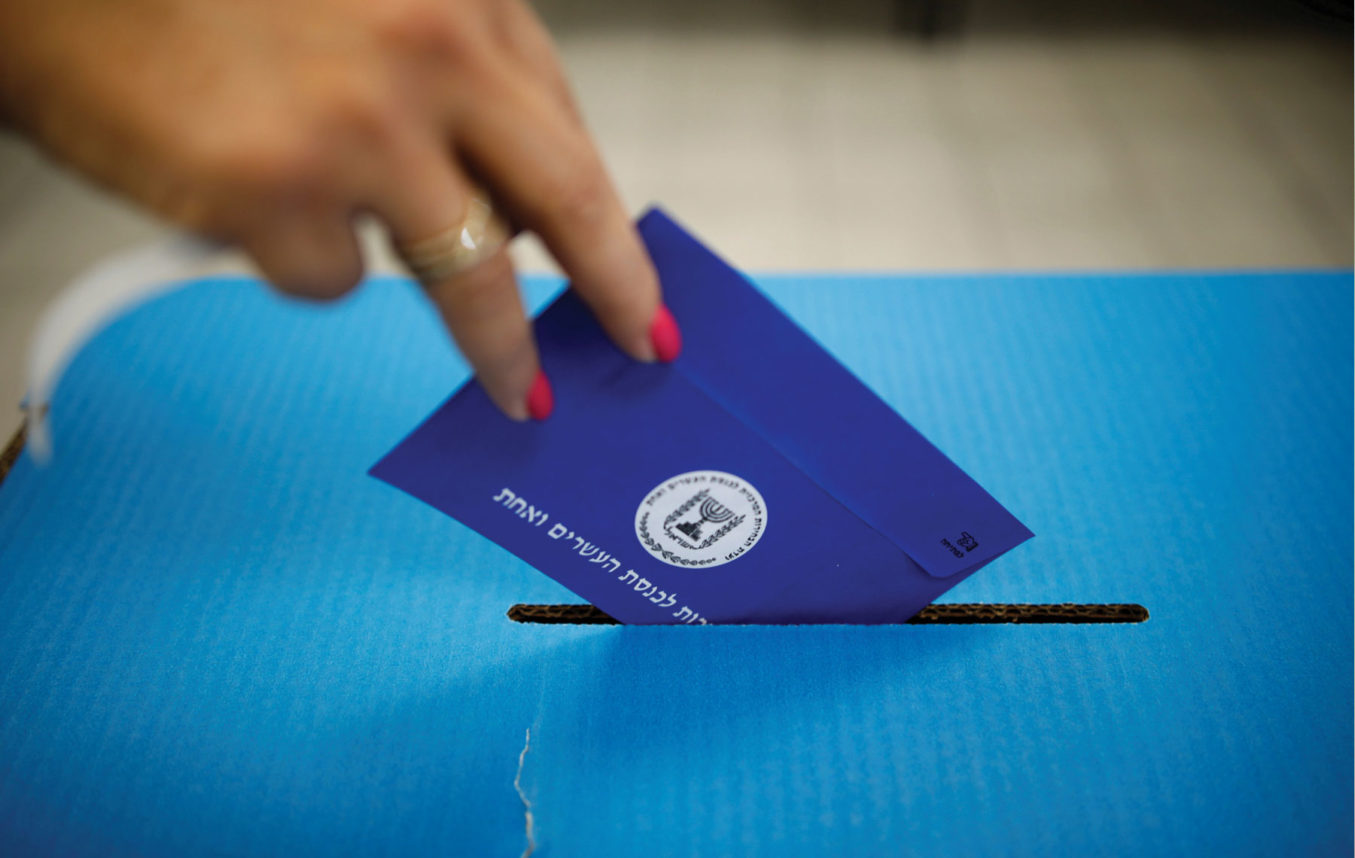
According to exit polls conducted on Israel’s national election day, April 9 (this story was written when only exit polls were available, and the final vote tally wasn’t known), no leader got a clear mandate to do as he pleases. Voters finally can rest after having played their role in this election. Incumbent Prime Minister Benjamin Netanyahu and his rival, Lt. Gen. Benny Gantz, are just beginning a long journey of tough and treacherous negotiations with small and power-hungry parties. Their aim seems simple: to gain the support of 61 members of the Knesset. But it’s not really simple. For one, because getting to 61 seats means, in many of the possible scenarios, getting the support of parties with a great sense of entitlement. 

Let’s examine the scenarios, all of which must be based on early results and exit poll numbers. By the time you read this, the numbers might have changed (for information on changes, including updated graphs of possible coalitions, see the Journal website). But one thing is worthy of note at the outset: Israelis didn’t approve of small, radical parties in this election. Israelis voted for the center. They voted for two parties whose ideologies are  similar. More than half of the votes went to the two big mainstream parties: Likud and Blue and White. 

Blue and White has more seats, so its leaders will argue that they deserve a chance to form a coalition. But the party’s advantage isn’t overwhelming. Its leaders argued during the past few weeks that they need an advantage of more than five seats to get a mandate from the president. The exit polls didn’t reveal such an advantage, and so, if it can’t present President Reuven Rivlin with new information — such as a commitment of parties such as Kulanu or Yisrael Beiteinu to join a Gantz coalition — the president is unlikely to choose Gantz over Netanyahu. Rivlin probably would prefer that because although it’s common knowledge that relations between Rivlin and Netanyahu are quite tense, there is the office to consider, and the legacy. Rivlin must have looked at the polls on the night of April 9 and realized that he will have no choice. Netanyahu has a clearer path to forming a coalition.

Netanyahu’s coalition is likely to include all of the members of his previous coalition. The Likud Party is stronger than is was in 2015, but this strength will not translate to more leeway in the forming of the next coalition. That’s because small parties in small coalitions tend to be demanding. A coalition can’t form without the United Right, so the party will expect significant reward. A coalition can’t form without Kulanu, so that party’s Moshe Kahlon will expect significant reward, possibly even the position of finance minister. Yes, he might have only four seats, but he still wants to retain this senior position. 

“Blue and White is probably the most mainstream party in Israel’s history.”

The price will be paid by the members of Likud. Netanyahu won’t have many cards to play with. If he must give away the education, defense, finance and justice minister posts, Likud members will get less senior cabinet ministries. And yes, they will grumble, they will complain behind Netanyahu’s back. But they can’t much argue with a leader who delivered another victory, for a fifth time. True, the Likud party is not the largest party. It was not the largest party 10 years ago and still formed a coalition.

In every election, there are few memorable events that join the pantheon of great political moments. In 1981, tomatoes were thrown at Shimon Peres. In 1996, Israelis went to sleep thinking that Peres would be the next prime minister, and woke up the next morning to discover that no, it was Netanyahu. In 1992, Yitzhak Rabin made a memorable, if brute, victory speech (“I will lead, I will navigate”). In 2001, the fierce Gen. Ariel Sharon was downgraded to a teddy bear-type grandfather. 

In 2015, Netanyahu’s election day warning that Arab voters are “flocking to the polls” was the high point — and low point — of the campaign. And no, this Netanyahu last-minute clip wasn’t the direct cause for Likud’s final surge and ultimate win. There’s no proof to back that up. And yet, it was a moment that captured the essence of Netanyahu’s political strength and weakness: his mastery of political strategy and laser-beam ability to implement it, and his complete lack of concern for decency. 

In 2019, Netanyahu displayed those same qualities with a vengeance — first, when he was pushing hard for the merger of right-wing and radical right-wing factions. He was the matchmaker of the Jewish Home, a very right-wing party, with Otzma Yehudit, a small, fringe faction that many, including Supreme Court justices, consider to be at least partially racist. One member of this faction was eliminated as a candidate by the court, but the other stayed. Netanyahu, in his quest to use all available votes on the right, is personally responsible for the fact that this radical member of the Knesset gained a seat at the table (on April 9, leaders of the Jewish Home vowed that he will get the seat no matter the number of seats the party ends up capturing).

During the final days of the campaign, Netanyahu did something that seems like the exact opposite of what he intended to do previously. In a blitz of interviews and other public appearances, he warned voters that the right-wing camp was about to lose, and that the only way to prevent such an outcome was to vote for Likud. Not any party that was part of the bloc. Not any party that had committed itself to join his coalition. Only Likud. Netanyahu trusts no one. Not the leaders of the New Right party, Naftali Bennett and Ayelet Shaked, not the leader of Kulanu, Moshe Kahlon; not the leader of Yisrael Beiteinu, Avigdor Lieberman. The media counted all these leaders as members of Netanyahu’s bloc. And yet, the prime minister decided to take a risk and propagandize against them. 

The risk was twofold. 

Risk No. 1: Parties essential to forming a coalition might not cross the electoral threshold of 3.25%. Only a few weeks ago, Netanyahu was willing to tolerate a racist so as not to lose any vote, but now he was suddenly willing to risk many votes of parties who might not cross the threshold. 

Risk No. 2: Leaders essential to forming a coalition might get angry and decide to take revenge after the votes are counted. These leaders were disappointed by Netanyahu’s so-called “Gevalt campaign” because it put them at risk. But the prime minister is cynical about such things. When he wins, all is forgiven. At least, he hopes it’s forgiven. If he loses, none of it matters. 

Netanyahu’s lack of concern for decency was his rival’s main asset. Gantz heads a group of decent leaders. For most of the campaign, with few exceptions, they didn’t use harsh language, didn’t incite against others, didn’t attempt to polarize the public. They made a bet that Israelis got tired of Netanyahu’s hyperactive rhetoric. They made a bet that many Israelis who might agree with Netanyahu’s policies are tired of his personality. Thus, their main effort was not to be an ideological alternative to Netanyahu, but rather to be a behavioral alternative to his way of politicking. And in a way, their bet worked just fine: Blue and White came from behind and within two to three months to become the largest Israeli party — in fact, the largest party in many years. The last party to gain a similar number of seats was Sharon’s 2003 Likud Party.

“Rivlin must have looked at the polls on the night of April 9 and realized that he will have no choice. Netanyahu has a clearer path to forming a coalition.”

The party that was assembled for this mission, Kahol Lavan (Blue and White), is a makeshift group of former generals, officials, activists and celebrities who agree on most things and also agree to be agreeable when they disagree. That’s one thing that Netanyahu isn’t capable of doing. Moshe Yaalon is a former member of Likud, and a rather hawkish member. Yair Lapid was a minister in Netanyahu’s government, and is also quite hawkish. The party that Lapid headed until the merger into Blue and White was also a diverse group of people who don’t always agree with one another. 

Blue and White is probably the most mainstream party in Israel’s history. It says nothing controversial. It does nothing controversial. It proposes nothing controversial. It is a party of the status quo. That is its main strength, that is its main weakness. Thou shalt not insult your fellow citizen. Thou shalt not hurt any feelings. Thou shalt not rock the boat. Thou shalt not storm the Bastille — be it the Supreme Court, the media, old elites, the academy. These leaders insisted on only one controversial position: They will never join a coalition headed by Netanyahu. On the night of April 9, they reiterated their commitment to never sit with Netanyahu. So, a unity government is out of the question, unless further complications make such option the only wat to avoid another round of election.

To make himself attractive to right-wing voters, Netanyahu made a bold statement that on the eve of election day got only a fraction of the attention it deserved. Asked by an interviewer if the next government, headed by him, would annex the settlement blocs in Judea and Samaria, the prime minister said yes. “I’m going to apply sovereignty, but I don’t distinguish between settlement blocs and the isolated settlement points because from my perspective, every such point of settlement is Israeli,” Netanyahu said. Some of his rivals dismissed this as empty campaign rhetoric. They were wrong. 

Well, not completely wrong. The timing surely was tied to the election and to Netanyahu’s decision to pillage his allies on the right. But they would be wrong to assume that annexation would be nothing more than a campaign ploy. Netanyahu, usually cautious in the diplomatic arena, often reluctant to initiate moves as bold as annexation, smells an opportunity. The annexation of the Golan Heights recently was recognized by President Donald Trump’s administration. If the Golan can be annexed, why not Gush Etzion? 

Not long ago, an Israeli presented this exact question to a Trump administration official. “What’s the difference between the Golan and the Gush?” The response was silence. Obviously, the official didn’t see much difference. The Gush was taken away from Israel in the war of 1948 and was recaptured by Israel in 1967. Two years ago, Lapid, one of Netanyahu’s main rivals, participated in a foundation stone-laying ceremony for a new neighborhood in Kfar Etzion. He said that the Gush is “at the center of Israeli consensus.” When Netanyahu ponders the possibility of gradual annexation of areas in the West Bank, backed by the Trump administration, the Gush is a good place to start.

“In a blitz of interviews and other public appearances, Netanyahu warned voters that the right-wing camp was about to lose, and that the only way to prevent such an outcome was to vote for Likud.”

On the eve of the election, the Trump administration handed Netanyahu another piece of political ammunition. In an unprecedented move, the administration designated the elite Iranian military unit, the Revolutionary Guard, a “terrorist organization.” It took the prime minister maybe 20 minutes from the moment the decision was announced to the moment he first used it in a radio interview — one of more than a dozen a day he conducted between April 7 and April 9.

Trump was Netanyahu’s most useful political tool. Trump’s friendship with Netanyahu was his most talked-about asset. The president moved the American embassy to Jerusalem, canceled the Iran nuclear deal, recognized Israel’s sovereignty over the Golan. Netanyahu believes that he deserves some of the credit for these actions. He believed that the voters give him credit for these actions. 

Gantz could take credit for no such achievements. A few weeks before election day, he knew nothing about the looming Trump peace plan. He was not briefed by anyone. He was not asked to weigh in. Gantz knew all along that Netanyahu is Trump’s choice. In private conversations, he made the assumption that if and when he becomes prime minister, the administration will be quick to adjust to the new reality. And he is probably right about that.

On the night of April 9, the Trump peace team was following the news coming out of Israel and weighing its options: They can hold publication of the plan until a new government is formed, or they can put the plan on the table now or right after Rivlin decides who gets to form the next government. 

Each of these options has its advantages and disadvantages. Choosing the later date would give a new Israeli government time to prepare for what’s coming. Choosing the earlier date would shape the negotiations as a new coalition is formed. Before election day, more than a few observers and pundits assumed that an early issuance would be a pretext to forming a unity government. The plan would hand Netanyahu and Gantz the ladder with which to climb off the tree of mutual snub. 

There is logic behind such an assumption. The parties on the right probably would object to any peace plan; Netanyahu and Gantz recognize that Israel must respond positively to the plan; unity is the logical outcome. That is, if one assumes that the right would object to the plan. But what if the Trump plan is much more acceptable to right-wing voters than previously assumed? What if the plan is one that a Kahlon and a Lieberman and a Rafi Peretz (of the Jewish Home) can accept as a basis for negotiation? 

“In Israel’s context, unilateralism usually is associated with withdrawal… Netanyahu’s unilateralism is different. It is about annexation of areas and settlements. Netanyahu’s unilateralism could be a glue that holds together a coalition.”

Don’t dismiss such an option, and with it the option that an early publication of the plan would help Netanyahu form not a unity government but rather a right-religious government. Here is what Netanyahu is going to tell them: We have a great opportunity to completely overhaul the parameters of an Israeli-Palestinian settlement. We can form a coalition, say yes to Trump, wait for the Palestinians to say no (they already did, and will do it again), and then turn to unilaterally shaping the future. 

In Israel’s context, unilateralism usually is associated with withdrawal. From southern Lebanon in the late 1990s, from Gaza in 2005. Even today, different groups advocate for unilateral moves in the West Bank, from evacuation of settlements to setting up clear borders. 

Netanyahu’s unilateralism is different. It is about annexation of areas and settlements. Netanyahu’s unilateralism could be a glue that holds together a coalition. There is a narrow window of opportunity, he would whisper to his prospective allies, when I am still here — before the indictment and trial and verdict (those joining him will get cushy jobs and will be asked to commit to see him through the trial). There is a narrow window of opportunity, he would whisper to his prospective allies, when Trump is still in office — before the threat of a Democrat in the White House (maybe Beto O’Rourke, who called Netanyahu a “racist” earlier this week) makes unilateralism too risky. 

Let’s get over our personal grievances and work together to seize this opportunity, Netanyahu would tell them, with the Trump plan laid on the table. If this is a plan that guarantees no evacuation of Jewish settlements; if this is a plan that guarantees a retention of control over the Jordan Valley; if it guarantees freedom of operation to the Israel Defense Forces in all of the West Bank; if it calls for a united Jerusalem; if this is the plan, and indeed, it seems to be the plan — would they dare say no?


Shmuel Rosner is senior political editor. For more analysis of Israeli and international politics, visit Rosner’s Domain at jewishjournal.com/rosnersdomain.

On the Path to Annexation Coalition? Read More »

The Very Short Rosner Guide to Voting in Israel’s Elections

 This is a translation of a guide for the Israeli voter that was published in the Hebrew-language daily newspaper Maariv. If you are an American who could not vote in Israel’s election, it still could help you understand how and why Israelis vote the way they do.

Is it hard for you to decide? It shouldn’t be. The very short Rosner Guide for voting is going to solve your problems.

1. If you are an Arab who wants to annoy the Jews: Vote Ra’am-Balad.

2. If you are an Arab or a Jew who wants to do something really radical (or a communist, but there are no real communists): Vote Hadash-Ta’al.

3. If you are a Jew who wants to do something radical but not as radical as voting for an Arab party: Vote for libertarian Zehut.

4. If you are an Israeli who thinks that Israel is to blame for the fact that there is no peace (but also do not want to vote for an Arab party): Vote Meretz.

5. If you are an Israeli with a strong historical sentiment for the founders’ generation: Vote Labor.

6. If you are an Israeli who thinks that Prime Minister Benjamin Netanyahu is doing everything right but incites the public and creates a polarized political atmosphere: Vote Blue and White.

7. If you are an Israeli who thinks that Netanyahu is doing everything right: Vote Likud.

8. If you are an Israeli who thinks that Netanyahu is doing everything right except for economics: Vote Kulanu.

9. If you are an Israeli who thinks that Netanyahu is doing everything right except for security, and also that voting for Likud is not cool: Vote for the New Right.

10. If Naftali Bennett’s kippah looks too small to you, and Yaakov Litzman’s kippah looks too black for you, and you find it difficult to forget that Netanyahu does not have a kippah: Vote for the United Right.

11.  If you are an Ashkenazi ultra-Orthodox Jew who thinks that someone sees you even behind the curtain: Vote United Torah Judaism.

12. If you tear up at the mention of Rabbi Ovadia Yosef: Vote Shas.

13. If you trust only a leader with a Russian accent like yours: Vote Yisrael Beiteinu.

14. If you go with the heart, regardless of the electoral threshold: Vote Gesher.

Appendix for difficult cases:

If what really matters to you is the bloc, not the party, vote Likud or Blue and White.

If it is difficult for you to decide which bloc, see points 6 and 7. Then you’ll know.

If you answered yes to two questions — say, you have sentiments for the founders but you also go with the heart — vote for a party that has a chance to pass the electoral threshold. If both have a chance, vote for the smaller of the two parties — it probably needs you more (and we already said you have a heart).

If you do not feel like voting for any party, try something radical (options 2 and 3). If that does not help, exercise your right (yes, in a free country this is also a right) to not vote.

In such case, do not complain about the results.


Shmuel Rosner is senior political editor. For more analysis of Israel and international politics, visit Rosner’s Domain at jewishjournal.com/rosnersdomain.

The Very Short Rosner Guide to Voting in Israel’s Elections Read More »

The Lioness of Female Empowerment

Rotem Weinner Shapira’s official title is director of Lion of Judah Israel (LOJI). The organization is the Israeli arm of a global philanthropic community of Jewish women that funds projects and nongovernment organizations geared to improving the lives and rights of women and girls. In reality, however, being LOJI’s only paid employee, Weinner Shapira is Jill-of-all-trades, with fundraiser, event producer, graphic artist and video editor among the many hats she wears. 

“I believe that when women [come] together, they have special powers,” she said. “Things happen differently when the space is shared with men.” 

LOJI hosts events for its community of some 160 women donors. Weinner Shapira says these are key to the foundation’s continued success because it affords them a space to just be themselves. “These are women who spend all day juggling their philanthropy, their businesses, their families, husbands, grandchildren but where are they themselves? Where are their souls?” 

With a focus that changes every few years, LOJI is currently homing in on three fields: violence against women, pensioners and women with disabilities. The communal fund has enabled issues that fall under the radar to gain exposure. One example is a project LOJI did in conjunction with Maslan, the sexual violence crisis center, training medical teams in hospitals and staff in senior citizens’ centers how to deal with women who have either experienced sexual abuse in the past or have suffered it in later years. The project also highlighted the abuse of Holocaust survivors by their caretakers. “We want these women to finish their lives with honor,” Weinner Shapira said. 

Weinner Shapira became LOJI’s director 11 years ago after returning to Israel from the United States, where she was an emissary in Pittsburgh. Even though her master’s specialized in American-Jewish studies, Weinner Shapira admits that she knew nothing about Jewish-American communal life before moving stateside. “I was amazed to see women reading the Torah and wearing a tallit,” she said, adding that Israelis are largely ill-informed about streams of Judaism outside Orthodoxy, since, unlike in the U.S., they comprise the fringes of Israeli society. 

“I believe that when women [come] together they have special powers. Things happen differently when the space is shared with men.” 

The growing disconnect between young American Jews and their peers in Israel is something that has to be tackled head-on, Weinner Shapira says, and it shouldn’t be the one-way street it currently is. “I think Taglit (Birthright) should be both ways, to make sure young Israelis get to know young American Jews.”

Weinner Shapira’s views on life and her career have evolved since taking the helm at LOJI, enabling her to navigate through different worlds. “I was born to be a bridge,” she said. This stems, in part, from her parents’ diverse economic backgrounds. “One grandmother gave me 500 shekels on my birthday while the other gave me chocolate,” she quipped. 

Weinner Shapira and her husband also decided to become more observant. Four months ago, the secular couple decided to begin keeping Shabbat. Asked how her three children under the age of 10 are accepting such a drastic change, Weinner Shapira beams. “They’re all over it. It’s the most amazing thing that’s ever happened to us,” she said. “They’re suddenly discovering one another.” 

Her views on her professional worth have also been transformed. “There was the Rotem of the Foundation who was a professional, a kind of prophet, and there was the Rotem who came home crying to her husband,” she said. “I will do all the work but it doesn’t matter if I don’t get the credit. I don’t care. Now I understand that there is a place to feel proud of myself.” n

The Lioness of Female Empowerment Read More »