fbpx

September 9, 2026

This New Year, Become a Spiritual Warrior

As Rosh Hashanah begins, we should all take a deep breath, being mindful we are here once again while also sighing for all that we have suffered through, as Jews and Americans. Every part of our being has been impacted by economic, cultural, ecological, technological, political, and religious chaos. Our sense of safety and security feels distant, our country as a home feels remote, and the treasure that is Israel is marred by some questionable actions and ongoing conflict which at times is self-imposed. Who hasn’t questioned – what can I depend on, which institutions will survive, will the Jewish community continually be splintered, and whether democracy and decency will survive?

The world is changing at an incredible pace, and we wonder can we keep up? Watching driverless cars, little boxed robots rolling down the street, Ai infiltrating our communications and technology, and even a robotic nurse’s assistant greeting me at Cedars, I feel I’m living the science fiction movies of decades ago. Our world is aflame, jolted by earthquakes and lately gushing with water and mud causing damage and death to many. And as many of us are facing change and our own aging, we are challenged to find moments in our lives when the glass really feels ½ full instead of ½ empty. These Holy Days give us an opportunity to share this as a community, to acknowledge and express our most powerful feelings and do it together. There is comfort in that.

I have been practicing Qi Gong and even created some mindful movements that relate more to Jewish spiritual practice, using words and Kabbalistic language to create more meaning and relevancy for me and those I teach. These practices help me withstand the turmoil and be a ‘spiritual warrior,’ to sustain myself and be protected from the continuous trauma of living in a world full of chaos and unexpected natural disasters. To live with a ‘shield,’ of resiliency. When I started my cantorial studies my mentor said, “You are joining Gd’s army!” But each person needs to be a warrior, courageous and protecting their values, their home, their family, their very being. The somatic power of this kind of practice renews, re-energizes, calms, and heals my nerves and emotions so impacted by the realities I have just outlined. Some of these can’t be changed, at least not quickly or immediately, but we must be strengthened in spiritual practices, religious engagement and joy, and mind/body resilience, to truly be an Etz Chayyim, a Tree of Life. The storms of change and the winds of challenge may rail against us but we must remain sturdy, centered, and grounded, ready for the onslaught and the unexpected. We need to conquer new ways for the New Year that will expand and deepen our strategies and skill, accessible pathways for renewed expression of our souls, impervious to the evil surrounding us.

First, we must unload the unwanted toxic feelings, attitudes, and habits that only sabotage us and prevent accessing new ways of being. We must cleanse the hurts and the relationships to bring reconciliation and healing. Perhaps write on paper, that which must go and cast it in the water along with all the symbolical crumbs at Tashlich and then listen to the ‘still small voice,’ guiding, with intention, to moments of enriching and nourishing activities, create, dance/move, learn, volunteer, sing/listen to music, be curious or write your story; connect with Gd by being your truest self.

In the service we chant and fear “Who will live and who will die.’ Better to focus on ‘how’ we live and not who or when it might happen. Trust there is a grander scheme and Gd is in charge of that. Psalm 90 tells us to ‘count our days,’ I say, ‘make our days count,’ dedicated to enhancing the quality of our lives, using spiritual tools to hold ourselves steady, to nourish our souls, and have our mind, body, and spirit align and be unified. This should be our purpose for the coming year. 

I want to wish you all a new year of possibilities, of opening your heart and soul, becoming even more expansive, more giving, and internally strong. Be a Jewish spiritual warrior.

Rabbi/Cantor Eva Robbins is co-Rabbi Nvay Shalom, and Faculty, AJRCA.

This New Year, Become a Spiritual Warrior Read More »

California Bill Would Add Jewish Identity to State Demographic Data

California could require many state agencies to give residents the option to identify their Jewish ancestry or ethnicity when demographic forms ask about race, ethnicity or ancestry.

Senate Bill 1387, authored by State Sen. Henry Stern (D-Sherman Oaks), passed the Assembly 74-0 and the Senate 39-0 on Aug. 31. No legislator cast a “no” vote in any committee or floor vote listed in the Legislature’s record for the bill.

As of press time, the bill was enrolled (the final bill has passed both houses, been proofread for accuracy and sent to the governor) and awaits action from Gov. Gavin Newsom.

Under SB 1387, California law would state that “ethnicity” is inclusive of Jewish identity. State agencies that collect demographic data on ancestry or ethnic origin would have to provide a separate category for Jewish ancestry or ethnicity on forms that allow respondents to select one or more racial or ethnic designations.

In talking points provided to The Journal by Stern’s office, Henry Stern said the bill is meant to account for Jewish identities that extend beyond religious practice.

“Jewish identity is unique. For many Jews, being Jewish is not solely a matter of religious belief or observance. It is also rooted in shared ancestry, ethnicity, culture, family heritage, language, history and peoplehood,” Stern said.

“Yet California’s demographic data systems generally do not provide an opportunity for individuals to identify as Jewish ethnically. As a result, many Jewish Californians may not be accurately reflected in state demographic data,” Stern said.

“That matters because good policy depends on good data. If we do not collect accurate information, it becomes more difficult to understand demographic trends, identify disparities, evaluate the impacts of discrimination or ensure that government programs are effectively serving all Californians.”

Stern said that “this bill does not create a new protected class. It does not alter existing religious classifications. And it does not require anyone to identify as Jewish.

He said that “SB 1387 simply allows individuals who understand their identity through an ethnic, ancestral, or cultural lens to self-identify accordingly if they choose.”

Jewish Voice for Peace (JVP) opposed SB 1387, calling it “a dangerous bill that would allow state government agencies to classify ‘Jewish’ as an ethnicity.”

“This bill does nothing to add to protections for Jewish Californians,” JVP said. The organization also warned that the measure “could be exploited by antisemites.”

Stern said the legislation does not define every Jew as a member of one ethnicity.

“We have worked closely with committee staff and are accepting amendments that further clarify this point. The bill does not declare that all Jews are an ethnicity. Rather, it recognizes that Jewish identity may include an ethnic component for those who choose to identify that way,” Stern said.

The final bill contains restrictions on how the information can be used. State agencies could not disclose personal identifying information and would have to apply privacy and deidentification methods. The data could be used for demographic analysis, approved research, reporting requirements, identifying disparities and guiding policy or funding decisions.

The bill bars agencies from using the information to create a registry of individuals or for law enforcement or immigration enforcement.

The Simon Wiesenthal Center (SWC) supported SB 1387. “SWC also worked to help ensure the bill includes strong privacy safeguards, including prohibitions on creating a registry or using the data for law enforcement or immigration enforcement,” the SWC said. The organization said SB 1387 “reflects the reality that Jewish identity encompasses far more than religious practice alone” and urged Newsom to sign the bill.

The enrolled legislation also contains provisions not apparent from the broad description of adding a checkbox to state forms. The University of California and California State University are excluded from the bill’s definition of “state agency.”

Beginning in 2029, “Jewish” would also be included among the voluntary race or ethnic-origin self-identification categories used by the California Department of Corrections and Rehabilitation for people admitted, in custody, released or paroled.

The Employment Development Department would collect Jewish ancestry or ethnicity data under demographic reporting requirements for people claiming disability or family temporary disability insurance benefits.

SB 1387 would become operative Jan. 1, 2029. State demographic reports covered by the law and published on or after Jan. 1, 2030 would include the Jewish ancestry or ethnicity data collected under the measure.

“SB 1387 will help California collect more accurate information, better understand the experiences of Jewish Californians, and make more informed policy decisions moving forward,” Stern said.

California Bill Would Add Jewish Identity to State Demographic Data Read More »

Jewish Federation Los Angeles Names Becky Sobelman-Stern Deputy CEO

The Jewish Federation Los Angeles is adopting a new shared executive leadership model, with longtime L.A. Federation leader Becky Sobelman-Stern assuming the newly created board-appointed role of deputy chief executive officer.

Sobelman-Stern will share executive responsibility for the organization with Rabbi Noah Farkas, the L.A. Federation’s president and CEO, in a structure designed to accommodate the growing size and complexity of the organization.

Under the new arrangement, Sobelman-Stern will oversee the L.A. Federation’s internal management and enterprise strategy, while Farkas—who has served as CEO since 2021—will have greater capacity to focus on the organization’s external role, according to a letter shared with the Federation board on Sept. 3.

The announcement marks a “momentous change to our Federation’s leadership structure,” the letter, co-signed by Farkas and Sobelman-Stern, says.

The two leaders will retain shared authority and operate from a common vision for the Federation’s future, while taking primary responsibility for different areas of the organization.

“At a moment when the external role of the CEO is paramount, this new model provides me greater capacity to focus on global strategy, civic and communal issues, public speaking and representing JFEDLA in moments of opportunity and crisis,” Farkas said in announcing the change.

Farkas also cited financial resource development, including relationships with major donors and foundations, as a key area of his continued focus.

Sobelman-Stern, meanwhile, will take on responsibility for the Federation’s internal operations, drawing on her extensive experience within the organization and the broader Jewish community.

“Federation’s internal management will now be in the hands of a leader with unmatched institutional knowledge, credibility and judgment,” Farkas said, describing Sobelman-Stern’s nearly 12 years of experience at the L.A. Federation and across the national Federation system as positioning her to lead its internal enterprise strategy.

The new structure represents a significant shift from a traditional model in which the chief executive holds primary responsibility for both the internal management and external representation of an organization. At L.A. Federation, the two executives will instead divide leadership responsibilities while maintaining joint authority.

“Each of us will lead a distinct lane but the authority of JFEDLA is shared and complements our strengths,” Farkas and Sobelman-Stern say in the letter.

Sobelman-Stern has served for 11 years as the L.A. Federation’s chief impact officer, where her work has included guiding the organization’s response to the COVID epidemic, the crisis in Ukraine, recent wildfires and the Israel emergency, according to the L.A. Federation website.

Married to Stephen Wise Temple Rabbi Ron Stern, she has been a longtime figure in Los Angeles Jewish communal life. Her experience also includes serving as vice president of consulting at community development at Jewish Federations of North America. 

The announcement did not provide details about how the transition will affect specific departments or staff reporting structures. Farkas and Sobelman-Stern said they expect to share additional information about the transition “in the coming weeks.”

In the letter, the two leaders emphasized that the new model is intended not merely as a management change but as an opportunity for “expanding our concept of what a Federation can be.”

The leadership change comes as Jewish Federations nationally and locally navigate an increasingly complicated communal landscape, including heightened demands for advocacy, fundraising, crisis response and support for Jewish communities in Los Angeles, Israel and around the world.

The sharing of the letter with L.A. Federation leadership followed what the announcement calls “a closed board session” held Sept. 1.

Jewish Federation Los Angeles Names Becky Sobelman-Stern Deputy CEO Read More »

High Holy Days Sermon Preview

Rabbi David Woznica, Stephen Wise Temple

What can we do? What can we do in these painful and confusing times? These questions have become an ongoing theme in conversations among Jews. We are living through a painful and frightening rise in antisemitism in America. At the same time, many Jews are confused and disappointed by the lack of support from groups and institutions they once believed would stand with them.

My sermon will begin with a brief “open letter” to those who harbor hatred toward Jews and Israel. I will then turn to a second “open letter” to my fellow Jews: a call to consider what each of us can do in response.

Most importantly, I hope to explore how we can channel our energy not simply into surviving antisemitism, but into living fuller, stronger, and more meaningful Jewish lives in the year ahead.

Rabbi Joel Nickerson, Wilshire Boulevard Temple

As we enter 5787, I keep thinking about two different ways we exile ourselves from one another. This summer, I spent the Fourth of July in Jerusalem. On a Shabbat afternoon walk, I found myself standing before a replica of the Liberty Bell, 7,000 miles from Philadelphia. Standing there, far from home, I found myself thinking about America and about the particular stake American Jews have in the American project. The Liberty Bell reminded me that America has always been an unfinished project. A gap has always existed between the ideals we proclaim and the country we actually are, but I don’t think that means we give up on those ideals. I think it means we have a responsibility to keep pushing America closer to them. There is something deeply Jewish about that idea: we don’t have to pretend something is perfect in order to love it. We can see what is broken and still believe it is worth repairing. At a moment when many Americans, including many Jews, feel tempted to withdraw, go quiet, or give up on the possibility of a shared future, I want to argue for the opposite. Silence can become a kind of self-imposed exile. We have a responsibility to stay engaged, use our voices, ask hard questions, and keep helping America become more fully what it aspires to be.

And on Rosh Hashanah morning, I’ll turn that challenge inward. At a time when we increasingly sort people through political, ideological and communal “litmus tests,” we should ask what conversations and relationships we close off before they even begin. Perhaps this New Year calls us to resist both forms of exile – refusing to withdraw from the communities we love, and refusing to push others outside them.

Rabbi Julia Knobloch, Temple Beth El and Center, San Pedro

The underlying theme this year is “humility.” I see much fanaticism wherever I look, self-gratification and self-righteousness. Daily discourses, be they political or personal, are characterized by extremes, partisanship, or an overblown perception of our achievements. Not everything or everyone is brilliant, fantastic, outstanding or deserves an A+. I believe that this unrealistic perception of ourselves also conditions unrealistic expectations we may have: Of life, of relationships, of teshuva.

So, my Erev Rosh Hashanah sermon, “Second Chances: Hard Work and Happenstance,” encourages us to accept something that is less than ideal as good enough.

We’re not always going to get what we think we deserve, and that’s okay.

On Rosh Hashanah Day I speak about the tension between what I call “Sacred Longing and Entitlement.” The idea for the sermon was sparked by a scandal that took place in Germany over the summer. It involved a politician who had a child through surrogacy, which is illegal in Germany – and it allows me to bring in some thoughts about Hagar [the mother of Abraham’s firstborn son] as well, which goes, of course, with the Torah reading – we’re not doing the Akedah this year.

For Kol Nidrei, I felt I needed to speak about antisemitism. In part prompted by the proposed bill to list Jewish as an ethnicity on census forms, it is called “A Renewal of Vows: Reaffirming Jewish Identity in the Face of Antisemitism.” It largely appeals to a sense of Jewish uniqueness, but I also snuck in the claim that true pride and sustainable courage don’t really work without a sense of humility.

I still need to write the sermons for Yom Kippur Day and Neilah, but they will feature clay in a potter’s hand, Jonah, Job, and Jeremiah, thoughts about Spain’s and Argentine’s national anthems, as well as, for good measure, some references to Leonard Cohen songs – though not “Who by Fire!” L’shana tova! 

Rabbi Brad Artson, Goldstine Distinguished Scholar of American Jewish University

With the new beginning of the Jewish year, with the dawning of another Rosh HaShanah, we must find a way to respond to the rising partisan extremism in all camps, the fear, rage and divisiveness of our age, by affirming the core wisdom of Torah: that God (and we) are all one. In God we all have one Source, so all of us, equally, are God’s children. Can we model approaching the world with curiosity, wonder, and gratitude? Can we dare to be open to a range of human cultures, political views and opinions, while also insisting on our own dignity, values, and worth. As Jews, we have an ancient and deep tradition of wisdom and holiness that has fashioned people of resilience and compassion across the millennia. Despite the surging tide of bigotry, antisemitism, and violence, we dare not hide. We dare not retreat. We must not let their hate silence or marginalize us. Instead, let’s dig deep into the fountain of Torah to renew big, openhearted love: for God, for each other, for the stranger. Let us affirm and defend American democracy, Israel as a Jewish and democratic state, and the right of all peoples to freedom, dignity, and self-determination and to dream a Jewish future worthy of our past. Our ancient sacred mission is to dare to model the path not taken: one of courage, purpose, and faith. Blessings to all for a new year of health, joy, and shalom.

Rabbi Adam Kligfeld, Temple Beth Am

We must transform עם ישראל חי/Am yisrael hai from a song to a slogan. We must elevate singing those words from an activity to an anthem.

As writer Dara Horn has taught, at the core Judaism is about peoplehood. The people of Israel are a joinable nation, with a distinct religion represented in myriad forms and expressions, with a timeless and inseverable bond to our one sacred land. No outsider, hater or enemy gets to define us, box us in, reduce us to “merely” a religion in order to sanitize their antizionism with the defense that they are not against the Jewish religion…ergo they are not antisemites.

We must reclaim our nationhood, our tribe, both with pride, confidence and conviction on the one hand, and an honesty and realism that permits us to identify and repudiate those expressions of Jewish peoplehood that push past healthy and noble tribalism to ugly jingoism.

This moment affords us no luxury of excessive, perseverative self-critique. One day, we hope and pray, עם ישראל/Am yisrael will be sufficiently secure from the threat of annihilation that we can focus most of our energies on the lofty and Sisyphean task of refining our nation, polishing it ever closer towards perfection. One day I will give that sermon, loudly and proudly. Part of my soul wants to, now. But my people need something different today

Our enemies are real. They lurk. They encircle. They are growing. And they are devious. And from within that crucible our task is clear: to uphold, defend and perpetuate this historic, embattled, land-centered, divinely-attuned nation.

Today? עם ישראל חי.

Rabbi Erez Sherman, Sinai Temple

A few weeks ago, I attended the World Cup quarterfinal match between Spain and Belgium at Los Angeles Stadium. The night before the game, my host alerted me that we would be taking three more guests to the game: three of the last Israeli hostages released after 738 days in captivity. I watched as these free young men smiled from ear to ear, fulfilling a dream to see a World Cup match.

After an exhilarating game, we drove them to the airport. As we parted ways, I told them, “We don’t know each other well. But I want to let you know that for 738 days, our community knew you.” The three freed hostages extended their arms for an embrace and replied, “And we felt your prayers every single day.”

This Jewish New Year will begin like no other. For the first time since October 7th, we will no longer need to pray on the High Holidays for the return of the hostages

The Passover Haggadah does not tell us to retell our story as if we were slaves in Egypt, but rather to tell our story as if we left Egypt and became free people.

This Rosh Hashanah will be different. We will be a free people, but our work is far from over.

When Jews arrive at their synagogues this year, they will miss the sound of the shofar, as it is not sounded when the new year coincides with the Sabbath. Yet, this may be the exact moment we need this year.

The ancient ram’s horn is our spiritual alarm clock. The prophet Isaiah teaches us, “rise and wake up, shine your light unto the world” (Isaiah 60:1).

Sometimes we do not hear the alarm clock when it sounds, and other times it fails to go off. So this year, when we are commanded not to sound the shofar, what are we obligated to listen to?

Perhaps the answer comes in the central prayer of the High Holy Days, called the Un’taneh Tokef. The liturgy tells us that the great shofar is sounded, and a still small voice is heard.

This year we must listen to the cries of those we cannot hear. Last year, those cries emanated from the tunnels of Hamas, from the families whose loved ones were murdered on that fateful day. We heard their stories, we met their families, we stood in public squares, blasting the shofar to bring them home.

As released hostage Yosef Ohana recently told an audience in the United States, he could understand why his parents and family would continue to pray for him, but it did not make sense to him why the entire world would do so too. That is the power of hearing those cries, as they stir our souls to make a difference.

There were not 251 hostages. There were 251 worlds that needed to be restored.

While in captivity, we could not hear their voices, but the sound of the shofar symbolized their shouts from the depths of distress.

And now, on this first Rosh Hashanah of their freedom, as they tell stories that we could never imagine, the sound of the shofar will be silent.

So this year, while the shofar cannot be sounded, we must make our voices heard.

We know we cannot do it alone. That is the power of bringing together the voices of our people. A place where a diverse spectrum of the Jewish community can gather to exchange ideas, sharpen each other’s minds, and make significant differences in building the bridges of tomorrow.

This new year, listen to the silent cries, for they too can pierce our hearts and souls as strongly as the loudest sound of the shofar.

Rabbi Sherman’s article, “The Silent Shofar,” was originally published by Voice of the People, a collaborative effort involving the President of Israel, the World Zionist Organization and the Jewish Agency for Israel.

Rabbi Michael Barclay, Ner Simcha

 This year, Rosh Hashanah falls on the 25th anniversary of the horrific tragedies of September 11th. While anti-Semites often complain that Jews cannot be truly committed to America, the exact opposite is true: this country is based on Jewish values and history, and America has been the greatest place in the history of the Diaspora for us.

From the very beginning of this nation, Jews and Jewish values have been integral in the formation of the United States. Christopher Columbus was a Jew (among other proofs, he placed “B”H” on the top of his personal letters to his son); the first death of the American Revolution in 1770 that led to the Boston Massacre was a Jew named Christopher Seder; and Alexander Hamilton’s mother, Rachael Levine, converted prior to his birth, making Hamilton Jewish (he was additionally raised in a Yeshiva on Nevis).  The three branches of our government were consciously and directly taken from the governmental model of ancient Israel.  Even before the Revolution, there was the Jewish influence in American colleges, and you can still see the importance of Judaism simply by looking at the seals of Yale, Dartmouth, and Columbia, all of which have Hebrew prominently placed in their official seals.

The values of America and Judaism are consonant with each other, and both rely on individual responsibility and dedication to the values that are shared.

As we mourn the tragedies of September 11th, let us all remember that in order to observe our Judaism, we must also be American patriots… and that any true patriot must also, by definition, respect and treasure Judaism and our Jewish values.

High Holy Days Sermon Preview Read More »

How Israel Brings Adversaries Together

Editor’s note: Sign up for Dan’s new weekly newsletter and podcast, “Sanity Check,” at danschnur.substack.com. Politics … but calmer. 

When Donald Trump and Bernie Sanders exploded onto the popular national consciousness just over a decade ago during their insurgent presidential campaigns, it became clear that the two of them were running remarkably similar crusades from opposite ends of the political spectrum. Both Sanders and Trump ran aggressively against their parties’ establishments, rallying disaffected voters with a populist message calling for dramatic change in a system that had left many people behind. 

Trump appealed to unemployed factory workers, Sanders inspired underemployed baristas. But both candidates promised their constituencies that their voices would finally be heard after having been ignored for such a long time. Both stormed the gates of their parties, and the only difference between the two candidacies is that the Bushes’ control of the Republican hierarchy wasn’t as strong as the Clintons’ hold over the Democratic Party apparatus. This disparity allowed Trump to prevail while Sanders fell just short. But they have continued to co-exist as improbable political bookends ever since, both still agitating against more traditional politicians to the delight of their respective loyalists. 

As both of them begin to come closer to the end of their careers in office, it appears that both have ideological successors ready to continue this improbable left/right joint effort. But this time, the so-called “horseshoe” effect that brings the two disparate political movements together is not the broader societal anger and dissatisfaction that Sanders and Trump supporters have shared, but a more specifically targeted hostility. This time the target is not career politicians or a broken and nonresponsive system of government. This time the shared adversary is Israel. 

Not all that surprisingly, Trump’s successor in this cross-partisan effort is his vice president, JD Vance. Sanders’ replacement is only slightly less predictable, the U.S. Senate candidate from Michigan, Abdul El-Sayed. In recent months, both Vance and El-Sayed have come under frequent and deserved fire for their criticism of Israel and both have repeatedly strayed in their condemnations from the geopolitics of the Middle East to more personal and more ugly pejorative allusions to American Jews. 

The fact that El-Sayed’s references are even more repulsive than Vance’s is not the point here. Rather, we must recognize that both men are intentionally using divisive language to stoke nativist and bigoted sentiment among the most extreme ideological zealots within their respective political movements for their own career advancement. El-Sayed knows that using words like “genocide” and refusing to state whether he believes Israel should exist as a Jewish state motivate the most antisemitic voters on the far left. Vance recognizes that similar dog whistles, such as playing a chicken-and-the-egg game that equalizes Hamas and Hezbollah terrorist violence with Israel’s defense of its people, are comparably useful in his efforts to appeal to the extreme right.

Both El-Sayed and Vance have made occasional outreach efforts to the Jewish community, but neither has ever been particularly successful. Both have used noticeably similar language, most notably a pseudo-apology that leans heavily on phrases like “if I offended anyone” to demonstrate faux sensitivity without any substantive retreat. If either is to be successful in the next stage of their political careers – El-Sayed in this fall’s general election Senate campaign or Vance’s likely 2028 primary against Marco Rubio, Ted Cruz or another more reliable ally of Israel – they will need to find a more effective way of mollifying Zionist voters of all ethnicities and religions.

Ironically and tellingly, the biggest obstacle that both Vance and El-Sayed face is their refusal to separate themselves from even more noxious denigrators of the Jewish state and the Jewish people. El-Sayed’s relationship with social media demagogue Hasan Piker and Vance’s friendship with the equally reprehensible podcaster Tucker Carlson, and both men’s refusal to disavow their digital confederates, expose these two men as normalizers of the worst type of antizionist and antisemitic hatred.

We will not dignify either Piker’s or Carlson’s detestable screeds by repeating them here. But no friend of Israel should ever be tempted to cast a ballot for either Vance or El-Sayed until they repudiate their high-tech collaborators.


Dan Schnur is the U.S. Politics Editor for the Jewish Journal. He teaches courses in politics, communications, and leadership at UC Berkeley, USC and Pepperdine. He hosts the monthly webinar “The Dan Schnur Political Report” for the Los Angeles World Affairs Council & Town Hall. Follow Dan’s work at www.danschnurpolitics.com

How Israel Brings Adversaries Together Read More »

Rosh Hashanah – The Holiday of Creation

The Rosh Hashanah holiday may well be the most underrated holy day of the Jewish calendar. Some people are aware that there are Jews who go to synagogue only three days a year. These are called the High Holy days – viz. the two days of Rosh Hashanah and Yom Kippur (the Day of Atonement). Still, most people think of Rosh Hashanah as a light festival where Jews celebrate the arrival of the New Year on the Hebrew calendar – maybe without the excitement of a dropped crystal ball festooned with 32,000 LEDs at the stroke of midnight. This understanding misses a central religious message of Rosh Hashanah – that this world of ours is a Creation.

The teaching of Creation asserts that we live on a planet, the context of our existence, that is not a random outcome of a blind physical process. It is part of a vast universe brought into being, controlled by rigorous laws of nature shaped and sustained by a Creator who is the ground of Being.

The most remarkable teaching of Judaism may not be monotheism – that there is One God – which is commonly accepted as the greatest Jewish contribution to world civilization. Rather the extraordinary Jewish religious claim is that this God, whose Presence exceeds all space and whose existence precedes and extends beyond all time, is nevertheless deeply connected to our little speck of life. God cares. In fact, God loves life – especially life’s highest developed form, the human being, and wants the best for Creation and all God’s creatures. This teaching is taken up and taught to all of humanity by Christianity, with 1.9 billion adherents, and by Islam, with 1.1 billion followers.

On Rosh Hashanah, Jews gather to celebrate the process of Creation as if this is the anniversary of the Big Bang. “Today is the birth day of the world,” says the High Holy Days prayer book. The blasts of the ram’s horn symbolize the coronation trumpets of the Lord who is responsible for this reality. As a community we acknowledge that we have received an extraordinary gift, Creation. We are not the Masters of the Universe who can do with it whatever we will. We are accountable to a higher Power for how we treat it, whether by polluting it or by preserving it.

There is a second dimension of Creation. Contrary to ancient science and the classic Aristotelian wisdom that postulated a steady state eternal matter, we recognize that this universe came into being and will one day exhaust and end its existence. Therefore, we approach Nature in a spirit of respecting its design and beauty, but feel free to join in its evolution and transformation. Judaism in its messianic vision teaches that this earth can and should be turned into a paradise for all the living. According to the prophets, this world was created to be filled with life (see Isaiah 45:18). The calling of all humanity is to nurture the growth of life and overcome the enemies of life – poverty, hunger, oppression/inequality, war, and sickness. The Talmud says that humanity is invited to covenant with God to improve Creation. We become partners in Creation when we cure a disease or when we upgrade the productivity of the land to sustain more life.

In the period from Rosh Hashanah to Yom Kippur, we do a reckoning as to when we lived up to our calling and when we failed so that we can turn from degrading or destroying to upgrading the quality of life, both in society and in nature.

There is a third, more personal dimension to the concept of Creation. This understanding implies that there are levels of existence. The level of material existence is visible and measurable and manipulable. But at the same time, divinity and holiness exist that are not visible or measurable. Yet this spiritual realm is as real as the physical.

We can live life at a purely material level and never miss the other aspect of existence. But when we go into our inner nature and connect to others, we develop relationships and love that are the deepest and most moving aspects of life. To meet God’s presence, we must go into the deepest levels of life, where we can intuit and encounter the divine.

From Rosh Hashanah to Yom Kippur, we try to focus on and go deeper into the inner life. This includes making an honest reckoning of where we cheated and failed and where we lived up to our best values. But it is not just about sin. In every aspect of our life and behavior, we review what we can change or how we can embrace living more deeply. In the words of Rabbi Joseph Soloveitchik, one of the greatest Jewish theologians of the twentieth century, we try to develop a deeper consciousness, a new heart and spirit, to expand our longings and goals. If we succeed in some measure, then we will have been partners with the Creator in the highest level of creation – self-creation. 


Rabbi Irving Greenberg is a Senior Scholar in Residence at the Hadar Institute and the author of “The Triumph of Life: A Narrative Theology of Judaism.”

Rosh Hashanah – The Holiday of Creation Read More »

What if Rosh Hashanah Were a Best Friend?

Among the many traits of a best friend is that when you need them, they always show up.

This is how I’m seeing Rosh Hashanah this year – not as another holiday to get through but as a trusted friend I can always count on.

What is more nourishing in life than to have friends who are there for us no matter what?

The Jewish community hasn’t had too many “friends who show up” these past few years. If anything, it’s been the opposite —  the Jew-haters have had a coming-out party.

In such vulnerable times, it’s natural to look for things that make us feel safe. Things we can count on. Anchors.

Jewish holidays are anchors. They’re like our best friends.

Year after year, century after century, these best friends have been there for us, on time and ready to serve.

But like anything that always shows up, it’s easy to take them for granted. We expect Rosh Hashanah to show up because it always does!

At no point do we ever consider the possibility that a Jewish holiday will call in sick.

This year, however, I tried doing a thought experiment: What would Jewish life be like without these holidays?

I couldn’t do it.

I couldn’t do it because it made no sense. It was disconnected from reality. How could you have a year without a Seder or a Yom Kippur or simply Shabbat?

Our holidays are an independent force. They show up whether we like it or not.

But then something occurred to me. In the case of Rosh Hashanah, I realized the thought experiment might work.

Imagining life without something means that when it does come, it feels new, and Rosh Hashanah is all about feeling new.

This is a time when we’re supposed to renew ourselves — engage in introspection, seek forgiveness, shed past mistakes and move forward with a new slate.

But what if in addition to renewing ourselves, we also renew the holiday itself?

What if we could see Rosh Hashanah in a whole new way?

It’s difficult, of course, to see anything Jewish in a new way, even a holiday that touches on that theme. That’s because we carry the weight of memory. Memory defines us. We never forget the past.

If I have decades of memories of Rosh Hashanah swimming in my mind, how am I supposed to see it in a new way– as if I’m seeing it for the first time?

Here’s one way: Associate the holiday with something we all love and value.

And who doesn’t value a best friend?

We can renew Rosh Hashanah, in other words, by seeing it as that trusted best friend who never lets us down.

The better we can imagine this relationship, the better we’ll be ready to meet the holiday’s many demands.

Let’s face it – it’s not easy doing the real work of Rosh Hashanah. It’s not easy to be honest with ourselves, admit mistakes, ask for forgiveness, commit to being a better person.

But if we see these demands as coming from a best friend, from someone we trust who only wants what’s best for us, we’ll be more willing to do the difficult but rewarding work of the holiday.

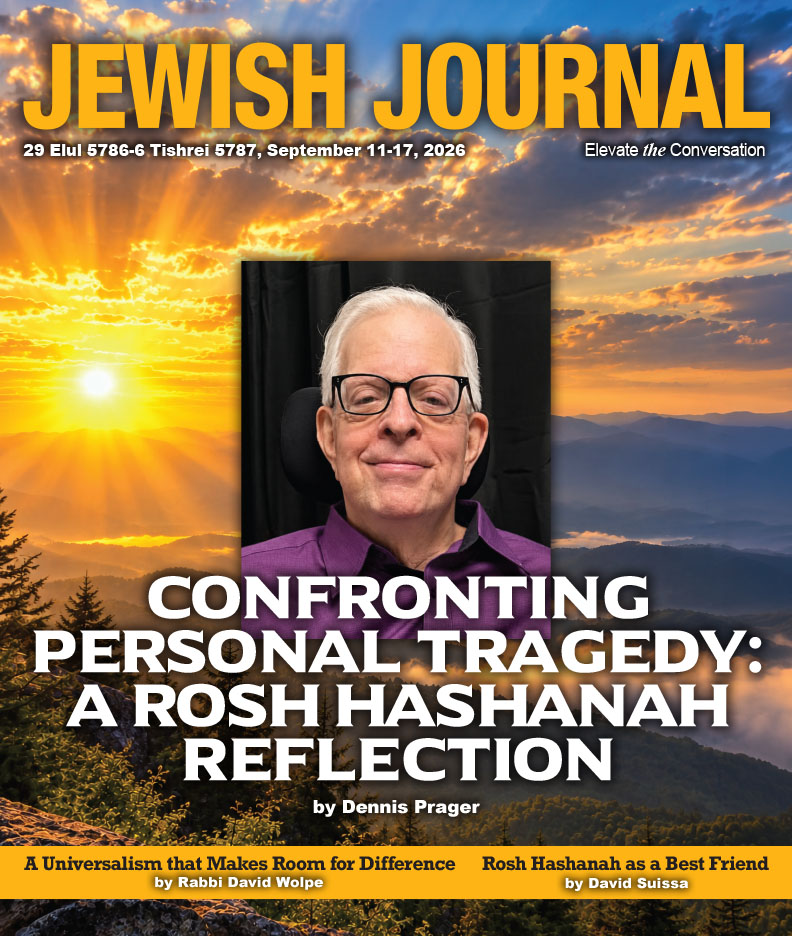
This column idea came to me while I was visiting with my friend Dennis Prager and we discussed him writing our Rosh Hashanah cover story.

After our conversations, I realized that I couldn’t separate my friendship with Dennis from my feelings toward the holiday itself.

Maybe it was because of the poignancy of his personal story, but it was as if Rosh Hashanah became Dennis and Dennis became Rosh Hashanah.

Just as Rosh Hashanah continues to nourish us with its wisdom, so does Dennis.

Just as Rosh Hashanah is a trusted friend we can always count on, so is Dennis.

When we gather Friday night to begin the Holy Days, we can sit down with something we completely trust— a holiday that has been our friend for millennia.

Imagine if the long, emotional month ahead of us — the good, the joyful and the difficult—will be coming not only from our Creator and our ancestors and our rabbis but from an eternal friend.

A friend who’s always been there for us.

Shana Tova.

What if Rosh Hashanah Were a Best Friend? Read More »