Now go and get to work! You will not be given any straw, but you must deliver your quota of bricks!” ~ Exodus 5:18
This one’s for the ride-share driver
pouring their time into moving people
from one place to the other –
their car a commodity –
their gasoline provided on their own dime.
This one’s for the teachers
draining their bank accounts
to make sure pencils are
on their students’ desks.
This one’s for the gig worker –
health insurance – an expensive dream
in this greatest country where
all the other less great countries
wouldn’t dream of charging you
for a bandaid.
This one’s for the bill-payers –
the ones who count their own beans
the ones who compare toothpaste prices
the ones who think only rich people
go out to eat. This one’s for the ones
who think they saw the word mortgage
in a fantasy novel –
who see the word rent
as a punishment.
This one’s for the ones who
have to gather their own straw.
These treasure cities
aren’t going to build themselves –
these bricks – our own burden to make
out of nothing.
Rick Lupert, a poet, songleader and graphic designer, is the author of 28 books including “God Wrestler: A Poem for Every Torah Portion.” Visit him at www.JewishPoetry.net
Moses’ mother wove a basket,
and put her infant into it,
and put it in the Nile, a task it
thought by many not legit.
They feared the babe might drift and drown;
it happened alas to those parents
who’d done the same, and — watered-down —
had not like Miriam’s and Aaron’s
young sibling managed to survive,
as Aaron clearly had without
the very risky step that I’ve
explained completely freaks me out,
and probably freaked out the friends
of Moses’ mother, and his dad,
since other babes had reached dead-ends,
not safely sailing like Sinbad.
Abarbanel wrote Torah blogs
implying what I wrote above,
explaining that the plague of frogs,
the one that surely kids most love,
occurred because the loud noise they
made echoed bitter wails of woe
wept by sad parents in dismay
when suffering the dreadful blow
caused when their little children drowned,
unlike the baby Moses who,
when by a miracle was found,
survived since Pharaoh’s daughter drew
him from the Nile.
When you read what
I’ve chosen in this verse to tell,
remember its midrashic plot
is by a Don, Abarbanel,
famous partly for composing
a brilliant Torah commentary,
convivencia opposing
what priests preached in Spain’s promontory,
prioritizing laws that Moses
received on Sinai before breaking
two tablets, prescribed in two doses,
because most people were forsaking God’s Is One, and tolerated
convivencia with what’s forbidden,
a golden calf, idolerated,
against the laws in Torah written.
Anti-Aaron, ironically,
Moses smashed what God prescribed,
but then restored harmonically
the laws God had on stones inscribed.
Convivencia is a Spanish word that means “coexistence” or “living together”. It’s used to describe the period in medieval Spain when Christians, Muslims, and Jews lived together and exchanged ideas.
Gershon Hepner is a poet who has written over 25,000 poems on subjects ranging from music to literature, politics to Torah. He grew up in England and moved to Los Angeles in 1976. Using his varied interests and experiences, he has authored dozens of papers in medical and academic journals, and authored “Legal Friction: Law, Narrative, and Identity Politics in Biblical Israel.” He can be reached at gershonhepner@gmail.com.
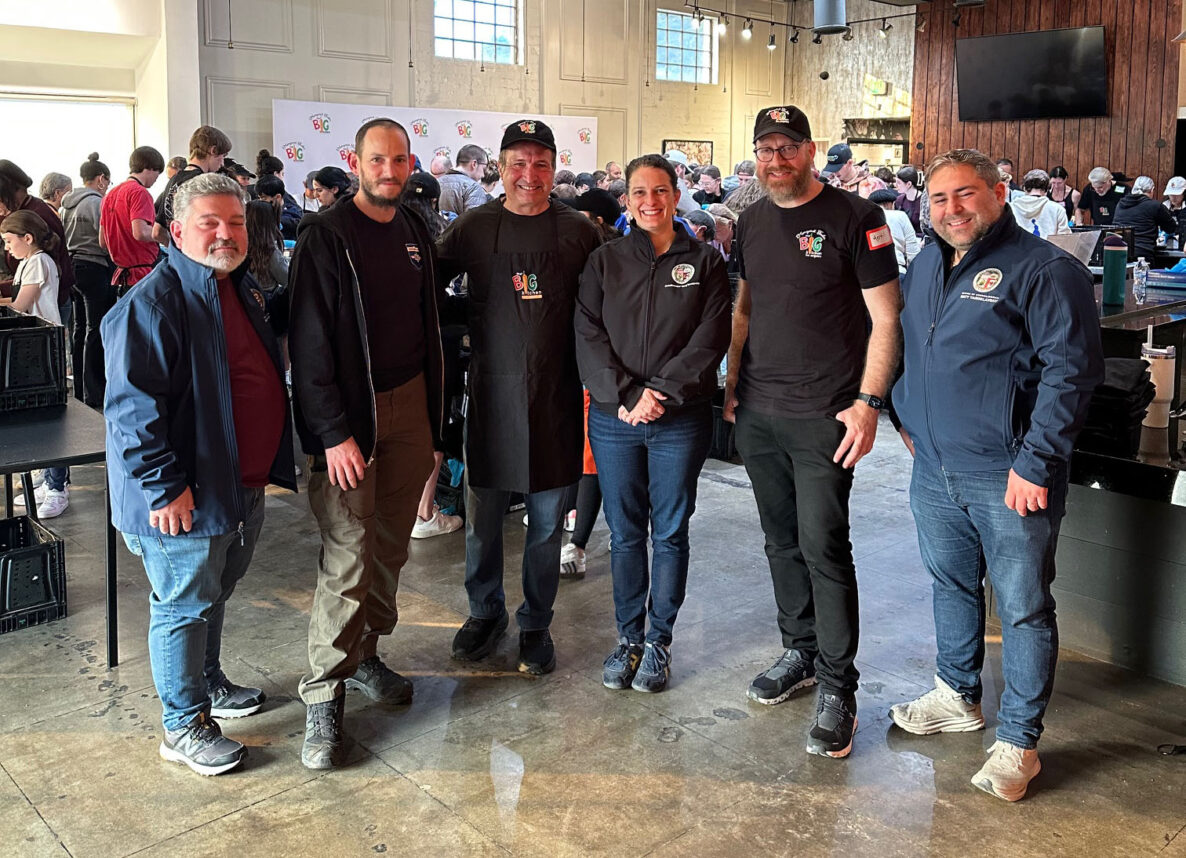
Almost as soon as the wildfires broke out last week, Our Big Kitchen Los Angeles (OBKLA) sprung into action, providing thousands of warm kosher meals, as well as their signature OBKLA chocolate chip cookies, to first responders and evacuees.
“We worked 16 hours straight on Wednesday, making those thousand meals, getting them distributed and setting up the infrastructure [to continue],” Yossi Segelman, OBKLA’s Executive Director, told the Journal. “Thursday had the same number of meals produced, the same number of volunteers, with hundreds of volunteers still on the waitlist.”
Funding for the first 1000 meals produced was provided by the Jewish Community Foundation of Los Angeles.
Founded by Yossi and Chaya Segelman, the organization, aka Margaret Feder Our Big Kitchen, usually prepares and provides kosher meals that are distributed to 43 community partners around Los Angeles.
“For the first time, we put out a memo that pretty much said, ‘If you need a meal, email us; we’ll get it to you,’” Segelman said. “Magen Am lined up volunteers and Wednesday there was just a rotating door of the volunteers, picking up the meals and transporting them.”
OBKLA then activated a WhatsApp chat, where people in addition to the Magen Am volunteers can offer to drive food to all over the LA area from Mount Olympus and the Pacific Palisades to Hollywood, West Hollywood and Hollywood Hills.
“What we are now putting together is the funding to be able to execute this emergency response plan for the foreseeable future,” Segelman said.
They are committing a 90-day plan of sending meals that are healthy, hand packed, nourishing and made with love to those in need; they will assess and review daily and weekly.
“OBKLA has the capacity to provide a quarter of a million meals at least this year,” he said. “As long as the need is there, we will increase both the number of meals we prepare and also the number of volunteer opportunities … where the community can come together [and] support each other.”
Volunteers, which include evacuees, participate in meal-prep sessions in two-hour slots.
“What these families are doing is coming here and transforming helplessness into hopefulness,” Segelman said. “That’s really what we’re trying to do, as a resource in the community, is provide people not only with nourishment and emergency meals, but also an opportunity to … take that energy and create something … positive out of this horrific tragedy.”
Segelman was in Pacific Palisades 18 hours before everything went up in flames.
“I dropped off my parents who went on a hike; they were visiting from London,” he said. “This is very personal because in addition to knowing a lot of people, I walked that ground just hours before, and it is still mind boggling that I’m looking out of my window and I can see it’s still smoldering.”
Segelman said he is “humbled” to be in this position to help.
“We’re simply doing what we do all day, every day, and it’s only because of our phenomenal team that we’re able to scale up this quickly,” he said. “As soon as we heard [what was happening], we activated what we call our OBKLA emergency response plan.”
They posted the need for volunteers, put the kitchen staff on notice that they were going to be producing a lot more meals, called up their partner agencies and started putting together resources.
“We sent out an email to our mailing list, which is about 16,000 people, saying that we will be hosting three volunteer sessions to prepare a thousand meals,” he said.
Within three minutes, every single slot was filled and they had over 400 people sign up for the waitlist.
“To have hundreds of people clamoring for an opportunity to come together for two hours and give of themselves to others is just awe inspiring,” Segelman said. “I am blown away; I’m truly honored.”
For more information, or to get involved, please contact OBKLA. Email info@obkla.org if you need a meal or go to OBKLA.org to sign up for the volunteer waitlist or make a donation.
It’s Veganuary. Started in 2014 by a UK non-profit, the annual challenge encourages people to try out the vegan lifestyle during January. The organization’s ultimate goal is to make vegan the norm, as opposed to the exception.
“For those looking to include more vegetarian or vegan dishes into their repertoire, soups are a great gateway to a more plant based diet,” Micah Siva, chef and author of “Nosh: Plant-Forward Recipes Celebrating Modern Jewish Cuisine,” told the Journal. “Their versatility, ability to build complex flavors and hands-off technique, make them the perfect introduction to vegetarian dishes.”
Her favorite soup is sweet and sour cabbage.
“With our Ukrainian heritage, nearly every soup included either beets or cabbage,” she said. “[This soup] reminds me of snowy days visiting my grandparents, served piping hot in a big bowl with a side of her homemade challah buns slathered with margarine.”
Sweet and Sour Cabbage Soup
Serves: 8 to 10
Adapted from “Nosh: Plant-Forward Recipes Celebrating Modern Jewish Cuisine”
On the table in one hour
2 Tbsp extra-virgin olive oil
1 medium yellow onion, finely chopped
2 garlic cloves, finely chopped
2 Tbsp tomato paste
2 Tbsp sweet paprika
1 medium (about 2-lb) head green cabbage, quartered and thinly sliced
3 medium carrots, cut into ½-inch pieces
1 sweet potato, peeled and cut into ½-inch pieces
1 bay leaf
8 cups vegetable broth, low-sodium if preferred
1 (28-oz) can crushed tomatoes
¼ cup apple cider vinegar
3 Tbsp maple syrup, plus more as needed
2 Tbsp lemon juice
¾ cup sauerkraut
1 Tbsp miso paste
Salt
Black pepper
¼ cup chopped fresh parsley, for serving
Heat the oil in a 4- or 5-quart heavy-bottomed pot over medium heat. Add the onion, garlic, tomato paste, and paprika and cook until the onion begins to soften slightly, 3 to 4 minutes.
Add the cabbage, carrots, sweet potato and bay leaf to the pot. Pour the broth, crushed tomatoes, vinegar and maple syrup over the cabbage and stir to combine.
Bring to a boil over medium-high heat and simmer, stirring occasionally, until the cabbage is fully cooked and tender, 25 to 30 minutes.
Add the lemon juice, sauerkraut and miso and simmer over low heat for an additional 5 minutes. Remove the bay leaf and discard. Season with salt and pepper to taste. Add more maple syrup as needed.
Serve topped with fresh parsley and freshly ground pepper.
Note: Store the soup in airtight containers in the fridge for up to 4 days or in the freezer for up to 6 months. If freezing, portion it into 2- or 4-serving containers so you aren’t stuck eating the same soup every day for a week!
Variation: Make this soup into an even heartier meal by adding 2 (14-oz) cans of drained and rinsed white beans
Alon Shaya’s bright green falafel stands out for its vibrant flavors and textures.
“It’s a testament to the fresh herbs used in their preparation,” Shaya, co-founder of Pomegranate Hospitality and author of “Shaya: An Odyssey of Food, My Journey Back to Israel,” told The Journal. “Unlike the typically dense falafel, these are light and airy, and they are perfect in a pita with harissa, tossed in a salad or dipped in tzatziki.”
Photo by Rush Jagoe
Bright Green Falafel
1 1/3 cups dried chickpeas
¼ cup water, plus plenty for soaking the chickpeas
2 egg whites (If you’re looking for a vegan version, you can omit them and still have great results)
2 – 3 quarts canola oil
Put the chickpeas in a large bowl, and submerge in water. Soak overnight.
In the bowl of your food processor, pulse the parsley a few times, until it’s roughly chopped. Drain and rinse the chickpeas, then add them along with the onion, lemon zest, ¼ cup water, flour, salt, baking powder and spices. Process until the mixture is all the same color and starting to pull together.
Whip the egg whites to stiff peaks with a whisk or mixer. Fold the whites into the chickpea mixture, and chill for at least 1 hour.
Clip a thermometer to the side of a heavy-bottomed pot or Dutch oven, and add enough canola oil to come about halfway up the sides of the pot. Bring to 350˚F over medium-high heat. While it warms up, line a plate or cooling rack with paper towels.
Working in batches of six to eight - just enough so they’ll have plenty of space in your pot – shape the dough into golf-ball-sized pieces; it will be pretty loose but should still hold together.
Use a slotted spoon to lower them carefully into the oil, one at a time, and fry each batch for about 4 minutes. After about 1 or 2 minutes, if they’re sticking to the bottom of the pan, nudge them loose with your spoon. These will look done before they’re completely cooked through, so be patient and let the crust become a very deep, burnished brown. Cut into one — it should be firm, the same consistency throughout.
Once the falafels are cooked, keep them warm in the oven while you cook the rest. Serve warm on their own or with any of the suggestions mentioned in the headnote.
One of Eric Sornoso’s favorite recipes isvegan cholent.
“When I went plant-based, I made a point to keep the essence intact and revise it for my updated values,” Sornoso, CEO of Mealfan, told the Journal. “This vegan version captures the same depth of flavor and stick-to-your-ribs satisfaction as the traditional recipe.”
Vegan Cholent
1 cup pearl barley
1 cup dried chickpeas (soaked overnight)
1 cup diced potatoes
1 cup chopped carrots
1 cup chopped onions
4 cloves garlic, minced
2 Tbsp olive oil
1/4 cup tomato paste
1 Tbsp smoked paprika
1 tsp cumin
6 cups vegetable broth
Salt and pepper, to taste
Heat olive oil in a big pot; sauté onions and garlic until golden.
Stir in the tomato paste, smoked paprika and cumin; let the flavors meld for a minute.
Add chickpeas, barley, potatoes, carrots and vegetable broth; season with salt and pepper.
Bring to a boil, then reduce heat and simmer. Let it cook low and slow for 4-6 hours or use a slow cooker overnight.
Stir occasionally, add more broth if needed, and serve warm with a sprinkle of fresh parsley.
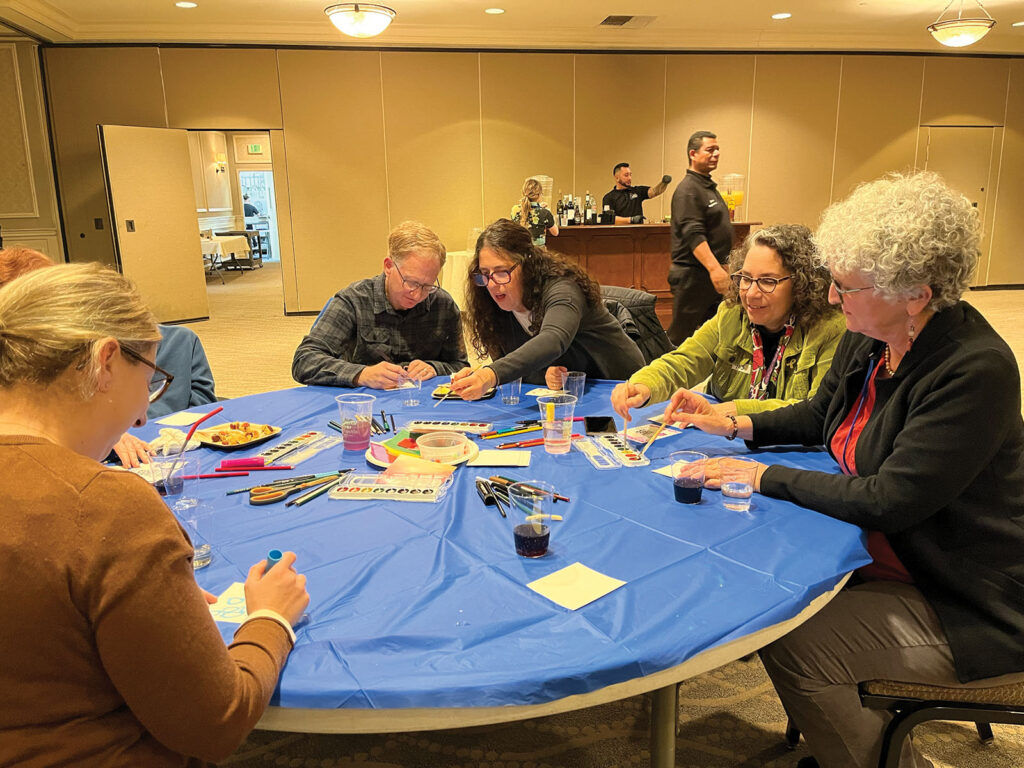
Over several days, Los Angeles Jewish community members and those visiting from out of town got a respite from the anxiety-inducing fires happening around the city and took part in contemplative workshops designed by an organization integrating art therapy into Jewish spiritual practice.
Attendees of Temple Beth Am’s Kol Tefilla conference, held at the Conservative synagogue in Los Angeles from Jan. 9-12, participated in a series of creative exercise led by the Berkeley-based Jewish Studio Project; worshipped together over Kabbalat Shabbat and all day Saturday and took part in learning courtesy of Rabbi David Ingber of the New York-based community Romemu.
Jewish Studio Project Co-Founder and Creative Director Rabbi Adina Allen led several of the sessions during the weekend-long gathering. Her organization’s goal is harnessing the power of creativity to revitalize one’s relationship with Judaism.
Hadassah’s new CEO, Ellen Finkelstein. Courtesy of Hadassah
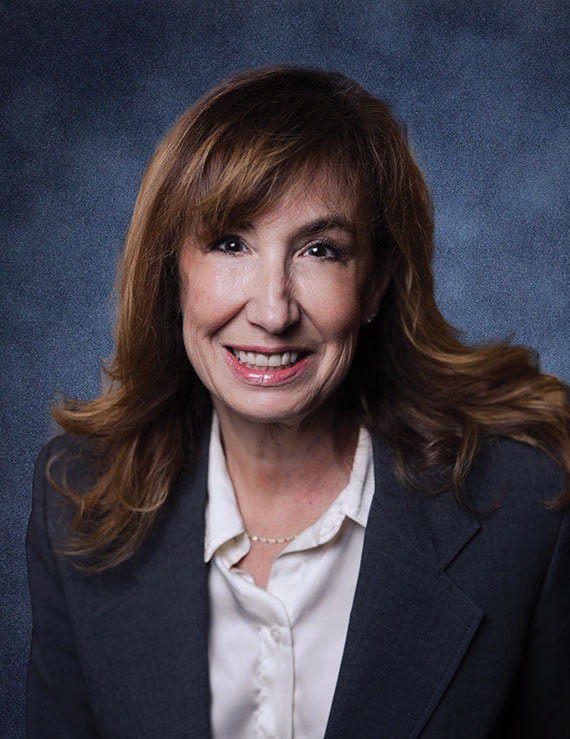
Hadassah, The Women’s Zionist Organization of America, has named longtime nonprofit leader Ellen Finkelstein as its chief executive officer and executive director, effective Jan. 6.
Finkelstein most recently served as chief strategy officer in the office of institutional advancement at Yeshiva University, where she was responsible for annual giving, corporate and foundation relations, alumni services and engagement, and fundraising, among other public-facing areas. In this role, Finkelstein helped the university raise more than $90 million in a single year – the largest amount in the school’s history.
“I and the rest of Hadassah’s leadership team are delighted to welcome Ellen, a proven leader with extensive experience in Jewish communal work and an outstanding track record in institutional advancement,” Hadassah National President Carol Ann Schwartz said in a statement. “She is the perfect person to work with us to build on Hadassah’s accomplishments, increase its impact globally and lead the organization into the future.”
Finkelstein, a self-described Zionist, was born and raised in New Jersey, where she lives today. The graduate of University of Virginia began her career at Accenture Consulting. Before joining YU, she served as the director of marketing at Jewish Family and Children’s Services of Northern New Jersey.
She said she has long been inspired by the work of Hadassah.
“As a Jewish woman and a Zionist, there is no place I would rather be than at Hadassah,” she said. “With its commitment to Israel, its dedication to fighting antisemitism, its determination to improve healthcare for women and children and its mission to stay on the front line of medical advancement, Hadassah is playing a vital role in bringing the Jewish community together and helping us focus on what is important. I couldn’t be prouder to have this opportunity.”
Hadassah, the country’s largest Jewish women’s organization, with nearly 300,000 members, donors and supporters and a professional staff of 200, is focused on Israel’s security, combating antisemitism and promoting women’s health care. Its Jerusalem-based Hadassah Medical Organization provides healthcare to more than one-million people each year.
Andrea Goren, new chairman of the Americans for Ben-Gurion University board of directors. Photo by Preston Rescigno.
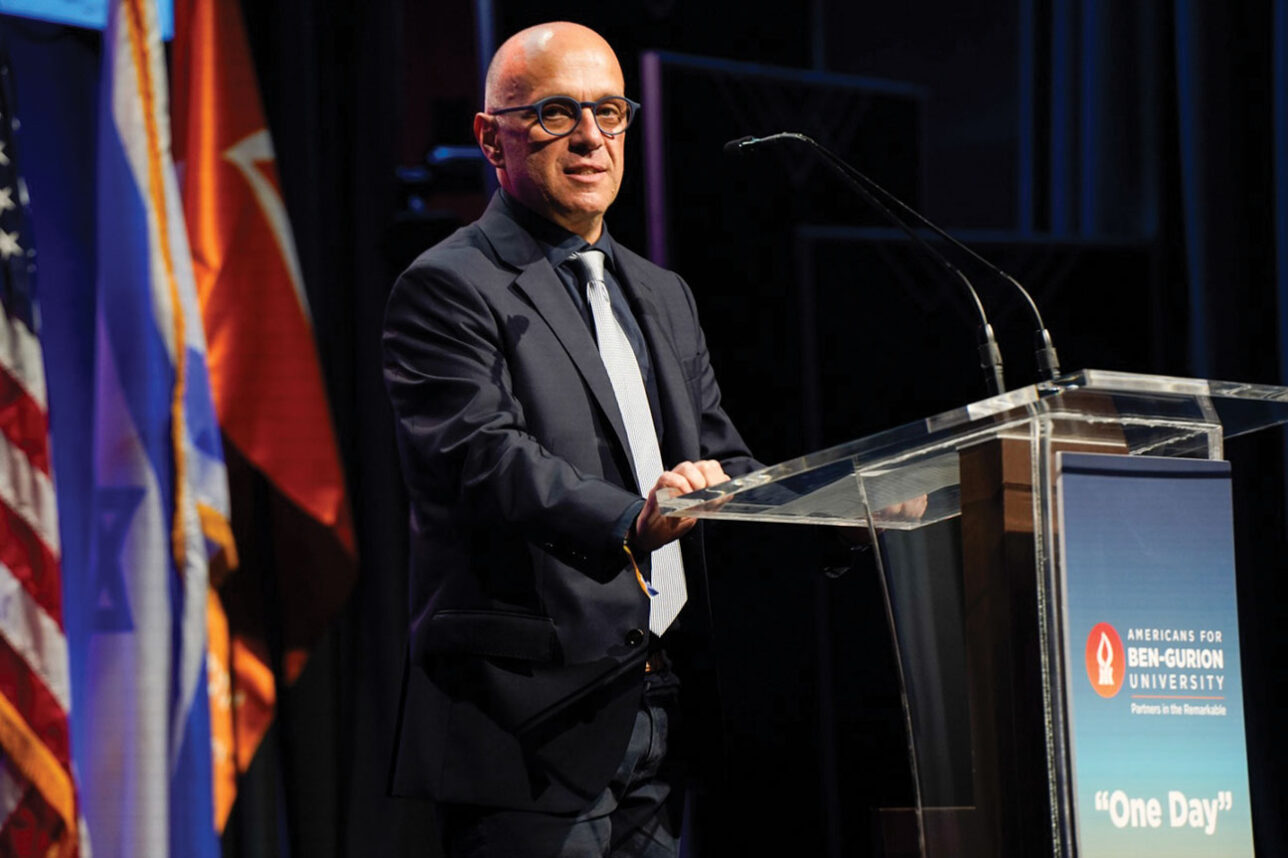
Americans for Ben-Gurion University (A4BGU) has appointed Andrea Goren, a third-generation supporter of Ben-Gurion University of the Negev, as the new chairman of the organization’s board of directors.
Goren, a New York-based finance executive, assumed the role at the recently held A4BGU meeting in New York.
“I visited BGU for the first time when I was seven years old,” Goren said. “It has been part of my life for as long as I remember, and I have been privileged to witness its amazing growth and development over the years. I am deeply honored to lead A4BGU’s board at a time when it is more important than ever for Jews around the world to stand up and do what they can to secure a peaceful future for Israel.”
Goren, who succeeds immediate past chair Gary DeBode, has previously held a variety of senior roles on the A4BGU board, including treasurer, chairman of the finance committee, executive committee member and vice chairman.
In his appointment as board chairman, he is following in the footsteps of his father and grandfather as ambassadors for Ben-Gurion University.
“It is especially meaningful that Andrea is continuing his family’s legacy of support for BGU as chairman of A4BGU’s board of directors,” A4BGU CEO Doug Seserman said in a statement. “His leadership is a modern manifestation of the Jewish value of l’dor v’dor — from one generation to another. And, it couldn’t be happening at a more crucial juncture, when BGU is leading the way forward for Israel in the ongoing aftermath of the October 7th attacks. We wish Andrea our heartfelt congratulations on his new position and give our utmost gratitude to Gary DeBode for his four years of dedicated service.”
Ben-Gurion University, a public university in Beersheba, is the largest nongovernmental employer in the Negev. A4BGU’s primary role is to fundraise for the university, as most of the philanthropic support for the institution comes from the United States. The university was directly and disproportionately impacted by Oct. 7, with 117 dead from its community and 6,000 of its students serving in IDF reserve duty.
On behalf of the State of Israel, I extend our deepest concern and heartfelt empathy as we witness the devastation caused by the wildfires ravaging Southern California. Our thoughts and prayers are with those who have lost loved ones, the brave first responders risking their lives, and the countless families displaced and facing unimaginable hardships.
As Jews, we are guided by the principle of “Kol Yisrael aravim zeh bazeh”— all of Israel is responsible for one another. This sacred mandate calls us to support one another, especially in adversity. We stand in solidarity with you, ready to assist in any way we can.
Our hearts ached at the destruction of the Pasadena Jewish Temple and the loss of homes belonging to so many clergy and congregants of Kehillat Israel, among others. Yet, we are inspired by the resilience and unity of the Los Angeles Jewish community. In the aftermath of Oct. 7, you demonstrated unwavering support for your Israeli brothers and sisters. Through heartfelt prayers, donations, volunteering, hosting families and former hostages, and countless other acts of kindness, your actions were a beacon of hope and strength. Today, it is our turn to support you.
Los Angeles has long been home to hundreds of thousands of Israelis and a loyal partner to Israel since the rebirth of our nation. This enduring relationship reminds us that we are stronger together.
We have unwavering faith in the resilience of California’s Jewish community and the broader communities affected by these fires. The strength and resolve that have carried us through countless challenges will guide us through this one as well. Together, we will overcome, rebuild, and emerge stronger.
The Consulate remains fully operational during this time. We are exploring every avenue to contribute meaningfully to relief efforts by sharing Israeli technology, know-how and expertise. We will stand shoulder-to-shoulder with you in these efforts.
The Jewish people are no strangers to destruction and displacement, yet through every chapter of our history, we have drawn strength from our timeless faith, always finding a way to rebuild, endure, and face even the darkest moments with unwavering hope.
At this difficult time, may we draw strength from one another and our unshakable belief in a brighter future.
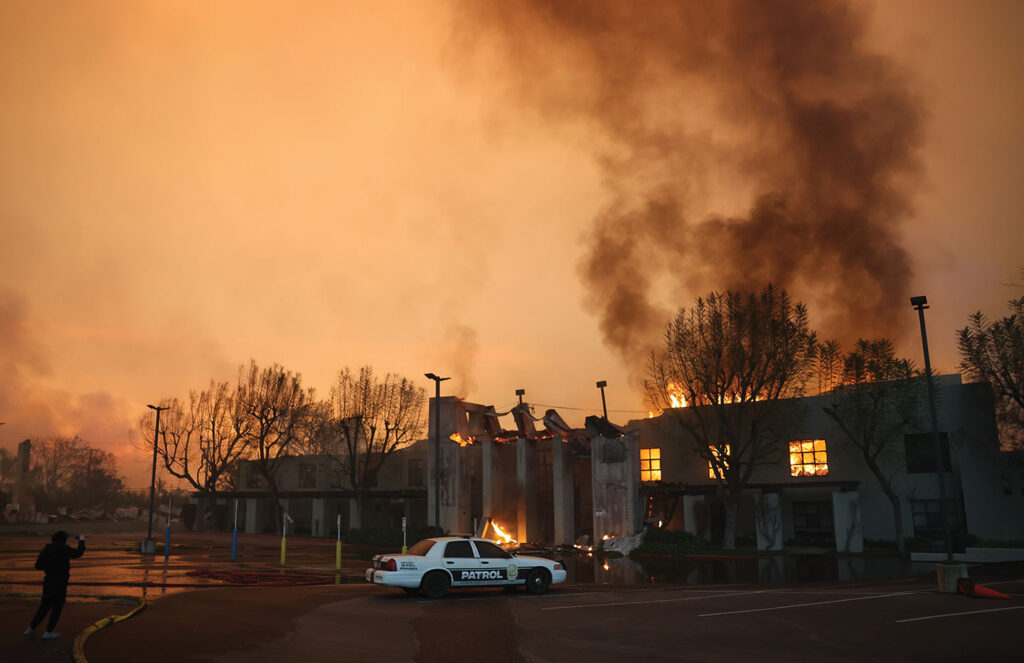
Editor’s Note: The large stone structure that was the Pasadena Jewish Temple & Center was “completely destroyed,” Rabbi Jill Gold Wright said. Below is the sermon she delivered on the following Shabbat morning.
This past Sunday, not even 50 hours before the Eaton Canyon fire exploded our neighborhoods, homes, and beloved shul, our Religious School Limud LBSRS reconvened after Winter Break.
Once again, our devoted volunteers from the Men’s Club laid out their wonderful pancake breakfast for our families. Sticky fingers and chocolate-chip smiles greeted each other – children and parents – one friend to the next. We were there. Together.
We moved from breakfast into Kehilla Kedosha, our morning minyan. We sang and prayed, clapping and dancing. A joyous group of kindergartners went up the bimah steps to lead the whole school in Bar’chu. And we were there. Together.
Then, our youngest kids went off to class, and our 3rd through 7th graders joined the congregation in the parking lot, where we replaced the cornerstone that had once marked the spot of our Sierra Madre synagogue almost a century ago.
We spoke on that morning about how that stone, first engraved in the 1930s, had traveled from its synagogue property, into the homes and garages of different generations of families.
Non-Jews, whom we didn’t even know, cherished and protected it, until it found its way back to PJTC. We placed it next to our Centennial time capsule, and we welcomed it home. We celebrated its return to its rightful place.
Because, you see, its rightful place was not about being on Altadena Drive just north of Washington. The address is not the place. The place is the community.
On that bright and windless Sunday morning, we sang the words of Exodus 25:
V’yasu li / mikdash / ve-shachanti b’tocham. God’s words to Moses that simply say, “And you will build for me a sanctuary, and I will dwell among you.”
We spoke about the Mishkan – the temporary sanctuary that the Children of Israel built in the wilderness. Constructed to careful dimensions and descriptions, the Mishkan had two very clear intents. It was meant as a place for God to dwell among us. And it was meant to be built, dismantled, carried, rebuilt, and unbuilt again and again. The Mishkan was an impermanent, portable, traveling structure – and we carried it with us for 40 years in the desert, in the wilderness.
We didn’t know where we were going — not really — but we knew where we had been, and we knew who we were. And we were there. Together.
Our clergy and senior staff sent out the same words to our congregation on Wednesday morning. We were all utterly devastated. Shattered. It was all gone; everything was lost. But we thought about the words from our Torah that we had invoked just 50 hours before. V’shachanti b’tocham — God doesn’t say to Moses that God will live within IT — the sanctuary. God says – within YOU — the community, the builders, the ones who build.
And then, 50 more hours elapsed. In those few days, I had been thinking constantly about a line from Pirke Avot, the Words of our Fathers. In Chapter 3, Rabbi Elazar ben Azariah teaches, Im ein kemakh, ein Torah. Im ein Torah, ein kemakh.
If there is no wheat, there is no Torah. If there is no Torah, there is no wheat.
But what does this actually mean to us today?
“Kemach” can be translated as wheat or flour — basic provisions — so “kemach” represents the sustenance our bodies need to work, to raise families, to live our lives. It is the stuff that keeps us alive – it is the WHAT.
But Torah. Torah is the reason for, the purpose, the meaning, the embodiment of that survival or existence. If basic sustenance is the WHAT, then Torah is the WHY.
This crisscross structure is neither a riddle nor a paradox. It’s actually a pretty simple equation. If we cannot eat, we cannot live Torah. But if we are not living in a meaningful way, if we are only eating to survive, if we are not embodying our Torah, what’s the purpose? What is the WHY?
The devastating fire has given us the bitter and painful reminder that nothing is permanent. That everything we took for granted and assumed would always be there, can be ripped away before our very eyes. But Cantor Ruth Berman Harris, along with other amazing congregants and staff, entered our building while ashes and embers fell from the sky to rescue our most sacred and treasured possessions.
In 10 minutes, they retrieved 11 Sifrei Torah from our shul. The Torah that we just read was carried in their arms, like the Ark of the Covenant was carried on the shoulders of our ancestors in the wilderness, as they journeyed from place to place.
This past Shabbat took place about 50 hours after losing our spiritual home.
Some of us have lost our personal, physical homes as well. The devastation is without expression. No words can really reach or describe what we have witnessed, experienced, and shared over the last few days. The tears, the memories, the loss, the grief– all of this envelops us and sometimes makes it hard to breathe.
But it was Shabbat, and with some of us on Zoom and many of us in person, we are here. Through the graciousness and generosity of our friends at Mayfield Senior School, we congregated for services on Friday night. We davened together on Saturday morning, and on Sunday morning, the same children who stood around that cornerstone, the ones who represent the next 100 years, were together again.
We sang and danced at Kehilla Kedosha, and another of our students wrapped tefillin for the first time. Our kids wrote letters of gratitude to the First Responders and notes of love to their families and friends. They created hygiene kits for people in need. They lived their Torah. We were here, and we were together.
In the fall, those same children of Limud LBSRS made four magnificent banners – imprinted with their handprints and names – that represented the four seasons of the year. The Hebrew words on the tops of the banners read, “La-kol z’man v’eit” – in every time and every season – “yad b’yad” – hand in hand.
Our beautiful banners are gone – but the hands aren’t gone. The seasons aren’t gone. The Torah that guides them is never gone.
Place, as we see again and again, is not an address, or city, or continent where buildings stand and where buildings fall. Place – Ha-Makom – is where God dwells among us, within us, and within our relationships with each other.
L’Dor VaDor – From generation to generation: We are here.
Le’olam Vaed – For ever and ever: We are here.
This Shabbat and on the Shabbatot of a million generations to come: We are here. We are here. And we are, say it with me, together.
Those supporting peace at any price are celebrating the ceasefire agreement between Israel and Hamas. After 15 months of war, a peace agreement was reached that mirror’s Neville Chamberlain’s piece of paper. Presidents Joe Biden and Donald Trump both rushed to take credit for a deal deserving blame. Israel again surrendered rather than finish the job. Charlie Brown will not be kicking the football. Israel will not receive lasting peace.
Mr. Biden foolishly insists his administration deserves credit. Israeli Prime Minister Benjamin Netanyahu repeatedly and properly ignored Biden and Secretary of State Anthony Blinken. Biden and Blinken continued their trend of being spectacularly wrong about war and peace matters. They are the heirs to former President Jimmy Carter’s peace through weakness doctrine.
Mr. Trump is different. He believes in former President Ronald Reagan’s doctrine of peace through strength. There were zero wars during Trump’s first term because his threats of overwhelming force were credible. He vowed to smash ISIS to pieces, and he did. America’s enemies noticed.
Trump has always been a friend of Israel. His Abraham Accords are a major success. He personally admires Israelis, who share his love of military strength and business negotiating skills. He wheels and deals. They shpiel and deal. The admiration is mutual.
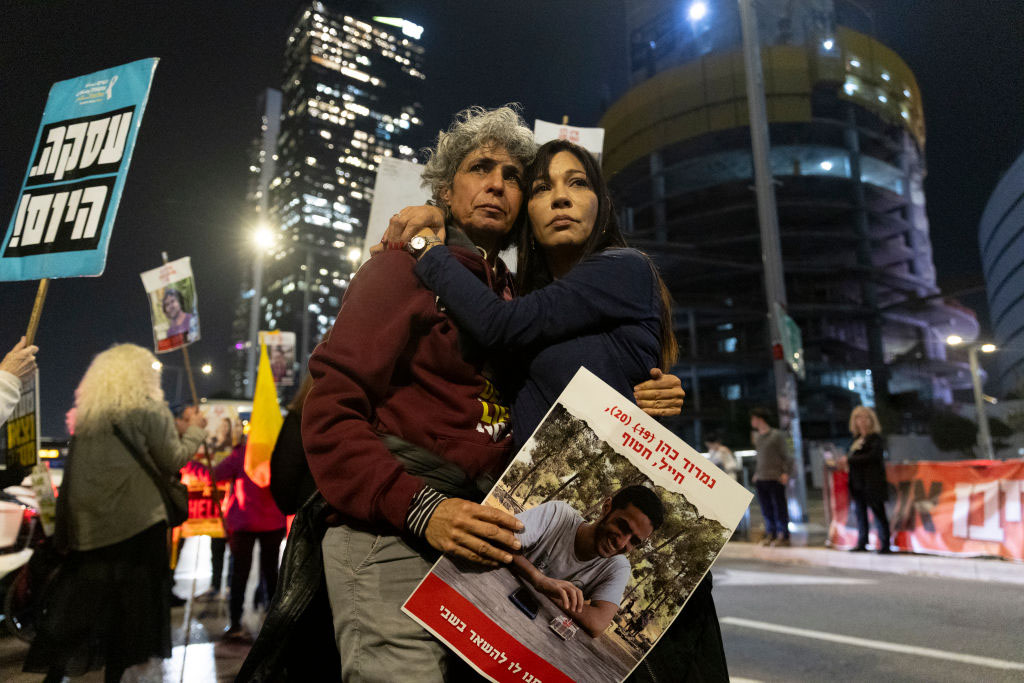
Sadly, Trump’s peace deal is a sequel to the terrible Gilad Shalit deal. Israel received two dead bodies and one live soldier in exchange for 1,000 Islamist prisoners including October 7th mastermind Yah-Ya Sinwar.
Now Israel is accepting some live hostages and dead bodies while releasing more terrorists including the next Sinwar.
For family members of hostages, this deal is good. Their top priority, understandably, is bringing loved ones home. For Israelis unrelated by blood or friendship to the hostages, this deal is a future inevitable nightmare. A weakened Hamas is still alive. Unlike Trump obliterating ISIS, the Israeli Defense Forces were denied the right to smash Hamas and Hezbollah to bits.
Trump supporters insist he has earned the benefit of the doubt. His pro-Israel credentials are significant. If Hamas or Hezbollah attacked Israel again, Trump would encourage Mr. Netanyahu to go full tilt.
This is true, but meaningless. Trump’s strategy makes sense with him in power. Iran will forego meaningful action during his presidency. Iran was economically strangled during his first term.
Iran funds Hamas, Hezbollah and other global Islamist terrorist groups. The mullahs in Iran are the hydra’s heads. They play the long game. They know that in four or eight years, Democrats will retake the White House. Tehran can then restart the jihad party.
Former President Barack Obama gave Iran billions of dollars. Former Secretary of State John Kerry performed shadow diplomacy during the first Trump presidency. Biden and Vice President Kamala Harris continued coddling Iran. Democrats show zero interest in changing their feckless foreign policy approach.
Trump will contain Iran’s Islamists, but containment is not total victory. Even reimposing sanctions on Iran is not dayenu. Hamas and Hezbollah already received their foreign aid. Clawing that money back is impossible.
Hamas and Hezbollah will use the next four years to quietly rebuild, rearm, and reproduce. Their young children will reach Jihad-waging age by 2032. Eight years comes in the blink of an eye. Hamas and Hezbollah had their ambitions delayed but not ended. All the Islamists need is one more Democrat in the White House. Rather than have their nuclear facilities destroyed, Iran will be able to build nuclear bombs.
Israel’s only hope is Hamas or Hezbollah violating the ceasefire. With Trump in power, that is highly unlikely.
Israelis are now free to enjoy a temporary lull. If they thought October 7th was hell on earth, just wait until the next war that could be 100 times worse. Such is life of Western democratic nations when brilliant military leaders are restrained by political leaders. The IDF won. The Israeli government under heavy American pressure surrendered again.
Eric Golub is a retired stockbrokerage and oil professional living in Los Angeles.
Havadalah is the ritual at the end of Shabbat. One of the blessings we offer thanks God as the creator of fire (borei m’orei ha-eish). To my understanding, this is the sole prayer for fire in Judaism. (Yes, we have prayers regarding the commandment to kindle lights – but no prayer about the fire itself).
That said, the critical point in the Havdalah ritual occurs when the fire ceases, as we extinguish the candle in the cup of wine. We all become silent, waiting for the “sizzle.”
This week, two events occurred regarding the ceasing of fire.
We have the Los Angeles fires becoming more contained.
And we have the ceasefire deal between Israel and Hamas.
While both give us hope, both also leave a residue with many questions:
Are we safe?
Have the ashes from these fires made us physically or emotionally unhealthy?
Where do we go from here?
How do we prevent these fires in the future?
What does rebuilding look like?
And – specifically with Israel/ Hamas – will this end the vitriol against the Jewish people – or will it fuel haters to burn even more?
We have a true moment in time to take a world-wide pause, to listen to the sound of fire going out, and to have a true cooling off period. I pray that the fires cease. And I hope that we can move forward toward a future with woven promises and shared dreams.