fbpx

July 25, 2024

The Wisdom to Know When

I’m not sure he was quite ready to let go; to give up his role as leader.

On the one hand it is, objectively, an unspeakably difficult role to be in; one filled with stress and aggravation beyond what most of us could even imagine.

Half of the time, half of the people you serve are angry at you. Some of the time, they all are.

And then there are those whom you don’t serve, the ones you don’t lead — your enemies, haters, those who seek your literal ruin: the destruction of both you and your nation.

On the other hand, despite the headaches and heartaches, what a privilege, what an absolute privilege it is to lead.

The task of leading clearly energized him, brought him purpose and meaning. Maybe it even helped him with the stutter he’d had since childhood. However, it also aged him and, bit by bit, people noticed. He was occasionally slower to respond – slower to react. At times he seemed a little less sure of himself.

But who would tell him that perhaps for the good of the people he served, it was time to let go? Who could sensitively and effectively deliver such a message?

Initiating and having that conversation must have been a difficult task.

However, that talk was a necessary one to have; initiating it was the right thing to do for both him and the people. It was also just as necessary that such a conversation be left to someone close to that leader.

The leader I’m talking about of course is Moses.

We learn all about it in this week’s parasha. God comes to Moses and tells him that he will not be the one who will lead the Israelites into the land of Israel. That task will be for someone else. Moses had done his job well and the time had come to move on.

Consider how hard it must have been for Moses to hear this news and then, finally, to accept it.

The rabbis of the midrash imagine Moses arguing his case again and again, pleading to be given more time; to be given the gift of being the one to lead the people into the land which he’d himself told the Israelites flowed with milk and honey. He practically exhausted God in the process. But finally, acceptance came. For his own good,  as well as the good of the people, and to set an example for the generations to come, Moses  would let go – he would pass the torch to the next leader.

Ultimately, Moses came up with the transition plan himself:

“Moses spoke to the Eternal, saying, ‘Let God, Source of the breath of all flesh, appoint someone over the community who shall go out before them and come in before them, and who shall take them out and bring them in, so that God’s community may not be like sheep that have no shepherd.’” (Numbers 27:15-17)

The flock must have its shepherd, even if a different one needs to be appointed to the role.

It takes a little courage. It takes a little humility. It takes a little faith as well – faith that the people will be alright without you; that those who depend upon you will somehow find their way forward, will somehow reach their destination with a different leader at the helm.

It is not a little thing to do this. .

It is a big thing. When you have a job like Moses did – leading a whole community, a whole people – it’s a very big thing to do indeed.

It’s a big thing to let go. It’s a hard thing to get right–the timing, the communication of it. It’s never easy.

Ultimately, however, choosing to step aside, getting to decide instead of having such a thing decided for you, that’s a privilege – a blessing even.

May each of us have that privilege. May we experience that blessing. May we know the good fortune of having a supportive friend and community that can gently guide us on this journey.

May we, at just the right moment, or close enough perhaps, come to understand when the time has come to let go – for ourselves and for those we serve as well.

And then may we be blessed to know the thanks of the grateful community we have served.


Rabbi Yoshi Zweiback is the Senior Rabbi of Stephen Wise Temple in Los Angeles, California.

The Wisdom to Know When Read More »

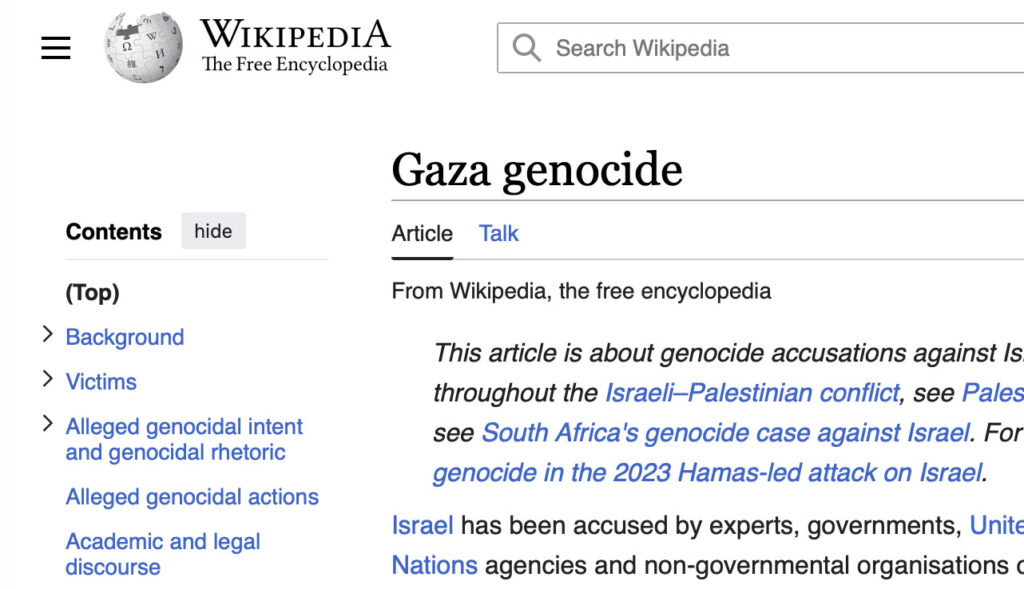
Wikipedia Editors Title Article “Gaza Genocide”

Wikipedia editors have officially renamed an article that was titled “Allegations of genocide in the 2023 Israeli attack on Gaza” to “Gaza genocide” following a discussion that lasted for a couple months.

The discussion, known in wiki-parlance as a “Requested move” (RM), started on May 3, when it was suggested that “Allegations of genocide in the 2023 Israeli attack on Gaza” was no longer a sufficient description since Israel’s war against Hamas in the Gaza Strip has continued well into 2024. Three options were proposed: 1) “Gaza genocide question,” 2) “Gaza genocide accusation,” and 3) “Gaza genocide.” The discussion centered around whether or not “Gaza genocide” is the most common term used in reliable sources and if it should follow other similarly titled Wikipedia articles; editors sparred over whether or not there is a scholarly consensus that Israel’s actions in Gaza are tantamount to genocide. A comprehensive source survey was conducted to determine where various scholars and experts stand on the matter, which can be found on the top of the article’s talk page where it states “scholarly and expert opinions (to be extended),” though other sources have been added to the list following the RM discussion.

Editors in favor of the “Gaza genocide” title argued that the sources show there is a scholarly consensus on the matter, as their arguments included citations to articles in the Journal of Genocide Research, a Holocaust historian claiming there is consensus among genocide scholars and an international human rights professor claiming there’s consensus in the human rights legal community worldwide as well as “many other legal and political experts, including many Holocaust scholars.” A Brookings Institute poll concluding that “a third of [Middle East] scholars see Israel’s military actions in Gaza as ‘genocide’” and 41% view that Israel’s actions as being “major war crimes akin to genocide” was also cited. Editors in favor of the “Gaza genocide” title also contended that there are plenty of examples of Wikipedia articles like “Extraterrestrial life” where the article does not state that the title itself is true, and that regardless of if there’s academic consensus, “Gaza genocide” should be the title since it’s the most common term used in reliable sources. They further argued it would be consistent with articles like “Tamil genocide” (referencing Sri Lanka’s Tamil population) and “Transgender genocide” that are “much less academically certain” than “Gaza genocide.” Editors against the title opined that other “questionably titled articles” are “appropriately qualified in the lead” or should be renamed altogether and that there’s enough sources documenting pushback to the allegation that Israel is committing genocide in Gaza that titling it as such would violate Wikipedia’s policy barring non-neutral titles (WP:POVTITLE). Further, editors against the “Gaza genocide” title argued that the other two options would be better reflect the article’s scope as a matter of debate. The article begins by stating that Israel faces allegations of genocide against the Palestinians in Gaza.

In this RM, editors put in their “!votes” where they argue which title best reflects site policy, and a closer (an uninvolved Wikipedian in good standing) rendered a verdict based on the numbers and strength of the arguments presented. The closer here was Joe Roe, who according to his user page is a computational archaeologist at the University of Bern; he concluded that there was “rough consensus” for the “Gaza genocide” title.

“The rough headcount in favor of each option was 23 for Option 1, 26 for Option 2, and 32 for Option 3. Few editors in favor of Option 1 were strongly opposed to Option 2 and vice-versa; amongst those that indicated support for both, the preference was generally for Option 2. A fair number of comments in favor of Options 1 and 2, but generally not Option 3, were not policy-based (i.e. along the lines of ‘there is no Gaza genocide’) and the headcounts for those options should be down-weighted accordingly,” Roe wrote. “The main argument in favor of Option 3 was that ‘Gaza genocide’ is reflective of the wording used by available reliable sources, and several editors presented detailed source analyses in support of this. This argument was contested but not convincingly rebutted. The main argument in favor of Options 1 and 2 were that the unqualified use of the word ‘genocide’ in an article title, when the existence of a genocide is disputed, would violate Wikipedia’s neutral point of view (NPOV) policy, and specifically the principle that titles should be nonjudgmentally descriptive. Editors in favor of Option 3 countered that the source analysis supported ‘genocide’ as a neutral descriptor (and conversely that ‘accusation’ is non-neutral), and/or that the presence of a statement in an article title does not imply that the statement is factual. Considering that Option 3 had the most support by a clear margin, that the arguments in favor of this title generally had a stronger grounding in reliable sources, and that neither side achieved a consensus on the question of which title is favored by WP:POVTITLE, I see a rough consensus that the title of this article should be Gaza genocide.”

Roe elaborated further on the close on his talk page in response to an editor questioning the close explaining that the numbers were around 31-27 in favor of the “Gaza genocide” title over the other two options, as some editors had picked more than one option for the title and stood “by my assessment that the vast majority of arguments in favor of Option 3 were policy-based, whilst a significant minority of arguments against it were not” when challenged on the 31-27 !vote being too thin of a majority.  Roe subsequently explained in response to a different editor’s query about his statement in the close about “the presence of a statement in an article title does not imply that the statement is factual” that “several examples were given in the discussion itself: ‘extraterrestrial life,’ homeopathy,’ ‘anti-gravity,’ ‘Epstein didn’t kill himself.’ Editors also noted that there are several articles on genocides (‘Tamil genocide,’ ‘Black genocide in the United States,’ ‘transgender genocide,’ ‘Armenian genocide’) that follow the same pattern, where the designation of genocide is also contested” and that “broadly speaking, those supporting Option 3 considered the title a mention of the phrase ‘Gaza genocide,’ whilst those against considered it a use.”

A challenge was launched against the close on July 22; as of publication time, the challenge remains ongoing.

Editors told me they believe there are enough academics disputing the Israeli genocide claim that the article title should not have been changed to “Gaza genocide.” One editor who made thousands of edits over a decade but no longer edits because of disillusionment with the project said the fact that there are “plenty of academics saying it isn’t [genocide] shows there’s no [academic] consensus, as does reliable sources specifically and deliberately showing both views.”  The editor contended that “whoever has the numbers decides what the scholarly consensus is” and that establishing the majority view among scholars “is also somewhat of a numbers game as whoever has more people looking is likely to find more sources supporting their side. There are thousands of academics in many fields.” The editor argued that “allegations” or “claims” should be in the title to better reflect the disagreement among experts in reliable sources. Another editor noted that Wikipedia’s Manual of Style (MOS) states that words like “‘alleged and accused are appropriate when wrongdoing is asserted but undetermined’ — and indeed, there seem to be enough sources that are reliable that refer to it as a genocide at the present time even though that is quite disputed.” This editor believes that a better title would be “Gaza genocide accusation”––following the same format as  the “Palestinian genocide accusation” article ––and that the “consistency” argument put forth by proponents of the “Gaza genocide” title is a goal, not a rule, and it’s “the last and least important goal.”

A different editor contrasted the article with the “Climate crisis” article, which they told me has “some sources that specifically talk about the use of ‘climate crisis’ vs ‘climate change’ because it has a more motivating impact on readers” and is not “villainizing any particular group.” But with the “Gaza genocide” article, “the name is very much not neutral and its acceptance clearly casts Israel as some sort of collective war criminal… I don’t think we can use the term just because *some* scholars use it… It’s the sort of thing I would expect a good, wise editor at a real publication to reject. Conversely, it’s the sort of 51% voted for it thing that seems to happen a lot at Wikipedia.” In response to what I have heard from a couple of editor sources that writing “this is a word that refers to a thing” goes against Wikipedia’s MOS, this editor maintained that the sources in the “Climate crisis” article fits Wikipedia’s policy on when a word can be an article subject.

By contrast, an editor with experience in moderating Israeli-Palestinian conflict topics told me that while “it’s certainly a valid argument that some reliable sources disagree … I’m not convinced it’s dispositive,” though they do feel “very middling about the actual merits of the conclusion” and “I don’t think Wikipedia got any better by moving this article”; they believe that ideally the article would have a title akin to “The Israel-Hamas war and genocide” since no one disputes that those two concepts exist and the article would discuss how the two interact.

“The problem is that, yeah, you have a minority of academics or minority of experts who disagree that something is a thing, you’re still usually allowed to have the article as that title,” the editor said, as they argued that it’s not required to show that a supermajority of scholars agree on something to establish scholarly consensus. “A key issue is that Wikipedia article titles are not always neutral, and not always assertions that the thing in question exists.  We have, for instance, articles on ‘Great Replacement,’ ‘Transgender genocide,’ and ‘Birds Aren’t Real,’ but none of those articles say that their titles are true,” though the editor acknowledged that “we aren’t consistent with article titles.”

Still, they believe that “anything above 50% you can’t throw out as it must have been wrong” regarding the !vote count in the RM. “Based on the numbers and that down-weighting, a close for Option 3 likewise seems reasonable.  Most debates like this come down to what term is most used in reliable sources, and the Option 3 camp made a good showing in that regard.”

An editor who authors “The Wikipedia Flood” blog called the decision to change the title to “Gaza genocide” as being “disgusting and typical … There are anti-Israel editors who have an agenda,” they told me. “They then find sources that fit the agenda. This is easy, because there is an entire body of sourcing that is considered ‘reliable’ whose entire purpose is to delegitimize Israel … POVTITLE should prevent this kind of thing from happening but enforcing that rule means you don’t go before an impartial jury or a judge as in real life, but rather a mob of anonymous editors who are dominated by anti-Israel operatives.”

A Double Standard?

Interestingly, there is a Wikipedia article titled “Allegations of genocide in the 2023 Hamas-led attack on Israel” and there was a brief discussion on if it should be renamed to “Genocide in the 2023-led Hamas attack on Israel” that appears to have stalled out. An editor told me that it’s “hilariously biased” for this article to be using “alleged” in the title but not in the “Gaza genocide” article. “A double standard doesn’t begin to describe it,” the editor said. “Someone should remove the ‘alleged’ from the Hamas article and refer to this admin’s close and talk page. Let’s see how that works out.”  A different editor told me that “the pro-Hamas editors often use a double standard … But consistency is not mandated on Wikipedia, so different topics may have different treatments depending on their individual circumstances. But if enough editors cared and were allowed to pursue it, I think that maybe the other ‘allegations’ title would also be moved, though I do not know what it should be moved to.” The editor who has experience moderating Israel-Palestine discussions, on the other hand, contended that it may not necessarily be a double-standard if the academic sources don’t refer to the Oct. 7 massacre as a genocide but do refer to Israel’s actions in Gaza as such.

Article Content

Some editors I spoke with criticized the content of “Gaza genocide” article, with one calling it “a doozy” for using “Hamas numbers in the encyclopedia’s neutral voice” and that there’s only a brief mention at the end of the three-paragraph lead that Israel disputes the International Court of Justice’s (ICJ) initial ruling (and views it as antisemitic) rather than mentioning that Israel disputes the allegations of genocide in Gaza as a whole and that “Israel has made various legal and moral objections to the ICJ.” One editor concurred “that the Gaza Health Ministry numbers should be considered unreliable at this point or at least attributed and contextualized” and that the brief mention of Israel’s view in the lead is “a little perfunctory.”

“The way this is framed is totally backwards,” the editor added, contending that the first sentence of the lead––which states that “Israel has been accused by experts, governments, United Nations agencies and non-governmental organizations of carrying out a genocide against the Palestinian population during its invasion and bombing of the Gaza Strip during the ongoing Israel–Hamas war”––should specifically name some of those who are accusing Israel of genocide. It should then mention Israeli Prime Minister Benjamin Netanyahu’s defense against the allegations as well as countries and government officials who defend Israel on the matter, the editor said. The lead mentions United Nations Special Rapporteur Francesca Albanese as one of the “various observers” who “have cited statements by senior Israeli officials that may indicate an ‘intent to destroy’ Gaza’s population”; it doesn’t mention Albanese’s various controversies, including that she’s being investigated for allegedly taking trips funded by pro-Hamas groups. “If you’re going to name her, it’s a little weird to do it this way,” the editor said.

The editor pointed out that the “Gaza genocide” article is littered with a handful of citations to the Turkish-state run media outlet Anadolu Agency, which is considered generally unreliable on Wikipedia for controversial topics and international politics, as well as a citation to The Canary, a leftist news site that is considered generally unreliable on Wikipedia. There are also multiple citations to the London-based Middle East Monitor (MEMO) watchdog; HonestReporting’s Chaim Lax listed MEMO in June 2023 as one of the five worst anti-Israel alternative news sources. The Community Security Trust, a UK-based antisemitism watchdog, has previously “accused MEMO of peddling conspiracy theories and myths about Jews, Zionists, money and power,” the Jewish News reported in 2015.

 “The Wikipedia Flood” editor argued that editors have “stacked the deck” by axing various pro-Israel sources while allowing anti-Israel sources like Al Jazeera, The Guardian and the U.N. “Naturally you are going to have an article on ‘Gaza genocide,’” the editor told me. “Wikipedia reflects and it magnifies the bias in world media due to the efforts of a small but influential cadre of anti-Israel editors and their helpers and stooges.” They called on more people on the pro-Israel side to edit Wikipedia, which they elaborated on further in a July 17 blog post.

The “Palestinization of the Academy”

Middle East scholar Asaf Romirowsky, who heads Scholars for Peace in the Middle East and Association for the Study of the Middle East and North Africa, told me that the large number of academics referring to Israel’s actions in Gaza as a genocide is indicative of the “Palestinization of the academy” and Wikipedia is “echoing that narrative … Let me be blunt:,” he said. “If you’re adopting the word ‘genocide,’ you’re denying facts … the term itself is a loaded term to create the kind of emotional propaganda-ish narrative that they’re looking to achieve.”. He added that those perpetuating the genocide narrative are relying on biased sources like Palestinian media, the Hamas-run Gaza Ministry of Health, Amnesty International, UNRWA (which Romirowsky contends “is Hamas”), and Human Rights Watch. Further, these academics do not consider Hamas’s attack on Israel on Oct. 7 to be genocide, according to Romirowsky. “They deny the reality, they deny the rape, they deny the maiming, every part of the barbery that was instituted by design by Hamas. They give them a pass… they argued that if Israel was a colonial settler state, this is decolonialism and this is justified … nothing here was remotely factual, but they are walking around to this very day supporting the fact that this is as a result of the occupation and Israel’s much worse and this is all justified.”

The reason for the “Palestinization of the academy” is that it’s centered on the narrative that “Palestinians are the quintessential victim of every issue in the world, and the quintessential victim of anyone who is discriminated against, ergo anybody who supports that narrative or supports the narrative of DEI [Diversity, Equity, and Inclusion] for example has to support the Palestinian issue,” contended Romirowsky.

“The main problem is that since academia is biased against Israel, and Wikipedia sourcing policies give deference to academia, such opinions find their way into Wikipedia articles and it is hard to counteract,” a veteran editor who has edited almost entirely outside of the Israeli-Palestinian conflict told me. “It is a kind of closed loop of bias and misinformation, much as would have happened if the Nazis had won the war and taken over universities and think tanks. We are at about that point with Hamas and its allies. I think that even if Wikipedia editors wanted to be NPOV (which is a fiction) it would be hard.”

“The greatest problem with Wikipedia is that it is based on academic and journalistic sources, and neither of them are particularly good,” the editor who has experience moderating Israel-Palestine discussions told me, adding that “when people have a problem with bias on Wikipedia, I find that what they almost always really mean is that they have a problem with the bias in the academic sources… What I wish people’s takeaway would be when they see Wikipedia is––in their perspective––wrong about something, is, ‘how can I change the overall discourse? How can I change the sources that Wikipedia is working from?’”

Romirowsky told me that he and his colleagues are that “out there combating these allegations” that Israel is committing genocide against the Palestinians and that it is “not 100% the norm” among academics to echo that anti-Israel narrative. “The unfortunate reality is that there is this kind of echo chamber that has fed into this fallacious terminology, illustrated by everyone of the kind of fanfare on campuses when you see ‘Israel is a genocidal state,’ ‘baby killers’… all of this stuff is detached from reality,” he said. “Anybody who is an honest scholar and anybody who actually looks at the facts, if you have had any shred of decency and believe in honest discourse, would come to a different conclusion.”


Wikipedia Editors Title Article “Gaza Genocide” Read More »

How Successful Have Jewish Athletes Been at the Olympics?

As the 2024 Paris Summer Olympics get underway, you may be wondering how Jewish athletes fared over the years.

A Jewish athlete has medaled at every Summer Olympics since the first modern games in Athens in 1896. Back then, five different Jewish athletes placed in the top three in their events, including gymnast Alfred Flatow of Germany who won finished first in gymnastics.

Back then, winners received a silver medal, second place received a copper medal, and no others were awarded. It was only in 1904 in St. Louis when the current gold, silver and bronze medals began to be awarded. That year, six Jewish athletes took home medals, with American long jumper Myer Prinstein winning two golds.

Based on total medals won, the three most decorated Jewish Olympic athletes of all-time are Dara Torres (12 medals in swimming – USA), Mark Spitz (11 medals in swimming – USA) and Ágnes Keleti (11 medals in gymnastics – Hungary). Keleti first competed in 1952 in Helsinki, winning four medals, including one gold. She currently lives in Israel and, at age 103, has the title of “oldest Olympic champion of all-time.”

Using data from the official Olympic athlete database and Jewish Virtual Library and the International Jewish Sports Hall of Fame,  the Journal found some interesting statistics on just how well Jewish athletes have competed at the world’s grandest sports stage.

A few interesting observations: The year that the most medals were awarded to Jewish athletes across all teams was in 1952 at the Helsinki Summer Olympics. It happened to be the first year that Israel fielded an Olympic team, though they wouldn’t bring home a medal until 1992 in Barcelona.

The year that the most medals were awarded to Jewish athletes across all teams was in 1952 at the Helsinki Summer Olympics. It happened to be the first year that Israel fielded an Olympic team, though they wouldn’t bring home a medal until 1992 in Barcelona.

After the United States, the country with the most Jewish athletes who have medaled is Hungary, with 69 medalists, though a Hungarian Jew has yet to medal since 1972.

The Olympic event where Jewish athletes have had the most success is in swimming, but until 2016, it was fencing. Israel’s two most successful events are in judo and sailing.

While the success rate of Jewish athletes skews towards the Summer Olympics (where there are more athletes and more events overall), the data below is based on all Olympic Games, summer and winter.

Top 5 Events Where Jewish Athletes Have Won Medals ALL-TIME

(Gold, silver, bronze combined)

1:  Swimming  –  76 medals

2:  Fencing – 72 medals

3:  Gymnastics – 26 medals

4:  Track – 23 medals

5:  Water Polo – 21 medals

COUNTRIES WITH MOST TIMES THAT A JEWISH ATHLETE MEDALED

(Gold, silver, bronze combined)

1:  USA: 115 times

2: Hungary:  69 times

3: USSR:  67 times

4: Austria: 21 times

5: France:  15 times

Most TOTAL Medals Won by Jewish Athletes at an Olympics

(Gold, silver, bronze combined; all teams combined)

1:  1952 Helsinki Summer Olympics: 29 total Jewish medalists

2:  1964 Tokyo Summer Olympics: 26 total Jewish medalists

3:  1960: Rome Summer Olympics: 24 total Jewish medalists

4:  1956: Melbourne Summer Olympics: 24 total Jewish Medalists

5:  1968: Mexico City Summer Olympics: 22 total Jewish medalists

Jewish Athletes with Most Appearances at Olympics Where they Medaled

(Gold, silver, bronze combined)

1 (tie): Sue Bird5 appearances and medaling in basketball – USA.

2004 Athens

2008 Beijing

2012 London

2016 Rio de Janeiro

2021 Tokyo

1 (tie): Dara Torres5 appearances and medaling in swimming – USA.

1984 Los Angeles

1988 Seoul

1992 Barcelona

2000 Sydney

2008 Beijing

2 (tie): György Kárpáti4 appearances and medaling in water polo – Hungary.

1952 Helsinki

1956 Melbourne

1960 Rome

1964 Tokyo

2 (tie): Jason Lezak4 appearances and medaling in swimming – USA.

2000 Sydney

2004 Athens

2008 Beijing

2012 London

2 (tie): Robert Dover – 4 appearances and medaling in equestrian – USA.

1992 Barcelona

1996 Atlanta

2000 Sydney

2004 Athens

Most GOLD Medals Won By a Jewish Athlete at a SINGLE Olympics

1:  Mark Spitz – USA:  7 gold medals in swimming at the 1972 Munich Summer Olympics.

2:  Agnes Keleti – Hungary: 4 gold medals in gymnastics at the 1956 Melbourne Summer Olympics.

3:  Alfred Flatow – Germany: 3 gold medals in gymnastics at the 1896 Athens Summer Olympics.

4:  Lenny Krayzelburg – USA: 3 gold medals in swimming at the 2000 Sydney Summer Olympics.

All-Time Most GOLD Medals Won by a Jewish Athlete at the Olympics

1:  Mark Spitz – USA – 9 gold medals in swimming.

2:  Agnes Keleti – Hungary – 5 gold medals in gymnastics.

3 (tie):  Myer Prinstein – USA –  4 gold medals in track.

3 (tie):  Dr. Jeno Fuchs – Hungary – 4 gold medals in fencing.

4 (tie):  Jason Lezak – USA – 3 gold medals in swimming.

4 (tie):  Tamara Press – USSR – 3 gold medals in track & field.

4 (tie):  Anthony Ervin – USA –  3 gold medals in swimming.

4 (tie):  Aly Raisman – USA – 3 gold medals in gymnastics.

4 (tie):  Lenny Krayzelburg – USA – 3 gold medals in swimming.

Most GOLD Medals Won By A Jewish Athlete Since 2000

1:  Sue Bird – USA: 5 in basketball

One at 2004 Athens

One at 2008 Beijing

One at 2012 London

One at 2016 Rio de Janeiro

One at 2021 Tokyo

2:  Jason Lezak – USA: 4 in swimming

One at 2000 Sydney

One at 2004 Athens

Two at 2008 Beijing

3:  Aly Raisman – USA: 3 in gymnastics

Two at 2012 London

One at 2016 Rio de Janeiro

4:  Anthony Ervin – USA: 3 in swimming

One at 2000 Sydney

Two at 2016 Rio de Janeiro

*Dara Torres won 4 gold medals in swimming but in three different decades: one at 1984 Los Angeles, one at 1992 Barcelona, and two at 2000 Sydney.

How Has Israel Fared at the Olympics? Quick facts:

  • Israel has participated in the Summer Olympics since 1952 in Helsinki.
  • Since 1952, the only year Israel did not participate in the Summer Olympics was the 1980 Summer Olympics in Moscow – 65 nations
  • The first time Israel medaled at the Summer Olympics was in 1992 in Barcelona when Yael Arad won silver in the women’s Judo 61 kg. The next day, Oren Smadja won a bronze medal in the men’s Judo 71 kg.
  • The first gold medal won by Israel at the Olympics was Gal Fridman in Men’s sailboard at the 2004 Athens Olympics.
  • Since 1992, the only Summer Olympics that Israel has not medaled in was in London in 2012.
  • The most successful year for Israel at the Olympics was in Tokyo in 2021, taking home four medals and placing 39th out of 93 participant countries. Israel fielded its largest team to date (90 athletes in 15 sports and 66 events). It was the first time that Israel won two gold medals: Artem Dolgopyat in the floor event in men’s gymnastics, and Linoy Ashram in gymnastics women’s all-around.
  • Israel has participated in the Winter Olympics since 1994 in Lillehammer. Israel’s lone participant (and the first to compete under the Israel flag at the Winter Olympics) was Michael Shmerkin in men’s figure skating.
  • The most athletes that Israel has fielded in the Winter Olympics was in 2018 in Pyeongchang: 10 athletes.
  • Israel has yet to medal in the Winter Olympics.

YouTuber Daniel Shorstein, The Pythonic Accountant, contributed to this story.

How Successful Have Jewish Athletes Been at the Olympics? Read More »

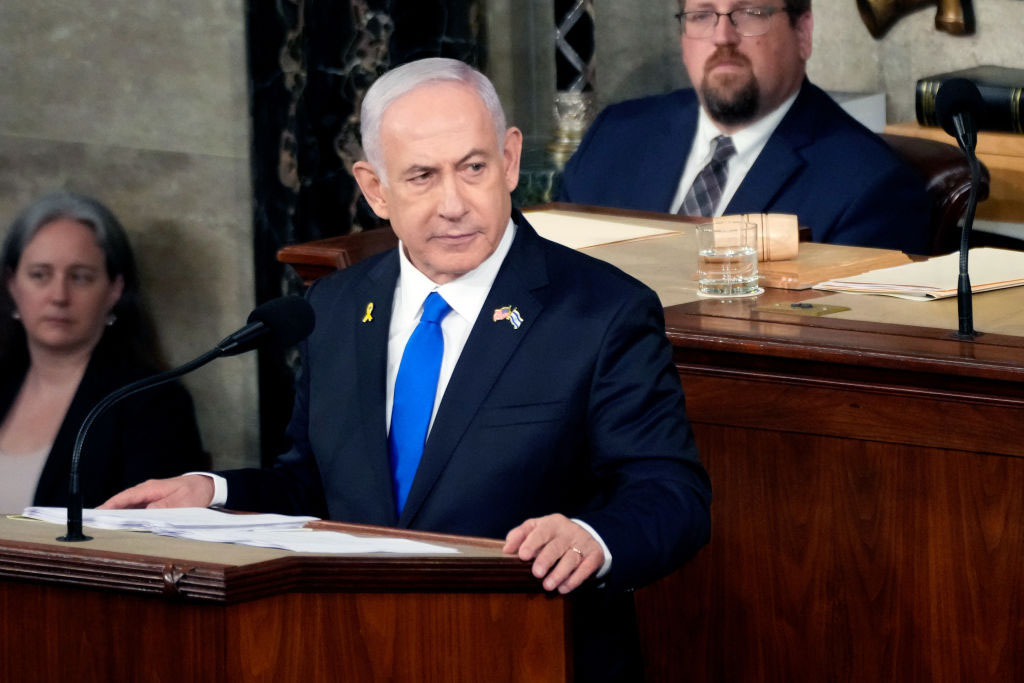
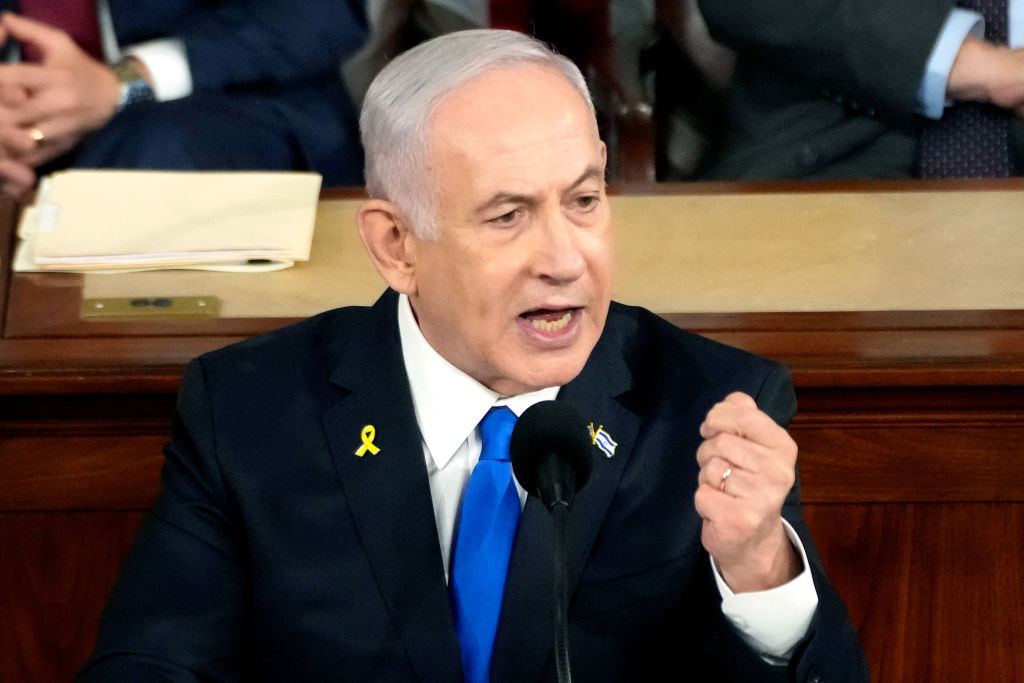
Ten Quotes from Netanyahu’s Address to Joint Meeting of Congress

Israeli Prime Minister Benjamin Netanyahu delivered a 53-minute speech to a joint meeting of U.S. Congress on Wednesday that covered Israel’s perilous past nine -and-a-half months. Among the many topics he covered were the barbarity of the Oct. 7 attacks, calling attention to the remaining hostages in Gaza and recognizing rescued hostage Noa Argamani seated in the House Gallery, U.S. military aid, and commemorations to the bravery of several Israel Defense Forces soldiers.

The full speech can be watched at the YouTube video below. But here’s a list of ten of the hardest-hitting quotes from Netanyahu’s speech.

Iran’s Useful Idiots

“For all we know, Iran is funding the anti-Israel protests that are going on right now outside this building — not that many, but they’re there — and throughout the city. Well, I have a message for these protesters: When the tyrants of Tehran, who hang gays from cranes and murder women for not covering their hair, are praising, promoting and funding you, you have officially become Iran’s useful idiots.”

An F in Geography

“These protesters chant ‘From the river to the sea.’ But many don’t have a clue what river and what sea they’re talking about. They not only get an F in geography, they get an F in history. They call Israel a colonialist state. Don’t they know that the Land of Israel is where Abraham, Isaac and Jacob prayed, where Isaiah and Jeremiah preached and where David and Solomon ruled?”

Calling out the International Criminal Court

“The prosecutor of the International Criminal Court has shamefully accused Israel of deliberately starving the people of Gaza. This is utter complete nonsense. It’s a complete fabrication. Israel has enabled more than 40,000 aid trucks to enter Gaza. That’s half a million tons of food, and that’s more than 3,000 calories for every man, woman and child in Gaza. If there are Palestinians in Gaza who aren’t getting enough food, it’s not because Israel is blocking it, it’s because Hamas is stealing it.”

Iran’s Ultimate Goal

“In the Middle East, Iran is virtually behind all the terrorism, all the turmoil, all the chaos, all the killing. And that should come as no surprise. When he founded the Islamic Republic, Ayatollah Khomeini pledged, ‘We will export our revolution to the entire world. We will export the Islamic revolution to the entire world.’ Now, ask yourself, which country ultimately stands in the way of Iran’s maniacal plans to impose radical Islam on the world? And the answer is clear: It’s America, the guardian of Western civilization and the world’s greatest power. That’s why Iran sees America as its greatest enemy.”

Total Victory Over Hamas

“The war in Gaza could end tomorrow if Hamas surrenders, disarms and returns all the hostages. But if they don’t, Israel will fight until we destroy Hamas’ military capabilities and its rule in Gaza and bring all our hostages home. That’s what total victory means, and we will settle for nothing less.”

Day One After Hamas is Defeated

“The day after we defeat Hamas, a new Gaza can emerge. My vision for that day is of a demilitarized and de-radicalized Gaza. Israel does not seek to resettle Gaza. But for the foreseeable future, we must retain overriding security control there to prevent the resurgence of terror, to ensure that Gaza never again poses a threat to Israel.”

Long-Term Vision for Gaza After Hamas

“Gaza should have a civilian administration run by Palestinians who do not seek to destroy Israel. That’s not too much to ask. It’s a fundamental thing that we have a right to demand and to receive. A new generation of Palestinians must no longer be taught to hate Jews but rather to live in peace with us. Those twin words, demilitarization and de-radicalization, those two concepts were applied to Germany and Japan after World War II, and that led to decades of peace, prosperity and security.”

Gratitude for President Joe Biden

“All countries that are in peace with Israel and all those countries who will make peace with Israel should be invited to join this alliance. We saw a glimpse of that potential alliance on April 14. Led by the United States, more than half a dozen nations worked alongside Israel to help neutralize hundreds of missiles and drones launched by Iran against us. Thank you, President Biden, for bringing that coalition together. The new alliance I envision would be a natural extension of the groundbreaking Abraham Accords. Those Accords saw peace forged between Israel and four Arab countries, and they were supported by Republican and Democrats alike. I have a name for this new alliance. I think we should call it: The Abraham Alliance.”

Gratitude for former President Donald Trump

“I want to thank President Trump for his leadership in brokering the historic Abraham Accords. Like Americans, Israelis were relieved that President Trump emerged safe and sound from that dastardly attack on him, dastardly attack on American democracy. There is no room for political violence in democracies. I also want to thank President Trump for all the things he did for Israel, from recognizing Israel’s sovereignty over the Golan Heights, to confronting Iran’s aggression, to recognizing Jerusalem as our capital and moving the American embassy there. That’s Jerusalem, our eternal capital never to be divided again.”

A Call for Bipartisanship and Democracy

“My dear friends, Democrats and Republicans. Despite these times of upheaval, I’m hopeful about the future. I’m hopeful about Israel because my people, the Jewish people, emerged from the depths of hell, from dispossession and genocide, and against all odds we restored our sovereignty in our ancient homeland, we built a powerful and vibrant democracy, a democracy that pushes the boundaries of innovation for the betterment of all humanity.”

Ten Quotes from Netanyahu’s Address to Joint Meeting of Congress Read More »

Mundane Observations – a poem for Parsha Pinchas

On the first day is a holy convocation; you shall not perform any mundane work. ~ Numbers 28:18

Every time I flick a light switch on Saturday
I wonder about the spiritual repercussions.

I also wonder if I should have said flip
a light switch and the internet search into

which is correct is, clearly, Someone
trying to teach me about the word mundane.

I recall working as a temporary employee
where I would don a tie to sit in a

windowless room to type numbers from
pieces of paper into, essentially, an abacus

for the greater good of the company.
Decades later I couldn’t tell you what any

of those numbers meant or what difference
I made. I also don’t own a tie.

(This is also untrue. I have some old ties
but I consider them to be costume elements

and they hold the same meaning to me as
the afro wig I wear at least every other Purim.)

I’m also a proud tuner of my guitar on the Sabbath
because it is for the greater good.

Let’s put aside that I am playing an instrument
at all on holy days. Had the ancient priests

heard the catchy tunes we bring for
Kabbalat Shabbat, I’m sure they would have

given us a waiver. One person’s mundane
is another person’s spectacle.

I don’t get caught up with the mundane details
of how I observe. Even if I have to occasionally

operate a motor vehicle, or flip a slight switch,
my heart just tells me to observe.


Rick Lupert, a poet, songleader and graphic designer, is the author of 28 books including “God Wrestler: A Poem for Every Torah Portion.” Find him online at www.JewishPoetry.net

Mundane Observations – a poem for Parsha Pinchas Read More »

A Bisl Torah – Pray with God

In the many occasions we witness or experience with congregants, rabbis are asked, “Rabbi, what is the right prayer to say?” And while often, there is a blessing or psalm that matches the simcha or sorrow, the congregant is usually asking something else. They want to know; will God hear the prayers they are offering? Do their words matter?

Rabbi Lawrence Hoffman, author of “The Way into Jewish Prayer” teaches, “Once we divest ourselves of the elementary and childish notion that the purpose of prayer is only to get petitions answered positively, we can begin the art of prayer all over again, hoping to take our rightful place as recognized actors in the universe.” In other words, it is less about finding the right words and more about the willingness to see ourselves as partners with God. Praying becomes a dialogue, conversation, exchange and brainstorming with the Holy One. The question isn’t whether God hears our prayers. The question becomes, are we taking the time to hear God’s response?

Rabbi Abraham Joshua Heschel explains, “To pray is to dream in league with God.” Instead of praying to God, start praying with God. Dreaming together as co-visionaries in the life you are leading and the world you are building.

Shabbat Shalom


Rabbi Nicole Guzik is senior rabbi at Sinai Temple. She can be reached at her Facebook page at Rabbi Nicole Guzik or on Instagram @rabbiguzik. For more writings, visit Rabbi Guzik’s blog section from Sinai Temple’s website.

A Bisl Torah – Pray with God Read More »

A Moment in Time: “Seeing Things from Another Perspective”

Dear All,

No, this photo isn’t up-side-down.

Or maybe it is!

You decide after considering this moment in time.

Our family was recently in a science museum with a bunch of funky mirrors. As we gazed at our whimsical reflection, I was reminded of some wisdom from Rabbi Hillel: “Do not judge another until you have been in that person’s place.”

How could this image before us connect me to that teaching? Well, in this complicated and often polarized world that surrounds us, it’s really important to look at things from another perspective. Yes, we can hold our values close while still being receptive to seeing things the way someone else might.

It’s not easy, and we may need to come out of our comfort zone. And perhaps, just perhaps, we might learn that the future is not based exclusively on seeing eye-to-eye. It’s also based on looking from head to toe, and toe to head.

With love and shalom,

Rabbi Zach Shapiro

A Moment in Time: “Seeing Things from Another Perspective” Read More »

Thank God for the Greatness of His Salvation

Praising God for having made great the United States is not

the reason why on weekdays Jews say “magdil” when we bless

God for the food that we have eaten, and not what

we say a little differently when choosing to express

our thanks to Him by blessing Him on Shabbat and fest-

ivals by saying not magdil but “migdol,” a variation that denotes a Tower,

to God most grateful on the days we do not work but rest,

dependent for salvation less on all our personal actions than His Power.


Expressing our thanks

to God quite differently

on festivals and Sabbaths

than on weekdays,


we demonstrate awareness

that without God’s help

Jews would be insecure not just

on secularly weak days.


Psalm 18:51 states:

מַגְדִּל֮ יְשׁוּע֢וֹת מַ֫לְכּ֥וֹ וְעֹ֤שֶׂה חֶ֨סֶד ׀ לִמְשִׁיח֗וֹ לְדָוִ֥ד וּלְזַרְע֗וֹ עַד־עוֹלָֽם׃ {פ}

Magdil, He magnifies, the salvation given to His king, And keeps faith with His anointed,

with David and his offspring forever.

2 Sam. 22:51:

(מגדיל) [מִגְדּ֖וֹל] יְשׁוּע֣וֹת מַלְכּ֑וֹ וְעֹֽשֶׂה־חֶ֧סֶד לִמְשִׁיח֛וֹ        לְדָוִ֥ד וּלְזַרְע֖וֹ עַד־עוֹלָֽם׃ {פ}

Migdol, a Tower, of salvation, to His king, Who deals graciously with His anointed,

with David and his offspring evermore.

Qimhi’s comment to 2 Sam. 22:51:

Migdol. Magdil is the ketiv (“written” tradition of the Masoretic Text), and the qeri (“recited” tradition of the Masoretic Text) is with a vav, like in Psalms [18:51] in the qeri! So too, the qeri is migdol with a cholam [i.e., a vowel creating an ‘o’ sound like in the name “Jo”], and it is a descriptor, and the idea is [all] one.


Gershon Hepner is a poet who has written over 25,000 poems on subjects ranging from music to literature, politics to Torah. He grew up in England and moved to Los Angeles in 1976. Using his varied interests and experiences, he has authored dozens of papers in medical and academic journals, and authored “Legal Friction: Law, Narrative, and Identity Politics in Biblical Israel.” He can be reached at gershonhepner@gmail.com.

Thank God for the Greatness of His Salvation Read More »

Antisemitic LA Times Captions Reveal Troubling Bias That Endangers the Safety Of Jewish Angelenos

Despite a decline in readership and extensive layoffs, reports of the demise of the LA Times are greatly exaggerated.  It remains the most important news outlet in California.

This makes its anti-Israel bias in a number of recent articles especially troubling.  The newspaper’s bias not only breeds distrust among its dwindling Jewish readership but advances blatant lies that endanger the safety of Jewish Angelenos.

Its bias was laid bare for all to seen on July 2nd.  Nine days prior, violent extremists descended on the heavily Jewish neighborhood of Pico Robertson, blocking access to a synagogue and attacking Jewish residents.  As posts and videos of Jews being attacked went viral online, strong condemnations followed from President Biden, Governor Newsom, and Mayor Bass, with promises to take “swift action” to protect the Jewish community from further attacks.  The LAPD conceded that it was ill-prepared, undermanned, and late to the scene of what some Jewish residents are calling the “Pico Pogrom.”  Fortunately, several Jewish non-profit organizations were on the scene on June 23rd to prevent fatal injuries from the antisemitic violence.

Recognizing that the LAPD (which has shrunk from 10,000 officers down to only 8,800) lacks the manpower to protect vulnerable Jewish institutions, the LA City Council swiftly proposed a motion to provide $1 million in security funding to three Jewish non-profit organizations.  The innocuous motion was modeled on the long-standing California State Nonprofit Security Grant Program.  The three non-profit organizations are the Jewish Federation of Los Angeles, the Jewish Community Foundation of Los Angeles, and Magen Am.  Each is a well-respected and vital mainstay of the Los Angeles Jewish community, especially the Jewish Federation, which dates back to 1911.

Fast forward to July 2nd, when extremists (including some of the same hate groups that participated in and promoted the Pico Pogrom) descended on the LA City Council to block the motion.  Bullied by these hate groups, the City Council quickly tabled the motion, reportedly to make the funding available to non-profits of all religious backgrounds.

However, when Angelenos read the LA Times story about the motion and the City Council proceedings, a far more sinister story was told.  Five photo captions described the motion as providing $1 million to “Pro-Israel vigilante/security companies for Zionist Defense training.”  Yes, you read that right.  Not only is the caption factually false and easily debunked (none of the three above organizations are “vigilante” or “Zionist defense” organizations), but the caption breeds the same hate that the motion seeks to address.  Anyone reading that caption would be outraged that her tax dollars would be handed over to “vigilante security companies for Zionist defense training,” this reader included.  Outrage like that breeds hate and violence.

The article itself was just as biased.  Not a single Jewish victim of the Pico Pogrom was quoted.  But, “multiple” unnamed “pro-Palestinian protesters” were, anonymously telling the LA Times that it was actually LAPD officers and “pro-Israel supporters” who were the violent ones.  Pro-Palestinian protester Ron Gochez (who was not even at the Pico Pogrom) was quoted about being “attacked” by “pro-Israel counter protesters” at the UCLA “encampment.” Pro-Palestinian protester John Parker (who was also not present at the Pico Pogrom) was quoted as calling Jews “fascists” and the LAPD “racist.”

The sole “Jewish” person quoted was from a virulently antisemitic fringe organization called “Jewish Voice for Peace,” which calls for the dismantlement of Israel and actively organizes violent protests, including the Pico Pogrom.  The LA Times effectively bolstered this violent fringe organization, giving the impression that it was speaking for Jewish Angelenos, which it does not.

The LA Times could have easily quoted the many Jewish residents of Pico Robertson who were attacked on June 23.  Interviewing the victims of hate crimes is a standard practice in journalism.  Seemingly every other local print and broadcast news outlet in town, including CBS, ABC7, Fox11, KTLA, and the Westside Current, rushed reporters to the scene and interviewed victims.  Conspicuously absent was the LA Times, who did not send a reporter to the scene.

When Jewish leaders expressed outrage about the antisemitic photo captions and biased reporting, the LA Times quietly changed the captions to “Groups protest a proposed City Council resolution to fund Pro-Israel security companies at Los Angeles houses of worship.”  When the Hollywood Reporter and the Westside Current covered the continuing “firestorm,” the caption was again changed to “Groups against a proposed City Council resolution speak out during public comments.”  No changes were made to the article.  No victims were quoted.  No explanation was provided about the antisemitic photo captions, other than the following note: “Earlier captions accompanying this article stated that city funding was being proposed to pay for pro-Israel vigilante groups. The proposal called for funding for pro-Israel security companies.”  This, of course, is still not accurate.  The Jewish Federation, the Jewish Community Foundation, and Magen Am are Jewish non-profit organizations, not “pro-Israel security companies.”

Most importantly, the LA Times never apologized for spreading in lies that fan the flames of antisemitism.  The newspaper did not apologize for slandering three leading Jewish organizations as “Pro-Israel vigilante/security companies for Zionist Defense training” and for giving legitimacy to a violent fringe organization.  The newspaper did not apologize for ignoring the experience of Jewish victims of hate crimes.

Unfortunately, the LA Times does not warrant the benefit of the doubt.  On November 17, 2023, the newspaper was forced to tackle its own anti-Israel bias by banning “more than three dozen reporters and editors from covering the war in Gaza after they signed an open letter condemning Israel’s response to the Oct. 7 massacre.”  It is also well-known that Nika Soon-Shiong, the daughter of the newspaper’s owner, proudly traffics in the same antisemitic vitriol reflected in the antisemitic July 3 photo captions.  On July 18th, Ms. Soon-Shiong repeated the same lie, tweeting “LA City Council funded and unleashed a new Zionist militia.”  Sadly, the antisemitic photo captions and tweets of the owner’s daughter gave air to antisemitic conspiracy theorists across the Internet to spread further lies and hate about Jews.

It is easy to imagine the outcry if racist, homophobic, or Islamophobic captions and reporting described a motion to provide security funding to protect a Black church, LGBTQ center, or mosque after a violent attack by hate-filled extremists.

Words matter.  Our hometown newspaper should devote itself to unbiased reporting with a better understanding of the concerns of the Los Angeles Jewish community.  Meanwhile, when the security funding motion reportedly returns for a vote on July 31, we should all demand that the LA Times and the LA City Council do the right thing and protect Jewish Angelenos.


Sam Yebri is a trial attorney, non-profit leader, and Jewish civic leader in Los Angeles.

Antisemitic LA Times Captions Reveal Troubling Bias That Endangers the Safety Of Jewish Angelenos Read More »

Bibi’s Brilliant Speech Showed the Limits of the Strongest Words

“Standing up to Iran is not easy. Standing up to dark and murderous regimes never is,” Israeli Prime Minister Benjamin Netanyahu told a joint session of the U.S. Congress, resulting in one of many standing ovations. “We must always remember, the greatest dangers facing our world is the marriage of militant Islam with nuclear weapons.”

Netanyahu was at his best: persuasive, inspiring and brilliant. It’s hard to imagine anyone making a stronger case to combat the gravest threat to Israel and the U.S. today, the evil and murderous regime of Iran.

The date of that speech was March 3, 2015, when Netanyahu argued against the Iran nuclear deal.

His speech yesterday in the same august hall was equally brilliant and equally focused on the moral imperative of calling out evil.

“In the Middle East, Iran is virtually behind all the terrorism, all the turmoil, all the chaos, all the killing,” he said. “And that should come as no surprise. When he founded the Islamic Republic, Ayatollah Khomeini pledged, ‘We will export our revolution to the entire world.’”

Netanyahu’s words, as in 2015, received countless ovations. They were powerful, truthful and supremely relevant to his audience and to America.

“When Israel acts to prevent Iran from developing nuclear weapons, nuclear weapons that could destroy Israel and threaten every American city, every city that you come from, we’re not only protecting ourselves. We’re protecting you,” he said.

Netanyahu made a compelling case to defend Israel’s actions in Gaza, and he put Hamas sympathizers who burn Israeli and American flags in their rightful place as “useful idiots” of Iran. He also reminded his audience that the violent turmoil that has inflamed the region in recent years, and especially since Oct. 7, traces back to Iran’s ultimate goal of taking down the Great Satan:

“Iran understands that to truly challenge America, it must first conquer the Middle East. And for this it uses its many proxies, including the Houthis, Hezbollah and Hamas.”

His money shot drew another ovation: “Yet in the heart of the Middle East, standing in Iran’s way, is one proud pro-American democracy—my country, the State of Israel.”

The speech had this rousing spirit, a clarion call for the forces of civilization to combat evil. But it also reminded me that since his last rousing speech in Congress nine years ago ringing the same alarm bells, things have gotten significantly worse, with Iran virtually weeks from nuclear breakout. It almost made me wish that Netanyahu himself was the leader of the free world, so he could better translate his words into action.

But Netanyahu is the leader of Israel, and Israelis were most interested in what he would do for them, including combatting Iran. As far as the current leader of the free world, President Joe Biden, his best offer for dealing with Iran is an alliance between the U.S., Saudi Arabia and Israel, all sharing a common mission to counter the predatory Iranian regime sworn to Israel’s destruction.

The Saudis have already shown a high level of interest. But to get Congress to approve the alliance as a formal treaty, Biden needs Israel to join. Of course, expanding the Sunni-based Abraham Accords to include Saudi Arabia, the birthplace of Islam, is hardly a new idea. Every Israeli leader sees it as winning the lottery.

One can argue, in fact, that forging such an alliance, backed by the most powerful army in the world, should be the top strategic priority for the Jewish state. It is widely accepted that one of the reasons for the Oct. 7 massacre was to sabotage any possible deal between Israel and Saudi Arabia, which was brewing at the time. Reviving such an alliance today would crush the soul of sworn enemies of Israel like Hamas and Hezbollah, not to mention the genocidal mullahs in Iran.

Netanyahu knows that the alliance would make history and may even help rescue his legacy as Mr. Security, which has taken a huge beating since the worst attack in Israel’s history happened under his watch.

So what’s holding Netanyahu back from this win-win-win? Put simply, there is a political price he would have to pay, which would jeopardize the survival of his coalition.

First, he would need to agree, without equivocation or new conditions, to the ceasefire-hostage deal tentatively reached by U.S., Israeli, Qatari, Egyptian and Hamas negotiators. This deal entails a six-week pause in the fighting in Gaza and the return of 33 Israeli hostages in return for several hundred Palestinian prisoners in Israeli jails.

The problem is that the very notion of a “ceasefire” is unacceptable to his far-right partners, even though the deal is supported by the majority of the Israeli public and the defense establishment, and wouldn’t preclude operations against Hamas in the future.

The second price demanded by the Saudis would be for Israel to show a willingness to negotiate with the Palestinians, another sharp red line for his partners. But throughout his career, Netanyahu has had a brilliant response to this request, which became a kind of Bibi mantra: “Israel is ready to negotiate without any preconditions anytime and anywhere.”

On my recent trip to Israel, I spoke with an expert who told me, somewhat cynically, that this was a low-price concession because the Palestinians will never agree to any deal, and given the benefit of a Saudi alliance, certainly not a prohibitive price.

In any case, Netanyahu is surely aware of the strategic value of a U.S.–Saudi-Israel alliance. He even brought up the idea of such an alliance in his speech, but without specifying the steps needed to get there, let alone any steps that would entail a political risk.

Netanyahu is also aware that a ceasefire with Hamas would pave the way not just for a release of hostages but for a Hezbollah-Israel ceasefire, enabling tens of thousands of Israeli refugees to return to their homes in the north. These issues were top of mind for Israelis listening to his speech.

Like Netanyahu said in his speech, he went to MIT— so he knows all about cost-benefit analyses and assessing worth. He also knows that there’s a decided difference between rhetoric and action.

His speech overflowed with extraordinary rhetoric. But at the end, all I wanted to know was: How close are we to a security alliance with Saudi Arabia to help Israel combat the biggest and most urgent threat to its existence? How close are we to a deal that will return the hostages and pave the way for a Saudi alliance that will crush the soul of Hamas?

For his next speech, then, maybe Netanyahu can utter the words that will finally make such an alliance happen. And if his far-right partners complain, he can tell them the truth in the most eloquent way possible: it’s in their country’s interest.

Indeed, Mr. Prime Minister, standing up to Iran is not easy.

Bibi’s Brilliant Speech Showed the Limits of the Strongest Words Read More »