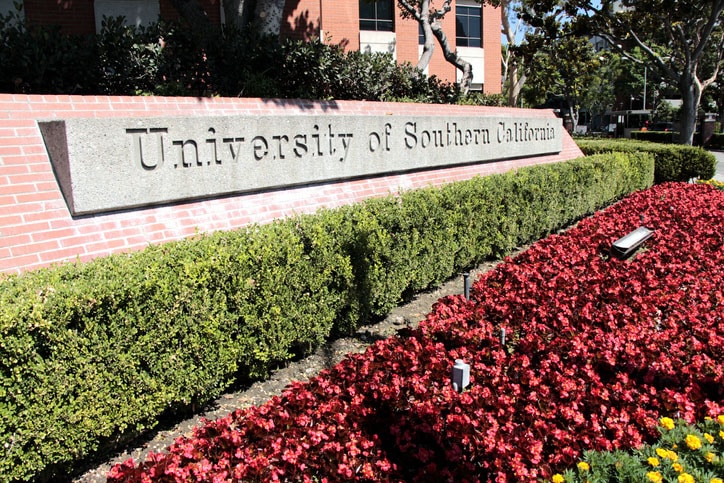
USC has dismissed the complaints against Economics Professor John Strauss over a exchange he had with pro-Palestinian protesters in November that went viral.
As previously reported by The Journal, Strauss had said to pro-Palestinian protesters on Nov. 9: “Hamas are murderers, that’s all they are. Every one should be killed, and I hope they all are.” A selectively edited clip of him just saying, “Every one should be killed, and I hope they all are” went viral on social media to claim that he wanted all Palestinians killed. Strauss has maintained that the “every one should be killed” line was referencing Hamas, not all Palestinians. He was also accused of stepping on a list of names of Palestinians that have been killed in the Gaza Strip during the ongoing war with Israel; Strauss claimed that if he did step on it was by accident.
The university initially relegated him to teaching virtually the rest of the semester, as a “precautionary” move to “minimize classroom disruption” before subsequently reinstating him to campus.
The exchange resulted in complaints of discrimination and harassment filed against Strauss; the Academic Freedom Alliance (AFA) announced in a June 20 press release all the complaints against Strauss were dismissed and there was a “favorable resolution” to the outcome.
“We’re pleased that Professor Strauss has been vindicated and that his rights have been acknowledged,” AFA Academic Committee Chair Lucas Morel said in a statement. “The university rightly found that John had not engaged in harassment and dismissed the complaints against him. The university also acknowledged John’s right to free speech and declined to subject him to discipline. The successful resolution of this case is a victory for academic freedom rights everywhere, particularly during these contentious times on campuses nationwide.”
Strauss also said in a statement, “I am grateful to the AFA for its support during this difficult period. I hope this outcome will serve as a reminder to universities across the country that professors have a right to free speech both inside and outside the classroom. I am deeply relieved to put this case behind me.”
“I hope this outcome will serve as a reminder to universities across the country that professors have a right to free speech both inside and outside the classroom. I am deeply relieved to put this case behind me.” – Prof. John Strauss
The university told The Los Angeles Times that they “are unable to discuss any individual cases because of the confidential nature of personnel matters. USC takes allegations of harassment and discrimination seriously.”
USC Professor Anna Krylov and freelance statistician Jay Tanzman congratulated Strauss in a June 20 post on the “Voices Against Antisemitism and Anti-Zionism at USC” Substack. Krylov and Tanzman asked why the investigation took so long since “it was clear from the very beginning Professor Strauss had done nothing wrong, and that the accusations were without merit and made in bad faith.” They asked: “What about the miscreants who doctored videos of Professor Strauss’ encounter with the protesters, launched the vicious social media campaign against him, doxxed him and flooded his email with threats, and lodged frivolous and false complaints against him? What is their punishment?”
As previously noted by The Journal, the Times spoke with a student who only wanted to be identified by her first name, Daphne, who is responsible for one of the videos of Strauss’ now-viral remarks. “I do not possess the ability to doctor a video like that,” she told the Times. “And also we have a second video that matches so, like, there’s no way on God’s green Earth that I would have been able to doctor that video.” The Times reported that while they could not find any evidence that the videos of Strauss were doctored, “as the clip circulated online, it was at times trimmed to a few seconds of Strauss uttering, ‘Everyone should be killed.’ The captions and superimposed text in social media posts could be minimal, misleading or wrong.”
Krylov and Tanzman added toward the end of their post: “Professor Strauss’ treatment is yet another example of the double standard for Jews, as discussed in the Report to the President and the Provost. A USC student DEI ambassador tweets that she wants to “kill every motherf—ing Zionist”? It’s all chill. A professor says that an Islamist terror organization must be exterminated? Another matter.” They called for USC to publicly apologize to Strauss.
Now the manna was like coriander seed, and its appearance was like the appearance of crystal. The people walked about and gathered it. Then they ground it in a mill or crushed it in a mortar, cooked it in a pot and made it into cakes. It had a taste like the taste of oil cake. ~ Numbers 11:7-8
This is the recipe for manna.
You won’t find it in “The Joy of Cooking”
or in a Pinterest search for breakfast ideas.
It is only in this one place
and this is the day and the week that
you have to read it.
You have to read it – even if you choose not to
and you never do. It is our tradition that
you have to read it.
You won’t find the ingredients at the market
not even at Whole Foods. It’s not something
you can have delivered
Grubhub has not heard of manna.
You must gather it, and it will be everywhere.
Look for the crystal-like substance
that shows up in the morning –
double on Friday so you don’t have to
worry about it on Saturday.
It is not a drug. It is the essence of
what you need and when you have it
you can do with it what you will.
Grind it so it is familiar.
Cook it as you know how.
Now you can have your cake.
It will be delicious, though the same cake
every day can lead to understandable complaints.
So meat will be provided.
It will come out your nose – more than you need.
You’ll still complain about the free cucumbers,
watermelon, leeks, and garlic
you used to get in communist Egypt.
This is the diet of the wanderers.
It is not a fad. It’s what you need
until your children cross the river.
Rick Lupert, a poet, songleader and graphic designer, is the author of 28 books including “God Wrestler: A Poem for Every Torah Portion.” Find him online at www.JewishPoetry.net
One of my favorite poems was written by Hannah Senesh in 1942. It’s commonly known as “Eli, Eli” but she titled it, “Halicha l’Kesarea.” The poem it seems was inspired by a walk Senesh took from her Kibbutz, S’dot Yam, to the ancient city of Caesarea. Senesh reflects on the beauty of nature she encounters on the way:
My God
That these things should never end
The sand and the sea
The rush of the waters
The crash of the heavens
Humanity’s prayer.
The poem is itself a prayer, one made all the more poignant by its historical setting. Senesh wrote it just two years before she would bravely parachute into then Yugoslavia in an effort to save Jews from being murdered by the Nazis. She was captured shortly after she crossed into Hungary, the nation of her birth, tortured, and then executed as a spy. The poem was discovered a year after her death along with other personal items that are now on display at the new national library in Jerusalem.
I thought of her words on my walk along the sea the other night.
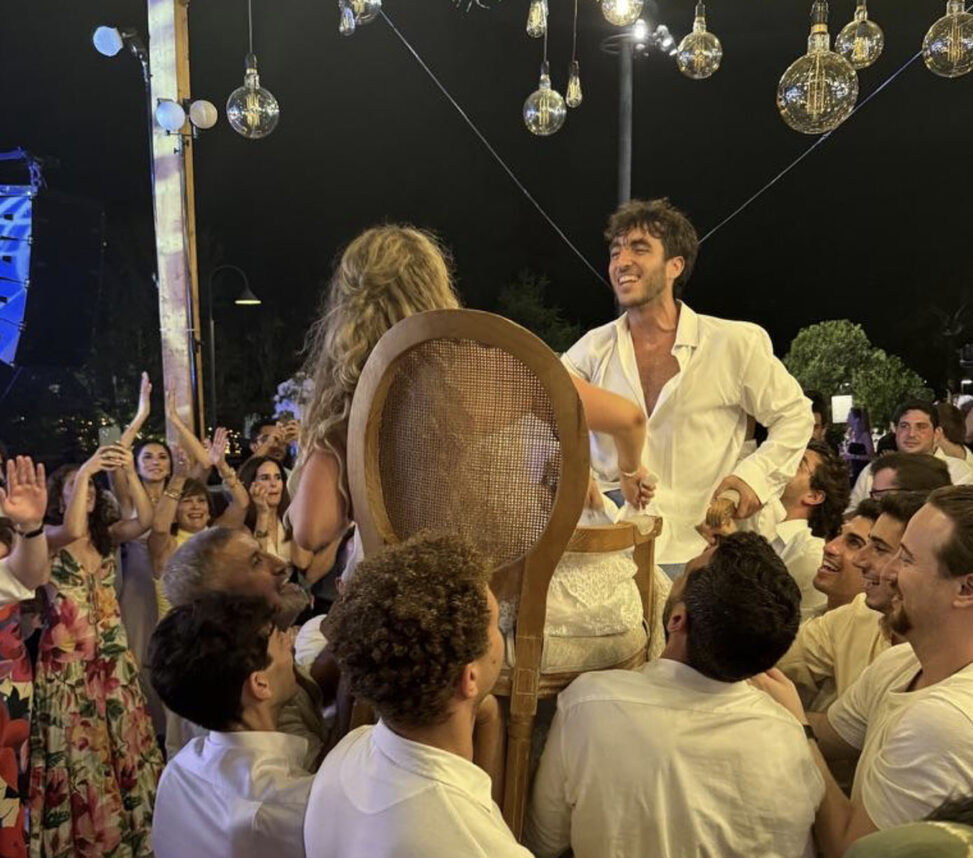
I’m in Israel for the wedding of my cousin, Kayla. The ceremony itself was last Sunday night. It was uplifting and healing and dearly, dearly needed. The day before the celebration we heard the terrible news of the deaths of 12 IDF soldiers killed in Gaza. Even as some of the funerals were still being held, as the eulogies were delivered, we danced with Kayla and her husband Asaf and sang the words of the prophet Jeremiah, composed in this same land some 2,500 years ago: “Once again we will hear in the cities of Judah and the courtyards of Jerusalem the sound of joy and gladness, the voices of the bridegroom and the bride!”
Photo courtesy Yoshi Zweiback
The evening after the wedding, the celebration continued with a gathering in Yafo, a mixed city of Arabs and Jews just south of Tel Aviv, one of the oldest cities in the world, famously mentioned in the Bible in the book of Jonah.
Walking with my daughters, in the midst of heavy and conflicting emotions, joy in being with family for a simcha, heartbreak in the pain of this terrible war, anguish at the thought of the captives, I saw wonder after wonder that gave me reason to hope.
From a beautiful seaside park along the boardwalk Tayelet, we heard the voices of hundreds of Israel’s Muslim citizens celebrating Eid al-Adha, the “Feast of the Sacrifice,” one of the most sacred days in Islam. There were teenagers playing soccer, parents carrying their exhausted children home in their arms, the fragrant smell of bar-b-ques and the sound of good cheer. A large family passed by us with small children in strollers, a young man being pushed by his parents in a wheelchair, and grandparents carrying baskets of food for a family feast. We wished them “Eid Mubarak (happy holiday),” in Arabic and received a warm, surprised smile and a “todah rabbah” in return.
We saw a young modern orthodox couple on what was probably an arranged date, modestly sitting on a bench overlooking the sea a few feet apart, chatting and sharing a soda. Just one bench over, sitting under the special Tel Aviv Pride flag that was created this year honoring the captives was a gay couple, kissing and holding hands as the sun sank into the sea.
There were soldiers on leave coming back from the beach with sand on their feet and machine guns on their shoulders, weaving their way through a phalanx of teenagers riding their electric scooters too fast, barefoot and without helmets.
On a brand new luxury hotel with stunning views and $800/night rooms, there was a two-story digital display with the faces of the 120 hostages still being held in Gaza and the words: Bring Them Home Now!
Of course, it being summer in Tel Aviv, we bumped into a family from our congregation who had just arrived for the wedding of their relative. We stood for twenty minutes talking about the war, catching up on our children, exchanging “mazel tovs” and hugs.
Outside of a restaurant near our apartment was a shrine: a large yellow ribbon for the hostages in between two prayers, one for the safety of the soldiers of the Israel Defense Forces and one asking God to return our brothers and sisters, Acheinu, from captivity.
Photo courtesy Yoshi Zweiback
It was inspiring and a bit overwhelming, what our tradition calls shefa, a type of spiritual “overflow.”
The diversity of experiences, cultures, ethnicities, traditions, and histories coming together in such a rich tapestry: intense joy, heartbreaking sadness, longing, anguish, hope.
Someday, soon, this war will end. Our hostages and our soldiers will come home. The dead will be buried and mourned. The bereaved and wounded will return, slowly, step by step to life. There will be rebuilding, chuppas to dance beneath, babies to welcome into the world, simchas to share.
Until then, may we have the strength to hold on to hope. May we have the awareness to notice and give thanks for the blessings already here. May we have the resilience to trust that better days will come again.
This is our faith. This is our hope. This is our prayer.
Rabbi Yoshi Zweiback is the Senior Rabbi of Stephen Wise Temple in Los Angeles, California.
Throughout Germany, there are student protests that define themselves as “pro-Palestinian.” What they have in common is that they decontextualize and ignore the bestial massacres carried out by Hamas, Palestinian Islamic Jihad and their supporters on October 7, 2023 in southern Israel. For it was precisely these massacres of children, women and men that were the starting point for the Israeli army’s war against Hamas and its supporters.
The eviction of the protest camps in Berlin and elsewhere in Germany by police forces has been met with fierce criticism, including from Berlin lecturers and professors and other supporters who see it as a threat to freedom of expression and demonstration as well as the rule of law. An open letter from Berlin lecturers and professors states: “Regardless of whether we agree with the specific demands of the protest camp, we stand in front of our students and defend their right to peaceful protest, which also includes the occupation of university grounds.”
Implicitly, this letter supports a narrative that has been circulating online and in the press for months, and not only in Germany: “pro-Palestinian” or Palestinian voices are “suppressed” or “not heard.” The reality is quite different. The “pro-Palestinian voices” have been the loudest ever since October 7, 2023, fueled by an unprecedented antisemitic smear campaign on TikTok, Instagram and other social media, as well as in the press and on the streets.
There are protests on the streets of Germany that publicize their views on the war in Gaza and the sadistic actions of Hamas, Palestinian Islamic Jihad and some Gazan civilians who participated in rape and looting on October 7 and celebrated the abduction of Israeli hostages on the streets of Gaza. The majority of these protests are whitewashing terror and reinterpreting it as “resistance.” The demands for a ceasefire or an end to the war are directed exclusively at Israel, not Hamas and collaborators; nor is there any demand that Hamas lay down arms.
Since October 7, false, presuppositional claims have circulated, many of which have been well known for decades. Some claim there is a “sense of guilt over the Holocaust” in Germany that does “not allow” for criticism of Israel. This narrative has also been perpetuated by countless journalists over the past few months—journalists who, supposedly objectively, can describe a “war of extermination” against Palestinian civilians in Gaza, calling it a “slaughterhouse,” but do not even question the figures from the Ministry of Health in Gaza. Nor is the sudden halving of the number of 14,500 children killed in Gaza (every child killed is one too many!) on May 8 explained. Perhaps “child murderer” Israel should just leave it at that.
What these claims make clear is that this is an antisemitic smear campaign, nothing more.
A federal press conference of German academics on May 21 characterized the protests as “protests against the war in Gaza,” which triggered “understandable emotional reactions” and was part of a “culture of debate” in which also Jewish students participated. The obviously antisemitic, anti-Israeli, and historically misleading content of the majority of student protests was overlooked. An in-depth analysis of the protest camps and political messages of the student actors and their presentation on the respective social media channels was also largely ignored. These academics claimed that the student protests were at the mercy of “police violence”—a decontextualized and literally invented interpretation of the real events that happened in Berlin and elsewhere. The implication here is that the protest camps were cleared because criticism of Israel is not permitted. This is certainly not true, and it proves that professors and students lack the ability to criticize Israel without fueling antisemitism or without regarding Zionism itself as a crime—another distorted perception.
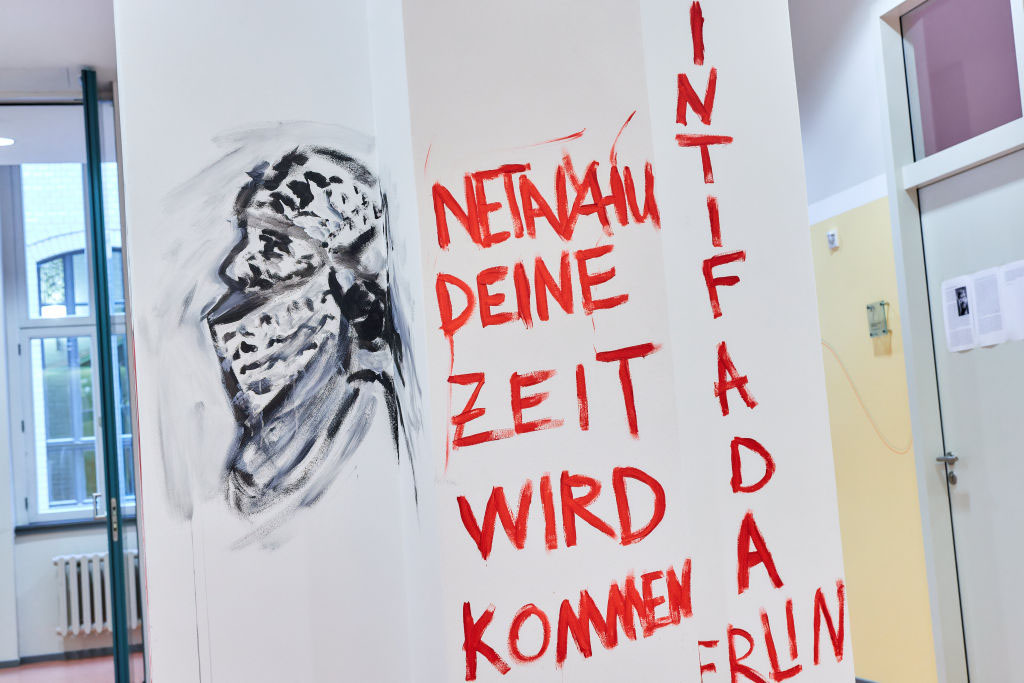
Graffiti covers a wall following an occupation by pro-Palestine activists in a building at Humboldt University on May 29, 2024 in Berlin, Germany. (Photo by ddp – Pool/Getty Images)
The demands by these student protestors are simple-minded, underpinned by post-colonial approaches to explaining the world, enemy images such as “the white Jew,” and even the glorification of Palestinian terror. A real vision for peace in the Middle East, which could be achieved above all through the disempowerment of Hamas and the Palestinian Islamic Jihad (whose origins predate Hamas), does not exist here. The suggestion that the participation of Jewish students legitimizes the protests suggests that you can be “pro-Palestinian” only if you define yourself as “anti-Zionist” and/or question the existence of the State of Israel as a Jewish state. Moreover, it’s a means to demonize the majority of Jews who disagree with this stance.
And why do the atrocities committed in Israel rarely, in both Germany and throughout the world, trigger any empathy? Since October 7, there has been a multi-front war against Israel and its civilians. To this day, little is known about the targeted massacres of Israeli families and the targeted murder of Israeli children on October 7. The north has been evacuated, while people from the south are still living in temporary shelters. The war with Hezbollah is imminent, Iran attacked Israel directly for the first time on April 13, 2024, and there are repeated attacks from Syria and Yemen, not to mention the seemingly endless barrage of rockets that Hamas, the Palestinian Islamic Jihad and their supporters are constantly firing at civilians in Israel (and have been doing so repeatedly for almost twenty years). School lessons are interrupted or do not take place at all, and children in Israel are also confronted with hatred on social media. Nowhere is there even a modicum of empathy in these student protests, even when it comes to the release of hostages or bodies of murdered to find their final resting place. On X, Berlin students have the audacity to make comments such as “The hostages will stay there until the war is over.”
And why do the atrocities committed in Israel rarely, in both Germany and throughout the world, trigger any empathy?
The statements made by academics in Germany are a dark turning point. They massively misjudge or ignore the deep-seated hatred of Israel, a hatred that unites mutually exclusive political movements. They ignore disinformation and historical misrepresentation (“the Palestinians took in Jews from Europe”) or brutal hatred of Jews. In addition, the aforementioned lecturers and professors not only ignore the acute massive threat to the State of Israel by placing the war in Gaza in the history of the “Middle East conflict,” in which there is only one “oppressor” (Israel) and one “oppressed” (Palestinians) or one perpetrator and a victim, but also they overlook the obvious Palestinian involvement in other Islamist movements (Hamas – Islamic Republic of Iran) as well as the terror of Hamas, Hezbollah and other terrorist organizations supported by Iran. For them, Netanyahu poses a greater threat than Ali Khamenei. The fact is that October 7 poses a massive threat not only to the security of the State of Israel, but also to a diverse Jewish life worldwide, and also at universities and colleges in Germany.
It is astonishing that lecturers and members of universities—for example on May 23 at Humboldt University in Berlin—believe they must support “pro-Palestinian” students, ignoring the fact that antisemitic statements, the marking with the red triangle (a Hamas symbol for marking opponents) or simple world declarations directed solely against Israel have been made. The seemingly pro-democratic argumentation of lecturers and professors (and not only from Berlin) defines the protest camps as democratic simply because they take place at universities, and literally gives them a free pass. Ignored are the open calls for violence such as “Intifada Revolution,” “Yalla, yalla, Intifada,” the one-sided demand for a ceasefire on Israel and massive ignorance of state and non-state sponsored disinformation on the internet such as “genocide in Gaza” or the open delegitimization of the existence of the State of Israel, as at the Free University Berlin.
The protests become completely absurd when students or professors demand that collaborations with Israeli institutions cease. If you criticize them, you are cancelled, ignored or never receive an answer. Is this the progressive left that demands to hear “all voices”? The overwhelming majority of these student protests lack context and complex perspective on the Israel-Hamas war as well as on the history of the Israeli-Palestinian conflict. Instead, they rely primarily on the strategy of emotional radicalization. How is it that these academics, who work on the Holocaust, antisemitism, migration and integration, allow narratives that brand Israel as a “white, colonizing apartheid state that is committing genocide in Gaza”? The well-known blind man with a walking stick should realize that this is literally Nazi Germany. Moreover, this branding of Israel leaves no space for the Palestinian side as agents of their own history; a “perpetrator” (Israel) and “victim” (Palestine) dichotomy is quite clearly defined.
The voices of Palestinians who criticize Hamas and the Palestinian leadership are omitted from these protests. For example, consider Ahmed Fouad Alkhatib, who has lost at least 31 family members in the war in Gaza and still maintains a realistic view of the future, or Hamza Abu Howidy, also from Gaza, who accuses most of the protests at universities and colleges in the U.S. of simply hating Jews and says that the protest camps harm the Palestinian cause. He also criticizes the fact that Palestinians did not receive any media support, or any support at all, during the “We want to live” protests in Gaza in 2019 or 2023, which were directed against Hamas. Where were the students then?
The voices of Palestinians who criticize Hamas and the Palestinian leadership are omitted from these protests.
Other Arab voices, such as human rights activist Dalia Ziada, who exposes the narrative of Hamas as resistance as a lie, Bassam Eid, who directs attention to internal Palestinian conflicts and calls for Israel’s policies not to be presented exclusively as an obstacle to peace, or Mousab Hassan Yousef, son of a Hamas founder, who characterizes Hamas as an idea for the destruction of the state of Israel, which is more difficult to destroy than Hamas as an Islamist organization—none of them are discussed here, and rarely in the press. And haters claim of course they are either paid by Israel or Mossad.
Who, if not lecturers and professors, should ask “pro-Palestinian” protesters for the basics of academic work—source criticism? Academics should be initiating critical discussions about phrases that are uncritically promoted by students. Rather than mindlessly shouting slogans, they should be challenging terms such as “white settler colonialism” or “Zionism” and forcing students to confront their various meanings. And instead of stating unequivocally that there is a “genocide in Gaza,” professors should be initiating dialogue about what actually constitutes a genocide and raising a discussion of the genocidal traits of the Hamas massacre of Oct. 7. Further, we should be asking our students: What manipulation strategies do Hamas and Palestinian Islamic Jihad use on social media? And: What critical voices exist in Palestinian society and the diaspora that do not rely on emotionalization but instead aim for peace alongside Israel?
Black-and-white thinking only manifests hatred of Jews and ultimately divides society. German professors and lecturers have a responsibility to resist this kind of thinking.
But perhaps most importantly it is the hate-filled accusation of “genocide in Gaza,” which serves to justify many anti-Israeli activities, that should be viewed critically. This accusation was made by Holocaust and Genocide scholars in the United States just a few days after October 7, 2023 even though the IDF had not even begun its ground offensive. It was said to be a “textbook genocide.” Rather, this view is a textbook example of how a one-sided view and interpretation of sources can damage peace in the Middle East. This was topped only by the statement “Intent in the genocide case against Israel is not hard to prove,“ published on AlJazeera, the mouthpiece of Qatar. More than 800 academics “warned” of a genocide in the form of an open letter and continue to do so to this day. Disinformation that fuels antisemitism is not a way to achieve peace.
But the genocide accusation is not new. In the course of the 1982 Lebanon War, PLO leader Yasser Arafat accused Israel of genocide against Palestinians and even Lebanese. And the German press liked to let Israeli leftists have their say, as in the article in SPIEGEL as of September 1982 entitled “We are all murderers.” In his essay “From Moscow to Beirut” historian Léon Poliakov, one of the pioneers of early Holocaust research, highlighted the underlying masterminds and traditions of antisemitism, a fusion of the Soviet and Arab antisemitic propaganda machinery directed against the “Jew among the states” (Israel).
But the genocide accusation is not new.
He attested to the left-wing press in France (but not only there), where he was living at the time: “The French anti-Semites … were truly celebrating a party.” And he attested to the worldwide pro-Palestinian demonstrations: “Neither the Kurds, the Afghans, nor the last tribes in the Amazon—not even the Cambodians—experienced such ‘care.’” The epilogue to this essay, which will be published in a new edition in Germany in a few days’ time and has never been translated into English or Hebrew, is enlightening. Rudolf Pfisterer, retired senior church councilor, writes on the reception of the 1982 Lebanon war, focusing on the situation in Germany, that even then there were demands, admonitions and patronizing, Israel should moderate itself and exercise restraint. Additionally, he claimed the right-wing government (then under Menachem Begin) was to blame for the war and was the real culprit for the Christian massacres of Palestinians in the Sabra and Shatila refugee camps. At the time, there were efforts to charge Ariel Sharon in Belgium with war crimes in Lebanon, but these were rejected.
So history repeats itself. Back then, too, Palestinians were described as terrorists, but were always perceived as victims of Israel. Both can be proven using sources in newspaper archives. In 1982, Fatah manipulated the numbers of dead in Lebanon and claimed that the victims were primarily women and children. Poliakov wrote: “Tens of thousands of civilians were killed and injured, 600,000 to 700,000 Lebanese were on the run.” In reality, there were probably around 9,000 dead; the PLO had provoked a house-to-house battle and used human shields. The press worldwide reported mostly uncritically and celebrated Arafat as a hero. Today, Hamas and the Palestinian Islamic Jihad are demonstrably manipulating the situation.
It is important to campaign for peace in the Middle East, and criticism of Israeli policy can and should be part of this. However, pro-Palestinian activities are not credible if they are based solely on blaming Israel. Why do “pro-Palestinian” protests take place in front of the Holocaust memorial or synagogues in Berlin? Why is the Kindertransport memorial in Berlin smeared with the words “Al Aqsa Mosque” and “Dome of the Rock”? Slogans like “If Gaza burns, Berlin burns too” do not help one Palestinian. To be “pro-Palestinian” today means to define oneself unilaterally through incitement against Israel. In fact, too often it is simply dull antisemitism, hatred of Israel and a desire for destruction.
Lecturers, professors and students must perceive Palestinians and their leaders as acting subjects with responsibility for their history and critically examine the romanticized glorification of Palestinian nationalism. So far, Palestinians have far too often served as a projection surface. There is the urgent need for an unprejudiced discussion of the current war in Gaza and the Oct. 7 massacres. Berlin colleges and universities must question terms such as “apartheid,” “genocide” and “ethnic cleansing” in a clear-cut manner. And indeed, there should be no discussion with pro-Palestinian supporters who do not set the minimum standard for peace in the Middle East: the recognition of the state of Israel, which has already been delegitimized at the Free University Berlin.
Another low point of “pro-Palestinian” protests was reached on June 1 in Berlin, which took place in the heart of the city, not at a university but on the streets: 3000 participants marched under the slogan “Solidarity with Palestine” against, among other things, the “genocide in Gaza.”
The agitator shouts: “Rapists” and the crowd responds: “Israel.”
The agitator shouts: “Child murderer” and the crowd responds: “Israel.”
The agitator shouts: “Murderer of women” and the crowd answers: “Israel.”
The agitator shouts: “Genocide” and the crowd answers: “Israel.”
The number of those who confronted the hatred: around 30. They were sent the red triangle of Hamas with finger signs, by men and women, both Muslim and non-Muslim. There was aggression against police officers. Participants in the counter-demonstration and spectators were largely stunned. It is almost a failure of the state when the German government proclaims Israel’s security as a “reason of state” and in reality allows the abuse of freedom of expression at “pro-Palestinian” demonstrations at universities and on the streets. Is the raison d’état only to increase the police presence at Jewish institutions? Freedom of expression is not a free pass for protests that trivialize Islamism, terrorism and antisemitism, which are used to unite left-wing and Islamist actors and spread blind hatred of Israel. As a rule, it is precisely these protests that turn against social cohesion and dissolve the previous consensus on what constitutes Islamist terror.
As a rule, it is precisely these protests that turn against social cohesion and dissolve the previous consensus on what constitutes Islamist terror.
The victims of the current conflicts and unrest, including at German universities and colleges, are undoubtedly the Jewish students in particular. They must be given support and solidarity in order to be able to continue their studies in safety and unthreatened. This no longer seems to be the case at various universities and colleges.
At a meeting with activist Ahmed Fouad Alkhatib in Berlin the common false narrative that criticism of Israel is not allowed and wrongly called antisemitic was proven wrong. He criticizes the Israel government but does not question the existence of Israel and does not use propaganda terms like “Apartheid” or “Jewish supremacy.” He also pushes back against the claim that Gaza is a concentration camp. He can criticize fueling antisemitism or anti-Zionism and explains on X what being pro-Palestinian really means: time for introspection and speaking out against Hamas. He is convinced that there is no genocide in Gaza, even though there might be war crimes. Consequently, he is accused of being a “Zionist” and was blocked by students from “Students for Palestine” or “Students for Jihad in Palestine.” He wishes more Palestinians in the Diaspora would speak out against Hamas—he is sure they exist. According to Alkhatib, ideology that regards Palestinians as mere victims (only of Israel and not victims of their governments) or without any agency or responsibility, are not helping Palestinians .
Professors and student protestors in Germany and beyond would do well to listen to the voices of people like Alkhatib or Abu Howidy.
Dr. Verena Buser is a historian and lives in Berlin. She researches childhood during and after the Holocaust.
The real danger of Artificial Intelligence (AI) is not the fact that it will displace workers or that students will cheat on their assignments, although those are serious issues that need to be addressed.
The more profound challenge is the integrity of what we may call “human purpose,” the very reason for our existence. We live in a world dominated by science, technology, engineering and mathematics (STEM), a new era less concerned with the issues that constitute our common humanity.
As is usually the case, Jewish thinkers anticipated something oddly similar. The Golem, an early Frankenstein, is the creation of humans, as Jeremy Dauber points out, which “seeks to imitate the Divine urge” and dates back to the Talmudic period. “Chomer Golem” in Hebrew means “raw material,” something incomplete or unfinished. In each case, the creation of the Golem represents a threat to its creator and is disabled in one way or another. Because it “fails in the most basic acts of humanity,” according to Dauber, it is considered monstrous in the final analysis. The question of whether a Golem can count in a minyan, a prayer quorum of ten Jewish men, is answered by Rabbi Chaim Tzvi with a resounding “No,” as the Golem is seen as a body without a soul.
The best-known Golem was the creation of the famous rabbi, the Maharal of Prague, who, according to legend, infused life into the monster by invoking the ineffable name of God. With its super-strength, the Golem of Prague was enjoined to protect the Jews of his community from pogroms. It, too, became violent in the end and the rabbi was forced to destroy it. As Jay Michaelson writes at the “My Jewish Learning” website, “the power of life is so strong, that it brings both promise and terror.”
It is astonishing to read about human-like machines that challenge humans in the Jewish imagination dating back many centuries. Humans always want to reach out beyond themselves, to achieve what seems beyond human. What seemed possible then, becomes real today with the development of technology. The challenge is to answer the question: What does it mean to be human?
Jews of the past saw the prototype of AI, the Golem, as unfinished or incomplete, potentially dangerous, a tool at best. Modern thinkers recognize the great strides that AI can make in science and health care, among other areas of life, but see its incompleteness in fundamental values such as insight, compassion, justice and wisdom, all unique to humans, whether religious or not.
As Clifford Stoll writes, “Data is not information, information is not knowledge, knowledge is not understanding, understanding is not wisdom.” There is a subtle, gradual development in a person’s life that distinguishes humans from any other species, natural or technological. We have the capacity to learn more than the technical, to examine questions of life lived, to reflect and ponder, and to create art, literature, music that emerge from that process of growth and inner development.
Civil society calls for people to join together in groups for the benefit of one another so that life is enriched for all, whether in churches or synagogues, charities or benevolent undertakings. These are uniquely human impulses.
In “Marginalia” online, Maria Popova writes that “we are each born with a wilderness of possibility within us. Who we become depends on how we tend to our inner garden—what qualities of character and spirit we cultivate to come abloom, what follies we weed out, how much courage we grow to turn away from the root-rot of cynicism and toward the sunshine of life in all its forms: wonder, kindness, openhearted vulnerability.” She expresses the very heart and soul of the human enterprise and thereby demonstrates the limitations of a modern Golem no matter how technically sophisticated.
However, a letter writer to the Globe and Mail adds a disturbing thought that exemplifies the complexity of our modern dilemma: “AI doesn’t need to have a soul, consciousness or emotions. It just needs to be competent. Competence is what we should dread, not malevolence or evil. Anything a human can do, a competent AI could do better and cheaper.” AI won’t be better, but will pass for competent or good because few will know the difference. What percentage of young students do any sustained reading? Ask any high school teacher of English or history.
The problem is not that the machine will take over the world as in a horror movie, but that it will empty people of the richness, depth, complexity, nuance and the uniqueness of life. While we blithely accept what it produces, it will mimic life, but will not be life. Who will know the difference or care?
The problem is not that the machine will take over the world as in a horror movie, but that it will empty people of the richness, depth, complexity, nuance and the uniqueness of life.
The problem, though, is not AI, The Machine, The Golem. It is us. “The fault” wrote Shakespeare, “is not in our stars but in ourselves.” Students don’t read books, they read summaries of books; adults don’t read newspapers and magazines—they get their information from snippets on social media and think they’re informed. It is this new era of self-inflicted ignorance that makes AI dangerous. If you can’t tell the difference between authentic, profound human expression and machine-produced writing, then the fault lies not in the machine but in us.
Only if we reclaim the best of the human experience will we be able to disable the Golem’s power over us.
Dr. Paul Socken is Distinguished Professor Emeritus founder of the Jewish Studies program at the University of Waterloo.
North Hollywood-based Sephardic community Em Habanim celebrated its 50th anniversary during a joyous June 9 ceremony.
Honoree Sidney Chriqui, Rabbi Joshua Bittan, President Albert Ifrah and Trustee Richard Elgrichi celebrate Em Habanim’s 50th anniversary. Courtesy of Em Habanim
The evening — which was filled with warmth, laughter, friendship and a sense of shared history, reflecting the synagogue’s enduring commitment to its members — began with a speech from synagogue President Albert Ifrah. Jason Rimokh served as master of ceremonies, and Sidney Chriqui, founder of Em Habanim who also serves as the synagogue’s chairman of the board of trustees, was the evening’s esteemed honoree. He received the Keter Shem Tov Award.
Spiritual Leader Rabbi Joshua Bittan was among the evening’s participants.
Em Habanim is a Sephardic synagogue in the San Fernando Valley. Fifty years ago, a group of friends immigrated to Los Angeles from Morocco and acted on a dream — that dream was Em Habanim.
Since its founding in 1974, Em Habanim has served not only as a place of worship and spiritual devotion but also as a hub for education, cultural enrichment and community involvement.
The golden anniversary celebration included heartfelt tributes to the founding members, whose unwavering faith, vision and dedication brought the synagogue to fruition, congregant Sandi Chriqui Bouhadana said.
“The historic occasion epitomized the enduring warmth and vibrancy that have always defined Em Habanim, emphasizing its pivotal role as a sanctuary of faith, tradition, and unity. Furthermore, it looks ahead to the future with optimism and determination, steadfast in its commitment to preserving its heritage and passing it on to generations to come.”
Mishkon Tephilo honoree Murray Kalis and his daughter, Sam Aotaki, kick up their heels on the dance floor. Courtesy of Mishkon Tephilo
Longtime Mishkon Tephilo congregant Murray Kalis was honored by Mishkon Tephilo at the synagogue’s 2024 gala on May 19 at the 1217 Second Street venue in Santa Monica. More than 130 people attended the sold-out “Mad Men”-themed event, celebrating Kalis’ 50-year legacy in advertising.
In keeping with Kalis’ role as an Emmy Awards judge, guests entered the room on a red carpet, were greeted by paparazzi flashbulbs and enjoyed an eye-popping reel of Kalis’ commercials over the decades.
Kalis’ impressive career spans from psychological operations in the Korean War, to creative director stints at top agencies like Leo Burnett, Burson-Marstelle, and Young and Rubicam, to principal of his own firm, Kalis Inc. His daughter, Karen Solomon, had the crowd in stitches with her stories about growing up with a father in advertising.
Mishkon Tephilo is the historic heart of Jewish life in Venice, located a few blocks from the ocean. The oldest operating synagogue on the Westside, its diverse community and thriving preschool warmly welcome everyone, including interfaith families and converts to Judaism.
The latest cohort of iCenter’s Israel education program includes six Los Angeles participants. Courtesy of The iCenter
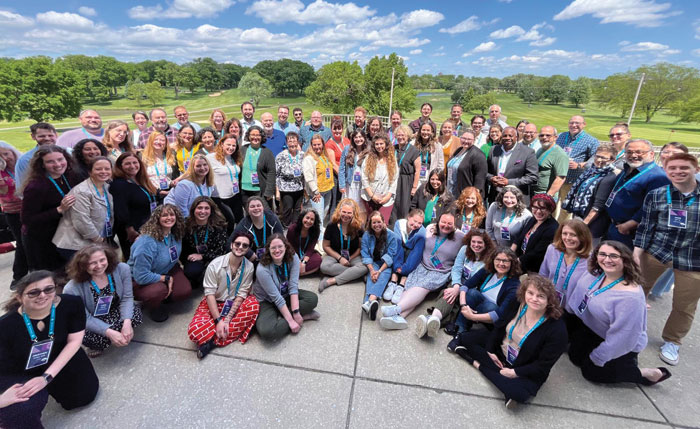
The iCenter’s Master’s Concentration program is bringing graduate students together from 17 different universities across North America and Israel to learn together for a year to become more effective Israel educators.
The program’s newest cohort—the first to launch since Oct. 7—kicked off earlier this month. Among the local participants in the cohort are CJ Mays, a student rabbi at the Venice Beach-based Open Temple; Jeffrey Silverstein of Hebrew Union College-Jewish Institute of Religion in Los Angeles; Chloe Levian, a Beverly Hills-based senior campus regional manager at pro-Israel education group StandWithUs; and Erin Wyner, a teacher at Adat Ari El in Studio City.
The program aims to strengthen Israel education, reimagine what that looks like and identify Jewish leaders’ needs in the dynamic and ever-evolving reality in Israel and around the world, post-Oct. 7.
“Jewish organizations are navigating increasingly complex realities post-October 7th,” Rachel See, program director at the iCenter, said. “Campus Hillels, day schools, youth groups, JCCs, camps, synagogues, and beyond want to support their learners in every way they can, and a big part of this means having highly qualified Israel educators in this moment who themselves are members of a supportive environment of colleagues and mentors.”
As Ron and I walked through our home of 22 years before finally moving out, remnants of life there appeared everywhere. There are the markings on the doorposts where our mezuzot once hung. There’s the playing card that had fallen under a sofa. And there’s the sound of the A/C kicking in, echoing throughout the empty rooms.
But what impacted us most was this chalk drawing that Maya had made outside on our porch. More than anything, this brought up profound emotions.
And it made me think deeply. We all leave some kind of mark in any given moment in time. It could be an interaction we have. It could be a donation we make. It could be pollution we produce. It could be hope we instill. It could be love we foster.
What mark do you want to gift to humanity? What difference will you make? When someone sees that you were there, what emotion will it evoke? And how will your soul-print on earth leave our world a better place?
In the fictional book, “The Measure” by Nikki Erlick, the world turns upside down with a single occurrence. Outside each home is a box containing a unique string to be matched with the people within the household. Accompanying the string is a message, “The measure of your life lies within.” Some strings are longer, others shorter. The measurement of the string foretells whether you will live longer or spend less physical time on earth.
The book asks us to ponder, is it worth knowing how long we might live? Does that change the ways we might treat ourselves or each other?
Rabbi Eliezer taught, “Repent one day before your death.” 15th century commentator, Bartenura explains that one doesn’t know when he will die; therefore, he should repent today. Meaning, the question is not when you will die; the question is how you use your days while you are alive.
While artificial intelligence tries to give us accurate predictions about our timelines, there is still no box or string waiting outside our door. Which means, while we are breathing, let us take time to make amends, seek out holy connections and experience the love this world offers… right here…right now.
Make the most of today. Who knows what tomorrow might bring?
Shabbat Shalom
Rabbi Nicole Guzik is senior rabbi at Sinai Temple. She can be reached at her Facebook page at Rabbi Nicole Guzik or on Instagram @rabbiguzik. For more writings, visit Rabbi Guzik’s blog section from Sinai Temple’s website.
what quantum physicists ascribe to particles and waves, called weirdness,
the inability of observers to detect
simultaneously position and momentum, the cause of what I label Learedness,
a problem that affected Lear when making
a choice between three daughters, physically comparable to that between weird particles,
whose very observation leads to the mistaking
of their precise position and momentum—-as per Heisenberg’s scientifically uncertain articles.
Einstein, who defined the particles of light,
did not approve of Heisenberg’s suggestion, and Lear also surely realized
that making choices gives no one the right
to feel that what we see as right is right: uncertainty should be most highly prized.
I’d like to add the rabbis to the people who
gave their approval to uncertainty, recording in the Talmud views
considered by them to be wrong, as if they knew
that Heisenberg with his proof of uncertainty provided a principle thought kosher by most Jews.
In “Escape from Shadow Physics’ Review: Quantum Weirdness,” WSJ, 6/14/24, Andrew Crumey, reviewing Escape from Shadow Physics: The Quest to End the Dark Ages of Quantum Theory by Ada Forrest Kay, writes:
In 2005 two French scientists discovered something about oil droplets that had potential implications far beyond the realms of engineering. Yves Couder and Emmanuel Fort of the École Normale Supérieure in Paris were experimenting with a small bath of silicone oil, to which they added further tiny droplets. They wanted to see if they could make the droplets stick to the surface, rather than be absorbed into the fluid. By accident they found that one way to achieve this was to hold the container in their hands rather than fix it to a table. They realized that vibration was the trick—that as a result the droplets would bounce imperceptibly on microscopic surface ripples. Using machinery rather than shaky hands, the physicists made these bouncing droplets move in controlled ways, remaining perfectly intact while riding the waves.
Physicists have wondered whether the same principle applies to light: whether light is, in fact, made of particles, guided by waves. The idea was first suggested in 1927 by Louis de Broglie, a French physicist, and in a different way in 1952 by David Bohm, an American physicist. Known as pilot-wave theory, it was firmly rejected by mainstream quantum physicists such as Niels Bohr and Werner Heisenberg, and by the time Bohm died in 1992 the idea had few followers left.
Couder and Mr. Fort’s discovery changed that, creating intense interest in what came to be called hydrodynamic quantum analogs. In “Escape From Shadow Physics: The Quest to End the Dark Ages of Quantum Theory,” Adam Forrest Kay, a postdoctoral research associate in mathematics at MIT, eloquently explains the history behind hydrodynamic quantum analogs.
In the 19th century, Mr. Kay tells us, light was understood to consist solely of waves, like sound. Red light was low frequency, blue light was high. Then in 1905 Albert Einstein argued that, rather than being a continuous stream, light flowed in discrete bursts of what were effectively particles. All had the same speed, but particles of blue light would have greater momentum than red ones. This was verified in a 1922 experiment, and the particles were called photons.
De Broglie seized the idea and extended it. If light could have both frequency and momentum, then surely anything with momentum should also have a corresponding frequency? Experiments previously used to demonstrate that light was made of waves were now applied to electrons, which indeed showed the wavelike behavior De Broglie predicted.
Now the problem was to reconcile the two apparently contradictory explanations. De Broglie tried to do so with the pilot-wave theory, but lost to Bohr’s principle of complementarity. According to Bohr, the wave and particle interpretations were both valid, but only one or the other could be verified in any particular experiment. The difficulty with this view, Mr. Kay writes, is that “it is a small step from here to the idea that it is our act of looking at the electron that has collapsed its wave nature into its particle nature.” Mr. Kay characterizes Bohr as a charismatic guru “who, by virtue of his nontransferable and unmediated grasp of mantic truth, promises access to a hidden world.” Bohr’s vague principle, enormous prestige and powerful personality opened the door to “quantum weirdness,” Mr. Kay tells us, “the supposedly revolutionary import of modern science with its particles in two places at once, its mind-body connections, its multiverses, its vindication of the Indian sage Nagarjuna, blah blah blah.”
What Mr. Kay wants—and the bouncing droplets seem to promise—is quantum theory without the weirdness. His book is a vigorous defence of “local realism,” the idea that the universe at its smallest level ought to work in much the same way we’re used to seeing it work in ordinary life. Energetically written in short chapters interspersed with digressions into other episodes of scientific wrong turnings, “Escape From Shadow Physics” is consistently interesting, even if it sometimes wanders too far off topic into tales of neglected geniuses and scientific mavericks in other fields.
A crucial component of quantum theory is Heisenberg’s uncertainty principle: Measure the exact location of a particle, and there will be great uncertainty about the particle’s momentum; measure momentum instead, and the particle’s position will be less accurately known. Bohr took this to be an ambiguity of nature itself—there is no real position or momentum prior to measurement, only probabilities of what the result will be. But why? Toss a coin, and you don’t know if it will turn up heads or tails, yet you do know that it must depend on how the coin is tossed, where it lands and so on. Bohr’s opponents—notably Einstein—insisted that the probabilities of quantum theory were like those of a coin toss, governed by as-yet unknown factors termed “hidden variables.”
Conventional wisdom is that these hidden variables cannot exist. Bohr was right, Einstein was wrong, quantum theory is incompatible with local realism and weirdness is inescapable. Yet there is still some debate going on, and Mr. Kay does a good job of unpicking the subtle arguments, showing that there remains room for doubt.
Gershon Hepner is a poet who has written over 25,000 poems on subjects ranging from music to literature, politics to Torah. He grew up in England and moved to Los Angeles in 1976. Using his varied interests and experiences, he has authored dozens of papers in medical and academic journals, and authored “Legal Friction: Law, Narrative, and Identity Politics in Biblical Israel.” He can be reached at gershonhepner@gmail.com.